
In This Article
Choosing the right electric wheelchair isn’t just about getting from point A to point B—it’s about reclaiming independence and opening up possibilities. Whether you’re recovering from surgery, managing a chronic condition, or finding that walking long distances has become challenging, the right power wheelchair can transform your daily life.
The electric wheelchair market has exploded recently, with manufacturers creating lighter, more powerful, and surprisingly affordable options. You’ll find models weighing as little as 30 pounds that fold in seconds, yet can travel 30+ miles on a single charge. But with hundreds of options flooding Amazon and specialty retailers, how do you separate quality from disappointments?
This electric wheelchair buying guide cuts through marketing hype to focus on what matters—weight capacity considerations, battery type comparison, warranty coverage importance, and crucial wheelchair selection tips. According to the Centers for Disease Control and Prevention, wheelchairs provide mobility, postural support, and freedom to those who cannot walk or have difficulty walking. Finding the right one shouldn’t feel like solving a puzzle.
Quick Comparison Table: Top Electric Wheelchairs at a Glance
| Model | Weight | Range | Capacity | Price Range | Best For |
|---|---|---|---|---|---|
| HNLBFG 2026 Lightweight | 36 lbs | 18 miles | 220 lbs | $800-$1,200 | Travel enthusiasts |
| Aotedor 203 Long-Range | 60 lbs | 30 miles | 330 lbs | $1,500-$2,000 | Daily outdoor use |
| Forcemech Navigator Pro | 60 lbs | 18 miles | 400 lbs | $1,800-$2,300 | Heavy-duty needs |
| Vive Airframe | 39 lbs | 9 miles | 225 lbs | $1,200-$1,600 | Indoor mobility |
| Hassky 2026 All-Terrain | 58 lbs | 15 miles | 350 lbs | $900-$1,400 | Budget buyers |
| Zurcheel SLB30 Ultra-Light | 30 lbs | 12 miles | 220 lbs | $600-$900 | Easy portability |
| Forcemech Ultralite G10 | 26 lbs | 10 miles | 300 lbs | $2,500-$3,200 | Premium lightweight |
💬 Just one click – help others make better buying decisions too! 😊
✨ Don’t Miss These Exclusive Deals!
🔍 Take your mobility to the next level with these carefully selected products. Click on any highlighted item to check current pricing and availability. These tools will help you create authentic independence your family will appreciate!
Top 7 Electric Wheelchairs: Expert Analysis
1. HNLBFG 2026 Model Lightweight Foldable
At just 36 pounds with battery, the HNLBFG 2026 Model folds in under three seconds and slides into practically any trunk. The 360W dual brushless motors and 10AH lithium battery deliver an 18-mile range with 220 lbs capacity.
Customer feedback consistently praises the ultra-tight turning radius and intelligent electromagnetic braking system that automatically engages when you release the joystick—crucial for slope safety.
Pros:
✅ Exceptionally lightweight
✅ Quick-fold mechanism
✅ Airline-approved
Cons:
❌ Lower weight capacity
❌ Shorter outdoor range
Price: $800-$1,200
2. Aotedor 203 Long-Range Folding Power Wheelchair
The Aotedor 203 delivers an impressive 30-mile range on dual 12Ah batteries (24Ah total). This powerhouse combines a 500W motor system with 330 lbs capacity and features electromagnetic braking plus anti-tip wheels for 12-degree slopes.
One customer reported using it all day at Disneyland with charge remaining—that’s real-world performance you can trust.
Pros:
✅ Industry-leading 30-mile range
✅ Higher capacity
✅ Dual charging methods
Cons:
❌ Heavier than ultra-lightweight models
❌ Premium pricing
Price: $1,500-$2,000
3. Forcemech Navigator Pro All-Terrain
With a robust 400-pound capacity and genuine all-terrain capabilities, the Forcemech Navigator Pro has earned Forbes Health recognition for five consecutive years. Dual 250W brushless motors on a reinforced aluminum-alloy frame tackle grass, ramps, sand, and mud.
The traction-tuned tires and powerful motors handle challenging surfaces that stop lighter models cold.
Pros:
✅ Exceptional 400 lbs capacity
✅ Verified all-terrain
✅ Multiple battery compatibility
Cons:
❌ Heavier overall (60 lbs)
❌ Higher price point
Price: $1,800-$2,300
4. Vive Airframe Carbon Fiber Lightweight
The Vive Airframe weighs just 39 pounds with its 12AH battery and arrives pre-assembled. The carbon fiber construction offers excellent strength-to-weight ratio, backed by a five-year guarantee. While the 9-mile range is shorter, it’s perfect for daily errands and indoor use.
Pros:
✅ Premium carbon fiber
✅ No assembly required
✅ Five-year guarantee
Cons:
❌ Shorter battery range
❌ Premium pricing
Price: $1,200-$1,600
5. Hassky 2026 Upgrade All-Terrain
Offering remarkable value, the Hassky 2026 Upgrade delivers a 500W motor, 15-mile range, and 350 lbs capacity at mid-range pricing. The shock-absorbing suspension, anti-tipping wheels, and emergency braking system handle 12-degree inclines confidently.
Pros:
✅ Excellent price-to-performance
✅ Robust 350 lbs capacity
✅ Comprehensive safety
Cons:
❌ Moderate portability weight
❌ Mid-range battery
Price: $900-$1,400
6. Zurcheel SLB30 Ultra-Lightweight
At an astonishing 30 pounds, the Zurcheel SLB30 folds in one second and drags like a suitcase. Despite lightweight construction, it handles carpet and outdoor terrain well. The dual 150W motors and 10.4Ah battery deliver 12 miles with a removable battery for independent charging.
Pros:
✅ Lightest model available
✅ One-second folding
✅ Budget-friendly
Cons:
❌ Lower weight capacity
❌ Smaller motors
Price: $600-$900
7. Forcemech Ultralite G10 Carbon Fiber
The Forcemech Ultralite G10 showcases 100% carbon fiber construction at 25.8 pounds while maintaining 300-pound capacity. Dual 150W brushless motors and 10Ah battery provide 10-mile range with a tight 28-inch turning radius perfect for indoor navigation.
Pros:
✅ Premium carbon fiber
✅ Ultra-lightweight
✅ Excellent maneuverability
Cons:
❌ Premium pricing
❌ Shorter range
Price: $2,500-$3,200
How to Choose Power Wheelchair: Essential Criteria
Understanding Your Mobility Needs
Before falling in love with specifications, honestly assess your daily routine. Will you primarily navigate tight indoor corners or explore outdoor terrain? Your environment dictates everything.
According to Medicare.gov, Part B covers power wheelchairs only when medically necessary, requiring a face-to-face examination and written prescription. This ensures you receive appropriate equipment matched to actual needs.
Consider these practical questions: How many hours daily will you use the wheelchair? Can you navigate standard 32-36 inch doorways? What’s your longest typical daily distance? Can you operate a joystick comfortably?
✨ Ready to Upgrade Your Mobility?
💡 Don’t settle for less than perfect! Browse these expert-recommended wheelchairs to find your ideal match. Each model is carefully vetted for quality, safety, and value!
Weight Capacity Considerations: More Than Numbers
Weight capacity isn’t just about whether the wheelchair supports you—it’s about performance at different load levels. A 330-pound rated chair won’t handle the same at 300 pounds as at 180 pounds.
Motor Performance: Smaller motors (250W or less) struggle with heavier loads on inclines. The Forcemech Navigator Pro uses dual 250W motors specifically because its 400-pound capacity demands extra power.
Battery Efficiency: Heavier loads drain batteries faster. A wheelchair rated for 20 miles at minimum weight might deliver only 12-14 miles approaching maximum capacity.
Frame Longevity: Operating near maximum capacity stresses joints and welds. Choose 20-30% more capacity than needed. If you weigh 250 pounds, target 330+ pound models.
Safety Margins: Account for body weight plus clothing, bags, equipment, and shopping. That 220-pound capacity feels tight with winter coats and groceries.
Capacity Recommendations:
| Capacity | Suitable For | Models |
|---|---|---|
| 220-260 lbs | Average adults, indoor | HNLBFG, Zurcheel, Vive |
| 300-350 lbs | Larger adults, daily outdoor | Aotedor, Hassky |
| 400+ lbs | Heavy-duty needs | Forcemech Navigator |
Battery Type Comparison: Understanding Power
Every modern wheelchair uses lithium-ion technology for high energy density, minimal memory effect, and lighter weight than lead-acid alternatives.
Amp-Hour (Ah) Rating: Measures storage capacity. A 10Ah battery at 24 volts stores 240 watt-hours. The Aotedor 203 uses dual 12Ah batteries (24Ah total) for its 30-mile range.
Charging Cycles: Quality lithium batteries support 500-800 full cycles before noticeable degradation. At one charge every three days, that’s 4-6 years of reliable service.
Single vs. Dual Battery Systems
Single Battery: Lighter weight, lower cost, adequate for indoor use, simpler charging.
Dual Battery: Extended range (20-30+ miles), spare battery option, better weight distribution, essential for outdoor enthusiasts.
Charging typically takes 4-6 hours for 10Ah batteries, 6-8 hours for 12Ah batteries. Many users purchase spare batteries to maintain continuous availability.
Power Chair Features Explained
Joystick Controllers
Modern controllers offer 3-5 speed settings, battery indicators, and repositionable design for right- or left-handed use. Quality systems include programmable acceleration and turning sensitivity.
Folding Mechanisms
The Zurcheel SLB30 truly folds in one motion—release, lift, done. Some require multiple steps that create failure points. When unfolded, wheelchairs must lock positively; inferior pin-and-hole systems wear quickly.
Seating Comfort
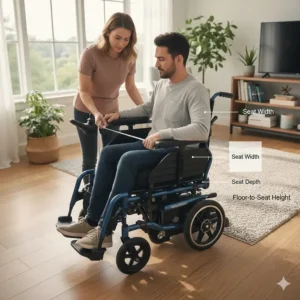
Standard seats measure 17-18 inches wide. Larger individuals need 19-20 inch options like the Hassky 2026. High-density foam maintains support without “bottoming out.” Breathable materials prevent heat buildup during extended sitting.
Warranty Coverage Importance
Quality manufacturers offer component-specific warranties because different parts have different failure rates.
Frame/Structure: Premium brands like Aotedor and Vive offer 3-5 year coverage, signaling build quality confidence.
Electrical Components: Motors, controllers, and wiring typically carry 1-2 year coverage. The Aotedor 203 extends this to 2-3 years on select models.
Batteries: Many exclude batteries or limit coverage to 90 days. Vive’s six-month battery warranty exceeds industry norms.
Watch for red flags: vague “limited” coverage, impossible registration timeframes, excessive shipping costs, or non-transferable warranties.
Wheelchair Selection Tips: Expert Insights
Motor Power Simplified
- 150W Motors: Adequate for flat indoor surfaces, users under 180 lbs
- 250W Motors: Sweet spot for most users, handles moderate inclines
- 500W+ Motors: Necessary for steep hills and maximum capacity loads
Turning Radius Matters
Standard doorways measure 32-36 inches wide. A 35-inch turning radius means struggling with tight corners. The Forcemech Ultralite G10 features a 28-inch radius—exceptional for indoor navigation.
Terrain Reality Check
Most electric wheelchairs excel on indoor floors, smooth concrete, paved lots, and gentle ramps. They handle moderate performance on short grass and packed gravel. Avoid thick grass, loose gravel, mud, or steep hills over 12 degrees.
Medicare and Insurance Coverage
Medicare requires face-to-face examination, written prescription, and purchase through enrolled DME suppliers. After meeting Part B deductible, Medicare pays 80% of approved costs—you cover the remaining 20% coinsurance.
Private insurance varies dramatically. Check your specific policy for pre-authorization requirements, approved supplier networks, coverage percentages, and annual limits.
Maintenance Essentials
Weekly: Clean frame, inspect tires, check battery, wipe controls
Monthly: Tighten bolts, clean battery contacts, lubricate folding mechanisms
Quarterly: Deep clean, check alignment, test safety features, inspect battery
Common issues include battery degradation after 500-800 cycles (budget $200-400 for replacements), joystick drift from worn components, and motor noise indicating bearing wear.
Travel and Transportation
Airlines
TSA allows lithium batteries under 300 watt-hours. Calculate: voltage × amp-hours. A 24V, 12Ah battery equals 288Wh—just under limits. Notify airlines 48 hours beforehand about wheelchair specifications.
Vehicle Storage
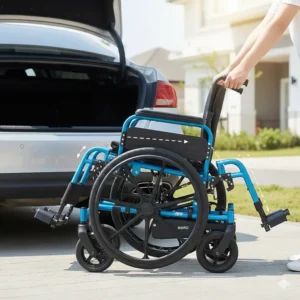
The HNLBFG 2026 collapses to 15 inches tall, fitting compact car trunks. Consider whether you can lift your wheelchair’s weight (30-73 pounds). Vehicle platform lifts cost $1,500-3,000 installed for heavier models.
Safety Best Practices
Pre-operation checks: adequate battery, functioning brakes, no loose wires, seat locked, anti-tip wheels positioned. Never exceed manufacturer’s slope rating (typically 10-12 degrees). Approach thresholds straight-on at slow speed.
Lock wheels before transfers, engage parking brake, flip up footrests. Reduce speed in crowds and use the horn to alert pedestrians.
Price vs. Value Analysis
| Price Range | What to Expect | Target Buyer |
|---|---|---|
| $600-$900 | Basic features, shorter range | Budget-conscious |
| $900-$1,500 | Good balance, 15-20 mile range | Most first-timers |
| $1,500-$2,500 | Premium features, extended range | Daily users |
| $2,500+ | Top materials, maximum performance | Performance demands |
Hidden costs include replacement batteries ($200-400 every 3-5 years), annual maintenance ($100-300), accessories ($150-300), and optional extended warranties ($200-400).
FAQs: Your Questions Answered
❓ How long do electric wheelchair batteries last before replacement?
❓ Can I use my electric wheelchair in light rain or wet surfaces?
❓ What weight capacity should I choose if I'm near maximum rating?
❓ How often should I charge the battery when not using daily?
❓ Do electric wheelchairs work during power outages or dead batteries?
Conclusion: Making Your Final Decision
Choosing your electric wheelchair represents an investment in independence and quality of life. After analyzing seven top models and exploring critical wheelchair selection tips, clear winners emerge for specific needs.
Travelers: HNLBFG 2026 or Zurcheel SLB30 deliver lightweight design and quick-fold mechanisms.
Daily outdoor users: Aotedor 203 provides 30-mile capability and robust construction.
Maximum capacity needs: Forcemech Navigator Pro handles 400 pounds with all-terrain capability.
Budget buyers: Hassky 2026 Upgrade delivers 350-pound capacity and 15-mile range at mid-range pricing.
Remember these takeaways: weight capacity considerations affect motor performance and durability—choose 20-30% above your weight. Battery type comparison shows that capacity (Ah) and single vs. dual batteries dramatically impact range. Warranty coverage importance protects your investment through component-specific terms.
The perfect electric wheelchair balances mobility needs, physical capabilities, budget, and lifestyle. According to the Americans with Disabilities Act, wheelchairs are devices designed for individuals with mobility disabilities for indoor or outdoor locomotion. Your wheelchair should empower you to live fully. For comprehensive information about wheelchair standards and selection, visit Wikipedia’s wheelchair article.
Choose wisely, maintain diligently, and reclaim the freedom that mobility provides.
Recommended for You
- 7 Best Electric Wheelchair Brands for Seniors 2026
- 7 Best Reclining Electric Wheelchairs for Seniors 2026 Guide
- 7 Best Fast Electric Wheelchairs 2026 | High Speed Power Guide
Disclaimer: This article contains affiliate links. If you purchase products through these links, we may earn a small commission at no additional cost to you.
✨ Found this helpful? Share it with your friends! 💬🤗
