
In This Article
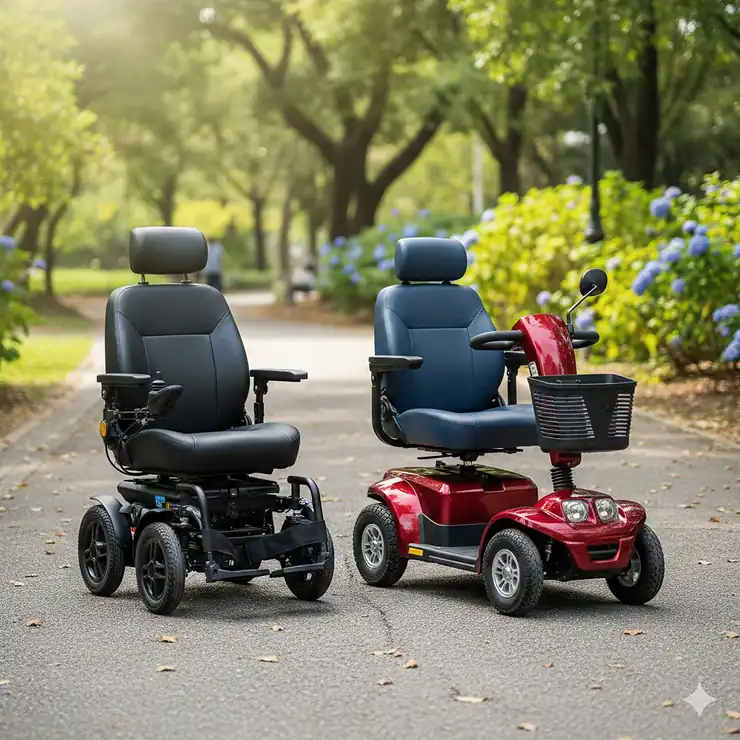
Picture this: you’re standing in a medical supply store, staring at two very different mobility devices, and you’re completely confused about which one will actually change your life for the better. Should you go with an electric wheelchair or a mobility scooter?
Here’s the truth that nobody tells you upfront—choosing between an electric wheelchair vs mobility scooter isn’t just about picking the cheaper option or grabbing whatever looks coolest. It’s about understanding how each device will fit into your daily routine, your home layout, and your lifestyle.
You see, over 14 million Americans aged 65 and older report falling every year, according to data compiled by healthcare researchers. That’s a staggering number that shows just how critical proper mobility support has become. The right device doesn’t just prevent falls—it gives you back your independence, your confidence, and your ability to do the things you love.
But here’s where it gets interesting. An electric wheelchair vs mobility scooter comparison reveals some surprising differences that could make or break your daily comfort. From turning radius to Medicare coverage, from battery life to indoor maneuverability, these two devices are surprisingly different animals.
Quick Comparison: Electric Wheelchair vs Mobility Scooter
| Feature | Electric Wheelchair | Mobility Scooter |
|---|---|---|
| Control Method | Joystick | Tiller/Handlebars |
| Indoor Maneuverability | Excellent (tight turning radius) | Good to Fair (larger turning radius) |
| Outdoor Performance | Good | Excellent |
| Weight Capacity | 220-400 lbs typical | 265-500 lbs typical |
| Typical Range | 10-25 miles | 12-30 miles |
| Average Price | $2,000-$5,000 | $600-$4,000 |
| Medicare Coverage | Stricter requirements | Moderate requirements |
| Best For | Frequent indoor use, limited upper body strength | Outdoor travel, able to sit upright |
💬 Just one click – help others make better buying decisions too!😊
Top 7 Electric Wheelchairs & Mobility Scooters: Expert Analysis
Best Electric Wheelchairs
1. Forcemech Navigator Pro Electric Wheelchair
The Forcemech Navigator Pro represents the 2026 evolution in electric wheelchair technology. Weighing just 60 lbs, this powerhouse handles a remarkable 400 lb capacity—that’s nearly double what many competitors offer.
Key specs include dual 250W brushless motors, an 18-mile range, and travel-friendly design that fits most car trunks. What sets this apart? The intelligent electromagnetic braking system and retractable anti-tip wheels that provide stability on slopes up to 12 degrees.
Customer feedback reveals users particularly appreciate the all-terrain capabilities. One reviewer mentioned, “tackles grass and gravel like a champ,” while another praised its compact storage when traveling. The price point sits around $1,800-$2,200.
✅ Pros: Heavy-duty 400 lb capacity, airline approved, smooth brushless motors
❌ Cons: Heavier than ultra-lightweight models, requires some assembly
2. Aotedor 2026 Upgraded Electric Wheelchair
If you’re chasing impressive range, the Aotedor 2026 delivers a jaw-dropping 35 miles with its dual battery system. This foldable powerchair combines two brushless motors with a 330 lb capacity for serious everyday use.
The dual battery configuration means you’re never stranded mid-journey. At approximately 60-70 lbs with both batteries, it’s airline approved and features adjustable armrests for comfortable long-haul sitting. Customers report the charge time is reasonable at 6-8 hours.
One user shared, “finally took a full day trip to the museum without worrying about battery life.” Price range: $1,600-$1,900.
✅ Pros: Incredible 35-mile range, dual batteries, all-terrain capable
❌ Cons: Higher weight with both batteries, premium price point
3. NVORJO Lightweight Foldable Electric Wheelchair
At just 36 lbs, the NVORJO claims the title of ultra-lightweight champion. Don’t let the featherweight fool you—it supports up to 220 lbs and offers a respectable 12-mile range.
Crafted from aviation-grade aluminum, this wheelchair folds in 3 seconds flat. The electromagnetic braking system automatically engages when you release the joystick, preventing unwanted rolling on inclines. Perfect for apartment dwellers and frequent travelers, with prices around $800-$1,100.
Customer reviews highlight how easy it is to lift into vehicles: “My 70-year-old wife can load it into our sedan trunk by herself.” The trade-off? Lower weight capacity compared to heavy-duty models.
✅ Pros: Extremely lightweight (36 lbs), fast folding, affordable
❌ Cons: Lower weight capacity, shorter range than premium models
Top Mobility Scooters
4. MOVEMAGIC 30-Mile Long Range Mobility Scooter
The MOVEMAGIC scooter absolutely crushes the competition when it comes to range. With a 30-mile maximum on a single charge and a powerful 350W motor, this 4-wheel beast is built for adventure.
The 720Wh lithium battery powers you through extended shopping trips, park visits, and daily errands without range anxiety. It handles 300 lb capacity and features dual baskets for grocery runs. The foldable design means you’re not stuck with a garage-dominating behemoth. Expect to pay $1,200-$1,500.
Users rave about the stability: “handles uneven sidewalks better than my previous scooter,” reported one satisfied customer.
✅ Pros: Outstanding 30-mile range, dual storage baskets, foldable
❌ Cons: Heavier than compact models, longer charging time
5. Vive 4-Wheel Mobility Scooter
Vive brings reliability and comfort with their 4-wheel flagship model. Supporting up to 400 lbs and offering 12.4 miles of range, this scooter balances capability with affordability at $900-$1,200.
The heavy-duty stability comes from a reinforced steel-and-plastic frame, while the padded height-adjustable swivel seat ensures all-day comfort. Large wheels and higher ground clearance smooth out bumpy rides. LED headlight and front basket complete the package.
Customer feedback centers on the smooth ride quality and easy disassembly for transport. One reviewer noted it’s “perfect for grocery shopping and doctor visits.”
✅ Pros: Heavy-duty 400 lb capacity, affordable, comfortable seating
❌ Cons: Requires disassembly for transport, moderate range
6. ChiefCarOfficer 3-Wheel Folding Mobility Scooter
Want superior maneuverability for indoor use? The ChiefCarOfficer 3-wheel model delivers a tighter turning radius than most 4-wheel scooters while maintaining 300 lb capacity.
This lightweight folder weighs around 40-45 lbs and offers multiple speed settings up to approximately 9 mph. The triangular tiller design makes operation intuitive even for first-time scooter users. Airline approved and compact, it’s ideal for apartment living. Pricing typically runs $700-$1,000.
Users appreciate the nimble handling: “fits through my apartment hallways better than any 4-wheel scooter I tried.”
✅ Pros: Tight turning radius, lightweight, multiple speed modes
❌ Cons: Less stable on uneven terrain than 4-wheel models
7. MIHAYO 30-Mile Range 4-Wheel Scooter
The MIHAYO rounds out our lineup with another long-range champion. Featuring a 720Wh battery for 30 miles of range and weighing just 58 lbs, this scooter proves you don’t need massive bulk for serious performance.
Dual baskets provide substantial storage, while the rotating seat and USB charging port add modern convenience. Supporting 300 lb capacity with a 350W motor, it handles both pavement and light off-road conditions. Expect prices around $1,100-$1,400.
Customer testimonials highlight the value proposition: “can’t believe how much scooter you get for the price.”
✅ Pros: Excellent range, lightweight for class, USB charging
❌ Cons: Seat comfort could be better for very long trips
✨ Don’t Miss These Exclusive Deals!
🔍 Take your mobility to the next level with these carefully selected products. Click on any highlighted item to check current pricing and availability. These devices will help you regain authentic independence your family will celebrate!
Power Wheelchair vs Scooter: Understanding the Core Differences
Let me break down something that confuses almost everyone when they first start researching: the fundamental design philosophy between a power wheelchair vs scooter is completely different.
Electric wheelchairs evolved from manual wheelchairs. They’re designed with a joystick control that allows incredibly precise movements—think of it like using a video game controller. You can pivot in place, navigate tight corners, and maneuver through doorways that would make a scooter user cry in frustration.
Mobility scooters, on the other hand, developed from a different lineage. They use tiller steering (like a motorcycle or bicycle) which requires you to physically turn handlebars. This design assumes you have decent upper body strength and trunk stability.
Here’s what really matters: wheelchair users typically sit in their device for most of the day, while scooter users generally need the device for getting from place to place but can still stand and walk short distances.
The Control System Showdown
Joystick control on electric wheelchairs provides 360-degree maneuverability. You can spin in place, which is absolutely crucial when you’re in a tight bathroom or trying to position yourself at a dining table. The joystick sensitivity is typically adjustable—important if you have limited hand dexterity.
Tiller steering on mobility scooters requires more physical input. You’re actually turning the front wheels through mechanical linkages. Some people find this more intuitive because it mimics driving a car or riding a bike. However, you need both hands and decent grip strength.
The practical impact? According to research from mobility equipment manufacturers, electric wheelchair users report higher satisfaction with indoor maneuverability, while mobility scooter users prefer the outdoor handling characteristics.
Wheelchair or Scooter Better for Indoor Use?
This is where the difference between wheelchair scooter performance becomes crystal clear. If your primary concern is indoor mobility, electric wheelchairs dominate.
Turning Radius Reality Check
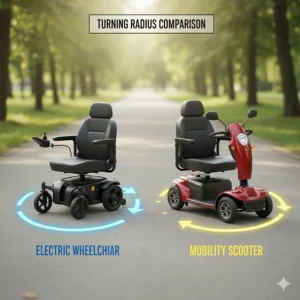
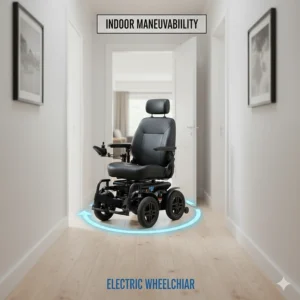
Electric wheelchairs typically offer turning radii between 22-26 inches. That might not sound impressive until you realize it means you can execute a complete 180-degree turn in a standard 36-inch hallway. Mid-wheel drive models can actually pivot on their center axis.
Mobility scooters usually need 38-50 inches to turn around. In practical terms, this means you’re backing up and repositioning frequently in homes built before the 1990s. Older apartments with narrow hallways become obstacle courses.
I’ve seen countless situations where someone buys a mobility scooter without measuring their home’s tightest spaces, only to discover they can’t reach their bathroom or bedroom. Don’t be that person.
Doorway Navigation
Standard interior doorways measure 30-32 inches wide. Electric wheelchairs, especially compact models, typically measure 23-26 inches in width. You’ve got comfortable clearance.
Most mobility scooters measure 26-28 inches wide—which sounds fine until you account for the turning angle. If you’re trying to enter a doorway that requires even a slight turn, that scooter width becomes a real problem.
The Wikipedia article on mobility scooters notes that older building retrofits often create situations where lifts or elevators accommodate wheelchairs but not the longer scooters.
Indoor vs Outdoor Use: Where Each Device Shines
Let’s get real about terrain capabilities, because marketing materials often oversell what these devices actually handle.
Outdoor Performance: Scooters Take the Crown
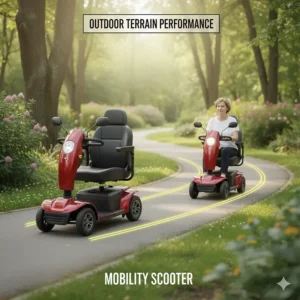
Mobility scooters excel outdoors for several reasons. First, they typically feature larger wheels (8-14 inches) compared to wheelchair casters (6-8 inches on most models). Bigger wheels roll over cracks, curbs, and rough pavement more easily.
Second, scooter batteries are often optimized for sustained cruising at moderate speeds. You’re looking at 4-9 mph top speeds with range extending to 30 miles on premium models. That’s genuine all-day capability.
Third, most scooters sit higher off the ground. Ground clearance of 3-6 inches means you’re less likely to get hung up on sidewalk transitions or minor obstacles.
The WHILL guide on electric wheelchairs vs mobility scooters emphasizes that scooters’ larger tires and robust battery systems make them ideal for extended outdoor journeys.
When Wheelchairs Win Outdoors
Don’t write off electric wheelchairs for outdoor use, though. Modern power wheelchairs with rear-wheel drive configurations provide excellent outdoor performance. They climb inclines up to 12 degrees (about 21% grade) and handle grass, gravel, and uneven surfaces surprisingly well.
The key advantage? You maintain the same tight control and precise positioning that makes wheelchairs superior indoors. If you need to navigate both a crowded shopping mall AND the parking lot, a good electric wheelchair gives you consistent performance.
Maneuverability Comparison: The Technical Details
Let’s dig into the engineering that creates these performance differences, because understanding the mechanics helps you choose correctly.
Drive Wheel Configuration Matters
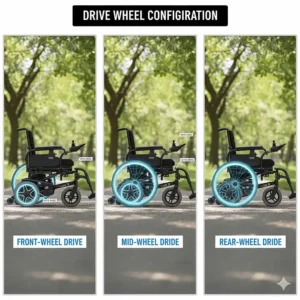
Electric wheelchairs come in three main drive configurations:
Rear-Wheel Drive: Best for outdoor use and higher speeds. The driving wheels are behind your center of gravity, providing excellent traction and straight-line stability. Trade-off? Wider turning radius.
Mid-Wheel Drive: The powered wheels sit directly under your center of gravity. This creates incredibly tight turning radius—some models pivot on a point. Perfect for indoor use but slightly less stable on outdoor terrain.
Front-Wheel Drive: Powered wheels in front pull you along. These feel most similar to manual wheelchairs and offer good obstacle climbing. Less common in modern power wheelchairs.
Mobility scooters typically use rear-wheel drive for stability and traction. Three-wheel models sacrifice some stability for tighter turns. Four-wheel scooters prioritize stability over maneuverability.
Speed and Acceleration Patterns
Electric wheelchairs generally offer lower top speeds (3-8 mph) but superior acceleration control and deceleration. The joystick gives you proportional speed control—push harder, go faster. Release it, and electromagnetic brakes immediately stop forward motion.
Mobility scooters reach higher speeds (up to 15 mph for road-legal Class 3 models in some regions) but with less granular control. The tiller design means you’re either accelerating or coasting/braking. This works great for sustained travel but feels less precise in tight quarters.
Difference Between Wheelchair Scooter: Physical Requirements
Here’s something critical that medical equipment suppliers should tell you upfront but often gloss over: these devices have very different physical requirements.
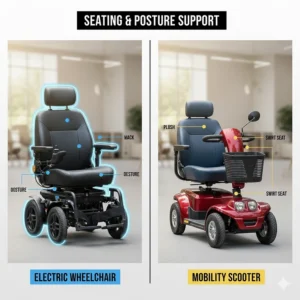
What You Need to Operate an Electric Wheelchair
Minimal upper body strength—you’re controlling everything with a joystick that requires only light finger pressure. People with arthritis, Parkinson’s tremors, or severe weakness can often operate modern electric wheelchairs successfully.
Ability to sit upright for extended periods is important, but most electric wheelchairs offer extensive postural support options. Adjustable backrests, lateral supports, and headrests accommodate various conditions.
You DON’T need to be able to stand or transfer independently. Many wheelchair users rely on lift devices or assistance for transfers.
What You Need for a Mobility Scooter
Here’s where requirements become stricter. According to information from Medicare coverage sources, mobility scooter users must:
- Sit upright without torso support for extended periods
- Have sufficient arm and hand strength to steer the tiller
- Possess the coordination to operate speed controls and turn simultaneously
- Be able to stand briefly and transfer on/off the scooter independently
- Maintain balance while the scooter is moving
If you have severe arthritis in your shoulders or hands, steering a mobility scooter through a full day of errands becomes exhausting. If you can’t stand even briefly, getting on and off the scooter safely becomes problematic.
Medicare Coverage Differences: The Insurance Reality
Time for some real talk about money, because Medicare coverage for these devices follows different rules that dramatically affect your out-of-pocket costs.
General Medicare DME Requirements
Both electric wheelchairs and mobility scooters fall under Medicare Part B Durable Medical Equipment coverage. The baseline requirements are identical:
- Face-to-face examination with Medicare-approved physician
- Written prescription stating medical necessity
- Documentation of mobility limitations affecting daily living activities
- Proof that the device is needed for IN-HOME use (critical point)
- Both physician and DME supplier must be Medicare-enrolled
After meeting your Part B deductible ($283 in 2026), Medicare pays 80% of approved costs. You’re responsible for 20% coinsurance.
Electric Wheelchair Coverage: Stricter Standards
Medicare applies more stringent criteria for power wheelchair vs scooter coverage. Here’s why: electric wheelchairs cost significantly more, and Medicare wants proof you genuinely need that level of support.
Additional requirements for electric wheelchair coverage include:
- Documented proof that you CANNOT safely use a manual wheelchair
- Evidence that a mobility scooter won’t meet your needs
- Sometimes prior authorization is required (Medicare reviews your case before approving)
- More detailed medical documentation regarding your specific condition
The Solace Health explanation of coverage criteria notes that electric wheelchairs require specialty evaluations demonstrating lack of strength or coordination to use other mobility aids.
Mobility Scooter Coverage: Moderate Requirements
Scooters face less restrictive approval processes because Medicare views them as appropriate for people with somewhat less severe mobility limitations.
You still need to prove you can’t use a cane, walker, or crutches safely, but you don’t need to prove that a manual wheelchair won’t work. The assumption is that if you have the trunk stability and strength to operate a scooter, you probably wouldn’t qualify for the more expensive electric wheelchair anyway.
The Home Use Catch-22
Here’s a frustrating reality: Medicare only covers mobility devices for in-home use. If you want a scooter purely for getting around your neighborhood or shopping but you can manage inside your house with a walker, Medicare probably won’t cover it.
However, if your home requires mobility assistance—getting from bedroom to bathroom, reaching the kitchen, etc.—then Medicare coverage kicks in. The device doesn’t need to be used EXCLUSIVELY indoors, just needed for indoor mobility.
Cost Breakdown: Electric Wheelchair vs Mobility Scooter Pricing
Budget-Friendly Options
You can find decent mobility scooters starting around $600-$900. These typically offer:
- 10-15 mile range
- 250-300 lb capacity
- Basic features (headlight, basket)
- 3-wheel or compact 4-wheel design
Budget electric wheelchairs start closer to $1,200-$1,800 and provide:
- Basic joystick control
- 8-12 mile range
- 220-300 lb capacity
- Standard seating
Mid-Range Sweet Spot
Most people find their ideal device in the $1,500-$2,500 range. Mid-range scooters offer:
- 20-25 mile range
- Enhanced comfort features
- Better suspension
- 350-400 lb capacity
Mid-range electric wheelchairs ($2,000-$3,500) deliver:
- 15-20 mile range
- Improved seating and positioning
- Better outdoor performance
- More robust construction
Premium Performance
High-end mobility scooters ($2,500-$4,000) feature:
- 30+ mile range
- Heavy-duty construction (500 lb capacity)
- Advanced suspension systems
- Full lighting packages
Premium electric wheelchairs ($4,000-$10,000+) offer:
- Specialized seating systems
- Standing capability
- All-terrain performance
- Extensive customization options
Maintenance and Long-Term Ownership
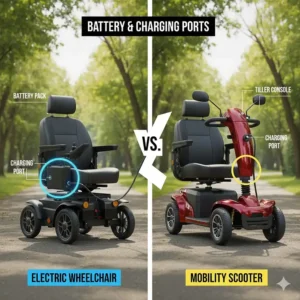
Battery Life and Replacement
Lithium-ion batteries (standard in modern devices) typically last 300-500 charge cycles. That translates to 2-4 years depending on usage patterns.
Replacement battery costs:
- Mobility scooter batteries: $200-$600
- Electric wheelchair batteries: $300-$800
Pro tip: charge your battery after each use rather than letting it fully discharge. This extends overall battery life significantly.
Common Maintenance Tasks
Mobility Scooters: Check tire pressure quarterly, clean connections monthly, lubricate steering column annually. Most users can handle these tasks independently.
Electric Wheelchairs: More complex. Joystick connections need regular inspection, caster wheels wear faster and require replacement, motor brushes (on brushed motors) need attention. Professional service recommended annually.
Warranty Coverage
Most manufacturers provide:
- 1-2 year parts and labor warranty
- 3-5 year motor/controller warranty
- Separate battery warranty (usually 6-12 months)
Extended warranties cost $200-$500 and may make sense for premium devices or if you use your device intensively.
Benefits Comparison Table
| Benefit | Electric Wheelchair | Mobility Scooter |
|---|---|---|
| Indoor Maneuverability | ⭐⭐⭐⭐⭐ Excellent tight turns | ⭐⭐⭐ Good in open spaces |
| Outdoor Performance | ⭐⭐⭐⭐ Very capable | ⭐⭐⭐⭐⭐ Designed for it |
| All-Day Comfort | ⭐⭐⭐⭐⭐ Extensive support | ⭐⭐⭐⭐ Comfortable seating |
| Portability | ⭐⭐⭐ Foldable models available | ⭐⭐⭐⭐ Often lighter/easier |
| Range | ⭐⭐⭐⭐ 10-25 miles typical | ⭐⭐⭐⭐⭐ 12-30+ miles |
| User Independence | ⭐⭐⭐⭐⭐ Minimal strength needed | ⭐⭐⭐ Requires some strength |
| Price Point | ⭐⭐⭐ $2,000-$5,000 | ⭐⭐⭐⭐ $600-$4,000 |
How to Choose: Decision Framework
Choose an Electric Wheelchair If You:
✅ Need precise indoor maneuverability daily
✅ Have limited upper body strength or hand dexterity
✅ Require extensive postural support
✅ Use your mobility device most of the day
✅ Navigate tight spaces regularly (small apartment, narrow hallways)
✅ Have progressive conditions affecting strength
Choose a Mobility Scooter If You:
✅ Primarily need outdoor mobility assistance
✅ Can sit upright without torso support
✅ Have good arm/hand strength for steering
✅ Can transfer on/off independently
✅ Travel longer distances regularly
✅ Want maximum range and speed
✅ Have a more spacious home environment
Still Unsure? Try Before You Buy
Many medical supply stores offer rental programs. Spending $150-$300 to rent each device for a week provides invaluable real-world experience. Test your device in:
- Your actual home (does it fit through all doorways?)
- Your local grocery store
- Your doctor’s office
- Outdoor sidewalks in your neighborhood
- Getting in/out of your vehicle
✨ Don’t Miss These Exclusive Deals!
🔍 Take your mobility to the next level with these carefully selected products. Click on any highlighted item to check current pricing and availability. These devices will help you regain authentic independence your family will celebrate!
Frequently Asked Questions
❓ Can you use a mobility scooter indoors like a wheelchair?
❓ Does Medicare cover both electric wheelchairs and mobility scooters?
❓ Which has better battery life for all-day use?
❓ Are electric wheelchairs easier to transport than scooters?
❓ What physical requirements are needed to operate each device safely?
Conclusion: Making Your Electric Wheelchair vs Mobility Scooter Decision
Look, I’ve thrown a lot of information at you. Let me boil it down to what really matters.
An electric wheelchair vs mobility scooter choice fundamentally comes down to where you’ll use it most and what your body can handle. If you’re spending most of your time indoors, navigating tight spaces, and you need comprehensive support, an electric wheelchair is your answer. Period.
But if you’re looking to reclaim outdoor adventures, you’ve got decent upper body function, and range matters more than precision maneuverability, a mobility scooter delivers freedom at a lower price point.
The power wheelchair vs scooter debate isn’t about which device is “better”—it’s about which one fits YOUR specific situation. That’s why trying before buying is so valuable. That’s why measuring your doorways matters. That’s why having honest conversations with your doctor about your strength and stamina is critical.
Remember this: the wheelchair or scooter better suited to you is the one that you’ll actually use confidently every day. Not the one that looks coolest or costs least. The one that matches your real-world needs.
The difference between wheelchair scooter options becomes crystal clear once you understand your priorities. Need precision? Choose a wheelchair. Want range? Go scooter. Require Medicare coverage? Document everything meticulously for either device.
Whether you’re comparing indoor vs outdoor use, analyzing maneuverability comparison data, or decoding Medicare coverage differences, you now have the knowledge to choose wisely.
Your mobility device isn’t just equipment—it’s your ticket to independence. Choose the right one, and you’re not just getting around. You’re getting your life back.
Recommended for You
- 7 Best Electric Wheelchairs 2026: Complete Buying Guide
- 7 Best Electric Wheelchair Brands for Seniors 2026
- 7 Best Reclining Electric Wheelchairs for Seniors 2026 Guide
Disclaimer: This article contains affiliate links. If you purchase products through these links, we may earn a small commission at no additional cost to you.
✨ Found this helpful? Share it with your friends! 💬🤗
