

In This Article
Imagine boarding a plane with the same ease as any other passenger, exploring cruise ship destinations without limitations, or simply fitting your mobility aid into your car trunk in seconds. That’s the promise of today’s portable electric wheelchair technology—and it’s genuinely life-changing.
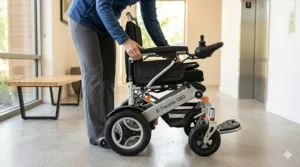
The travel landscape for wheelchair users has transformed dramatically in recent years. Modern portable electric wheelchairs weigh as little as 27-36 pounds, fold in under 3 seconds, and meet strict airline regulations. Whether you’re planning a European cruise, visiting family across the country, or just want the freedom to explore your own city, the right portable electric wheelchair makes all the difference.
According to the FAA’s PackSafe guidelines, wheelchairs with lithium-ion batteries under 300 watt-hours can travel on commercial aircraft when properly documented. This has opened up a world of possibilities for travelers with mobility challenges. But with dozens of models flooding the market, how do you choose the right one?
In this comprehensive guide, I’ll walk you through the 7 best portable electric wheelchairs currently available on Amazon, break down what makes each unique, and help you find the perfect match for your travel needs.
Quick Comparison Table
| Model | Weight | Range | Battery | Price Range | Best For |
|---|---|---|---|---|---|
| Zurcheel SLB30 | 30 lbs | 12 miles | 5.2AH dual | $800-$1,200 | Budget travelers |
| Zurcheel SLF30 | 36 lbs | 12 miles | 5.2AH dual | $900-$1,300 | Heavy-duty needs (300 lbs) |
| 2026 New Upgrader | 38 lbs | 18+ miles | 12AH | $1,200-$1,600 | Extended range |
| VIPLAND Dual Battery | 45 lbs | 30 miles | 20AH+12AH | $1,500-$2,000 | Long-distance travel |
| Mujocooker 2026 | 44 lbs | 25 miles | 20AH+12AH | $1,400-$1,800 | All-terrain cruising |
| NVORJO Compact | 36 lbs | 12 miles | 10AH | $900-$1,400 | Compact portability |
| SHANGYUEFEI Premium | 73 lbs | 25+ miles | Dual 12AH | $1,600-$2,200 | Premium comfort |
💬 Just one click – help others make better buying decisions too!😊
Top 7 Portable Electric Wheelchairs: Expert Analysis
1. Zurcheel SLB30 – World’s Lightest Travel Champion
At just 30 pounds, the Zurcheel SLB30 claims the title of the lightest foldable electric wheelchair on the market. This featherweight design doesn’t sacrifice capability—it supports up to 220 pounds and delivers a respectable 12-mile range.
Key Specifications:
- Dual 5.2AH lithium batteries (removable)
- 300W dual brushless motors
- One-second folding mechanism
- 17-inch seat width
The SLB30 uses aerospace-grade aluminum alloy construction, which explains how it achieves such remarkable weight savings. Customer reviews consistently praise its ease of handling, with many users noting that even petite caregivers can lift it into car trunks without strain.
Pros:
✅ Lightest option available
✅ Quick-release batteries for easy charging
✅ Superior maneuverability in tight spaces
Cons:
❌ Lower weight capacity (220 lbs)
❌ May struggle on thick carpet
Price typically ranges from $800-$1,200, making it an excellent entry point for budget-conscious travelers. The dual battery system means you can charge one while using the other—a thoughtful design choice for extended outings.
2. Zurcheel SLF30 – Heavy-Duty Reliability
For users needing more robust support, the Zurcheel SLF30 steps up with a 300-pound weight capacity while maintaining a travel-friendly 36-pound frame. The wider 19-inch seat provides additional comfort for larger users without compromising portability.
Key Specifications:
- 300 lbs weight capacity
- 19-inch wide seat
- Reinforced four-layer construction
- Puncture-resistant PU tires
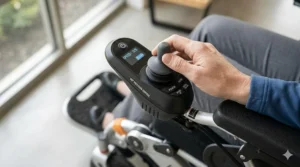
This model incorporates aerospace stainless steel materials in critical stress points, enhancing durability without excessive weight gain. Users appreciate the electronic braking system that engages instantly when releasing the joystick—a critical safety feature on inclines.
Pros:
✅ Highest weight capacity in lightweight class
✅ Wider seat for enhanced comfort
✅ Exceptional build quality
Cons:
❌ Slightly heavier than SLB30
❌ Higher price point
Customer feedback highlights the SLF30’s stability, with one reviewer noting it “handles like a dream on gravel paths and uneven sidewalks.” Priced between $900-$1,300, it offers excellent value for users requiring extra capacity.
3. 2026 New Upgrader – Extended Range Explorer
The 2026 New Upgrader addresses the most common complaint about portable electric wheelchairs: range anxiety. With its 12AH battery delivering 18+ miles on a single charge, you can explore all day without worrying about finding an outlet.
Key Specifications:
- 18+ mile range
- 500W dual motors (250W each)
- 350 lbs weight capacity
- Five adjustable speed levels
This model features brushless motors that provide continuous, stable power even on 12-degree inclines. The 12-inch shock-resistant rear wheels make it genuinely all-terrain capable, handling rocky paths and grassy areas that would bog down lesser models.
Pros:
✅ Longest range in its weight class
✅ Powerful climbing ability
✅ Comfortable for extended use
Cons:
❌ Slightly bulkier when folded
❌ Takes longer to fully charge
Reviews frequently mention the comfortable seat and backrest design, with users reporting minimal fatigue even after hours of use. At $1,200-$1,600, it’s positioned as a mid-premium option for serious travelers.
4. VIPLAND Dual Battery – Ultimate Travel Companion
When 30 miles sounds more appealing than 12, the VIPLAND Dual Battery model delivers exceptional range through its innovative dual-battery configuration. The combination of 20AH and 12AH batteries provides flexibility—use both for maximum distance or just one for lighter daily needs.
Key Specifications:
- 30-mile range (dual batteries)
- 700W dual motors (600W variant available)
- Airline approved
- Cup holder included
The 600W motor variant offers impressive torque for navigating steep cruise ship ramps and hilly terrain. VIPLAND includes thoughtful extras like a storage backpack, LED lights for evening visibility, and rear control for caregiver assistance.
Pros:
✅ Exceptional 30-mile range
✅ Powerful 700W motors
✅ Comprehensive accessory package
Cons:
❌ Heavier due to dual batteries (45 lbs)
❌ Premium pricing
One verified purchaser shared that they completed an entire day at a theme park on a single charge with battery to spare. The $1,500-$2,000 price reflects its premium positioning, but for travelers who refuse to compromise on range, it’s worth every penny.
5. Mujocooker 2026 Upgraded – All-Terrain Adventure
The Mujocooker 2026 Upgraded combines rugged capability with travel-friendly features. Its dual battery system (20AH+12AH) delivers 25 miles of range, while the 350-pound weight capacity accommodates nearly any user comfortably.
Key Specifications:
- 25-mile range
- 700W motor system
- LED lighting system
- Three storage compartments
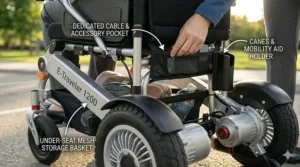
What sets this model apart is its storage versatility. With compartments behind the seat and in both armrests, you can carry personal items, medications, and travel documents without needing an additional bag. The 8-inch PU front wheels and 12-inch pneumatic rear tires provide excellent shock absorption.
Pros:
✅ Multiple storage compartments
✅ Superior shock absorption
✅ Dual-mode operation (electric/manual)
Cons:
❌ Requires tools for battery removal
❌ Bulkier folded dimensions
Users consistently praise its smooth ride quality, with one reviewer comparing it favorably to wheelchairs costing twice as much. The $1,400-$1,800 price point positions it competitively in the premium segment.
6. NVORJO Compact – Smart Travel Solution
The NVORJO Compact emphasizes intelligent design for the modern traveler. At 36 pounds with a 12-mile range, it hits the sweet spot between portability and capability while incorporating unique safety features like one-click mute functionality and an SOS alert button.
Key Specifications:
- 10AH lithium battery
- Dual brushless motors
- One-click mute function
- Emergency SOS button
The mute function addresses a common frustration—operational beeping in quiet environments like libraries, theaters, or medical facilities. The SOS button provides instant audible alerts to notify caregivers in emergencies, offering peace of mind for both users and families.
Pros:
✅ Innovative safety features
✅ Quiet operation option
✅ Ergonomic 360° joystick
Cons:
❌ Shorter range than premium models
❌ Limited color options
Customer reviews highlight the thoughtful design details, with many noting it’s “clearly designed by people who understand real-world wheelchair use.” Priced at $900-$1,400, it offers excellent value for tech-forward travelers.
7. SHANGYUEFEI Premium – Maximum Comfort
The SHANGYUEFEI Premium takes a different approach—prioritizing comfort and stability over ultra-lightweight design. At 73 pounds, it’s the heaviest model on our list, but that weight translates to rock-solid stability and premium build quality that frequent travelers appreciate.
Key Specifications:
- 25+ mile range
- Dual 12AH batteries
- Premium alloy construction
- 44.9″ width x 36.6″ height
This model features the widest wheelbase in its class, providing exceptional stability on uneven surfaces and inclines. The larger frame accommodates a more spacious seat and enhanced lumbar support—critical for users who spend extended periods in their wheelchair.
Pros:
✅ Maximum stability and comfort
✅ Premium construction quality
✅ Excellent for all-day use
Cons:
❌ Heaviest model (73 lbs)
❌ Requires assistance for car loading
Reviews from cruise ship travelers are particularly positive, noting it handles ship movement and gangway transitions better than lighter models. The $1,600-$2,200 price reflects its premium positioning, making it ideal for users who prioritize comfort over portability.
Understanding FAA Lithium Battery Regulations
Before booking your flight, understanding battery regulations is crucial. The Federal Aviation Administration sets clear guidelines that all portable electric wheelchairs must meet for air travel.
Battery Size Limits
✅ Under 300 Wh: Allowed with airline approval
✅ Two batteries under 160 Wh each: Permitted as alternative
❌ Over 300 Wh: Prohibited on passenger aircraft
Most portable electric wheelchairs use batteries between 5.2AH-20AH, translating to approximately 62-240 watt-hours—well within legal limits. To calculate watt-hours, multiply voltage (V) by amp-hours (Ah). For example, a 12V 10AH battery = 120 Wh.
New 2026 Requirements
According to updated IATA guidelines, effective January 2026, several airlines now require:
- Removable batteries must be extracted and carried in cabin
- Battery terminals must be protected from short circuits
- Documentation showing watt-hour rating
- Advance notification (recommended 48-72 hours)
Airlines can implement stricter requirements than federal minimums. Southwest Airlines, for instance, limits single batteries to 300 Wh and requires advance notification for all powered mobility devices.
Traveling Smart
When flying with your portable electric wheelchair:
- Contact your airline’s accessibility department 48 hours before departure
- Bring manufacturer documentation showing battery specifications
- Practice removing batteries quickly (some airlines require this at gate)
- Protect battery terminals with electrical tape or manufacturer caps
- Arrive at airport with extra time for screening
The TSA guidelines note that lithium-ion batteries in wheelchairs may require additional screening, but this typically adds only 5-10 minutes to the security process.
Fits Airplane Aisle Width: Design Considerations
Aircraft aisles present unique challenges for wheelchair users. According to federal regulations, standard single-aisle aircraft feature aisles approximately 19.75 inches wide at their narrowest point.
Why Width Matters
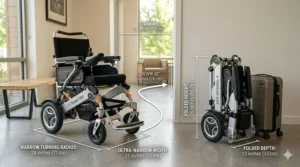
While personal electric wheelchairs are checked as baggage, their folded dimensions determine storage feasibility in overhead bins or under seats. Most portable electric wheelchairs fold to 12-15 inches thick, easily accommodating standard airline storage requirements.
The aircraft’s onboard wheelchair—provided by airlines for in-flight lavatory access—must fit through aisles no wider than 17 inches in some aircraft sections. This explains why personal wheelchairs, even portable ones, cannot be used within the cabin during flight.
Strategic Design Features
Top portable electric wheelchair manufacturers address travel concerns through:
Narrow wheelbase: Most models feature 17-18 inch seat widths
Quick-fold mechanisms: 1-3 second folding enables rapid boarding
Compact footprint: Folded dimensions typically under 31″ x 27″ x 17″
Lightweight construction: Under 40 lbs allows easy handling by gate agents
These specifications ensure your wheelchair fits standard airline baggage dimensions while remaining functional for actual use.

Cruise Ship Wheelchair Friendly Features
Cruise lines have made significant strides in accessibility, but requirements vary considerably by ship and route. Understanding these nuances helps you choose the right portable electric wheelchair for maritime adventures.
Cabin Door Requirements
According to Royal Caribbean’s specifications, standard stateroom doors are 23 inches wide, while accessible cabins feature 32-inch entrances. Most portable electric wheelchairs measure 17-19 inches wide, easily passing through standard doors.
However, mobility devices must be stored inside your cabin when not in use—a safety regulation ensuring clear corridors for emergency evacuation. This makes compact folding capability essential for cruise travel.
Tender Port Challenges
Some ports require “tendering”—using small boats to shuttle passengers from ship to shore. Carnival Cruise Line notes that tender platforms typically have stairs, requiring:
- Collapsible wheelchair under 100 pounds
- Ability to walk a few steps
- Advance notification to ship staff
If you cannot transfer or walk short distances, tender ports may be inaccessible. Review your itinerary carefully, as popular destinations like Grand Cayman and St. Maarten often require tendering.
Onboard Navigation
Modern cruise ships accommodate wheelchairs throughout public areas:
✅ Wide corridors (minimum 36 inches for 180° turns)
✅ Automatic doors in main thoroughfares
✅ Accessible dining venues and theaters
✅ Priority boarding assistance
✅ Complimentary embarkation/disembarkation wheelchair service
MSC Cruises requires guests to complete accessibility request forms 30 days prior to sailing, ensuring appropriate accommodations and assistance.
Battery Considerations
Cruise lines accept lithium-ion batteries but prohibit wet cell batteries. Most allow unlimited recharging in your cabin, though some ships implement:
- Maximum device width restrictions (typically 32 inches)
- Weight limits including user (often 272 kg/600 lbs)
- Advance notification requirements (30-60 days)
The lightweight electric wheelchair for travel models we’ve reviewed all meet standard cruise ship requirements, making them ideal for maritime adventures.
How to Choose Your Perfect Portable Electric Wheelchair
Selecting the right model requires balancing multiple factors. Here’s a systematic approach to making your decision:
1. Assess Your Weight Capacity Needs
Match your body weight plus typical cargo (bags, equipment) to the wheelchair’s capacity:
- 220-250 lbs: Budget models (Zurcheel SLB30, NVORJO)
- 300-350 lbs: Mid-range options (Zurcheel SLF30, 2026 Upgrader)
- 350+ lbs: Premium models (Mujocooker, SHANGYUEFEI)
Leave 20-30 pounds margin for safety and to prevent premature wear on motors and frame.
2. Calculate Your Range Requirements
Consider your typical daily activities:
- Local errands (< 5 miles): Any model works fine
- Full-day outings (8-12 miles): 12-15 mile range minimum
- Extended adventures (15+ miles): 18-30 mile models essential
- Multi-day travel: Dual battery systems recommended
Remember that range decreases with heavier loads, inclines, and cold weather. Manufacturers’ stated ranges assume ideal conditions—reduce by 20% for real-world expectations.
3. Evaluate Portability vs. Comfort Trade-offs
Ultra-lightweight models (27-36 lbs) excel at portability but may sacrifice:
- Seat cushioning thickness
- Armrest padding
- Suspension quality
- Overall stability
Heavier models (45-73 lbs) provide superior comfort but require:
- Assistance for car loading
- More storage space
- Stronger caregivers
4. Consider Your Primary Use Environment
Urban environments: Prioritize tight turning radius and compact dimensions
Suburban areas: Balance portability with moderate all-terrain capability
Rural settings: Invest in robust motors and puncture-resistant tires
Frequent travelers: Maximize battery compliance and folding speed
5. Budget Realistic Total Costs
Beyond the wheelchair’s purchase price, factor in:
- Spare batteries ($150-$400 each)
- Protective travel case ($100-$300)
- Extended warranty ($200-$500)
- Maintenance supplies ($50-$100 annually)
Quality portable electric wheelchairs represent significant investments, but proper maintenance extends their lifespan to 5-7 years or more.
Airline Approved Folding Wheelchair: Certification Process
The term “airline approved” appears frequently in marketing materials, but what does it actually mean? Understanding the certification process helps you verify claims and avoid travel-day surprises.
Official Certification Requirements
The FAA doesn’t “approve” specific wheelchair models—rather, they set standards that devices must meet. A wheelchair qualifies for air travel when:
- Battery specifications comply: Under 300 Wh or dual batteries under 160 Wh each
- Batteries are removable: For carrying in cabin during flight
- Short circuit protection: Terminal covers or similar safeguards
- Accidental activation prevention: Disconnection capability required
Marketing vs. Reality
When manufacturers claim “airline approved,” they mean the design meets general FAA criteria—not that airlines have specifically tested or endorsed that model. Individual airlines may still:
- Require additional documentation
- Impose stricter battery limits
- Request advance notification
- Limit total number per flight
Always contact your specific airline’s accessibility department regardless of marketing claims.
Documentation Best Practices
Create a travel folder containing:
- Battery specifications sheet (voltage, amp-hours, watt-hours)
- Manufacturer’s compliance statement
- Wheelchair dimensions (folded and unfolded)
- Weight specifications
- Quick-reference guide for battery removal
Laminate critical documents and keep digital copies on your phone. This preparation prevents gate-side delays and ensures smooth processing through security checkpoints.

Maintenance Tips for Long-lasting Performance
Proper maintenance extends your wheelchair’s lifespan and prevents travel-day malfunctions. Here’s a systematic maintenance schedule:
Daily Checks (Before Each Use)
✓ Inspect tire pressure and tread condition
✓ Test joystick responsiveness in all directions
✓ Verify brake engagement and release
✓ Check battery charge level
✓ Examine frame for cracks or damage
Weekly Maintenance
- Clean seat and backrest with mild soap solution
- Wipe down frame and remove debris from wheels
- Test folding mechanism smoothly operates
- Inspect electrical connections for corrosion
- Verify all bolts and screws remain tight
Monthly Deep Maintenance
- Battery care: Fully discharge then recharge to calibrate meter
- Motor inspection: Listen for unusual sounds or vibrations
- Tire maintenance: Clean debris from tread patterns
- Lubrication: Apply manufacturer-recommended lubricant to pivot points
- Electronics check: Test all lights, horn, and safety features
Seasonal Servicing
Consider professional servicing every 6-12 months for:
- Motor performance testing
- Electrical system diagnostics
- Battery capacity evaluation
- Frame structural inspection
- Replacement of worn components
Many manufacturers offer service packages through authorized dealers, providing peace of mind for critical components.
Common Mistakes to Avoid
Learning from others’ experiences saves time, money, and frustration. Here are the most common portable electric wheelchair mistakes:
1. Ignoring Weight Distribution
Many users overload wheelchair backs with bags and equipment, creating dangerous instability. The anti-tip wheels help, but excessive rear weight can still cause tipping on inclines. Use side bags or front-mounted storage instead.
2. Depleting Batteries Completely
Lithium-ion batteries last longest when kept between 20-80% charge. Regularly running to zero capacity shortens overall battery lifespan by 30-40%. Recharge when you hit 20% remaining.
3. Skipping Advance Airline Notification
While not legally required, notifying airlines 48-72 hours ahead prevents:
- Insufficient trained staff at boarding
- Confusion about battery specifications
- Last-minute gate checks delaying departure
- Potential denial of boarding
Ten minutes spent calling the accessibility desk saves hours of airport stress.
4. Buying Based Solely on Price
The cheapest option often costs more long-term through:
- Shorter battery lifespan
- Lower-quality components requiring replacement
- Poor customer service when issues arise
- Inadequate warranty coverage
Invest in mid-range quality from established brands with strong support networks.
5. Neglecting to Test Folding Mechanism
Practice folding/unfolding at home before your first trip. Some models require specific sequences or hand positions. Struggling with this at airport gates causes stress and delays.
Comparison: Portable vs. Standard Electric Wheelchairs
Understanding the fundamental differences helps clarify whether a portable model suits your needs:
| Feature | Portable Electric | Standard Electric |
|---|---|---|
| Weight | 27-75 lbs | 100-400+ lbs |
| Folding | 1-3 seconds | Not foldable |
| Range | 12-30 miles | 15-35 miles |
| Speed | 4-6 mph | 4-8 mph |
| Comfort | Moderate | Excellent |
| Durability | Good (5-7 years) | Excellent (10-15 years) |
| Price | $800-$2,200 | $2,000-$8,000+ |
| Travel-friendly | Excellent | Poor |
When Portable Makes Sense
Choose portable electric wheelchairs if you:
- Travel frequently by car, plane, or cruise ship
- Need to navigate tight indoor spaces regularly
- Require caregiver assistance with transportation
- Have limited home storage space
- Prioritize independence and spontaneous outings
When Standard Is Better
Consider traditional electric wheelchairs if you:
- Use wheelchair as primary mobility aid 8+ hours daily
- Rarely travel or transport via personal vehicle
- Need maximum comfort for extended sitting
- Require advanced features (elevating seats, reclining backs)
- Have dedicated storage and charging space at home
Many users find the ideal solution involves both: a standard wheelchair for daily home use and a portable model for travel and outings.
FAQs
❓ How long does a portable electric wheelchair battery last on a single charge?
❓ Can you take a portable electric wheelchair on a plane with lithium battery?
❓ What is the weight limit for airline approved folding wheelchairs?
❓ Do portable electric wheelchairs fit through standard doorways?
❓ How much does it cost to ship a portable electric wheelchair on a cruise?
Conclusion: Your Journey Starts Here
The freedom to travel independently transforms lives in profound ways. Whether you’re dreaming of European adventures, planning family visits, or simply want to explore your local farmers market without exhaustion, the right portable electric wheelchair makes it possible.
Throughout this guide, we’ve examined seven exceptional models, each excelling in different areas. The Zurcheel SLB30 delivers unmatched portability at 30 pounds, while the VIPLAND Dual Battery provides 30-mile range for marathon adventures. The 2026 New Upgrader balances capability and weight perfectly for most travelers, earning my personal recommendation for first-time buyers.
Remember that the “best” wheelchair is the one that matches your specific needs. Consider your typical travel patterns, weight requirements, budget constraints, and comfort priorities. Don’t rush this decision—reach out to manufacturers with questions, read detailed reviews, and if possible, test models at medical supply stores.
The investment you make today in a quality portable electric wheelchair pays dividends in experiences, independence, and joy. From navigating airport terminals to exploring cruise ship destinations, from visiting grandchildren to attending concerts and sporting events—your mobility device should enhance rather than limit your life.
Start by bookmarking your top three choices from our comparison, then contact the sellers with specific questions about your situation. Most reputable manufacturers offer excellent customer support and can help match you with the perfect model.
Your adventure awaits. Choose your wheels wisely, travel confidently, and embrace the freedom you deserve.
Recommended for You
- 7 Best Automatic Folding Electric Wheelchairs 2026
- 7 Lightest Electric Wheelchairs 2026 – Under 30 Pounds Guide
- 7 Best Lightweight Folding Electric Wheelchairs – 2026
Disclaimer: This article contains affiliate links. If you purchase products through these links, we may earn a small commission at no additional cost to you.
✨ Found this helpful? Share it with your friends! 💬🤗
