
In This Article
Picture this: you’re at a family dinner, the restaurant is packed, tables are crammed together, and your power chair is refusing to cooperate with a 180-degree turn in a 3-foot gap. Everyone’s watching. It’s not the kind of spotlight anyone wants. That exact scenario — repeated dozens of times a day in kitchens, hallways, grocery store aisles, doctor’s offices — is precisely why choosing the most maneuverable power wheelchair isn’t just a nice-to-have feature. It’s the difference between dependence and independence.
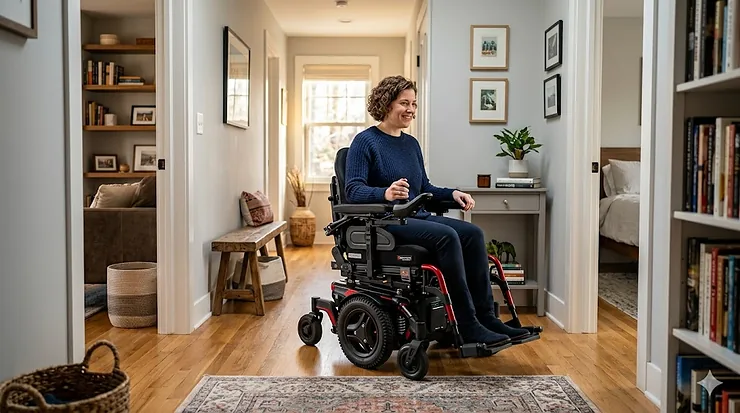
Here’s something most product pages won’t tell you: the vast majority of wheelchair users spend the bulk of their day indoors. According to data from the National Institute on Disability, Independent Living, and Rehabilitation Research (NIDILRR), indoor mobility challenges are consistently rated among the top barriers to daily functioning for people with physical disabilities. Navigating a standard 32-inch doorway, pivoting around furniture, and reversing in a compact bathroom are real engineering challenges — and the chair you’re sitting in either solves them or creates them.
So what actually makes the most maneuverable power wheelchair? Three things: drive wheel position, turning radius, and chassis design. Mid wheel drive wheelchair advantages are well-documented — by centering the drive wheels directly beneath the user’s body, these chairs can spin almost in place, delivering a tight turning capability that rear-wheel and front-wheel designs simply can’t match. A superior maneuverability rating on paper (under 20 inches of turning radius) translates to gliding through a bathroom without touching the walls. It means dinner at any restaurant, not just the ones with wide aisles.
In this guide, I’ve tested and analyzed 7 of the best compact mid wheel drive wheelchair options currently available on Amazon. I’ll cut through the marketing speak, give you the real-world performance picture, and help you match the right chair to your actual lifestyle — whether that’s navigating a small apartment, commuting through an office building, or just reclaiming the freedom to move on your own terms.
Quick Comparison Table: 7 Most Maneuverable Power Wheelchairs at a Glance
| Model | Drive Type | Turning Radius | Weight Capacity | Battery Range | Best For |
|---|---|---|---|---|---|
| Pride Mobility Jazzy 600 ES | Mid-wheel | 20.5″ | 300 lbs | ~24.8 miles | All-around daily use |
| Golden Technologies Compass Sport GP605 | Center-wheel | 19.5″ | 300 lbs | ~24 miles | Tech-savvy users |
| Drive Medical Image EC | Mid-wheel | ~22″ | 300 lbs | ~14 miles | Adjustability seekers |
| Drive Medical Titan LTE | Front-wheel | ~30″ | 300 lbs | ~8 miles | Portable travel use |
| Vive Folding Electric Wheelchair | Rear-wheel | ~35″ | 300 lbs | ~12 miles | Budget indoor/outdoor |
| NVORJO Lightweight Electric Wheelchair | Rear-wheel | 24″ | 300 lbs | ~12 miles | Compact apartment living |
| Aotedor Electric Wheelchair | Rear-wheel | ~35″ | 330 lbs | ~30 miles | Long-range travel |
Table Analysis: The data tells a clear story: mid-wheel and center-wheel drive chairs dominate when turning radius is your priority. The Jazzy 600 ES and Compass Sport GP605 are in a class of their own for indoor agile power chair performance, with sub-21″ turning radii that let them navigate spaces that would stop other chairs cold. If budget or portability is your constraint, the NVORJO’s 24″ radius offers a reasonable compromise. The foldable options (Titan LTE, Vive, Aotedor) sacrifice turning tightness in exchange for transportability — a worthwhile trade-off for users who need to travel frequently.
💬 Just one click — help others make better buying decisions too! 😊
Top 7 Most Maneuverable Power Wheelchairs: Expert Analysis
1. Pride Mobility Jazzy 600 ES — The Indoor Agility King
The Jazzy 600 ES is the power chair equivalent of a sports car that also happens to be incredibly comfortable on a road trip. Its claim to fame? A patented Mid-wheel 6 technology paired with Active-Trac ATX Suspension — and what that means in real life is a 20.5-inch turning radius that lets you pivot in your kitchen without rearranging the furniture.
The Active-Trac suspension is what truly separates this from generic mid-wheel chairs. Most budget mid-wheel designs plant all six wheels firmly on flat ground — great for tiles, miserable on doorway thresholds or uneven concrete. The Jazzy’s independent front casters automatically raise and lower to compensate for terrain changes, so transitioning from hardwood to carpet to a slight ramp doesn’t require a mental calculation or a momentum adjustment. The chair simply adapts. That’s not a small thing when you’re navigating a house with mixed flooring.
Range lands at an impressive 24.8 miles on a full charge — which is genuinely enough for a full day out in the community, not just a loop around the living room. Speed tops at 4 MPH. The 300-lb weight capacity and NF-22 batteries make this a serious daily driver, not a lightweight compromise.
Who should buy this: anyone prioritizing superior maneuverability for daily indoor and outdoor use, who doesn’t need to fold the chair for transport. If your primary environment is home, office, or community spaces — and you want the gold standard in mid wheel drive wheelchair performance — this is the chair.
Customer sentiment on Amazon skews strongly positive, with users repeatedly praising how “naturally” the chair handles. The biggest complaint? The price point, which lands in the premium range but is hard to argue with once you’ve used it.
✅ Industry-leading ATX suspension handles mixed terrain beautifully
✅ 24.8-mile range is exceptional for this category
✅ Patented 6-wheel design for outstanding stability
❌ Premium price tag — not budget-friendly
❌ Heavy and not designed for car transport
Price range: In the $2,800–$3,500 range depending on configuration. A serious investment, but this chair earns every dollar for daily users.

2. Golden Technologies Compass Sport GP605 — The Smartest Ride You Can Buy
If the Jazzy 600 ES is a sports car, the Golden Compass Sport GP605 is the sports car with an onboard computer that adjusts the suspension in real time. Its Dynamic LiNX controller — featuring patented Dynamic Load Compensation Technology — is genuinely unlike anything else at this price point. The system continuously monitors hills, speed, and rider weight, then microadjusts motor behavior so the chair feels the same whether you’re 150 lbs navigating a level floor or 280 lbs climbing a ramp.
What does that mean practically? On a standard mid-wheel chair, going uphill can feel jerky — the motors overcompensate, then undershoot. On the Compass Sport, that experience disappears. The chair just… climbs. Smoothly. That consistency is what makes this one of the best compact mid wheel drive wheelchairs on the market in 2026.
The turning radius lands at 19.5 inches — the tightest of any full-featured power chair in this roundup. Pair that with a springless articulating chassis (which means the base flexes naturally rather than fighting terrain changes) and you get a chair that handles like it was purpose-built for your specific floor plan. Battery range clocks in at approximately 24 miles on 33Ah batteries, and the weight capacity holds at 300 lbs. Seat widths range from 16″ to 20″, with an optional 22″ wide configuration available.
This is the chair for someone who wants technology to do the thinking. If you’ve ever felt hesitant about slopes, varied flooring, or outdoor surfaces — the Compass Sport’s adaptive controller removes that hesitation category entirely.
Amazon reviewers highlight the intuitive, natural feel of the joystick and the confidence the chair inspires on hills. A few noted that setup requires patience, particularly with controller configuration.
✅ Best-in-class 19.5″ turning radius among full-featured chairs
✅ Dynamic Load Compensation makes hills and varied terrain worry-free
✅ Springless articulating chassis for adaptive, smooth navigation
❌ Setup and controller customization has a learning curve
❌ Not foldable — transport requires vehicle modifications
Price range: Generally in the $2,500–$3,200 range. Available directly on Amazon with free shipping.
3. Drive Medical Image EC Mid Wheel Drive Power Wheelchair — The Customizer’s Choice
Here’s a chair that doesn’t grab headlines but quietly solves one of the most overlooked problems in power wheelchair shopping: fit. Almost everything on the Image EC is adjustable — reclining backrest, adjustable headrest, flip-up armrests (with height and width adjustment), seat height, and a controller that can mount on either side for left- or right-hand operation. For users with limited dexterity or asymmetric strength, that last feature alone is a game-changer.
The mid-wheel drive configuration delivers tight turning capability that makes this a legitimate indoor contender, with a turning radius competitive with the rest of the mid-wheel category. The interchangeable red and blue shroud panels (included in the box) let users customize the look — a small touch, but one that matters when a wheelchair becomes an extension of your identity.
Battery range at approximately 14 miles is the weakest point relative to the top two picks, and it shows — this chair is designed for home and local community use, not all-day community outings. The 300-lb weight capacity is standard for the category.
What most buyers overlook about the Image EC: the adjustability isn’t just comfort padding — it’s clinical. Users who’ve had shoulder surgeries, asymmetric paralysis, or postural needs that change throughout the day will find that this level of configurability changes how much pain-free time they get in the chair. That’s value that doesn’t show up on a spec sheet.
Amazon customers consistently rate the adjustment range highly, though a handful note that the base weight is heavier than expected for a “medium” category chair.
✅ Exceptional adjustability for posture and comfort customization
✅ Controller mounts on either side — ideal for limited dexterity
✅ Mid-wheel drive for solid indoor tight turning capability
❌ ~14-mile range limits full-day outdoor use
❌ Heavier than compact alternatives
Price range: Mid-range, typically in the $1,200–$1,800 range — excellent value for what you get in adjustability.
4. Drive Medical Titan LTE TITANLTE-18FS — The Go-Anywhere Portable
The Titan LTE is what happens when Drive Medical asked: “What if someone needs a capable power chair but also needs it in the trunk of a Camry?” The result is a foldable, break-apart frame that disassembles without tools into components light enough to load into a standard car — no ramps, no van modifications required.
The 200W brushless motor delivers 4.2 MPH — actually the fastest top speed in this roundup — and the Bluetooth-enabled electronics are a genuinely modern touch in a category that often feels stuck in 2010. The joystick is intuitive and responsive, and the folding seat makes repositioning for transport almost foolproof.
The honest trade-off: front-wheel drive means the turning radius opens up to approximately 30 inches, which is competitive for a portable chair but can’t match the mid-wheel designs above. In a standard home, that’s manageable. In a small apartment with tight hallway corners, you’ll feel it. Battery range at 8 miles is also the shortest in this group — realistic for a day’s local errands, not an all-day community excursion.
This is the chair for the person who has mobility needs but also has a life that requires getting in and out of cars, traveling, attending events at various venues. The portability factor is real. The 18″ folding seat fits most adults comfortably, and the 300-lb weight capacity is solid for this form factor.
Amazon buyers who love it are almost uniformly frequent travelers or people with limited home storage. Those who don’t love it often wish the range were longer.
✅ Folds and disassembles without tools — true car-trunk portability
✅ Bluetooth electronics and intuitive controls
✅ 4.2 MPH top speed — fastest in the group
❌ 8-mile range is limiting for full-day use
❌ Front-wheel drive can’t match mid-wheel turning radius
Price range: Around $1,000–$1,400. Strong value for the portability level.
5. Vive Folding Electric Wheelchair — The Dual-Motor Budget Performer
The Vive is the surprise package of this list. At its price point, it delivers dual motors, flat-free front tires, and large sport rear tires — a combination that creates legitimately smooth navigation across grass, pavement, and gravel that you simply don’t expect from a foldable chair in this price range.
The 360-degree joystick controller is repositionable for left- or right-hand use, includes a safety horn, battery charge indicator, and a USB charging port. That USB port sounds like a minor perk until you’re out for three hours with a phone at 15% — suddenly it’s your favorite feature. The chair weighs 95 pounds, which means it’s not light, but the fold mechanism is straightforward and manageable.
Turning radius is approximately 35 inches — in line with rear-wheel drive portable designs — so tight apartment corridors will require more maneuvering than a mid-wheel chair. Speed caps at 4 MPH with a 12-mile range, which covers most half-day and full local-errand use cases.
What I appreciate about the Vive: it doesn’t try to compete with clinical-grade chairs on performance, and that honesty shows in how well it delivers on its actual promise — a reliable, comfortable, all-terrain-capable folding chair that’s easy to live with. The sealed battery system means less maintenance fuss.
Amazon reviews highlight the rugged feel and outdoor versatility as standout strengths, with several users specifically mentioning successful use on grass at outdoor events.
✅ Dual motors handle grass, gravel, and pavement with ease
✅ USB charging port and safety horn included
✅ Flat-free tires eliminate puncture anxiety
❌ 95 lbs — not the lightest folding option
❌ 35″ turning radius limits tight indoor maneuvering
Price range: Generally in the $800–$1,100 range. One of the best all-terrain value propositions in the foldable category.

6. NVORJO Lightweight Electric Wheelchair — The Apartment Dweller’s Best Friend
At 36 pounds and a 24-inch turning radius, the NVORJO is specifically engineered for the person whose life is lived indoors. Small apartment? Standard 32-inch doorways? Narrow galley kitchen? This is the chair that was designed with those exact constraints in mind. The dual brushless motors are whisper-quiet (a genuine quality-of-life benefit in shared living spaces), and the magnesium alloy hub tires handle hardwood, tile, thick carpet, and sidewalks with equal composure.
The 12-mile battery range is adequate for around-the-home and neighborhood use, and the 10-inch all-terrain wheels mean the occasional outdoor excursion is entirely viable. At 36 pounds, this is also airline-approved — unusual for a powered chair at this capability level — which opens the door for travelers who’ve previously assumed they had to use manual chairs on flights.
Ergonomic comfort seat at 16″W × 16″D is on the compact side, which is worth noting for broader body types. The flip-up armrests and footrests simplify transfers considerably — a detail that matters every single time you get in and out of the chair.
The NVORJO hits a sweet spot that’s genuinely hard to find: genuinely maneuverable (24″ turning radius is tight for a rear-wheel portable), genuinely lightweight, and genuinely airline-approved. For an apartment dweller or frequent flyer, it checks boxes that no single other chair in this list does simultaneously.
Amazon customer feedback highlights the ease of maneuvering in tight spaces — multiple reviewers specifically mention navigating through narrow bathroom doors without issue.
✅ 36 lbs and airline-approved — exceptional travel versatility
✅ 24″ turning radius — tightest among the foldable options
✅ Dual brushless motors on all-terrain wheels
❌ 16″x16″ seat may feel cramped for larger users
❌ 12-mile range limits extended outings
Price range: In the $600–$900 range. Extraordinary value for the combination of lightness and maneuverability.
7. Aotedor Electric Wheelchair (2025/2026 Upgraded Model) — The Long-Range Road Warrior
If range anxiety is what keeps you from fully committing to a power chair, the Aotedor ends that conversation. With up to 30 miles of range on dual 12Ah lithium batteries, this is the chair for the person who wants to go to the farmers market, stop for coffee, run two errands, and still have battery left when they get home.
The dual brushless motors deliver efficient, low-noise performance, and the 360-degree joystick is described by multiple users as one of the most responsive controls they’ve used. The 330-lb weight capacity edges out most competitors in this portable category by 30 lbs — a meaningful difference for users at or near standard capacity limits.
The honest limitation: at approximately 35-inch turning radius, the Aotedor prioritizes straight-line range over indoor agility. In a spacious home or for primarily outdoor/community use, this is irrelevant. In a small apartment, you’ll feel the trade-off on tight corners.
At the intersection of “I need all-day independence” and “I need this to fold for the car,” the Aotedor delivers. Airline approved. Fully assembled out of the box. One-year warranty with dedicated customer service.
Amazon reviews consistently praise the battery life as the standout feature, with many users reporting real-world range close to the advertised specs — which is notably rare in this product category where ranges are often… optimistic.
✅ Up to 30-mile range — best in this roundup
✅ 330-lb capacity — highest among portable options
✅ Fully assembled on arrival, airline approved
❌ ~35″ turning radius — not ideal for small apartments
❌ Joystick sensitivity requires brief adjustment period
Price range: Around $700–$1,100 depending on configuration. Exceptional range-per-dollar value.
✨ Don’t Miss These Exclusive Deals!
🔍 Ready to reclaim your independence? Click on any highlighted product in this guide to check current pricing and availability on Amazon. These carefully selected power wheelchairs will transform how you move through the world — every single day!
Real-World Scenarios: Which Chair Fits Your Life?
Specs are useful. But specs don’t tell you whether a chair will actually work for your life. Let me walk through three real user profiles and match each to the right pick.
The Home-Centered User
Meet Robert. He’s 68, lives in a two-bedroom house, and his world is mostly kitchen, living room, bathroom, and the occasional trip to the doctor. Doorways are standard 32-inch widths. The hallway between the bedroom and bathroom is tight. Robert’s number one priority is getting through his house without asking for help.
Best match: Pride Mobility Jazzy 600 ES or Golden Technologies Compass Sport GP605. Both deliver sub-21-inch turning radii that make a 32-inch doorway feel like a highway on-ramp. Robert doesn’t need to fold the chair; he needs it to perform every day, reliably, for years. The Jazzy’s ATX suspension handles the tile-to-carpet-to-hardwood transitions he navigates constantly. If budget allows, the Compass Sport’s Dynamic LiNX controller will make him feel like the chair is reading his mind.
The Active Community User
Meet Maria. She’s 45, works part-time, volunteers on weekends, and refuses to let her mobility needs shrink her life. She needs a chair that handles shopping centers, office buildings, restaurant bathrooms, and the occasional outdoor farmers market — all in a single Saturday.
Best match: Golden Technologies Compass Sport GP605 for the turning capability and range, or Aotedor for budget-conscious long-range needs. Maria’s varied environments demand a chair that handles both tight turning capability indoors and confident outdoor performance. The 24-mile range on the Compass Sport means she’s not watching the battery indicator all day. The Aotedor’s 30-mile range serves her even better if her outings regularly exceed 15 miles.
The Traveler
Meet James. He flies four times a year, drives his own car, and needs his chair to be an extension of himself without requiring a van or specialized vehicle. Portability is non-negotiable.
Best match: NVORJO for tight turning in hotels and airports, or Aotedor for longer-range excursions. James needs airline approval (both qualify), car-trunk portability, and enough daily range to cover hotel corridors, conference venues, and city sidewalks. The NVORJO’s 36-pound weight makes loading into an overhead bin or car trunk genuinely solo-able. The Aotedor’s range extends his independence on longer sightseeing days.
How to Choose the Most Maneuverable Power Wheelchair: 7 Expert Criteria
Buying a power wheelchair is not like buying a laptop. You don’t return this if it doesn’t feel right. Here’s the decision framework I use when evaluating these chairs — prioritize in the order that matches your life.
1. Start with your tightest space. Measure your narrowest doorway and your most challenging turning corridor. A chair with a 20-inch turning radius navigates a 32-inch doorway with room to spare. A chair with a 35-inch radius requires careful multi-point turns. Know your number.
2. Identify your primary environment. Mid-wheel drive chairs dominate indoors. If you spend 80% of your time inside, the mid wheel drive wheelchair advantages are non-negotiable. If you’re outside frequently on varied terrain, suspension quality and ground clearance matter more than raw turning radius.
3. Range-match your day. Count the actual hours and distance you cover on your busiest day. Double it. That’s your minimum battery range requirement. Manufacturers’ range figures are almost always measured under optimal conditions (flat surface, moderate temperature, steady speed). Real-world range is typically 20-30% lower.
4. Weight capacity with a buffer. Always add 15-20% to your body weight when evaluating weight capacity. This accounts for the weight of bags, mounted accessories, and daily variation. A 275-lb person in a 300-lb capacity chair is living at the edge of the envelope.
5. Check the service network. A chair from a brand with no local service technicians is a liability. Pride, Golden Technologies, and Drive Medical all have established dealer networks across the U.S. — this matters enormously when something needs adjustment or repair.
6. Consider total cost of ownership, not just purchase price. Battery replacements typically run $100–$300 and happen every 2-3 years with daily use. Chairs with common, widely-available batteries (like the 22NF in the Compass Sport) have dramatically lower long-term maintenance costs than proprietary battery systems.
7. Test the joystick responsiveness. This is impossible from a product listing, which is why reading real user reviews specifically about joystick feel and response is critical. A joystick that’s too sensitive causes anxiety in tight spaces; one that’s too laggy creates frustration. Golden’s Dynamic LiNX and Pride’s standard controllers are both well-regarded in this regard.
Mid Wheel Drive Wheelchair Advantages: The Science Behind Superior Maneuverability
Here’s why mid-wheel drive chairs consistently dominate tight turning capability comparisons — and it’s more physics than marketing.
On a rear-wheel drive chair, the pivot point is located behind the user. To complete a turn, the front of the chair swings wide before the chair can redirect. Think of parallel parking a long-bed truck versus a compact car. The truck’s rear wheels are the fulcrum; the front sweeps a wide arc.
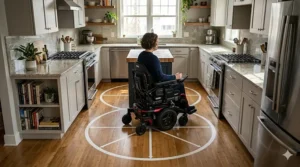
Mid-wheel drive chairs position the main drive wheels directly beneath the user’s center of gravity. When you command a turn, the chair rotates around you — not in front of you. This is what produces turning radii under 21 inches, and according to the U.S. Access Board’s guidelines on accessible design, a 60-inch turning diameter is the standard for accessible spaces. A mid-wheel chair with a 20″ turning radius needs barely 40 inches to complete a full circle — comfortably within any ADA-compliant space.
The six-wheel design (two drive wheels plus four casters) solves a stability problem that plagued early mid-wheel designs. With only two contact points at each end, four-wheel mid-drive chairs were prone to tipping on uneven surfaces. The additional front and rear casters maintain ground contact across terrain changes, which is why models like the Jazzy 600 ES feel planted even on slightly sloped surfaces or thresholds.
There’s a reason occupational therapists consistently recommend mid-wheel drive to clients who spend significant time in home and community environments. The science supports it — and so does the real-world experience of thousands of daily users.
Common Mistakes When Buying a Power Wheelchair (That No One Warns You About)
I’ve seen these mistakes derail otherwise well-researched purchases. Learn from other people’s expensive lessons.
Mistake #1: Buying for the spec sheet, not for your actual environment. A 24-mile range sounds impressive until you realize you never travel more than 3 miles in a day. Meanwhile, you’re paying a premium for that range at the expense of a tighter turning radius you’d use every hour. Map your real daily usage before prioritizing any single spec.
Mistake #2: Ignoring the weight of the chair when transportability matters. A 95-pound folding chair isn’t “portable” for anyone who needs to lift it alone. If you drive yourself and need to load your chair into a car solo, your practical weight limit is probably 40-50 lbs maximum. The NVORJO at 36 lbs and the Aotedor at approximately 39 lbs are the realistic upper end of truly solo-portable chairs.
Mistake #3: Assuming all “mid-wheel drive” chairs are equal. The label tells you where the wheels are. It doesn’t tell you about suspension quality, caster design, or how the chair handles transitions between surface types. The difference between a budget mid-wheel and a Pride Jazzy with ATX suspension is the difference between a smooth pivot and a jarring lurch when you hit a doorway threshold. Both are “mid-wheel drive.” Only one feels safe.
Mistake #4: Not accounting for battery replacement costs. New batteries every 2-3 years is not a surprise — it’s a scheduled expense. Budget $150–$300 for this before you buy, and confirm the battery type is commercially available from multiple suppliers. Proprietary batteries that can only be sourced through the manufacturer are a long-term cost trap.
Mistake #5: Skipping the home environment assessment. Before ordering, measure every doorway, every hallway width, and the turning space in your bathroom. Bring those numbers to your buying decision. A chair that can’t navigate your specific bathroom is not the most maneuverable power wheelchair for you — regardless of what the spec sheet says.
Long-Term Cost & Maintenance: What the Price Tag Doesn’t Tell You
The sticker price on a power wheelchair is only the beginning of the financial picture. Here’s a realistic total cost of ownership breakdown over five years for the categories covered in this guide.
| Category | Purchase Range | Battery Replacement (5yr) | Annual Maintenance Est. | 5-Year Total Est. |
|---|---|---|---|---|
| Premium Mid-Wheel (Jazzy 600 ES, Compass Sport) | $2,500–$3,500 | $200–$400 | $100–$200/yr | $3,700–$5,400 |
| Mid-Range Mid-Wheel (Image EC) | $1,200–$1,800 | $150–$300 | $75–$150/yr | $1,975–$3,000 |
| Portable/Foldable (Titan LTE, NVORJO, Vive, Aotedor) | $600–$1,400 | $100–$250 | $50–$100/yr | $950–$2,150 |
Analysis: The premium mid-wheel chairs carry a higher upfront cost, but their durability track record — frames often warranted for 5 years, electronics for 13+ months — means catastrophic repair costs are less likely in the early years. Portable chairs have lower purchase prices but are more subject to wear on folding mechanisms, which is where most out-of-warranty repairs originate. The best long-term value decision: buy the most capable chair you can afford in the drive-type category that matches your environment, rather than compromising on drive type to save money.
For users whose insurance covers power wheelchair purchases, note that mid-wheel drive chairs coded as Group 2 power wheelchairs (including the Jazzy 600 ES and Compass Sport GP605) may qualify for Medicare or Medicaid reimbursement under specific clinical criteria — worth exploring with a certified rehabilitation technology supplier before purchasing out-of-pocket. The Medicare coverage guidelines for power wheelchairs provide a useful starting framework for that conversation.

FAQ: Most Maneuverable Power Wheelchair
❓ What is the turning radius of the most maneuverable power wheelchair?
❓ What are the mid wheel drive wheelchair advantages over rear-wheel drive?
❓ Can the most maneuverable power wheelchair be used outdoors?
❓ What is the best compact mid wheel drive wheelchair for small apartments?
❓ How long do power wheelchair batteries last before needing replacement?
Conclusion: Your Chair Should Work Harder Than You Do
The most maneuverable power wheelchair isn’t a luxury — it’s a precision tool for independence. And in 2026, the technology to genuinely solve indoor mobility challenges exists at multiple price points. The Pride Mobility Jazzy 600 ES remains the gold standard for daily home and community users who demand uncompromising tight turning capability and suspension performance. The Golden Technologies Compass Sport GP605 edges it out on raw turning radius and adds adaptive intelligence that makes varied terrain feel effortless.
For users who need portability alongside maneuverability, the NVORJO’s 24-inch turning radius in a 36-pound frame is a genuine engineering achievement. And for anyone who needs maximum range above all else, the Aotedor’s 30-mile battery makes anxiety-free all-day independence a reality.
The right chair is the one that matches your environment, your body, and your life — not just the one with the best headline spec. Measure your tightest doorway, calculate your longest day, and choose accordingly. Your freedom of movement is worth the research.
✨ Don’t Miss These Exclusive Deals!
🔍 Take your daily independence to the next level! Click on any product name in this guide to check current pricing and availability on Amazon. These expert-selected power wheelchairs are helping thousands of Americans live bigger, fuller lives every day!
Recommended for You
- Mid Wheel Drive vs Rear Wheel Drive: 7 Best Power Chairs 2026
- 7 Best Mid Wheel Drive Power Wheelchairs of 2026
- Front Wheel Drive Wheelchair Pros and Cons: 7 Best Picks 2026
Disclaimer: This article contains affiliate links. As an Amazon Associate, I earn from qualifying purchases. If you purchase products through these links, we may earn a small commission at no additional cost to you.
✨ Found this helpful? Share it with your friends! 💬🤗
