
In This Article
Here’s a scenario that plays out in thousands of households every year: someone finally decides to invest in a power wheelchair, spends hours researching motors, battery ranges, and seat sizes — and then completely ignores the one spec that will affect nearly every single moment of using the chair. The drive wheel configuration.
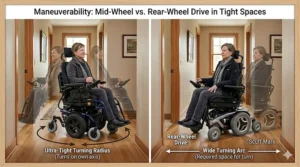
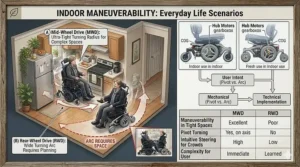
Mid wheel drive vs rear wheel drive comparison isn’t just a technical footnote. It’s the difference between spinning a tight circle in your kitchen doorway and ramming into the same cabinet for the fifth week in a row. It’s the gap between a chair that handles a cracked sidewalk like a champ and one that bucks and shimmies every time the terrain gets interesting.
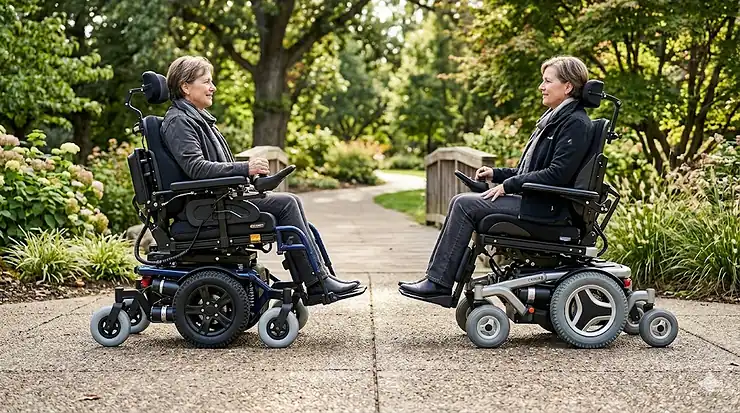
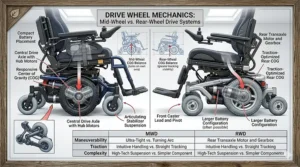
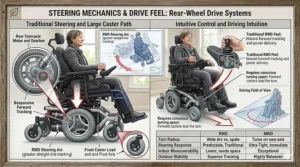
So what exactly is this mid wheel drive vs rear wheel drive comparison about? In simple terms: a mid wheel drive (MWD) power wheelchair places the large drive wheels directly beneath the user’s center of gravity, surrounded by four smaller caster wheels. A rear wheel drive (RWD) power chair positions the drive wheels at the back of the base, with front casters handling the steering pivot. Two completely different philosophies — both valid, depending on your world.
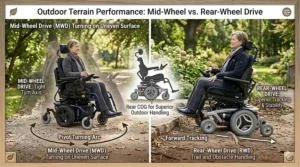
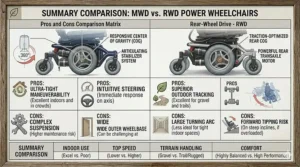
If you spend most of your day navigating a home, office, or shopping mall, mid wheel drive turns that world into something you can actually maneuver. If you’re regularly out on sidewalks, uneven paths, or genuinely rough ground, rear wheel drive offers a stability and straight-line confidence that mid wheel simply can’t replicate.
This guide cuts through the noise. We’ve researched 7 real, currently available power wheelchairs on Amazon, dug into the engineering behind each drive system, and translated all of it into plain advice you can actually use. Whether you’re shopping for yourself, a parent, or a patient — by the end of this article, you’ll know exactly which drive type belongs in your life.
Quick Comparison: Mid Wheel Drive vs Rear Wheel Drive at a Glance
| Feature | Mid Wheel Drive | Rear Wheel Drive |
|---|---|---|
| Turning Radius | Very tight (17″–24″) | Moderate (24″–30″+) |
| Stability | 6-wheel system — very stable | 4-wheel system — stable forward |
| Best Environment | Indoors, tight spaces | Outdoors, open terrain |
| Learning Curve | Short — intuitive | Moderate — “late turn” learning |
| Obstacle Climbing | Good with suspension | Excellent — rear wheels push over |
| Straight-Line Tracking | Moderate | Excellent — natural directional stability |
| Typical User | Home, office, community | Outdoor-focused, active terrain users |
| Price Range | $1,800 – $4,200+ | $2,600 – $3,700+ |
| Best For | Daily indoor independence | Outdoor confidence and speed |
The table above tells a clean story, but real life is always messier than a spreadsheet. What jumps out immediately: mid wheel drive chairs offer a significantly tighter turning radius — often half that of rear wheel drive models. That metric matters enormously in an average American home, where hallways average 36 inches wide and kitchens can feel like obstacle courses. On the other hand, rear wheel drive chairs carry a directional stability advantage that’s genuinely irreplaceable on uneven ground; the rear pivot point means the chair naturally wants to go straight, which translates to less corrective steering and a more relaxed ride outdoors.
💬 Just one click — help others make better buying decisions too! 😊
Top 7 Power Wheelchairs: Expert Analysis
🏆 1. Pride Mobility Jazzy 600 ES — The Mid Wheel Drive Gold Standard
The Pride Mobility Jazzy 600 ES is, without exaggeration, one of the most refined mid wheel drive power chairs you can buy on Amazon right now. Pride’s patented Mid-Wheel 6 technology places six wheels in constant contact with the ground — two 14″ drive wheels in the center, two 6″ OMNI-casters at the front, two at the rear — and pairs that six-wheel system with Active-Trac ATX Suspension that independently raises and lowers front casters to compensate for terrain changes in real time.
The turning radius clocks in at 20.5 inches. To appreciate what that means in practice: most standard doorways in American homes are 32–36 inches wide. The Jazzy 600 ES can execute a full U-turn inside a single doorway with room to spare. The 14″ drive wheels and ATX suspension make curb transitions smooth enough that users consistently report the chair “just handles it” without the nose-dropping lurch you get from lesser mid-drive designs.
With a 300-lb weight capacity and a maximum speed of 4 mph — paired with a 24.8-mile range per charge on the Group 2 version — this chair genuinely handles a full day’s independence. The spec sheet says “versatile indoor and outdoor performance,” and for once, that’s not just marketing copy.
Who is this for? Anyone who splits time between a home environment and regular community outings — grocery stores, doctors’ offices, indoor venues. The Jazzy 600 ES is the chair for people who don’t want to compromise between indoor agility and outdoor competence. It’s a premium purchase, but the 5-year frame warranty and 3-year parts coverage make it a long-term investment.
Customer feedback summary: Buyers repeatedly praise the smoothness of terrain transitions and the confidence it gives navigating tight home layouts. The suspension system earns particular appreciation from users who previously had chairs that “bumped hard on every threshold.”
✅ Patented 6-wheel ATX Suspension system
✅ 20.5″ turning radius — exceptional for mid-size chairs
✅ 24.8-mile range per charge on Group 2 version
❌ Significant freight weight — delivery logistics require planning
❌ 300-lb weight capacity won’t suit bariatric users
Price range: Around $3,500–$3,900
🥈 2. Golden Technologies Compass Sport GP605 — Mid Wheel Precision Meets Smart Technology
The Golden Technologies Compass Sport GP605 takes mid wheel drive performance and layers in technology that most chairs in its price range don’t even attempt. The Dynamic LiNX controller — a genuine differentiator — uses Dynamic Load Compensation to continuously read driving conditions (hill grade, rider weight, terrain surface) and automatically adjust motor output. Translation: the chair drives consistently whether you weigh 150 lbs or 300 lbs, whether you’re on flat tile or a gentle outdoor grade. Other chairs make you feel every variable. This one absorbs them.
The GP605’s patented springless articulating chassis keeps all six wheels grounded across uneven terrain without relying on traditional spring suspension. This matters because spring systems wear down and occasionally fail in ways that are difficult and expensive to diagnose. The springless design is mechanically simpler and more predictable over a multi-year ownership period.
A 19.5-inch turning radius (some configurations achieve 24″) and a range of up to 24 miles on standard batteries — expandable to 34 miles with optional 50Ah batteries — make this a legitimately all-day chair. Seat widths span 16″ through 22″, covering a wide range of users.
The Compass Sport is ideal for someone who wants intelligent, self-adjusting mobility without the rehab-complexity of a clinical chair. It drives naturally. It adapts quietly. New users pick it up fast.
Customer feedback summary: Users highlight the “drive-it-and-forget-it” feel the Dynamic LiNX controller creates, with several noting it handles inclines they expected to struggle with.
✅ Dynamic LiNX Load Compensation Technology
✅ Springless articulating chassis — simpler, more durable
✅ Up to 34-mile range with 50Ah battery option
❌ Freight delivery only — not suited for quick returns
❌ Limited to 300-lb weight capacity
Price range: Around $2,500–$3,000
🥉 3. Drive Medical Image EC — Mid Wheel Drive for the Adaptable User
The Drive Medical Image EC earns its place on this list by doing something many chairs at its price point fail at: genuine configurability without a clinical prescription. Almost every dimension on this chair adjusts — reclining backrest with adjustable headrest, flip-up height- and width-adjustable armrests, seat height, and a joystick controller that can be mounted to either armrest for left- or right-hand operation.
That joystick placement flexibility is more valuable than it sounds. For users with limited dexterity on one side — whether from stroke, cerebral palsy, injury, or aging — the ability to operate from either side without additional customization keeps costs down and delivery timelines short.
The mid wheel drive on this model provides a turning radius that makes tight indoor navigation manageable, and the slim frame design helps in narrow spaces. The interchangeable red and blue body panels are a small touch, but a meaningful one — mobility aids are part of daily identity, and choice matters.
This chair represents excellent value for users who need a reliable, adaptable mid wheel drive solution without committing to a full clinical power chair budget. The trade-off is a shorter range and less sophisticated suspension compared to the Jazzy 600 ES or GP605.
Customer feedback summary: Reviewers appreciate the easy customization and note the chair fits well in standard home environments. Some flag the range as a limitation for full-day outdoor use.
✅ Joystick configurable to either armrest
✅ Extensive adjustability without requiring clinical setup
✅ Interchangeable color panels for personal style
❌ Shorter range — better suited for home and community use than all-day outdoor outings
❌ Less sophisticated suspension than premium mid-drive models
Price range: Around $1,800–$2,200
4. Pride Mobility Jazzy EVO 614 — Mid Wheel Drive Meets Modern Design
The Pride Mobility Jazzy EVO 614 represents Pride’s most current thinking on what a mid wheel drive power chair should look like. The two-motor in-line mid wheel drive configuration delivers a turning radius tight enough for the narrowest home environments, while the Memory Foam seat — a feature you genuinely don’t expect at this tier — elevates daily comfort to a level that rivals chairs costing significantly more.
The 21-mile range per charge (on a single charge cycle) and a 300-lb weight capacity make this a practical full-day chair. Pride’s in-line motor technology ensures both drive wheels respond in precise coordination, reducing the slight drift that can appear in cheaper dual-motor systems during turning.
What separates the EVO 614 from earlier Jazzy generations is the seating: the memory foam comfort seat actively distributes pressure over time, which matters enormously for anyone spending 6–10 hours a day in the chair. Pressure sores are not a comfort inconvenience — they’re a medical complication. Memory foam seating at this price point is a legitimate health upgrade.
The EVO 614 is best suited for daily indoor-outdoor users who want contemporary aesthetics and comfort alongside mid wheel performance. It’s a chair you won’t resent after six months of use.
Customer feedback summary: Strong reviews around comfort and the premium feel of the seat. Users note it handles home environments with confidence.
✅ Memory foam comfort seat — genuine health benefit for all-day users
✅ In-line mid wheel drive for precise turn coordination
✅ 21-mile range, 300-lb capacity
❌ Premium pricing — this is a considered investment
❌ Freight delivery logistics apply
Price range: Around $3,500–$4,200
5. Shoprider Streamer Sport 888WA — Rear Wheel Drive That Delivers What It Promises
The Shoprider Streamer Sport 888WA is the rear wheel drive answer to users who want a mid-size chair with genuine outdoor composure and a turning radius that won’t embarrass you indoors. Shoprider’s rear-wheel drive axle with 10″ solid no-flat rear tires delivers the directional stability that RWD is known for — point this chair toward a destination outdoors and it goes there without the constant micro-corrections that some mid-drive chairs require on open terrain.
A turning radius of 25.5″ is moderate for its class, and the 3-inch ground clearance allows comfortable navigation over most threshold and terrain transitions. The 19-inch captain’s seat, height- and width-adjustable armrests, and three footplate options give users a solid foundation of customizable fit. Top speed reaches 5 mph — slightly faster than many competitors — which matters for users covering longer distances in community settings.
The 10-mile battery range is the one genuine limitation here. This is a daily home-and-community chair, not an all-day adventure vehicle. But for the user who primarily navigates outdoor sidewalks, visits neighbors, or goes grocery shopping, the Streamer Sport’s rear-wheel stability makes every outdoor errand feel controlled and predictable.
Customer feedback summary: Users describe it as “comfortable and easy to steer” with multiple reviews highlighting satisfaction for regular home-and-community use. The 5 mph speed earns consistent praise.
✅ Rear-wheel stability excellent for outdoor pavement and sidewalks
✅ 5 mph top speed — faster than most in class
✅ Adjustable captain’s seat and armrests for customizable fit
❌ 10-mile range limits all-day outings
❌ 25.5″ turning radius means extra care in tighter indoor environments
Price range: Around $2,600–$3,100
6. Merits P301 Gemini — Heavy-Duty Rear Wheel Drive for Demanding Users
The Merits P301 Gemini is rear wheel drive power chair engineering taken seriously. Built for users requiring a 450-lb weight capacity — dropping to 350 lbs with the optional power seat lift — this is a chair that doesn’t ask you to compromise on strength, range, or features because your needs fall outside the standard envelope.
The dual 50Ah batteries deliver a 20-mile range per charge, and the 14-inch aluminum cast drive wheels provide the kind of outdoor stability that makes Merits a consistently respected name in the heavy-duty mobility market. The top speed of 5 mph combined with a 22″x22″ captain’s seat that swivels, tilts, and folds reflects a level of engineering thoughtfulness that justifies the price.
The power seat lift — which raises the seat 10 inches — deserves specific mention. For users who struggle with reaching higher shelves, interacting at standing conversation height, or crossing a busy intersection where visibility matters (research indicates elevated seating measurably improves intersection safety), a seat lift is a functional advantage, not a luxury. Merits has been building this category for over 30 years, and the Gemini represents that accumulated experience.
The rear wheel drive configuration on this model excels on sidewalks, outdoor concrete, and moderate terrain — exactly where a 450-lb-capacity chair is most likely to be used. Heavy-duty users navigating the real world deserve that outdoor confidence.
Customer feedback summary: Buyers consistently commend the build quality and durability. The swivel seat earns strong feedback for transfer ease.
✅ 450-lb weight capacity — one of the highest in class
✅ Dual 50Ah batteries, 20-mile range
✅ Optional power seat lift — 10-inch elevation
❌ Heavier overall weight affects transport logistics
❌ RWD turning radius requires wider indoor turning space
Price range: Around $3,200–$3,700
7. Rubicon DX14 — Rear Wheel Drive for the Traveler
The Rubicon DX14 is the answer to a specific and underserved question: what if I need a power wheelchair that genuinely works outdoors and folds down small enough to fit in an SUV or an airplane overhead compartment? Most full-size power chairs make travel a logistical ordeal. The Rubicon DX14 doesn’t.
Dual 2x300W motors and dual 12Ah lithium batteries power a 30-mile maximum range — the longest range in this price segment, by a meaningful margin. The rear-wheel drive configuration keeps the chair stable on outdoor surfaces, sidewalks, and mild terrain, while the foldable frame and airline-approved design make it genuinely portable. The leather cushion is a practical upgrade from the foam found on travel competitors.
The spec sheet says 30 miles, but real-world range on lithium travel chairs varies considerably with rider weight and terrain. Expect 20–25 miles in typical mixed-surface daily use. Still impressive for a folding chair in this price range. What you trade away compared to a full-size mid-drive chair is the tight turning radius — this is a “get out and go” chair rather than a “navigate my small apartment” chair.
Best suited for active users who are out and about regularly, travel by vehicle or air, and value range and portability over extreme indoor agility.
Customer feedback summary: Reviewers highlight the impressive range and the travel convenience. Consistent praise for the airline-friendly design.
✅ 30-mile range — best in class for folding rear-drive chairs
✅ Airline approved, foldable for SUV/vehicle transport
✅ Dual 300W motors provide genuine outdoor push
❌ Folding compromise means less rigid feel than full-size chairs
❌ Rear-wheel drive turning radius requires planning in tight spaces
Price range: Around $900–$1,100
Top 7 Products Specifications at a Glance
| Model | Drive Type | Turning Radius | Range | Capacity | Best For |
|---|---|---|---|---|---|
| Jazzy 600 ES | Mid Wheel | 20.5″ | 24.8 mi | 300 lbs | Indoor/outdoor all-rounder |
| GP605 Compass Sport | Mid Wheel | 19.5″–24″ | 24–34 mi | 300 lbs | Smart terrain adaptation |
| Drive Medical Image EC | Mid Wheel | Tight | 10–12 mi | 300 lbs | Adjustable daily use |
| Jazzy EVO 614 | Mid Wheel | Tight | 21 mi | 300 lbs | Comfort-focused daily |
| Streamer Sport 888WA | Rear Wheel | 25.5″ | 10 mi | 300 lbs | Outdoor community use |
| Merits P301 Gemini | Rear Wheel | Moderate | 20 mi | 450 lbs | Heavy-duty outdoor |
| Rubicon DX14 | Rear Wheel | Moderate | 30 mi | 300 lbs | Travel and portability |
Looking at the table, the pattern is clear: mid wheel drive chairs dominate in turning radius — three of the four MWD models achieve turning circles under 22 inches, which is simply not achievable with rear wheel configurations. Where RWD pulls ahead is in range and — critically for the Merits P301 — weight capacity. The Rubicon DX14’s 30-mile range stands alone in its category. Budget shoppers should note that the Drive Medical Image EC offers mid wheel agility at the lowest entry point in this group.
✨ Don’t Miss These Exclusive Deals!
🔍 Take Your Mobility to the Next Level
Click on any highlighted product to check current pricing and availability. These carefully selected power chairs represent the best of both drive configurations — whether you need tight indoor turning or confident outdoor performance.
How to Actually Choose: A Practical Decision Framework
The mid wheel drive vs rear wheel drive comparison becomes much simpler when you stop asking “which is better?” and start asking “better for what?”
If you answer yes to three or more of these, choose mid wheel drive:
- You spend most of your day inside a home, office, or shopping center
- Your hallways are narrower than 40 inches
- You are a new power chair user — MWD’s intuitive turning (your body stays centered over the drive wheels) means the chair moves where you think it should go
- You regularly navigate thresholds, minor curbs, or uneven indoor flooring
- You value a short learning curve over anything else
If you answer yes to three or more of these, choose rear wheel drive:
- You spend significant time outdoors on sidewalks, pavement, or mild terrain
- Straight-line stability matters more than tight turns
- You have experience with power chairs and understand the “turn late” technique RWD requires
- Your home is relatively spacious with wide doorways and corridors
- You need bariatric capacity (400–450+ lbs) — RWD options dominate this segment
The overlooked middle ground: If you truly split time evenly between demanding indoor navigation and regular outdoor use, seriously consider a mid wheel drive chair with robust suspension — the Jazzy 600 ES with its ATX system or the GP605 with its springless articulating chassis. Modern suspension engineering has largely closed the gap between mid wheel outdoor performance and rear wheel drive, while MWD’s turning radius advantage remains unchanged. According to Quantum Rehab’s clinical resources, mid wheel drive is currently the most commonly prescribed drive configuration precisely because it balances competing demands more effectively than either alternative.
Real-World Scenarios: Who Should Buy What
Three users. Three very different lives. One decision.
Scenario 1 — Margaret, 74, suburban home-dweller. Margaret has mild to moderate mobility limitations following a hip replacement. She navigates a 1,980-square-foot ranch house with standard doorways, a small bathroom, and a kitchen that requires precise positioning to reach the counter and stove. She occasionally joins her daughter for shopping trips.
Best match: Pride Mobility Jazzy 600 ES or Drive Medical Image EC. The 20.5-inch turning radius on the Jazzy 600 ES is built for exactly Margaret’s kitchen scenario. The Drive Medical Image EC is the better option if budget is a primary consideration and range requirements are modest. Either mid wheel drive choice will let Margaret move independently through her home without the furniture casualties that larger-radius chairs tend to leave behind.
Scenario 2 — David, 52, active outdoor user. David has a spinal cord injury and is an experienced power chair user. He lives in a neighborhood with wide sidewalks and regularly uses his chair for half-mile or longer community outings. His home is a modern open-concept layout with 38″+ doorways.
Best match: Merits P301 Gemini or Shoprider Streamer Sport 888WA. David’s outdoor time and experienced driving style suit rear wheel drive perfectly. The directional stability means less fatigue over longer outings. Given his activity level, the Merits P301’s superior range and build quality justify the investment.
Scenario 3 — Elena, 38, frequent traveler with limited mobility. Elena works part-time, travels for family events several times per year, and needs a chair that fits in her compact SUV and meets airline requirements. Her daily environment mixes office hallways with outdoor sidewalks.
Best match: Rubicon DX14. The 30-mile range, airline approval, and folding design are purpose-built for Elena’s lifestyle. She trades some indoor agility for genuine portability — and for her, that’s the right trade.
Common Mistakes When Buying a Power Wheelchair
The power wheelchair market is full of expensive regrets. Here are the ones worth avoiding:
Buying for specs instead of environments. A chair with impressive range numbers is useless if it can’t fit through your bathroom doorway. Always measure your three narrowest navigational chokepoints — hallways, bathroom doorways, kitchen passages — before comparing turning radii. According to ADA accessibility standards maintained by the U.S. Access Board, accessible doorways require at least 32 inches of clear width. Many older American homes fall short of this.
Underestimating terrain reality. Mid wheel drive gets sold hard as the “best all-around” option, and in most cases it is — but caster wheels (especially smaller ones) can genuinely get stuck on rough outdoor surfaces, gravel, or soft ground. If your yard or neighborhood has legitimately rough terrain, don’t let a smooth showroom floor demo set false expectations. Test on terrain that resembles your actual life.
Ignoring total weight and transport logistics. Full-size power chairs weigh 100–200+ lbs assembled. If you plan to transport your chair in a vehicle, the heaviest single piece must be liftable by whoever loads it. Some chairs disassemble into manageable components; others require vehicle lifts or ramps. Plan this before you buy, not after delivery.
Overlooking the joystick and controller. The joystick is your primary interface for every single moment in the chair. A controller that doesn’t match your hand strength, dexterity, or dominant side will make the chair exhausting to use. Most quality chairs allow alternative input devices — mini joysticks, head controls, sip-and-puff systems — but confirm availability and cost before purchase. Per FDA guidance on Class II Medical Devices, powered wheelchairs are regulated medical devices, and controller compatibility is part of the clinical assessment process.
Skipping the clinical evaluation. This one is counterintuitive coming from an online buying guide: for complex power wheelchairs, working with an occupational therapist and an Assistive Technology Professional (ATP) isn’t bureaucracy — it’s how you get a chair correctly configured for your specific posture, range of motion, and daily function. Medicare and most insurance plans require this evaluation anyway for coverage. Use it. The seating assessment alone can prevent pressure injuries that are significantly more expensive than any chair.
What the Spec Sheet Won’t Tell You: Real-World Performance Differences
Specs are clean. Reality is messier. Here’s what you actually need to know.
Turning radius numbers assume a flat, smooth surface. A 20.5″ turning radius on paper becomes something closer to 24–26″ on a thick area rug or slightly uneven flooring. Mid wheel drive chairs with smaller rear casters are particularly sensitive to surface texture — softer or uneven floors can cause the rear casters to drag, effectively widening your turning circle. If your home has thick carpet, test before you commit.
Rear wheel drive chairs take learning. The physics of RWD requires users to “turn late” — meaning you initiate the turn before you reach the corner, because the back of the chair swings outward. Research from Permobil’s clinical education team notes this is the primary reason RWD has a steeper learning curve, particularly for users with cognitive or perceptual challenges. For new power chair users, this isn’t a reason to avoid RWD — it’s a reason to factor in training time.
Mid wheel drive “bumpiness” is a suspension question, not a drive system flaw. A common complaint about MWD chairs is that users feel obstacles three times — once when the front casters hit, once when the drive wheels hit, and once when the rear casters hit. This is physics, not defective engineering. The answer is suspension quality. The ATX suspension on the Jazzy 600 ES and the springless articulating chassis on the GP605 were specifically designed to absorb this tripled bump transmission. Budget mid-drive chairs without suspension investment will feel noticeably rougher on outdoor terrain. You get what you pay for here.
Range specs are ideal-condition numbers. A chair rated for 24 miles will cover meaningfully less distance at maximum weight capacity, on sloped terrain, in cold weather (which reduces battery efficiency), or at higher speeds. For planning purposes, discount published range specs by 20–30% when estimating real-world daily range.
Long-Term Costs and Maintenance: The Numbers Nobody Mentions at Point of Sale
The purchase price is the beginning of the cost conversation, not the end.
Batteries are a recurring expense. Standard sealed lead acid (SLA) batteries in most power wheelchairs need replacement every 1–2 years under regular use, typically running $150–$400 for a pair depending on capacity. Lithium batteries (as in the Rubicon DX14) last longer and perform better in cold temperatures but cost more upfront. Over a 5-year ownership period, budget $300–$800 in battery replacement regardless of drive type.
Caster wheels wear out faster on MWD chairs. Mid wheel drive chairs have four casters versus RWD’s two front casters. More casters means more maintenance touchpoints. Caster bearings and tires on MWD chairs need inspection every 6–12 months. Replacement cost per caster is typically $20–$80 depending on model. Not budget-breaking, but a real cost of the six-wheel system.
Rear wheel drive tires handle outdoor wear better. The larger 10″–14″ rear drive wheels on RWD chairs distribute outdoor terrain stress over more surface area. For users who regularly navigate rough sidewalks or concrete, RWD tire wear tends to be slower and more predictable than MWD drive wheels doing double duty as obstacle climbers.
Service access matters more than most buyers realize. Before purchasing any power chair, confirm that your geographic area has an authorized service center for that brand. A gorgeous chair with no local service option means waiting weeks or months for repairs — and during that time, you’re without mobility. Brands like Pride Mobility, Golden Technologies, and Merits have extensive dealer networks in the US; lesser-known brands may not. Manufacturer warranty terms registered with the FDA vary significantly, and in-home service (where a technician comes to you) is worth the premium for users who can’t easily transport a 150+ lb power chair.
FAQ
❓ What is the main difference between mid wheel drive and rear wheel drive power wheelchairs?
❓ Which power wheelchair drive type is better for indoor use?
❓ Is mid wheel drive or rear wheel drive more stable on outdoor terrain?
❓ Can mid wheel drive power wheelchairs go up curbs and inclines?
❓ Do insurance or Medicare cover mid wheel or rear wheel drive power wheelchairs?
Conclusion: The Drive System That Changes Everything
After all the spec-diving and scenario-mapping, the mid wheel drive vs rear wheel drive comparison comes down to a single honest question: where do you actually live your life?
If that answer involves a kitchen, a bedroom, a small office, or any space where turning around means negotiating reality — mid wheel drive is your answer. The intuitive control, the tight turning radius, and the six-wheel stability system were engineered for exactly those constraints. The Pride Jazzy 600 ES remains the best overall choice in this category, with the GP605 Compass Sport as a strong alternative for users who want intelligent terrain adaptation and the Drive Medical Image EC for those who need configuration flexibility at a lower price point.
If your answer involves long sidewalk stretches, outdoor terrain, or daily trips into the community where straight-line stability and confidence matter more than spinning tight circles — rear wheel drive deserves serious consideration. The Shoprider Streamer Sport 888WA delivers that outdoor composure at a practical price, the Merits P301 Gemini brings it to the bariatric segment, and the Rubicon DX14 offers it in a package that fits in an airplane.
One final thought: consult a mobility professional before making a final decision. This guide gives you the knowledge to have an intelligent conversation — but an occupational therapist or ATP will assess your specific posture, strength, range of motion, and daily environments in ways no article can replicate. Use this as preparation, not a substitute.
Your independence is worth getting exactly right.
✨ Don’t Miss These Exclusive Deals!
🔍 Ready to find the right power chair for your life? Click any product link in this article to check current pricing and availability. Comparing a few models side-by-side takes minutes — and getting the right drive system is a decision you’ll live with every single day.
Recommended for You
- 7 Best Mid Wheel Drive Power Wheelchairs of 2026
- Front Wheel Drive Wheelchair Pros and Cons: 7 Best Picks 2026
- 7 Best Front Wheel Drive Wheelchairs for Rough Terrain in 2026
Disclaimer: This article contains affiliate links. As an Amazon Associate, I earn from qualifying purchases. If you purchase products through these links, we may earn a small commission at no additional cost to you.
✨ Found this helpful? Share it with your friends! 💬🤗
