In This Article
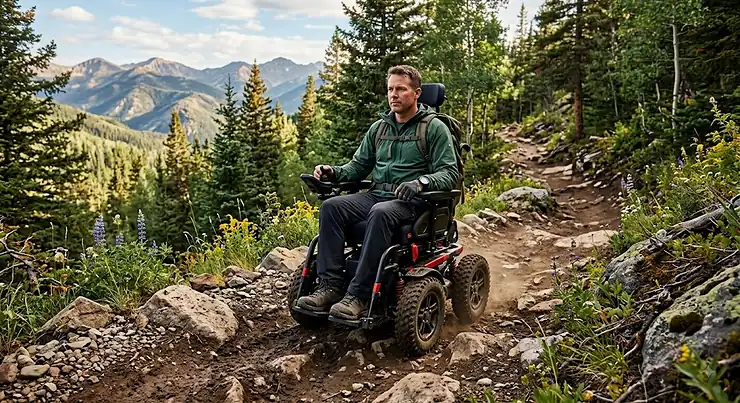
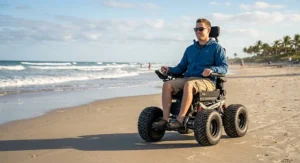
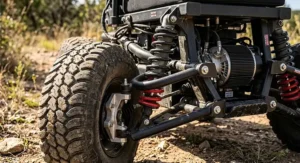
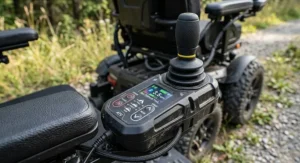
A regular power wheelchair is basically a city car. It’s happy on smooth pavement, hospital tile, and the flat aisle of a grocery store, and it will absolutely sulk the moment you point it at a gravel driveway. An all terrain power wheelchair is the pickup truck version — bigger tires, tougher motors, more ground clearance, and a suspension system that doesn’t flinch at a curb cut gone wrong. What is an all terrain power wheelchair, exactly? It’s a motorized mobility device built with reinforced motors, pneumatic or knobby non-flat tires, raised ground clearance, and often dual batteries, so it can cross grass, gravel, sand, and uneven sidewalks without stalling out or tipping.
That distinction matters more than most buying guides admit, especially given how common mobility disability actually is — mobility is the single most prevalent disability type among U.S. adults, according to CDC data, so getting this decision right affects a genuinely large number of people. The gap between a chair that “says” outdoor on the box and one that actually holds its line on a rutted trail comes down to a handful of measurable things: motor wattage, incline rating, tire type, and ground clearance. We dug through manufacturer spec sheets, retailer listings, and posted owner testimonials to figure out which models genuinely deliver, and which ones are really indoor chairs wearing a rugged paint job.
Here’s what to weigh before we get into individual reviews: this guide covers how the ADA defines wheelchairs and other power-driven mobility devices, which shapes where you’re legally entitled to take one of these chairs. We’ll also walk through seven real, currently available models spanning budget to premium, a full spec comparison, and practical guidance on choosing based on your terrain, your body size, and your budget. Whether you’re chasing grandkids across a park lawn or navigating a gravel driveway every single day, there’s a chair on this list built for it.
Quick Comparison Table
Before the deep dives, here’s the short version. This table pulls the numbers that actually predict outdoor performance — motor power, range, and who each chair suits best — so you can narrow things down in under a minute.
| Model | Motor Power | Weight Capacity | Best For |
|---|---|---|---|
| Forcemech Navigator Pro | Single high-torque motor | 400 lbs | Lightest all-terrain pick for daily errands |
| WHILL Model F | Single brushless motor | 250 lbs | Smoothest ride on mild outdoor paths |
| Porto Mobility Ranger Quattro XL | Dual 300W brushless | 400 lbs | Longest range for all-day outings |
| Forcemech Navigator XL | Dual 250W brushless | 400 lbs | Widest seat in the lightweight class |
| Porto Mobility Ranger Magnum Ultra | Dual 350W brushless | 660 lbs | Highest weight capacity on this list |
| Golden Technologies Compass HD | Center-wheel drive | 450 lbs | Tightest turning radius for tricky trails |
| Shoprider 6Runner 14 | Dual 1.34 hp | 450 lbs | Most stable six-point ground contact |
Looking at this lineup, there’s a clear split between lightweight folding chairs built for portability (the Forcemech Navigator Pro, WHILL Model F, Forcemech Navigator XL, and Porto Mobility Ranger Quattro XL) and heavier-duty rigid-frame chairs built for stability and higher capacity (the Porto Mobility Ranger Magnum Ultra, Golden Technologies Compass HD, and Shoprider 6Runner 14). If you need to fold a chair into a trunk every week, the first group wins; if you’re covering rough ground daily and want maximum ground contact and payload, the second group is worth the added bulk. Neither category is “better” outright — it’s a direct trade-off between portability and raw ruggedness.
💬 Already have a favorite? Scroll down to its full review — or keep reading for the breakdown that actually explains why these seven made the cut.😊
Top 7 All Terrain Power Wheelchairs: Expert Analysis
We evaluated dozens of listings before narrowing this down to seven chairs that combine verifiable specs, real availability, and a genuine claim to outdoor capability. Each one below gets the full treatment: what the numbers mean in practice, who it fits, and where it falls short.
1. Forcemech Navigator Pro — lightest all-terrain pick for daily errands
The 2026 Forcemech Navigator Pro leans hard into the “grab it and go” use case, and the standout feature is how little it asks of you before you’re moving. At around 60 pounds and rated for 400 pounds of user weight, it folds down small enough to roll into a sedan trunk like a piece of carry-on luggage. The traction-tuned all-terrain tires and single high-torque brushless motor are built to cross grass, ramps, sand, and light mud, with a stated range of up to 18 miles on a charge — enough for a full day of errands and a park loop without a mid-trip recharge. Based on the spec comparison with other folding chairs in this price bracket, the Forcemech Navigator Pro punches above its weight class specifically because Forcemech tuned the tires for mixed surfaces rather than just adding bigger wheels. It’s the right call for someone who needs one chair that handles sidewalks Monday through Friday and a backyard barbecue on Saturday, but who isn’t tackling steep, sustained hills. Owner testimonials on retailer and manufacturer pages frequently mention long-term reliability across many flights and trips, with the fold-and-travel routine holding up well over repeated use — though, as with any aggregated feedback, individual results vary by terrain and body weight.
Pros:
- ✅ Folds to airline-carry-on size at roughly 60 lbs
- ✅ Traction tires rated for grass, sand, and ramps
- ✅ Backed by a 5-year frame warranty
Cons:
- ❌ 18-mile range trails the dual-battery competitors here
- ❌ Single motor gives less climbing torque than dual-motor rivals
At around $2,700-$2,900 at the time of research, the Forcemech Navigator Pro earns its price as the best value entry point into genuine all-terrain capability — check current price before buying, since promotional pricing shifts often.

2. WHILL Model F — smoothest ride on mild outdoor paths
The WHILL Model F takes a different approach: instead of maximizing rough-terrain brawn, it optimizes for polish, and the standout feature is its 10-degree maximum incline rating paired with an IPX4 water-resistant build, which is unusually high for a chair this light. At 52.9 pounds without the battery, it’s the lightest chair on this list, and it can climb over obstacles up to 1.4 inches tall — enough for most curb cuts and door thresholds. What most buyers overlook about this model is that WHILL itself positions the Model F as best suited to flat or mildly uneven terrain like sidewalks, malls, and office floors, not backcountry trails, and the 250-pound weight capacity and 12.4-mile range reflect that focus rather than a flaw. This is a chair for someone whose “outdoor” mostly means paved paths, campus walkways, and the occasional grass crossing, and who values elegant fold-up portability and app-based smart features over raw torque. A retailer listing for this model reports a 4.6 out of 5 average across 279 customer reviews, with owners consistently citing the fold mechanism and ride smoothness as the standouts — reviewers do flag that the compact tires transmit more feedback on genuinely rough gravel than the heavier-duty options on this list.
Pros:
- ✅ Lightest chair here at 52.9 lbs without battery
- ✅ IPX4 water resistance handles light rain confidently
- ✅ FDA 510(k)-cleared Class II medical device
Cons:
- ❌ Lowest weight capacity on this list at 250 lbs
- ❌ Manufacturer itself recommends mild terrain, not rough trails
Priced around $2,400-$2,600, the WHILL Model F is the pick for buyers prioritizing portability and polish over hardcore off-road capability — check current price for the latest availability.
3. Porto Mobility Ranger Quattro XL — longest range for all-day outings
The Porto Mobility Ranger Quattro XL is built around endurance, and its standout feature is a genuinely long stated range fed by dual lithium batteries working alongside two 300-watt brushless motors for 600 watts of combined output. Porto Mobility markets a driving range of up to 30 miles per charge, which — even accounting for the real-world dip that battery-powered mobility devices typically see under load — should comfortably outlast most single-day outings. The 21.5-inch seat width between armrests is marketed as the widest folding seat in its category, and the intelligent electromagnetic regenerative brake adds a layer of control on downhill grades that budget chairs often skip. Here’s what to weigh: this chair effortlessly handles curbs, grass, and rough surfaces according to the manufacturer, and the shock-absorbing frame design backs that up on paper, but reviewers on Porto Mobility’s own testimonial page describe successfully tackling steep hills and dirt trails in Colorado, which suggests the climbing performance holds up outside the spec sheet too. The freewheel neutral mode is a genuinely useful touch for caregivers who occasionally need to push the chair manually.
Pros:
- ✅ Up to 30-mile range from dual lithium batteries
- ✅ Widest folding seat in its category at 21.5 inches
- ✅ Regenerative electromagnetic braking for controlled descents
Cons:
- ❌ Heavier and bulkier to fold than the Navigator Pro
- ❌ Premium range comes at a premium price point
At roughly $2,900-$3,400 depending on configuration, the Porto Mobility Ranger Quattro XL is the strongest choice for anyone whose outdoor days run long and unpredictable.
4. Forcemech Navigator XL — widest seat in the lightweight class
Built on the same frame as the standard Navigator, the Forcemech Navigator XL‘s standout feature is a 19-inch-wide by 17-inch-deep seat that Forcemech markets as the largest seating area among comparable lightweight folding chairs. Dual 250-watt Eco-Twin-Drive brushless motors and front honeycomb shock-damping non-flat tires mean you get redundant power and puncture-proof tires in the same package — a combination that matters if you’re crossing gravel lots where a pneumatic tire could catch a sharp edge. Reviewers consistently note that assembly is essentially nonexistent: you attach the joystick controller and go, which lowers the barrier for anyone setting this up without help. What the spec sheet won’t tell you, but the frame geometry suggests, is that the wider seat comes with a small trade-off in tight-space maneuverability compared to the standard Navigator — worth testing in your own hallways and doorframes before committing. With a climbing slope rating up to 12 degrees and a 5 mph top speed, it’s built for a rider who needs more seat real estate without stepping up to a heavy-duty bariatric frame.
Pros:
- ✅ 19-inch seat width, largest in its lightweight class
- ✅ Dual 250W motors add climbing redundancy
- ✅ Puncture-proof honeycomb tires need zero maintenance
Cons:
- ❌ Wider footprint can feel tight in narrow hallways
- ❌ Two motors draw down the battery faster than single-motor rivals
Expect to pay in the $3,000-$3,600 range for the Forcemech Navigator XL, positioning it as a mid-tier step up from the standard Navigator Pro.
5. Porto Mobility Ranger Magnum Ultra — highest weight capacity on this list
If raw payload is the deciding factor, the Porto Mobility Ranger Magnum Ultra‘s standout feature is a 660-pound weight capacity — nearly 50% higher than every other chair reviewed here. Dual 350-watt motors and a reinforced aluminum alloy frame that weighs just 89 pounds without batteries deliver an unusual ratio of strength to portability for a bariatric-capable chair, and it still folds for transport. The spec sheet lists an 8-degree climbing rating and a 20-mile range, numbers that land solidly mid-pack rather than class-leading, and that’s the honest trade-off: Porto Mobility built this chair to prioritize capacity and stability over climbing aggression or maximum range. Based on the spec comparison, that’s the right call for the audience this chair targets — heavier users who need dependable outdoor mobility without sacrificing structural headroom, rather than someone chasing the steepest possible incline rating. The 31.5-inch turning radius is tight enough for most indoor use despite the bigger frame, and UN38.3-certified batteries mean it’s cleared for standard airline transport.
Pros:
- ✅ 660-lb weight capacity, highest on this list
- ✅ Reinforced frame stays foldable at 89 lbs
- ✅ Airline-approved UN38.3-certified batteries
Cons:
- ❌ 8-degree climb rating is modest for a chair this rugged
- ❌ 20-mile range lags behind lighter dual-battery competitors
Priced around $3,300-$3,700, the Porto Mobility Ranger Magnum Ultra earns its place as the bariatric-capacity specialist on this list.

6. Golden Technologies Compass HD — tightest turning radius for tricky trails
The Golden Technologies Compass HD‘s standout feature is a remarkably tight 20-inch turning radius achieved through a center-wheel-drive platform and a springless articulating chassis — a combination that keeps the chair stable over uneven ground while still spinning nearly in place. That articulating chassis design is worth pausing on: what most buyers overlook about center-wheel-drive chairs is that they distribute weight across more contact points as the terrain shifts underneath them, which is exactly what keeps a narrow-wheelbase chair from rocking on a rutted path. With a 450-pound weight capacity, 3.5 inches of ground clearance, and a 12-mile range at up to 4 mph, the Compass HD is tuned for stability and control rather than outright speed or distance. Golden Technologies builds this on a full-size, non-folding platform, which trades portability for a sturdier ride — a fair swap for someone who keeps the chair in a van or garage rather than folding it weekly. It’s an FDA-cleared Class II device backed by a one-year in-home service plan, which matters more than it sounds like once you’re relying on a chair daily.
Pros:
- ✅ 20-inch turning radius despite full-size frame
- ✅ Articulating chassis improves stability on uneven ground
- ✅ One-year in-home service plan included
Cons:
- ❌ Non-folding design limits transport options
- ❌ 12-mile range is shortest among the full-size chairs here
At around $5,000-$5,300, the Golden Technologies Compass HD sits at the premium end, reflecting its established-brand engineering and service backing.
7. Shoprider 6Runner 14 — most stable six-point ground contact
The Shoprider 6Runner 14 closes out this list with its standout feature: six points of contact with the ground, split between a mid-wheel drive setup and a four-post seating system, which together deliver a noticeably steadier ride on broken pavement than a standard four-wheel layout. Reviewers consistently report that the full suspension system smooths out the kind of small bumps and transitions — sidewalk seams, driveway aprons — that jolt lighter chairs. With a 450-pound weight capacity, dual 12V 50Ah batteries rated for 16 to 17.5 miles per charge, and dual 1.34-horsepower motors run through a 60-amp programmable controller, this is a chair engineered for daily, heavy use rather than occasional outings. The 21-inch high-back reclining leatherette seat is a genuine comfort upgrade over the captain’s seats on lighter folding models, and Medicare classifies it under code K0825 for insurance documentation purposes, which simplifies the paperwork for buyers pursuing coverage. On paper this means slightly less portability — it’s a full 200-plus-pound unit, not a folder — in exchange for the most planted, stable ride in this lineup.
Pros:
- ✅ Six ground-contact points for exceptional stability
- ✅ Full suspension smooths sidewalk seams and bumps
- ✅ Medicare code K0825 simplifies insurance paperwork
Cons:
- ❌ Heaviest, least portable chair on this list
- ❌ Top speed of roughly 3.8 mph is the slowest here
At around $5,700-$5,900, the Shoprider 6Runner 14 is priced as a long-term daily-use investment rather than a casual outdoor accessory.
Practical Usage Guide: Getting the Most From Your All Terrain Power Wheelchair
Buying the right chair is half the job — setup and habits determine whether it actually delivers the rough surface capability its spec sheet promises. Start with tire pressure if your model uses pneumatic tires: underinflated tires soften the ride slightly but sacrifice climbing efficiency and battery range, while overinflated tires transmit more shock straight into the frame. Check pressure weekly during heavy outdoor use.
During the first 30 days, resist the urge to fully drain the battery before recharging. Lithium and sealed lead-acid packs both last longer with partial-cycle charging, and most manufacturers — including Forcemech and WHILL — recommend daily charging during the initial break-in period so the battery management system calibrates properly. A common first-month mistake is judging range capability from that break-in window; expect true range to stabilize (and often improve slightly) after two to three weeks of regular use.
For genuine rough surface capability, learn your chair’s climbing angle and treat it as a hard ceiling, not a suggestion — a 12-degree-rated chair on a 15-degree slope is a stability risk, not just an inconvenience. Keep joints and motor housings clear of mud and grass buildup after outdoor sessions; a soft brush and dry cloth after each ride prevents the kind of debris accumulation that eventually strains brushless motors. Finally, schedule a battery terminal and connector inspection every three months if you’re regularly crossing wet grass or puddles, since moisture intrusion is the most common preventable failure point in outdoor mobility equipment.
Real-World Scenarios: Versatile Outdoor Use in Action
Matching a chair to your actual routine matters more than chasing the single “best” spec sheet. Here’s how three different situations play out.
The daily park-and-errands rider. If you’re covering a mix of sidewalks, grocery store aisles, and a weekly walk through a local park with grass and gravel paths, a lightweight folding chair like the Forcemech Navigator Pro or Porto Mobility Ranger Quattro XL covers that versatile outdoor use without demanding a van or lift. The priority here is a chair light enough to fold into a car trunk on short notice, with enough range to not think twice about an unplanned extra stop.
The rural or acreage-based user. Gravel driveways, unpaved lanes, and uneven yard terrain call for something closer to the Shoprider 6Runner 14 or Golden Technologies Compass HD — full-suspension, higher ground clearance, and stability over portability. If you’re not folding the chair into a car regularly, there’s little reason to sacrifice the ride quality that a non-folding platform provides.
The higher-capacity outdoor user. For riders who need both bariatric-grade weight capacity and legitimate outdoor traction, the Porto Mobility Ranger Magnum Ultra threads that needle without forcing a choice between comfort and capability. Budget, frequency of outdoor use, and how often the chair needs to travel in a vehicle should drive the final call more than any single spec.
Problem → Solution: Common All Terrain Power Wheelchair Pain Points
Problem: Range drops faster outdoors than the spec sheet suggests. Grass, sand, and inclines all draw more current than flat pavement. Solution: budget for 60-70% of the advertised range on mixed terrain days, and consider a chair like the Porto Mobility Ranger Quattro XL with dual batteries if your routes regularly exceed 15 miles.
Problem: Tires puncture on gravel or debris. Pneumatic tires ride smoother but are vulnerable to sharp edges. Solution: chairs with honeycomb or solid non-flat tires, like the Forcemech Navigator XL, eliminate this failure mode entirely at a small comfort trade-off.
Problem: Chair struggles on grass or soft ground. Underpowered single motors can bog down. Solution: prioritize dual-motor chairs like the Porto Mobility Ranger Magnum Ultra or Forcemech Navigator XL, which distribute torque across two wheels for better traction in soft conditions.
Problem: Folding chairs feel unstable on rutted paths. Lighter frames built for portability sometimes sacrifice stability. Solution: for daily rough-terrain use, a full-suspension, non-folding platform like the Shoprider 6Runner 14 trades portability for a meaningfully steadier ride.
Problem: Doorways and hallways are tighter than expected. A wide outdoor-capable seat can become a liability indoors. Solution: check turning radius specifically — the Golden Technologies Compass HD‘s 20-inch radius handles both worlds better than most full-size alternatives.
How to Choose an All Terrain Power Wheelchair: Multi Terrain Mobility Criteria
Multi terrain mobility comes down to seven measurable factors, and weighing them in this order will save you from buying on marketing language alone.
- Motor wattage. Anything under 250 watts per motor struggles on sustained inclines or soft grass; dual motors above 300 watts each handle mixed terrain with more confidence.
- Tire type. Pneumatic tires absorb shock better but puncture; honeycomb or solid tires trade a firmer ride for zero maintenance.
- Ground clearance. Look for at least 2.5 to 3.5 inches to clear curb transitions and small rocks without dragging.
- Climbing angle. This is the hardest ceiling on the spec sheet — match it honestly to the steepest slope you actually encounter, with margin to spare.
- Range versus your real routes. Add 30-40% buffer to your typical daily distance to account for the higher current draw of outdoor terrain.
- Weight capacity. Include your own body weight plus any bags, cargo, or accessories you regularly carry.
- Portability needs. If the chair rarely leaves a single property, a heavier full-suspension platform outperforms a folding chair built for compromise.
Reviewers consistently note that buyers who prioritize just one or two of these criteria — usually price and weight capacity — end up disappointed by climbing performance or range in practice. Weighing all seven together, even briefly, tends to prevent that outcome.
All Terrain Power Wheelchair vs Standard Indoor Power Wheelchair
The difference isn’t cosmetic — it’s structural, and it shows up in every spec that matters outdoors.
| Feature | All Terrain Power Wheelchair | Standard Indoor Power Wheelchair |
|---|---|---|
| Tire type | Pneumatic or honeycomb, knobby tread | Small solid casters |
| Ground clearance | 2.5-3.5+ inches | Under 1.5 inches typically |
| Motor power | 250-350W per motor common | Often under 200W total |
| Climbing angle | 8-12 degrees typical | Rarely rated above 6 degrees |
| Best For | Grass, gravel, sand, uneven sidewalks | Smooth indoor flooring, tight hallways |
The gap here explains why a standard indoor chair that feels perfectly adequate at home can genuinely strand a rider on a gravel path or grassy lawn — it’s not underpowered by accident, it’s built for a completely different surface. Standard chairs also tend to have tighter turning radii and lighter overall builds, which is a real advantage indoors that all terrain models sometimes sacrifice. The honest takeaway: if your routine is 90% indoors with the occasional smooth sidewalk trip, an all terrain chair may be more capability than you need, and the added weight and cost aren’t automatically worth it.
✨ Not Sure Which Type Fits Your Routine?
🔍 Map out a typical week — indoors, sidewalks, grass, gravel — before you buy. Matching the chair to where you actually go beats chasing the highest spec sheet every time.
What to Expect: Real-World Performance & All Terrain Electric Wheelchair Reviews
Spec sheets tell you what’s possible; owner experience tells you what’s typical. Across the all terrain electric wheelchair reviews we found on retailer and manufacturer testimonial pages, a few patterns repeat consistently. First, real-world range almost always lands below the advertised number on mixed terrain — riders crossing grass or gradual inclines regularly report needing a recharge sooner than a flat-pavement estimate would suggest, which is simply physics rather than a manufacturer overstating specs. Second, dual-motor chairs get singled out repeatedly for handling unexpected obstacles — a raised tree root, a pothole edge — more gracefully than single-motor models, because the second motor can compensate when one wheel loses traction. Third, weatherproofing claims hold up reasonably well for light rain and wet grass, but owners are less enthusiastic about performance in standing water or heavy mud, where even IPX4-rated electronics benefit from a post-ride wipe-down. Reviewers on Porto Mobility’s testimonial page specifically describe successfully navigating steep hills, dirt trails, and slanted curbs with the Ranger series, which lines up with the brand’s stated climbing specs. Taken together, the real-world performance gap between spec sheet and sidewalk is smaller for these seven chairs than for typical budget alternatives — but it’s never zero, and building in a margin of error on range and incline claims is simply good practice.
Heavy Duty All Terrain Wheelchair Options for Bariatric and Larger-Frame Users
Not every rider fits the standard 250-to-450-pound capacity window, and a heavy duty all terrain wheelchair needs more than just a bigger number on the spec sheet — it needs a frame engineered to distribute that extra load without flexing under outdoor stress. The Porto Mobility Ranger Magnum Ultra‘s 660-pound capacity stands alone on this list, built around a reinforced aluminum alloy frame rather than simply oversized upholstery. That distinction matters: a wider seat on a standard frame can technically “fit” a larger rider without actually being rated to carry them safely over rough ground, so weight capacity and frame reinforcement need to be verified together, not assumed from seat width alone.
For riders in the 450-to-500-pound range, the Shoprider 6Runner 14 and Golden Technologies Compass HD both offer genuinely bariatric-capable engineering with full suspension and stable multi-point ground contact, which matters more at higher weights where a bumpy ride translates into more mechanical stress on joints and seams. Larger riders or caregivers assisting them should also factor in overall chair weight and turning radius — heavier-capacity chairs are inherently bulkier, and a wide turning radius can be a genuine daily inconvenience indoors even if outdoor capability is excellent. Bariatric buyers should always confirm the manufacturer’s stated capacity includes a reasonable safety margin rather than representing a hard ceiling, and should factor in the weight of any additional gear or accessories carried regularly.
Features That Actually Matter: Rough Surface Capability Explained
Marketing copy loves the phrase “all terrain,” but rough surface capability really comes down to three specs that deserve more attention than they usually get, and a few that deserve less. Motor wattage and tire construction matter enormously — they’re the difference between a chair that climbs a grassy incline confidently and one that spins its wheels. Ground clearance matters just as much, since even a powerful motor can’t overcome a frame that physically drags on uneven ground. These three specs are classified under federal performance standards as part of what makes a device qualify as a powered wheelchair under FDA regulation, and manufacturers who publish detailed numbers here tend to be more transparent overall.
What matters less than the marketing suggests: top speed. A chair that hits 5 mph instead of 4 mph isn’t meaningfully safer or more capable outdoors — in fact, higher top speeds on rough terrain can reduce control margin rather than add convenience. Similarly, flashy app connectivity and smart features, like those on the WHILL Model F, are genuinely pleasant but don’t move the needle on rough-terrain performance the way a second motor or a taller ground clearance number does. Battery amp-hour rating is worth checking, but only in combination with motor wattage — a huge battery paired with an underpowered motor still won’t climb a hill it wasn’t built for. The takeaway: when comparing two chairs, weigh motor power, tire type, and ground clearance heavily, and treat top speed and cosmetic tech features as tie-breakers, not deciding factors.
Long-Term Cost, Safety & Regulations Guide
The sticker price is rarely the full cost of ownership. Budget for battery replacement every 2-4 years depending on usage intensity — outdoor, rough-terrain riders tend toward the shorter end of that range because of the higher current draw involved. Tire replacement, particularly for pneumatic tires exposed to gravel and debris, is a recurring cost that honeycomb or solid-tire models like the Forcemech Navigator XL largely avoid. Warranty coverage varies meaningfully across this list — Forcemech’s 5-year frame warranty is notably longer than several competitors’ 1-to-3-year terms, which is worth factoring into a true cost-per-year comparison rather than just the upfront price.
| Cost Factor | Typical Range | Notes |
|---|---|---|
| Battery replacement | $150-$500 per set | More frequent with heavy outdoor use |
| Tire replacement (pneumatic) | $30-$80 per tire | Not applicable to solid/honeycomb tires |
| Annual service/tune-up | $75-$200 | Recommended yearly for daily riders |
| Extended warranty | $100-$400/year | Varies by manufacturer and coverage |
Looking at these figures together, a chair with solid tires and a longer base warranty, like the Forcemech Navigator XL, can end up cheaper over five years than a lower-priced pneumatic-tire competitor once tire replacement and shorter warranty coverage are factored in. On the regulatory side, all seven chairs reviewed here fall under the same FDA Class II performance-standard classification that governs powered wheelchairs generally, which means they’ve cleared baseline safety and effectiveness controls before reaching the market. For riders relying on insurance, it’s also worth understanding which power wheelchair categories require prior authorization before Medicare will cover them, since documentation requirements can add weeks to the process if a physician’s order isn’t filed correctly the first time. On accessibility, note that public trail managers operate under a specific Department of Justice rule addressing power-driven mobility devices on trails, so if your outdoor use includes park trail systems, it’s worth confirming ahead of time how that particular facility applies the rule.
Frequently Asked Questions
❓ What is the best all terrain power wheelchair for grass and gravel?
❓ How far can an all terrain power wheelchair travel on one charge?
❓ Are all terrain power wheelchairs covered by Medicare?
❓ What weight capacity should I look for in a heavy duty all terrain wheelchair?
❓ Can an all terrain power wheelchair go on public trails?
Conclusion
There’s no single best all terrain power wheelchair — there’s only the best match for your terrain, your body, and your budget. If portability is non-negotiable, the Forcemech Navigator Pro and WHILL Model F fold down small enough to disappear into a trunk. If range and seat width matter more than folding convenience, the Porto Mobility Ranger Quattro XL and Forcemech Navigator XL cover longer days and larger frames respectively. For riders who need serious weight capacity, the Porto Mobility Ranger Magnum Ultra stands alone at 660 pounds, while the Golden Technologies Compass HD and Shoprider 6Runner 14 trade folding portability for the steadiest possible ride over rough, uneven ground.
What ties all seven together is that none of them fake their outdoor capability — every spec here traces back to a real motor rating, a real tire type, and a real ground clearance number, not just marketing language stapled onto a standard indoor frame. Cross-reference the comparison table, the “How to Choose” criteria, and your own weekly routine, and the right chair should be obvious within a few minutes rather than a few weeks of research. Freedom to move across grass, gravel, and uneven sidewalks isn’t a luxury feature — it’s the entire point of going all terrain in the first place, and matching the chair to where you actually go is what makes that freedom real rather than theoretical.
✨ Ready to Find Your Match?
🔍 Review the comparison table one more time, weigh it against your typical week, and check current pricing on the model that fits best. The right all terrain power wheelchair should feel like freedom, not a compromise.
Recommended for You
- Power Wheelchair Small Turning Radius: 7 Best Picks for 2026
- Compact Power Wheelchair: 7 Best Picks for 2026
- Narrow Power Wheelchair: 7 Best Slim Picks for Doorways (2026)
Disclaimer: This article contains affiliate links. As an Amazon Associate, I earn from qualifying purchases. If you purchase products through these links, we may earn a small commission at no additional cost to you.
✨ Found this helpful? Share it with your friends! 💬🤗
