

In This Article
A foldable electric wheelchair for teens is a battery-powered chair with a collapsible frame, joystick or lever steering, and seating sized for a growing body. It lets a teenager drive to school, fold the chair into a car trunk, and keep pace with friends. Choosing the right foldable electric wheelchair for teens starts with fit, not features.

Teenagers are hard on equipment and harder on awkward gear. Nobody at sixteen wants a clunky machine announcing itself down the hallway. They want something quick to fold, easy to steer, and light enough that a parent isn’t wrestling it into the car at 7:40 a.m. That is why folding, lightweight designs have exploded in popularity.
There is a catch the glossy listings skip. Almost none of the chairs on the market are built or marketed specifically for teens. They are adult or universal-fit designs, which makes seat dimensions, weight capacity and control style matter far more than a marketing label. Occupational therapists point out that pediatric seating and mobility equipment is not simply a shrunken adult version, and growth has to be planned for from day one.
So this guide does three jobs. It compares seven real, currently listed chairs using their published specs. It explains what those numbers mean in daily life. It also walks through the practical stuff, like lithium battery travel rules, that the product pages leave out. Prices below are ranges as of the time of research, so check current pricing before you buy.
Quick Comparison: 7 Chairs at a Glance
| Product | Approx. Weight | Weight Capacity | Control | Best For |
|---|---|---|---|---|
| Feather Power Chair | ~33 lbs (listings vary on battery) | ~250 lbs | Joystick | Teens whose parents do the lifting |
| Jazzy Carbon | ~32-44 lbs (version dependent) | 285-400 lbs | LCD joystick | Active teens wanting a premium carbon build |
| WHILL Model F | 52.9 lbs without battery | 250 lbs | 360° joystick + app | Tech-savvy teens who travel |
| EWheels EW-M45 | ~59 lbs with batteries | 400 lbs | Joystick, either side | Taller or still-growing teens |
| Journey Air 2026 | 39 lbs without battery | 300 lbs | Joystick | Everyday school and errands |
| Jazzy Passport | 59.8 lbs without batteries | 250 lbs | Joystick | Smaller frames, tight spaces |
| Journey Zinger | ~47 lbs with battery | 275 lbs | Dual levers | Teens with strong, steady hands |
Looking at the table, the Feather Power Chair and Jazzy Carbon win the weight contest, which matters most if someone else loads the chair daily. The EWheels EW-M45 gives the most headroom for a growing teen, with a 400 lb capacity, but you pay for it in carrying weight. The Journey Zinger is the outlier because it steers with levers instead of a joystick, so it suits a narrower set of riders.
💬 Just one click — help others make better buying decisions too!😊
Top 7 Foldable Electric Wheelchair for Teens: Expert Analysis
A quick honesty note before the list. Everything below comes from published manufacturer and retailer specs, plus the general pattern of what buyers report. I haven’t tested these chairs, and review pools for several models are thin. Where I couldn’t verify review sentiment, I say so.
1. Feather Power Chair — lightest lift for trunk-and-curb days
If your biggest pain point is lifting, the Feather Power Chair is the most direct answer. Listings put it around 33 lbs, though sources disagree on whether that number includes the battery, so confirm before ordering.
Key specs: roughly 250 lb capacity (one listing says 242.5), up to about 11 miles of range, a 4 mph top speed, a 35-inch turning radius and a right-hand joystick. The 24V 10.4Ah pack works out to roughly 250 Wh by simple volts-times-amp-hours math, which sits under the 300 Wh airline ceiling. A 35-inch turning radius is wider than the Jazzy Passport‘s, so tight bathrooms and crowded classrooms will take more maneuvering.
On paper, this is a strong fit for a lighter-framed teen who needs a chair mostly for distance rather than all-day indoor use. Review sentiment is hard to pin down. I could only find one 5-star rating on a sibling Feather model, which is too thin to call a trend.
Pros:
- ✅ Among the lightest folding chairs listed
- ✅ Removable battery under airline limits
- ✅ Folds quickly without tools
Cons:
- ❌ Right-hand joystick only on the listed version
- ❌ Modest range for full school days
Price range: roughly the $1,500-$2,000 range. For a lift-friendly chair, the value looks solid.
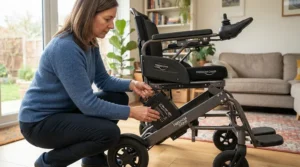
2. Jazzy Carbon — premium carbon frame with real suspension
The Jazzy Carbon from Pride Mobility trades money for grams. Its carbon fiber frame keeps weight down while the chair still carries front and rear suspension, which most featherweight folders skip.
The numbers vary by version. The standard model lists about 285-300 lbs of capacity and roughly 43.6 lbs with the battery. A heavy-duty version cited around 32.2 lbs without the battery and 400 lbs of capacity, with a 20 Ah lithium battery, up to 3.7 mph and up to 12.4 miles of range. Suspension is the sleeper feature here: it soaks up the cracked-sidewalk chatter that rattles a teen’s back over a school day.
The larger pack is also a lesson in reading labels. The info sheet lists 10 Ah and 20 Ah options, and voltage decides the watt-hour figure. Confirm the Wh label before booking a flight. One retailer-hosted review says the chair is light enough for a spouse to lift, which fits the weight story but is a single data point.
Pros:
- ✅ Carbon frame keeps carrying weight low
- ✅ Front and rear suspension smooths rough ground
- ✅ LCD joystick display with USB-C charging
Cons:
- ❌ Costs more than aluminum-frame rivals
- ❌ Specs differ across versions, so verify
Price range: around $3,000 and up depending on version. It is a premium spend, justified if suspension and weight both matter.
3. WHILL Model F — app-connected folder built for travel
The WHILL Model F reads like a gadget teens will actually want to be seen with. It folds in under three seconds to roughly 18 inches long, and a smartphone app lets you check battery and settings or drive the chair remotely over Bluetooth.
Specs: 250 lb capacity, 12.4 miles of range, 3.7 mph, a 30.7-inch turning radius, and 52.9 lbs without the battery (58.9 lbs with it). It handles inclines up to about 10° and obstacles around 1.4 inches. The 25.3V 10.6Ah lithium pack comes to roughly 268 Wh by volts-times-amps math, which is under the 300 Wh line. WHILL notes airline approval depends on using the original manufacturer battery, so skip third-party replacements.
The honest analysis: the Model F is lighter than the EWheels EW-M45 and far easier to stash. But 250 lbs of capacity gives less growth headroom for a big teen. The app-based remote driving is also a quiet parent-friendly feature when positioning the chair at the car.
I couldn’t verify a robust aggregated review pool, so treat comfort claims as unproven until you see one in person.
Pros:
- ✅ Folds in under three seconds
- ✅ App control and 360° joystick
- ✅ FDA-cleared Class II medical device
Cons:
- ❌ Highest price in this lineup
- ❌ Only 250 lb capacity for bigger teens
Price range: around $4,000. It’s pricey, but it’s the best “feels modern” option here.
4. EWheels EW-M45 — biggest capacity and range per dollar
The EWheels EW-M45 is the workhorse of the group. It weighs about 59 lbs with batteries (roughly 50 lbs without) and carries up to 400 lbs, making it the roomiest option for a teen who might add inches and pounds before the warranty runs out.
Specs: 3.7 mph top speed, 15.5 miles of range, two 180W brushless motors, a 31-inch turning radius, and a 19-inch-wide, 17-inch-deep seat. The two 12V/6Ah lithium batteries each work out to about 72 Wh, which is well within the per-battery allowance for dual-battery devices. The joystick mounts left or right, a small thing that matters for left-handed teens.
The tradeoff is carrying weight. At roughly 59 lbs, it’s a one-adult lift, not a casual one. The batteries are removable, which cuts the lift, but the frame is still a two-hand job.
Retail listings I found showed no posted reviews, so I can’t speak to sentiment. Warranty terms are modest on the electronics: three years on the frame, one year on parts, six months on batteries.
Pros:
- ✅ 400 lb capacity leaves growth room
- ✅ Longest listed range here
- ✅ Joystick mounts on either side
Cons:
- ❌ Heavier than carbon-frame rivals
- ❌ Only six months of battery warranty
Price range: mid-$1,000s to around $2,000. This is arguably the best value for a larger teen.
5. Journey Air 2026 — balanced everyday folder with comfort touches
The Journey Air 2026 is the sensible middle child. It’s an aluminum-frame folder with dual brushless motors, electronic braking and a joystick, weighing 39 lbs without the battery.
Specs: 300 lb capacity, up to 10 miles of range, a 35.4-inch turning radius, 6.5-inch front wheels and a memory foam seat cushion. Flip-back armrests make side transfers easier, and the listing describes an FAA-compliant battery. Those larger front wheels help over thresholds and cracked pavement.
At 10 miles, range is the weak link for a full school day plus an evening out, so plan to charge between uses. The weight capacity is a comfortable middle: more headroom than the WHILL Model F or Feather Power Chair, without the EWheels EW-M45‘s heft.
I found no posted review sentiment for this 2026 model, so its long-term reliability is unproven. Lean on warranty terms and dealer support instead.
Pros:
- ✅ Light enough at 39 lbs without battery
- ✅ Memory foam seat and flip-back arms
- ✅ 300 lb capacity gives growth room
Cons:
- ❌ 10-mile range is on the short side
- ❌ No verified reviews for the new model
Price range: roughly $2,000-$3,000. Fair value for a well-equipped daily driver.

6. Jazzy Passport — tightest turning radius for crowded spaces
The Jazzy Passport earns its keep indoors. Its 24.25-inch turning radius is the tightest of the seven, which is a real advantage in packed hallways, small bedrooms and school bathrooms.
Specs: 250 lb capacity, up to 3.6 mph, 11.25-inch drive wheels, 8-inch casters, and a standard foam seat measuring 17.5 by 16.5 inches. That seat is smaller than most adult-sized options, which suits a smaller-framed teen better. It’s also heavier than its footprint suggests, at 59.8 lbs without batteries.
Range depends heavily on the battery you pick. The 10.4 Ah travel battery is listed at roughly 4.6-5 miles, while the 18 Ah pack reaches about 7.9-8.6 miles. That is the shortest range here, so it’s an indoor-first, short-trip chair. Travel-minded buyers should note the travel battery is optional.
Review sentiment wasn’t available on the listings I found.
Pros:
- ✅ Tight turning radius for small spaces
- ✅ Smaller standard seat fits slimmer teens
- ✅ Travel battery option available
Cons:
- ❌ Short range, especially on the travel battery
- ❌ Heavy for a folding chair
Price range: varies widely by dealer and battery option, so check current price. Value depends on whether tight turning matters to you.
7. Journey Zinger — lever-steered, not joystick-driven
The Journey Zinger breaks the pattern. It steers with two levers, one on each side of the seat, rather than a single joystick, and it needs both hands to drive.
Specs: 275 lb capacity, about 47.4 lbs with the battery, a 5 lb battery, and an all-terrain pitch. Earlier Zinger materials cited roughly 8 miles of range, but I couldn’t confirm a current figure, so verify with the seller.
Who is this for? A teen with strong, steady hands who finds lever steering natural, like a lawn-mower or go-kart feel. For anyone with limited grip strength, tremors or one-handed control needs, a joystick controller is the safer fit. A therapist’s input matters most here.
I found no reviews to summarize.
Pros:
- ✅ Lighter than most joystick folders
- ✅ Dual-lever steering feels sporty
- ✅ Light enough to lift into a trunk
Cons:
- ❌ Needs both hands to drive
- ❌ Not suited to limited hand function
Price range: I couldn’t verify a current U.S. figure, so check current price. Expect low-to-mid thousands.
Top 7 Comparison: Specs, Price Ranges and Review Data
| Product | Range (listed) | Price Range | Review Data | Best For |
|---|---|---|---|---|
| Feather Power Chair | up to ~11 mi | $1,500-$2,000 | Thin | Lighter loads |
| Jazzy Carbon | up to 12.4 mi | ~$3,000+ | One retailer review | Premium carbon build |
| WHILL Model F | 12.4 mi | ~$4,000 | Not verified | Travel-focused teens |
| EWheels EW-M45 | 15.5 mi | Mid-$1,000s-$2,000 | None posted | Larger or growing teens |
| Journey Air 2026 | 10 mi | $2,000-$3,000 | None posted | All-round daily use |
| Jazzy Passport | ~4.6-8.6 mi | Check current price | Not verified | Tight indoor spaces |
| Journey Zinger | ~8 mi (older spec) | Check current price | None posted | Strong-handed teens |
The EWheels EW-M45 wins on range and capacity per dollar, while the WHILL Model F wins on polish and travel features. Budget-minded families should note that the Feather Power Chair undercuts most rivals on price while staying light. If you need a chair that spins in a closet, the Jazzy Passport is the specialist, but its short range limits it to indoor-first lives.
Practical Usage Guide: Setting Up a Folding Power Chair for a Growing Teen
A chair that fits in March may pinch by September. Treat setup as an ongoing project, not a one-afternoon task.
Day-One Setup
Start with a seating check. Feet should rest flat on the footplate, knees roughly level with hips, and elbows supported by the armrests without lifting the shoulders. If the chair has a mountable joystick controller, put it on the side with the steadier hand. Charge the battery fully before the first drive, and practice in an open room before attempting doorways.
First 30 Days
Drive daily short loops. Practice fold-and-unfold until it takes under a minute. Teens often skip this and then struggle at the worst moment, like a rainy curb at pickup. Note which tasks feel awkward, such as reaching a backpack or turning in a hallway, and bring that list to a seating evaluation.
Maintenance Rhythm
- Weekly: wipe the joystick, check tire pressure on air tires, and look for loose armrests.
- Monthly: inspect cables and the fold latch.
- Seasonally: re-check seat fit during growth spurts.
Airport Prep
Before any flight, read the FAA’s wheelchair and mobility device PackSafe guidance, then call the airline. Airlines can be stricter than the baseline rules, so ask ahead rather than hoping the gate agent agrees with your reading.

Real-World Scenarios: Matching Chairs to Real Teens
Scenario 1: The Campus Commuter (Age 14)
Budget around $2,000-$3,000. Daily trips across a sprawling school campus, plus home use. The Journey Air 2026 fits: 10 miles covers a typical day, the 300 lb capacity leaves growth room, and 39 lbs without the battery keeps car loading manageable.
Scenario 2: The Family Traveler (Age 16)
Budget around $4,000 and up. Frequent flights and road trips. The WHILL Model F earns its premium because it folds fast, uses an airline-friendly battery, and looks like something a sixteen-year-old would actually be proud to use. The Jazzy Carbon is the alternate if suspension matters more than the app.
Scenario 3: The Tall Late-Bloomer (Age 17)
Budget around $1,500-$2,000. Still growing, nearly adult-sized, and heavier than the smaller chairs allow for. The EWheels EW-M45 has the capacity and range, and the seat is 19 inches wide. Lifting is a two-person job, so plan the car setup.
Scenario 4: The Small-Framed Indoor Driver (Age 13)
Budget varies. Mostly indoor, with short outdoor trips. The Jazzy Passport‘s tight turn and smaller standard seat suit narrow hallways. The short range is acceptable because trips are brief.
In every case, a therapist-led trial beats a spec sheet. Many dealers offer demos, so ask.
How to Choose a Foldable Electric Wheelchair for Teens
Here is a step-by-step approach to picking a foldable electric wheelchair for teens:
- Start with a seating evaluation. A therapist can flag posture, tone and skin-integrity needs a spec sheet never will.
- Measure the seat. Compare seat width and depth against your teen’s hips and thighs, with a little room to grow.
- Check the weight capacity. Choose a number comfortably above current weight plus backpack, not one that barely clears it.
- Weigh the carry load. Whoever lifts the chair daily should test it. Weight with versus without the battery matters.
- Match the controls. Joystick, lever or alternative input should match hand function.
- Verify the battery. Read the watt-hour label and compare it against airline limits.
- Test the fold. If folding is fiddly, it won’t get used.
Weight Capacity for Teens: Getting the Number Right
Weight capacity for teens is where families most often under-buy. A chair rated for 250 lbs may technically cover a 140 lb teen, but weight capacity for teens should include backpack, laptop, water bottle and a growth cushion of at least a year or two.
Rated capacity also isn’t a guarantee of the same performance at the limit. Pride’s own spec sheets note that range figures are tested at maximum capacity and vary with user weight, terrain, battery condition and tire condition. In practice, a lighter rider on smooth floors will beat the listed range; a heavier rider on hills will fall short.
Consider how the models stack up. The EWheels EW-M45 tops the list at 400 lbs. The Journey Air 2026 (300 lbs) and Journey Zinger (275 lbs) sit mid-pack, and the Feather Power Chair, WHILL Model F and Jazzy Passport hover around 250 lbs. If your teen is still in a growth spurt, lean toward the higher end. If your teen is small and unlikely to outgrow the chair soon, the lighter folders trade capacity for easier lifting.
Joystick-Controlled Mobility Chair for Adolescents: What the Joystick Controller Actually Does
A joystick-controlled mobility chair for adolescents works much like a game controller: push to move, release to stop. Most folding chairs here use a joystick controller mounted on an armrest, and several, like the EWheels EW-M45 and WHILL Model F, let you choose left or right placement.
What matters in practice:
- Mounting side. A controller on the non-dominant side can be frustrating. Pick a chair where it can move.
- Speed settings. Teens will test limits. Lower speed modes are handy while learning.
- Display. The Jazzy Carbon adds an LCD readout with USB-C, which is oddly useful for teens living on phones.
- Grip and travel. A joystick with a short throw suits limited hand strength; a longer throw gives finer control.
Not every teen can use a standard joystick. Some need alternative drive methods, and a therapist can advise. The Journey Zinger‘s dual levers are an interesting alternative for strong hands but are a poor match for limited grip. Whatever you choose, test steering through a doorway before committing.
Portable Electric Wheelchair for Teens With Removable Battery: Why It Matters
A portable electric wheelchair for teens with removable battery solves three problems at once: lifting, charging and flying. Pulling the pack drops several pounds from the lift, lets you charge at a desk instead of beside the chair, and keeps the cabin-carry option open for air travel.
The savings are visible in the specs. The WHILL Model F drops from 58.9 lbs to 52.9 lbs without its 6 lb battery. The Feather Power Chair carries a battery weighing roughly 4 lbs. The EWheels EW-M45 uses two small packs that each pull out, which spreads the weight. On the Journey Zinger, the 5 lb battery is a modest part of its 47 lb total.
There are catches. Pull-and-go batteries can walk away, so label them. Spares cost real money. A removable pack also needs terminals protected from short circuits when carried loose. And never swap in a cheaper non-original battery on a chair whose airline approval depends on the manufacturer pack, as WHILL Model F materials warn.

Lithium Battery Travel Rules: What Families Need to Know
The lithium battery travel rules are mostly consistent, but airlines apply them in their own ways.
Under FAA PackSafe guidance, a lithium-ion wheelchair battery that is not adequately protected must be removed. It is limited to 300 watt-hours, travels in carry-on only, and needs its terminals protected from short circuits. The chair itself may travel as checked baggage. Where the battery is installed and protected by design, the device may be handled differently, and the airline decides on the specifics. The TSA’s guidance for battery-powered wheelchairs tells you which items go through the checkpoint and which stay with the passenger.
Here’s how to read the numbers. Watt-hours equal volts times amp-hours. The WHILL Model F pack, at 25.3V and 10.6Ah, is roughly 268 Wh. The Feather Power Chair pack, at 24V and 10.4Ah, is about 250 Wh. The EWheels EW-M45 carries two packs at roughly 72 Wh each, and rules for dual-battery devices are usually stated per battery.
Airlines may be stricter than baseline rules, so confirm with yours in advance, ideally days before departure. Pack the battery label where you can find it, and tell the airline where the battery is.
Lightweight Folding Power Wheelchair for Teenagers: Weight vs. Stability
A lightweight folding power wheelchair for teenagers promises easy lifting, but weight cuts both ways. Lighter frames are easier to load, yet they can feel twitchier on slopes and rougher on bad surfaces unless suspension or larger wheels compensate.
The lineup shows the tradeoff clearly. The Feather Power Chair and Jazzy Carbon sit at the featherweight end, with the Jazzy Carbon adding suspension to compensate. The Journey Air 2026 gets larger front wheels for stability at 39 lbs without the battery. The EWheels EW-M45 and Jazzy Passport are heavier but feel planted.
Ask three questions. How often will someone lift it? What surfaces will it cross? And does your teen need to climb thresholds or inclines? The WHILL Model F lists about 10° inclines and a 1.4-inch obstacle clearance, useful reference points for comparing others. If you will use ramps or rough campus paths, prefer the larger-wheel or suspended designs even if they weigh more.
Foldable Power Chairs vs. Manual Chairs, Power-Assist and Scooters
| Option | Effort to Drive | Portability | Control Style | Best For |
|---|---|---|---|---|
| Foldable power chair | Low | Good (30-60 lbs) | Joystick or levers | Teens needing independent mobility |
| Folding manual chair | High | Excellent | Hand-pushed | Teens with strong arms and short trips |
| Power-assist add-on | Medium | Good | Hand-pushed with boost | Teens wanting to keep pushing |
| Folding mobility scooter | Low | Varies | Tiller steering | Teens with good trunk control |
A manual chair builds upper-body strength and folds smaller, but it drains energy over distance. Power-assist add-ons split the difference. Mobility scooters steer with a tiller, which needs good grip and trunk support, so they suit fewer teens than a joystick-driven power chair.
The right answer depends on stamina, distance and hand function. A foldable electric wheelchair for teens usually wins when distance and fatigue are the main barriers, and a therapist can help decide whether a hybrid setup, such as a manual chair at home and a power folder for school, makes sense.
Long-Term Cost and Maintenance
| Product | Price Range | Value Verdict | Best For |
|---|---|---|---|
| Feather Power Chair | $1,500-$2,000 | Strong for lightness | Easy-lift households |
| EWheels EW-M45 | Mid-$1,000s-$2,000 | Best capacity per dollar | Growing teens |
| Journey Air 2026 | $2,000-$3,000 | Balanced all-rounder | Daily school use |
| Jazzy Carbon | ~$3,000+ | Premium for suspension | Rough-surface commuters |
| WHILL Model F | ~$4,000 | Premium for travel features | Frequent flyers |
Sticker price is only part of the cost. Replacement batteries, tires, cushions and chargers add up, and warranty coverage varies widely. The EWheels EW-M45 lists only six months on batteries, so budget for an eventual replacement. Pneumatic tires, like those on the Jazzy Passport, need pressure checks, while solid tires skip flats but ride rougher.
Spread the cost over use: a chair used daily for three or four years costs far less per trip than a cheap one that fails in year one. Also factor in growth. A chair with a 300+ lb capacity and adjustable seating may outlast a smaller one, and that matters more than a few hundred dollars saved today.

FAQ
❓ Can a teen take a foldable electric wheelchair on a plane?
❓ How much does a foldable electric wheelchair for teens cost?
❓ Will insurance cover a foldable electric wheelchair for teens?
❓ How far can a foldable electric wheelchair for teens go on one charge?
❓ Can a teen use a foldable power chair at school?
Conclusion
There is no single best foldable electric wheelchair for teens, only a best match for one teenager. The Feather Power Chair and Jazzy Carbon reward families who lift the chair daily. The WHILL Model F is the travel-friendly, tech-forward pick. The EWheels EW-M45 gives growing teens the most room, while the Journey Air 2026 balances comfort and weight. The Jazzy Passport shines in tight spaces, and the Journey Zinger suits strong hands that prefer levers.
Whichever you choose, get a seating evaluation, check weight capacity for teens with growth in mind, confirm the battery’s watt-hours, and test the joystick controller before you commit. The chair should disappear into your teen’s life, not dominate it.
✨ Ready to find the right fit?
🔍 Compare the models above, click any highlighted product to check current pricing and availability, and give your teen a chair that feels like freedom rather than equipment. 🚀
Recommended for You
- Pediatric Wheelchair For School Use: 7 Best Picks (2026)
- High-Speed Mobility Scooter Over 10 mph: 7 Best Picks 2026
- Long-Range Mobility Scooter For 30 Mile Range: 7 Best Picks 2026
Disclaimer: This article contains affiliate links. As an Amazon Associate, I earn from qualifying purchases. If you purchase products through these links, we may earn a small commission at no additional cost to you.
✨ Found this helpful? Share it with your friends! 💬🤗
