
In This Article
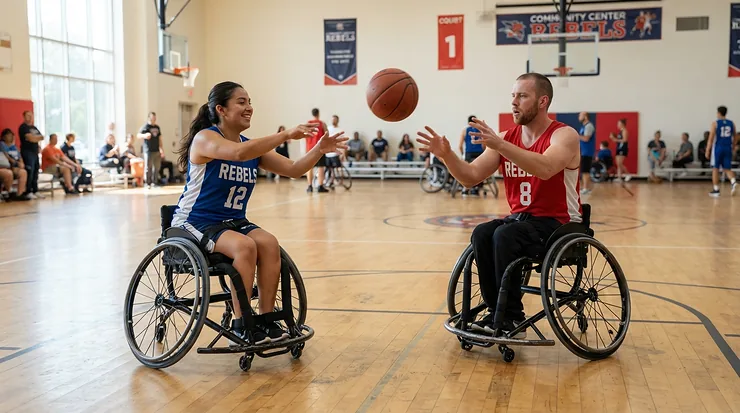
An adaptive basketball wheelchair for recreational leagues is a rigid-frame sports chair with angled (cambered) rear wheels, small front casters and anti-tip casters at the back. It is built for fast pivots, chair-to-chair contact and constant stopping. It is not your everyday chair with a sportier paint job. It is the closest thing the court has to a pair of properly fitted basketball shoes.
Here’s the part nobody tells first-timers: the chair matters more than almost any other purchase you’ll make in this sport. Wheelchair basketball has been played in its modern form since the International Stoke Mandeville Games in 1956. In the decades since, the equipment has split into two worlds. One is custom-built, carbon-and-titanium-adjacent gear for national teams. The other is the world you’re probably shopping in: a friendly Tuesday-night league, a college intramural program, or a community adaptive sports club that just got a gym slot.
This guide is written for that second world. I researched real chairs, real specs and the rules that actually govern equipment. I did not test any of these chairs myself, and nothing below pretends otherwise. What you’ll get instead is honest analysis: what each spec means once you’re moving on a hardwood floor, where reviewers’ feedback is thin, and which chair fits which kind of player.
You’ll also find plain-English explanations of anti-tip casters, Paralympic wheelchair basketball standards, and player classification, because those three things quietly shape what you should and shouldn’t buy.
One note on shopping: most of these chairs are made to order and sold through specialty dealers or manufacturer channels, not off a warehouse shelf. Availability, lead times and options change, so confirm them before you commit.
Quick Comparison: 7 Chairs at a Glance
| Chair | Tier | Frame / Key Feature | Approx. Price Range | Best For |
|---|---|---|---|---|
| Decathlon BW500 | Entry | Adjustable seat widths, ready-to-use setup | Lowest here; check current price | Brand-new players testing the sport |
| RGK Club Sport | Entry | Club/multi-sport design | Low-to-mid $2,000s | Clubs sharing chairs, beginners |
| Quickie All Court (RGK) | Mid | Adjustable seat/back, center-of-mass tuning | Roughly $3,800-$4,500 base | One chair for several court sports |
| Top End Pro BB | Mid | Welded aluminum, fixed camber, quick adjustments | Roughly $3,500-$6,000 by configuration | Players still dialing in a setup |
| RGK Allstar | Mid-to-upper | 7020 aluminium, made to measure | Around $4,000-$4,500 | Regular players who are progressing |
| Top End Paul Schulte 7000 | Premium | 7005 aluminum, fully customizable | Dealer quote; premium tier | Committed, competitive players |
| RGK Elite | Premium | Tri-frame design, 30+ measurements | $5,000-$6,000+ configured | Top-level league players |
Looking at the table, the Decathlon BW500 and the RGK Club Sport are the sensible on-ramps for anyone who isn’t sure basketball will stick. The Quickie All Court (RGK) and the Top End Pro BB sit in the middle, where adjustability starts paying for itself. If you already know you’re staying, the RGK Allstar hits the best balance between price and performance, while the RGK Elite and Top End Paul Schulte 7000 make sense only once your playing time justifies a precision fit.
💬 Just one click — help others make better buying decisions too!😊
Top 7 Adaptive Basketball Wheelchairs for Recreational Leagues: Expert Analysis
1. Decathlon BW500 — cheapest way to try the sport
The Decathlon BW500 exists for one reason: lowering the barrier to the first practice. It comes in 24″ and 26″ wheel versions and is billed as a beginner chair that arrives ready to use in a standard configuration, with the rear wheels shipped off.
On the 24″ version, the seat width adjusts across four settings (30, 32, 34 or 36 cm), with a 40 cm seat depth. That adjustability matters more than it sounds. A rental or loaner chair that fits a 5’2″ teenager and a 5’10” adult is a gift to a program with a small budget. The listing also notes the chair is recognized as a medical device and certified by CERAH, and that it was developed with input from players with disabilities.
My take: this is a “learn the sport” chair, not a “win the league” chair. Pricier chairs trade money for lower weight and finer tuning, which a first-month player can’t yet exploit. A caveat: Decathlon sells primarily in Europe, so US availability may be limited, and I couldn’t verify a meaningful volume of independent reviews. Treat it as a model to compare against, not a guaranteed buy.
Pros:
- ✅ Adjustable seat width across several settings
- ✅ Arrives in a ready-to-use standard setup
- ✅ Designed specifically for beginner players
Cons:
- ❌ US availability is uncertain and region-dependent
- ❌ Independent review data is hard to verify
Price: the lowest-priced chair in this lineup, but check current price. Value verdict: excellent for trying the sport, less so for long-term growth.
2. RGK Club Sport — built for sharing and learning
The RGK Club Sport is the textbook entry-level wheelchair basketball chair. Distributors describe it as the beginner-and-club model, sitting below the made-to-measure intermediate and elite chairs. One Australian dealer frames it as a multi-sport chair suited to beginners, clubs and schools, and notes it accommodates players of different shapes.
That “different shapes” point is the whole sales pitch. Programs buying equipment for a rotating roster want durability and reuse, not a gram-shaving custom frame. Aluminum, rigid, and designed to take punishment. A European retailer’s base listing sits around the €2,000 mark, which roughly translates to the low-to-mid $2,000s before options.
Who is it for? Newer players who want their own chair without paying for tuning they won’t use yet, plus clubs building a loaner fleet. Because the RGK Club Sport is one rung below the RGK Allstar, a player who outgrows it has a clear upgrade path inside the same brand. I couldn’t verify enough independent reviews to summarize sentiment honestly, so ask your local adaptive sports program whether any teammates already use one.
Pros:
- ✅ Positioned squarely for beginners and clubs
- ✅ Multi-sport design widens use beyond basketball
- ✅ Clear upgrade path to the Allstar and Elite
Cons:
- ❌ Less fine-tuning than intermediate chairs
- ❌ Review data is thin and hard to confirm
Price: low-to-mid $2,000s before options. Value verdict: one of the smartest starting points for a program or a first-timer.
3. Quickie All Court (RGK) — best one-chair-for-several-sports pick
The Quickie All Court (RGK), sold under the Sunrise Medical umbrella (model EISP1), is the chair for the player who also wants to try tennis, rugby or other court sports. It features adjustable seat height, back height and back angle, plus a patented center-of-mass adjustment that lets you shift body positioning without changing the wheelbase.
In practice, that last feature is the quiet hero. Center of mass changes how easily the chair pivots and how tippy it feels when you reach for a rebound. Being able to tune it without rebuilding the chair means a beginner can experiment and a mid-level player can refine. The large-diameter tubing is meant to absorb contact, which in a recreational league (where chair-to-chair bumps are guaranteed) is exactly the stress you want covered.
On SpinLife’s listing, the chair carries a 4.6 rating from six reviews, with 100% of reviewers recommending it, and a lifetime limited warranty. Six reviews is a small sample, so read that as a mildly positive signal and not a verdict. It is custom built, so expect a wait.
Pros:
- ✅ Center-of-mass adjustment without changing wheelbase
- ✅ Adjustable seat height, back height and back angle
- ✅ Lifetime limited warranty on the listing
Cons:
- ❌ Custom build means lead time before delivery
- ❌ Small review sample limits confidence
Price: roughly $3,800-$4,500 base, climbing with options. Value verdict: strong for multi-sport players who can wait for a custom build.
4. Top End Pro BB — adjustment-friendly welded frame
The Top End Pro BB (model 10000) is a fully welded aluminum chair with fixed camber, quick-release axles and high-pressure clincher tires. It pairs a height-adjustable fixed swivel anti-tip (roughly a 58-59mm fifth wheel) with super-hard 72mm front casters.
Why does that matter? A welded frame is stiff, so more of your push goes into forward motion instead of frame flex. The adjustability list is generous: front seat height, center of gravity, back height and angle, upholstery and footrest position. Invacare’s own materials pitch it at competitors “still dialing in” their game, a sensible read of where it sits. Spec sheets show a starting weight around 22 pounds and a 250-pound capacity.
Reviewer data is limited here too: SpinLife shows a 4.8 average from two reviews, which is too few to lean on. Listings also quote very different lead times, from several weeks to much longer, so confirm before a season starts. Base pricing varies a lot across listings and configurations, roughly $3,500 up to nearly $6,000.
Pros:
- ✅ Welded aluminum frame feels stiff and durable
- ✅ Adjustable anti-tip height and seat settings
- ✅ Made in the USA with a 2-year warranty
Cons:
- ❌ Starting weight is heavier than lighter premium chairs
- ❌ Lead times vary widely by listing
Price: roughly $3,500-$6,000 depending on configuration. Value verdict: solid for players who want adjustability and US-based support.
5. RGK Allstar — the “I’m staying in this sport” chair
The RGK Allstar is the intermediate step, positioned between the Club Sport and Elite. It is built from 7020 aluminium, starts around 9.8 kg (roughly 21.6 pounds), and supports up to 100 kg (about 220 pounds) of user weight. Every chair is made to measure.
The distinction between this and an off-the-shelf chair is fit. Toe-in/toe-out alignment and low-friction casters reduce drag and dirt pickup, while back-support center-of-gravity adjustment and a lightweight adjustable foot support let you fine-tune as your game develops. Calf and toe straps come standard, with optional waist strapping.
Here’s the analytical read: this is where weight and fit start shaving real effort off every push. Over a 40-minute league game, a lighter, better-aligned chair means less shoulder fatigue, though the exact payoff varies by player. The 100 kg limit is worth noting for heavier players. I couldn’t verify independent reviews, so ask local players what they think of the fit process.
Pros:
- ✅ Made to measure with controlled adjustments
- ✅ Light frame with low-friction casters
- ✅ Calf and toe straps included as standard
Cons:
- ❌ 100 kg maximum user weight limits some players
- ❌ Made-to-measure ordering takes time
Price: around $4,000-$4,500 (based on European listings; check current price). Value verdict: the best balance of price and performance for regulars.
6. Top End Paul Schulte 7000 Series — precision for committed players
The Top End Paul Schulte 7000 Series is the premium Top End option. It uses ultra-lightweight 7005 aluminum, is fully customizable, and features a reinforced anti-tip system for stability during sharp turns. Its listing credits input from a Paralympic champion.
Translation: this is a chair for someone whose game has outgrown a general-purpose frame. Tailoring every detail to your playing style matters most when you know your preferences: your ideal camber, your seat height, how far forward you like to sit. Without that knowledge, you’re paying for customization you can’t yet use.
My honest advice: don’t buy this as a first chair. Play a season or two in the Top End Pro BB or RGK Allstar, learn what you want, then upgrade. Pricing isn’t published openly, so you’ll need a dealer quote, and I couldn’t verify independent reviews. Since premium chairs hold value better when well maintained, resale can soften the sticker shock.
Pros:
- ✅ Ultra-lightweight 7005 aluminum construction
- ✅ Fully customizable to your playing style
- ✅ Reinforced anti-tip for sharp turns
Cons:
- ❌ Pricing requires a dealer quote
- ❌ Overkill for brand-new players
Price: premium tier; get a current dealer quote. Value verdict: worth it for committed players, wasteful for first-timers.
7. RGK Elite — the top-shelf, built-around-you chair
The RGK Elite is described by its maker as the sports chair of choice for professional wheelchair basketball athletes, made to exact measurements. Its newer TRI-FRAME design spreads in-game energy across more sections of the chair, and more than 30 individual measurements go into the build.
In plain terms, that means the chair is built around your body, not the other way around. For a recreational player, most of that precision goes unused; for a former or aspiring competitive athlete returning to a rec league, it’s the chair that matches how they already play. A European retailer’s base listing sits around €4,800, which translates to roughly $5,000-$6,000 or more once configured.
The honest trade-off: the performance gap between this and the RGK Allstar is real but narrow for casual play. You’re buying the last few percent. I couldn’t verify independent reviews, but the brand’s pro-level reputation, as stated by its manufacturer, is the main evidence here, and that’s marketing, not neutral testing.
Pros:
- ✅ Built from 30+ individual measurements
- ✅ Tri-frame design spreads impact energy
- ✅ Chosen by professional athletes per the maker
Cons:
- ❌ Highest price point in this lineup
- ❌ Extra precision rarely matters at recreational level
Price: $5,000-$6,000+ configured. Value verdict: justified for serious players, a luxury for casual ones.
How to Choose an Adaptive Basketball Wheelchair for Recreational Leagues
Choosing well comes down to seven steps. Work through them in order and you’ll avoid the most expensive mistakes.
- Confirm your league’s equipment rules. Ask the organizer whether the league follows NWBA or IWBF specs, or looser recreational rules. This decides whether anti-tip casters, seat heights and footrest limits are enforced.
- Decide how serious you are. If you’ve played zero games, start with an entry-level wheelchair basketball chair. If you play weekly already, step up to a made-to-measure intermediate chair.
- Prioritize fit over features. A chair that’s too wide or too narrow causes discomfort and, over time, can create pressure problems. Manufacturers’ own guidance stresses being as narrow as possible while staying comfortable and safe.
- Check adjustability. Some frames adjust; others are fully welded with no flexibility. If your body or skills will change, adjustability protects your investment.
- Look at weight and weight limits. A lighter chair is easier to push, but check the maximum user weight against your own.
- Verify anti-tip setup. Make sure the chair has anti-tip casters that meet league rules and can be adjusted in height.
- Budget for the whole package. Include straps, gloves, tires, a cushion, shipping and the wait time.
Entry-Level Wheelchair Basketball Chair: What “Entry-Level” Really Means
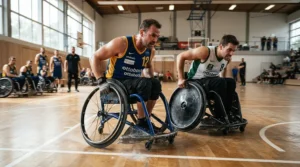
“Entry-level” can mislead. It doesn’t mean flimsy; it means fewer fine-tuning options and less custom measurement. An entry-level wheelchair basketball chair still needs a rigid frame, cambered wheels and a proper anti-tip setup. What you give up is precision: the Decathlon BW500 and RGK Club Sport offer a handful of adjustments, while the RGK Elite offers dozens.
Here’s what the spec sheet won’t tell you but common sense does: an entry-level chair is the best classroom. You’ll learn what feels wrong about it, whether that’s the seat being too high, the back too short, or the camber too flat, and those lessons make your next chair dramatically better. A beginner who jumps straight to a premium custom build is guessing at specifications they can’t yet name.
Entry-level chairs also work as a shared resource. Programs that keep a handful of Decathlon BW500-style adjustable chairs, or RGK Club Sport frames, can let new players try the sport without a four-figure commitment. Think of it as a library card for basketball: borrow, learn, then decide what to buy.
Wheelchair Basketball Chair With Anti-Tip Wheel: Why It Matters
Wheelchair basketball chairs lean hard into tipping risk. Tight turns, rebound reaches and chair-to-chair contact all push the chair toward its rear tipping point. That’s why a wheelchair basketball chair with anti-tip wheel is standard, not optional. Wikipedia’s overview notes the physics plainly: tipping happens around a fulcrum, and a higher seat tips more easily.
The anti-tip caster is a small safety wheel at the rear. On the Top End Pro BB, it’s a height-adjustable swivel; on the Top End Paul Schulte 7000 Series, it’s a reinforced system for sharp turns. Rules also constrain it: according to NCHPAD’s summary of wheelchair basketball equipment regulations, anti-tip casters may attach to the underside or rear of the chair, but their lowest point can’t sit more than 1 inch from the floor, and no part may project rearward past the rear wheels.
Practical takeaway: set the anti-tip height correctly, and recheck it after any tire change. Too high and it won’t catch you; too low and it drags, slows you and may break league rules. Also remember that tilting or falling while holding the ball can be a violation if anti-tip casters touch the floor, a rule noted in educator resources for wheelchair basketball.
Anti-Tip Casters: Setup, Wear and Replacement
Anti-tip casters earn their keep quietly. They rarely get attention until one is cracked, worn flat or loose. Because they are small, hard wheels hitting a hardwood floor, they take more abuse than they look like they do.
Here’s a simple routine. Before every session, spin each anti-tip caster by hand and check for wobble. Look for flat spots, which signal uneven wear. Confirm the mounting bolts are snug. Check the height against your league’s one-inch limit. Manufacturer manuals for sports chairs include steps for adjusting the swivel anti-tip height and replacing casters, so keep your manual handy.
Compare options when you shop. A Top End Pro BB offers adjustable-height anti-tips, which makes dialing in clearance easy. A budget chair may offer fewer adjustments, which is fine as long as it meets your league’s rules. If you play on rougher surfaces, expect faster wear. Replacement casters are typically cheap compared with the chair itself, so keep a spare set in your gear bag.
Beginner Wheelchair for Adaptive Basketball League: Your First-Season Guide
If you’re searching for a beginner wheelchair for adaptive basketball league play, here’s how to spend your first season wisely. This is practical, transformation-style guidance you won’t find on a product listing.
Weeks 1-2: borrow before you buy. Ask your league or a local adaptive sports program whether loaner chairs exist. Many programs keep adjustable beginner models like the RGK Club Sport for exactly this purpose.
Weeks 3-6: learn your preferences. Notice what bugs you. Is the seat too high for ball handling? Does the chair feel twitchy in turns? Write it down. Those notes become your order sheet.
Weeks 7-12: tune what you can. If you own an adjustable chair, adjust one variable at a time (back height, seat height, center of gravity) and test each change over a few sessions.
First 30 days mistakes to avoid:
- Over-tightening straps so you restrict breathing or circulation.
- Ignoring tire pressure, which affects roll speed.
- Skipping the anti-tip height check.
- Buying a custom chair before you know your preferences.
Gloves and hand-rim covers help grip and control while pushing, turning and stopping, and straps add stability and injury prevention, so budget a little for accessories. That checklist turns a spec-sheet purchase into a plan, and that’s the difference between a chair you tolerate and one you trust.
Paralympic Wheelchair Basketball vs Recreational Play
Paralympic wheelchair basketball is the sport’s pinnacle, and it’s governed by the IWBF’s detailed rules on equipment and classification. Chairs at that level are custom-built, rigid and tuned to the gram. The Paralympic Committee’s classification overview describes the point system and the 14-point team limit on court.
Recreational leagues borrow the spirit but loosen the specifics. Some intramural programs, for example, apply NWBA rules but explicitly don’t enforce team-balance rules. Others add house rules like dribbling once for every two pushes. That flexibility is great news for newcomers: you don’t need a Paralympic-grade chair, and you rarely need to worry about the kind of strict equipment checks that apply in sanctioned competition.
What carries over from the elite game is the equipment physics. Camber still boosts agility, rigid frames still transfer power efficiently, and anti-tip casters still protect you. So when you read about Paralympic wheelchair basketball chairs, treat the technology as a preview of what’s trickling down into the RGK Allstar and Top End Pro BB tier, not as a requirement for your Tuesday league.
Player Classification and Your Chair
Player classification sounds like paperwork, but it quietly shapes team composition and, indirectly, what you need from a chair. According to the IWBF’s classification page, players are assigned points based on functional ability, with 1, 2, 3 and 4 as the recognized classes, half-point classes in between, and 4.5 for the player with the least impairment. The total on court at any time is 14.0 points.
The key detail is that classification rests on function, not diagnosis. Observers watch trunk movement and stability during actual basketball situations. Players with lower classifications typically have more limited trunk control, which is why seating position, straps and back support matter more for them. A chair’s backrest height, strapping options and center-of-gravity adjustment can change how stable a lower-classified player feels.
For recreational play, player classification is often relaxed or skipped. Still, it’s worth knowing: if your league uses it, your classification can affect lineup decisions, and your chair choice should support your function. A player with more trunk control may prefer a lower back and a more forward center of gravity, while a player needing more support may want taller backs and waist strapping. The RGK Allstar and Quickie All Court (RGK) both offer back and strapping adjustments that suit that kind of tuning.
Features That Actually Matter (And Those That Don’t)
Marketing language can blur what’s useful. Here’s a quick filter.
Features that matter:
- Fit and seat width. Everything else depends on this.
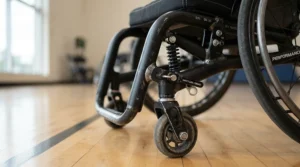
- Rigid frame. Basketball chairs use rigid, non-folding frames for strength, responsiveness and durability.
- Camber. More camber boosts maneuverability and stability but widens the chair.
- Anti-tip casters. Non-negotiable for safety and league compliance.
- Adjustability. Especially if you’re new or still growing.
Features that matter less (for casual play):
- Ultra-premium alloys. The difference between 7020 and 7005 aluminum won’t change your Tuesday-night experience.
- Dozens of custom measurements. Valuable if you know your preferences, wasted if you don’t.
- Brand prestige. A pro endorsement doesn’t guarantee a better fit for you.
Here’s the practical read: a mid-range chair with the right fit beats a premium chair with the wrong one. A research study published in Technology and Disability found that a highly adjustable prototype basketball wheelchair performed comparably to participants’ personal chairs, which suggests good adjustability can stand in for expensive customization.
Basketball Wheelchair vs Everyday Wheelchair
Can you just roll onto the court in your daily chair? Technically, maybe in an informal shoot-around. For organized play, it’s a poor idea, and often not permitted.
| Feature | Basketball Chair | Everyday Chair | Best For |
|---|---|---|---|
| Frame | Rigid, non-folding | Often folding | RGK Allstar for regular play |
| Wheels | Strong camber, quick turns | Little to no camber | Top End Pro BB for agility |
| Casters | Small, hard front casters + anti-tip | Larger front casters | Quickie All Court (RGK) for balance |
| Contact durability | Built for chair-to-chair impact | Not designed for impact | RGK Club Sport for rough use |
| Adjustability | Tunable for sport | Tuned for daily life | Decathlon BW500 for beginners |
The difference comes down to purpose. Basketball chairs are harder and use smaller casters than everyday wheelchairs, and the cambered wheels trade a wider footprint for quicker turning. An everyday chair optimizes for doorways and transfers, so it feels sluggish and unstable under court conditions. If you plan to play more than casually, a dedicated sport chair protects both your performance and your everyday chair from damage.
Long-Term Cost & Maintenance
The sticker price is only the opening bid. Total cost of ownership includes tires, gloves, straps, a cushion, spare casters, shipping and occasional repairs. Think of it as buying a bike: the frame is the start, the maintenance keeps it rolling.
| Tier | Typical Chairs | Approx. Range | Cost-Per-Season Logic |
|---|---|---|---|
| Entry | Decathlon BW500, RGK Club Sport | Lowest to low-to-mid $2,000s | Cheap to learn, resells easily |
| Mid | Quickie All Court (RGK), Top End Pro BB | Roughly $3,500-$6,000 | Pays off after a few seasons |
| Upper / Premium | RGK Allstar, RGK Elite, Top End Paul Schulte 7000 | Roughly $4,000-$6,000+ | Best for heavy weekly use |
Reading this table, the entry tier minimizes risk, while the mid tier is where adjustability starts lowering your long-term costs, since you can adapt the chair instead of replacing it. The premium tier rewards frequent players; if you play twice a month, the extra spend rarely pays back.
Maintenance is simple but consistent. Check tire pressure, tighten bolts, clean casters, inspect straps, and keep the manual accessible. A well-kept chair holds resale value better, and ordering the right size the first time is the cheapest fix of all. The same adjustability principle appears in research on a highly adaptable basketball wheelchair, which highlights how adaptable designs can help beginning players who can’t afford full customization.
Real-World Scenarios: Matching Chairs to Players
Here are three composite profiles, illustrative rather than real people, showing how to match a chair to a situation.
Scenario 1: The curious beginner. A 28-year-old joining a community league with a modest budget, playing once a week. Best fit: the Decathlon BW500 or RGK Club Sport. Reasoning: low commitment, adjustable fit, easy resale. Revisit after one season.
Scenario 2: The returning athlete. A 35-year-old who played competitively years ago and now wants weekly league games. Best fit: the RGK Allstar or Top End Pro BB. Reasoning: they already know their preferences, so made-to-measure fit pays off immediately, and mid-range pricing avoids paying for pro-level extras.
Scenario 3: The multi-sport student. A college student trying basketball and tennis on a tight timeline. Best fit: the Quickie All Court (RGK). Reasoning: one chair covers several court sports, and center-of-mass adjustment helps them tune between games.
For a serious competitor planning travel tournaments, the RGK Elite or Top End Paul Schulte 7000 Series enters the conversation, but only after the player has logged enough court time to specify their own setup. The pattern across all three is the same: match the chair to current needs, then upgrade with data, not hype.
Problem → Solution Guide
Here are common problems and fixes you won’t get from a product listing.
Problem: the chair tips backward during rebounds.
Solution: lower the center of gravity, check anti-tip caster height, and confirm the casters sit within the one-inch league limit. Chairs like the Top End Pro BB and Quickie All Court (RGK) are built for these adjustments.
Problem: shoulders ache after games.
Solution: check seat width, since a chair that’s too wide forces awkward arm angles. A lighter chair like the RGK Allstar can also reduce effort per push.
Problem: the chair feels twitchy or slow to turn.
Solution: review camber and caster condition. Worn casters add drag, and camber influences how quickly you pivot.
Problem: your hands slip when pushing.
Solution: try hand-rim covers or gloves, which improve grip and control.
Problem: the chair no longer fits after a year.
Solution: choose adjustable frames from the start. The Decathlon BW500‘s width settings and the Quickie All Court (RGK)‘s adjustability address exactly this.
✨ Ready to Find Your Chair?
🏀 Take your court game to the next level with these carefully researched options. Click on any highlighted chair to check current pricing and availability, and bring this guide to your league organizer, therapist or dealer so you can compare notes with confidence.
Common Mistakes When Buying a Basketball Wheelchair
Buyers repeat the same errors, so here’s the short list with some expert-style reasoning.
- Buying premium first. Customization only helps when you know what to customize. Start mid-range or entry-level, then upgrade.
- Ignoring league rules. A chair that violates anti-tip, seat-height or footrest limits can be flagged. Seat rail height may not exceed 21 inches, and the first contact point of the footrest has limits, per NCHPAD’s equipment summary.
- Guessing at size. An ill-fitting chair hurts comfort and performance. Get measured by a professional.
- Forgetting lead times. Made-to-order chairs can take weeks or longer. Order before the season starts.
- Skipping accessories. Straps, gloves and covers aren’t extras; they’re part of the setup.
- Trusting thin reviews. A 4.8 rating from two reviews is a hint, not proof. Ask local players.
- Overlooking weight limits. The RGK Allstar, for instance, lists a 100 kg maximum user weight, so check that your numbers fit.
The pattern: most mistakes stem from rushing. Slow down, borrow a chair if possible, and talk to teammates.
FAQ
❓ How much does an adaptive basketball wheelchair for recreational leagues cost?
❓ Do I need a special chair to play wheelchair basketball?
❓ What is the best entry-level wheelchair basketball chair?
❓ Are anti-tip casters required in wheelchair basketball?
❓ Does player classification matter in recreational leagues?
Conclusion
Choosing an adaptive basketball wheelchair for recreational leagues doesn’t require a pro budget or a spec-sheet degree. It requires honesty about where you are right now. If you’re brand new, an entry-level wheelchair basketball chair like the Decathlon BW500 or RGK Club Sport lets you learn without overspending. If you play regularly, the RGK Allstar, Top End Pro BB or Quickie All Court (RGK) reward you with better fit and adjustability. And if basketball has become your weekly obsession, the RGK Elite and Top End Paul Schulte 7000 Series are there when you’re ready.
Remember the essentials: confirm your league’s rules, prioritize fit over features, set your anti-tip casters correctly, and treat classification as context rather than a barrier. Reviews for several of these chairs were too thin to verify, so lean on local players, dealers and therapists to fill the gaps. Prices and availability shift, so check current options before you order.
The court is waiting, and the right chair makes it feel like home.
✨ Ready to roll onto the court?
🏀 Compare your top picks, confirm sizing with a professional, and click through to check current pricing and availability. Your first game is closer than you think!
Recommended for You
- Push Gloves For Wheelchair Athletes: 7 Essential Picks (2026)
- Lightweight Sport Wheelchair For Beginners: 7 Top Picks In 2026
- Pressure Relief Cushion For Child Wheelchair Users: 7 Best Picks 2026
Disclaimer: This article contains affiliate links. As an Amazon Associate, I earn from qualifying purchases. If you purchase products through these links, we may earn a small commission at no additional cost to you.
✨ Found this helpful? Share it with your friends! 💬🤗
