
In This Article
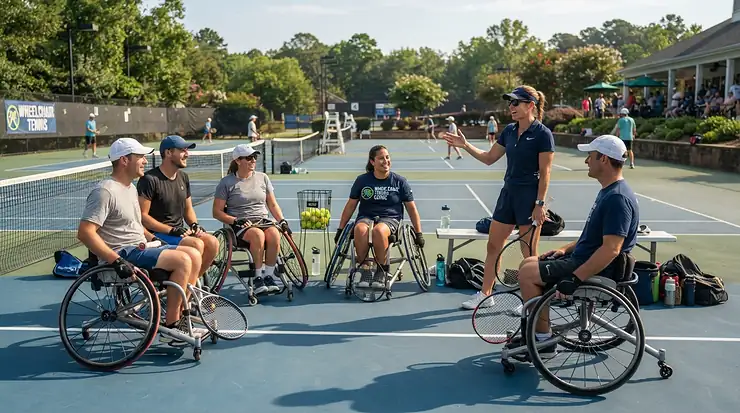
Here’s the thing nobody tells you on day one. Picking a wheelchair for casual tennis on hard courts isn’t about finding the fastest chair in the world. It’s about finding the one that keeps you upright, keeps you pushing, and doesn’t eat its own tires by Thanksgiving. 🎾
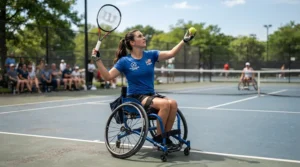
The timing is good. Wheelchair tennis turns 50 this year, and the ITF’s 50th-anniversary retrospective notes that Brad Parks founded the sport in California in 1976. It now spans 160-plus tournaments in 40-plus countries. Most of those players started out as weekend hitters, and that’s who this guide is for.
What is a wheelchair for casual tennis on hard courts?
A wheelchair for casual tennis on hard courts is a lightweight sport chair with cambered rear wheels, a rear anti-tip wheel and small front casters. It’s built for quick turns and stable stroke-making on asphalt or concrete surfaces. It trades everyday-chair features, such as folding frames and armrests, for agility, fit and durability.
Below, I compare seven real chairs, from entry-level multisport frames to premium made-to-measure builds. We’ll also cover lightweight tennis wheelchair options for club players, an adaptive tennis chair for beginners, why a tennis wheelchair with an anti-tip wheel matters, USTA wheelchair tennis, hard court tire wear and the two-bounce rule. Think of it as the conversation you’d have with a knowledgeable friend, minus the sales pitch.
Quick Comparison: 7 Chairs at a Glance
| Chair | Approx. Weight | Price Range (check current price) | Best For |
|---|---|---|---|
| Motivation Multisport | ~33 lb (15 kg, UK spec) | Entry level; kids’ version lists around $1,000-$1,600 | First-timers, loaner chairs, schools |
| Top End Pro-2 All Sport | Varies by size | Dealer-quoted; check current price | Clubs and multi-sport newcomers |
| Top End SportTN | Lightweight aluminum, custom | Mid-$3,000s base | Beginners ready to own a tennis chair |
| Top End Pro Tennis | 21-23 lb | Around $4,500-$5,000 | Regular club players |
| Quickie Match Point | Custom | Premium, dealer-quoted | Players who tinker with setup |
| RGK Grandslam | From ~20 lb (9 kg) | Premium, made to measure | Competitive-minded casual players |
| Top End T-5 7000 Series | ~16-20 lb by configuration | Premium, custom order | Players chasing the lightest build |
Looking at the table, the real dividing line isn’t brand. It’s whether the chair is a flexible multisport tool or a custom-fit tennis instrument. The Motivation Multisport and Top End Pro-2 All Sport win on getting you on court without a second mortgage. The Top End SportTN and Top End Pro Tennis are the sweet spot for players who’ve caught the bug. The Quickie Match Point, RGK Grandslam and Top End T-5 7000 Series reward you for knowing exactly what you want.
💬 Just one click — help others make better buying decisions too!😊
Top 7 Wheelchairs for Casual Tennis on Hard Courts: Expert Analysis
A quick honesty note before we dive in. Verified, tennis-specific user reviews for custom sport chairs are scarce, because these are built-to-order products from small dealer networks. Where I can’t verify real review data, I say so rather than invent it. Everything below rests on published specs, manufacturer and retailer documentation, and honest reasoning about what the numbers mean on court.
1. Motivation Multisport — the friendliest way to start
Its standout is the price-to-versatility ratio. This is a dedicated entry-level court chair with an aluminum frame, two sport mini casters up front and a sport anti-tip wheel at the rear. The brand says it was designed with both wheelchair basketball and ITF regulations in mind.
The spec sheet lists 24-inch pneumatic wheels and a removable toe guard. Pull the guard for tennis, and your feet and the racquet’s swing path get a lot more freedom. The UK adult version weighs roughly 15 kg, around 33 pounds. That’s noticeably heavier than the 20-ish pound premium builds below, which means more effort on every push and more fatigue in the third set.
Based on the spec comparison, this chair suits first-timers, schools and clubs that need several chairs in different sizes. Its common wheel and bearing sizes make repairs less painful, as trade coverage points out. I could not verify a meaningful pool of tennis-specific owner reviews, so treat durability claims as manufacturer-reported.
Pros:
- ✅ Lowest entry cost in this lineup
- ✅ Easy-to-replace parts and common sizes
- ✅ Works for tennis and other court sports
Cons:
- ❌ Heavier than purpose-built tennis chairs
- ❌ Less fine-tuned fit than custom builds
Price range: entry level, with the kids’ model listing around $1,000-$1,600 and the adult model priced separately. Check current price. Value verdict: excellent for trying the sport before committing.

2. Top End Pro-2 All Sport — the club-friendly multi-sport workhorse
The headline here is adjustability. It comes in five seat widths, from 10 to 18 inches, so one model can outfit a whole club roster. That’s the trick for programs and families sharing a chair.
The aluminum frame has adjustable seat depth, adjustable front and rear seat heights, and a back height range of roughly 11-14 inches. It ships with a removable single swivel anti-tip bar and 15 degrees of camber. Fifteen degrees widens the wheelbase, which gives you stability when you lean into a forehand and the ability to pivot without feeling like you’re steering a barge.
Who should care? Clubs, coaches and new players who aren’t sure whether tennis will become their sport. Invacare’s own materials pitch it at clubs and aspiring athletes, which tracks with the spec sheet. Public review data specific to tennis use is thin, so I can’t summarize genuine reviewer sentiment beyond saying that buyers should ask their dealer about demo options.
Pros:
- ✅ Five seat widths fit many bodies
- ✅ Removable anti-tip bar for flexibility
- ✅ Fixed 15° camber for stable turning
Cons:
- ❌ Not tennis-specific, so fewer tuning options
- ❌ Fixed camber limits later experimentation
Price range: dealer-quoted and configuration-dependent, so check current price. Value verdict: strong if you need versatility over perfection.
3. Top End SportTN — a purpose-built tennis frame without the premium sticker
Standout feature: it’s tennis-specific and aimed squarely at beginners. Top End describes it as built for teams, programs and athletes starting their tennis journey, with a handmade aluminum frame built in the USA.
It comes with a single adjustable-height anti-tip, over 30 color options and an order form that lets you specify the fit. In practice, that means you’re not stuck with a generic frame that sort of fits. A chair that hugs your trunk and hips makes pushing more efficient, because less energy leaks out through wobble.
The honest caveat is the custom-build model. Sport chairs ordered this way are typically non-returnable, and the order ships in roughly 30 days or less after you complete the form. Measure carefully, ideally with a dealer or therapist. Verified owner reviews weren’t available for me to aggregate, so I’ll say what’s verifiable: the maker’s positioning is clear, and the build approach matches how serious sport chairs are made.
Pros:
- ✅ Tennis-specific geometry at a friendlier price
- ✅ Custom fit and wide color choice
- ✅ Adjustable-height anti-tip wheel
Cons:
- ❌ Custom order, typically non-returnable
- ❌ About a month’s wait for delivery
Price range: mid-$3,000s for the base model, with options extra. Check current price. Value verdict: the best “first real tennis chair” in this guide.
4. Top End Pro Tennis — the club player’s adjustable all-rounder
The standout here is quick adjustability. Retailers describe it as a welded aluminum chair with tall or short frame options, high-pressure tires, aluminum handrims and fixed camber of 15, 18 or 20 degrees. Weight is listed around 21-23 pounds depending on the source, with a 250-pound capacity and a three-year warranty at one major retailer.
Why does adjustability matter for a casual player? Because your body changes. Your fitness improves, your technique evolves, and the chair should keep up. Quick-adjust seat and center-of-gravity settings mean you can tweak the setup in minutes rather than shipping the chair back to a builder. Higher camber, such as 20 degrees, makes turning snappier but widens the chair, so test your local court gate and your car trunk.
Here’s what the spec sheet won’t tell you, but reasoning from it suggests: this is the chair you grow into, not out of. Tennis-specific reviewer data wasn’t verifiable in the sources I reviewed.
Pros:
- ✅ Three camber options to match style
- ✅ Tall or short frame choices
- ✅ Weight near 21-23 lb for the class
Cons:
- ❌ Fixed camber once ordered
- ❌ Higher cost than entry-level multisport chairs
Price range: around $4,500-$5,000 for the base model. Check current price. Value verdict: worth it if you play weekly.
5. Quickie Match Point — the tinkerer’s chair
Standout feature: the patented center-of-mass adjustment. Sunrise Medical says it offers about 3.5 inches of center-of-gravity range and up to 5 inches of vertical seat adjustment without swapping fork, caster or stem parts.
In plain English, you can tune how tippy or how stable the chair feels, which matters more than people expect. Move the center of gravity forward and it turns quicker. Slide it back and it settles. Add a wide footprint and a long anti-tip tube, and you get stability when leaning for a wide ball or reaching into a serve. Camber comes in 16 or 20 degrees, with spoke or Spinergy sport wheels in 24 to 26 inches.
One retailer calls it the most agile manual sports wheelchair in its roundup and highlights stability when leaning forward or serving. That’s marketing-adjacent, so weigh it accordingly. The listings also use variant names, including a titanium version, so confirm the exact configuration with your dealer.
Pros:
- ✅ Center-of-gravity tuning without part swaps
- ✅ Wide footprint for leaning shots
- ✅ Long anti-tip tube for confidence
Cons:
- ❌ Premium dealer-quoted pricing
- ❌ Variant naming confuses shoppers
Price range: premium and dealer-quoted, so check current price. Value verdict: great for players who love dialing in setups.

6. RGK Grandslam — made-to-measure and feather-light
Its standout is the weight. RGK lists the frame from about 9 kg, roughly 20 pounds, for a 40 cm by 40 cm seat with standard wheels. The frame is 7020 aluminum with a 45 mm straight camber bar and camber options of 16, 18, 20 or 22 degrees.
The rest of the spec list reads like a tailor’s order form. You get a 61 mm sport castor, fixed or adjustable center of gravity, single or double anti-tip (fixed or removable) and a multi-adjustable knee support system. It’s also compatible with prosthetic fixings, which is a thoughtful touch for athletes with different needs.
Lower weight means less inertia, so each push translates into more movement and less shoulder fatigue. For club players logging two-hour sessions, that adds up. The retailer listing I found was Australian, so US buyers should confirm availability, service and warranty before ordering. No verifiable tennis-specific review sample turned up.
Pros:
- ✅ Around 20 lb with standard wheels
- ✅ Four camber options up to 22°
- ✅ Highly customizable anti-tip and knee supports
Cons:
- ❌ Premium, made-to-measure cost
- ❌ US availability needs confirming
Price range: premium and quote-based, so check current price. Value verdict: a “buy once, tune forever” chair for serious regulars.
7. Top End T-5 7000 Series — the lightest-build contender
The standout is its weight range. One US retailer lists 15 to 20 pounds depending on customization, with a 250-pound capacity and a 7000-series aluminum frame. Treat the exact figure as configuration-dependent.
Why does the T-5 matter? Invacare’s tennis lineage is long. Trade coverage notes its earlier three-wheel T-3 helped make three-wheel designs a sport standard. I can’t confirm the T-5’s wheel configuration from my sources, so ask your dealer, because it changes stability and turning feel.
Who should buy it? Players who’ve outgrown entry chairs and want to shave every pound. For casual hard court play, it’s arguably more chair than you need, but if you’re in a competitive club ladder, the efficiency gains are real. No verifiable aggregated tennis reviews were available.
Pros:
- ✅ Among the lightest options listed
- ✅ Dedicated tennis chair lineage
- ✅ 7000-series aluminum frame
Cons:
- ❌ Custom order and premium cost
- ❌ Wheel layout needs dealer confirmation
Price range: premium and quote-based, so check current price. Value verdict: best for committed regulars.
Specs That Matter: Side-by-Side
| Chair | Camber | Anti-Tip Setup | Customization |
|---|---|---|---|
| Motivation Multisport | Confirm with dealer | Single sport anti-tip wheel | Adjustable footrest and backrest |
| Top End Pro-2 All Sport | 15° | Removable single swivel bar | Five seat widths |
| Top End SportTN | Confirm at order | Single adjustable-height | Custom order form |
| Top End Pro Tennis | 15°, 18° or 20° | Anti-tippers | Tall or short frame |
| Quickie Match Point | 16° or 20° | Long anti-tip tube | Center-of-mass adjustment |
| RGK Grandslam | 16°-22° | Single or double, fixed or removable | Made to measure |
| Top End T-5 7000 Series | Confirm at order | Confirm at order | Custom build |
Read this table as a negotiation cheat sheet. The Top End Pro Tennis and RGK Grandslam give you the widest camber menu, while the Quickie Match Point is the only one here that advertises tool-free center-of-gravity tuning. If you’re a beginner, a camber that’s a little modest, like the 15 degrees on the Top End Pro-2 All Sport, is a feature rather than a flaw. It keeps the chair narrower and easier to live with.
✨ Ready to Hit the Court?
🔍 Take your game to the next level with these carefully selected chairs.Click on any highlighted product name to check current pricing and availability. The right fit will help you play longer, push easier and enjoy every rally with friends and family!
First 30 Days: Setup, Fit Checks and Court Habits
A new chair needs a settling-in period, and so do you. Tennis Australia’s wheelchair setup guide stresses that the goal is a chair that works with your body, and that more camber boosts stability and turning while less camber rolls easier in a straight line.
Start with fit. You should sit snugly, with your hips stable and your knees positioned so your trunk can rotate freely. Too loose and every stroke wobbles. Too tight and your breathing and circulation suffer. If you’re ordering a custom build such as the Top End SportTN or RGK Grandslam, bring a therapist or experienced coach to the fitting.
Then check the hardware weekly. Confirm the quick-release axles click firmly, the front casters spin freely and the anti-tip wheel sits at the right height. Hard court dust gets into everything, so wipe bearings and wheels after play. Tennis Australia’s guide notes you don’t need to oil or grease the chair, and I’d add that over-lubricating attracts grit.
Common mistakes in the first month include over-inflating tires, skipping the anti-tip check and cranking the camber higher than your technique can handle. Start moderate. You can always get more aggressive once your pushing becomes second nature. 💪

Case Studies: Three Players, Three Chairs
The weekend hitter (age 34, spinal cord injury, plays twice a month with friends). She wants to know if tennis will stick. A Motivation Multisport or Top End Pro-2 All Sport from a club loan program lets her find out for little commitment. If it sticks after a season, upgrading to the Top End SportTN is the logical next step.
The ladder climber (age 47, plays weekly at a club, mixed doubles). He pushes hard, wants his chair to feel like part of his body, and has noticed shoulder fatigue after long sessions. The Top End Pro Tennis gives him quick adjustments and camber options. If budget allows, the RGK Grandslam at around 20 pounds is the weight-saving dream.
The tinkerer (age 29, loves equipment, plays two or three times a week). She enjoys experimenting with setup, so the Quickie Match Point‘s center-of-mass system fits her personality. She tweaks, tests and tweaks again until every turn feels right.
None of these profiles needs the lightest chair on earth. They need the chair that matches how often they play, how much they enjoy tuning, and how much they can spend without regret.
Problem → Solution: Fixing the Most Common Hard Court Headaches
Problem: your tires are wearing unevenly. Solution: rotate wheels side to side, check pressure before each session and avoid skidding turns. More on this in the tire section below.
Problem: your chair feels tippy on serves. Solution: lower the anti-tip wheel height or move to a setup with a longer anti-tip tube. The Quickie Match Point and Top End SportTN both advertise adjustable approaches, but always adjust gradually.
Problem: your shoulders ache after 45 minutes. Solution: weight is the first suspect, but fit is the second. A chair that’s too wide forces awkward reach. A lighter option like the RGK Grandslam or Top End T-5 7000 Series may help, though technique and conditioning matter more than hardware.
Problem: the chair won’t fit in your car. Solution: quick-release wheels help, and remember that higher camber widens the chair. Measure your trunk before ordering.
Problem: friends want to play but you’re not sure how the bounces work. Solution: see the two-bounce explanation below, then stage a friendly one-up, one-down doubles match.
How to Choose a Wheelchair for Casual Tennis on Hard Courts
- Start with how often you play. Once a month? A loaner-style chair such as the Motivation Multisport is plenty. Weekly or more? Move into custom territory.
- Get measured. Seat width, depth and backrest height decide your comfort. A therapist or dealer fitting beats guesswork every time.
- Pick a camber range. More camber increases stability and turning but widens the chair. Beginners usually do well with moderate settings.
- Check the anti-tip setup. A rear anti-tip wheel that’s adjustable and secure protects you from backward tips during serves.
- Weigh the weight. Lighter chairs reduce effort, but the lightest builds cost the most.
- Plan for tires. Hard courts are abrasive. Budget for replacement tires and know their size before you buy.
- Confirm service. Ask where the chair gets serviced and how long parts take to arrive.
Lightweight Tennis Wheelchair for Club Players: What Weight Really Buys You
A lightweight tennis wheelchair for club players isn’t about bragging rights. It’s about energy economy. Every pound you don’t have to accelerate is a pound that doesn’t tax your shoulders on the fifth hard push of a rally.
The published numbers give you a ladder to climb. The Motivation Multisport sits around 33 pounds in its UK specification. The Top End Pro Tennis lands near 21-23 pounds. The RGK Grandslam starts at about 20 pounds, and the Top End T-5 7000 Series lists a configuration-dependent 15-20 pounds. That’s roughly a 13-pound spread from bottom to top.
Does that matter? On paper, a lighter chair accelerates faster and stops sooner. In practice, a poorly fitted lightweight chair can feel worse than a well-fitted heavier one. Frame stiffness and fit decide how efficiently your push reaches the wheels, a point custom builders emphasize in their own materials. If you’re a club regular, spend on fit first and grams second.
Adaptive Tennis Chair for Beginners: Start Here
An adaptive tennis chair for beginners should be forgiving, adjustable and affordable. Think of it like a rental car before buying: you learn what you need by driving it.
NCHPAD’s overview of wheelchair tennis explains that the wheelchair counts as part of your body under the rules, which means touching the net with the chair counts as touching it with you. Worth knowing before your first rally.
For equipment, the Motivation Multisport and Top End Pro-2 All Sport fit the “start here” brief best. Both are designed for clubs, schools and new athletes. The Top End SportTN is the step-up pick if you already know you’re hooked.
Beginners also benefit from slower balls. Red, orange and green balls are used to ease newcomers into the game, as the Challenged Athletes Foundation notes in its adaptive equipment overview. A softer ball plus a stable chair is the fastest way to fall in love with the sport.
Tennis Wheelchair With Anti-Tip Wheel: Why Casual Players Shouldn’t Skip It
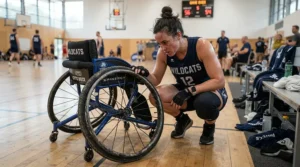
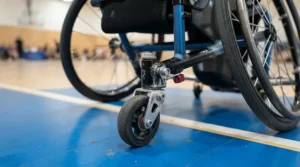
A tennis wheelchair with anti-tip wheel features one small component that does a very big job. The rear anti-tip wheel prevents backward tipping when you lean back to serve, reach overhead or get surprised by a high bounce.
Tennis Australia’s guide notes the anti-tip and front casters add stability and stop the chair toppling over. Invacare’s manual warns users not to shift their weight toward the direction they’re reaching, because the chair may tip.
Here’s the practical takeaway. Single anti-tip designs, like those on the Motivation Multisport and Top End SportTN, are light and simple. Double options, like those available on the RGK Grandslam, offer extra security. Removable versions, like the Top End Pro-2 All Sport, give flexibility but demand discipline. Never play with a loose or missing anti-tip. It’s a three-second check that prevents a very bad day. ⚠️
Hard Court Tire Wear: What Concrete Does to Your Rubber
Hard court tire wear is the hidden cost of casual tennis. Asphalt and acrylic-coated concrete are abrasive, and sport chairs turn in tight pivots that grind tread against the surface.
Tire makers don’t publish mileage figures for court use, so treat any claimed lifespan with suspicion. What the spec sheets do tell us is useful. The IRC Exeracer Pro uses a silica compound designed to balance grip with low rolling resistance and weighs about 255 grams in a 25 by 1 size. The Primo Racer is a popular alternative at around 315 grams per tire, rated up to about 110 psi. The Schwalbe Dunk King is built for indoor basketball floors and is directional, so installing it backwards can wear it down to its fabric layer within days, according to one retailer. That’s an indoor tire, so I’d think twice about using it on outdoor concrete.
Practical tips: rotate wheels, maintain recommended pressure, avoid skidding turns, and inspect for flat spots and cuts weekly. Expect to budget roughly $80 to $150 per pair for decent court tires. Bridgestone’s patent filings even note that tennis tires also run on wet surfaces, so drainage and grip matter outdoors.
USTA Wheelchair Tennis and the Two-Bounce Rule Explained
The two-bounce rule
The two-bounce rule is the one real rule difference in wheelchair tennis. The ball must be returned before it bounces a third time. The first bounce has to land in bounds, and the second may land anywhere. When a wheelchair player faces a stand-up player, only the wheelchair player gets two bounces. The able-bodied player still gets one.
The USTA’s own double-bounce explainer makes a point worth remembering: opponents who celebrate after a second bounce are in for a surprise, because the point isn’t over until a third bounce occurs for the wheelchair player.
USTA wheelchair tennis in practice
USTA wheelchair tennis is more accessible than most people assume. The USTA says the sport follows the same rules as stand-up tennis aside from the extra bounce, and that wheelchair players can compete in USTA team leagues alongside stand-up players. One-up, one-down doubles lets friends and family play together on equal footing.
At the server’s end, a wheelchair player must be stationary before serving, though one push is allowed before striking the ball. That’s a useful drill for your first month.
Sport Chair vs Everyday Chair: Can You Play in What You Already Own?
You can try, but you probably shouldn’t for long. Everyday chairs have low or zero camber, little lateral stability and no rear anti-tip tuned for court play. Invacare’s manual even describes its sport chairs as intended for sport use, not as a medical wheelchair for daily transport.
| Feature | Sport Tennis Chair | Everyday Chair |
|---|---|---|
| Camber | High (15°-22°) | Low (0°-4°) |
| Stability on court | Wide footprint, anti-tip tuned | Narrower, built for aisles |
| Weight | ~15-33 lb range | Varies, often heavier |
| Best For | Top End Pro Tennis, RGK Grandslam | Daily errands and transfers |
Think of the difference like running shoes versus dress shoes. Both get you across the room, but only one survives a sprint. Ultralight everyday models such as Ki Mobility’s Catalyst 5Vx, with its 0-4 degree camber range, are wonderful for life but won’t give you the stable platform a tennis chair delivers. If budget forces a compromise, try a loaner Motivation Multisport first.
Long-Term Cost & Maintenance: The Real Math
A chair is a capital purchase, and tires, bearings and cushions are the operating costs. An older USTA Midwest tip sheet put an average new sports chair around $2,500, but current quotes run well above that, so use today’s dealer pricing instead.
| Cost Item | Typical Range (check current price) | Notes |
|---|---|---|
| Entry multisport chair | Around $1,000-$2,000 | Motivation Multisport class |
| Tennis-specific chair | Mid-$3,000s to around $5,000 | Top End SportTN, Top End Pro Tennis |
| Premium custom chair | Dealer-quoted | RGK Grandslam, Quickie Match Point, Top End T-5 7000 Series |
| Court tires (per pair) | Around $80-$150 | Rotate regularly |
Spread a $4,500 chair across five years of weekly play and you’re paying less per session than a monthly gym membership, with better shoulders. Some custom-chair sellers note HSA/FSA eligibility for qualified customers, so ask your provider before buying. Tennis Australia’s guide suggests checking quick-release wheels, castors and anti-tip fixings regularly, which costs nothing but five minutes.
FAQ
❓ How much does a wheelchair for casual tennis on hard courts cost?
❓ Can I use my everyday chair for casual tennis?
❓ Are tennis wheelchairs covered by HSA or FSA accounts?
❓ Can able-bodied friends play against me?
❓ How often should I replace sport wheelchair tires on hard courts?
Conclusion
Choosing a wheelchair for casual tennis on hard courts comes down to honesty about how often you’ll play and how much you enjoy tinkering. If you’re just starting, the Motivation Multisport and Top End Pro-2 All Sport get you on court without drama. If tennis has hooked you, the Top End SportTN and Top End Pro Tennis are the sweet spot. If you’re chasing efficiency and tuning, the Quickie Match Point, RGK Grandslam and Top End T-5 7000 Series reward the extra investment.
Remember the basics: fit first, anti-tip always, tires rotated, and the two-bounce rule in your pocket. Your first rally will teach you more than any spec sheet. Go find a loaner, hit some balls and let the court decide. 🎾
✨ Don’t Miss Out on Your Perfect Fit!
🔍 Click any highlighted chair above to check current pricing and availability, then get measured and get playing. Your next great rally is waiting!
Recommended for You
- Adaptive Basketball Wheelchair For Recreational Leagues: 7 Best 2026
- Push Gloves For Wheelchair Athletes: 7 Essential Picks (2026)
- Lightweight Sport Wheelchair For Beginners: 7 Top Picks In 2026
Disclaimer: This article contains affiliate links. As an Amazon Associate, I earn from qualifying purchases. If you purchase products through these links, we may earn a small commission at no additional cost to you.
✨ Found this helpful? Share it with your friends! 💬🤗
