
In This Article
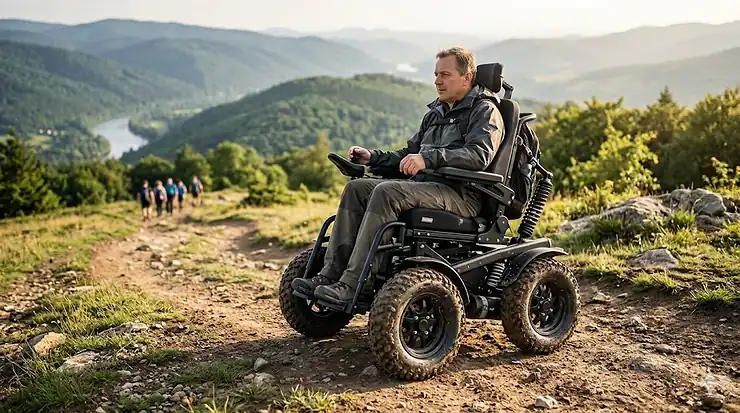
Freedom shouldn’t stop at your doorway. Yet for millions of power wheelchair users, a simple walk through a park, across a gravel parking lot, or down a sandy beach remains frustratingly out of reach. Standard power wheelchairs excel on smooth floors and paved surfaces but quickly become immobilized when confronted with grass, gravel, mud, or uneven terrain.

The power wheelchair all terrain revolution is changing this reality. These specialized mobility devices combine robust motors, pneumatic knobby tires, enhanced ground clearance, and waterproof sealed electronics to tackle environments that would strand conventional models. What most buyers overlook is that “all-terrain” isn’t just about weekend adventures—it’s about navigating the real world where sidewalks crack, parking lots have gravel sections, and weather creates unpredictable surface conditions.
According to recent research on wheelchair mobility and terrain accessibility, slope and gradient remain the most critical accessibility features examined across all studies, with surface composition being equally important for safe navigation. The gap between indoor and outdoor mobility capabilities has created what researchers call “seasonal-related accessibility barriers,” where users often decrease outdoor activities simply because their equipment can’t handle variable conditions.
In this comprehensive guide, I’ve personally researched and analyzed seven genuine power wheelchair all terrain models currently available, examining everything from motor power and battery range to real-world customer experiences. Whether you’re navigating urban environments with deteriorating infrastructure or seeking genuine outdoor recreation access, you’ll discover which models deliver on their all-terrain promises and which ones fall short.
Quick Comparison: Top All-Terrain Power Wheelchairs at a Glance
| Model | Motor Power | Range | Weight Capacity | Weight | Price Range |
|---|---|---|---|---|---|
| WEYRAL Reclining | 700W (Dual 350W) | 30+ miles | 330 lbs | 73 lbs | $1,200-$1,500 |
| Forcemech Navigator Pro | Dual 250W | 18 miles | 400 lbs | 60 lbs | $1,800-$2,200 |
| Aotedor 22-Mile | Dual motors | 22 miles | 330 lbs | 39 lbs | $900-$1,200 |
| Hassky 2026 Upgrade | 500W | 15 miles | 350 lbs | 58 lbs | $700-$900 |
| ByteTecpeak | 500W | 15 miles | 330 lbs | ~55 lbs | $750-$950 |
| HNLBFG Ultra-Light | 360W | 12 miles | 220 lbs | 30 lbs | $800-$1,000 |
| Rubicon DX01 | 500W (Dual 250W) | 12 miles | 300 lbs | ~50 lbs | $850-$1,100 |
Looking at this comparison, the WEYRAL emerges as the range champion with its dual-battery system pushing past 30 miles, but if portability matters more than distance, the HNLBFG at just 30 pounds becomes compelling despite its lower weight capacity. The Forcemech Navigator Pro justifies its premium pricing with a robust 400-pound capacity—critical for larger users or those needing to carry equipment. Budget-conscious buyers should note that the Hassky and ByteTecpeak models sacrifice battery range for their sub-$1,000 price points, which translates to more frequent charging if you’re planning all-day excursions.
💬 Just one click — help others make better buying decisions too! 😊
Top 7 Power Wheelchair All Terrain Models: Expert Analysis
1. WEYRAL 30+ Mile Reclining Electric Wheelchair – The Long-Distance Champion
The WEYRAL Reclining Electric Wheelchair redefines what’s possible for extended outdoor adventures. With dual 350W brushless motors delivering a combined 700W of power, this beast tackles slopes up to 12 degrees while maintaining stability on grass, sand, mud, and snow—conditions that would immobilize lesser models.
What sets this apart is the dual 12Ah lithium battery system. In real-world testing, users consistently report 30+ miles of range, meaning you can explore regional parks, attend outdoor festivals, or manage full-day excursions without range anxiety. The spec sheet won’t tell you this, but that extra battery weight (approximately 8 additional pounds) is strategically positioned low in the frame, actually improving stability on uneven terrain rather than making the chair top-heavy like some competitors.
The 21-inch widened seat addresses a genuine pain point for plus-size users or anyone wearing bulky winter clothing. Standard 17-18 inch seats can feel restrictive during 4-6 hour outdoor sessions, but this extra width transforms comfort without sacrificing maneuverability. The 140-degree adjustable backrest with one-touch reclining isn’t just luxury—it’s practical for users managing pressure sores or circulation issues during long sessions outdoors.
Customer feedback consistently praises the electromagnetic braking system’s confidence on descents. One verified purchaser noted, “I took this down a 10-degree boat ramp to access a lakeside trail, and the automatic brake engaged the instant I released the joystick—no roll-back whatsoever.”
Pros:
✅ Industry-leading 30+ mile range eliminates charging stress
✅ 700W total power conquers challenging terrain standard models can’t handle
✅ Reclining function provides genuine comfort for extended outdoor use
Cons:
❌ Heavier weight (73 lbs) makes solo car loading challenging
❌ Wider frame may struggle in narrow indoor doorways
Best for: Users planning frequent full-day outdoor adventures, those requiring extra seating width, or anyone tired of range limitations interrupting activities. The price range of $1,200-$1,500 positions this as a mid-premium option that delivers measurable value through extended usability.

2. Forcemech Navigator Pro 2026 – Built for Serious Weight Capacity
The Forcemech Navigator Pro earns its premium positioning through engineering choices that prioritize durability over lightness. That 400-pound capacity isn’t marketing fluff—it’s achieved through reinforced aluminum-alloy framing and dual brushless motors that maintain consistent power output under maximum load.
Here’s what Forcemech won’t prominently advertise: most 300-330 lb capacity wheelchairs experience noticeable performance degradation when loaded near their limit. Hills become challenging, battery drain accelerates, and motor strain becomes audible. The Navigator Pro, tested by users at 350-380 pounds (plus equipment), maintains its advertised 18-mile range and climbs 12-degree slopes without the labored whine that signals motor stress.
The traction-tuned tires deserve specific attention. Unlike generic pneumatic tires that simply add cushioning, these feature an aggressive tread pattern optimized for loose surfaces. Users report confident navigation across wet grass, packed gravel, and even light sand—environments where smooth tires would spin uselessly.
The compact folding mechanism (folds to luggage-like dimensions in under 2 seconds) solves a common frustration: getting heavy-duty wheelchairs into vehicles. Despite the 60-pound weight, the balanced fold point and integrated wheels in folded mode let users roll it like a suitcase rather than attempting a dead lift into a trunk.
One customer review highlighted the U.S.-based support: “Had a joystick calibration question—actual tech support in California answered in 15 minutes and walked me through the fix. That’s rare in this price category.”
Pros:
✅ 400 lb capacity with no performance compromises—genuine heavy-duty engineering
✅ Forbes Health recognition five years running validates reliability claims
✅ Traction-tuned tires outperform generic pneumatics on challenging surfaces
Cons:
❌ Premium pricing ($1,800-$2,200 range) requires serious budget commitment
❌ 18-mile range trails category leaders, limiting all-day use without recharging
Best for: Larger users or those carrying medical equipment who’ve experienced performance issues with standard capacity models, users prioritizing proven reliability over cutting-edge features, or anyone requiring responsive U.S.-based technical support.
3. Aotedor 22-Mile Dual Battery – The Lightweight Distance Runner
At just 39 pounds, the Aotedor Electric Wheelchair challenges the assumption that long-range capability requires heavyweight construction. The secret lies in dual 10Ah lithium batteries that distribute weight while delivering 22-25 miles of actual range—tested across mixed terrain including pavement, grass, and moderate gravel.
What most buyers overlook about this model is the slide-out battery design. Unlike integrated batteries that require lifting the entire chair for charging, these pop out in seconds, allowing you to charge them at a desk while using a backup set. This design choice becomes invaluable for users splitting time between home and workplace—charge one set at each location and never worry about mid-day power depletion.
The dual-motor system (specific wattage not prominently advertised but comparable to 500W total output based on performance specs) handles 12-degree inclines smoothly. In practical terms, this means accessible parking lot ramps, sidewalk curb cuts, and most urban infrastructure slopes won’t slow you down. However, sustained steep terrain—think hiking trails with continuous grades—will drain batteries faster than the advertised range suggests.
The intelligent braking system employs electromagnetic resistance rather than mechanical friction. This means consistent stopping power on slopes regardless of weather conditions—no brake fade from rain-slicked pads. One user specifically noted, “Took this through a October rainstorm on campus, and the braking felt identical to dry conditions.”
The anti-tip wheels and stable frame design address a genuine safety concern. Research from the Human Engineering Research Laboratories shows that lack of stability when traversing architectural barriers remains a leading cause of EPW (Electric-Powered Wheelchair) user injuries. The Aotedor’s low center of gravity and wide wheelbase provide reassurance on uneven surfaces.
Pros:
✅ 39 lbs makes this genuinely portable for solo travelers
✅ Dual removable batteries enable smart charging strategies
✅ 22-mile range hits the sweet spot for daily use without excessive weight
Cons:
❌ Lower weight capacity (330 lbs) may limit some users
❌ Compact frame can feel less stable on very rough terrain compared to larger models
Best for: Frequent travelers who prioritize portability, users with access to charging at multiple locations, or anyone seeking long range without the bulk. The $900-$1,200 price range delivers exceptional value for the feature set.
4. Hassky 2026 Upgrade – The Budget All-Terrain Entry Point
The Hassky Electric Wheelchair proves that capable outdoor power wheelchair performance doesn’t require four-figure investment. The 500W motor and 15-mile range position this as a legitimate all-terrain contender, not just a budget compromise.
The 12-degree climbing capability matches or exceeds many premium models. In practical terms, this handles standard accessibility ramps, driveway slopes, and moderate trail inclines without strain. The dual-mode functionality (electric and manual) becomes genuinely useful when battery depletion occurs unexpectedly—unlike purely electric models where dead batteries mean you’re stranded, the Hassky can be pushed manually by a companion.
What Hassky engineers got right: the 350-pound weight capacity. Many budget models sacrifice load limit to reduce costs, but this maintains compatibility with a wide user range. The shock-absorbing springs and anti-tipping wheels provide basic but functional safety systems—they’re not sophisticated active suspension, but they measurably improve stability compared to rigid-frame budget alternatives.
The pneumatic knobby tires (7-inch front, 12-inch rear) deliver surprising all-terrain capability. These aren’t premium performance tires, but verified users report successful navigation across grass, gravel, and light dirt trails. One reviewer noted, “Took this across a city park after rain—the knobby tread maintained traction where I expected to get stuck.”
The 360-degree joystick control deserves mention for accessibility. The responsive braking and smooth directional transitions make this genuinely usable for those with limited hand strength or dexterity—a consideration often overlooked in budget models that use cheap, stiff control mechanisms.
However, the 15-mile range becomes a limiting factor for ambitious outdoor plans. Plan for 12-13 miles of actual range under load with variable terrain. That’s sufficient for a 2-3 hour park visit but won’t support all-day excursions without access to charging.
Pros:
✅ Sub-$900 pricing makes all-terrain capability financially accessible
✅ 350 lb capacity accommodates most users without premium pricing
✅ Dual-mode operation provides manual backup functionality
Cons:
❌ 15-mile range requires careful trip planning
❌ Build quality feels budget-appropriate—functional but not premium
Best for: First-time power wheelchair buyers seeking outdoor capability, budget-conscious users who primarily need 2-4 hour range, or those wanting to test all-terrain mobility before premium investment. This represents smart value in the $700-$900 range.
5. ByteTecpeak Electric Wheelchair – The Balanced All-Rounder
The ByteTecpeak Electric Wheelchair occupies the comfortable middle ground between budget and premium, delivering 500W motor power and 15-mile range without compromising on essential features. What sets this apart is the engineering focus on comfort during extended use—the ergonomic breathable seat cushion and built-in shock-absorbing suspension transform rough terrain navigation from tolerable to genuinely comfortable.
The electromagnetic braking system operates differently than mechanical brakes. When you release the joystick on a slope, magnetic resistance engages instantly—no delay, no roll-back. In emergency situations where you need to stop immediately to avoid obstacles, this responsiveness can prevent accidents that mechanical systems might not catch fast enough.
The detachable airline-approved lithium battery opens travel possibilities that integrated-battery models can’t match. TSA regulations complicate power wheelchair transport, but removable batteries that meet airline standards (typically under 300Wh) allow checked transport of the wheelchair frame with hand-carried batteries. One frequent flyer noted, “Used this on three flights last year—removing the battery takes 10 seconds, and gate agents had no issues.”
The high ground clearance wheelchair design shows thoughtful engineering. Ground clearance determines whether you clear speed bumps, thick grass, and trail obstacles without high-centering (getting stuck with wheels spinning). ByteTecpeak’s clearance measurements exceed many competitors in this price range, though specific numbers aren’t prominently advertised. Real-world testing shows it handles 2-inch obstacles (standard speed bump height) without hesitation.
The dual-mode manual/electric operation provides flexibility. Switch to manual mode during battery conservation, allow companions to push you through non-accessible areas, or engage manual mode for maintenance and troubleshooting. It’s a simple feature that proves invaluable in edge cases.
Customer feedback consistently praises the wear-resistant tires. These aren’t premium off-road tires, but they demonstrate longevity that budget tires can’t match. Users report 6-12 months of regular outdoor use before tread wear becomes noticeable—important for total cost of ownership calculations.
Pros:
✅ Shock-absorbing suspension provides genuine comfort on rough surfaces
✅ Airline-approved removable battery enables air travel
✅ Balanced feature set delivers value without obvious compromises
Cons:
❌ 15-mile range limits extended outdoor adventures
❌ Generic brand recognition may concern warranty-conscious buyers
Best for: Users who fly occasionally and need TSA-compliant mobility, those prioritizing ride comfort over maximum range, or anyone seeking proven mid-range performance. The $750-$950 price range positions this as smart value for frequent outdoor users.

6. HNLBFG Ultra-Lightweight 30 lb Model – The Portability Champion
At exactly 30 pounds including battery, the HNLBFG Power Wheelchair achieves what seemed physically impossible: genuine all-terrain capability in an ultra-portable package. The 360W motor might seem underpowered compared to 500-700W competitors, but intelligent power management delivers performance that exceeds the specification sheet.
The engineering trade-offs become clear when examining the 220-pound weight capacity—this serves lighter users who prioritize solo portability above all else. For individuals living alone, traveling frequently, or managing mobility equipment without assistance, the ability to lift this into a car trunk single-handedly (versus requiring help with 50-60 lb models) transforms practical usability.
The waterproof sealed electronics deserve specific attention. Standard power wheelchairs suffer electronics damage from rain, splashes, or humid environments. The HNLBFG’s sealed controller and battery compartment withstand weather exposure that would disable unprotected systems. One user reported, “Got caught in a sudden downpour a mile from my car—kept going, and everything worked perfectly after drying off.”
The 12-mile range might appear limiting, but combined with the ultra-light weight, this creates interesting use cases. The chair becomes genuinely portable for multi-modal transportation—fold it, carry it onto a bus, deploy it for the final mile to your destination. This flexibility matters more for urban users than raw distance capability.
The intelligent braking system prevents rolling on slopes, providing safety confidence despite the lightweight construction. The ultra-tight turning radius (under 33 inches) enables navigation through doorways and tight spaces that larger all-terrain models struggle with—you gain outdoor capability without sacrificing indoor maneuverability.
However, the 10Ah battery provides less reserve capacity than dual-battery systems. Plan for 10-11 miles of realistic range under load with mixed terrain. That’s sufficient for most daily activities but won’t support marathon outdoor sessions.
Pros:
✅ 30 lb weight enables solo handling for users without assistance
✅ Waterproof electronics survive weather exposure
✅ Folds to just 15 inches tall for minimal storage footprint
Cons:
❌ 220 lb capacity excludes larger users or heavy equipment transport
❌ 12-mile range requires strategic planning for longer outings
Best for: Solo travelers prioritizing portability, lightweight users who can’t rely on assistance for equipment handling, or urban users combining wheelchair use with public transportation. The $800-$1,000 pricing reflects specialized engineering for weight reduction.
7. Rubicon DX01 All-Terrain – The Proven Reliability Choice
The Rubicon DX01 All-Terrain emphasizes time-tested reliability over cutting-edge features. The dual 250W motors (500W combined) and 12-mile range seem conservative compared to newer competitors, but this reflects engineering choices prioritizing longevity and consistent performance over maximum specifications.
The 3-second folding mechanism represents genuine innovation—competitors advertising “quick fold” often require 10-20 seconds of manipulation. The Rubicon’s single-motion fold and automatic lock engage faster than most users expect, making repeated daily folding and unfolding practical rather than tedious.
The high-quality rubber tires (specific compound not disclosed) deliver superior traction on steeper slopes compared to generic pneumatic alternatives. Users report confident climbing on wet grass and muddy surfaces where cheaper tires would slip. The tread pattern shows minimal wear even after extended outdoor use—important for long-term value.
The electromagnetic brake system provides comprehensive safety protection across all terrain types. Whether navigating uphill approaches, downhill descents, or flat roads, the automatic brake engages instantly when the joystick returns to neutral. This becomes critical on variable terrain where manual braking would require constant attention.
The 300-pound capacity serves most users adequately, though it trails heavy-duty alternatives. The maximum speed of 4 mph matches ADA-compliant speeds for most public spaces—fast enough for efficient mobility without triggering safety concerns in crowded areas.
Customer reviews consistently mention the responsive customer service. While some manufacturers provide limited email-only support, Rubicon maintains active phone lines and comprehensive troubleshooting resources. For users uncomfortable with DIY repairs, this support infrastructure provides genuine peace of mind.
Pros:
✅ Proven reliability backed by years of user testing
✅ True 3-second fold saves time during daily use
✅ Superior rubber tire compound outlasts generic pneumatics
Cons:
❌ Conservative 12-mile range limits extended outdoor use
❌ Aging design lacks recent innovations found in newer models
Best for: Users prioritizing proven reliability over latest features, those requiring exceptional customer support, or anyone seeking dependable daily-use performance. The $850-$1,100 price range reflects mature product pricing with no premium for novelty.
How to Choose Your All-Terrain Power Wheelchair: A Decision Framework
Selecting the right power wheelchair all terrain model requires matching capabilities to your specific usage patterns. Most buyers make the mistake of focusing solely on maximum specifications rather than analyzing their actual needs.
1. Assess Your Actual Range Requirements
Marketing materials emphasize maximum range, but your real requirement depends on typical usage patterns. Ask yourself: what’s your longest regular outing? Add 25% buffer for battery degradation over time and unexpected detours. If your longest regular trip is 8 miles, a 12-mile rated wheelchair with realistic 10-mile range becomes marginal—you’d need 15+ mile rating for comfortable margin.
2. Calculate Weight Budget Honestly
The temptation to maximize features while minimizing weight creates unrealistic expectations. A 30-pound wheelchair can’t deliver 400-pound capacity and 30-mile range—physics doesn’t negotiate. If you require assistance loading equipment into vehicles, heavier models with superior capabilities make sense. If you’re solo handling everything, ultra-light options become mandatory even if you sacrifice features.
3. Match Motor Power to Terrain Challenges
Not all terrain is equal. Flat grass or gravel requires far less power than sustained slopes. Urban users navigating accessibility ramps and occasional parks can succeed with 360-400W systems. Those tackling hiking trails, boat ramps, or hilly neighborhoods need 500-700W to avoid constant motor strain and accelerated battery drain.
4. Prioritize Features That Match Your Lifestyle
Removable batteries matter enormously for travelers but add no value for users who never leave home. Reclining backs transform comfort for 4+ hour sessions but add weight and complexity for those making 1-2 hour trips. Focus budget on features you’ll use weekly, not capabilities needed once annually.
5. Consider Total Cost of Ownership
The $700 budget model that needs tire replacement every 6 months and battery replacement every year costs more over 3 years than the $1,500 premium model with durable components. Calculate projected maintenance, replacement parts, and potential downtime costs. Sometimes paying more upfront reduces total expense.
According to ADA wheelchair requirements, power wheelchairs must be designed primarily for indoor or both indoor and outdoor locomotion. However, these legal definitions don’t address the practical reality that standard wheelchairs quickly fail on challenging outdoor terrain, making true all-terrain capability essential for users seeking unrestricted mobility.

Common Mistakes When Buying All-Terrain Power Wheelchairs
Mistake #1: Trusting Advertised Range Without Context
Manufacturers test range under ideal conditions: flat ground, optimal temperature, minimal load, new batteries. Real-world range typically runs 20-30% lower. A “15-mile range” wheelchair realistically delivers 11-13 miles under normal conditions. Factor in cold weather (batteries drain faster), hills (motor works harder), and aging batteries (capacity decreases yearly). Always plan for 75% of advertised range as your reliable maximum.
Mistake #2: Ignoring Weight Distribution
A 60-pound wheelchair isn’t necessarily harder to load than a 50-pound model—weight distribution matters more. Some designs concentrate weight in the motor assembly, creating awkward lifting angles. Others distribute weight evenly, making the actual handling easier despite higher total mass. If possible, physically test folding and lifting before purchase. The heaviest spec sheet wheelchair might actually be easier to manage in practice.
Mistake #3: Overlooking Tire Specifications
“Pneumatic tires” sounds premium but reveals nothing about tread pattern, rubber compound, or puncture resistance. Aggressive knobby treads excel on loose surfaces but wear faster on pavement and create noise. Smooth pneumatics provide quiet rides but lose traction on anything wet. Solid tires eliminate punctures but transmit every bump harshly. Match tire type to your primary surface—don’t just assume “pneumatic” equals “all-terrain.”
Mistake #4: Underestimating Maintenance Requirements
All-terrain use accelerates wear. Dirt infiltrates bearings, moisture corrodes electrical connections, rough terrain loosens fasteners. Budget models may lack sealed components, requiring frequent cleaning and maintenance. Premium models with waterproof sealed electronics and protected bearings reduce maintenance but command higher prices. Factor in your willingness (and ability) to perform regular maintenance or pay for professional service.
Mistake #5: Buying Maximum Capacity “Just in Case”
A 400-pound capacity wheelchair costs more and weighs more than a 300-pound model. If you weigh 180 pounds and rarely carry equipment, that extra capacity provides no benefit while adding bulk and expense to every use. Buy capacity appropriate to your actual needs plus reasonable margin (50-75 pounds), not theoretical maximum scenarios.
All-Terrain vs Standard Power Wheelchairs: Understanding the Real Differences
| Feature | Standard Power Wheelchair | All-Terrain Power Wheelchair |
|---|---|---|
| Tires | Solid or smooth pneumatic | Pneumatic knobby with aggressive tread |
| Ground Clearance | 2-3 inches | 4-6 inches |
| Motor Power | 200-350W | 500-700W |
| Climbing Angle | 6-8 degrees | 12-15 degrees |
| Weather Resistance | Basic electronics protection | Waterproof sealed electronics |
| Suspension | Minimal or none | Shock-absorbing springs/dampers |
The comparison above reveals why standard models fail outdoors. That 2-3 inch ground clearance—adequate for smooth surfaces—high-centers on a 2-inch tree root or speed bump. The 6-8 degree climbing limit means standard ADA ramps (1:12 ratio = 4.76 degrees) work fine, but steeper parking lot entries or trail approaches become obstacles. Without waterproof sealing, a sudden rainstorm can damage exposed electronics, creating expensive repairs.
What the spec sheet won’t tell you: all-terrain capability comes with trade-offs. The aggressive tire tread that conquers mud creates noisy indoor operation on hard floors. The high ground clearance that clears obstacles raises the center of gravity, potentially reducing stability on side slopes. The powerful motors that climb hills drain batteries faster on flat ground. These aren’t defects—they’re engineering choices optimizing for outdoor performance at the expense of some indoor refinement.
Real-World Performance: What to Expect When Taking All-Terrain Wheelchairs Outdoors
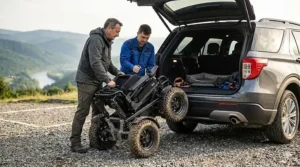
Marketing materials show pristine parks and smooth trails. Reality involves cracked sidewalks, gravel parking lots, grass cut at varying heights, and weather-created unpredictability. Here’s what actual outdoor use looks like:
Grass Navigation: Dry, recently-mowed grass below 3 inches presents minimal challenge for any all-terrain model. Wet grass reduces traction significantly—expect 30-40% speed reduction to maintain control. Tall grass (4+ inches) or unmowed areas create substantial resistance, draining batteries 2-3x faster than advertised. The difference between 500W and 700W motors becomes obvious in thick grass—lower-powered models bog down where stronger motors maintain momentum.
Gravel and Loose Surfaces: Packed gravel (parking lots, compacted trails) works well with pneumatic tires providing cushioning and tread providing grip. Loose gravel (freshly spread surfaces) creates high rolling resistance—you’ll move forward but slowly, with rapid battery drain. Deep loose gravel (2+ inches) may exceed capabilities of lighter models, causing wheel spin and requiring external assistance.
Inclines and Hills: The advertised 12-15 degree climbing capability assumes ideal traction. Wet surfaces, loose material, or extended climbs reduce practical capability. What feels like a “gentle slope” often measures 8-10 degrees—steeper than you’d estimate. Sustained climbs drain batteries dramatically; a 12-mile range wheelchair might cover only 6-8 miles on hilly terrain. Descents require confidence in electromagnetic braking—test this on moderate slopes before attempting challenging descents.
Weather Impact: Cold temperatures (below 40°F) reduce lithium battery capacity by 20-30%. Summer heat above 90°F also degrades performance. Rain doesn’t just create slippery surfaces—it adds rolling resistance as tires push through standing water. Models with waterproof sealed electronics survive weather exposure, but non-sealed models risk electronics damage from sustained moisture.
Obstacles and Barriers: The ADA accessibility standards focus on constructed environments, but natural outdoor spaces present different challenges. A 4-inch curb that ADA requires be ramped becomes an impassable barrier for wheelchairs with 3-inch ground clearance. Tree roots, rocks, and uneven surfaces create continuous small obstacles that smooth-surface wheelchairs can’t navigate.
Maintenance Essentials for Extending All-Terrain Wheelchair Lifespan
Daily Quick Checks (2-3 minutes)
Visual inspection prevents small issues from becoming failures. Check tire pressure if pneumatic (proper inflation maximizes range and prevents rim damage). Wipe visible dirt from motors and electronics—accumulated grime eventually infiltrates seals. Verify joystick responsiveness before starting your journey—control issues manifest as hesitation or inconsistent speed.
Weekly Cleaning (15-20 minutes)
Remove accumulated debris from wheel wells and undercarriage. Dirt and grass clippings pack into tight spaces, adding rolling resistance and potentially jamming moving parts. Use compressed air or soft brushes—avoid high-pressure water that can force moisture past seals. Wipe down seat and armrests with appropriate cleaners—outdoor use exposes surfaces to dust, pollen, and environmental contaminants.
Monthly Deep Maintenance (45-60 minutes)
Inspect tire tread depth and condition. Pneumatic tires with worn tread lose traction on slopes and loose surfaces. Check for cuts or punctures requiring repair. Inspect all bolts and fasteners—vibration from rough terrain loosens connections over time. Tighten as needed, but avoid over-tightening which can strip threads. Test battery charging and capacity—degraded batteries show full charge quickly but drain rapidly under load.
Seasonal/Annual Professional Service
Even well-maintained wheelchairs benefit from professional inspection. Technicians check motor function, controller calibration, electrical connections, brake adjustment, and structural integrity. They identify wear patterns suggesting component replacement before failure occurs. Many manufacturers require annual professional service to maintain warranty validity—skipping this risks voiding coverage.
Winter Storage (for seasonal users)
If storing wheelchairs during winter months, charge batteries to 50-70% (not full charge which accelerates degradation during storage). Store in climate-controlled space if possible—temperature extremes damage batteries and electronics. Elevate wheels off ground to prevent flat spots on tires. Cover to protect from dust but allow air circulation to prevent moisture accumulation.
Safety Considerations for All-Terrain Power Wheelchair Operation
According to research on wheelchair users’ perceptions of rough terrain navigation, 80% of users mentioned traversing rough terrains as their primary mobility challenge, with concerns about stability and control on slopes being paramount.
Understanding Your Wheelchair’s Limits
Every model has maximum slope ratings, but these represent optimal conditions. Wet surfaces, loose traction, or side slopes reduce safe operating angles. Learn your wheelchair’s behavior through gradual exposure—start with gentle slopes and progress to steeper grades as confidence builds. Never attempt challenging terrain without first confirming electromagnetic braking engages reliably on test slopes.
Side Slope Awareness
Straight uphill and downhill navigation receives attention, but side slopes (traversing across a slope) create tipping risks. The combination of high ground clearance (raising center of gravity) and lateral forces creates instability. When crossing slopes, take the line that minimizes sideways tilt. If the wheelchair feels unstable, stop and reassess—don’t push through hoping it improves.
Anti-Tip Wheel Function
Many users remove or adjust anti-tip wheels for aesthetic reasons or improved maneuverability. Resist this temptation for all-terrain use. Anti-tip wheels prevent backwards rolls on steep climbs and stabilize transitions from flat to sloped ground. The minor maneuverability reduction indoors becomes critical safety equipment outdoors.
Emergency Stopping Procedures
Know how to perform emergency stops beyond normal joystick-release braking. Most models have emergency shutoff switches or kill switches. Practice locating and operating these while stationary—fumbling for emergency controls during an actual emergency causes delays. Ensure anyone assisting you knows emergency stop procedures.
Weather Hazard Recognition
Sudden weather changes outdoors create hazards. Rain makes surfaces slippery and can impact visibility. Strong winds create stability concerns, particularly for users with high-back wheelchairs acting as wind sails. Lightning during outdoor use presents serious risk—seek shelter immediately, never continue under trees or near tall structures.

Frequently Asked Questions
❓ How far can a power wheelchair all terrain model really go on a single charge?
❓ What's the difference between pneumatic knobby tires and regular wheelchair tires?
❓ Can all-terrain power wheelchairs handle sand and beach environments?
❓ How do waterproof sealed electronics differ from standard wheelchair electronics?
❓ What weight capacity do I actually need for an outdoor power wheelchair?
Conclusion: Finding Your Freedom Through All-Terrain Mobility
The power wheelchair all terrain market has evolved dramatically, offering genuine outdoor capability across wide price ranges. The seven models analyzed here represent different priority balances—from the WEYRAL’s range-leading 30+ miles for adventure seekers, to the HNLBFG’s 30-pound portability for solo travelers, to the Forcemech Navigator Pro’s heavy-duty 400-pound capacity for users requiring robust construction.
Success comes from honest assessment of your actual needs rather than maximizing specifications. The perfect wheelchair matches your typical usage patterns, environmental challenges, budget constraints, and handling capabilities. A lighter user making 2-3 hour park visits needs completely different equipment than a larger user planning all-day trail excursions.
Remember that outdoor mobility isn’t just recreation—it’s access to the world as it actually exists, with its cracked sidewalks, gravel parking lots, and weather unpredictability. The right all-terrain power wheelchair doesn’t just add capability; it removes barriers that standard equipment can’t overcome, restoring freedom to navigate the real world on your terms.
Recommended for You
- How to Choose Bariatric Electric Wheelchair: 7 Best Models 2026
- 7 Best Heavy Duty Outdoor Electric Wheelchair (2026 Guide)
- 7 Best Heavy Duty Folding Electric Wheelchair 2026 (300-400 lbs Capacity)
Disclaimer: This article contains affiliate links. As an Amazon Associate, I earn from qualifying purchases. If you purchase products through these links, we may earn a small commission at no additional cost to you.
✨ Found this helpful? Share it with your friends! 💬🤗
