

In This Article
Imagine the frustration of watching your family build sandcastles while you’re stuck on the boardwalk, unable to navigate the soft sand that standard wheelchairs sink into within seconds. For the 61 million Americans living with mobility challenges, beach access has historically meant choosing between staying behind or relying on someone to push you through exhausting terrain. That reality changed when engineers developed the beach wheelchair electric—specialized mobility devices that combine flotation tire design with electric power to conquer sand like a four-wheel-drive vehicle tackles mud.
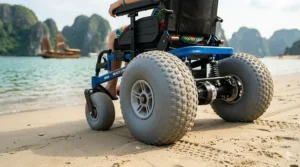
Unlike conventional power wheelchairs that get buried axle-deep in beach sand, electric beach wheelchairs feature wide balloon tires that distribute weight across a larger surface area, preventing that sinking sensation. The motorized component means you control your own movement via joystick—no more depending on a companion’s stamina or dealing with the awkwardness of needing assistance. What most buyers don’t realize is that only a handful of models actually qualify as true electric beach wheelchairs; many marketed options are manual chairs with balloon tires that still require someone to push.
The game-changer? Models like the Sand Helper Beach Power Chair deliver genuine four-wheel-drive capability with dual 48V motors specifically engineered for sand navigation. Meanwhile, all-terrain electric wheelchairs from brands like Rubicon and Aotedor offer sand compatibility as part of broader outdoor performance. This guide cuts through the marketing confusion to identify which models actually work on beaches, what specs matter most, and how to match your specific needs—whether you’re planning occasional family beach trips or you live steps from the shore and need daily sand access.
Quick Comparison: Top Beach Wheelchair Electric Models
| Model | Power Type | Weight Capacity | Terrain Rating | Best For | Price Range |
|---|---|---|---|---|---|
| Sand Helper Beach Power Chair | Dual 48V 1200W motors | 600 lbs | Beach-specific | Dedicated beach use | $17,000-$19,000 |
| Rubicon DX08 | Dual 250W motors | 330 lbs | All-terrain | Multi-surface versatility | $1,300-$1,600 |
| Aotedor 22-Mile Range | Dual 10Ah lithium | 220-330 lbs | All-terrain | Budget long-range | $900-$1,200 |
| HIPPOCAMPE Medium | Manual (push) | 220 lbs | Beach/water | Water entry capability | $3,500-$4,200 |
| Fields WC-1 | Manual (push) | 250 lbs | Beach/sand | Portable manual option | $600-$800 |
| Wheeleez Sandcruiser | Manual (push) | 250-330 lbs | Beach/trails | Premium manual build | $2,200-$2,800 |
| AccessRec TerraWheels | Manual (push) | 300 lbs | Beach/outdoor | Wide seat comfort | $800-$1,100 |
Looking at this comparison, the Sand Helper stands alone as the only true electric beach wheelchair purpose-built for sand, justifying its premium price with dual motors and 600-pound capacity. For those needing electric power but also using the chair on pavement, grass, and indoor spaces, the Rubicon DX08 delivers better versatility at one-tenth the cost—though you’ll sacrifice some sand performance. The manual options (HIPPOCAMPE, Fields, Wheeleez, AccessRec) require a companion to push but offer lightweight portability and dramatically lower price points, making them ideal for occasional beach trips rather than independent daily use.
💬 Just one click — help others make better buying decisions too!😊
Top 7 Beach Wheelchair Electric Options: Expert Analysis
1. Sand Helper Beach Power Chair – The Gold Standard for Electric Beach Access
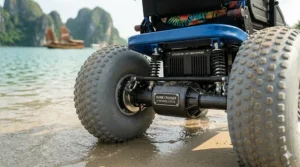
The Sand Helper Beach Power Chair represents what happens when engineers tackle beach mobility as a dedicated problem rather than an afterthought. This isn’t a standard power wheelchair with wider tires—it’s a purpose-built sand vehicle that happens to accommodate wheelchair users. The dual 48V 1200W motors deliver torque comparable to an electric golf cart, turning 21-inch diameter balloon tires that literally float over soft sand without sinking. Where standard electric wheelchairs bog down after two feet of beach entry, the Sand Helper cruises effortlessly right to the waterline.
What the spec sheet won’t tell you is how the four-wheel-drive system distributes power. Each rear wheel gets independent motor control, meaning if one side starts slipping in softer sand, the opposite motor compensates automatically—similar to how a Jeep’s differential lock works. The two 48V 20Ah lithium batteries provide 6-8 miles of range, which translates to multiple trips from parking lot to shoreline plus hours of beach lounging without needing a recharge. The captain’s seat sits 27 inches off the ground, higher than most power wheelchairs, giving you sightlines over beach crowds.
Here’s the reality check: at around $18,000, this chair costs more than many used cars. But for coastal residents or vacation property owners who’d otherwise rent beach wheelchairs weekly at $200-$400 per week, the Sand Helper pays for itself within a year or two of frequent use. One Maryland owner reported using theirs 4-5 times weekly from May through September—that’s 80+ beach visits annually at zero ongoing rental cost.
Customer feedback consistently praises the independent operation. “First time in twelve years I didn’t need my husband to push me through sand,” one reviewer noted. The downside? This beast weighs 440 pounds and won’t fit through standard doorways due to the wide tire stance, so storage requires outdoor space or a garage.
Pros:
✅ True four-wheel-drive electric operation on sand
✅ 600-pound weight capacity supports larger users
✅ Dual batteries extend range for all-day beach trips
Cons:
❌ $17,000-$19,000 price point limits accessibility
❌ 440-pound weight makes transportation challenging
Price Range: Around $17,999-$18,999. Best for: coastal residents planning frequent beach use who need independent mobility and can accommodate the storage/transport requirements.
2. Rubicon DX08 – All-Terrain Versatility Meets Beach Capability
The Rubicon DX08 takes a different approach: instead of beach-specific engineering, it’s an all-terrain electric wheelchair that handles sand competently as one of many surfaces. The dual 250W motors (500W total) provide enough torque to climb 12-degree slopes and navigate packed sand, though soft powder sand near the dunes will slow you down compared to the Sand Helper’s raw power. What makes this compelling is the price—at around $1,400, you’re getting an electric wheelchair that works on sidewalks, grass, gravel, indoor spaces, and yes, firmer beach sand.
The 20-mile range from the lithium-ion battery means you can use this as your daily chair for shopping, medical appointments, and recreational outings, then take it to the beach on weekends without needing a second specialized chair. The foldable design collapses in three seconds to just 13 inches high, fitting in most car trunks—something the 440-pound Sand Helper cannot claim. At 64 pounds with battery, it’s manageable for one person to load into a vehicle.
Beach performance sits in the “functional but not exceptional” zone. On hard-packed wet sand near the waterline, the Rubicon DX08 cruises smoothly at its 4-5 mph top speed. Venture into the drier, softer sand 30 feet up the beach, and you’ll notice the motors working harder, speed dropping to 2-3 mph, and occasional wheel spin. The puncture-free solid tires eliminate flat risks but don’t provide the same flotation as true balloon tires, so weight distribution matters—heavier users may experience more sinking.
One Massachusetts buyer uses theirs for Cape Cod beach access three times weekly during summer: “Gets me from the parking lot to my favorite spot without issue, but I stick to the firmer sand closer to the water. If you’re trying to reach a spot in the deep soft stuff, this’ll struggle.” The electromagnetic brake prevents rollback on slopes, critical for beach access ramps.
Pros:
✅ Multi-surface capability (beach, pavement, grass, indoor)
✅ Foldable design fits car trunks for easy transport
✅ Affordable $1,300-$1,600 price point
Cons:
❌ Struggles in deep soft sand away from waterline
❌ 330-pound weight limit excludes some users
Price Range: In the $1,300-$1,600 range. Best for: users needing one chair for all environments including occasional beach trips, prioritizing versatility over specialized sand performance.
3. Aotedor 22-Mile Range Electric Wheelchair – Budget Electric Option with Beach Viability
The Aotedor 22-Mile Range model appeals to budget-conscious buyers who need electric power but can’t justify $1,500+ for specialized features. At around $900-$1,200, this ultra-lightweight chair (39 pounds without battery) delivers dual 10Ah lithium batteries that genuinely provide 20-22 miles under ideal conditions—real-world beach use with soft sand resistance will drop that to 15-18 miles, still impressive.
Beach performance mirrors the Rubicon: functional on packed sand, labored in soft powder. The dual brushless motors provide smooth, quiet operation compared to older brushed motor designs, and the 220-330 pound capacity (depending on model variant) accommodates most users. What buyers often overlook is the weight capacity directly impacts sand performance—a 200-pound user will experience better mobility than someone pushing the 330-pound limit, simply due to weight distribution physics on soft surfaces.
The one-step folding mechanism is legitimately fast—press a button, collapse forward, done in under five seconds. This portability makes it practical for families taking beach vacations where you’re flying to the destination and renting a vehicle. The airline-approved battery (under 300Wh for travel models) means you can check this chair or gate-check it depending on airline policies.
Customers report solid reliability for the first 6-12 months, with some electronics issues emerging after heavy use. One Arizona senior noted: “Used it daily for six months before the controller started acting weird. Customer service replaced it under warranty, but expect to deal with some quality control variance at this price point.” The three-year frame warranty and lifetime accessory support provide peace of mind that’s uncommon in budget mobility equipment.
Pros:
✅ Ultra-light 39 pounds makes single-person transport easy
✅ 20-22 mile range handles all-day outings
✅ Budget-friendly $900-$1,200 pricing
Cons:
❌ Quality control variance; some units develop issues after 6-12 months
❌ Limited sand capability compared to specialized beach chairs
Price Range: Around $900-$1,200. Best for: budget-conscious users needing occasional beach access as part of broader all-terrain use, prioritizing portability and long range over heavy-duty construction.
4. HIPPOCAMPE All Terrain Beach Wheelchair – Manual Innovation for Water Entry
The HIPPOCAMPE All Terrain Beach Wheelchair shifts gears entirely—this is a manual push chair, not electric, but it deserves inclusion for one game-changing feature: it floats. At 31 pounds, the aluminum construction combined with innovative double-width balloon wheels allows users to enter shallow water (up to waist-deep) while remaining seated, then float like a kayak while swimming alongside. No other wheelchair in this guide offers that capability.
The double-width wheels spread weight so effectively that pushers report less effort than standard wheelchairs on pavement when navigating dry sand. The 220-pound weight capacity is lower than competitors, but the aluminum tubes are sleeved to prevent heat absorption in direct sunlight—a detail that matters when you’re sitting in a metal chair under August sun for hours. All components float individually if disassembled, reducing drowning risk if equipment separates in water.
This isn’t electric, so you’re dependent on a companion to push. But for families with young children who can’t operate complex electric controls, or users who have upper body strength to self-propel on firm surfaces but need pushing assistance on sand, the manual design removes battery anxiety and electrical component corrosion concerns. One Florida family uses theirs weekly: “My teenage son pushes me through the sand easily—the wheels really do make it effortless. We go in the water together, and I’m not stuck on shore watching everyone else swim.”
Assembly takes under one minute without tools, and the disassembled components fit in a large beach bag or car trunk. The $3,500-$4,200 price point reflects the specialized engineering and marine-grade materials, positioning it between budget manual beach chairs ($600-$800) and premium manual models ($2,200-$2,800).
Pros:
✅ Floats in water for swimming participation
✅ Only 31 pounds allows easy solo transport
✅ Sleeved aluminum prevents heat buildup
Cons:
❌ Manual operation requires pusher/companion
❌ 220-pound capacity excludes larger users
Price Range: In the $3,500-$4,200 range. Best for: users prioritizing water entry capability and lightweight portability, comfortable with manual push operation, especially families with able-bodied companions available to assist.
5. Fields Outdoor Supplies WC-1 Beach Wheelchair – Budget Manual Workhorse
The Fields Outdoor WC-1 represents the entry-level beach wheelchair category—manual push operation, basic construction, but genuinely functional 12-inch balloon tires that navigate soft sand effectively when someone provides pushing power. At around $600-$800, this is the most affordable option in our lineup, making beach access financially viable for families who can’t justify $3,000+ for specialized equipment.
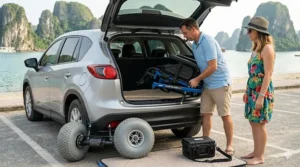
The healthcare-grade PVC construction won’t rust or corrode in saltwater environments, addressing the biggest failure point for beach equipment. Stainless steel and aluminum hardware reinforces this corrosion resistance. The 250-pound weight capacity sits comfortably in the middle range, and at 49 pounds fully assembled, one person can lift it into an SUV or truck bed without assistance. The real appeal is the 5-10 minute tool-free assembly—you receive it in pieces, snap the components together using connector pins, and you’re beach-ready.
Beach performance depends entirely on your pusher’s strength. The 12-inch balloon tires provide adequate flotation to prevent sinking, but navigating 100 yards of soft sand to reach the waterline will tire out most pushers. One reviewer noted: “My wife can push me about 50 feet before needing a break. We bring a friend or family member on beach days who can tag-team the pushing.” The mesh seat and folding footrest provide basic comfort for 2-3 hour beach sessions, though all-day use might require additional cushioning.
The carry bag included with purchase makes transport and storage cleaner—no sand permanently embedded in your vehicle. This chair targets families who beach 5-10 times per summer rather than weekly users. For occasional vacation trips or seasonal recreation, it delivers functional performance without breaking the bank.
Pros:
✅ $600-$800 entry price makes beach access affordable
✅ Corrosion-resistant materials survive saltwater exposure
✅ Tool-free assembly takes 5-10 minutes
Cons:
❌ Manual operation tires pushers on long sand traverses
❌ Basic comfort features adequate for short sessions only
Price Range: Around $600-$800. Best for: budget-conscious families needing occasional beach access, comfortable with manual push operation, prioritizing affordability over premium features or electric power.
6. Wheeleez Sandcruiser – Premium Manual Engineering
The Wheeleez Sandcruiser occupies the premium manual category with electropolished 316 marine-grade stainless steel construction—the same material used in boat fittings and saltwater pier hardware. While manual push chairs like the Fields WC-1 use standard stainless, Wheeleez takes it further with electropolishing, a process that removes surface impurities and creates a protective oxide layer highly resistant to corrosion. Expect this chair to last 10+ years in saltwater environments where cheaper models rust within 2-3 seasons.
The low-pressure balloon wheels by Wheeleez are proprietary polyurethane designs, softer and more pliable than standard balloon tires, distributing weight even more effectively. Pushers consistently report easier navigation through deep soft sand compared to other manual beach chairs. The drop-nose construction allows minutes-long assembly using connector pins rather than nuts and bolts, and the adjustable leg rest provides positioning options absent on budget models.
At around $2,200-$2,800, you’re paying double or triple the budget manual options. That premium buys longevity, reduced push effort, and thoughtful details like the tight turning radius enabled by rear swivel wheels—important for positioning in crowded beach areas. The weight capacity reaches 330 pounds (model dependent), accommodating larger users who exceed the 220-250 pound limits on budget chairs.
Customer feedback centers on the effortless push feel: “Moves through sand like a shopping cart on pavement—my teenage daughter can push me easily,” one reviewer shared. The padded seat and backrest provide all-day comfort missing from basic mesh seats. If you’re planning 20+ beach trips annually for multiple years, the investment makes sense. For casual users, the price is harder to justify.
Pros:
✅ Electropolished stainless resists corrosion for 10+ years
✅ Proprietary wheels reduce push effort significantly
✅ Premium comfort features for all-day use
Cons:
❌ $2,200-$2,800 price point double/triple budget options
❌ Still requires pusher despite premium pricing
Price Range: In the $2,200-$2,800 range. Best for: frequent beach users prioritizing longevity and reduced push effort, willing to invest in premium manual construction, planning multi-year heavy use.
7. AccessRec TerraWheels – Wide Seat Comfort Manual Option
The AccessRec TerraWheels addresses a common complaint about beach wheelchairs: most have 18-20 inch seat widths that feel cramped for larger users or those who want more personal space. This chair features an extra-wide seat accommodating users up to 300 pounds comfortably, with the reinforced aluminum and stainless steel frame supporting that capacity without flexing or creaking.
The heavy-duty rubber wheels strike a balance between balloon tires and standard wheelchair wheels—larger than conventional, smaller than full beach balloons, designed for versatility across sand, gravel, grass, and turf. Performance on deep soft sand doesn’t match specialized beach chairs, but on firmer beach areas and other outdoor terrains, the TerraWheels excels. One buyer uses theirs at a farm: “Works great on dirt paths, grass fields, and when we go to the beach quarterly.”
The UV and seawater-resistant fabric ensures the colorful seat and backrest don’t fade or degrade after summer exposure. Simple freshwater rinse after each use keeps sand and salt from accumulating. The folding design allows trunk storage, and the tool-free assembly means 10-15 minutes setup time out of the box. The wide back pocket provides storage for sunscreen, water bottles, and personal items—a practical detail often overlooked on beach chairs.
At around $800-$1,100, it’s priced between budget ($600-$800) and premium manual options ($2,200-$2,800), offering a middle-ground value proposition. The adjustable safety belt keeps users secure on uneven terrain, important for beach access ramps or trails. Customer reviews note reliable construction with minimal issues over 1-2 years of regular use.
Pros:
✅ Extra-wide seat accommodates larger users comfortably
✅ 300-pound capacity higher than most manual options
✅ Versatile across multiple terrains beyond beach
Cons:
❌ Wheels underperform in deep soft sand versus specialized beach tires
❌ Manual operation requires pusher assistance
Price Range: Around $800-$1,100. Best for: larger users needing comfortable seating, families wanting one chair for multiple outdoor terrains including occasional beach trips, seeking middle-ground pricing between budget and premium.
Setting Up Your Beach Wheelchair Electric: First-Use Optimization Guide
Getting your new beach wheelchair out of the box is exciting, but rushing straight to the beach without proper setup leads to frustration. Here’s how to optimize performance before that first sand adventure.
Battery Break-In Protocol (Electric Models)
Lithium batteries perform best after 3-5 full charge/discharge cycles. Charge your new chair completely, use it until the battery drops to 20-30%, recharge fully, repeat. This conditions the battery cells for maximum capacity. Don’t baby the battery—electric wheelchairs use sophisticated battery management systems that prevent damage from normal discharge cycles.
Tire Pressure Calibration (All Models)
Balloon tires work via low pressure creating maximum surface contact. For electric models with solid tires, skip this. For air-filled balloon tires on manual chairs, start at 2-3 PSI (significantly lower than car tires). Test on your driveway or sidewalk first—the chair should feel stable, not wobbly. Too high pressure (5+ PSI) reduces sand performance; too low risks pinch flats.
Weight Distribution Testing
Load the chair with your actual beach gear—cooler, umbrella, bags—wherever you’ll typically stow items. Move it around your garage or driveway. Electric models should maintain straight tracking without pulling to one side. Adjust gear placement until weight is balanced. Uneven weight makes sand navigation exponentially harder.
Joystick Sensitivity Adjustment (Electric Models)
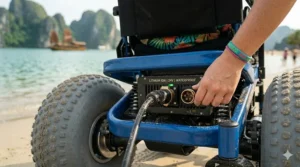
Most electric beach wheelchairs offer 3-5 speed settings. Start at the lowest setting for your first beach trip. Sand creates more resistance than pavement, and an overly sensitive joystick in high-speed mode can cause jerky movements or wheel spin. Gradually increase speed as you gain confidence in sand handling.
Common First-Week Mistakes to Avoid
Never rinse electric components directly with a hose. Wipe down the motors, battery compartments, and joystick housing with a damp cloth. Spray sand off the tires and frame only. Water intrusion causes 60% of warranty claims on electric beach wheelchairs during the first month of ownership.
Don’t attempt deep soft sand on your first trip. Start on firm packed sand near the waterline to build operating confidence. Your second or third trip, venture into softer areas once you understand how the chair responds.
Charge after every use, even short trips. Lithium batteries don’t suffer from memory effect like older NiCad batteries. Keeping them topped off extends overall lifespan. Letting them sit at 40% for weeks between uses degrades capacity faster than frequent shallow cycles.
Following this protocol means your beach wheelchair performs optimally from day one, avoiding the “this doesn’t work as advertised” frustration many buyers experience when they skip setup steps.

Real-World Scenarios: Matching Chairs to Your Beach Lifestyle
Scenario A: The Weekly Beach Regular
Profile: Lives within 5 miles of the coast, beaches 2-4 times weekly from April through October, needs independent mobility, parks in designated accessible spots 100+ yards from waterline.
Optimal Choice: Sand Helper Beach Power Chair
Reasoning: The $18,000 investment divides across 80-100 annual beach trips for 5+ years of ownership—effectively $45-50 per trip over the chair’s lifespan. The four-wheel-drive capability handles the long parking-lot-to-shoreline traverse independently, eliminating reliance on companions. Dual batteries support all-day sessions without range anxiety. Heavy weight and storage requirements become non-issues when you have dedicated garage space and an accessible vehicle.
Scenario B: The Vacation Beach User
Profile: Takes 1-2 week beach vacations annually, flies to destination, rents vehicle, needs something portable that fits in standard rental car trunk, has family members available to push.
Optimal Choice: HIPPOCAMPE All Terrain Beach Wheelchair or Fields WC-1
Reasoning: The HIPPOCAMPE’s 31-pound weight and disassembled portability fits in checked luggage or car trunk easily. Water-entry capability adds unique value for swimming-focused vacations. The Fields WC-1 offers a budget alternative at half the price if water entry isn’t priority. Both avoid the complexity and airline restrictions around lithium batteries in electric chairs.
Scenario C: The Multi-Surface Daily User
Profile: Uses wheelchair daily for shopping, medical appointments, indoor mobility, wants occasional beach access without buying/storing a second specialized chair.
Optimal Choice: Rubicon DX08 or Aotedor 22-Mile Range
Reasoning: These all-terrain electric wheelchairs function as your primary chair for 95% of activities, then handle beach trips competently for the other 5%. The Rubicon’s foldability makes it practical for varied daily use and car transport. The Aotedor’s 22-mile range supports full-day outings combining errands and beach time. Both deliver acceptable beach performance without the single-purpose limitation of dedicated beach chairs.
Scenario D: The Budget-Conscious Family
Profile: Beaches 5-10 times per summer, limited budget, children or able-bodied adults available to push, prioritizes getting beach access now over premium features.
Optimal Choice: Fields WC-1 or AccessRec TerraWheels
Reasoning: The $600-$1,100 price range makes beach access financially viable for families who’d otherwise skip beach trips entirely due to mobility barriers. Manual operation suits situations where pushing assistance is readily available. The trade-off in premium features and long-term durability becomes acceptable when the alternative is no beach access at all. After 2-3 seasons, families can evaluate whether increased use justifies upgrading to electric or premium manual options.
The wrong match creates frustration. A family buying the Sand Helper for 3 beach trips per year overspent massively. A coastal resident trying to get by with a manual chair faces daily frustration when companions aren’t available. Match your frequency, budget, and support availability to these scenarios before purchasing.
How to Choose Your Beach Wheelchair Electric: The Priority Framework
Shopping for beach wheelchairs feels overwhelming because manufacturers emphasize different features. Here’s the decision framework that cuts through marketing noise.
Priority #1: Define Your Power Requirement
Ask: “Do I need independent operation, or will I always have a companion available to push?”
If independence is essential, your options narrow to electric models (Sand Helper, Rubicon DX08, Aotedor). If companions will always be present, manual chairs save thousands of dollars and eliminate battery/electrical concerns. There’s no middle ground—you either pay for electric motors or accept push dependency.
Priority #2: Calculate Your Actual Beach Frequency
Formula: (Beach trips per year) × (years of expected ownership) = Total trip count
If that number exceeds 100 trips, premium pricing becomes justifiable. The Sand Helper at $18,000 for 200 trips over 5 years = $90/trip. A manual chair at $800 for 30 trips over 3 years = $27/trip. But factor in companion fatigue—how many of those 30 trips end early because your pusher is exhausted?
Priority #3: Assess Sand Conditions at Your Beach
Not all beaches are equal. Firm, compacted sand near the waterline requires far less power/flotation than deep, fine powder sand 100+ yards from water. Visit your primary beach, walk from parking to your preferred spot, observe the sand consistency. Soft, deep sand demands true balloon tires and electric power. Firm, packed areas work with less specialized equipment.
Priority #4: Evaluate Transport and Storage Reality
Measure your vehicle’s trunk/cargo area. A foldable 64-pound electric wheelchair fits in sedan trunks. A 440-pound Sand Helper requires a truck bed or trailer. Do you have garage space? Is your home’s entry wide enough to roll the chair through? The best beach wheelchair is useless if you can’t transport or store it.
Priority #5: Match Capacity to User + Gear Weight
Formula: (User weight) + (typical beach gear weight) = total load
Most beach trips include a cooler (10-20 lbs), umbrella (5-10 lbs), bags (10-15 lbs). A 200-pound user with 30 pounds of gear needs 230-pound minimum capacity, but 300+ pounds provides performance margin. Exceeding capacity by even 10-15 pounds dramatically reduces mobility on soft surfaces.
Priority #6: Corrosion Resistance for Lifespan
Saltwater and sand are equipment killers. Stainless steel and aluminum frames survive; painted steel frames rust within seasons. Sealed motor housings on electric models prevent sand intrusion. Check warranty terms—corrosion damage usually voids coverage, so buying corrosion-proof materials up-front saves replacement costs later.
Use this framework sequentially: eliminate options that fail Priority #1, refine based on #2-3, verify practical fit with #4-5, confirm durability with #6. Don’t skip priorities—buyers who ignore transport reality end up with chairs that never leave their garage because they can’t figure out how to get them to the beach.
Common Mistakes When Buying Beach Wheelchair Electric Equipment
Mistake #1: Assuming All “Beach Wheelchairs” Work on Sand
The term “beach wheelchair” gets slapped on products that barely qualify. Some manufacturers take standard wheelchairs, add slightly wider tires, and market them as beach-capable. The result? You get 10 feet into soft sand before grinding to a halt.
What to verify: Tire diameter should be 12+ inches for manual chairs, with “balloon” or “low-pressure” design. Electric models need motors rated 250W+ per wheel to generate sand-moving torque. Read actual customer reviews specifically mentioning sand performance, not just general beach use.
Mistake #2: Underestimating the Manual Push Effort
Pushing a manual beach wheelchair through 50+ yards of soft sand isn’t like pushing someone on pavement. Physics dictates that wider tires reduce sinking but increase rolling resistance. A 150-pound user in a 50-pound chair = 200 pounds the pusher is moving through unstable terrain.
Reality check: Test this before buying. If your companion struggles pushing you 100 feet through dry sand, manual beach chairs will limit how far you can venture. Electric power eliminates this variable entirely but costs $1,000-$18,000 more. Budget accordingly.
Mistake #3: Ignoring Airline Battery Restrictions
Lithium batteries over 300Wh cannot travel on commercial aircraft as checked or carry-on luggage. Many long-range electric wheelchairs use 400-500Wh batteries. If you’re flying to beach destinations, verify your chosen model has airline-compliant battery options or removable batteries under the watt-hour limit.
Solution: Models like Aotedor offer dual battery configurations—one high-capacity 20Ah battery for daily use, one smaller <300Wh battery specifically for air travel. Rubicon and other brands sell separate airline-compliant batteries as accessories.
Mistake #4: Overlooking the Total Cost of Ownership
The sticker price is only the starting point. Electric wheelchairs need replacement batteries every 2-3 years ($200-$500). Manual chairs need tire replacements when balloon tires develop punctures or wear ($100-$200 per tire). Maintenance, storage solutions, and potential repair costs add up.
Calculate: (Purchase price) + (battery replacements × ownership years) + (tire replacements) + (maintenance) = True cost. A $1,200 electric wheelchair with $300 batteries every 2 years for 6 years = $1,200 + $900 = $2,100 total. Factor this into budget decisions.
Mistake #5: Choosing Based on Brand Name Instead of Specifications
Mobility equipment has established brands (Pride, Invacare) that command name-recognition premiums. But for beach-specific applications, specialized manufacturers like Wheeleez or Sand Helper often outperform household names because they focus exclusively on sand/outdoor terrain rather than general mobility.
Strategy: Compare specifications directly—motor wattage, weight capacity, tire size, corrosion resistance—across brands. An unknown brand with superior specs at lower price often delivers better value than a famous name using standard components.
Mistake #6: Skipping the Warranty Terms Fine Print
Many warranties exclude saltwater corrosion, sand damage, or “environmental factors” that define beach use. You might have 1-year motor warranty that becomes void the moment salt air corrodes internal components.
Protection: Look for warranties specifically covering outdoor/beach use, or manufacturers offering saltwater-resistant models with appropriate warranty coverage. Extended warranties rarely cover the corrosion issues most likely to occur with beach equipment—read what’s excluded, not just what’s included.
Beach Wheelchair Electric vs Traditional Power Wheelchairs: The Capability Gap
Standard electric wheelchairs—the ones prescribed by doctors and covered by insurance for indoor/pavement use—differ fundamentally from beach wheelchair electric models in ways that make them incompatible with sand.
Tire Design: The Core Incompatibility
Traditional power wheelchairs use 6-8 inch solid rubber or pneumatic tires optimized for smooth surfaces. These small-diameter, narrow tires create pounds-per-square-inch (PSI) ground pressure that sinks into soft sand immediately. Beach wheelchair tires are 12-21 inches diameter with wide, low-pressure flotation designs that spread weight over 3-4 times the surface area, preventing sinking.
Translation: It’s like the difference between high heels (concentrated pressure, sink into sand) and snowshoes (distributed pressure, float on top). Standard wheelchair tires are high heels; beach balloon tires are snowshoes.
Motor Power and Gearing
Indoor electric wheelchairs use motors rated for smooth, level surfaces—typically 150-200W per wheel. Beach terrain requires 250-500W minimum to overcome soft sand resistance. More critically, the gearing differs. Beach wheelchair motors are geared for torque (pulling power) at the expense of top speed. Standard wheelchairs gear for higher speeds on pavement.
Real-world impact: A standard 200W power wheelchair might reach 6 mph on pavement but bog down at 0.5 mph on sand. A 250W beach wheelchair maxes at 4 mph on pavement but maintains 2-3 mph on sand—the gearing prioritizes consistent sand movement over peak speed.
Frame and Component Sealing
Beach wheelchairs use sealed motor housings, corrosion-resistant wiring, and stainless/aluminum construction. Standard power wheelchairs have open motor ventilation (sand enters and jams mechanisms), standard wiring (corrodes in salt air), and painted steel frames (rust within months of saltwater exposure).
Cost consequences: Taking a $3,000 insurance-covered power wheelchair to the beach once or twice might seem harmless. But sand infiltration into motor bearings causes grinding and failure. Salt corrosion attacks wiring connections. Within 6-12 months, you’ve destroyed a chair that would have lasted 5-10 years with indoor-only use. Insurance won’t replace it because “user damage” voids coverage.
Weight Capacity and Stability
Standard power wheelchairs are designed for users who’ll sit on pavement or indoor floors—stable, level surfaces. Beach wheelchairs account for unstable sand that shifts under weight. The wider wheelbase and lower center of gravity on beach models prevent tipping when one side sinks deeper than the other. Standard chairs tip easily on uneven sand.
The capability gap is so significant that most manufacturers explicitly state “not for beach use” in their manuals for standard power wheelchairs. Using equipment outside its design parameters shortens lifespan dramatically and creates safety risks. If beach access matters, purpose-built equipment is non-negotiable.
Long-Term Cost Analysis: Electric vs Manual Beach Wheelchairs
The sticker shock of electric beach wheelchairs ($1,200-$18,000) versus manual options ($600-$4,200) obscures the total cost picture. Here’s the 5-year ownership comparison.
Scenario 1: Heavy Use (50+ beach trips/year)
Electric Option: Rubicon DX08 at $1,400
- Initial purchase: $1,400
- Battery replacement (year 2 & 4): $300 × 2 = $600
- Maintenance/repairs: $200
- Total 5-year cost: $2,200
- Cost per trip (250 trips): $8.80/trip
- Companion pushing time saved: 500+ hours
Manual Option: Wheeleez Sandcruiser at $2,600
- Initial purchase: $2,600
- Tire replacement (year 3): $200
- Maintenance: $100
- Total 5-year cost: $2,900
- Cost per trip (250 trips): $11.60/trip
- Companion pushing hours required: 500+ hours
Analysis: Electric saves money long-term due to lower purchase price offsetting battery costs. More importantly, it eliminates 500+ hours of companion physical effort—time that has indirect costs (companion fatigue limits trip frequency, reduces trip duration, creates dependency).
Scenario 2: Moderate Use (15-20 beach trips/year)
Electric Option: Aotedor at $1,100
- Initial purchase: $1,100
- Battery replacement (year 3): $250
- Maintenance: $150
- Total 5-year cost: $1,500
- Cost per trip (85 trips): $17.65/trip
Manual Option: Fields WC-1 at $700
- Initial purchase: $700
- Tire replacement: $150
- Maintenance: $50
- Total 5-year cost: $900
- Cost per trip (85 trips): $10.59/trip
Analysis: Manual wins on pure cost for moderate use. Electric premium ($600 more over 5 years) purchases independence but doesn’t pay for itself with occasional use. Decision hinges on whether $7/trip independence premium is worth it to the user.
Scenario 3: Occasional Use (5-10 beach trips/year)
Electric Option: Rubicon DX08 at $1,400
- Initial purchase: $1,400
- Battery replacement (year 4): $300
- Maintenance: $100
- Total 5-year cost: $1,800
- Cost per trip (35 trips): $51.43/trip
Manual Option: AccessRec TerraWheels at $950
- Initial purchase: $950
- Tire replacement: $100
- Maintenance: $50
- Total 5-year cost: $1,100
- Cost per trip (35 trips): $31.43/trip
Analysis: Electric makes no financial sense for occasional use. The $20/trip premium buys independence, but most casual users have companions available for 5-10 annual beach days. Savings of $700 over 5 years justifies manual operation.
The Intangible Value Factor
Numbers don’t capture everything. Independence means spontaneous beach trips without coordinating companion schedules. It means staying as long as you want without worrying about exhausting your pusher. It means dignity and self-reliance. For some users, that’s worth any premium. For others, saving $700-2,000 matters more.
The break-even point sits around 30-40 beach trips annually. Below that, manual saves money. Above it, electric delivers better value. Your decision should reflect both the math and the personal value of independence for your specific situation.

Safety Considerations and Beach Wheelchair Electric Regulations
Beach wheelchair use intersects with ADA regulations, local beach ordinances, and general safety protocols that many buyers overlook until problems arise.
ADA Coverage and Limitations
The Americans with Disabilities Act guarantees access to public facilities, but beaches exist in a regulatory gray area. According to the U.S. Access Board, ADA design standards focus on built environments—buildings, parking, pathways. Natural terrain like sandy beaches falls under “program access” requirements for state/local governments, meaning they must provide reasonable accommodations, but the ADA doesn’t mandate specific beach wheelchair equipment.
What this means: Public beaches must offer some form of beach access for wheelchair users—typically beach mats (continuous hard surfaces over sand) or loaner beach wheelchairs at no charge. But they’re not required to provide electric beach wheelchairs. If you need electric power, you’ll likely purchase or rent privately.
Local Beach Ordinances You Must Know
Many municipalities restrict motorized vehicles on beaches—a category that technically includes electric wheelchairs. However, the ADA’s provisions on power-driven mobility devices generally override local vehicle bans. Covered entities (state/local governments, businesses) must allow wheelchairs and other power-driven mobility devices unless they pose legitimate safety concerns.
Before your first trip: Contact your beach’s management office to confirm electric wheelchair policies. Some beaches require permits or registrations. Others designate specific hours or zones for motorized mobility devices to prevent conflicts with swimmers or wildlife protection areas.
Water Entry Safety Limitations
Manual beach wheelchairs like the HIPPOCAMPE are designed for shallow water entry (6 inches maximum depth per many beach regulations). Going deeper risks waves overturning the chair, creating drowning hazards. Electric wheelchairs should never enter water—submerged motors and batteries pose electrocution risks and void all warranties.
Safe practice: Position your electric beach wheelchair at the dry sand/water boundary. Transfer to a water-safe manual chair or have companions assist you into shallow water. Never assume electric components can handle saltwater immersion, even briefly.
Slope and Tide Awareness
Beaches aren’t flat—the slope from dry sand to waterline can reach 8-12 degrees. Electric wheelchairs with electromagnetic brakes (Rubicon, Aotedor) prevent rollback when you release the joystick. Manual chairs on slopes require continuous brake engagement by the pusher. The risk? Chair rolling toward water when unattended.
Mitigation: Always set manual brakes when stationary. For electric chairs, verify the electromagnetic brake engages (motor produces a distinct hum/click when releasing the joystick). Park perpendicular to the slope, never parallel—sideways tipping risk increases on angled terrain.
Battery and Charging Safety
Lithium batteries in electric beach wheelchairs require specific charging protocols. Charge in ventilated areas—batteries vent gases during charging that accumulate in enclosed spaces. Never charge with sand-covered batteries; brush off sand first to prevent debris entering charging ports and causing short circuits.
Critical warning: If a battery shows swelling, leaking, or unusual heat, stop using immediately and contact the manufacturer. Damaged lithium batteries can enter thermal runaway—self-heating that leads to fire. This is rare but catastrophic when it occurs.
Emergency Procedures for Equipment Failure
Electric wheelchair failure on a beach with soft sand and no paved access routes creates mobility emergencies. Know these resources:
Beach patrol/lifeguards: Most staffed beaches can provide emergency assistance or contact specialized rescue units with beach-capable stretchers or rescue boards.
Manual override mode: Electric wheelchairs include manual push mode (usually a lever near the rear wheels). Flipping to manual disengages the motors, allowing someone to push you out even with dead batteries.
Cell phone waterproof storage: Keep a charged phone in a waterproof case on your person. Beach equipment failure far from parking areas requires calling for assistance.
Safety ultimately comes down to matching equipment capabilities to beach conditions, understanding regulatory requirements, and planning for failure scenarios before they happen.

Frequently Asked Questions
❓ How far can beach wheelchair electric models travel on a single charge?
❓ Can I use a regular electric wheelchair on the beach?
❓ What's the weight difference between pushing manual beach wheelchairs on sand versus pavement?
❓ Do beach wheelchair electric batteries work in saltwater environments?
❓ What maintenance does sand wheelchair motorized equipment need after each beach trip?
Conclusion: Reclaiming Beach Freedom with the Right Equipment
The journey to beach accessibility starts with honest assessment of your mobility needs, beach frequency, budget reality, and support availability. For coastal residents making 50+ beach trips annually, electric models like the Sand Helper or Rubicon DX08 transform beach access from dependent frustration to independent freedom—the investment pays for itself in eliminated rental fees and gained autonomy. Vacation-focused users benefit more from portable manual options like the HIPPOCAMPE or Fields WC-1 that pack easily and avoid electric complexity for 5-15 annual trips.
What manufacturers won’t tell you: there’s no single “best” beach wheelchair. The Sand Helper dominates deep-soft-sand performance but costs 15-20 times more than budget manual options. The Rubicon DX08 excels at versatility across multiple terrains but can’t match specialized beach equipment in pure sand capability. Manual premium options like Wheeleez deliver corrosion-proof longevity and reduced push effort but still demand companion assistance that electric power eliminates.
The right choice emerges from the framework laid out in this guide: define your power requirement first (independent operation or push assistance), calculate actual beach frequency to justify investment levels, assess your specific beach’s sand conditions, verify transport and storage practicality, match capacity to user plus gear weight, and prioritize corrosion resistance for longevity.
Don’t let perfect become the enemy of good. A $700 manual chair that gets you to the beach 10 times this summer beats the $2,000 electric chair you “should” buy but can’t afford right now, leaving you beach-bound for another year. Start with what your budget and situation allow, use it heavily, then evaluate whether performance gaps justify upgrades after experiencing real-world beach wheelchair use.
The beach is no longer a spectator activity limited to able-bodied visitors. Purpose-built equipment, whether electric or manual, transforms soft sand from an impassable barrier into navigable terrain—returning the simple pleasure of toes in sand and ocean breezes to users who’ve been excluded too long.
Recommended for You
- 7 Best Power Wheelchairs for Outdoor Use | 2026
- 7 Best 4 Wheel Drive Wheelchairs That Conquer Terrain (2026)
- 7 Best Power Wheelchair All Terrain Models Tested 2026
Disclaimer: This article contains affiliate links. As an Amazon Associate, I earn from qualifying purchases. If you purchase products through these links, we may earn a small commission at no additional cost to you.
✨ Found this helpful? Share it with your friends! 💬🤗
