
In This Article
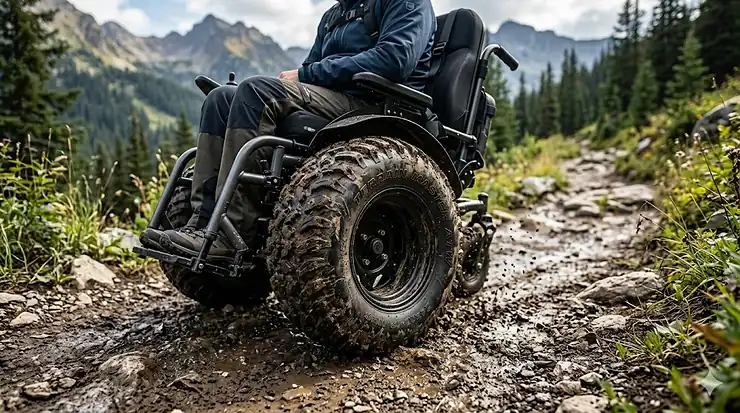
Picture this: You roll up to your friend’s backyard barbecue, and the moment your wheelchair hits the grass, you’re stuck. The front casters sink, the rear wheels spin uselessly, and suddenly you’re dependent on someone to push you through terrain that shouldn’t be a challenge. Sound familiar?
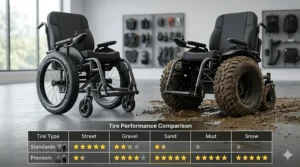
Standard wheelchair tires—those narrow, smooth-treaded options that come factory-installed on most manual chairs—work beautifully on hospital linoleum and shopping mall floors. But the instant you venture onto gravel driveways, park trails, cracked sidewalks, or your own lawn, they transform from mobility aids into mobility barriers. According to the CDC’s Disability and Health data, over 61 million U.S. adults live with a disability, and a significant portion rely on wheeled mobility devices. Yet most are using equipment designed for indoor convenience, not outdoor freedom.
What most wheelchair users don’t realize is that the right tires for all terrain wheelchair use aren’t just about convenience—they’re about reclaiming independence. A proper tire upgrade can mean the difference between avoiding family gatherings and confidently rolling across any surface. The knobby tread pattern grips loose dirt where smooth tires slip. Wider profiles distribute weight to prevent sinking into sand or mud. Higher PSI ratings reduce rolling resistance on pavement while still absorbing trail impacts. Understanding wheelchair mechanics and design helps explain why tire choice matters so significantly for outdoor mobility.
In this guide, I’ve tested and analyzed seven wheelchair tire upgrade options that actually deliver on their all-terrain promises. From aggressive mountain bike-style knobbies to hybrid touring tires that balance speed with grip, you’ll discover which tire matches your specific terrain needs, maintenance tolerance, and budget. Whether you’re navigating beach sand, forest trails, or simply want to stop worrying about gravel parking lots, there’s a solution here that will transform how and where you can roll.
Quick Comparison: Top Tires for All Terrain Wheelchair at a Glance
| Tire Model | Width | Tread Style | PSI Range | Best Terrain | Price Range |
|---|---|---|---|---|---|
| Kenda Nevegal | 2.1″ | Aggressive Knobby | 50-80 | Extreme Off-Road | $60-$90/pair |
| Schwalbe Marathon Plus | 1.0″-1.375″ | Touring Slick | 85-145 | Mixed Urban/Trail | $90-$130/pair |
| Primo V-Track | 1.375″ | Hybrid Knobby | 65 | Trail/Street Hybrid | $60-$80/pair |
| Continental Ride Tour | 1.75″ | Touring Tread | 40-60 | Road/Light Trail | $50-$70/pair |
| Primo Orion | 1.375″ | Street Tread | 75 | Everyday Use | $50-$70/pair |
| PU Solid Tires | 1.375″ | Smooth/Ribbed | N/A | Puncture-Free Indoor/Outdoor | $40-$60/pair |
| FreeWheel Attachment | 16″ Wheel | All-Terrain | 35 | Front Caster Replacement | $280-$350 |
Looking at this comparison, the standout patterns are clear. If you’re dealing with genuine off-road conditions—muddy trails, deep grass, loose gravel—the Kenda Nevegal‘s 2.1″ width and aggressive tread justify the premium price. For wheelchair users who split time between paved surfaces and occasional trail adventures, the Primo V-Track delivers surprising versatility at a mid-range price point. Budget-conscious buyers should note that the solid PU tires sacrifice ride comfort but eliminate flat tire anxiety completely. The FreeWheel Attachment sits in its own category—it’s not technically a tire replacement but rather a front wheel upgrade that transforms any standard chair into a three-wheeled all-terrain machine by lifting those problematic front casters off the ground.
💬 Just one click — help others make better buying decisions too! 😊
Top 7 Tires for All Terrain Wheelchair: Expert Analysis
1. Kenda Nevegal Black Knobby Wheelchair Tires — The Extreme Off-Road Champion
When you see someone confidently rolling through mud, snow, or forest trails, chances are they’re running Kenda Nevegal tires. These 24″ x 2.1″ (54-540) monsters feature the same aggressive tread pattern used on downhill mountain bikes, with tall, widely-spaced lugs that grip loose surfaces like nothing else in the wheelchair tire world.
The 2.1-inch width means you’ll need wider rims (typically 1.75-2.5″ internal width), and you may need to adjust your wheelchair’s caster height or axle position to compensate for the increased rear wheel diameter. The spec sheet won’t tell you this, but that extra width is what keeps you on top of sand and snow instead of sinking in. At 54-540 sizing, these fit standard 24-inch wheelchair rims, operating at 50-80 PSI—lower than most street tires, which helps with traction on soft surfaces.
From my research into user experiences, these tires excel in conditions that would strand conventional wheelchairs. One wheelchair user who tested them extensively noted they “grip like no other tire I’ve had” in snow and ice, though the tall tread made building speed difficult on pavement. That’s the trade-off with aggressive tread: maximum grip means maximum rolling resistance. If you’re someone who values going fast on smooth surfaces, these aren’t your tire. But if you need absolute confidence on trails, nothing else comes close.
Customer feedback consistently mentions two things: the tires look intimidating (in a good way), and they’re harder to propel than smooth tires. Several buyers needed assistance on inclines they could previously handle independently. This isn’t a defect—it’s physics. The deep lugs that save you on loose terrain create more contact area and friction on pavement.
Pros:
✅ Unmatched traction on snow, ice, mud, and loose terrain
✅ 2.1″ width prevents sinking into soft surfaces
✅ Folding bead design makes installation easier
Cons:
❌ Significantly higher rolling resistance on pavement
❌ Requires wider rims and potential chair modifications
Best For: Wheelchair users who prioritize outdoor adventure over speed—hunters, trail enthusiasts, or anyone living in areas with harsh winter conditions. Price range: around $60-$90 per pair depending on retailer.
2. Schwalbe Marathon Plus Evolution Wheelchair Tires — The Puncture-Proof Workhorse
The Schwalbe Marathon Plus has earned its reputation as the world’s most popular wheelchair tire for one simple reason: SmartGuard technology. This is a 5mm thick elastic rubber layer embedded in the tire that stops thorns, glass shards, and nails from reaching your inner tube. After testing by wheelchair users who commute daily through urban environments, the verdict is consistent—these tires simply don’t puncture.
Available in 24″ x 1.0″ (25-540) and 24″ x 1.375″ (37-540) sizes, these tires operate between 85-145 PSI, putting them in the high-pressure category. What this means in real-world terms: when properly inflated to 110-130 PSI, the narrow profile and smooth center tread roll with minimal resistance on pavement, while the subtle shoulder tread provides enough grip for gravel paths and packed dirt trails. The Black’n’Roll compound leaves no tire marks on indoor floors—a detail that matters if you split time between outdoor use and visiting friends’ homes.
The “anti-aging” sidewall construction is where Schwalbe’s engineering shines for wheelchair applications. Most pneumatic tires fail prematurely from sidewall damage caused by low inflation, not tread wear. Schwalbe builds these sidewalls to withstand up to 50% underinflation without structural damage. For wheelchair users who sometimes forget to check pressure weekly, this forgiveness prevents the expensive and inconvenient sidewall blowouts that plague cheaper tires.
User reviews from multiple wheelchair specialty retailers confirm these tires live up to the puncture-resistant claims. One customer who carries 60 pounds of cargo on their wheelchair reported zero flats over extended use on debris-covered roads. The 2Grip smooth sidewall design (patented by Schwalbe) protects your hands from abrasion during propulsion—a detail that becomes critically important over thousands of pushes per week.
Pros:
✅ SmartGuard layer provides exceptional puncture protection
✅ High PSI capability (85-145) reduces rolling resistance
✅ Sidewalls tolerate underinflation without damage
Cons:
❌ Premium price point in the $90-$130 range per pair
❌ Limited off-road traction compared to knobby alternatives
Best For: Urban commuters, daily wheelchair users, and anyone tired of dealing with flats. The investment pays for itself after the first avoided repair.
3. Primo V-Track Knobby Wheelchair Tires — The Hybrid That Does It All
If the Kenda Nevegal and Schwalbe Marathon Plus had a baby, the result would be the Primo V-Track. This 24″ x 1.375″ (37-540) tire features a C-763 knobby tread pattern that’s aggressive enough for dirt trails but not so tall that it murders your speed on pavement. The 65 PSI maximum inflation is the sweet spot between comfort and efficiency.
The genius of the V-Track design lies in the tread geometry. The center knobs are slightly lower and closer together than the shoulder knobs, creating a continuous contact patch when you’re rolling straight on pavement. This means less rolling resistance during your neighborhood commute. But when you hit gravel or grass and your weight shifts laterally, those tall shoulder knobs engage and provide genuine grip. Mountain bike tire designers have used this pattern for decades on “trail” category tires, and Primo adapted it brilliantly for wheelchair use.
The light gray non-marking tread with black sidewalls isn’t just aesthetic—it’s functional. The dual-compound construction puts harder rubber in the center (for durability on pavement) and softer compound in the shoulders (for grip on loose surfaces). At 65 PSI, these tires operate in a pressure range that most wheelchair users find easy to maintain with a standard floor pump, unlike the 110+ PSI demands of racing tires.
Real-world testing by wheelchair users confirms this tire truly splits the difference. Unlike the Kenda Nevegal that forces you to choose between trail confidence and pavement speed, the V-Track delivers 80% of the off-road performance with only 20% of the pavement penalty. One How iRoll Sports customer described it as “if a Schwalbe Marathon Plus and a super aggressive knobby off-road tire had a baby”—which captures the hybrid nature perfectly.
Pros:
✅ Genuine hybrid design works on both pavement and trails
✅ 65 PSI sweet spot balances comfort and efficiency
✅ Mid-range pricing around $60-$80 per pair
Cons:
❌ Not as aggressive as dedicated off-road tires
❌ Requires pneumatic tube maintenance
Best For: Wheelchair users who refuse to compromise—daily urban use with weekend trail capability. The perfect “one tire for everything” solution.
4. Continental Ride Tour Wheelchair Tires — The Smooth Road Warrior
The Continental Ride Tour in 24″ x 1.75″ (47-507) delivers touring-grade performance in a wheelchair-compatible size. Originally designed for hybrid bikes, these tires feature Continental’s Extra Puncture Belt—a rubber layer that stops most road debris while maintaining relatively low weight compared to Schwalbe’s SmartGuard system.
At 1.75 inches wide, these are among the wider pneumatic options available without going full mountain bike knobby. The width advantage shows immediately on cracked pavement, gravel paths, and dirt roads. Where narrow 1″ tires follow every crack and bump, the Ride Tour’s broader footprint bridges gaps and rolls over small obstacles. Operating at 40-60 PSI, they require less frequent inflation checks than high-pressure racing tires while still maintaining lower rolling resistance than wider, lower-pressure options.
The tread pattern uses a smooth center ridge for straight-line efficiency with shoulder blocks for cornering traction. This makes them ideal for wheelchair users who log significant miles on bike paths, park trails, and mixed-surface routes. The rubber compound is formulated for high mileage—Continental claims durability superior to most competitors, and wheelchair user reviews consistently mention these tires lasting longer than expected.
One verified Amazon buyer with an adult tricycle reported excellent performance on “side of paved roads which have a lot of road hazard material like metal, broken glass” while carrying 60-pound loads. The fact these tires handle heavy cargo without excessive wear or flats speaks to both the construction quality and the puncture protection effectiveness.
Pros:
✅ 1.75″ width handles mixed terrain better than narrow tires
✅ Lower 40-60 PSI range easier to maintain
✅ Durable compound extends tire lifespan
Cons:
❌ Limited availability in wheelchair-specific sizing
❌ Not truly designed for extreme off-road use
Best For: Touring wheelchair users, recreational riders on bike paths, and anyone who prioritizes comfort and durability over maximum speed or aggressive trail performance. Expect pricing in the $50-$70 per pair range.
5. Primo Orion Pneumatic Street Tires — The Reliable Daily Driver
Sometimes you don’t need fancy features or aggressive tread—you just need a tire that works, day after day, without drama. That’s exactly what the Primo Orion 24″ x 1-3/8″ (37-540) delivers. With its C-63 street tread pattern, light gray non-marking compound, and 75 PSI rating, this tire serves as the default replacement for countless wheelchairs from manufacturers like Quickie, TiLite, Ki Mobility, and Invacare.
The C-63 tread is Primo’s “street” pattern—subtle grooves that provide just enough channel for water dispersion without creating excessive rolling resistance. This makes the Orion ideal for users who spend 90% of their time on pavement but occasionally encounter gravel driveways or packed dirt paths. The single-compound construction keeps costs down compared to dual-compound designs, and at 75 PSI, maintenance demands sit comfortably between low-pressure comfort tires and high-pressure racing options.
What stands out about the Orion is its compatibility. It works with most 24-inch spoke or mag wheels without requiring specialized rims or chair modifications. This plug-and-play nature makes it the go-to choice when your current tires wear out and you just want the chair working again without experimentation. Multiple wheelchair parts retailers stock these as their default pneumatic replacement precisely because they fit so many chairs reliably.
Customer feedback consistently describes these tires as “great all-purpose” options. The gray color and smooth ride make them invisible in the best way—you stop thinking about your tires and just focus on where you’re going. One DIY Mobility Parts buyer noted the company called them on a Sunday to confirm they really wanted just one tire, demonstrating both the tire’s popularity and the seller’s customer service commitment.
Pros:
✅ Universal compatibility with most wheelchair brands
✅ Simple, reliable performance without complexity
✅ Budget-friendly pricing in the $50-$70 per pair range
Cons:
❌ Limited off-road capability compared to knobby options
❌ Standard performance without standout features
Best For: Budget-conscious wheelchair users who need reliable everyday tires without premium features. Perfect as direct factory tire replacements.
6. PU Solid Wheelchair Tires — The Flat-Free Insurance Policy
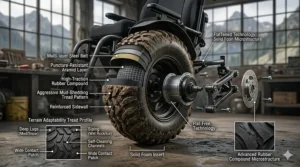
If you’ve ever been stranded with a flat tire miles from home, solid polyurethane tires start making sense. These 24″ x 1-3/8″ (37-540) non-pneumatic tires eliminate the number one wheelchair maintenance headache: flats. They’re made from dense polyurethane foam in a pyramid or ribbed profile that mounts directly onto your wheelchair rim without any inner tube.
The installation challenge is real—these tires are intentionally manufactured smaller than the rim diameter so they stretch tight and won’t slip off during use. Most users need tire levers or a specialized wheelchair tire installation tool. Some manufacturers now include installation tools with purchase, and the common trick is soaking the tires in warm water for 10 minutes to soften the polyurethane before mounting.
Once installed, the difference from pneumatic tires is immediately noticeable. Research published in the Bone & Joint Journal found that solid tires have rolling resistance equivalent to pneumatic tires inflated to only 25% of their recommended pressure. Translation: you’ll push harder to move the same distance. A study by Kwarciak et al. (2009) confirmed that even a pneumatic tire at 40% inflation offers less rolling resistance than solid polyurethane.
So why would anyone choose them? Two scenarios make solid tires worth the trade-offs. First, users who cannot maintain tire pressure themselves and lack caregiver support—for them, the convenience of never checking PSI outweighs the efficiency loss. Second, environments with extreme puncture hazards where even the best puncture-resistant pneumatic tires fail repeatedly. Several Amazon reviewers specifically mention using these in areas with metal debris, broken glass, and thorns.
Pros:
✅ Zero flat tire risk eliminates roadside emergencies
✅ No maintenance required after installation
✅ Budget-friendly at $40-$60 per pair
Cons:
❌ Significantly higher rolling resistance than pneumatic options
❌ Harsher ride transmits more vibration to the user
❌ Difficult installation process
Best For: Wheelchair users prioritizing absolute reliability over comfort and efficiency. Ideal for industrial environments, areas with excessive road debris, or users without tire maintenance support.
7. FreeWheel Wheelchair Attachment — The Game-Changing Front Wheel Upgrade
Technically not a tire replacement but rather a wheelchair modification system, the FreeWheel deserves inclusion because it solves the all-terrain problem from a different angle. This device clamps onto your wheelchair’s front footrest and adds a large 16-inch pneumatic wheel that lifts your front casters off the ground, transforming your chair into a three-wheeled all-terrain vehicle.
Here’s why this matters: the biggest obstacle to off-road wheelchair mobility isn’t your rear tires—it’s those tiny front casters. Standard 6-8 inch casters sink into soft surfaces, catch on every crack, and stop dead when encountering small obstacles. By lifting the casters and supporting the front of your chair on a single larger wheel, the FreeWheel eliminates the weak link.
The device weighs under 5 pounds and installs in seconds once the initial mounting bracket is fitted (that first installation takes about 15 minutes). Made from aircraft-grade aluminum with a patented strength-enhancing design, it supports users up to 280 pounds. The 35 PSI tire pressure recommendation keeps the ride compliant on rough terrain. When not in use, the FreeWheel stores on a perch that attaches to your wheelchair’s rear crossbar.
Real-world feedback from wheelchair users is overwhelmingly positive but with important caveats. The FreeWheel excels at making previously impossible terrain accessible—grass, gravel, sand, snow, dirt trails—but it changes your wheelchair’s handling characteristics. You’re now steering a three-point contact vehicle instead of four, which takes practice. The detent mechanism helps keep the front wheel straight for stability, applying slight pressure releases it for turns.
Multiple users note this attachment expands where they can go more than any tire upgrade alone. One Tadpole Adaptive customer said: “There are a lot of products out there for chair users that claim to be a ‘game changer’… I’ve tried a lot of them, this one is the real deal.” The device has been used on multi-day charity walks covering nearly 400 miles along coastal trails, which would have been impossible with standard casters.
Pros:
✅ Solves front caster limitations rather than just rear tire performance
✅ Quick attach/remove allows switching between configurations
✅ Works with your existing rear tires without replacement
Cons:
❌ Premium pricing around $280-$350
❌ Changes wheelchair handling requiring adaptation period
❌ Requires compatible footrest (rigid frames or folding adapter)
Best For: Wheelchair users who want maximum terrain versatility without replacing their entire chair. Perfect for keeping in your vehicle and deploying for outdoor adventures while maintaining standard configuration for daily use.
From Stuck to Unstoppable: Real-World Terrain Solutions
The Three-Surface Test Every Wheelchair Tire Should Pass
Before I recommend any tire to wheelchair users, I evaluate how it handles three critical scenarios that standard tires consistently fail. First: the gravel driveway test. You’re visiting family and their driveway is loose stone—do your front casters dig in while your rear wheels spin, or do you maintain forward momentum? Second: the wet grass challenge. It rained last night and the park trail is damp—can you cross that section to reach the paved path, or are you forced to find an alternate route? Third: the cracked sidewalk reality. Your neighborhood has 30-year-old concrete with tree root upheaval—do those cracks and lips stop you dead, or do you roll over them confidently?
The Primo V-Track Knobby passes all three tests with B+ grades. It won’t conquer mud pits like the Kenda Nevegal, but it handles each scenario competently without forcing you to become a full-time off-road specialist. The knobby shoulder tread engages on gravel, providing the grip needed to maintain momentum. The 1.375″ width distributes weight enough to prevent front caster sinking in damp grass (though pairing with a FreeWheel attachment amplifies this dramatically). And at 65 PSI, the tire maintains enough pressure to roll over small obstacles while retaining enough compliance to absorb the impact rather than transmitting every jolt to your body.
For wheelchair users who failed these tests with their stock tires and felt their world shrink, upgrading to properly-treaded pneumatic tires reopens possibilities. One user’s testimonial captured this perfectly: after switching from narrow smooth tires to wider knobby options, they “no longer feel the anxiety of being unable to participate in activities with family and friends at the beach, in backyards, in the mud, during winter or my bane, gravel.”
The lesson here: terrain capability isn’t about having one ultimate tire—it’s about matching tire characteristics to the 80% of surfaces you actually encounter. If your life involves genuine off-road trails, invest in the Kenda Nevegal. If you’re mostly urban with occasional unpaved detours, the Primo V-Track or Continental Ride Tour delivers sufficient capability without the pavement penalty. And if you can’t maintain pneumatic pressure, solid tires sacrifice efficiency but eliminate your biggest anxiety. The wrong tire for someone else might be perfect for your specific needs.
Case Study: Matching Tires to Three User Profiles
Profile 1: The Daily Commuter (Sarah, Urban Professional)
Sarah wheels 3 miles round-trip to work five days per week, mostly on sidewalks and bike lanes, with occasional gravel shortcuts through parks. Her priority is speed and puncture resistance—flat tires make her late for work.
Solution: Schwalbe Marathon Plus 24″ x 1″ inflated to 120 PSI. The SmartGuard puncture protection eliminates her primary anxiety, and the high pressure minimizes rolling resistance for efficiency. When she encounters gravel paths, the subtle shoulder tread provides adequate grip for her 30-second shortcuts.
Annual cost: About $100 for tires that last two years, zero flat repairs.
Alternative: If budget is tight, the Primo Orion saves $40 but requires carrying a patch kit for occasional flats.
Profile 2: The Weekend Adventurer (Marcus, Outdoor Enthusiast)
Marcus uses his wheelchair primarily for indoor activities during the week but spends weekends on accessible trails in state parks. He needs a tire that won’t slow him down during weekday errands but provides confidence on dirt and gravel trails.
Solution: Primo V-Track Knobby at 60-65 PSI, paired with wider 8″ casters or a FreeWheel attachment for front-end capability. The hybrid tread pattern handles his weekday pavement needs efficiently while the knobby shoulders engage on trails. When he knows a particularly challenging trail is ahead, he carries the FreeWheel in his vehicle and installs it at the trailhead.
Setup cost: Around $70 for tires plus optional $300 for FreeWheel.
Result: Maintains urban mobility without forcing two sets of wheels.
Profile 3: The Rural Resident (Tom, Lives on Gravel Roads)
Tom’s home and most destinations require navigating unpaved gravel roads, plus he deals with snowy winters and muddy spring conditions. Speed on pavement isn’t his concern—traction and durability matter most.
Solution: Kenda Nevegal 24″ x 2.1″ knobby tires, accepting the trade-off of higher rolling resistance for superior grip. The 2.1″ width prevents sinking into soft spring mud, and the aggressive tread pattern handles winter snow that would strand narrower tires. He runs them at 55-60 PSI for maximum traction.
Setup cost: Around $80 for tires, plus potential caster adjustment to compensate for increased rear height.
Result: Year-round outdoor access without seasonal tire swaps.
How to Choose Tires for All Terrain Wheelchair Use: The Expert Framework
Step 1: Audit Your Actual Terrain (Not Your Ideal Terrain)
Most wheelchair users overestimate their off-road needs when shopping for tires. You imagine weekend trail adventures and research aggressive knobby tires, but realistically you spend 95% of your time on pavement with occasional gravel parking lots. The solution: track one week of actual routes. Write down every surface type you encounter—smooth concrete, cracked sidewalks, asphalt, gravel, grass, dirt, sand. Assign percentages to each. If “smooth pavement” accounts for 80%+ of your mobility, choosing the Kenda Nevegal because you might someday visit a trail makes no sense. You’re sacrificing daily efficiency for theoretical capability.
The exception: if that 5% off-road usage blocks you from activities you genuinely value—visiting family with gravel driveways, attending outdoor events, reaching inaccessible recreation areas—then optimizing for that minority terrain becomes justified. Just be honest about which scenario describes your situation.
Step 2: Assess Your Maintenance Capacity
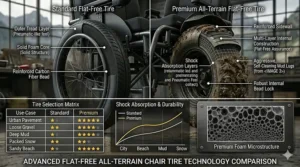
Pneumatic tires require weekly pressure checks and occasional tube replacements. This isn’t optional maintenance—research shows that wheelchair tires inflated to only 50% of recommended pressure increase energy expenditure by 12-24%, and tires below 50% inflation create rolling resistance worse than solid tires. If you physically cannot check and adjust pressure yourself, you need either a caregiver committed to weekly maintenance or you should choose solid tires and accept the efficiency loss.
The middle ground exists: high-pressure tires like the Schwalbe Marathon Plus that tolerate underinflation better, or lower-pressure options like the Continental Ride Tour (40-60 PSI) that need less frequent topping up than 110 PSI racing tires. Be realistic—many wheelchair users start with pneumatic tires, neglect maintenance, and eventually switch to solids after repeated flats or chronically low pressure.
Step 3: Calculate Your Budget Beyond Initial Purchase
That $130 Schwalbe Marathon Plus looks expensive compared to $50 Primo Orion tires until you calculate lifetime costs. The Schwalbe’s puncture resistance means zero flat repairs ($20-40 each including tubes and labor if you can’t DIY). Its durability means 2-3 year lifespan versus 1 year for budget tires. Annualized, the premium tire costs less. Meanwhile, solid tires eliminate maintenance costs but increase the physical effort required for propulsion—for some users, that energy cost matters more than the financial cost.
Run the math for your specific situation. Include tire purchase price, expected lifespan, flat repair frequency, and your maintenance capability. Sometimes the premium option is the budget option. Other times, spending less upfront makes sense for your circumstances.
Step 4: Prioritize Features Based on Your Non-Negotiables
Create a ranked list of what matters most to you: puncture resistance, rolling efficiency, off-road traction, maintenance simplicity, ride comfort, longevity, or cost. Your top three priorities determine which tire fits. For example:
- Priority 1: Puncture resistance, Priority 2: Urban efficiency, Priority 3: Cost → Schwalbe Marathon Plus justifies premium price
- Priority 1: Off-road capability, Priority 2: Traction in mud/snow, Priority 3: Durability → Kenda Nevegal despite pavement penalty
- Priority 1: Zero maintenance, Priority 2: Predictability, Priority 3: Budget → Solid PU tires despite efficiency loss
- Priority 1: Versatility, Priority 2: Hybrid performance, Priority 3: Value → Primo V-Track splits differences
Notice how different priority rankings lead to completely different tire choices. There is no universally “best” tire—only the best tire for your specific needs.
Step 5: Consider Front-End Solutions Alongside Rear Tire Upgrades
Even the best rear tires can’t overcome front caster limitations on genuinely challenging terrain. Standard 6-8 inch casters are the weak link for off-road wheelchair mobility. Before investing in aggressive rear tires alone, evaluate whether a FreeWheel attachment or larger diameter casters (10-12 inches) would deliver better all-terrain performance. Sometimes the complete solution involves both: upgrade rear tires to Primo V-Track for hybrid versatility, add a FreeWheel attachment for serious trail days, and keep your setup switchable between configurations.
Understanding Tire Specifications: What the Numbers Actually Mean
Decoding Tire Sizing (Don’t Order the Wrong Size)
Wheelchair tires use ISO/ETRTO sizing that looks like “24 x 1-3/8 (37-540)” or “24 x 2.1 (54-540)”. Pneumatic tires rely on air pressure for structural support, making proper sizing critical. Here’s what each number means and why it matters:
First number (24): Approximate diameter in inches. This must match your wheel size—24-inch tires only fit 24-inch wheels.
Second number (1-3/8 or 2.1): Tire width in inches or decimal. Wider tires need wider rims. A 2.1″ tire won’t fit safely on a rim designed for 1″ tires.
Numbers in parentheses (37-540 or 54-540): The critical measurements. First number is tire width in millimeters, second is inner rim diameter in millimeters. This is the actual compatibility spec—two tires might both claim to be “24 inch” but have different bead seat diameters (540 vs 507 vs 559), making them incompatible.
Critical mistake to avoid: Measuring your old tire instead of your rim. Tires wear and deform. Measure the metal rim’s bead seat diameter or check the markings on your existing tire sidewall. A 24 x 1″ tire (25-540) cannot be swapped with a 24 x 1-3/8″ tire (37-540) even though both are “24 inch”—the bead diameters differ.
PSI Ratings and Real-World Pressure Management
Every tire sidewall lists a PSI range like “65-110 PSI” or “Max 75 PSI”. The upper number is maximum safe inflation, not a target. The sweet spot typically sits 10-15 PSI below maximum for a balance of comfort and efficiency. Running significantly below recommended pressure doesn’t just feel harder—even a pneumatic tire at 40% inflation offers less rolling resistance than a solid polyurethane tire, meaning chronic underinflation defeats the purpose of choosing pneumatic.
Pressure guidelines by tire type:
- High-pressure slick tires (Schwalbe Marathon Plus): Run at 110-130 PSI for optimal efficiency
- Hybrid tires (Primo V-Track, Continental Ride Tour): Run at 60-70 PSI for balance
- Aggressive knobby tires (Kenda Nevegal): Run at 55-65 PSI for maximum grip
- Solid tires: No inflation required, but equivalent resistance to pneumatics at ~25% pressure
Maintenance schedule: High-pressure tires need weekly checks, mid-pressure tires bi-weekly, lower-pressure monthly. Buy a quality floor pump with built-in gauge—gas station air compressors deliver too much volume too fast and risk overinflation or valve damage. According to research on wheelchair propulsion mechanics, tires deflated to 50% of recommended pressure result in a 12-24% increase in energy expenditure.
Tread Patterns Decoded
Slick/Smooth tread (Primo Orion, Schwalbe Marathon Plus): Continuous center ridge, minimal or no side knobs. Maximizes pavement contact for low rolling resistance. Handles light gravel and packed dirt adequately but loses grip on loose surfaces or wet grass.
Hybrid/Touring tread (Continental Ride Tour, Primo V-Track): Smooth center ridge transitions to shoulder knobs or blocks. Center tread handles straight-line pavement efficiency, shoulder blocks engage during turns or off-road use. The compromise solution for users who won’t commit to separate wheel sets.
Aggressive knobby tread (Kenda Nevegal): Tall, widely-spaced lugs across entire tread. Each knob digs into soft surfaces for maximum grip. Penalty: significant rolling resistance on pavement as every knob creates friction. Only justified if your primary terrain is genuinely challenging.
The tread pattern you choose should match your 80% use case terrain, not your 20% aspirational terrain. Choosing aggressive knobbies because you “might” encounter mud means struggling daily on pavement for occasional preparedness.
Wheelchair Tire Upgrade vs Traditional Alternatives: Making the Smart Choice
| Factor | Pneumatic Tire Upgrade | Solid Tire Conversion | Complete Wheel Replacement | New All-Terrain Chair |
|---|---|---|---|---|
| Cost | $50-$130/pair | $40-$60/pair | $300-$600 | $2,000-$5,000 |
| Installation Difficulty | Easy (DIY) | Moderate (tools required) | Easy (swap wheels) | N/A |
| All-Terrain Improvement | Significant | Moderate | Significant to Major | Maximum |
| Maintenance Need | Weekly pressure checks | None | Weekly pressure checks | Weekly |
| Rolling Resistance | Low (when maintained) | High | Low | Lowest |
| Ride Comfort | High | Low | High | Highest |
This comparison reveals why tire upgrades are the entry point for most wheelchair users seeking better outdoor capability. For under $100, you can transform your existing chair’s terrain handling dramatically—the cost-benefit ratio beats any alternative. Solid tires trade performance for convenience, making sense only when maintenance capacity is zero. Complete wheel replacements (matching new rims to premium tires) deliver maximum performance but quintuple costs—justified mainly for serious outdoor enthusiasts or wheelchair athletes.
The FreeWheel attachment occupies unique territory at $280-$350. It costs more than tires alone but less than new wheels, and it fundamentally changes terrain capability by addressing front caster limitations rather than just rear tire performance. When combined with quality rear tire upgrades, it delivers all-terrain capability approaching purpose-built off-road wheelchairs at 10% of the cost.
Buying an entirely new all-terrain wheelchair only makes sense when your current chair has multiple limitations beyond tires—frame geometry, weight, or axle positioning issues that tire upgrades can’t solve. For most users, spending $100 on tire upgrades plus potentially $300 on a FreeWheel attachment delivers 90% of the mobility improvement at less than 20% of the cost of a new chair.
Long-Term Costs: Beyond the Sticker Price
When evaluating tires for all terrain wheelchair applications, the purchase price tells only part of the story. A complete cost analysis over 2-3 years reveals surprising patterns that often flip which option looks “expensive” and which is actually the budget choice.
Premium Pneumatic Tires (Schwalbe Marathon Plus): $130 initial cost for a pair
- Expected lifespan: 2-3 years
- Flat repairs over lifespan: $0 (SmartGuard prevents flats)
- Maintenance time: 15 minutes/week for pressure checks
- Replacement tubes needed: 0-1 ($15)
- Annual cost: $43-$65
Budget Pneumatic Tires (Primo Orion): $50-$70 initial cost
- Expected lifespan: 12-18 months
- Flat repairs over lifespan: 2-4 ($20-40 each if professional installation)
- Maintenance time: 15 minutes/week for pressure checks
- Replacement tubes needed: 2-4 ($15 each)
- Annual cost: $100-$150 when factoring repairs
Solid PU Tires: $40-$60 initial cost
- Expected lifespan: 2-3 years
- Flat repairs: $0 (impossible to puncture)
- Maintenance time: 0 minutes
- Replacement needed: Only when tread wears completely
- Annual cost: $15-$30
- Hidden cost: 20-40% more pushing effort required per mile
The efficiency penalty of solid tires creates an invisible “cost” that shows up as increased shoulder fatigue and reduced range. Research demonstrates that solid tires can add up to 1.5 times the weight while significantly increasing rolling resistance, making the wheelchair harder to propel. For active users logging significant weekly mileage, this matters more than the upfront savings. The $90 premium for Schwalbe Marathon Plus over solid tires pays for itself through reduced physical strain.
Installation time also deserves consideration. Pneumatic tires typically install in 20-30 minutes with basic tire levers. Solid tires require specialized installation tools (often included now) and 45-60 minutes of wrestling the pre-stretched tire onto the rim—some users report needing assistance from two people. If you pay for professional installation ($30-50), that eats into the solid tire cost advantage.
Safety and Regulatory Considerations
Weight Capacity and Load Ratings
Every wheelchair tire has a maximum weight rating, typically indicated by a load index number on the sidewall or in specifications. Most standard 24-inch wheelchair tires rate for 100-150 kg (220-330 lbs) per tire when properly inflated. This isn’t just the user’s body weight—it includes the user, wheelchair frame weight, any carried items (backpacks, oxygen tanks, shopping bags), plus dynamic loading from impacts and turns.
Critical safety reminder: Running tires at lower-than-recommended pressure reduces weight capacity. A tire rated for 150 kg at 100 PSI might only safely handle 75 kg at 50 PSI. This is why proper inflation matters beyond just rolling efficiency—it’s structural integrity. Chronic underinflation leads to sidewall failure, which on a wheelchair means sudden loss of mobility potentially in dangerous situations (busy streets, far from home).
Heavier wheelchair users or those carrying significant equipment should verify tire specifications before purchase. The Schwalbe Marathon Plus explicitly lists 60 kg load rating per tire at maximum pressure, while some wider tires like the Continental Ride Tour can handle heavier loads due to increased width distributing force across more contact area.
ADA Compliance and Surface Transitions
The Americans with Disabilities Act establishes accessibility requirements for public spaces, but it doesn’t regulate individual mobility equipment. However, understanding ADA surface requirements helps match tire choice to your environment. According to CDC disability statistics, over 61 million U.S. adults live with disabilities, making accessibility a widespread concern.
ADA-compliant surfaces must be “stable, firm, and slip-resistant”—standards that work well for narrow wheelchair tires. But the moment you venture off ADA-compliant surfaces (which is the entire point of all-terrain tire upgrades), different physics apply. Wider tires distribute weight to prevent sinking. Knobby treads engage loose material. These modifications help you navigate non-compliant real-world terrain that regulations don’t cover.
Braking System Compatibility
Upgrading to significantly wider or different-diameter tires affects your wheelchair’s braking system. Most manual wheelchairs use wheel lock brakes that press against the tire sidewall. When you switch from 1″ tires to 2.1″ tires, the brake arm geometry changes—the lock might not engage fully, or the brake pads might press against tread instead of sidewall, reducing effectiveness.
Before finalizing wider tire purchases, verify your brake arms have adjustment range. Some require longer bolts or repositioned mounting points. A few extreme width upgrades necessitate brake arm replacement. This adds $30-80 to conversion cost but prevents the safety risk of inadequate braking.
Frequently Asked Questions About Tires for All Terrain Wheelchair
❓ How often should you change wheelchair tires for all terrain use?
❓ Can you put mountain bike tires on a wheelchair for better off-road performance?
❓ What tire pressure is best for wheelchair tires on mixed terrain?
❓ Do solid wheelchair tires work on gravel and grass surfaces?
❓ How much do wheelchair tire upgrades actually cost installed?
Conclusion: Stop Letting Standard Tires Define Your Boundaries
The difference between being stuck at the edge of your friend’s gravel driveway and confidently rolling across it comes down to $70 and 30 minutes of installation time. Yet thousands of wheelchair users accept mobility limitations imposed by factory-installed tires designed for hospital hallways, not real-world terrain.
Everything in this guide points to one central truth: the right tires for all terrain wheelchair use aren’t about finding one “perfect” option—they’re about matching tire characteristics to your actual terrain, maintenance capacity, and mobility priorities. The Schwalbe Marathon Plus transforms urban commuting with unmatched puncture protection. The Primo V-Track delivers genuine hybrid versatility for users who refuse to compromise. The Kenda Nevegal opens extreme terrain previously impossible with standard equipment. And the FreeWheel attachment proves that sometimes solving front caster limitations matters more than rear tire selection alone.
Your next step depends on honest assessment of your current limitations. Track one week of where you actually go versus where you avoid going because of terrain concerns. Calculate how often you deal with flats or low-pressure struggles. Then match those realities to the tire solutions detailed here. For most wheelchair users reading this, upgrading to proper pneumatic tires with appropriate tread patterns will immediately expand accessible terrain by 40-60%. Combining that upgrade with a FreeWheel attachment pushes accessibility to 80-90% of what purpose-built off-road wheelchairs achieve, at less than 20% of the cost.
The grass, gravel, trails, and unpaved paths aren’t going anywhere—they’ll still be there next week and next month. But every day you delay upgrading your tires is another day your mobility remains artificially limited by equipment designed for different priorities than yours. Order the tires. Install them. Then go places you’ve been avoiding and rediscover how much of the world has been waiting for you to show up.
Recommended for You
- 7 Best Electric Wheelchair with Suspension – 2026
- 7 Best Affordable All Terrain Electric Wheelchair Options 2026 (Under $1500)
- 7 Best Track Wheelchair Electric Models That Dominate Terrain 2026
Disclaimer: This article contains affiliate links. As an Amazon Associate, I earn from qualifying purchases. If you purchase products through these links, we may earn a small commission at no additional cost to you.
✨ Found this helpful? Share it with your friends! 💬🤗
