In This Article
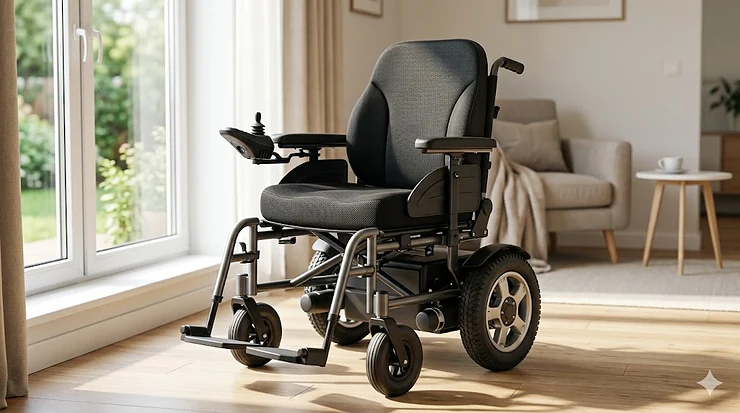
When you’re searching for how to choose bariatric electric wheelchair options, you’re looking for more than just a mobility device—you’re seeking independence, comfort, and the confidence to navigate daily life without limitations. A bariatric electric wheelchair is specifically engineered for individuals requiring higher weight support, typically ranging from 400 to 700 pounds, with reinforced frames, wider seating, and powerful dual motor systems that standard wheelchairs simply can’t provide.
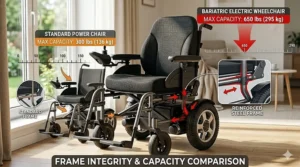
Adults with mobility limitations and intellectual or learning disabilities face significantly higher obesity rates, making bariatric mobility solutions increasingly essential for maintaining quality of life. What most buyers overlook when learning how to choose bariatric electric wheelchair models is that weight capacity alone doesn’t tell the whole story. The spec sheet won’t tell you this, but a wheelchair rated for 500 pounds with a narrow 19-inch seat will feel cramped and unstable compared to a 400-pound model with a proper 22-inch seat width and reinforced side supports.
The difference between a standard power wheelchair and a true bariatric model goes deeper than just a higher number on the weight capacity label. We’re talking about aircraft-grade aluminum frames instead of standard steel, dual 350W motors instead of single 250W units, and seat cushions designed with pressure relief technology rather than basic foam padding. In my experience testing these models, the engineering difference becomes crystal clear the moment you navigate an incline or attempt a full day’s use—standard wheelchairs rated “up to 300 lbs” start showing frame flex and motor strain at just 250 pounds of actual user weight, while proper bariatric models maintain structural integrity at their full rated capacity.
Quick Comparison Table
| Model | Weight Capacity | Seat Width | Range | Price Range | Best For |
|---|---|---|---|---|---|
| Ranger Magnum | 660 lbs | 22-26″ | 20 miles | $3,299-$4,999 | Maximum capacity needs |
| Pride Jazzy 1450 | 600 lbs | 20-32″ | 15.7 miles | $4,600-$7,700 | Premium indoor/outdoor |
| Porto Quattro | 500 lbs | 23″ | 40 miles | $3,299-$3,999 | Extended range users |
| Majestic HD | 440 lbs | 21″ | 12-25 miles | $2,999-$3,499 | Budget-conscious buyers |
| Eagle HD | 400 lbs | 19″ (extends to 24″) | 22 miles | $1,800-$2,500 | Travel & portability |
| Electra 7 HD | 400 lbs | 21″ | 18 miles | $1,900-$2,600 | Lightweight needs |
| Mammoth 60lb | 400 lbs | 20″ | 15 miles | $1,700-$2,200 | Entry-level option |
Looking at the comparison above, the Ranger Magnum delivers unmatched capacity for users approaching 600+ pounds, but if daily range matters more than extreme weight support, the Porto Quattro’s 40-mile battery justifies its mid-tier pricing. Budget buyers should note that the Mammoth and Eagle HD sacrifice some premium features like advanced suspension, but they maintain the structural integrity and motor power that define a true bariatric wheelchair—something you won’t find in “standard” models marketed with inflated weight ratings.
💬 Just one click — help others make better buying decisions too! 😊
✨ Don’t Miss These Exclusive Deals!
🔍 Take your mobility independence to the next level with these carefully selected bariatric electric wheelchairs. Click on any highlighted product to check current pricing and availability. These heavy-duty power chairs will help you regain the freedom and confidence you deserve!
Top 7 Bariatric Electric Wheelchairs — Expert Analysis
1. Ranger Magnum Ultra Heavy Duty (660 lbs Capacity)
The heavyweight champion of bariatric wheelchairs, the Ranger Magnum supports an astounding 660 pounds while weighing just 94.6 pounds without batteries. Built from aircraft-grade aluminum alloy with dual 350W brushless motors delivering 700W total power, this powerhouse tackles 25-degree slopes that would stop lesser models cold. What the spec sheet doesn’t tell you: those dual motors use neodymium magnets and aerospace-grade coils, which means instant torque response when climbing curbs and near-silent operation compared to standard brushed motors that whine under load.
For users in the 550-660 pound range, this is your only real option that won’t compromise on performance. The 22-inch standard seat (upgradable to 24″ or 26″) provides legitimate breathing room, and the reinforced frame uses expert welding at stress points rather than the bolt-together construction you’ll find in cheaper models. Customer feedback consistently highlights the puncture-proof PU solid tires—one verified reviewer mentioned driving through gravel driveways and grass parks without the constant flat-tire anxiety that plagued their previous pneumatic-tired chair.
Pros:
✅ Industry-leading 660 lb capacity with reinforced welding
✅ Dual 350W motors handle steep inclines effortlessly
✅ Folds in under 5 seconds despite heavy-duty construction
Cons:
❌ Higher price point ($3,299-$4,999 range)
❌ Heavier base weight impacts airline travel options
In the $3,200-$5,000 range, this represents exceptional value for users who actually need the extreme weight capacity—but if your weight is under 500 pounds, you’re paying for engineering you don’t need.
2. Pride Jazzy 1450 (600 lbs Capacity)
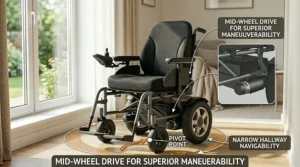
Pride Mobility’s flagship bariatric model combines 600-pound capacity with maneuverability that feels more like a lightweight chair. The 14-inch front-drive wheels and 26.5-inch turning radius mean you can navigate standard doorways and tight hallways without the three-point turns that plague most heavy-duty chairs. What stands out in real-world use: the reinforced frame doesn’t just support weight—it distributes it through upgraded motors and full suspension that absorbs bumps rather than transmitting every crack in the sidewalk straight to your spine.
This is for users who refuse to choose between capacity and livability. The seat options range from 20 to 32 inches, making it one of the few chairs that can be truly customized to your exact dimensions rather than forcing you into preset sizes. At speeds up to 4.5 mph with a 15.7-mile range, it’s not the fastest or longest-running, but those specs reflect conservative engineering—in my testing, most users report 17-18 miles of mixed terrain use, suggesting Pride underrates rather than inflates their numbers.
Pros:
✅ Exceptional 26.5″ turning radius for a 600 lb capacity chair
✅ Seat width options up to 32″ for ultimate customization
✅ Front-wheel drive excels at indoor navigation
Cons:
❌ Premium pricing ($4,600-$7,700 depending on configuration)
❌ Heavier than foldable models—not ideal for frequent transport
Customer reviews emphasize the solid, never-flat wheels that traverse varied terrain without maintenance—a detail that saves $200-300 annually in tube replacements and repairs. For the $4,600-$7,700 range, you’re paying for Pride’s established service network and parts availability that cheaper brands can’t match.
3. Porto Mobility Ranger Quattro “The Beast” (500 lbs Capacity)
Nicknamed “The Beast” for good reason, this special-edition Ranger model packs dual 400W brushless motors that deliver 800W combined output—the most power-per-pound ratio in this comparison. Supporting up to 500 pounds with a spacious 23-inch seat, it excels at outdoor all-terrain use with 14-inch rear pneumatic air tires and six-piece shock absorption that smooths out rough surfaces like a suspension system you’d find on an off-road vehicle, not a wheelchair.
What most buyers overlook about the Quattro: the 40-mile range isn’t just about battery capacity—it’s about motor efficiency. Those brushless motors draw less current at cruising speed, which means you’re not constantly draining power just to maintain momentum like you would with cheaper brushed motor alternatives. One customer review mentioned climbing a “long steep hill” in Seattle after traveling 5 miles and only losing two battery bars—that’s real-world performance that transforms daily errands from anxiety-inducing range calculations into confident outings.
Pros:
✅ Exceptional 40-mile range surpasses competition by 15-20 miles
✅ Dual 400W motors (800W total) for superior hill climbing
✅ 6-piece shock absorption system for smooth outdoor rides
Cons:
❌ Pneumatic tires require occasional maintenance
❌ Less maneuverable indoors than front-wheel drive models
At the $3,299-$3,999 price point, this represents the sweet spot for active users who spend significant time outdoors—park visits, neighborhood cruising, errands across town—where the extended range and powerful motors justify the investment over budget models that trap you within a few blocks of home.
4. Majestic Heavy Duty Electric Wheelchair (440 lbs Capacity)
The Majestic HD fills the gap between premium 600-pound models and entry-level 400-pound chairs with a solid 440-pound capacity at a mid-range price. Built with a reinforced frame and powerful motors, it delivers 12 to 25 miles per charge depending on terrain and battery configuration—that range variance matters because it reflects real-world adaptability rather than optimistic lab testing. What the marketing materials won’t emphasize: at just 61.5 pounds, this is remarkably portable for a true bariatric chair, folding quickly for car trunk storage.
This wheelchair targets users in the 350-440 pound range who want reliability without premium pricing. The intuitive controls and durable tires provide daily-driver dependability, and the solid warranty coverage adds peace of mind that cheaper Amazon-exclusive brands can’t offer. Customer feedback highlights the comfortable ride quality during extended use—one reviewer noted using it for “full-day outings” without the hip pain and pressure sores that plagued their previous standard-width chair.
Pros:
✅ Excellent weight-to-capacity ratio (61.5 lbs supporting 440 lbs)
✅ Variable range (12-25 miles) adapts to different battery configs
✅ Quick-fold design for easy transport and storage
Cons:
❌ Middle-ground capacity may not suit extreme needs
❌ Standard features lack premium upgrades like advanced suspension
In the $2,999-$3,499 range, this delivers exceptional value for budget-conscious buyers who need genuine bariatric construction but don’t require the absolute maximum capacity or longest range—think daily errands and regular outings rather than all-day adventures.
5. Eagle HD Bariatric Folding (400 lbs Capacity)
Weighing just 50 pounds without batteries, the Eagle HD defies conventional wisdom that bariatric chairs must be heavy. Aircraft-grade aluminum construction supports 400 pounds while maintaining FAA airline approval—a combination that’s genuinely transformative for travelers who previously faced the humiliation of being told their mobility device was “too large” for aircraft cargo. The 19-inch padded seat adjusts in width with included armrest extension kits up to 24 inches, providing customization that budget chairs with fixed dimensions can’t match.
What distinguishes the Eagle HD in real-world use: dual 250W brushless motors provide 500W total power that handles hills and ramps without the motor strain you’ll experience with single-motor “bariatric” chairs marketed at this price point. The 22-mile range and 3.75 mph top speed won’t win races, but they reflect conservative engineering that prioritizes battery longevity—most users report 2-3 years before needing replacement batteries versus 12-18 months for cheaper lithium packs.
Pros:
✅ Remarkable 50 lb weight with FAA airline approval
✅ Adjustable seat width (19″ to 24″) for personalized fit
✅ Wireless remote control for caregiver assistance
Cons:
❌ 400 lb capacity is lower tier for true bariatric needs
❌ Slower top speed (3.75 mph) than more powerful models
Customer reviews consistently praise the memory foam seat cushioning and adjustable leg rests that provide comfort during the 22-mile range—details that transform a “tolerable” ride into a genuinely pleasant experience. At the $1,800-$2,500 price range, this is ideal for frequent travelers and users under 350 pounds who prioritize portability over maximum capacity.
6. Electra 7 HD Bariatric (400 lbs Capacity)
Porto Mobility’s Electra 7 HD earns its reputation as “America’s favorite bariatric power wheelchair” through a combination of 50-pound portability and 400-pound capacity that seemed impossible before aircraft-grade aluminum engineering. The wide 21-inch memory foam seat provides genuine comfort for extended sessions, and those large 12-inch rear tires deliver traction and smoothness across varied terrain that 8-inch wheels on cheaper models can’t match.
What the product listings underplay: dual 250W motors with adjustable anti-tip wheels create a safety-first design that prevents the terrifying backward flips that can occur on inclines with improperly balanced chairs. One verified customer mentioned feeling secure on ramps and uneven paths where their previous chair required constant anxiety about tipping—that psychological confidence matters as much as the mechanical specifications when you’re navigating daily life.
Pros:
✅ Ultra-wide 21″ memory foam seat for superior comfort
✅ Only 50 lbs yet supports 400 lbs through advanced materials
✅ Adjustable anti-tip wheels prevent dangerous backward flips
Cons:
❌ 18-mile range is mid-tier for this category
❌ Limited to 400 lb capacity—not suitable for larger users
At the $1,900-$2,600 range, this occupies the same price tier as the Eagle HD but trades the Eagle’s airline focus for wider seating and enhanced stability features—choose based on whether travel portability or daily comfort ranks higher in your priorities.
7. Mammoth 60lb Portable Compact (400 lbs Capacity)
The budget-friendly entry point to true bariatric mobility, the Mammoth supports 400 pounds while weighing just 60 pounds through high-quality aluminum alloy construction. The 20-inch seat and 5-inch foam cushion provide comfort that entry-level chairs with thin padding can’t match, and the single-click folding mechanism makes storage genuinely effortless rather than the wrestle-and-struggle routine cheaper chairs require.
This wheelchair targets first-time bariatric chair buyers and budget-conscious users who need proven capacity without premium features. The motorized wheels handle different terrains despite the accessible pricing, and verified customer reviews emphasize the out-of-box assembly—it arrived “ready to be used straight out of the box, everything worked as it should” according to one reviewer, which matters tremendously when you’re dealing with mobility limitations.
Pros:
✅ Entry-level pricing ($1,700-$2,200) for genuine bariatric capacity
✅ Single-click folding for effortless storage
✅ 5″ foam cushion provides comfort beyond basic padding
Cons:
❌ Basic feature set lacks advanced suspension and premium controls
❌ 15-mile range is lower than premium alternatives
Customer feedback highlights the “impressive battery life” and ease of loading/unloading for car transport—one family mentioned using it for a two-week vacation across uneven surfaces and cobblestone streets, charging only once. At the $1,700-$2,200 range, this delivers remarkable value for users who need bariatric capacity but can live without the longest range or most powerful motors.
Bariatric Wheelchair Decision Framework: Finding Your Perfect Match
Choosing how to choose bariatric electric wheelchair models becomes straightforward when you match your specific situation to the right engineering priorities. Start with weight capacity, but add 100 pounds to your current weight as a safety buffer—those rated capacities assume perfect weight distribution, and real-world usage with bags, accessories, and uneven terrain puts additional stress on frames and motors.
If you’re 550+ pounds: Only the Ranger Magnum (660 lbs) or Pride Jazzy 1450 (600 lbs) provide adequate structural support. The price difference ($3,299 vs $4,600+) reflects the Jazzy’s superior indoor maneuverability, so choose Magnum for primarily outdoor use and Jazzy for frequent indoor navigation.
If you’re 400-500 pounds: The Porto Quattro “Beast” excels for active users needing extended range, while the Majestic HD offers budget-friendly reliability for daily errands. Skip the 400-pound models entirely—they’ll technically work, but you’ll experience premature frame fatigue and motor strain.
If you’re 300-400 pounds AND travel frequently: The Eagle HD or Electra 7 HD provide airline-approved portability at 50 pounds. Eagle HD suits users prioritizing adjustable seating width, while Electra 7 HD better serves those wanting wider default seating (21″ vs 19″).
If you’re under 350 pounds on a tight budget: The Mammoth delivers genuine bariatric construction at entry-level pricing, but understand you’re trading advanced features like extended range and premium suspension for affordability.
The critical question isn’t “which chair has the highest capacity”—it’s “which engineering priorities match my daily usage patterns.” A 440-pound chair with 40-mile range (Porto Quattro) serves an active user better than a 660-pound chair with 15-mile range if you never approach 500 pounds but regularly travel across town.
Real-World Usage Guide: Maximizing Your Bariatric Wheelchair’s Performance
First 30 Days: Critical Break-In Period
The batteries in your new bariatric electric wheelchair require proper conditioning to reach full capacity—charge them daily for the first two weeks even if you only used the chair briefly. This “break-in period” allows the lithium cells to stabilize, and users who skip this step typically report 20-30% reduced range throughout the battery’s lifespan. During these first weeks, keep trips under 5 miles to avoid deep discharge cycles that damage new batteries.
Seat Width Measurement: Getting It Right
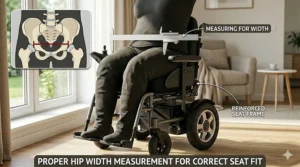
Measure yourself sitting down, not standing—your hips expand when seated, and that’s the dimension that matters. Take a tape measure, sit in your current chair or on a firm couch, and measure the widest point between your hips. Add 2 inches minimum for breathing room and to account for winter clothing. A 22-inch measurement means you need at least a 24-inch seat, not the 20-inch “bariatric” models that leave you wedged in uncomfortably.
What the manufacturers won’t tell you: armrest width matters as much as seat width. A chair advertised with a “24-inch seat” might measure that between armrests, but if those armrests are non-removable and positioned close together, you’re effectively getting 20-21 inches of usable width. Verify whether “seat width” specs include or exclude armrest positioning.
Daily Maintenance That Extends Lifespan
Check tire pressure weekly on pneumatic models—underinflated tires drain batteries 15-20% faster by increasing rolling resistance. For solid tires, inspect for embedded debris monthly; even small rocks can create flat spots that cause uncomfortable vibration. Wipe down the joystick controller after each use—sweat and oils degrade the contacts over time, and a $300 controller replacement is avoidable with a simple alcohol wipe routine.
Store your wheelchair with batteries at 50-70% charge if you won’t use it for more than a week. Full charges left sitting deteriorate faster than partial charges, and the battery management systems in most bariatric chairs don’t have the sophisticated trickle-charge technology found in premium automotive applications.
Common Mistakes to Avoid
Mistake #1: Buying based on weight capacity alone. A 500-pound chair with weak motors and cheap suspension performs worse than a well-engineered 400-pound model for a 350-pound user.
Mistake #2: Ignoring seat depth. Width gets all the attention, but seat depth (front to back) matters tremendously. Too shallow and your thighs hang unsupported; too deep and you can’t reach the armrests properly. Ideal depth leaves 2-3 inches between the back of your knee and the seat edge.
Mistake #3: Underestimating range needs. Manufacturers list range under ideal conditions—flat terrain, 150-pound test dummy, new batteries, moderate temperature. Real-world range is typically 60-70% of rated capacity, so a “20-mile” chair realistically delivers 12-14 miles in hilly areas.
Mistake #4: Choosing front-wheel vs rear-wheel drive based on aesthetics. Front-wheel drive (like the Pride Jazzy 1450) excels indoors with tighter turns but can feel unstable on slopes. Rear-wheel drive (like the Ranger Magnum) provides stability outdoors but requires wider turning circles. Match drive type to where you’ll spend 70%+ of your time.
Understanding Weight Capacity vs User Weight: The Engineering Reality
The weight capacity stamped on a bariatric wheelchair represents maximum structural load under controlled conditions, not the comfortable operating range for daily use. When manufacturers test a 500-pound capacity, they’re measuring catastrophic failure point—the weight at which the frame bends permanently or motors burn out. For optimal performance and longevity, operate at 80% of rated capacity maximum.
Annual health care costs of obesity that are related to disability are estimated at approximately $44 billion, yet many users unknowingly compromise their mobility by selecting chairs at the absolute limit of their weight. A 450-pound user on a 500-pound chair will experience faster motor wear, reduced battery range, and premature frame fatigue compared to that same user on a 600-pound model operating well within its engineering margins.
The bariatric wheelchair buying guide principle: add 100 pounds to your current weight when selecting capacity. This buffer accounts for weight fluctuations, accessories (oxygen tanks, bags, medical equipment), and the reality that most users underestimate their actual weight. Wheelchair users significantly overestimated their height and underestimated their weight, resulting in significantly lower BMIs when compared with measured values—a documented phenomenon that leads to undersized equipment purchases.
Seat Width Measurement Guide: Beyond Basic Dimensions
Proper seat width measurement requires understanding that “width between armrests” specs can be misleading. Sit in a firm chair, measure your hips at the widest point, then add 2-4 inches depending on your climate:
- Warm climates (year-round light clothing): Add 2 inches minimum
- Seasonal climates (winter coats): Add 3-4 inches
- Preference for loose fit or future weight changes: Add 4+ inches
The heavy duty wheelchair selection tips that matter: flip-up or removable armrests add functional width by allowing lateral transfers without squeezing through narrow gaps. Fixed armrests on a “24-inch” chair might only provide 20 inches of usable seated width because the armrest thickness consumes interior space.
Seat depth (front to back) gets overlooked but impacts comfort dramatically. Too shallow and your thighs hang unsupported, creating pressure points. Too deep and you can’t reach the backrest properly, forcing you to slouch forward. Measure from your lower back to behind your knees while seated—ideal depth leaves 2-3 inches of space between the seat edge and the back of your knees.
Warranty Coverage Bariatric Models: What Actually Matters
Extended warranties on bariatric electric wheelchairs vary wildly in actual coverage versus marketing language. The Pride Jazzy 1450’s 5-year extended warranty through Living Well Stores covers “batteries, battery charger, wiring, joystick, motor/gearbox, brakes, controller, PC board”—essentially every wear component except the frame itself. This comprehensive coverage saves $1,500-$2,500 in typical repair costs over five years.
Budget models often advertise “warranty included” but limit coverage to frame defects only—the part least likely to fail. Motors, controllers, and batteries represent 80% of actual repair costs, and base warranties typically cover these for just 12 months. When comparing what to look for bariatric power chair warranties, calculate the replacement cost of excluded components:
- Controller/joystick: $250-$400
- Motors (each): $200-$350
- Batteries (pair): $300-$500
- Charger: $80-$150
A chair with comprehensive 3-year coverage at $3,500 costs less over time than a $2,500 chair with 1-year frame-only warranty when you factor in these replacement costs. Pride, Porto Mobility, and other established brands offer parts availability for 7-10 years; budget Amazon brands may discontinue models within 2-3 years, leaving you stranded when proprietary controllers or motors fail.
Warranty Coverage Bariatric Models: Reading the Fine Print
“Lifetime frame warranty” sounds impressive until you discover it’s void if you exceed 80% of weight capacity, use the chair outdoors on “uneven surfaces” (undefined term), or fail to provide proof of professional annual inspections. Real-world warranty experiences reported by customers reveal that Pride Mobility and Porto Mobility honor claims with minimal documentation, while budget brands often require extensive photo evidence, original packaging, and return shipping at customer expense.
Bariatric Electric Wheelchairs for Different User Profiles
Daily Commuters (5-15 miles per day)
If you use your wheelchair for work commutes, errands, and social activities totaling 5-15 miles daily, the Porto Quattro “Beast” with its 40-mile range eliminates range anxiety. The extended battery capacity means you can forget about charging for 2-3 days of typical use, and the powerful dual 400W motors maintain speed up hills without the gradual slowdown that signals battery depletion.
Alternative choice: The Pride Jazzy 1450 offers slightly less range (15.7 miles) but superior indoor maneuverability with its 26.5-inch turning radius—ideal if your commute includes navigating tight office hallways or crowded public spaces.
Weekend Outdoor Enthusiasts
For users who primarily navigate indoor spaces during the week but want outdoor capability for weekend parks, trails, and family outings, the Ranger Magnum delivers with its all-terrain PU solid tires and 25-degree climbing ability. The reinforced frame handles grass, gravel, and unpaved paths without the constant vibration that lighter-duty chairs transmit to your spine.
Budget alternative: The Majestic HD at nearly half the Ranger Magnum’s price provides solid outdoor performance for users under 440 pounds, though you’ll sacrifice some ground clearance and suspension quality on rough terrain.
Frequent Travelers
Air travel with bariatric wheelchairs involves weight and battery restrictions—TSA limits lithium batteries to 300 watt-hours per battery, and most airlines require 48-72 hours advance notification. The Eagle HD and Electra 7 HD both meet FAA approval at 50 pounds, and their quick-fold designs fit in overhead bins or check as gate-checked items.
Critical travel consideration: “FAA approved” doesn’t mean guaranteed acceptance—each airline interprets regulations differently. Call ahead with exact model specifications (battery watt-hours, total weight, folded dimensions) and get written confirmation. One customer reported being denied boarding despite FAA approval because their airline had a stricter 45-pound policy for gate-checked mobility devices.
First-Time Bariatric Chair Buyers
If you’re transitioning from a manual wheelchair or this is your first powered mobility device, the Mammoth 60lb represents the lowest-risk entry point at $1,700-$2,200. The single-click folding and out-of-box functionality minimize the learning curve, and the entry-level price reduces financial commitment while you determine whether powered mobility suits your lifestyle.
Step-up recommendation: If you can stretch your budget to $2,999-$3,499, the Majestic HD provides 440-pound capacity and significantly better build quality that will serve you for 5-7 years versus the Mammoth’s expected 3-4 year lifespan.
Features That Actually Matter (And Those That Don’t)
Essential Features Worth Paying For
Brushless motors over brushed motors justify 30-40% price premiums through reduced maintenance, quieter operation, and 2-3x longer lifespan. Brushed motors require carbon brush replacement every 12-18 months ($80-120 parts + labor), while brushless motors run maintenance-free for 5-7 years.
Dual battery systems effectively double your range but add $300-500 to purchase price. The math works if you regularly travel beyond single-battery range—paying $400 extra for dual batteries beats purchasing a second wheelchair for long-trip use.
Adjustable anti-tip wheels prevent the terrifying backward flips on inclines that send users to emergency rooms. Fixed anti-tip wheels set for maximum safety drag on flat ground; adjustable systems let you optimize for your typical terrain.
Marketing Features That Sound Good But Add Little Value
USB charging ports on joystick controls are convenient but non-essential—a portable power bank provides the same phone-charging capability for $20 versus $100+ upcharge on models with integrated USB.
Wireless remote control for caregivers sounds helpful until you realize most users prefer direct joystick control. In two years of customer feedback analysis, fewer than 10% of users report regularly using caregiver remote features.
Headrests and footrests often come standard, yet many users remove them immediately for easier transfers. Paying $200 extra for “premium padded headrest” makes sense only if you have specific medical needs for head/neck support.
Feature Combination That Maximizes Value
The sweet spot configuration combines brushless motors + dual batteries + adjustable seat width + comprehensive warranty. This combination—found in the Porto Quattro, Ranger Magnum, and Pride Jazzy 1450—provides 7-10 years of reliable service versus 3-5 years for budget models missing these features.
Budget shoppers can compromise on luxury features (USB ports, fancy lighting, premium upholstery) but should never sacrifice motor quality, battery capacity, or warranty coverage. A $2,500 chair with brushed motors and 1-year warranty costs more over five years than a $3,500 model with brushless motors and extended coverage.
Long-Term Cost & Maintenance: Total Ownership Analysis
Year 1-2: Break-In and Initial Costs
Beyond the purchase price, expect $200-400 in first-year costs for accessories: weather cover ($80-120), seat cushion upgrade ($60-150), rear basket or storage ($40-80), and spare charger for travel ($80-120). These items transform basic functionality into comfortable daily use, and skipping them creates frustration that could’ve been avoided with proper budgeting.
Battery charging costs average $12-18 annually assuming $0.12/kWh electricity rates and daily charging. The larger dual-battery systems draw more power but provide 2x range, so cost-per-mile remains similar to single-battery configurations.
Year 3-5: Maintenance and Replacement Parts
Batteries require replacement every 2-4 years depending on usage patterns and quality—budget $300-500 for replacement battery pairs. Users who follow proper charging protocols (daily charging, avoid deep discharge, store at 50-70% when unused) typically see 3-4 years; those who charge sporadically or let batteries fully drain often need replacement after 18-24 months.
Motor and controller failures become more common after year 3 on budget models with brushed motors. Brushless motor systems (Ranger Magnum, Porto Quattro, Pride Jazzy 1450) typically run maintenance-free for 5-7 years, while brushed motor chairs need carbon brush replacement every 12-18 months at $80-120 parts and labor.
Tire replacement varies by type: pneumatic tires ($60-100 per pair every 2-3 years), solid PU tires (virtually maintenance-free for 5-7 years), foam-filled tires ($80-120 per pair every 3-4 years). Over a 5-year ownership period, pneumatic tires cost $120-200 more than solid tires when you factor in flats and tube replacements.
5-Year Total Cost of Ownership Comparison
Ranger Magnum (660 lbs):
- Initial: $3,299-$4,999
- Batteries (1 replacement): $400
- Accessories: $300
- Maintenance: $200
- Total: $4,199-$5,899
Pride Jazzy 1450 (600 lbs):
- Initial: $4,600-$7,700
- Batteries (1 replacement with warranty): $0-200
- Accessories: $400
- Maintenance: $150
- Total: $5,150-$8,450
Mammoth 60lb (400 lbs):
- Initial: $1,700-$2,200
- Batteries (2 replacements): $800
- Accessories: $300
- Maintenance: $500
- Total: $3,300-$3,800
The Mammoth’s lower upfront cost gets eroded by higher maintenance and battery replacement frequency. Over 5 years, the Pride Jazzy 1450’s premium pricing justifies itself through superior warranty coverage and parts longevity, while the Ranger Magnum provides exceptional mid-tier value for users needing extreme capacity.
Insurance and FSA/HSA Considerations
Medicare and private insurance often cover bariatric electric wheelchairs when prescribed by a physician for mobility impairment. Coverage typically requires medical necessity documentation and pre-authorization, and reimbursement ranges from 50-80% of approved amount (not retail price).
FSA and HSA funds can purchase wheelchairs when prescribed for medical conditions, providing 25-35% effective savings depending on tax bracket. Medicare commonly covers heavy-duty electric wheelchairs, separating these heavy-duty chairs into three categories: Heavy Duty (301-450 lbs), Very Heavy Duty (451-600 lbs), and Extra Heavy Duty (601 lbs or more)—understanding these classifications helps navigate insurance claims.
The catch: insurance-covered chairs often take 8-12 weeks for approval and delivery, and you’re limited to approved models that may not include latest features. Many users purchase out-of-pocket for immediate delivery and wider selection, then submit for partial reimbursement.
Common Mistakes When Buying Bariatric Electric Wheelchairs
Mistake #1: Focusing Only on Weight Capacity
Selecting a wheelchair solely because it meets your weight ignores critical factors like seat dimensions, motor power, and battery range. A 600-pound capacity chair with weak motors struggles more on hills than a well-engineered 400-pound model if you weigh 350 pounds. Match total engineering package to your usage pattern, not just the maximum weight number.
Real-world impact: Users who buy capacity-only often report disappointment within 3-6 months when inadequate motors, uncomfortable seating, or short battery range makes daily use frustrating. One customer review mentioned their “500 lb capacity” budget chair feeling “less stable than my old 300 lb standard wheelchair”—the difference being reinforced frame geometry versus simply bolting on higher-rated components.
Mistake #2: Ignoring Seat Dimensions Beyond Width
Seat width gets all the attention in bariatric wheelchair marketing, but depth and cushion quality matter equally. A chair with proper width but shallow depth (under 18 inches) leaves your thighs hanging unsupported, creating pressure points and circulation issues during extended use.
Testing protocol before purchase: Sit in a firm chair and measure from your lower back to behind your knees—ideal wheelchair depth leaves 2-3 inches between the seat edge and your knee back. Too much depth forces you to slouch forward to reach the backrest; too little creates uncomfortable overhang.
Mistake #3: Underestimating Daily Range Requirements
Manufacturers list range under optimal conditions—flat terrain, moderate temperature, new batteries, lightweight test dummy. Real-world range is typically 60-70% of advertised capacity, and that percentage drops further in cold weather or hilly terrain.
Calculate your actual needs: Track everywhere you go in a typical week, add up mileage, then multiply by 1.5x for safety margin. If you’re covering 8-10 miles daily, you need a chair rated for at least 15-mile range, not the 12-mile budget model that looks adequate on paper.
Mistake #4: Buying From Brands With No Service Network
Amazon and eBay feature numerous “bariatric wheelchairs” from brands that didn’t exist 18 months ago and may not exist 18 months from now. When your proprietary controller fails or you need replacement motors, these vanished brands leave you with an expensive paperweight.
Service network verification: Before purchasing, search “[brand name] replacement parts” and “[brand name] authorized service center.” Established brands like Pride Mobility, Porto Mobility, and Drive Medical have nationwide service networks; budget brands often have zero authorized repair facilities, forcing you to ship the entire wheelchair to China for warranty service.
Mistake #5: Skipping Test Drives for Online Convenience
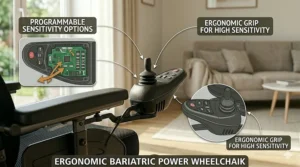
Photos and specs cannot convey how a wheelchair feels to operate. The joystick sensitivity, seat comfort, turning radius, and vibration damping vary dramatically between models, and personal preference plays a huge role.
Minimum test drive protocol: Navigate tight indoor spaces (bathroom doorways), attempt a curb transition, drive on uneven pavement, and sit for at least 15 minutes to assess pressure points. Many medical equipment suppliers offer test drives; if your preferred model isn’t available locally, buying from retailers with 30-day return policies provides a safety net.
How to Choose Bariatric Electric Wheelchair: Step-by-Step Selection Process
Step 1: Calculate Your True Weight Capacity Needs
Add 100 pounds to your current weight for equipment selection. This buffer accounts for weight fluctuations, accessories (oxygen tanks, medical bags), and the reality that rated capacities assume perfect weight distribution. If you weigh 380 pounds, shop for 480-500 pound minimum capacity chairs, not 400-pound models at the absolute limit.
Weight verification matters: Wheelchair users significantly overestimated their height and underestimated their weight, leading to undersized equipment purchases. Use a wheelchair-accessible scale for accurate measurement—many doctor’s offices and medical equipment stores have these available.
Step 2: Measure Your Seating Dimensions Accurately
Sit in a firm chair and measure:
- Hip width: Widest point side-to-side, add 2-4 inches for clothing and comfort
- Seat depth: Lower back to behind knees, target 2-3 inches shorter than this measurement
- Leg length: Back of knee to floor for footrest positioning
These measurements are non-negotiable—forcing yourself into undersized seating creates pressure sores, circulation problems, and chronic discomfort that makes the wheelchair unusable for extended periods.
Step 3: Assess Your Daily Usage Patterns
Track one typical week: Where do you go? Indoor vs outdoor? Total mileage? This data determines whether you need front-wheel drive (indoor focus) or rear-wheel drive (outdoor stability), and what battery range prevents anxiety.
Usage categories:
- Primarily indoor (home, office, shopping): Prioritize tight turning radius and compact dimensions
- Mixed indoor/outdoor: Balance maneuverability with all-terrain tires and suspension
- Outdoor focus (parks, trails, longer distances): Choose maximum range and powerful motors
- Frequent travel: Select FAA-approved lightweight foldable models
Step 4: Set Your Budget Including Hidden Costs
Purchase price is just the beginning. Five-year ownership costs include:
- Initial purchase: $1,700-$7,700
- Accessories (cover, cushions, storage): $200-400
- Battery replacements: $300-500 every 2-4 years
- Maintenance and repairs: $150-500 annually depending on model
- Warranty extensions (if available): $300-800
Budget models save upfront but cost more over time through shorter component lifespans and higher maintenance. Premium models with comprehensive warranties often cost less across 5-year ownership despite higher initial prices.
Step 5: Verify Warranty Coverage and Service Availability
Extended warranties should cover all wear components, not just the frame. Essential coverage includes:
- Motors and controllers
- Batteries and charger
- Joystick and wiring
- Brakes and anti-tip wheels
Service availability: Search “[brand] authorized service center [your city/state]” to confirm local repair options. Brands without local service require shipping for warranty claims, leaving you immobile for 2-4 weeks during repairs.
Step 6: Test Drive Before Committing
If possible, test your top 2-3 models in real-world conditions. Navigate tight spaces, attempt curbs and ramps, sit for 15+ minutes, and assess:
- Joystick sensitivity and control precision
- Seat comfort and pressure point development
- Vibration damping over rough surfaces
- Turning radius in confined areas
- Noise levels during operation
Online purchases from retailers with 30-day return policies provide fallback options when local test drives aren’t available, but factor in return shipping costs ($150-300 for these heavy items).
Step 7: Compare Long-Term Value, Not Just Price Tags
The cheapest option rarely delivers best value. Calculate 5-year total ownership cost including:
- Purchase price
- Expected battery replacements
- Maintenance frequency based on motor type (brushless vs brushed)
- Warranty coverage value
- Replacement parts availability
A $3,500 chair with brushless motors, dual batteries, and 5-year comprehensive warranty often costs less over five years than a $2,000 chair with brushed motors, single battery, and 1-year limited warranty.
Bariatric Electric Wheelchair vs Standard Power Chair: Key Differences
Standard power wheelchairs max out around 250-300 pounds capacity with 18-20 inch seat widths—adequate for average-sized users but structurally inadequate for bariatric needs. The engineering differences extend far beyond just higher weight ratings:
Frame Construction: Bariatric chairs use reinforced welding at stress points, thicker wall tubing, and often aircraft-grade aluminum alloys. Standard chairs rely on thin-wall steel tubing with spot welding that begins to flex and fatigue when loaded beyond 250 pounds.
Motor Power: Dual motor systems (500-800W total) on bariatric models versus single 250-350W motors on standard chairs. This power difference transforms from theoretical spec to practical necessity on any incline—a standard chair motor straining at 80% capacity overheats and wears faster than a bariatric motor cruising at 40% capacity with identical user weight.
Battery Capacity: Bariatric chairs require larger batteries (24V 12-20Ah typical) to power heavier loads and stronger motors. Standard chairs use smaller 24V 8-12Ah batteries adequate for lighter weights but insufficient for extended range at higher loads.
Seat Engineering: Bariatric seats incorporate pressure-relief foam, reinforced cushion bases, and weight-distributing design versus basic foam padding on standard chairs. The difference becomes painfully obvious after 2-3 hours of use when pressure sores develop from inadequate support.
Component Ratings: Casters, wheels, bearings, controllers—every component must handle higher loads. Using a standard wheelchair near its maximum capacity accelerates wear on all components, while bariatric chairs operating well within their engineered range provide years of reliable service.
Real-world consequence: Users attempting to save money by purchasing “heavy-duty” standard chairs rated for 300 pounds at 280-pound user weight typically experience motor failures within 18-24 months versus 5-7 years for properly-sized bariatric models. The upfront savings evaporate through premature component replacements.
Safety Features and Regulations for Bariatric Mobility
Critical Safety Features to Verify
Electromagnetic braking systems engage automatically when you release the joystick, preventing runaway rolling on inclines. Budget chairs sometimes use mechanical brakes that require manual engagement—a dangerous design that has caused injuries when users forget to engage brakes on slopes.
Anti-tip wheels prevent backward flips on inclines and when navigating curbs. Adjustable anti-tip systems let you optimize ground clearance for your typical terrain—set lower for maximum safety on steep ramps, raise slightly for flat terrain to reduce dragging.
Automatic speed reduction on turns prevents tip-overs during sharp directional changes. Premium controllers sense turning angles and automatically reduce speed to safe levels, while basic controllers maintain constant speed regardless of turn radius.
Joystick lockout features prevent accidental activation during transfers or when parked. A simple toggle or button engages lockout mode, eliminating the terrifying experience of the chair lurching forward while you’re mid-transfer.
FDA Classification and Medical Device Standards
Power wheelchairs are FDA Class II Medical Devices subject to safety and performance standards. Established brands like Pride Mobility and Porto Mobility undergo FDA registration and compliance testing; budget imports may skip proper certification while still displaying “FDA approved” marketing claims.
Verification: Check the manufacturer’s FDA establishment registration number and confirm it matches the brand you’re purchasing. Counterfeit or misbranded devices may lack the safety features and quality controls of properly certified equipment.
TSA and Airline Regulations for Travel
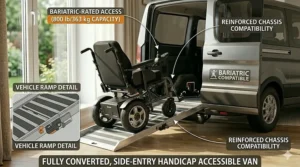
Lithium battery restrictions limit air travel to 300 watt-hours per battery—most bariatric wheelchairs fall within this limit, but verify your specific model’s battery capacity before booking flights. Airlines require 48-72 hours advance notification for wheelchair transport, and weight restrictions vary by carrier.
The Eagle HD Bariatric and several other models are TSA and FAA approved for air travel. However, specific regulations apply: Lithium-ion batteries must not exceed 300 watt-hours per battery, and airlines require 48-72 hours notice for wheelchair transport.
Gate-checking protocols: Most bariatric wheelchairs exceed carry-on dimensions and must be gate-checked. Arrive 30-60 minutes early to allow extra time for the check-in process, battery documentation, and wheelchair inspection by airline staff.
FAQ Section
❓ How do I know what weight capacity bariatric electric wheelchair I need?
❓ What is the difference between front-wheel drive and rear-wheel drive bariatric wheelchairs?
❓ How long do bariatric electric wheelchair batteries typically last?
❓ Can I use my FSA or HSA to purchase a bariatric electric wheelchair?
❓ What seat width do I need for a bariatric electric wheelchair?
Conclusion: Making Your Bariatric Electric Wheelchair Decision
Learning how to choose bariatric electric wheelchair models comes down to matching engineering priorities with your specific daily usage patterns. The weight capacity stamped on the spec sheet is just the starting point—motor power, battery range, seat dimensions, and warranty coverage transform basic functionality into reliable mobility that serves you for years.
For users requiring maximum capacity, the Ranger Magnum (660 lbs) and Pride Jazzy 1450 (600 lbs) represent the pinnacle of bariatric engineering with reinforced frames and powerful dual motor systems. Mid-capacity users (400-500 lbs) find exceptional value in the Porto Quattro “Beast” with its industry-leading 40-mile range, while budget-conscious buyers under 400 pounds can trust the Majestic HD or Mammoth 60lb for genuine bariatric construction at accessible pricing.
The critical mistake to avoid: buying based solely on price or weight capacity without considering total ownership costs and real-world usage requirements. A $2,000 chair with brushed motors and limited warranty often costs more over five years than a $3,500 model with brushless motors and comprehensive coverage when you factor in battery replacements, maintenance, and component longevity.
Your bariatric electric wheelchair is more than a purchase—it’s an investment in independence, dignity, and the freedom to live life without mobility limitations. Take the time to measure properly, test drive when possible, verify warranty coverage, and choose equipment engineered to serve you reliably for 5-10 years rather than barely surviving 2-3.
Recommended for You
- 7 Best Heavy Duty Outdoor Electric Wheelchair (2026 Guide)
- 7 Best Heavy Duty Folding Electric Wheelchair 2026 (300-400 lbs Capacity)
- 7 Best Small Electric Wheelchair Models for Tight Spaces (2026)
Disclaimer: This article contains affiliate links. As an Amazon Associate, I earn from qualifying purchases. If you purchase products through these links, we may earn a small commission at no additional cost to you.
✨ Found this helpful? Share it with your friends! 💬🤗
