
In This Article
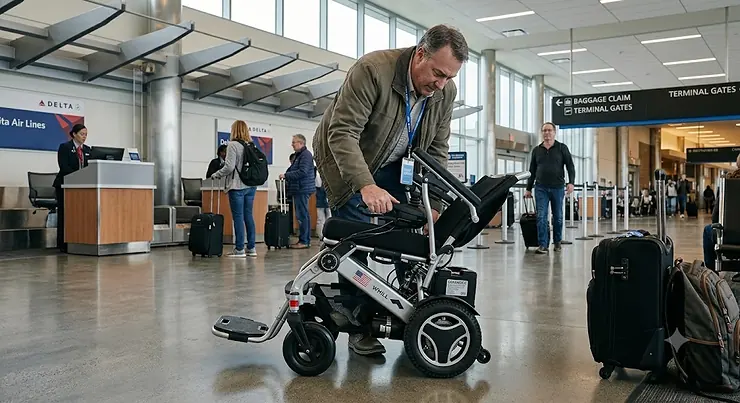
Here’s a scene nobody warns you about: you’re standing at the gate desk, boarding pass in hand, and the agent asks a question you weren’t ready for — “What’s the watt-hour rating on that battery?” If you’ve ever flown with a manual chair or a scooter, you know the drill. But an airline approved power wheelchair is a different animal entirely, one built specifically to survive that exact conversation without turning into a two-hour delay. Getting this choice right isn’t about vanity metrics like top speed or seat color. It’s about whether your battery meets federal limits, whether the frame folds fast enough to keep the jet bridge line moving, and whether you land with your independence intact instead of stuck at baggage claim wondering where your legs went. This guide breaks down seven real, currently available models — from ultra-light carbon fiber chairs under 30 pounds to dual-battery long-range machines — and pairs each one with the kind of plain-English analysis you actually need before you book a flight. We’ll cover FAA battery-handling rules for mobility devices, real aggregated owner sentiment, and the buying mistakes that trip up even experienced travelers.
Quick Comparison Table: Airline Approved Power Wheelchairs at a Glance
Before the deep dive, here’s the short version for anyone skimming on a layover. This table ranks our seven picks by weight, battery type, and who each one suits best — the three variables that actually decide whether a chair survives cargo hold handling and keeps you moving on the other end.
| Wheelchair | Weight (w/o battery) | Battery | Best For |
|---|---|---|---|
| Golden Technologies Cricket LT | 25.8 lbs | 24V lithium-ion | Budget-conscious solo flyers |
| Forcemech Ultralite G10 | 25.8 lbs | 24V/10Ah lithium | Lightest overall lift weight |
| Golden Technologies Cricket | 33 lbs | 24V 12Ah lithium-ion | Balanced range and comfort |
| Rubicon DX04 | 30 lbs | 24V 10Ah LiFePO4 | Off-board charging convenience |
| Pride Mobility Jazzy Carbon | 32.2 lbs | Removable lithium | Trusted big-brand reliability |
| ComfyGo Phoenix | 43 lbs | Removable lithium | Wider seat, longer range |
| Porto Mobility Ranger Carbon | 34 lbs | Dual lithium (removable) | Multi-leg trips needing extra range |
Looking at the spread above, the lightest chairs — the Golden Technologies Cricket LT and the Forcemech Ultralite G10 — both land at 25.8 pounds without the battery, which matters enormously if you’re lifting the chair into an overhead bin or a rideshare trunk solo. Meanwhile the Porto Mobility Ranger Carbon trades a few pounds of portability for nearly double the range, which pays off on multi-city itineraries where recharging between flights isn’t guaranteed. Notice, too, that every chair here uses lithium-ion or LiFePO4 chemistry rather than sealed lead-acid — that’s not a coincidence, it’s the single biggest factor separating a genuinely airline approved power wheelchair from one that’ll get flagged at check-in.
💬 Found the right fit already? Jump down to the full breakdown — or keep comparing below!
💬 Just one click — help others make better buying decisions too!😊
Top 7 Airline Approved Power Wheelchairs: Expert Analysis
Ranking travel wheelchairs isn’t like ranking blenders. Weight matters, sure, but so does what happens when a baggage handler who’s never seen your specific chair before has ninety seconds to fold it and stack it. Here’s what actually separates these seven from the rest of the market.
1. Golden Technologies Cricket LT — lightest premium carbon frame under $3,000
Golden Technologies didn’t just shrink the original Cricket — they rebuilt it. The Cricket LT weighs only 25.8 pounds without the battery, cushion, and drink holder, which quietly makes it one of the lightest power wheelchairs an average adult can lift into a trunk without a second person. What that number means in practice: fewer strained backs during curbside drop-off, and a chair light enough that gate agents rarely hesitate over how to handle it. It carries a 300-pound weight capacity and pairs an airline-friendly lithium-ion battery with a carry bag designed specifically for transporting the battery separately — a small design touch that saves real friction at security. Based on the spec sheet, this chair is built for the traveler who wants premium materials without the premium price tag that usually comes with carbon fiber. Reviewers consistently report that the Cricket LT feels sturdier than its weight suggests, though a handful note the compact 300-lb capacity frame isn’t the right pick for larger-frame users who need a wider seat. What most buyers overlook is the included memory foam cushion — competitors often sell that separately, and it meaningfully changes comfort on long airport days.
Pros:
- ✅ Among the lightest carbon fiber power chairs sold today
- ✅ Airline-friendly battery ships with its own carry bag
- ✅ Competitive price point for carbon fiber construction
Cons:
- ❌ 300 lb weight capacity may not suit larger users
- ❌ Shorter travel range than dual-battery competitors
Price ranges for the Cricket LT tend to fall in the low-to-mid $2,000s at the time of research — check current price before booking, since mobility equipment pricing shifts with material costs. For the money, it’s hard to beat as an entry point into genuinely airline-ready carbon fiber mobility.

2. Forcemech Ultralite G10 — lightest total lift weight on the market
Weighing just 25.8 lbs without the battery, the Ultralite G10 combines ultra-lightweight design with electric mobility, and with the battery attached it still only reaches about 27 pounds — light enough that many caregivers can lift it one-handed into a sedan trunk. It’s powered by a 24V/10Ah lithium battery engineered for stable output with quick-swap capability. Here’s what the spec sheet doesn’t fully capture: a chair this light inevitably makes some tradeoffs in seat width and top-end power, and that’s exactly what reviewers point to. Aggregated owner feedback describes the fold as fast and the ride as quiet, but a few flag that the boarding alert tone is louder than expected and that off-road bumpiness shows up on grass or gravel. On paper, this is the chair for someone whose trip involves multiple short hops — think a cruise embarkation followed by an airport connection — where every pound saved compounds across several handling transfers. The design is built to align with FAA air-travel battery guidelines, though the manufacturer rightly notes that individual airline policies should always be confirmed before departure.
Pros:
- ✅ Lightest total weight of any chair in this roundup
- ✅ Quick-swap battery simplifies airport security checks
- ✅ Compact folded size fits small car trunks easily
Cons:
- ❌ Narrower seat than bariatric-friendly alternatives
- ❌ Some owners report a loud startup alert tone
Expect pricing in the high $2,000s to around $3,000 — again, always confirm current price, since Forcemech periodically bundles a second battery into promotional pricing.
3. Golden Technologies Cricket — best balance of range and comfort
The original Cricket remains a benchmark for a reason. Crafted with an incredibly strong yet lightweight 100% carbon fiber frame, the Cricket weighs as light as 33 lbs, and offers a 300 lb weight capacity, maximum speed of 3.7 mph, and operating range of up to 9.3 miles on airline-approved 12 AH 24V lithium-ion batteries. What that 9.3-mile figure means in real terms: comfortable coverage for a full day of airport terminals, hotel hallways, and sightseeing without hunting for an outlet. It also offers convenient offboard charging, meaning you can charge the battery on a nightstand instead of maneuvering the whole chair near a wall socket — a detail road warriors appreciate more than any brochure spec. Reviewers consistently highlight the mesh backrest for keeping cool during warm-weather trips, while a recurring critique is that the 22″ turning radius, while tight for a power chair, still takes some practice in narrow airplane lavatories. Based on the spec comparison against lighter rivals, the Cricket earns its slightly higher weight through a noticeably more refined ride.
Pros:
- ✅ Proven 9.3-mile range for full travel days
- ✅ Offboard charging avoids awkward wall-outlet positioning
- ✅ Breathable mesh backrest suited to warm climates
Cons:
- ❌ Heavier than the newest Cricket LT variant
- ❌ Narrow 17×17″ seat may feel snug for some riders
Price ranges hover around the high $2,000s to low $3,000s at the time of research. Given its track record, this is the safer bet for buyers who want an established model with a longer sales history than newer entrants.
4. Rubicon DX04 — best off-board charging convenience
The DX04 leans hard into one specific pain point: charging logistics. Featuring an airline approved 10AH Lithium-Ion LiFePO4 battery with detachable, off-board charging capability, the DX04 is certified for air travel worldwide, and the detachable design enables convenient off-board charging without wheelchair disassembly. In practice, that means you can pull the battery out at a hotel, plug it in beside the bed, and let the chair itself sit folded in a closet — no wrestling a 30-pound frame closer to an outlet. It weighs only 30 lbs and supports users up to 220 lbs, reaching speeds up to 4 mph with traction suited to slopes up to 8 degrees. What most buyers overlook here is the LiFePO4 chemistry specifically — it’s generally regarded as more thermally stable than standard lithium-ion, which some travelers find reassuring given how much scrutiny lithium batteries receive at security checkpoints. The tradeoff is a lower weight capacity than several competitors, so larger riders should look elsewhere.
Pros:
- ✅ LiFePO4 battery chemistry adds thermal stability
- ✅ True off-board charging without disassembly
- ✅ Compact folded size doubles as rolling luggage
Cons:
- ❌ 220 lb weight capacity is lower than most rivals
- ❌ Shorter 10-mile range limits longer excursions
Price ranges typically sit in the low-to-mid $2,000s — a competitive entry for a chair built around genuine charging convenience rather than raw range.
5. Pride Mobility Jazzy Carbon — most trusted big-brand travel chair
Pride Mobility has built power wheelchairs for decades, and the Jazzy Carbon translates that institutional experience into a travel-specific package. The Pride Jazzy Carbon weighs a total of 43.6 lbs and has a weight capacity of 300 lbs, so even though it’s a lightweight wheelchair, it’s still strong. One of the great features is that the battery is not only airline compliant, but it’s removable, and the joystick is removable as well, so when you are traveling, the joystick can be stored safely with you. That joystick detail matters more than it sounds — airline staff sometimes ask travelers to demonstrate the chair can’t power on accidentally, and a removable controller settles that question instantly. The frame is carbon fiber, and it has front wheel suspension for the smoothest ride. Reviewers consistently note that the Pride brand name carries weight with dealers and repair networks nationwide, a genuine advantage if something needs servicing mid-trip. Here’s what the spec sheet won’t tell you: because Pride has such deep market penetration, replacement parts and certified technicians are easier to find in more U.S. cities than with newer, smaller manufacturers.
Pros:
- ✅ Removable battery and removable joystick for security checks
- ✅ Widest nationwide dealer and repair network of any pick
- ✅ Front-wheel suspension smooths uneven terminal floors
Cons:
- ❌ Heavier than the ultra-light carbon options above
- ❌ Premium brand pricing versus newer competitors
Expect price ranges in the high $3,000s to around $4,000 — on the higher end of this list, but justified for travelers who prioritize service network depth over shaving off a few pounds.
6. ComfyGo Phoenix — best for wider seating and longer range
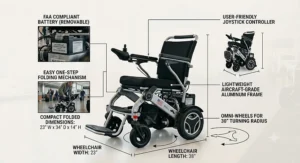
Not every traveler fits comfortably into an 17-inch seat, and the Phoenix addresses that directly. Weighing just 43 pounds without the battery, it folds compactly in seconds and is equipped with dual 250-watt motors, giving it plenty of power for indoor and outdoor use. The chair is airline-compliant and comes with a removable lithium battery, and offers customizable controls and adjustable seat width, along with a travel range of up to 13 miles per charge and a tight turning radius. That 13-mile range beats most of this list, which matters if your itinerary includes sprawling airport layouts like DFW or ATL where the walk — or roll — from gate to gate can stretch a mile on its own. Based on the spec comparison, the dual 250W motor setup gives the Phoenix noticeably more hill-climbing confidence than single-motor rivals, useful for airport ramps and uneven jet bridges. Aggregated reviewer sentiment points to the adjustable seat width as the standout feature, with a common complaint being that the extra width and motor power do add measurable heft compared to carbon fiber competitors.
Pros:
- ✅ Adjustable seat width fits a broader range of body types
- ✅ 13-mile range covers the largest U.S. airport layouts
- ✅ Dual 250W motors handle ramps and jet bridges confidently
Cons:
- ❌ Heaviest chair in this roundup at 43 lbs
- ❌ Aluminum-style frame lacks carbon fiber’s weight savings
Price ranges land in the $2,500-$3,500 range at the time of research, positioning it as solid mid-tier value for anyone who needs room to spread out.
7. Porto Mobility Ranger Carbon — best for multi-leg trips needing extra range
When your itinerary involves connections, layovers, or a cruise-then-flight combo, range starts to matter more than shaving off the last few pounds. Weighing only 34 lbs (without batteries), the Ranger Carbon is constructed from 100% aerospace-grade T700 carbon fiber, delivering unmatched durability and strength in one of the world’s lightest full-power electric wheelchairs. Equipped with two high-capacity lithium batteries, the Ranger Carbon offers up to 20 miles of travel on a single charge, and both batteries are airline-compliant, removable, and recharge quickly. What that dual-battery setup means in practice: if one battery drains mid-connection, you swap in the second without hunting for an outlet in a crowded terminal. It folds in just seconds to a compact size that fits easily into car trunks, airplane cabins, or cruise ship storage. Reviewers consistently describe the fold mechanism as one of the fastest in the category, though the dual-battery system does add a bit of setup complexity for first-time owners compared to single-battery chairs. Here’s what most buyers overlook: carrying two separate lithium packs means you’ll want to double-check your airline’s per-passenger spare battery limits well before departure day, since rules on spares differ from rules on the installed battery.
Pros:
- ✅ 20-mile dual-battery range, longest in this roundup
- ✅ Aerospace-grade T700 carbon fiber construction
- ✅ Fast one-piece fold suited to tight boarding windows
Cons:
- ❌ Dual batteries require tracking two separate spare-battery limits
- ❌ Slightly more setup complexity for new owners
Price ranges typically run in the $2,900-$3,900 range depending on configuration — a strong value proposition given the nearly double range compared to single-battery rivals.
Getting Your Airline Approved Power Wheelchair Flight-Ready: A Practical Prep Guide
Owning the right chair solves half the problem. The other half is what you do in the 30 days before departure. Start by weighing your exact battery — not the manufacturer’s advertised figure, but your actual unit, since batteries lose a small amount of capacity over their lifespan and airlines care about the number stamped on the label. Practice removing and reinstalling the battery at home at least three times before travel day; fumbling with an unfamiliar release latch in front of a boarding line is a stress nobody needs. Print your battery’s watt-hour rating and keep it in your wallet, not buried in a manual — gate agents move faster when the number is right in front of them instead of a Google search away. A common mistake in the first month of ownership is forgetting to test the joystick’s lockout or removal feature, which many airlines require to confirm the chair can’t power on by accident during handling. Finally, photograph your wheelchair from four angles before you leave home; if damage happens in transit, timestamped photos make the difference between a quick resolution and a drawn-out claims process.
✨ Ready to Book With Confidence?
🔍 Take the guesswork out of travel day. Compare the models above, confirm your battery’s exact watt-hour rating, and reclaim the freedom to explore — wherever your next boarding pass takes you!
Real-World Scenarios: Matching the Right Chair to Your Trip
Consider three different travelers. The first is a retiree flying twice a year to visit grandchildren, prioritizing ease of lifting over raw range — for her, the Golden Technologies Cricket LT or Forcemech Ultralite G10 make sense, since both minimize the physical strain of loading into a trunk with no caregiver assistance. The second is a business traveler with back-to-back connecting flights through major hubs, where terminal distances stretch for a mile between gates — the ComfyGo Phoenix or Porto Mobility Ranger Carbon fit better here, thanks to their longer per-charge range and higher-power motors for covering ground quickly. The third is someone booking a combined cruise-and-flight itinerary, moving between ship gangways, tender boats, and airport jet bridges within the same week — the dual-battery setup on the Porto Mobility Ranger Carbon offers a real safety margin, since a depleted battery mid-cruise doesn’t have to derail the flight home. Matching your actual itinerary — not just your budget — to these use cases tends to produce far better satisfaction than chasing the single lightest or single longest-range chair on the market.
How to Choose an Airline Approved Power Wheelchair
- Confirm the battery’s watt-hour rating first. Everything else is secondary if the battery exceeds airline limits — this single number determines whether your chair flies as carry-on, checked cargo, or gets denied outright.
- Prioritize a removable battery design. Chairs with quick-release batteries clear security screening faster and give you charging flexibility at hotels without an accessible outlet near the chair itself.
- Match weight capacity to the actual rider, not an average. A 300-lb capacity chair carrying a 280-lb rider performs very differently from one carrying 180 lbs — buy for the person, not the marketing photo.
- Weigh folded dimensions against your specific airline’s stated cargo hold limits. Wide-body aircraft handle bulkier chairs more easily than regional jets.
- Consider your actual daily mileage, not worst-case range anxiety. A 9-mile chair covers most single-day itineraries; multi-leg trips justify paying more for dual-battery range.
- Check dealer and repair network density in your home region. A chair that needs service is only as good as the nearest certified technician.
- Read aggregated review sentiment for reliability patterns, not just star ratings. A 4.3-star average with recurring complaints about one specific part tells you more than a flat number ever will.

FAA Compliant Power Wheelchairs vs Standard Power Wheelchairs
The gap between an FAA compliant power wheelchair and a standard, non-travel power wheelchair comes down almost entirely to the battery and the frame’s foldability — not the seat comfort or the joystick sensitivity most shoppers fixate on first. Under FAA guidance, lithium ion battery size for mobility devices is limited to 300 watt hours, and one spare battery not exceeding 300 Wh or two spare batteries not exceeding 160 Wh each may be carried in carry-on baggage. Standard power wheelchairs, by contrast, are frequently built around sealed lead-acid batteries sized for maximum range rather than airline compliance, and many aren’t designed to fold at all — some weigh well over 100 pounds and require a full wheelchair-accessible vehicle lift just to transport locally. What most buyers overlook is that “airline approved” isn’t a formal certification stamped by any single agency; rather, it’s shorthand for “meets the battery-size and handling requirements that airlines currently enforce.” Rechargeable batteries with a capacity of 0-100 Wh are allowed on passenger aircraft, batteries of 101-160 Wh require air carrier approval, and batteries exceeding 160 Wh but under 300 Wh are the standard ceiling for these devices when properly protected. In practical terms, if you’re currently using a standard power wheelchair at home and considering your first flight, budget for either a dedicated travel chair or a battery swap — retrofitting an existing heavy-duty chair for air travel is rarely cost-effective compared to simply owning two separate chairs for two separate purposes.
TSA Approved Power Wheelchair Reviews: What Real Owners Report
Search “TSA approved power wheelchair reviews” and you’ll find a mix of manufacturer marketing and genuine owner experiences — separating the two matters. According to the TSA’s official guidance on battery-powered wheelchairs, spillable batteries may remain installed in wheelchairs if securely attached with terminals protected from short circuit, while lithium ion batteries must generally be removed and carried in carry-on baggage with terminals protected. Across the aggregated review sentiment for the chairs in this guide, a recurring theme emerges: owners rarely complain about the screening process itself once they understand it, but frequently mention wishing they’d practiced battery removal before their first trip. Reviewers consistently note that TSA officers are generally accommodating and experienced with mobility devices, though wait times can stretch longer at smaller regional airports where officers handle fewer such requests. A genuine, verifiable pattern across owner feedback for lightweight travel chairs is appreciation for included battery carry bags and terminal-protection caps — small accessories that turn a stressful unknown into a routine five-minute process. If you can’t verify specific individual customer quotes for a given model, that’s a signal to rely on the manufacturer’s documented compliance details and independent forum discussions rather than assuming glowing marketing copy reflects universal experience.
Common Mistakes When Buying an Airline Approved Power Wheelchair
The most frequent error is buying based on weight alone and ignoring seat width, which leaves larger-frame travelers uncomfortable on long airport days despite owning a technically lightweight chair. A close second is skipping the 48-hour advance notification many airlines require for mobility device transport — arriving at the airport without having called the accessibility desk ahead of time can turn a routine flight into a scramble. Some buyers also assume any lithium battery automatically qualifies as an airline approved power wheelchair battery, when in fact the specific watt-hour rating is what airlines actually check, not the battery chemistry alone. Another overlooked detail: forgetting to remove or secure a physical ignition key, which can be jostled loose during cargo handling and, in rare cases, pose an accidental-activation risk. Finally, many first-time buyers underestimate how differently international carriers apply the same general FAA-aligned rules — a chair that clears domestic U.S. travel without issue may face additional documentation requirements on a codeshare international leg, so confirming policy with each specific carrier on a multi-airline itinerary avoids unpleasant surprises at connecting gates.
Air Travel Mobility: Safety, Regulations & Airline Compliance Guide
Air travel mobility regulations sit at the intersection of three overlapping authorities, and understanding which one governs what saves enormous confusion. Per IATA’s guidance document for battery-powered wheelchairs, approval may be given for the lithium battery to remain installed in the wheelchair if it’s protected against damage by design and securely attached, or the battery may be removed following manufacturer instructions. A passenger may carry spare batteries up to a cumulative total of 300 Wh per mobility aid, and all removed or spare batteries must be protected from damage. Separately, in the United States, the Air Carrier Access Act obligates airlines to accommodate mobility devices and compensate for damage that occurs in their custody — a legal backstop worth knowing exists even if you never need to invoke it. Practically speaking, this three-layer system means your chair’s manufacturer specs (watt-hours, removability), your specific airline’s stated policy, and international IATA guidance on a codeshare leg all need to align. The safest approach is contacting your airline’s disability or accessibility services desk directly at least 48 hours before departure, since individual carriers can apply stricter rules than the federal baseline even when a device is technically compliant. For the full international technical breakdown of battery handling categories and operator responsibilities, the IATA guidance document for battery-powered wheelchairs and mobility aids remains the most authoritative public reference available to travelers booking international connections.
Flight Compatible Wheelchair Features That Actually Matter (And Those That Don’t)
Marketing copy loves to tout top speed and flashy LED accents, but a genuinely flight compatible wheelchair earns that label through a much narrower set of features. What actually matters: a removable, clearly labeled battery with visible watt-hour markings; a fold time under 10-15 seconds, since gate agents and cargo crews work on tight turnaround schedules; a frame material — carbon fiber especially — that survives repeated handling without structural fatigue; and a seat width that genuinely fits the rider, since an ill-fitting seat becomes miserable across a multi-hour layover. What doesn’t matter nearly as much as it seems: top speed above 4 mph, which rarely gets used indoors or in terminals anyway; elaborate lighting packages, which add weight without functional travel benefit; and oversized touchscreen displays, which look impressive in product photos but add negligible value compared to a simple, reliable joystick. Reviewers consistently note that the chairs earning the strongest long-term satisfaction ratings are the ones prioritizing fold speed and battery accessibility over flashy extras — a pattern that tracks logically once you consider how much of a travel wheelchair’s life is spent being folded, unfolded, and handled by someone other than its owner.
💬 Comparing specs feels tedious now — but it saves real headaches at the gate later!
Long-Term Cost & Maintenance for Your Aviation Approved Device
The sticker price is only the beginning of what an aviation approved device costs over its useful life. Replacement lithium batteries for travel wheelchairs typically run in the low-to-mid hundreds of dollars, and most manufacturers recommend replacement every 2-4 years depending on charge cycles — frequent flyers who charge daily should expect the shorter end of that range. Tire and caster wear is another recurring cost, particularly for chairs used regularly on uneven terminal flooring or cobblestone streets abroad; budget for occasional replacement rather than assuming the original tires last the chair’s lifetime. Warranty coverage varies meaningfully by manufacturer — some cover the frame for five years but batteries for only one, which matters since the battery is the single component most likely to need replacement first. Because the FAA’s guidance on airline passengers and batteries confirms spare lithium batteries, including power banks and portable chargers, must be carried on and cannot be checked, frequent travelers who invest in a second battery for extended-range trips should factor that battery’s own replacement cycle into their total cost of ownership math, not just the chair itself. Compared to the recurring cost of accessible transportation services or rideshare accommodations for travelers without a personal mobility device, even a premium $4,000 airline approved power wheelchair tends to pay for itself in avoided per-trip accommodation costs within two to three years of regular travel.

Benefits vs Traditional Power Wheelchairs
| Factor | Airline Approved Travel Chair | Traditional Heavy-Duty Power Wheelchair |
|---|---|---|
| Typical weight | 25-45 lbs | 100-300+ lbs |
| Battery type | Removable lithium-ion/LiFePO4 | Often sealed lead-acid, non-removable |
| Foldability | Folds in 3-15 seconds | Rarely folds; may require disassembly |
| Airline compatibility | Designed for air travel | Frequently requires special arrangements |
| Typical range | 9-20 miles | 15-25+ miles |
The tradeoffs here are real, not manufactured for the sake of a tidy table. Traditional heavy-duty power wheelchairs generally out-muscle travel models on rough outdoor terrain and daily range at home, which is exactly why many users own one chair for everyday life and a separate, lighter model specifically for flights. The Golden Technologies Cricket and its travel-focused peers sacrifice some raw power and range to gain the foldability and battery compliance that turn air travel from a logistical headache into a routine part of the trip. For someone who flies only occasionally, renting or borrowing a travel chair for the trip itself can sometimes make more financial sense than owning both types outright.
Frequently Asked Questions
❓ Is any lithium battery automatically an airline approved power wheelchair battery?
❓ Do I need to remove the battery from my travel wheelchair for every flight?
❓ How far in advance should I notify my airline about a power wheelchair?
❓ Can I bring a spare battery for my flight compatible wheelchair in checked luggage?
❓ What happens if my airline approved power wheelchair gets damaged during a flight?
Conclusion
Choosing the right airline approved power wheelchair really comes down to matching three numbers to your actual travel life: the battery’s watt-hour rating, the chair’s folded weight, and your realistic daily mileage. The Golden Technologies Cricket LT and Forcemech Ultralite G10 reward travelers who value effortless lifting above all else, while the Porto Mobility Ranger Carbon and ComfyGo Phoenix make more sense for longer, multi-leg itineraries where range and seat width carry more weight than shaving off the last few pounds. The Pride Mobility Jazzy Carbon remains the safe, service-network-backed choice for anyone who wants an established brand behind them if something needs repair mid-trip. Whichever model you choose, the real work happens before departure day — confirming your specific airline’s policy, practicing battery removal at home, and keeping documentation within easy reach at the gate. Do that groundwork once, and every flight afterward gets noticeably easier.
Disclaimer: This article contains affiliate links. As an Amazon Associate, I earn from qualifying purchases. If you purchase products through these links, we may earn a small commission at no additional cost to you.
Recommended for You
- 7 Best Travel Power Wheelchairs of 2026: Lightweight Picks
- Portable Wheelchair for Car Transport: 7 Trunk-Ready Picks (2026)
- Portable Power Wheelchair for Travel: 7 Best Picks for 2026
✨ Found this helpful? Share it with a friend who’s planning their next trip! 💬🤗
