
In This Article
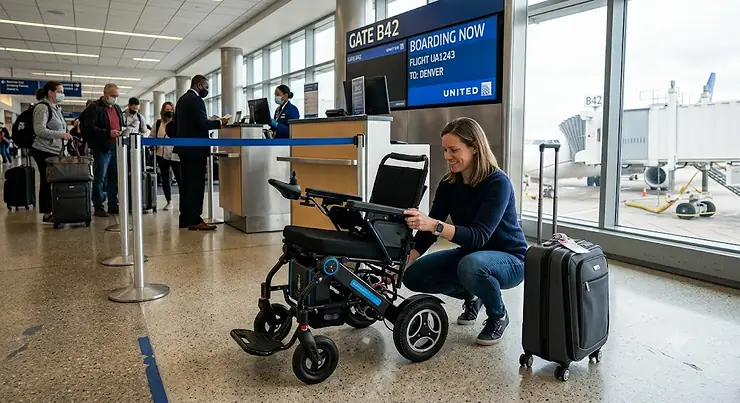
Packing for a trip used to mean one more headache if you rely on powered mobility: could the chair even make it into the trunk, let alone the overhead bin? A travel power wheelchair solves that specific problem. It is a compact, battery-powered chair engineered to fold small, lift light, and clear airline and TSA rules without turning your vacation into a logistics project. Unlike a full-size power chair — which can weigh 150 to 300 lbs and demand a ramp or vehicle lift — most travel-focused models fold down under 40 lbs and collapse in seconds.

This guide breaks down seven real, currently available models spanning budget, mid-range, and premium tiers. We looked at actual specs, manufacturer documentation, and aggregated buyer feedback rather than relying on marketing copy alone. Every product mention below includes honest analysis of who each chair suits and why — not just a spec dump. Whether you’re chasing the lightest possible frame, the longest range, or the friendliest price tag, there’s a genuine travel power wheelchair here that fits your itinerary. Let’s get into the comparison.
Quick Comparison Table
| Category | Best Pick | Folded Weight | Best For |
|---|---|---|---|
| Best Overall | Forcemech Carbon F1 | 33 lbs (no battery) | Frequent flyers who want carbon fiber durability |
| Best Budget | SuperHandy GoRide 2 Plus | 42 lbs (no battery) | First-time buyers on a tighter budget |
| Best One-Handed Control | Journey Zoomer | 35.7 lbs (no battery) | Users with limited function on one side |
| Best High-Capacity Ultralight | Journey Air Elite Max | 24.25 lbs (no battery) | Larger-frame users who still want to travel light |
| Best Auto-Fold | MAJESTIC IQ-7000 AF | ~60-70 lbs | Users who want zero manual lifting |
At a glance, the split here comes down to trade-offs: the lightest carbon fiber frames sacrifice a little weight capacity, the highest-capacity chairs run heavier, and the auto-folding option prioritizes convenience over portability. Buyers chasing the absolute lightest lift should lean toward Forcemech Carbon F1 or Journey Air Elite Max, while anyone prioritizing hands-off folding will find the MAJESTIC IQ-7000 AF more appealing despite its added bulk. Price shouldn’t be the only factor — the SuperHandy GoRide 2 Plus costs far less but trades away range and premium materials to get there.
💬 Found a pick you like already? Tap through to check current pricing and availability before it changes!
💬 Just one click — help others make better buying decisions too!😊
Top 7 Travel Power Wheelchairs: Expert Analysis
1. Forcemech Carbon F1 — Forbes-recognized full carbon fiber build
The Forcemech Carbon F1 opens this list because it does something few competitors manage: a genuinely rigid, full carbon fiber frame at just 33 lbs without the battery. That matters in practice because carbon fiber flexes less than aluminum under load while weighing noticeably less, so the ride feels planted rather than wobbly on uneven pavement.
Under the hood, dual 200W brushless motors and a 24V/10Ah lithium battery deliver a 10-mile range and a 4 mph top speed, with a folding sequence that collapses the chair in about two seconds — no tools, no disassembly. A 300-lb weight capacity is unusually generous for a chair this light, meaning the Forcemech Carbon F1 doesn’t force users into a portability-versus-support trade-off the way many ultralight chairs do.
Aggregated buyer feedback across multiple mobility retailers points to strong satisfaction with build quality and Forcemech’s customer support, including reports of the company proactively replacing units under warranty rather than dragging out repairs. The Forcemech Carbon F1 earned recognition from Forbes Health for its light-chair design, a detail worth noting since it reflects third-party evaluation rather than the brand’s own marketing.
Pros:
- ✅ Full carbon fiber frame keeps lift weight to just 33 lbs
- ✅ Folds in about two seconds with no tools needed
- ✅ Backed by an industry-leading 5-year frame warranty
Cons:
- ❌ Premium price compared to aluminum-frame competitors
- ❌ 10-mile range trails some longer-range folding models
Pricing for the Forcemech Carbon F1 typically falls in the $2,499-$2,999 range depending on retailer promotions — check current price before ordering, since mobility retailers frequently rotate limited-time offers. Given the carbon fiber build and 300-lb capacity, this is strong value for anyone who flies or road-trips more than a few times a year.
2. Journey Air Elite — lightest all-around travel chair
The Journey Air Elite has built its reputation on one number: 26 lbs without the battery, historically marketed as the world’s lightest folding power chair. That claim holds up reasonably well against the current field, and it translates into a real-world benefit — most caregivers and users can lift it into a trunk single-handedly without straining.
Dual 24V/150W motors and a 10Ah lithium battery provide up to 9.3-10 miles of range at roughly 2.8-3.7 mph depending on the specific listing, while a 35.4-inch turning radius keeps it nimble in hotel hallways and restaurant aisles. The single-pull fold collapses the chair to under 12 inches tall in seconds, and a built-in USB port lets riders top off a phone mid-outing — a small feature that matters more than it sounds on a full sightseeing day.
Reviewers consistently mention how much easier daily errands and family visits become once the lifting burden disappears, a sentiment echoed across several retailer review sections. The trade-off is a 240-lb weight capacity and a fixed, non-adjustable seat, so larger-frame users or those needing custom seating should look toward the Journey Air Elite Max instead.
Pros:
- ✅ One of the lightest folding power chairs sold today
- ✅ Built-in USB port keeps phones charged during outings
- ✅ Tight 35.4-inch turning radius fits through standard doorways
Cons:
- ❌ 240-lb weight capacity limits larger-frame users
- ❌ Seat and backrest are fixed, not adjustable
Expect pricing in the $2,900-$3,750 range, with occasional promotional pricing bringing it toward the lower end — always confirm the current price, since Journey and its retail partners run frequent seasonal discounts.
3. Journey Air Elite Max — highest capacity in the ultralight class
Where the standard Air Elite tops out at 240 lbs, the Journey Air Elite Max was built specifically to raise that ceiling without sacrificing the ultralight promise. At 24.25 lbs without the battery — genuinely lighter than the original — it supports up to 330 lbs, an unusual combination that opens travel power wheelchairs to a wider range of body types.
The dual 12Ah lithium batteries auto-switch between packs, extending range to roughly 19.8 miles, nearly double the standard Air Elite’s figure. Dual 150W motors (300W combined) power the chair to the same 3-mph-class top speed, while an 18-inch seat width and memory-foam cushioning address one of the most common complaints about ultralight chairs: cramped, thin seating.
Based on the spec comparison with its sibling model, the Journey Air Elite Max essentially removes the two biggest limitations of the category-leading Air Elite — capacity and range — at the cost of a higher price tag. For travelers who need both a light lift and genuine all-day battery life, this is currently one of the strongest combinations on the market.
Pros:
- ✅ 330-lb capacity packed into a 24.25-lb ultralight frame
- ✅ Auto-switching dual batteries stretch range to nearly 20 miles
- ✅ Wider 18-inch seat with memory-foam cushioning
Cons:
- ❌ Priced noticeably higher than the standard Air Elite
- ❌ Dual-battery system adds modest bulk versus single-battery rivals
Pricing generally sits in the $3,400-$3,900 range at the time of research. Given the capacity and range gains, that premium is easy to justify for heavier users or anyone planning multi-stop travel days without guaranteed charging access.
4. Pride Jazzy Carbon 27X — vertical X-frame fold for tight spaces
Pride Mobility has manufactured power chairs since 1986, and the Pride Jazzy Carbon 27X channels that legacy into a genuinely different folding mechanism: an X-frame design that collapses vertically, like a director’s chair, rather than flat. That matters for users with back or balance limitations who struggle to bend down and lift a flat-folded frame off the ground.
At approximately 27.5 lbs without the battery, the carbon fiber build keeps the Pride Jazzy Carbon 27X competitive with the lightest chairs in this list while supporting up to 275 lbs. An FAA-compliant 10Ah lithium battery delivers up to 8-10 miles of range at a 3.7 mph top speed, and a 35.4-inch turning radius handles indoor navigation about as well as any chair here.
What most buyers overlook about the vertical-fold design is that it trades a slightly lower weight capacity and a few extra folding steps for meaningfully reduced bending and lifting strain — a fair trade for anyone with lower-back sensitivity. Pride’s standard warranty and nationwide service network add a layer of long-term reliability that newer brands haven’t yet built up.
Pros:
- ✅ Vertical X-frame fold avoids bending down to lift
- ✅ Backed by Pride Mobility’s decades of manufacturing experience
- ✅ FAA-compliant lithium battery simplifies airline travel
Cons:
- ❌ 275-lb weight capacity is lower than flat-folding Jazzy models
- ❌ Folding involves a few more steps than flat-fold designs
Pricing typically runs $3,000-$3,900 depending on configuration and dealer. It’s a premium price point, but the combination of Pride’s reputation and the ergonomic fold justifies it for the right buyer.
5. Journey Zoomer — best one-handed joystick control
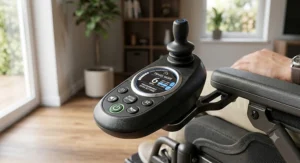
The Journey Zoomer occupies a distinct niche: it’s technically classified as a personal electric vehicle rather than a medical wheelchair, but its true one-handed joystick control makes it a standout option for users with limited grip or function on one side. The joystick mounts on either armrest and requires only a single finger to operate in any of 360 degrees.
At 35.7 lbs without the battery (about 39.6 lbs with it), the Journey Zoomer disassembles into two pieces for transport, with the heaviest single piece weighing under 27 lbs — a meaningful detail for a caregiver who can’t lift a full 40-lb unit alone. A patented floating footrest eliminates the fiddly footplate adjustments that slow down transfers on most competing chairs, and puncture-proof tires handle grass, gravel, and small bumps without extra effort.
Here’s what the spec sheet won’t tell you, but aggregated reviews suggest: owners frequently cite the Zoomer as restoring the ability to attend family gatherings and outdoor events they’d previously skipped, largely because the one-handed control removes a barrier that traditional joysticks don’t address. Range tops out around 8-9.3 miles at a modest 3.7 mph, which suits errands and outings better than long-distance touring.
Pros:
- ✅ True one-handed joystick control aids limited hand function
- ✅ Patented floating footrest skips awkward footplate adjustments
- ✅ Splits into two pieces, heaviest section under 27 lbs
Cons:
- ❌ Classified as a personal mobility device, not a medical wheelchair
- ❌ Lower top speed limits use for longer outdoor distances
Expect a price range of roughly $2,900-$3,600, with occasional sales pricing closer to the lower end — confirm current pricing before purchase.
6. MAJESTIC IQ-7000 AF — auto-folding remote convenience
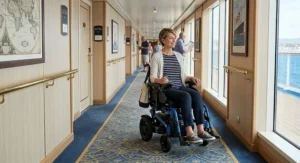
Every chair so far requires some manual folding effort. The MAJESTIC IQ-7000 AF removes that step entirely: its auto-folding mechanism collapses and unfolds the chair via joystick or wireless remote, which is a genuine game-changer for users with limited upper-body strength or a caregiver who’d rather not bend and lift at all.
That convenience comes with more mass — the MAJESTIC IQ-7000 AF weighs roughly 60-70 lbs depending on battery configuration, making it the heaviest chair in this roundup. In exchange, it offers the highest weight capacity here at 350 lbs and the longest available range, up to roughly 13 miles on the standard 12Ah airline-approved battery or as much as 21.8 miles on the optional 20Ah pack (which is not airline or cruise approved). Dual 250W motors and a 360-degree waterproof joystick round out the control system.
Based on the spec comparison, the trade-off is clear: buyers gain auto-folding convenience and best-in-class range and capacity, but lose some of the “lift it yourself” portability that defines lighter competitors. For travelers who mostly transport the chair by vehicle rather than carrying it up stairs, that trade-off tilts strongly in the MAJESTIC IQ-7000 AF‘s favor.
Pros:
- ✅ Remote-controlled auto-folding removes manual lifting entirely
- ✅ 350-lb weight capacity, the highest in this comparison
- ✅ Optional 20Ah battery stretches range to nearly 20 miles
Cons:
- ❌ Heavier overall than the true ultralight carbon fiber models
- ❌ Extended-range battery isn’t airline or cruise approved
Pricing generally ranges from $1,900-$3,000 depending on battery configuration and current promotions, making it a comparatively strong value for the feature set — always verify current price and battery options before ordering.
7. SuperHandy GoRide 2 Plus — best budget-friendly folding chair
Not every traveler needs (or can afford) a carbon fiber frame, and that’s exactly the gap the SuperHandy GoRide 2 Plus fills. It’s the most affordable chair in this comparison by a wide margin, while still delivering the core travel power wheelchair formula: one-step folding, a 300-lb weight capacity, and dual brushless motors with zero-turn maneuverability.
At 40-42 lbs without batteries, it’s heavier than the premium ultralight options, but its swappable dual 48V batteries mean a depleted pack can be quickly replaced rather than waiting through a full recharge cycle. Range runs shorter than pricier competitors — roughly 3-4 miles per battery depending on rider weight — which suits neighborhood outings, shopping trips, and short vacation excursions better than full-day touring.
Reviewers consistently report satisfaction with the value proposition here, including buyers who’ve taken the chair on international trips and described it as far nicer than expected for the price. Anti-tilt wheels and an electromagnetic brake system add safety features usually reserved for pricier models, which is what most buyers overlook about this budget tier — the safety hardware doesn’t get cut along with the price.
Pros:
- ✅ Lowest price range of any chair in this comparison
- ✅ Swappable dual batteries simplify recharging on the go
- ✅ Zero-turn joystick eases tight indoor maneuvering
Cons:
- ❌ Shortest range of the group at roughly 3-4 miles per battery
- ❌ Heavier aluminum frame than the carbon fiber options
Pricing typically falls between $1,100-$1,900, occasionally dipping lower during promotional periods. For first-time buyers or those testing whether a travel power wheelchair fits their lifestyle before investing in a premium model, this is a sensible entry point.
Top 7 Products Comparison Table
| Product | Folded Weight | Capacity | Range | Price Range | Best For |
|---|---|---|---|---|---|
| Forcemech Carbon F1 | 33 lbs | 300 lbs | ~10 mi | $2,499-$2,999 | Carbon fiber durability |
| Journey Air Elite | 26 lbs | 240 lbs | ~9.3-10 mi | $2,900-$3,750 | Lightest all-around lift |
| Journey Air Elite Max | 24.25 lbs | 330 lbs | ~19.8 mi | $3,400-$3,900 | High capacity + range |
| Pride Jazzy Carbon 27X | 27.5 lbs | 275 lbs | ~8-10 mi | $3,000-$3,900 | Vertical fold, low bending |
| Journey Zoomer | 35.7 lbs | 300 lbs | ~8-9.3 mi | $2,900-$3,600 | One-handed control |
| MAJESTIC IQ-7000 AF | ~60-70 lbs | 350 lbs | ~13-21.8 mi | $1,900-$3,000 | Auto-fold, highest capacity |
| SuperHandy GoRide 2 Plus | 40-42 lbs | 300 lbs | ~3-4 mi | $1,100-$1,900 | Budget-conscious buyers |
Looking at the full field side by side, the range-versus-weight trade-off becomes obvious: the Journey Air Elite Max and MAJESTIC IQ-7000 AF dominate on distance but ask for either a higher price or more folded weight in return. Buyers prioritizing the absolute lightest lift should stick with the Journey Air Elite or Forcemech Carbon F1, while the SuperHandy GoRide 2 Plus remains the only chair here that meaningfully undercuts the rest on price. There’s no universal “best” row in this table — the right choice depends entirely on which trade-off matters most for your specific trips.
According to the FAA’s PackSafe guidance for wheelchairs and mobility devices, lithium-ion batteries powering these chairs are capped at 300 watt-hours when installed, which every model in this comparison is designed to meet — a detail worth double-checking against your specific airline before departure.
Practical Usage Guide: Setup, First Trip & Maintenance
Getting a new travel power wheelchair from box to boarding gate goes more smoothly with a plan. Most models, including the Journey Air Elite and Forcemech Carbon F1, arrive nearly fully assembled — the main setup steps are connecting the battery and attaching the joystick, both of which take just a few minutes without tools.
Before the first outing, charge the battery fully (typically 6-8 hours for lithium packs) and take a short test drive indoors to get comfortable with speed settings and turning radius before venturing outside. A common first-30-days mistake is leaving the chair on the highest speed setting by default; dialing back to a lower setting indoors dramatically reduces the learning curve and the risk of clipping doorways or furniture.
For ongoing maintenance, wipe down tires and check for debris after outdoor use, inspect the battery terminals periodically for corrosion, and avoid letting lithium batteries sit fully depleted for extended periods, which shortens their lifespan. Most manufacturers, including Forcemech and Pride Mobility, recommend a monthly visual inspection of bolts and folding mechanisms since travel and frequent folding put more cyclical stress on hinges than stationary home use does.
Before flying, contact your airline 48-72 hours ahead to confirm battery documentation requirements, since even airline-approved batteries sometimes need advance notice for wheelchair transport. According to TSA’s guidance on battery-powered wheelchairs, lithium-ion batteries in these devices generally travel in carry-on baggage with terminals protected, though the exact procedure varies by whether the battery is removable.
✨ Ready to book that trip? Compare current prices on today’s top picks before you pack!
Real-World Scenarios: Who Should Buy Which Chair
Consider a college student commuting across a hilly campus and flying home twice a year: the Journey Air Elite or Forcemech Carbon F1 fits well here, since both prioritize the lightest possible lift for solo dorm-to-car transfers and easy overhead-bin stowage on short regional flights.
A retired couple planning a multi-week European river cruise faces a different set of priorities — daily boarding ramps, cobblestone streets, and long days of sightseeing favor the extended range of the Journey Air Elite Max or the auto-folding convenience of the MAJESTIC IQ-7000 AF, especially if a partner will be doing the lifting.
For a caregiver managing a parent with limited hand strength on one side, the Journey Zoomer‘s one-handed joystick and two-piece disassembly solve a specific accessibility gap that standard joysticks don’t address, making family outings and doctor visits meaningfully less physically demanding. Meanwhile, a budget-conscious traveler testing whether a power chair suits their lifestyle before a bigger investment will likely find the SuperHandy GoRide 2 Plus offers enough capability — 300-lb capacity, zero-turn control — to make that first trip successful without overspending.
How to Choose a Travel Power Wheelchair
Choosing the right travel power wheelchair comes down to matching specs to your actual travel pattern rather than chasing the lightest number on a spec sheet. Here’s a practical framework:
- Confirm your weight capacity first. A chair rated for 240 lbs that’s a poor fit for a 260-lb user isn’t a bargain no matter how light it folds.
- Match range to your typical day, not your best-case scenario. A 3-4 mile range suits short errands; multi-stop sightseeing days call for 10+ miles.
- Weigh folded weight against who’s lifting it. A solo traveler benefits most from sub-30-lb frames; a caregiver assisting can manage slightly heavier chairs.
- Check airline battery compliance before falling in love with a model. Not every extended-range battery pack is approved for air travel.
- Consider the folding mechanism, not just the weight. Vertical-fold and auto-fold designs reduce bending, which matters for back or joint limitations.
- Read aggregated review themes, not star ratings alone. Recurring complaints about seat width or battery life tell you more than an average score.
- Price the total ownership cost, not just the sticker price. Replacement batteries, cushions, and shipping fees add up over several years of use.

Common Mistakes When Buying a Travel Power Wheelchair
The single most common mistake is prioritizing the lightest possible weight without checking whether the seat width and capacity actually fit the user — a 26-lb frame does nobody any favors if it’s uncomfortable after twenty minutes. A close second is assuming every lithium battery is automatically airline-approved; as the comparison table above shows, some extended-range packs, like the optional 20Ah battery for the MAJESTIC IQ-7000 AF, explicitly aren’t cruise or airline compliant.
Buyers also frequently underestimate how much folding mechanism matters day to day. A flat-folding chair that requires bending down to lift may look identical on a spec sheet to a vertical X-frame design like the Pride Jazzy Carbon 27X, but the physical experience of using it daily is completely different for someone with back sensitivity. Finally, many shoppers skip reading the fine print on weight capacity tolerances — most manufacturers list a hard ceiling, and consistently riding near that limit accelerates wear on motors, tires, and batteries faster than manufacturers’ published lifespans suggest.
Travel Power Wheelchair vs Traditional Power Wheelchair
A travel power wheelchair and a traditional full-size power wheelchair solve different problems, and conflating them leads to disappointment either way. Traditional power chairs prioritize performance: bigger batteries, stronger motors, and rugged suspension built for daily all-terrain use, but at the cost of a 150-300 lb frame that requires a vehicle lift or ramp to transport.
| Factor | Travel Power Wheelchair | Traditional Power Wheelchair |
|---|---|---|
| Typical Weight | 24-70 lbs | 150-300+ lbs |
| Transport | Fits in a car trunk, airline-compliant | Requires ramp or vehicle lift |
| Range | 3-22 miles | Often 15-25+ miles |
| Terrain | Sidewalks, indoor floors, light gravel | Rugged, all-terrain capable |
| Best For | Frequent travelers, apartment dwellers | Daily all-terrain, heavier-duty use |
The data above makes the trade-off explicit: a trip friendly wheelchair sacrifices some raw terrain capability and battery capacity in exchange for genuine portability, while a traditional chair sacrifices portability for performance. Buyers who split time between home and frequent travel sometimes end up owning both — a traditional chair for daily use and a lighter travel-ready model, such as the Journey Air Elite or Forcemech Carbon F1, reserved specifically for trips.
What to Expect: Real-World Performance on Vacation
Specs on paper translate differently once you’re actually navigating a hotel lobby or a cobblestone plaza. A chair like the Pride Jazzy Carbon 27X, rated for a 35.4-inch turning radius, genuinely does turn cleanly in a standard hotel elevator, but tighter European lifts occasionally test that margin. Reviewers of several models in this comparison note that carpeted convention centers and thick hotel carpeting draw down speed and range faster than smooth outdoor pavement, a detail rarely mentioned on spec sheets.
Battery indicators are another area where real-world use diverges from marketing claims — most chairs here display charge level on the joystick console, but riders should build in a buffer rather than planning a day around the exact advertised mileage, since terrain, incline, and rider weight all shift the real number. On uneven cobblestones common in older European city centers, chairs with front suspension or larger front casters, like the Pride Jazzy Carbon 27X, handle noticeably smoother than lighter-duty budget models.
For airport use specifically, most chairs in this list fold quickly enough to clear TSA screening without major delays, though the auto-folding MAJESTIC IQ-7000 AF draws more attention at checkpoints simply due to its size and remote mechanism — worth factoring into your arrival-time buffer for vacation mobility on a tight connection.
Portable Travel Wheelchair Buying Guide for Specific Audiences
Different travelers weight the same specs very differently, so this portable travel wheelchair buying guide breaks recommendations down by who’s actually using the chair. Frequent business travelers flying weekly should prioritize airline-compliant batteries and the lightest possible frame — the Forcemech Carbon F1 and Journey Air Elite both fit this profile well, since minimizing lift effort across dozens of trips a year compounds meaningfully over time.
Seniors managing arthritis or limited grip strength benefit most from the Journey Zoomer‘s one-handed joystick and floating footrest, which remove two of the most physically demanding steps in typical chair operation. Larger-frame users who’ve found ultralight chairs uncomfortably narrow should look toward the Journey Air Elite Max, whose 18-inch seat and 330-lb capacity were specifically engineered to close that gap without abandoning the ultralight category entirely.
Caregivers assisting a family member rather than using the chair themselves often value the MAJESTIC IQ-7000 AF‘s auto-folding remote most highly, since it removes the physical bending and lifting that wears down a caregiver over months of regular use. First-time buyers testing whether powered mobility fits their lifestyle before a larger investment are generally best served by the SuperHandy GoRide 2 Plus, which delivers the core travel power wheelchair experience at meaningfully lower financial risk.
Long-Term Cost & Maintenance of a Lightweight Travel Power Chair
The sticker price on a lightweight travel power chair is only part of the total cost of ownership. Replacement lithium batteries for models like the Forcemech Carbon F1 or Journey Air Elite typically run a few hundred dollars every few years, depending on usage frequency and charging habits — batteries left fully depleted for long stretches tend to degrade faster, which is a maintenance detail warranty documents rarely emphasize enough.
Warranty coverage varies meaningfully across this comparison and should factor directly into a value calculation. The Forcemech Carbon F1‘s 5-year frame warranty substantially outpaces the 1-year frame coverage typical of budget models like the SuperHandy GoRide 2 Plus, meaning the higher upfront price partially offsets itself through reduced long-term repair risk. Tires, cushions, and joystick covers are considered consumables across virtually every brand and aren’t covered under standard warranties, so budgeting an extra $50-150 annually for wear items is realistic for daily or near-daily use.
From a pure cost-per-use perspective, a chair used several times weekly for years amortizes its upfront cost far more favorably than one purchased for a single vacation, which is worth weighing honestly before choosing between a premium carbon fiber frame and a budget aluminum model.
Airline & TSA Battery Rules: Safety and Compliance Guide
Every chair in this comparison relies on a lithium-ion battery, and understanding the regulatory limits matters more than most marketing pages let on. The FAA caps installed lithium-ion batteries in mobility devices at 300 watt-hours, with spare batteries limited to one at 300 Wh or two at 160 Wh each carried in the cabin — never in checked baggage. To calculate your battery’s watt-hours, multiply voltage by amp-hours; a 24V 12Ah battery, for example, comes out to 288 Wh, comfortably under the limit.
Not every extended-range battery pack meets this threshold. As noted in the comparison table above, the optional 20Ah pack for the MAJESTIC IQ-7000 AF exceeds standard airline compliance and isn’t approved for air or cruise travel, meaning buyers planning to fly should default to the standard 12Ah battery instead. Individual airlines may layer additional requirements on top of FAA baseline rules, so contacting your specific carrier 48-72 hours before departure remains essential regardless of which chair you choose.
Beyond battery rules, travelers with disabilities are protected under the Air Carrier Access Act, which requires airlines to accommodate battery-powered wheelchairs, including proper packaging of batteries when necessary. Details on passenger rights, including priority stowage and assistance requirements, are outlined in the Department of Transportation’s guidance for air travelers with disabilities, which is worth reviewing before any international or connecting flight involving a power wheelchair.

Frequently Asked Questions
❓ What is a travel power wheelchair?
❓ How much does a travel power wheelchair weigh?
❓ Can I take a travel power wheelchair on a plane?
❓ What is the average price of a travel power wheelchair?
❓ How far can a travel power wheelchair travel on one charge?
Conclusion
Choosing among these seven travel power wheelchairs really comes down to which trade-off matters most for your specific trips. If minimizing lift weight above everything else is the priority, the Journey Air Elite and Forcemech Carbon F1 remain the strongest picks in this comparison. Larger-frame users or anyone wanting extended range should look toward the Journey Air Elite Max, while users managing limited hand function will find the Journey Zoomer‘s one-handed control solves a problem no other chair here addresses as directly.
Buyers who’d rather skip manual folding altogether should weigh the MAJESTIC IQ-7000 AF‘s auto-fold convenience against its added bulk, and anyone testing the waters on a budget has a genuinely capable option in the SuperHandy GoRide 2 Plus. Whichever direction you go, confirm current pricing, double-check battery compliance with your specific airline, and factor total cost of ownership — not just the sticker price — into your final decision. A travel power wheelchair should expand where you can go, not add one more thing to worry about before you get there.
✨ Ready to reclaim your travel independence? Check current prices on today’s top picks and start planning your next trip with confidence! 💬🤗
Recommended for You
- Portable Wheelchair for Car Transport: 7 Trunk-Ready Picks (2026)
- Portable Power Wheelchair for Travel: 7 Best Picks for 2026
- 7 Best Affordable Folding Power Wheelchairs Under $2000 (2026)
Disclaimer: This article contains affiliate links. As an Amazon Associate, I earn from qualifying purchases. If you purchase products through these links, we may earn a small commission at no additional cost to you.
✨ Found this helpful? Share it with your friends! 💬🤗
