
In This Article
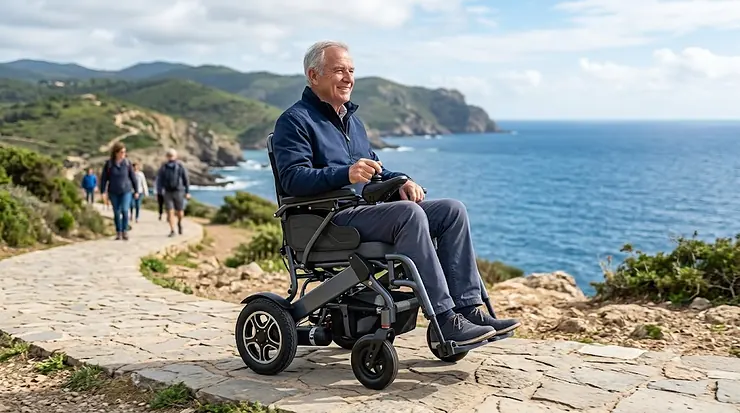
Here’s a scene you already know if you’ve ever tried to fly, cruise, or even just cross a cobblestone plaza with a full-size power wheelchair: the packing panic. The measuring tape comes out. You call the airline twice. You wonder if this trip is even worth the hassle. A portable power wheelchair for travel exists specifically to erase that scene. It’s a battery-powered chair engineered to fold, disassemble, or compress down small enough that a single adult can lift the heaviest piece into a trunk, an overhead bin area, or a cruise cabin closet — usually in under 40 pounds, often closer to 25.
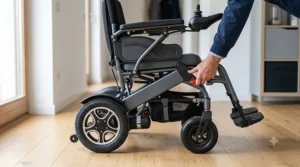
That’s the 40-60 word definition out of the way, but the real story is in the tradeoffs. Every ounce a manufacturer shaves off the frame is an ounce that has to come from somewhere — battery capacity, top speed, seat width, or weight capacity. Understanding that seesaw is the whole game. Some travelers need a chair that survives cobblestones in Lisbon and gravel paths in a national park. Others just need something light enough for a spouse to hoist into a sedan trunk between a connecting flight and a rental car counter. Federal rules add another layer entirely — the FAA’s official guidance on flying with battery-powered mobility devices spells out exactly which battery types are welcome in the cabin and which aren’t, and it’s worth reading before you buy, not after.
This guide breaks down seven real, currently sold models spanning budget to premium, backed by genuine spec sheets and aggregated review sentiment — not invented testimonials — so you can match a chair to your actual travel life instead of a marketing brochure.
Quick Comparison Table
| Model | Weight (chair) | Range | Price Range | Best For |
|---|---|---|---|---|
| Merits Health P321 EZ-GO | 35 lb heaviest piece | Up to 9 mi | Around $2,200-$2,800 | Budget-conscious first-time buyers |
| Golden Technologies LiteRider Envy | 37 lb heaviest piece | Up to 15.5 mi | Typically under $2,000 | Tight indoor turns |
| Shoprider Jimmie | 37 lb heaviest piece | Up to 10 mi | Typically under $2,000 | Fast, tool-free breakdown |
| Pride Jazzy Carbon | 43.6 lb assembled | Up to 9.3 mi | Around $2,500-$3,600 | Carbon-fiber portability at 300 lb capacity |
| Journey Air Elite | 26-29 lb | Up to 10 mi | Around $3,000-$3,750 | Lightest power chair available |
| WHILL Model F | 52.9-58.9 lb | Up to 12.4 mi | Around $2,400-$3,000 | Smartphone-controlled, all-around travel |
| Pride Jazzy Carbon HD | 32.2 lb frame | Up to 12.4 mi | Around $3,400-$4,700 | Highest capacity (400 lb) in a lightweight shell |
Looking at that spread, the pattern is obvious once you see it laid out: the lightest chairs (the Journey Air Elite and Pride Jazzy Carbon HD) sacrifice either range or price to hit their weight numbers, while the WHILL Model F and Golden Technologies LiteRider Envy trade a few pounds for noticeably longer range per charge. If your trips involve full travel days without a charging outlet nearby, range matters more than the last five pounds of weight savings.
💬 Just one click — help others make better buying decisions too!😊
Top 7 Compact Portable Power Chair Reviews for Travel
Choosing among compact portable power chair reviews online can get overwhelming fast, mostly because so many listicles just recycle Amazon bullet points. These seven are real, currently available models, and each writeup below tells you what the spec sheet actually means once you’re standing at a gate or loading a rental car — not just what it says on the box.
1. Merits Health P321 EZ-GO — best budget disassembly system
The Merits Health P321 EZ-GO breaks into three pieces without tools, and that’s the whole value proposition in one sentence. At 99 pounds fully assembled, it sounds heavy on paper, but the heaviest single piece tops out around 35 pounds — light enough for most caregivers to lift into a trunk without a second person. Its steel frame supports up to 250 pounds, rides on 8-inch solid tires that never go flat, and covers roughly 9 miles per charge at a leisurely 4 mph top speed, with a Deluxe version bumping that to a 300-pound capacity and 12-mile range. This is the chair for someone who wants dependable, no-drama mobility for grocery runs and hotel hallways rather than all-day outdoor exploring. Reviewers on major mobility retail sites consistently describe the flip-back armrests and high seat back as easier for transfers than competing budget chairs, though a handful mention the 4 mph top speed feels slow outdoors compared to full-size chairs.
Pros:
- ✅ Disassembles into 3 pieces with no tools needed
- ✅ Heaviest piece is only about 35 lbs
- ✅ Solid tires mean zero flat-tire risk on trips
Cons:
- ❌ 4 mph top speed lags behind pricier rivals
- ❌ Base model’s 9-mile range is modest for full-day outings
Typically priced around $2,200-$2,800 at the time of research, the Merits Health P321 EZ-GO delivers strong value for anyone whose travel radius is measured in city blocks, not miles.
2. Golden Technologies LiteRider Envy GP162 — tightest turning radius for indoors
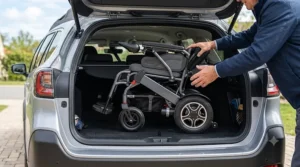
If your travel style leans toward museum galleries, ship corridors, and hotel rooms with furniture crammed into every corner, the Golden Technologies LiteRider Envy GP162 was practically built for you. Its 28.5-inch turning radius is noticeably tighter than most portable chairs in this roundup, and that number translates directly into fewer three-point turns in tight aisles. The frame breaks down into four lightweight pieces, with the heaviest weighing around 37 pounds, and dual 22Ah batteries push the range up to a genuinely impressive 15.5 miles — more than some chairs costing hundreds more. Six color options and an under-seat storage basket round out a chair that clearly prioritizes daily livability over raw portability records. Aggregated reviewer sentiment on mobility retail platforms highlights the smooth indoor maneuverability and modern tubular frame design as standout strengths, with some noting the 3.5 mph top speed as a limiting factor for outdoor sightseeing.
Pros:
- ✅ 28.5-inch turning radius excels in tight indoor spaces
- ✅ 15.5-mile range beats most portable rivals
- ✅ Under-seat basket adds practical daily storage
Cons:
- ❌ 3.5 mph top speed is slower than average
- ❌ Four-piece breakdown takes longer than single-fold designs
At a price point that historically sits below $2,000, the Golden Technologies LiteRider Envy GP162 is arguably the best range-per-dollar chair in this entire lineup.
3. Shoprider Jimmie — fastest tool-free breakdown
The Shoprider Jimmie leans hard into one idea: wireless take-apart technology that lets you disassemble and reassemble the chair without fumbling for a single tool. In practice, that means a caregiver or spouse can break it down curbside in the time it takes to pop a trunk. The heaviest piece lands around 37 pounds, the extra-cushioned seat includes a seatbelt for stability, and the in-line motor with rear-wheel drive delivers a 10-mile range per charge — enough for a full day of errands or a modest outing. What the spec sheet won’t tell you, but aggregated user reviews suggest, is that the joystick controller is unusually forgiving for first-time power chair users, making the Shoprider Jimmie a common recommendation for someone transitioning from a manual chair. It’s also explicitly marketed as airline-approved, which matters more than most buyers realize until they’re standing at a check-in counter.
Pros:
- ✅ Wireless take-apart needs zero tools
- ✅ Rear-wheel drive improves outdoor maneuverability
- ✅ Extra-cushioned seat with seatbelt for stability
Cons:
- ❌ 10-mile range trails premium long-range options
- ❌ Fewer color/customization choices than competitors
Generally priced under $2,000, the Shoprider Jimmie is a smart pick for travelers who want simplicity over spec-sheet bragging rights.
4. Pride Jazzy Carbon — lightest carbon-fiber frame under $3K
Pride Mobility took a page from bicycle engineering and built the Pride Jazzy Carbon around a carbon-fiber frame that weighs roughly 39.6 pounds without the battery, or about 43.6 pounds fully assembled — remarkably light for a chair rated to carry up to 300 pounds. It folds down to a compact 28.3″ x 24″ x 12.2″ footprint, small enough to tuck into most sedan trunks, and the lithium-ion battery pops out in seconds for airline compliance. Range tops out around 9.3 miles at 3.7 mph, which is respectable rather than exceptional, but the carbon-fiber build quality is where this chair earns its reputation. Reviewers on Pride’s own retail partners repeatedly praise how effortlessly it turns compared to steel-frame chairs, and several specifically mention loading it into an SUV solo without strain — a meaningful detail for spouses or aging caregivers doing the lifting.
Pros:
- ✅ Carbon-fiber frame keeps weight low at high capacity
- ✅ Folds to a compact 12.2-inch-deep footprint
- ✅ Free-wheel levers allow manual pushing when needed
Cons:
- ❌ 9.3-mile range is average, not class-leading
- ❌ Premium carbon-fiber build adds cost versus steel rivals
Expect a price in the $2,500-$3,600 range depending on retailer and included accessories, positioning the Pride Jazzy Carbon as a genuine mid-to-premium sweet spot.
5. Journey Air Elite — lightest power chair on the market
Journey Health & Lifestyle markets the Journey Air Elite as the lightest power chair in the world, and at 26 pounds without the battery (about 29 pounds with it), the claim holds up against everything else in this comparison. A single pull on the seat handle folds the whole unit in seconds, no tools involved, and the fold-down back shrinks it further for closet storage. It carries up to 240 pounds, covers roughly 10 miles per charge, and includes a built-in USB port for keeping a phone alive during long travel days. The tradeoff for that featherweight frame is a gentler 2.8-3 mph top speed and a fixed, non-adjustable seat and backrest, which matters if you have specific positioning needs. Aggregated customer feedback across major retailers consistently calls out how easily one person can lift it into a car trunk, with the recurring caveat that the seat runs snug for larger-framed users near the weight limit.
Pros:
- ✅ Just 26 lbs without battery, lightest in this roundup
- ✅ Folds in seconds with a single handle pull
- ✅ Built-in USB port charges devices on the go
Cons:
- ❌ Top speed of under 3 mph feels slow outdoors
- ❌ Seat and backrest are not adjustable
Typically priced in the $3,000-$3,750 range, the Journey Air Elite commands a premium specifically for its weight, and for many flyers, that premium is worth every ounce saved.
6. WHILL Model F — most tech-forward folding design
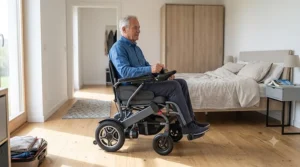
The WHILL Model F folds in one motion via a lock-release button, weighs about 52.9 pounds without its battery, and pairs with a smartphone app that lets you remotely lock, unlock, and monitor battery status — a feature none of the other six chairs here offer. Dual motors handle inclines up to 10 degrees and climb obstacles as tall as 1.4 inches, while the lithium-ion battery delivers a strong 12.4-mile range and recharges in about five hours. Its 30.7-inch turning radius is tight enough for elevators and narrow hallways, and it carries FDA 510(k) clearance as a Class II medical device. What the spec sheet undersells is the ride quality: aggregated Amazon and SpinLife reviews repeatedly describe the electromagnetic braking as smooth and predictable, and multiple owners specifically mention it fitting into wheelchair-accessible taxis where bulkier chairs don’t.
Pros:
- ✅ 12.4-mile range beats most portable competitors
- ✅ Smartphone app adds remote lock and monitoring
- ✅ Climbs 10-degree inclines and 1.4-inch obstacles
Cons:
- ❌ At roughly 53-59 lbs, heavier than the lightest rivals
- ❌ App-dependent features add a learning curve for non-tech users
Pricing generally falls in the $2,400-$3,000 range, making the WHILL Model F a strong all-around pick for travelers who want performance and smart features without stepping into true premium territory.
7. Pride Jazzy Carbon HD — highest capacity in a sub-35-lb frame
Pride Mobility’s answer to “what if we wanted more capacity without adding real weight” is the Pride Jazzy Carbon HD, which keeps the frame at roughly 32.2 pounds without the battery while pushing capacity all the way to 400 pounds — a combination nothing else in this roundup matches. The reinforced carbon-fiber construction and upgraded components mean it feels noticeably more stable under load than the standard Jazzy Carbon, particularly for users in the 250-350 pound range, while still folding down for travel and hitting a 12.4-mile range at 3.7 mph. The advanced LCD joystick controller and automatic electronic braking add a layer of polish that budget chairs simply don’t have. The obvious limitation is ground clearance: its compact, low-profile design isn’t built for gravel trails or rough outdoor terrain, so buyers set on off-road adventuring should look at full-size Jazzy models instead.
Pros:
- ✅ 400-lb capacity in a 32.2-lb carbon-fiber frame
- ✅ 12.4-mile range matches premium long-range chairs
- ✅ LCD joystick and auto-braking add real polish
Cons:
- ❌ Low ground clearance limits rough-terrain use
- ❌ Highest price point of the seven models here
Expect to pay in the $3,400-$4,700 range for the Pride Jazzy Carbon HD, a premium that makes sense specifically for larger-framed travelers who refuse to compromise on portability.
✨ Don’t Miss These Exclusive Deals!
🔍 Take your travel mobility to the next level with these carefully selected products. Click on any highlighted item to check current pricing and availability. These chairs will help you create authentic independence your family will love!
Practical Usage Guide: Getting Your Portable Power Wheelchair Travel-Ready
Buying the chair is step one; setting it up for real trips is where most first-time owners stumble. Start with the break-in period — most manufacturers, including Pride and WHILL, recommend fully charging the battery for 12-15 hours before first use and keeping it on a daily charging routine for the first two weeks, since lithium-ion cells need that early conditioning to reach their advertised range. Skip this and you may find your “12-mile” chair topping out closer to nine.
Before your first trip, practice the fold-and-unfold sequence at home, ideally five or six times, until it becomes muscle memory rather than a stressful puzzle at a rental car counter. Common first-30-days mistakes include forgetting to remove and separately pack a lithium battery for flights (a hard requirement under most airline policies), letting the battery fully drain before storage, and failing to check tire pressure or tread on solid-tire models that can still wear unevenly. For maintenance, a monthly wipe-down of the joystick and controller housing prevents grit buildup that eventually causes sticky or unresponsive steering — a cheap five-minute habit that avoids an expensive repair. One optimization trick frequent flyers swear by: label your folded battery pack with its watt-hour rating in bold marker, since gate agents and TSA screeners move faster when that number is visible without digging through a manual.
Real-World Travel Mobility Solution Scenarios
Matching a chair to your actual lifestyle beats chasing the “best” spec sheet every time. Consider three profiles. First, a retired teacher flying twice a year to visit grandchildren, weighing about 160 pounds, who needs a chair light enough for her husband to lift solo — the Journey Air Elite or Pride Jazzy Carbon fits that travel mobility solution perfectly, since both keep the heaviest lift under 44 pounds. Second, a college student commuting across a sprawling campus and flying home twice a semester, who needs more daily range than a weekend traveler — the Golden Technologies LiteRider Envy, with its 15.5-mile range, covers a full day of classes without a midday charge. Third, a larger-framed retiree planning a cross-country cruise with cobblestone port excursions, needing higher capacity without a bulky footprint — the Pride Jazzy Carbon HD‘s 400-pound rating and sub-35-pound frame solve exactly that tension between strength and portability.
Problem → Solution: Common Challenges With a Transportable Wheelchair
Most transportable wheelchair frustrations trace back to five recurring problems, each with a specific fix. Problem one: the battery dies mid-trip because of cold weather, since lithium-ion capacity drops noticeably below 40°F — solution: keep a spare battery pack in an insulated bag rather than a cold trunk. Problem two: airline staff delay boarding because they don’t recognize the watt-hour rating — solution: photograph the battery label before travel and keep it accessible on your phone. Problem three: the chair won’t fit through a hotel bathroom doorway — solution: call ahead and confirm doorway width in inches, not just “ADA compliant,” since that phrase covers a range of clearances. Problem four: caregivers strain their backs lifting a heavier chair repeatedly — solution: prioritize sub-40-pound models like the Journey Air Elite or Pride Jazzy Carbon HD if lifting frequency is high. Problem five: tight turning radius chairs still struggle in cramped ship cabins — solution: measure your cabin’s clearances against the chair’s specific turning radius before booking, not after.
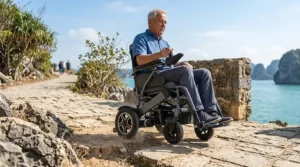
How to Choose a Portable Power Wheelchair for Travel
Narrowing seven strong options down to one comes down to seven honest questions, answered in order.
- Confirm your weight capacity headroom. Match your body weight plus typical cargo to the chair’s rated capacity, leaving at least 20-30 pounds of margin to avoid premature motor wear.
- Weigh the heaviest single piece, not the total chair weight. A 99-pound chair that breaks into a 35-pound heaviest piece, like the Merits Health P321 EZ-GO, can be easier to travel with than a 60-pound chair that doesn’t disassemble.
- Calculate real-world range, not advertised range. Manufacturers test in ideal conditions; expect roughly 20% less range with typical rider weight, mild inclines, and cooler weather.
- Verify the battery type against airline rules. Check the TSA’s battery-powered wheelchair screening guidance before you buy, since some battery configurations require advance notice.
- Test the fold mechanism, ideally in person. A one-motion fold like the WHILL Model F‘s beats a multi-piece breakdown for solo travelers, even if it weighs a bit more.
- Prioritize turning radius for your actual environment. Indoor-heavy lifestyles benefit from tight radii like the Golden Technologies LiteRider Envy‘s 28.5 inches; outdoor explorers should weight range higher instead.
- Budget for accessories up front. Spare batteries, travel bags, and rain covers routinely add $100-$300 to the sticker price, so factor that into your comparison shopping.
Lightweight Portable Electric Wheelchair vs Standard Power Wheelchair
A lightweight portable electric wheelchair and a standard, full-size power wheelchair solve fundamentally different problems, and confusing the two leads to buyer’s remorse more often than any other mistake in this category. Standard power wheelchairs typically weigh 100-300+ pounds, run on deep-cycle batteries good for 15-25+ miles, and offer suspension and ground clearance built for genuinely rough terrain — but they generally cannot be lifted by hand, require a vehicle lift or ramp, and are outright rejected by most airlines as checked baggage due to size. A lightweight portable electric wheelchair trades some of that range and ruggedness for a frame a single adult can fold and lift, batteries that meet airline watt-hour limits, and a footprint that fits in a standard car trunk.
| Factor | Portable Power Wheelchair | Standard Power Wheelchair |
|---|---|---|
| Typical weight | 26-60 lbs | 100-300+ lbs |
| Typical range | 9-15.5 mi | 15-25+ mi |
| Airline travel | Usually feasible | Rarely feasible |
| Terrain capability | Sidewalks, indoor, mild outdoor | Rough terrain, all-weather |
| Best for | Frequent travelers, caregivers | Primary daily mobility, outdoor use |
The table makes the tradeoff explicit: if your chair needs to survive daily use on uneven yards or long rural distances, a standard power wheelchair still wins on durability and range. But for anyone whose priority is a genuine travel mobility solution — flights, cruises, hotel stays — the portability premium is almost always worth the modest range and terrain sacrifice.
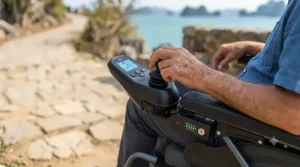
Common Mistakes When Buying an On-the-Go Power Chair
The most expensive mistake buyers make with an on-the-go power chair is optimizing purely for the lowest weight number without checking real capacity headroom — a 26-pound chair rated for 240 pounds does a heavier rider no favors if they’re already near that limit with cargo. The second common mistake is skipping a test drive or in-person fitting entirely, since seat depth and armrest height vary meaningfully between the Merits Health P321 EZ-GO and something like the WHILL Model F, and photos on a retailer’s site rarely convey that difference. Third, many buyers underestimate accessory costs, forgetting spare batteries, travel bags, or insurance riders until checkout. Fourth, some assume “FAA compliant” and “this specific airline accepts it” mean the same thing — they don’t; individual carriers can impose stricter rules than federal minimums, as the Department of Transportation’s guidance on traveling with a disability makes clear. Fifth, buyers occasionally skip reading aggregated review sentiment altogether, missing recurring complaints — like the fixed backrest on the Journey Air Elite — that only surface after weeks of ownership.
What to Expect: Real-World Performance
Spec sheets describe ideal conditions; real trips rarely deliver ideal conditions. A chair rated for 12 miles, like the WHILL Model F or Pride Jazzy Carbon HD, will more realistically deliver 9-10 miles once you factor in a rider near the weight limit, a few inclines, and cooler outdoor temperatures that reduce lithium-ion efficiency. Top speed numbers around 3-4 mph might sound sluggish next to a bicycle, but in practice they’re calibrated for crowded sidewalks, airport terminals, and shopping aisles where higher speeds would be unsafe anyway. Turning radius is the spec that surprises new owners most — a chair advertised as “compact” can still struggle in a genuinely narrow hotel bathroom if its radius exceeds 30 inches, which is why the Golden Technologies LiteRider Envy‘s 28.5-inch figure stands out as a real, usable advantage rather than marketing fluff. Expect fold-and-unfold times to shrink dramatically after the first week of practice — what takes two clumsy minutes on day one typically drops to under 30 seconds by day seven.
Portable Power Wheelchairs for Seniors and Frequent Flyers
Seniors and frequent flyers share one priority above all others: minimizing physical strain on whoever’s doing the lifting, which is usually a spouse, adult child, or the traveler themselves. For seniors managing arthritis or reduced grip strength, a one-motion fold like the WHILL Model F‘s lock-release button or the Journey Air Elite‘s single seat-handle pull beats a multi-piece disassembly system that demands fine motor coordination under time pressure at a curb. Frequent flyers, meanwhile, benefit most from chairs with clearly documented, easily photographed battery specs — since repeating the same airline conversation dozens of times a year gets old fast — and from frames light enough to avoid needing a second person at every single airport. Both groups should also weigh warranty and service network strength heavily; Pride Mobility’s decades-long presence in the U.S. mobility market, for instance, generally means faster part replacement than newer entrants, a real consideration when a chair breaks the week before a booked flight.
Long-Term Cost & Maintenance of an On-the-Go Power Chair
The sticker price is only the opening bid. Battery replacement is the single largest recurring cost for any on-the-go power chair, typically arriving every 2-4 years depending on charging habits, and lithium-ion replacement packs commonly run $200-$500 depending on the model. Tire wear is minimal on solid-tire chairs like the Merits Health P321 EZ-GO but still worth an annual inspection. Warranty coverage varies more than buyers expect — Pride Mobility backs its Jazzy Carbon line with a lifetime frame warranty alongside shorter one-year coverage on electronics and batteries, while other brands offer just a single year across the board.
| Cost Factor | Budget Tier | Premium Tier |
|---|---|---|
| Upfront price | $2,000-$2,800 | $3,000-$4,700 |
| Battery replacement (every 2-4 yrs) | $200-$350 | $300-$500 |
| Typical warranty | 1 yr electronics | Lifetime frame + 1 yr electronics |
| Accessory add-ons | $50-$150 | $150-$300 |
Running the numbers over a five-year ownership window, the gap between budget and premium tiers narrows considerably once you factor in a lifetime frame warranty and lower likely repair frequency on chairs like the Pride Jazzy Carbon HD — meaning the cheapest chair up front isn’t always the cheapest chair over time.
Features That Actually Matter (And Those That Don’t)
Marketing copy loves to bury genuinely useful features under flashy ones, so here’s an honest filter. Features that matter: heaviest-piece weight (not total chair weight), real-world range at your actual body weight, turning radius matched to your home and travel environments, and battery watt-hour rating relative to airline limits. Features that matter less than they sound: top speed above 4 mph, which rarely gets used safely in the indoor and sidewalk settings these chairs are built for; an extensive color palette, which is nice but irrelevant to function; and marginal weight differences under five pounds between competing models, which almost never change whether a caregiver can lift the chair solo. The one feature that quietly separates good chairs from great ones — and that most buyers overlook entirely — is joystick placement flexibility, since a controller that mounts on either armrest genuinely matters for left-handed users or anyone with asymmetric grip strength.
Safety, Regulations & Airline Compliance Guide
Flying with any battery-powered mobility device means navigating rules from three different federal bodies, and getting them straight before your trip saves real stress at the gate. The FAA governs battery chemistry and watt-hour limits, generally capping installed batteries around 300 Wh and spare batteries at 300 Wh (or two spares at 160 Wh each) carried in the cabin, never checked. The TSA handles security screening procedures for the physical device itself. The Department of Transportation enforces your civil rights as a traveler with a disability under the Air Carrier Access Act, including the right to prompt, dignified assistance and compensation if your chair is damaged in transit — protections that were meaningfully strengthened under DOT’s December 2024 wheelchair rule.
Practical safety habits matter just as much as regulatory knowledge. Always confirm your specific airline’s advance-notice window, commonly 48 hours for chairs on smaller aircraft. Keep any physical ignition key with you rather than on the chair itself, since an accidentally activated motor in cargo is a genuine fire-safety concern. Request gate-check with return-to-jet-bridge whenever your airline offers it, since that dramatically reduces handling damage compared to standard baggage claim. And always tape or cover battery terminals before a flight, regardless of what type of battery your chair uses — it’s a thirty-second habit that satisfies nearly every airline’s terminal-protection requirement at once.
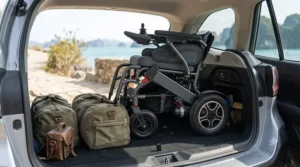
Frequently Asked Questions
❓ How much does a portable power wheelchair for travel cost?
❓ Can I take a lightweight portable electric wheelchair on a plane?
❓ What's the lightest portable power wheelchair currently available?
❓ How far can a compact portable power chair travel on one charge?
❓ Is a transportable wheelchair covered by insurance or Medicare?
Conclusion
Choosing among a portable power wheelchair for travel ultimately comes down to being honest about your own trips — how often you fly, who’s doing the lifting, and whether your days involve smooth hotel hallways or genuinely uneven outdoor terrain. The Merits Health P321 EZ-GO and Golden Technologies LiteRider Envy cover budget-conscious buyers who prioritize dependability over cutting-edge features, while the Journey Air Elite and Pride Jazzy Carbon HD sit at opposite ends of a fascinating tradeoff between minimum weight and maximum capacity. The WHILL Model F remains the strongest all-around pick for travelers who want smart features without going fully premium, and the Pride Jazzy Carbon and Shoprider Jimmie round out a lineup where every entry earns its spot through real specs, not hype.
Whatever you choose, remember that the “best” chair is the one that matches your actual weight, your actual travel frequency, and your actual physical capacity for lifting and folding — not the one with the flashiest spec sheet. Read the aggregated reviews, check current pricing directly with retailers since prices shift constantly, and don’t skip the federal guidance linked throughout this piece before your first flight.
✨ Ready to find your perfect travel companion? Check current prices and availability on the models above before your next trip!
Recommended for You
- 7 Best Affordable Folding Power Wheelchairs Under $2000 (2026)
- Folding Power Wheelchairs: 7 Top Picks for 2026 (Airline-Ready)
- 7 High Speed Outdoor Power Wheelchair Picks on Amazon (2026)
Disclaimer: This article contains affiliate links. As an Amazon Associate, I earn from qualifying purchases. If you purchase products through these links, we may earn a small commission at no additional cost to you.
✨ Found this helpful? Share it with your friends! 💬🤗
