
In This Article
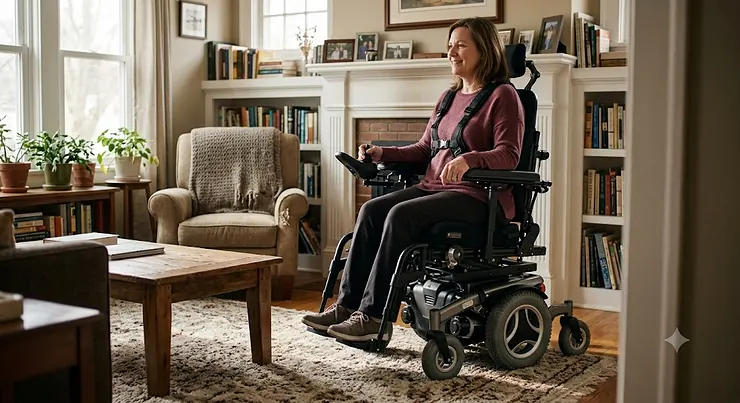
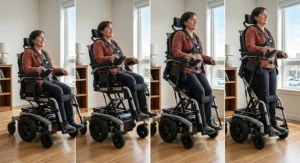
Here’s a question nobody asks out loud enough: why should standing up be a luxury? For years, the sitting position was just the default for wheelchair users — not because it was healthier, but because the technology to change it was clunky, rare, or absurdly expensive. That’s shifted. An electric standing wheelchair is a powered mobility device that lifts the user from a seated position into a supported standing posture at the push of a button, then lets them drive, recline, or hold that stance for as long as their body and their day require. It’s part rehab equipment, part independence machine, and — done right — part quiet act of dignity.
This guide skips the marketing gloss. We dug into real product specs, aggregated genuine review sentiment, and peer-reviewed research on standing wheelchair use to bring you seven actual models worth knowing about, spanning entry-level elevation chairs to fully custom rehab standers. If you’ve been typing “powered standing wheelchair reviews” into a search bar at 1 a.m., trying to figure out whether any of this is worth the investment, you’re in the right place. We’ll walk through what these chairs actually do, who they’re built for, what they cost (in honest ranges, not fantasy numbers), and how to avoid the mistakes that trip up first-time buyers. One quick note before we dive in: these are Group 3/4 complex rehab devices, most of which require a clinical evaluation and are typically obtained through an accredited durable medical equipment (DME) supplier rather than a same-day online cart checkout — so treat any purchase links here as a starting point for research, not a substitute for that process.
Quick Comparison: Electric Standing Wheelchairs at a Glance
| Model | Standout Feature | Price Range | Best For |
|---|---|---|---|
| Pride Mobility Jazzy Air 2 | Elevates 12″ in 11 seconds, even while driving | around $3,800–$4,500 | Budget-conscious buyers wanting elevation, not full stand |
| Sunrise Medical Quickie Q500 M (C-Me) | Drives at 3 mph while elevated | $9,000–$14,000 range | Users who need to move while elevated |
| Sunrise Medical Quickie Q700-UP M | Biomechanical stand to 77° | $15,000–$22,000 range | Users prioritizing true standing posture |
| Standing Wheelchair Company Superstand (Half-Power) | Hybrid manual-stand, power-drive base | $10,000–$15,000 range | Buyers wanting standing without full Group 4 pricing |
| LEVO C3 | Dual-drive stability in stand and seat modes | $18,000–$25,000 range | Users on uneven terrain or inclines |
| Permobil F5 Corpus VS | Multiple standing sequences (supine, semi-reclined, sit-to-stand) | $25,000–$35,000+ range | Complex positioning needs, maximum customization |
| UPnRIDE 1.1 | Auto-balances while standing, even on slopes | $28,000–$35,000+ range | Users prioritizing safety on uneven, outdoor terrain |
A glance at this table tells you most of the story: price climbs almost in lockstep with how close the chair gets to true, upright, ambulatory-feeling standing. The Pride Mobility Jazzy Air 2 sits at the accessible end because it elevates rather than fully stands — a meaningful distinction we’ll unpack below. Meanwhile, the Permobil F5 Corpus VS and UPnRIDE 1.1 command premium prices because they’re solving harder engineering problems: full postural support at height, or balance while moving upright on a slope. If your priority is eye-level conversation and reach, the mid-tier elevation chairs may be all you need; if it’s therapeutic standing time or mobility while upright, you’re shopping in the standing-specific tier.
💬 Already got a favorite on this list? One click helps other readers find the right chair faster too!😊
Top 7 Electric Standing Wheelchairs: Expert Analysis
1. Pride Mobility Jazzy Air 2 — fastest elevation for the money
The Jazzy Air 2 isn’t a true standing wheelchair — it’s a power elevating chair — but it earns its spot here because it’s the most accessible entry point into upright-adjacent mobility, and a lot of buyers searching for a standing wheelchair actually need elevation more than full stance. The captain’s seat rises 12 inches in about 11 seconds, and unlike its predecessor, it can do this while the chair is already rolling, which matters more than it sounds — you’re not stuck waiting at a counter before you can reach it. Mid-wheel-six drive and Active-Trac suspension keep the ride stable at both heights, with a tight 24.25-inch turning radius that apartment and office dwellers will appreciate. This chair is built for people who want face-to-face conversations, reach into upper cabinets, and navigate tight indoor spaces — not for those needing therapeutic full-body standing. Reviewers on retailer sites consistently describe feeling more included in group settings and more independent reaching for everyday items, though the aggregated sentiment skews toward casual home use rather than clinical rehab contexts. FDA Class II designation confirms it’s built to a real medical device standard, not just marketed as one.
Pros:
- ✅ Elevates while still driving, unlike many rivals
- ✅ Compact turning radius suits small homes and offices
- ✅ One-year in-home service contract included standard
Cons:
- ❌ No true standing/recline function for therapeutic use
- ❌ Heaviest component tops 100 lbs, complicating transport
Priced in the $3,800–$4,500 range at most private-pay retailers, the Jazzy Air 2 delivers strong value if elevation — not full standing — is genuinely what you’re after.

2. Sunrise Medical Quickie Q500 M with C-Me — only chair that elevates while driving
Sunrise Medical’s C-Me system on the Quickie Q500 M pushes the elevation concept further than most competitors dare: it lets you rise up to 12 inches while moving at up to 3 mph, meaning you don’t have to choose between height and momentum. That’s a genuinely practical difference in a grocery store aisle or a crowded hallway. The mid-wheel drive base pairs with the highly configurable SEDEO PRO seating system, giving clinicians real latitude to dial in pelvic and trunk support alongside the elevation hardware. An optional LUCI smart-sensing add-on brings collision and tip-detection technology into the mix, which is a meaningful safety layer for users navigating unfamiliar environments. Based on the spec comparison with the Jazzy Air 2, the Q500 M is aimed at a more clinically complex user — someone whose seating needs go beyond a standard captain’s chair. Aggregated feedback on rehab forums frequently praises the smoothness of elevation-while-driving and the color customization options, while some users note the LUCI add-on meaningfully raises the total cost.
Pros:
- ✅ Elevates and drives simultaneously, not sequentially
- ✅ SEDEO PRO seating allows deep clinical customization
- ✅ Optional LUCI tech adds collision and tip detection
Cons:
- ❌ LUCI safety package is a costly optional add-on
- ❌ Still elevation, not a true recline-to-stand posture
Expect a cash price commonly in the $9,000–$14,000 range, with insurance-billed totals varying significantly by state and provider network.
3. Sunrise Medical Quickie Q700-UP M — true 77° standing for eye-level living
Where the Q500 M elevates, the Quickie Q700-UP M actually stands its user — Sunrise Medical’s newer biomechanical standing seating system takes the rider to roughly 77 degrees, close enough to vertical for genuine face-to-face interaction and meaningfully more upright than a reclined “elevate” posture. What the spec sheet won’t tell you outright, but rehab clinicians note, is that this angle matters clinically: pressure redistribution, bladder and bowel function, and joint range of motion all respond differently to a near-vertical stand versus a partial recline. The chair is built on Sunrise’s Group 3/4 power base, meaning it carries the suspension and drive performance of the brand’s higher-tier chairs, not just a seating module bolted onto a basic frame. Aggregated review sentiment from rehab equipment forums is generally positive on standing comfort and transition smoothness, though a recurring theme is the longer insurance pre-authorization timeline typical of Group 4 standing codes — a documentation and patience cost as much as a financial one.
Pros:
- ✅ True 77° standing angle for genuine eye-level access
- ✅ Built on a robust Group 3/4 power base
- ✅ Compatible with SEDEO seating customization
Cons:
- ❌ Group 4 insurance approval process often runs long
- ❌ Heavier standing hardware needs a larger vehicle lift
Private-pay pricing for the Q700-UP M generally lands in the $15,000–$22,000 range, reflecting the added engineering of true standing versus simple elevation.
4. Standing Wheelchair Company Superstand (Half-Power) — hybrid stand-and-drive at a lower cost
If the premium standing chairs on this list feel financially out of reach, the Superstand deserves a serious look. Built by a veteran-owned manufacturer in Saginaw, Michigan, the Half-Power configuration pairs an easy-to-use manual standing mechanism — engaged via a simple lever, not a full power actuator — with a power mobility base for driving. That hybrid design is the whole value proposition: you get a real standing wheelchair without paying for power-assisted standing hardware on top of power-assisted driving hardware. Users on rehab forums describe it as the “best of both worlds,” since the power base extends range and reduces fatigue for daily transportation, while the manual stand assist keeps mechanical complexity — and the associated cost and maintenance — lower than fully powered alternatives. What most buyers overlook about this model is the tradeoff on weight: because the frame relies on steel rather than aluminum construction favored by some rivals, anecdotal owner reports put it meaningfully heavier than competitors like the LEVO line, which affects loading it into a vehicle without a lift.
Pros:
- ✅ Genuine standing function at below-premium pricing
- ✅ American-made with veteran-owned manufacturing background
- ✅ Simple one-button plus lever operation, less to break
Cons:
- ❌ Steel frame construction reportedly heavier than rivals
- ❌ Smaller company means fewer nationwide dealer/service points
Buyers typically report pricing in the $10,000–$15,000 range directly through the manufacturer, positioning it as one of the more accessible true standing wheelchairs available.
5. LEVO C3 — most stable dual-drive standing base
LEVO has been building dedicated standing wheelchairs for over four decades, and the C3 shows that experience in its engineering philosophy rather than its marketing copy. Its Dual Drive System is the standout: in the seated position, center wheels handle drive for tight mid-wheel maneuverability, but when the chair rises into standing mode, chain-driven front wheels lower to the floor and take over traction — a mechanical handoff designed specifically to prevent the front-heavy tipping risk that plagues cruder standing mechanisms on inclines. Here’s what the spec sheet won’t spell out plainly: that traction handoff is precisely why LEVO chairs get recommended more often for users who need to stand somewhere other than a flat clinic floor — sloped driveways, uneven sidewalks, gently graded ramps. The company’s “Low Shear” transition system also targets a smoother, less jarring rise from seated to standing, which matters for users with sensitive skin or spasticity. Long-running rehab community discussions consistently flag the C3 (and its LAE predecessor) as lighter than steel-framed competitors, largely due to aluminum construction, though exact weight varies by configuration.
Pros:
- ✅ Dual Drive System adds traction stability on inclines
- ✅ Low Shear transition eases seated-to-standing movement
- ✅ Decades of standing-wheelchair specialization behind the design
Cons:
- ❌ Special-order custom builds mean longer lead times
- ❌ Premium Group 4 rehab pricing typical of the category
Custom-built C3 configurations typically price in the $18,000–$25,000 range, varying with seating, controls, and base options selected.
6. Permobil F5 Corpus VS — most customizable standing sequences
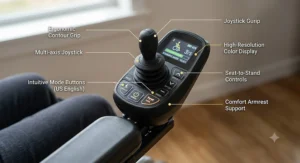
The Permobil F5 Corpus VS is, frankly, the Swiss Army knife of this list. It offers programmable standing sequences across supine, semi-reclined, or sit-to-stand techniques — meaning the chair can adapt its rising method to the user’s specific muscle tone, spasticity pattern, or comfort preference, rather than forcing one universal stand motion on everyone. Layer on the Corpus Ergo seating system, with a redesigned pelvic well cushion and dual-density backrest foam, and you’ve got a chair engineered as much around pressure injury prevention as around mobility. Reviewers and rehab clinicians consistently point to the redesigned knee support hardware — 75% lighter than the prior single-post design, with BOA Fit System dial adjustments — as a genuinely useful refinement for caregivers doing daily setup. On paper, the connected MyPermobil app (available on qualifying models) adding real-time battery and seating data feels like a gimmick, but for users managing complex equipment, remote diagnostics can meaningfully cut down on unplanned service visits. This is the chair for the most medically complex positioning needs on this list, and it’s priced accordingly.
Pros:
- ✅ Three distinct standing techniques for different needs
- ✅ Corpus Ergo seating targets pressure injury prevention
- ✅ Connected app enables remote battery and service insights
Cons:
- ❌ Highest price tier of any chair on this list
- ❌ Added connectivity tech means more components to maintain
As a fully custom Group 4 rehab chair, private-pay pricing often exceeds $25,000, and can run well past $35,000 depending on configuration.
7. UPnRIDE 1.1 — only chair that stands and balances on slopes
The UPnRIDE 1.1 approaches the category from a genuinely different engineering angle: it’s less “wheelchair with a stand function” and more robotic mobility platform that happens to look like one. Its signature feature is automatic balancing, letting users ride uphill, downhill, or across slanted surfaces in either a seated or fully upright standing position without the tipping risk that would come with a rigid standing frame on the same terrain. Peer-reviewed research from a VA-affiliated spinal cord injury research center has actually tested the device in a 12-week case series, finding it usable and well-tolerated for supervised standing sessions among participants with chronic spinal cord injury — a level of independent clinical scrutiny most consumer mobility products never receive. Top speed is modest by power-wheelchair standards — 3.73 mph seated, 2.8 mph standing — which is the tradeoff for the auto-balancing engineering. As a comparatively new company founded in 2014, UPnRIDE doesn’t yet have the sprawling US dealer network of legacy brands, something worth factoring into your service-access planning before buying.
Pros:
- ✅ Auto-balancing enables standing mobility on slopes
- ✅ FDA-recognized device with published clinical case-series data
- ✅ Reduces tipping risk versus rigid standing frames
Cons:
- ❌ Lower top speed than most rehab power chairs
- ❌ Smaller US service network than legacy manufacturers
Typical pricing runs in the $28,000–$35,000+ range, reflecting the specialized robotics engineering behind the auto-balancing system.
Setting Up and Living With Your Standing Power Wheelchair
Getting a new electric standing wheelchair delivered feels a bit like bringing home a very expensive, very opinionated appliance — it needs a proper introduction. In the first week, resist the urge to max out every setting immediately. Most clinicians recommend starting with short standing sessions (5–10 minutes) once or twice a day, gradually building toward the 30-plus minutes per session that research on standing powered wheelchair use associates with the strongest reported benefits in bowel regularity and blood pressure regulation. Pay close attention to how the powered stand function interacts with your specific knee and chest supports; an improperly fitted knee block is the single most common source of discomfort reported by new standing chair users, and it’s usually a five-minute adjustment once you know what you’re feeling for.
Maintenance-wise, batteries are the component most likely to bite you if ignored — most manufacturers recommend a full charge cycle every night for the first two to three weeks to properly condition new batteries, not just top them off. Keep the standing mechanism’s pivot points and any chain-drive components (as in dual-drive designs) free of debris, since grit accelerates wear on the exact parts responsible for standing stability. A common first-30-days mistake: leaving the chair in standing mode overnight to “save time” the next morning — most electric lift system components aren’t designed for extended static load in the raised position and this can shorten actuator lifespan considerably.
📋 Not sure which setup questions to ask your DME provider? Bookmark this guide before your fitting appointment.
Real-World Scenarios: Who Actually Needs an Automatic Standing Power Chair
Picture Maria, 34, with a T6 spinal cord injury from a car accident five years ago. She works a hybrid office job and spends most of her day in meetings where eye-level conversation matters for how seriously colleagues take her input. For Maria, an elevation-focused chair like the Pride Mobility Jazzy Air 2 or Sunrise Medical Quickie Q500 M solves the actual problem — she doesn’t need therapeutic standing time, she needs to not be looked down at during a budget review.
Now picture Daniel, 58, with multiple sclerosis and progressively worsening bone density concerns flagged by his neurologist. His physical therapist has specifically prescribed daily weight-bearing standing time to help slow further density loss and manage spasticity. For Daniel, a true standing chair — the LEVO C3 or Permobil F5 Corpus VS — isn’t a luxury, it’s closer to a piece of preventive medical equipment, and insurance documentation will likely reflect that framing.
Finally, consider Priya, 27, who lives in a hilly college town with cracked, uneven sidewalks and steep driveway approaches at half the buildings on campus. Her biggest fear with any standing chair isn’t the stand mechanism itself — it’s tipping on a slope while upright. For someone in Priya’s exact situation, the UPnRIDE 1.1‘s auto-balancing feature directly targets her real risk, even at a real cost premium.
Common Problems With Standing Wheelchairs (And How to Solve Them)
Problem 1: Skin irritation from knee and chest supports. Ill-fitted padding is the most frequently cited discomfort in aggregated user reports. Solution: request an in-person fitting adjustment rather than accepting factory defaults; most manufacturers, including Permobil’s swing-away knee support system, build in tool-free adjustment specifically for this.
Problem 2: Insurance denial or delay on Group 4 standing codes. This is common enough that experienced DME suppliers budget extra months for it. Solution: have your physical or occupational therapist document specific functional goals (pressure relief, bladder function, reach) rather than general “quality of life” language, since payers respond to measurable clinical justification.
Problem 3: Anxiety about tipping on slopes. A legitimate concern with rigid-frame standing chairs. Solution: either restrict standing use to flat, controlled surfaces with those chairs, or consider an auto-balancing design like the UPnRIDE if outdoor sloped terrain is a daily reality, not an occasional one.
Problem 4: Battery range anxiety during a full standing-and-driving day. Solution: request an upgraded battery pack (many manufacturers, including Pride Mobility, offer higher-AH options) if your daily use pattern regularly exceeds the standard range estimate.
Problem 5: Transport and vehicle-loading difficulty. Heavier standing chairs, particularly steel-framed models, complicate non-lift vehicle transport. Solution: weigh transport needs honestly during model selection — an aluminum-framed option like the LEVO C3 may be worth a price premium if you’re regularly loading into a personal vehicle without a lift.

How to Choose an Electric Standing Wheelchair
What is the right way to choose an electric standing wheelchair? The right choice balances your specific standing purpose (social/reach versus therapeutic), your daily terrain, your transport situation, and your insurance pathway — no single “best” chair fits every user, which is why a structured decision process matters more than a spec sheet.
- Define your standing purpose first. Social interaction and reach favor elevation chairs; medical goals like pressure relief or bone density favor true standing chairs with clinical documentation.
- Map your daily terrain honestly. Flat indoor environments tolerate rigid standing frames fine; sloped or uneven outdoor terrain pushes you toward auto-balancing designs.
- Confirm your Group classification with your therapist. Group 3 elevation-only chairs and Group 4 standing chairs follow very different insurance authorization timelines.
- Check total weight against your transport plan. A chair that’s perfect on paper becomes a daily obstacle if it won’t fit your vehicle lift or non-lift loading routine.
- Ask specifically about seating customization. SEDEO, Corpus Ergo, and similar systems vary meaningfully in pressure redistribution — this matters more over years of use than initial comfort.
- Get real user feedback, not just manufacturer copy. Rehab community forums and spinal cord injury support groups often surface the maintenance quirks manufacturers won’t volunteer.
- Budget for the full ownership timeline, not just the purchase. Battery replacement, seating refresh, and service visits add up meaningfully over a chair’s 5+ year lifespan.
Common Mistakes When Buying a Powered Standing Wheelchair
The single most common mistake in powered standing wheelchair reviews and forum posts alike is buyers conflating elevation with standing — assuming a chair that lifts the seat 12 inches delivers the same therapeutic benefit as one that reclines the user into a genuine upright stance. They’re different technologies solving different problems, and confusing them leads to real disappointment post-purchase. A second frequent mistake is underestimating weight and transport logistics; a chair that performs beautifully in a showroom can become a genuine daily burden if it won’t fit an existing vehicle setup. Buyers also commonly skip requesting a trial period or in-home demo when one is available, relying instead on spec sheets and video reviews — a mistake, since standing transition comfort is deeply individual and hard to judge secondhand. Finally, many first-time buyers underestimate the insurance documentation process for Group 4 standing codes, expecting a timeline closer to a standard power chair purchase, only to be caught off guard by months of additional back-and-forth.
Electric Standing Wheelchair vs Traditional Manual Wheelchair
| Factor | Electric Standing Wheelchair | Traditional Manual Wheelchair |
|---|---|---|
| Weight-bearing / bone health | Supports regular weight-bearing standing time | No standing capability |
| Independence for reach/eye-level tasks | High — powered stand or elevation on demand | Requires assistance or adaptive tools |
| Purchase cost | Often $10,000–$35,000+ | Often under $2,000 |
| Weight and portability | Heavy, 100+ lbs typical | Light, often foldable |
| Maintenance complexity | Higher — batteries, actuators, seating systems | Lower — mostly frame and wheel upkeep |
The comparison above makes the tradeoff explicit: a manual wheelchair wins decisively on cost, weight, and simplicity, while an electric standing wheelchair wins on the things a spec sheet can’t easily price — weight-bearing time, eye-level social access, and independence in tasks that otherwise require another person’s help. For many users, the honest answer isn’t “either/or” but “both,” with a manual chair for daily light mobility and a standing chair reserved for specific therapeutic or social windows in the day. Reviewers who’ve owned both consistently frame the standing chair less as a replacement and more as a specialized tool layered on top of existing mobility equipment.
What to Expect: Real-World Performance and Motorized Elevation
Specs describe potential; daily use describes reality, and the gap between the two is where most standing wheelchair frustration and satisfaction actually live. A published study of standing powered wheelchair users with spinal cord injury found that roughly nine in ten participants stood for at least 30 minutes at least once a week, and the most commonly reported perceived benefits clustered around improved activities of daily living, better bowel movement regularity, blood pressure regulation, and a stronger sense of body image — not flashy features, but quietly significant quality-of-life shifts. The same research flagged the most common complaints too: chair dimensions and weight, and difficulty maneuvering indoors or on uneven surfaces, echoing exactly the transport and terrain concerns we’ve raised throughout this guide.
Motorized elevation performance, meanwhile, tends to disappoint users who expected it to substitute for full standing — it doesn’t reposition weight-bearing load the same way, though it excels at exactly what it’s built for: reach, visibility, and social presence. A separate case series testing an auto-balancing standing wheelchair among spinal cord injury participants over 12 weeks found the device usable and well-tolerated in a supervised research setting, with blood pressure remaining stable across sessions — a reassuring signal for anyone nervous about the cardiovascular demands of frequent standing transitions.
Long-Term Cost & Maintenance of Your Electric Lift System
| Cost Category | Typical Range (Annual, Post-Warranty) | Notes |
|---|---|---|
| Battery replacement | $200–$600 | Every 1–3 years depending on usage |
| Actuator/motor service | $300–$900 | Standing mechanisms see more wear cycles |
| Seating/cushion refresh | $150–$500 | More frequent for pressure-sensitive users |
| Routine service visits | $100–$400 per visit | Frequency varies by manufacturer/dealer |
Reading the table above, the electric lift system itself — the motors and actuators physically raising the user — tends to be the single priciest long-term maintenance category, simply because it does more mechanical work than a standard power base. Buyers should also budget for seating refreshes more proactively than they might expect, since pressure-relief cushions genuinely degrade over time in ways that aren’t always visually obvious. Total cost of ownership over a five-year window can meaningfully favor brands with strong local dealer networks, since remote service call fees add up quickly for owners of less common models.
🔧 Ready to compare current listings for these models? Tap through to check availability near you.
Safety, Regulations & Compliance Guide
Every genuine power wheelchair sold in the US, including standing models, falls under the FDA’s Class II medical device classification, meaning manufacturers must demonstrate substantial equivalence to an already-approved device before bringing a new model to market, per the FDA’s official device classification database. That classification isn’t just bureaucratic trivia — it’s the baseline assurance that the standing mechanism you’re trusting with your body has cleared a real regulatory bar, not just a marketing claim. Federal regulations specifically addressing powered wheelchairs are codified under 21 CFR § 890.3860, which spells out the performance standards these devices must meet.
Beyond federal classification, safe standing wheelchair use comes down to practical habits: always engage seatbelts and chest/knee supports fully before initiating a stand, never attempt standing transitions on a slope unless your specific model is rated for it, and follow your manufacturer’s recommended weight limit exactly — exceeding it compromises the standing mechanism’s structural safety margins, not just comfort. If your use case involves genuinely uneven or sloped terrain regularly, research published through peer-reviewed clinical trials on standing wheelchair safety, such as a case series on an upright powered wheelchair published via the National Library of Medicine, offers a useful, evidence-based reference point beyond manufacturer claims alone.

FAQ
❓ How much does an electric standing wheelchair cost?
❓ Does insurance cover a powered standing wheelchair?
❓ Is an electric standing wheelchair the same as a seat-elevating power chair?
❓ How long can someone safely stand in a standing power wheelchair each day?
❓ Are automatic standing power chairs safe on hills or slopes?
Conclusion
An electric standing wheelchair isn’t a single product — it’s a category with real range, from a $4,000 elevation chair solving a reach-and-visibility problem to a $35,000 robotic standing platform solving a balance-on-slopes problem. The honest takeaway from all seven models we’ve covered is that the “best” chair is entirely a function of what problem you’re actually trying to solve: eye-level social presence, therapeutic weight-bearing time, outdoor terrain safety, or some combination of the three. Price alone is a poor guide — the Standing Wheelchair Company Superstand proves genuine standing function doesn’t require Permobil-tier spending, while the Pride Mobility Jazzy Air 2 proves elevation alone can meaningfully improve daily life without full standing costs at all. Whatever you land on, involve your physical or occupational therapist early; the clinical documentation trail matters just as much as the chair itself when insurance is footing part of the bill. Standing up, it turns out, is worth fighting for — and now you know exactly which chair might get you there.
✨ Found the right fit in this guide? Check current availability on the model that matches your needs today!
Recommended for You
- Standing Power Wheelchair vs Regular: 7 Real Picks Ranked (2026)
- Standing Power Wheelchairs: 7 Best Vertical Mobility Picks (2026)
- 7 Best Airline Approved Power Wheelchairs for Fearless Travel in 2026
Disclaimer: This article contains affiliate links. As an Amazon Associate, I earn from qualifying purchases. If you purchase products through these links, we may earn a small commission at no additional cost to you.
✨ Found this helpful? Share it with your friends! 💬🤗
