

In This Article
A foldable kids wheelchair for airplane travel is a pediatric mobility chair that collapses to a compact, carry-friendly shape, weighs little enough for one caregiver to lift, and survives gate-checking. The best ones pair a quick-fold frame with growth-friendly seating, so the chair that works at the airport also works at home.

Airports are built for people who travel light and think fast, and a child’s wheelchair complicates both. The chair is luggage, mobility aid and lifeline all at once. Since the Department of Transportation finalized its 2024 rule on safe accommodations for wheelchair users, airlines face tougher standards for handling mobility devices. But a stricter rulebook can’t fix a chair that’s too heavy to lift, too long to stow, or too fragile for the cargo hold. Choosing well still starts with you.
This guide compares seven real chairs: five pediatric-specific folding designs, one budget pediatric workhorse, and one featherweight adult-size transport chair for bigger kids. Everything here comes from published manufacturer and retailer specifications plus federal regulations, as of October 2026. None of it comes from hands-on testing. Where verified customer reviews were thin, the article says so instead of papering over it.
Along the way you’ll see what an ultra-compact folding pediatric wheelchair for flights means in actual inches and pounds, and how the airline gate-check policy works. You’ll also find out whether a kids wheelchair travel bag for airlines earns its keep, and where a lightweight pediatric transport chair for vacations beats a prescription-grade frame. One caution, said once: pediatric chairs are seating systems. A physical or occupational therapist should confirm the fit before anything is ordered.
Quick Comparison: 7 Foldable Pediatric Chairs at a Glance
Before the deep dive, here’s the whole field on one screen. Weights and features come from manufacturer and retailer listings, and sizes vary by frame, so treat the numbers as starting points, not promises.
| Product | Published Weight | Standout Trait | Best For |
|---|---|---|---|
| Convaid Cruiser | 27–32 lb (by size) | Umbrella-style fold, 30° fixed tilt | Kids needing postural support who fly often |
| Convaid Rodeo | 29–39 lb (by size) | Up to 45° tilt-in-space | Kids needing more involved positioning |
| Zippie Voyage | 28 lb | One-step fold, reversible seat | Babies and toddlers |
| Zippie GS | 25 lb | Growth-friendly folding frame | Active school-age kids |
| Zippie X’CAPE | 19 lb | Lightest pediatric option here | Caregivers who count every pound |
| Drive Medical Wallaby | 37 lb (14-inch seat) | WC19 transit option, lowest cost tier | Budget-conscious families |
| Feather Mobility Transport Wheelchair | 13 lb | Featherweight adult-size frame | Older, larger kids and teens on occasional trips |
Looking at the table, the Zippie X’CAPE and Feather Mobility Transport Wheelchair are the weight leaders, but they solve different problems: one is pediatric-specific, the other is an adult-size transport chair. The Convaid Cruiser and Convaid Rodeo trade extra pounds for positioning support. The Drive Medical Wallaby is the heaviest of the group, which is the price of a lower entry cost.
💬 Just one click — help others make better buying decisions too!😊
Top 7 Foldable Kids Wheelchairs for Airplane Travel: Expert Analysis
Each entry below turns specs into real-world meaning. Review sentiment is reported only where it could be verified, and prices are ranges, never exact figures. Check current listings and availability before you buy.
1. Convaid Cruiser — umbrella-style fold with 30° fixed tilt
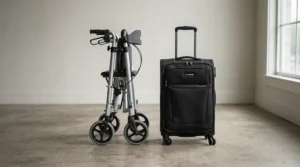
Think of the Convaid Cruiser as the wheelchair that learned to behave like an umbrella stroller. It collapses flat and slim, which is what a jet bridge rewards. Published specs list 27 to 32 pounds depending on frame size (sizes 10 through 18), a folded height of 17 inches, a folded width of 15 to 16 inches, and a folded length of 47 to 53 inches. That slim profile slides along a counter or into a rental-car trunk with little fuss, though the length is the trade-off.
Based on the spec comparison, this is a pushed-chair design for children who benefit from 30° of fixed tilt and self-tensioning seating. It builds in roughly five years of growth through seat-depth extension. Because it’s made to order, the fitting happens with a therapist and dealer, not in a checkout cart. For flying, the federal baseline for cabin priority space is a folded chair of 13 by 36 by 42 inches or less. The Convaid Cruiser exceeds that in length, so plan on gate-checking.
Reliable aggregated consumer reviews were hard to verify for this dealer-sold, made-to-order chair. Lean on your therapist’s and dealer’s experience and read current owner feedback before ordering.
Pros:
- ✅ Slim 15–16 inch folded width
- ✅ Five years of growth through seat-depth extension
- ✅ WC19 transit option available
Cons:
- ❌ Folded length of 47+ inches exceeds cabin-closet baseline
- ❌ Made to order, so no impulse buying
Pricing is dealer-quoted by size and options, so check current listings. For a child who needs tilt support and flies several times a year, the value case is strong.
2. Convaid Rodeo — tilt-in-space up to 45° for serious positioning
The Convaid Rodeo is what you reach for when positioning is the headline, not an add-on. It offers up to 45° of tilt plus 90° to 110° of back recline. Published weights run 29, 33, 37 and 39 pounds across sizes 10 to 16, with capacities from 75 to 170 pounds.
The folded numbers tell a different story from the Cruiser’s. The smallest size folds to about 17.5 inches high, 33.5 inches long and 21 inches wide, and widths climb to 27 inches on larger sizes. On paper, that means a shorter package that fits within the 36-inch element of the federal cabin baseline, but a much wider one than the 13-inch figure. Expect to gate-check it regardless.
Who is it for? Children whose therapists want tilt for pressure relief and upper-body support, and who will be seated for long stretches of travel. The listing also notes a transit option meeting WC19 standards and a lifetime guarantee, which matters for a chair that will be folded and unfolded dozens of times.
Independent review volume for this prescription-style chair was too thin to summarize fairly. Treat dealer and clinician feedback as your best evidence.
Pros:
- ✅ Up to 45° tilt and adjustable recline
- ✅ Folded length from 33.5 inches on the smallest size
- ✅ Five years of growth capability
Cons:
- ❌ Heavier, at 29–39 lb by size
- ❌ Wider folded profile than stroller-style rivals
Pricing is configuration-based through dealers. It’s a premium choice that justifies itself only when tilt is clinically needed.
3. Zippie Voyage — one-step quick fold for babies and toddlers
The Zippie Voyage is the stroller-shaped option for the youngest travelers, and its party trick is a one-step fold. At a published 28 pounds with a 75-pound capacity and seat widths from 6 to 13 inches, it’s built for small bodies with big positioning needs. Airless wheels mean no flats, and swivel front wheels lock out for straight tracking on long concourse stretches.
Here’s what those features mean at the airport. A one-step fold matters when you’re holding a child, a boarding pass and a diaper bag at the same time. The reversible seat lets you face your child or let them watch the world, and a cargo basket carries up to 15 pounds. The listing also states the chair is crash-tested for occupied transit in a motor vehicle, a plus for the rental-car leg.
The catch is the narrow sizing window. One used-equipment listing places the intended range at roughly 9 months to 2.5 years, so confirm limits with the manufacturer and your therapist.
Verified consumer review data wasn’t available for this model, so rely on spec reasoning and current dealer feedback.
Pros:
- ✅ One-step quick fold
- ✅ Airless wheels, so no flat tires
- ✅ Reversible seat with 35° tilt range
Cons:
- ❌ Narrow size range means it’s outgrown quickly
- ❌ Premium price for a short use window
Retail listings sit in the mid-$2,000s at one seller. Worth it for a baby who needs early-intervention seating, but not for a child close to the size ceiling.
4. Zippie GS — growth-friendly folding frame for active school-age kids
The Zippie GS is the grown-up sibling in the lineup, a wheelchair-style folding frame meant to keep pace with a growing child. Published specs list a 25-pound chair weight, a 165-pound capacity and seat widths from 10 to 18 inches. Features include full-length height-adjustable armrests and a universal axle plate designed to adjust through growth spurts.
What does that mean in practice? At 25 pounds, a caregiver can usually lift it into a trunk without a grunt, and seat widths stretching to 18 inches mean the chair can serve a child for years instead of seasons. For families who fly a few times a year, that longevity spreads the cost across many trips. Folded dimensions weren’t published in the sources reviewed, so ask your dealer for the exact folded size before you rely on a car trunk or cabin closet.
This is a better match for school-age kids with fewer positioning needs than the tilt chairs above. If your child needs significant tilt or a headrest system, a therapist may steer you elsewhere.
Verifiable consumer reviews were too sparse to characterize. Read current retailer feedback before ordering.
Pros:
- ✅ 25-lb frame is easy for one adult to lift
- ✅ Seat widths up to 18 inches for long-term growth
- ✅ High 165-lb capacity
Cons:
- ❌ Folded dimensions not clearly published
- ❌ Offers less positioning support than tilt chairs
Retail listings fall roughly in the $1,500–$2,000 range at one seller. Good long-term value if your child will use it for years.
5. Zippie X’CAPE — the lightest pediatric frame in this lineup
The Zippie X’CAPE earns the “ultra-compact folding pediatric wheelchair for flights” shorthand through sheer lightness. Loh Medical’s product sheet lists 19 pounds as one of the lightest pediatric folding wheelchairs. The frame is aluminum, available in foldable or rigid versions, with seat widths and depths from 8 to 16 inches and a 165-pound capacity.
Nineteen pounds changes the whole airport experience. Lifting it over your shoulder at a gate, dropping it onto a cart, or hoisting it into a taxi takes less effort. Pediatric-specific details include a 2-inch crossbar rise and a 3-inch seat-rail rise, and the sheet highlights an XLOCK folding spreader. It also lists the Z-finity lower-extremity positioning system and VersaRail for accessory mounting.
The thing to verify is the frame type. The same family offers rigid and folding options, and only the folding version suits cabin-friendly travel. Published folded dimensions weren’t in the sources reviewed, so request them.
Consumer review aggregation wasn’t verifiable for this model. Dealer and therapist input is your best evidence.
Pros:
- ✅ Just 19 lb, the lightest pediatric option here
- ✅ Folding or rigid frame choices
- ✅ Extensive positioning and accessory options
Cons:
- ❌ Folded size not published in reviewed sources
- ❌ Dealer-quoted pricing, so less transparent
Pricing is custom-quoted. For a weight-sensitive family that flies often, it’s a compelling investment.

6. Drive Medical Wallaby — the budget-friendly pediatric folding chair
The Drive Medical Wallaby is the least dramatic option here, and for some families that’s the point. It comes in 12-inch and 14-inch seat widths, with 22-inch rear wheels and 6-inch front casters. Standard features include flip-back padded desk arms, swing-away footrests with calf straps, a pelvic belt, adjustable-height push handles and push-to-lock wheel locks. The 14-inch version lists 37 pounds, with a 150-pound capacity.
Interpretation time. Thirty-seven pounds is noticeably heavier than the Zippie options, so gate-checking and trunk loading take more effort. But the flip-back armrests make transfers easier, and the listing notes wheels come off easily for compact packing. The chair is described as WC19 transit-compliant for users between 50 and 80 pounds when used with the separate WB8021 kit, so confirm that item if vehicle transit matters. Listed open dimensions are about 20 to 22 inches wide and 37 to 39 inches deep, so verify the actual folded size.
Verified consumer review data wasn’t available for this model during research.
Pros:
- ✅ Lowest price tier in this lineup
- ✅ Flip-back arms ease transfers
- ✅ WC19 transit option with kit
Cons:
- ❌ Heaviest chair here, at 37 lb in 14-inch size
- ❌ Fewer positioning options than premium chairs
Retail listings fall roughly in the $550–$800 range depending on seller. Fair value for occasional flyers who don’t need advanced seating.
7. Feather Mobility Transport Wheelchair — featherweight frame for bigger kids
The Feather Mobility Transport Wheelchair isn’t pediatric-specific, and you should hear that first. It’s an adult-size transport chair that listings describe as 13 pounds, with a 300-pound capacity and an 18-inch seat. For a taller older child or teen who doesn’t need pediatric positioning, that featherweight frame can be transformative at the airport.
The folded-size numbers conflict across listings. One lists 9 by 24 by 9 inches, while a distributor lists 29 by 24 by 9 with a 15-inch folded width. Confirm with the seller. A separate carry bag lists a loaded size of 31 by 13 by 27 inches, and some versions ship without handbrakes. Transport chairs are attendant-propelled and offer minimal postural support, so a therapist should approve this choice.
At 13 pounds, you can carry it through a terminal like a heavy tote, and that’s the whole argument for it. If your child sits upright comfortably and the chair is mainly for long airport distances, the weight savings outweigh the lack of growth features.
Verified customer review data wasn’t available in the sources reviewed.
Pros:
- ✅ Just 13 lb, lighter than every pediatric option
- ✅ 300-lb capacity leaves room to grow
- ✅ Dedicated carry bag available separately
Cons:
- ❌ Not pediatric-specific, with no growth or positioning system
- ❌ Folded dimensions conflict across listings
Pricing varies by seller, and the bag is extra. Strong value for older kids on occasional trips, but a poor fit for kids needing seating support.
Folded Dimensions, Capacity and Price Ranges Compared
Folded dimensions decide whether a chair rides in a trunk, a cabin closet or the cargo hold. This table gathers what’s published, and “not verified” means exactly that: don’t assume, ask the dealer.
| Product | Folded Size (Published) | Weight Capacity | Price Range | Best For |
|---|---|---|---|---|
| Convaid Cruiser | 17 H × 47–53 L × 15–16 W in | 75–250 lb | Dealer-quoted | Frequent flyers needing tilt |
| Convaid Rodeo | 17–18 H × 33.5–40 L × 21–27 W in | 75–170 lb | Dealer-quoted | Kids needing tilt-in-space |
| Zippie Voyage | Not verified | 75 lb | Mid-$2,000s | Babies and toddlers |
| Zippie GS | Not verified | 165 lb | $1,500–$2,000 | Long-term growth |
| Zippie X’CAPE | Not verified | 165 lb | Dealer-quoted | Lightest-weight priority |
| Drive Medical Wallaby | Open size 20–22 W × 37–39 D × 33 H in | 150 lb | $550–$800 | Budget buyers |
| Feather Mobility Transport Wheelchair | 9×24×9 or 29×24×9 in (listings differ) | 300 lb | Check current price | Older, larger kids |
The pattern is clear: the Convaid chairs publish their folded dimensions, but those dimensions exceed the cabin baseline. Chairs without published folded sizes may or may not do better, so ask before you buy. Weight capacity matters for longevity: the Zippie GS and Zippie X’CAPE keep a 165-pound ceiling, while the Feather Mobility Transport Wheelchair offers the highest at 300 pounds.

How to Choose a Foldable Kids Wheelchair for Airplane Travel
Here’s a seven-step filter that turns a confusing spec sheet into a decision.
- Start with a therapist fitting. Pediatric chairs are seating systems, and a physical or occupational therapist can confirm what your child actually needs.
- Match weight to your lifting ability. The lineup here runs from 13 pounds to the high 30s, and that gap is felt every time you hoist the chair at a gate.
- Check folded dimensions twice. Compare the published folded size against your car trunk and the federal baseline for cabin priority space (13 by 36 by 42 inches or less).
- Verify the transit option. If your child will ride in the chair in a vehicle, confirm WC19 transit compliance and any required brackets.
- Plan for growth. Seat-depth extension and adjustable widths spread the cost over years.
- Budget for protection. A bag or wheelchair travel cover is a small cost next to a damaged chair.
- Count total cost. Add cushions, bags and accessories before comparing sticker prices.
Airline Gate-Check Policy: What Federal Rules Say About Your Child’s Chair
The airline gate-check policy under the Air Carrier Access Act lets passengers take a personal wheelchair to the aircraft door. A gate-checked chair is tagged as assistive equipment, not ordinary baggage, and returned at the jet bridge.
Cabin stowage works differently. Under 14 CFR 382.67, carriers must provide priority space for at least one typical adult-sized folding manual wheelchair measuring 13 by 36 by 42 inches or less. They must also offer preboarding to a passenger stowing a chair in the cabin. DOT materials describe this requirement as applying to aircraft with 100 or more seats, and a chair that doesn’t fit goes in the cargo hold. Most of the pediatric frames above exceed those dimensions, so expect gate-checking.
The 2024 rule added teeth. Mishandling a wheelchair is now treated as a violation, and a delayed chair must be returned to your home or hotel within 24 hours of arrival on domestic and short-haul international flights, or within 30 hours on long international ones. Passengers can also request a loaner and choose a repair vendor after damage. Rules phase in and airlines add their own procedures, so confirm details directly with your carrier before you fly.
Kids Wheelchair Travel Bag for Airlines and the Wheelchair Travel Cover Question
A kids wheelchair travel bag for airlines is an enclosed, padded sack. A wheelchair travel cover is usually a thinner shell. Neither is required, but both reduce scuffs, snagged straps and lost small parts.
Options exist at several price points. Feather Mobility sells a carry bag for its chair, listed at 31 by 13 by 27 inches when loaded, with handles for lifting into a car. Padded wheel bags, like the Reckless Wheelchairs dual wheel bag, protect detachable wheels. An older New Mobility report described Airshells rental bags, which are foldable and weigh about six pounds, so check whether that service is still available. One look-alike to avoid: a hanging pouch such as the Sammons Preston Wheelchair Sac measures about 13.5 by 11 by 3.5 inches. It carries gear but protects nothing.
Practical tip: remove cushions, trays and harness pieces and carry them on board. Photograph the chair before it leaves your hands, and attach a contact tag. A bag helps with scuffs, but it doesn’t replace airline liability for damage.
Ultra-Compact Folding Pediatric Wheelchair for Flights vs. Transport Chair vs. Stroller
An ultra-compact folding pediatric wheelchair for flights isn’t the only choice. Sometimes a lighter transport chair or a standard stroller does the job. The question is how much support your child needs.
| Option | Typical Weight | Positioning Support | Airline Handling | Best For |
|---|---|---|---|---|
| Pediatric folding chair (Convaid Cruiser, Zippie GS) | 25–32 lb | High | Gate-check, often with bag | Kids needing seating support |
| Adult-size ultralight transport chair (Feather Mobility Transport Wheelchair, Drive Medical Travelite) | 13–20.5 lb | Minimal | Easy gate-check, compact fold | Older kids with good sitting balance |
| Standard umbrella stroller | Varies | None | Gate-check | Young kids without mobility needs |
Looking at the comparison, the pediatric frames earn their weight through support, which is exactly what a transport chair lacks. The Drive Medical Travelite is worth noting here. It lists 20.5 pounds, folds to under 12 inches wide, and ships with a wheeled carry bag. Its 18-inch seat makes it an adult-size alternative for bigger kids. Choose the lightest chair that still holds your child safely and comfortably, because comfort beats convenience when a flight is long.
Lightweight Pediatric Transport Chair for Vacations: What to Expect at the Destination
The flight is only half the trip. A lightweight pediatric transport chair for vacations has to handle hotel thresholds, cobbled streets, rental-car trunks and long walks to dinner.
Wheel design matters here. The Zippie Voyage uses airless wheels, so a flat tire never ruins a travel day. The Drive Medical Wallaby pairs 22-inch rear wheels with 6-inch front casters, which on paper suits bumpier ground better than the small wheels on many transport chairs. Eight-inch rear wheels, common on adult transport chairs, keep the fold narrow but handle rough pavement less gracefully.
Folding speed is the other vacation variable. A one-step fold, like the Zippie Voyage offers, is a gift when you’re loading a car with a tired child. Heavier chairs cost you energy over a week of repeated lifting. If your destination involves sand, stairs or long walks, test how the chair behaves at home before you go, and plan a backup like a sturdy carrier for tricky moments.

Features That Actually Matter (And Those That Don’t)
Marketing sheets love adjectives. Here’s what actually pays off for flying families.
Features worth paying for: low weight, a quick-fold mechanism, a verified transit option if you’ll ride in vehicles, and growth adjustability. Airless wheels also earn their keep for travel, since flat tires are miserable on vacation.
Features to question: tilt-in-space and heavy positioning systems matter only if your child’s therapist recommends them. Otherwise they add pounds and cost. Likewise, a long accessory list is useful only if you’ll use it. A plain Drive Medical Wallaby might serve an occasional flyer better than a feature-loaded chair that never leaves the closet.
Finally, don’t over-index on “ultra-compact.” The published folded dimensions of the pediatric frames here still exceed the cabin priority-space baseline. Compactness helps in trunks and on carts, but a good bag and good gate-check habits matter just as much.
Airport Day Playbook: A Step-by-Step Gate-Check Routine
This transformation guide turns the rules above into a routine you can run on autopilot.
Before travel day: Call the airline, request wheelchair assistance and note your chair’s weight and folded size. Call the TSA Cares helpline at least 72 hours ahead with screening questions. TSA’s special procedures page explains what to expect, and TSA guidance says officers won’t remove a child from their mobility aid, though parents may carry the child.
At check-in: Say you’re gate-checking the chair and ask for the gate-check tag. Photograph the chair, remove loose parts, and pack the cushion and harness in your carry-on.
At the gate: Request preboarding. Hand off the chair at the jet bridge, bagged if you’ve chosen a bag.
On arrival: Ask for the chair at the aircraft door and inspect it before leaving the gate area. If anything is damaged, report it to the airline immediately, before you leave the airport.
Real-World Scenarios: Matching Chairs to Families
Three hypothetical profiles show how the reasoning plays out. These are illustrations, not case studies.
The toddler and grandparents. Picture a family flying twice a year to visit relatives, with a toddler who needs positioning support. The Zippie Voyage fits on paper: quick fold, crash-tested transit, reversible seat. The budget is high, the use window is short, so the family might ask about used or loaner options.
The school-age frequent flyers. A family flying four or five times a year with a child whose therapist wants a growth-friendly frame might weigh the Zippie GS against the Zippie X’CAPE. Frequency favors the lighter chair and a padded bag.
The one-cruise budget. A family planning a single big trip with a child who needs basic support might choose the Drive Medical Wallaby, paying less and accepting the extra weight. For an older child with good sitting balance, the Feather Mobility Transport Wheelchair could replace it entirely.
Problem → Solution: Fixing Common Flying Headaches
The chair arrives damaged. Report it before leaving the gate area, file a claim, and ask for the Complaint Resolution Official. The 2024 rule gives you recourse and a loaner. Wheelchair Travel’s gate-check explainer summarizes the right to have your chair returned at the aircraft door.
The chair is too bulky. Compare folded dimensions before purchase. If it’s already bought, a padded bag and a luggage cart ease the load.
Your child can’t sit upright in the aircraft seat. The FAA-approved CARES harness is designed for children between 22 and 44 pounds, with a special-needs version offering longer chest straps. Heavier children may need an FAA exemption, so check current guidance.
Checkpoint stress. Use the TSA Cares helpline, carry a disability notification card, and request a passenger support specialist at the checkpoint.

FAQ
❓ Can a foldable kids wheelchair for airplane travel stay with us in the cabin?
❓ Do airlines charge to gate-check a child's wheelchair?
❓ Can my child stay in the wheelchair through airport security?
❓ Can an older child with disabilities use a CARES harness?
❓ How long can an airline take to return a delayed wheelchair?
Conclusion
The best foldable kids wheelchair for airplane travel isn’t the fanciest. It’s the one that fits your child’s needs, your lifting ability and your itinerary. If seating support is the priority, the Convaid Cruiser, Convaid Rodeo and Zippie Voyage lead on features. If weight matters most, the Zippie X’CAPE and Zippie GS keep pounds low, and the Feather Mobility Transport Wheelchair goes lighter still for older kids who don’t need pediatric seating. If budget rules, the Drive Medical Wallaby does the basics at the lowest price tier.
Three habits matter more than any brand: verify folded dimensions before you buy, protect the chair with a bag or cover, and use the airline gate-check policy to your advantage. Add a therapist’s fitting and a TSA Cares call, and flying gets far more predictable. Remember that specs are published numbers, not guarantees, so confirm details with sellers and read current reviews.
✨ Ready to find the chair that makes your next trip easier?
🔍 Click any highlighted product name above to check current pricing and availability, and fly with confidence!
Recommended for You
- Lightweight Toddler Wheelchair For Cerebral Palsy: 7 Best Picks 2026
- Growth-Adjustable Wheelchair For Kids Ages 5 To 10: 7 Best Picks 2026
- Foldable Electric Wheelchair For Teens: 7 Best Picks For 2026
Disclaimer: This article contains affiliate links. As an Amazon Associate, I earn from qualifying purchases. If you purchase products through these links, we may earn a small commission at no additional cost to you.
✨ Found this helpful? Share it with your friends! 💬🤗
