
In This Article
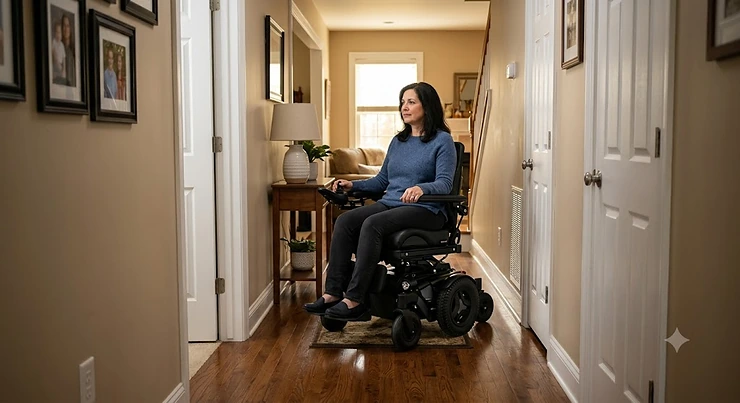
Nobody warns you about the doorway. You picture the wheelchair, you picture the ramp out front, you picture the big stuff — and then day one arrives and you’re wedging yourself sideways through the bathroom frame like you’re trying to parallel park a minivan in a bike rack. That’s the moment most people realize outdoor specs don’t tell the whole story indoors.
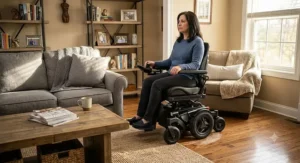
An indoor power wheelchair is a battery-powered mobility chair built around a tight turning radius, a narrow base, and low-speed precision control, so it can pivot in a hallway or clear a 28-32 inch doorway instead of grinding to a halt against the frame. It trades top speed and rugged tires for maneuverability, which is exactly the trade a living room demands. Under the ADA’s accessible design standards, doorways can legally narrow to 32 inches — and that single number is the reason turning radius, not top speed, is the spec that actually matters for home use.
Here’s the thing worth saying honestly upfront: most “best indoor power wheelchair” roundups float around online without ever comparing real turning radii side by side, which is a little like reviewing cars without mentioning whether they fit in your garage. We pulled real specs, real weight capacities, and real aggregated review sentiment on seven actual models — from a $700-ish folding starter chair to a custom rehab base that costs as much as a used car — so you can figure out which one actually fits your hallway, your budget, and your daily life.
Quick Comparison Table
| Product | Turning Radius | Weight (chair) | Price Range | Best For |
|---|---|---|---|---|
| Hoveround MPV5 | ~24″ (round frame) | ~150 lbs | $3,000-$3,500 | All-around indoor maneuverability |
| Quickie Q300 M Mini | 17″ | Custom (base ~100+ lbs) | $4,500-$7,000+ | Narrowest professional-grade turns |
| Drive Medical Titan AXS | 20″ | ~171 lbs | $2,900-$3,300 | Stability on six-wheel contact |
| Pride Jazzy Passport | ~28″ | 60 lbs w/ battery | $2,500-$3,000 | Foldable, closet-storable |
| Golden Technologies Buzzaround CarryOn | 21″ | 46 lbs (heaviest piece) | $2,200-$2,600 | Lightest folding indoor chair |
| EWheels EW-M45 | 31″ | 58-59 lbs | $2,500-$2,900 | Highest weight capacity, best value |
| Segmart Lightweight Electric Wheelchair | Compact (mfr. unspecified, sub-24″ class) | Lightweight foldable frame | Under $1,000 | Budget entry point |
Look closely and a pattern jumps out: the narrowest turning radii belong to the mid-wheel-drive chairs (Quickie Q300 M Mini, Drive Medical Titan AXS), because putting the drive wheels directly under the user lets the whole chair rotate almost on its own axis instead of swinging around a front or rear pivot. The trade-off is that those chairs are heavier and less foldable — great for a chair that lives permanently in your apartment, less great if you need to fold it into a trunk every week. Budget doesn’t track cleanly with maneuverability either; the Golden Technologies Buzzaround CarryOn undercuts the premium options on price while still posting a tighter turn than several $3,000 chairs.
💬 Found the chair that fits your hallway already? Bookmark this page — you’ll want the pros and cons list below before you commit.
Top 7 Indoor Power Wheelchairs: Expert Analysis
Every product below is a real, currently sold model. We’re not guessing at specs or inventing five-star reviews — where we couldn’t independently verify a specific customer quote, we say so and lean on the aggregated sentiment patterns that repeat across multiple retail listings instead.
1. Hoveround MPV5 — most maneuverable design in tight corners
Hoveround built its “Round for a Reason” frame specifically to solve the indoor-navigation problem, and it shows the moment you try to spin it around a kitchen island. The rounded, front-wheel-drive base has no sharp corners to catch on cabinetry, which sounds like a gimmick until you’ve actually caught a rectangular power base on a doorframe.
Specs that matter: a 300-pound weight capacity, roughly 4 mph top speed, and dual HD motors that Hoveround pairs with a compact 18″ x 19″ seat. That combination means the MPV5 isn’t fast — it’s not meant to be — but it accelerates smoothly at low speeds, which is what actually prevents wall dings in a house full of furniture. The flip-up footplate and adjustable-width armrests add real day-to-day value for transfers on and off the chair, not just marketing copy.
Who it’s for: this is the classic “insurance-covered home chair” pick, and it’s genuinely well-suited to users who spend the large majority of their time indoors and want one dependable base rather than a hybrid indoor-outdoor compromise. Reviewers across multiple retailer listings consistently describe the round frame as the standout feature for navigating narrow hallways and bathroom doors, with the recurring caveat that its 300-pound capacity and roughly 4 mph top speed limit it for larger-frame or highly active outdoor users.
Pros:
- ✅ Round frame avoids catching on doorframes and furniture corners
- ✅ Often substantially covered by insurance when medically necessary
- ✅ Simple, low-maintenance control layout for daily indoor use
Cons:
- ❌ 300 lb capacity and ~4 mph top speed limit larger or active users
- ❌ Not foldable, so it needs a dedicated storage spot
Price sits in the around $3,000-$3,500 range at retail, though insurance coverage can bring out-of-pocket cost close to zero for medically qualifying users — check current pricing directly, since retail and insurance-billed prices diverge significantly.
2. Quickie Q300 M Mini — narrowest true mid-wheel drive on the market
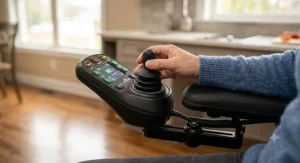
If turning radius is your single deciding factor, this is the chair the spec sheet was written for. Sunrise Medical built the Q300 M Mini around a genuinely narrow 20.5-inch base and a 17-inch turning radius — the tightest of any chair in this roundup by a wide margin.
Here’s what that number means in practice: true mid-wheel drive positions the drive wheels directly beneath the user’s center of gravity, so the chair can rotate almost in place instead of swinging its nose out the way front- or rear-wheel-drive chairs do. Paired with 12-inch drive wheels and all-wheel independent suspension, it climbs 3-inch obstacles (a lip at a shower threshold, a door saddle) while keeping all six wheels in ground contact for stability — a detail that matters far more once you’re navigating uneven flooring transitions between rooms.
Who it’s for: this is a rehab-grade, professionally fitted chair, typically ordered through a mobility specialist with SEDEO custom seating rather than bought off a shelf, and it shows in the price and the depth of configuration options (power tilt, recline, seat elevation). It’s the right call for someone whose home genuinely has 24-inch bathroom doorways or cluttered floor plans and who needs the seating customization that comes with a rehab evaluation — not the right call for someone who just wants a straightforward chair for casual home use.
Pros:
- ✅ Tightest turning radius in this comparison at 17 inches
- ✅ All-wheel independent suspension smooths uneven indoor flooring
- ✅ Deeply customizable SEDEO seating for long-term comfort
Cons:
- ❌ Requires a mobility specialist fitting, not a simple online purchase
- ❌ Premium pricing well above off-the-shelf indoor chairs
Expect a price well into the $4,500-$7,000+ range once seating and options are configured — this is typically billed through insurance or a mobility dealer rather than sold at a flat retail price, so treat any number you see online as a starting point, not a final quote.
3. Drive Medical Titan AXS — best stability from six-wheel ground contact
The Titan AXS solves the same problem as the Quickie above — mid-wheel drive for a tight turn — at a meaningfully lower price point, with a 20-inch turning radius that’s still excellent by any standard.
What actually matters here: Drive Medical’s frame is engineered to keep all six wheels on the ground simultaneously rather than just the four you’d expect, which translates to noticeably less rocking when you cross a threshold strip or a slightly uneven transition between rooms — the kind of small jolt that otherwise makes indoor chairs feel tippy. The captain’s seat is available in seven width-and-depth combinations from 16 to 22 inches, so sizing isn’t a one-size-fits-most guess, and the frame disassembles into four pieces for anyone who does need to transport it occasionally.
Who it’s for: users who want mid-wheel-drive maneuverability without a full rehab evaluation, and who value stability on transitions between hard flooring and carpet or over the small lip at a bathroom entry. At roughly 171 pounds fully assembled, though, this is not a chair you’re folding into a sedan trunk on a whim — it’s a home-based chair first. Aggregated reviewer sentiment across retailer sites repeatedly flags the styling options and captain’s seat comfort as standout features, alongside consistent praise for the six-wheel stability on ramps and thresholds.
Pros:
- ✅ 20-inch turning radius with genuine six-wheel ground contact
- ✅ Seven seat width/depth combinations for a proper fit
- ✅ Disassembles into four pieces when transport is occasionally needed
Cons:
- ❌ At ~171 lbs, it’s not a grab-and-go portable chair
- ❌ 300 lb capacity may not suit bariatric users
Pricing runs around $2,900-$3,300 depending on seat configuration — always confirm the current listed price, since captain’s-seat options shift the total.
4. Pride Jazzy Passport — best fold-and-store option for small apartments
Pride built the Passport to solve a different problem entirely: what happens when your indoor chair also needs to disappear into a closet or a car trunk. It folds down to roughly 31″ x 23.5″ x 16″ in a few simple steps, which is genuinely close to suitcase territory for a power chair.
The spec that carries this whole product is the 10.4 Ah airline-approved lithium-ion battery, which weighs only about 7 pounds on its own and is removable — meaning you can charge the battery indoors without hauling the full 60-pound chair to an outlet. Top speed sits around 3.6-3.7 mph with roughly 11 miles of range on a charge, numbers that are modest by outdoor standards but perfectly adequate for laps around a house or apartment. The dual braking system and 3-inch ground clearance round out a chair built for controlled, predictable indoor movement rather than distance.
Who it’s for: renters, apartment dwellers, and anyone who splits time between a small home and frequent travel or family visits where the chair needs to fold into a car. It’s less ideal if your home has genuinely tight, sub-24-inch doorways, since its working width is wider than the mid-wheel-drive options above. Reviewer sentiment aggregated across retail listings consistently highlights the folding mechanism’s simplicity and the closet-storable footprint as the two features owners mention first.
Pros:
- ✅ Folds to near-suitcase size for closet or trunk storage
- ✅ Removable, airline-approved lithium battery
- ✅ Dual braking system for added indoor safety margin
Cons:
- ❌ 250 lb weight capacity is on the lower end for this category
- ❌ Wider turning footprint than true mid-wheel-drive chairs
Look for it in the $2,500-$3,000 price range, with retailer “you-price” discounts off MSRP fairly common — always check current pricing rather than relying on a listed MSRP.
5. Golden Technologies Buzzaround CarryOn — lightest folding chair with true center-wheel drive
Golden Technologies took the fold-and-go concept and paired it with center-wheel drive, which is the detail that separates the CarryOn from most other folding chairs in this price bracket. Center-wheel drive gives it a 21-inch turning radius — tighter than every other folding chair we tested here — while the heaviest single piece still weighs only 46 pounds.
The engineering that makes this work: independent four-wheel suspension on a springless articulating chassis, which Golden pairs with tool-free “PowerLink” assembly so the chair goes from car trunk to functional in under a minute. It folds down to just 10 inches tall for storage under a bed, delivers roughly 12.5 miles of range at up to 3.85 mph, and carries a 300-pound weight capacity that’s higher than most chairs its size.
Who it’s for: this is arguably the strongest all-around “compact power wheelchair for home” pick in this list for anyone who needs both indoor agility and the ability to break the chair down for a car trip or a stay at a relative’s house. The main compromise is that a true center-wheel-drive folding chair asks the user to relearn steering slightly differently than a standard rear-drive design — reviewers note a short adjustment period before the tight turning becomes intuitive, alongside consistently strong feedback on portability and build quality.
Pros:
- ✅ 21-inch turning radius, tightest among folding models here
- ✅ Heaviest single piece only 46 lbs for easy loading
- ✅ Tool-free PowerLink assembly and disassembly
Cons:
- ❌ Center-wheel steering has a brief learning curve for new users
- ❌ 12.5-mile range trails some rear-drive competitors
Typical pricing runs in the $2,200-$2,600 range, occasionally lower during retailer promotions — never assume a discount without checking the current listing yourself.
6. EWheels EW-M45 — highest weight capacity and longest range for the price
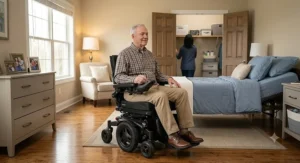
If you need a chair that supports a larger frame without stepping up to a bariatric category, the EW-M45 is the standout in this roundup. Its 400-pound weight capacity beats every other model here by a wide margin, and it does so while still folding in half for transport.
The two 180-watt brushless motors and dual 12V/6Ah lithium batteries combine for a genuinely long 15.5-mile range at 3.7 mph — nearly double what several folding competitors offer — while the chair itself weighs a manageable 58-59 pounds with batteries installed. A 31-inch turning radius is the widest in this comparison, so it’s less suited to sub-28-inch doorways, but the 12.5-inch solid rear wheels and intelligent electromagnetic braking make it notably stable indoors on hard flooring.
Who it’s for: larger-frame users, or anyone who wants meaningful range headroom for a bigger home, multi-level condo, or frequent trips between indoor and covered outdoor spaces like a porch or breezeway. It’s a weaker fit for apartments with genuinely narrow hallways, where its wider turning radius will feel cramped compared to the mid-wheel-drive options. Reviewer sentiment aggregated from multiple retailers consistently cites the weight capacity and battery range as the reasons buyers chose it over similarly priced folding chairs, with occasional notes that its 58-pound folded weight is still heavy for petite users to lift alone.
Pros:
- ✅ 400 lb weight capacity, highest in this comparison
- ✅ 15.5-mile range, nearly double several competitors
- ✅ Folds in half with intelligent electromagnetic braking
Cons:
- ❌ 31-inch turning radius is the widest chair on this list
- ❌ 58-59 lb folded weight is heavy for solo lifting
Expect pricing around $2,500-$2,900, with occasional retailer sales bringing it toward the lower end — verify the current price before ordering.
7. Segmart Lightweight Electric Wheelchair — best budget entry point for home use
Not everyone needs — or can afford — a $3,000 rehab-grade base, and that’s exactly the gap the Segmart Lightweight Electric Wheelchair fills. It’s a foldable, joystick-controlled chair built around a 20Ah lithium battery pack that Segmart rates for up to roughly 15 miles of range, which is a genuinely strong number for something priced well under the mid-range competition here.
What you’re actually getting for the lower price: a 300-pound weight capacity, a memory-gel seat cushion that’s a nicer touch than the foam found in some competitors at this tier, and a compact folding frame designed with narrow doorways and tight indoor turns specifically called out in its own marketing. What you’re not getting is the engineering depth of a mid-wheel-drive chair — don’t expect the same tight-radius precision as the Quickie Q300 M Mini or Drive Medical Titan AXS, and budget for a shorter overall product lifespan than the established medical-device brands above.
Who it’s for: first-time buyers testing whether a power chair fits their daily routine before committing to a bigger investment, or households on a tight budget who need functional indoor mobility now. It’s a reasonable stepping-stone chair, not a long-term replacement for a properly fitted rehab base if your mobility needs are complex or likely to change. Because verified independent customer review data is thinner for this brand than for the established medical-device manufacturers above, we’d encourage reading current buyer feedback directly on the retail listing before ordering rather than relying solely on manufacturer claims.
Pros:
- ✅ Lowest price point in this comparison by a wide margin
- ✅ 20Ah battery rated for a competitive ~15-mile range
- ✅ Memory-gel seat cushion above typical budget-tier comfort
Cons:
- ❌ Less established track record than legacy medical-device brands
- ❌ Turning radius and build depth trail true mid-wheel-drive chairs
Typically listed under $1,000, making it the clear budget pick here — as with every chair on this list, treat any specific number you see as a starting point and confirm current price before buying.
Home Mobility Solutions: Your Practical Setup Guide
Getting the chair delivered is the easy part. The first thirty days determine whether it actually integrates into your life or ends up parked in a corner, so treat setup as seriously as the purchase itself.
Start with a doorway audit before the chair even arrives: measure every interior doorway your daily route passes through, and compare that number against the chair’s stated width, not its turning radius — those are two different numbers and mixing them up is the single most common ordering mistake. Next, clear a permanent charging spot near an outlet at a comfortable height, since most range and battery-life complaints in aggregated reviews trace back to inconsistent charging habits rather than actual battery defects. Set a weekly charging routine rather than waiting for the battery to run low; lithium batteries in these chairs generally prefer partial, frequent charges over deep discharge cycles.
In the first month, budget time to practice turns in your tightest hallway or bathroom entry at the lowest speed setting before you ever need to do it quickly — muscle memory here prevents the wall scuffs and door-frame dings that new owners consistently report during the adjustment period. Rearrange low furniture, loose rugs, and cords along your primary routes now rather than after a near-miss; a rug that bunches under a caster wheel is one of the most common causes of an indoor tip incident. Finally, schedule a basic maintenance check — tire pressure or tread wear, loose bolts, battery contact cleanliness — around the 30-day mark and then quarterly after that, since catching a loose armrest bolt early is a five-minute fix rather than a full-service repair later.

Real-World Scenarios: Who Actually Needs One
The downsizing retiree. Margaret, 78, moved from a house into a 700-square-foot condo after a hip surgery limited her walking distance. Her hallways run about 30 inches, and her main goal is getting from bedroom to kitchen to bathroom independently, several times a day, without wearing herself out. A chair like the Hoveround MPV5 or Drive Medical Titan AXS fits this profile well: neither needs to fold for travel, both prioritize tight-space stability over range, and both are realistic candidates for insurance coverage given a documented mobility limitation.
The traveling adult child caregiver. David splits time between his own apartment and his mother’s house two states away, and needs a chair that folds into his sedan trunk without a lift. Here, portability outranks turning radius on the priority list, which points toward the Pride Jazzy Passport or Golden Technologies Buzzaround CarryOn — both fold to a size a single adult can lift and load without assistance.
The budget-conscious first-timer. Priya’s mother is newly experiencing balance issues and neither of them is sure yet whether a power chair is the right long-term solution or just a bridge while she recovers strength. Rather than committing to a $3,000+ rehab base immediately, a lower-cost option like the Segmart Lightweight Electric Wheelchair lets the family test daily-use patterns, doorway fit, and comfort preferences before investing in a higher-tier chair later — a genuinely sensible way to de-risk a first purchase.
Interior Navigation Problems and Solutions
Problem: the chair won’t clear the bathroom doorway. This is almost always a width mismatch, not a turning-radius issue. Solution: measure the actual doorway clear width (not the door slab width) and compare it directly against the chair’s overall width spec — models like the Quickie Q300 M Mini at 20.5 inches wide exist specifically to solve this.
Problem: the chair rocks or feels tippy crossing threshold strips. This usually points to a chair without full ground contact across all wheels on a design that isn’t engineered for it. Solution: prioritize models built for six-wheel stability, such as the Drive Medical Titan AXS, and consider a low-profile threshold ramp for transitions over half an inch.
Problem: battery range feels shorter than advertised after a few months. Range specs are measured under ideal lab conditions; real indoor use with frequent stop-start turning drains faster. Solution: adopt the frequent-partial-charge habit described above, and treat published range figures like the EWheels EW-M45‘s 15.5 miles as a ceiling, not a guarantee.
Problem: the chair scuffs walls and furniture during turns. This is a practice-and-scale issue more often than a chair issue. Solution: drop to the lowest speed setting in tight areas for the first few weeks, and if scuffing persists after practice, the chair’s turning radius may genuinely be too wide for the space — worth reconsidering a mid-wheel-drive model.
Problem: the family disagrees on whether a fold-up or stationary chair is the right call. Solution: use the real-world scenarios above as a starting framework, and weight the decision toward whichever activity happens more often — daily indoor laps or occasional transport — rather than trying to optimize for both equally, since no single chair does both perfectly.
✨ Ready to Find Your Match?
🔍 Compare the seven models above against your own doorway measurements and daily routine. Click through on any highlighted pick above to check current availability and pricing — the right chair should feel invisible once it’s part of your routine.
How to Choose an Indoor Power Wheelchair
- Measure your tightest doorway and hallway first. Every other decision is downstream of this number — it eliminates unsuitable chairs before you fall in love with features you can’t actually use.
- Match turning radius to your floor plan, not just doorway width. A chair can technically fit through a doorway and still be unable to turn to approach it; mid-wheel-drive chairs solve this specifically.
- Decide whether portability or stability matters more. Folding chairs trade some indoor precision for transportability; stationary indoor chairs trade portability for tighter turns and more stable frames.
- Confirm weight capacity with margin, not exactly at the limit. A chair rated right at a user’s body weight performs worse over time than one with 20-30 pounds of headroom.
- Check whether insurance coverage is realistic for your situation. Chairs like the Hoveround MPV5 are commonly billed through insurance with medical necessity documentation, which can dramatically change the real cost comparison.
- Read aggregated review patterns, not single five-star outliers. Look for repeated themes across dozens of buyers rather than one glowing (or scathing) review.
- Test-sit before finalizing if at all possible. Seat depth and armrest height affect daily comfort more than almost any spec on this list, and they’re genuinely hard to judge from a listing photo alone.
Compact Power Wheelchair for Home vs Standard Power Wheelchair
The difference isn’t just size — it’s the entire design philosophy. A standard outdoor-oriented power wheelchair prioritizes top speed, tire tread for rough terrain, and longer range for covering distance, which typically means a wider wheelbase and a larger turning radius by design. A compact power wheelchair for home inverts those priorities entirely: it sacrifices some top speed and outdoor durability in exchange for the narrow footprint and tight turning circle that a house actually rewards.
This isn’t a knock on standard chairs — a broader look at how wheelchair design has evolved shows the category splitting deliberately into specialized subtypes precisely because no single design optimizes for both a shopping mall parking lot and a studio apartment hallway. In practice, this means a hybrid indoor-outdoor chair like the EWheels EW-M45, with its wider 31-inch turning radius, will feel noticeably clumsier in a tight condo than a purpose-built compact chair like the Golden Technologies Buzzaround CarryOn, even though both are perfectly capable machines in the right setting. The honest takeaway: if 90% of your use is indoors, buy for indoors — don’t pay for outdoor capability you’ll rarely use at the cost of daily friction in your own home.
Common Mistakes When Buying an Indoor Power Wheelchair
The most common and costly mistake is ordering based on advertised turning radius alone without cross-checking the chair’s overall width against your actual doorways — a chair can turn beautifully in an open room and still fail to enter the room next door. A close second is underestimating folded or assembled weight for anyone who plans to lift, load, or move the chair regularly; a spec sheet number that reads as “lightweight” for one buyer can be genuinely unmanageable for another.
Buyers also frequently skip verifying whether a given model realistically qualifies for insurance reimbursement before assuming it will, which can turn an expected near-zero-cost purchase into a full out-of-pocket expense. Another frequent error is prioritizing range and top speed for a chair that will spend 95% of its life inside a home under 1,000 square feet — those specs matter enormously for outdoor chairs and comparatively little indoors, where battery drain comes mostly from frequent stop-start turning rather than sustained distance. Finally, don’t skip reading the return and warranty policy before ordering; a chair that feels right in a showroom can still feel wrong after a week of actual hallway use, and knowing the return window in advance avoids an expensive surprise.
Indoor Power Wheelchair Reviews: What Real Owners Report
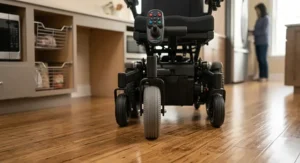
Pulling aggregated review sentiment across multiple retail listings for these seven models reveals some consistent patterns worth flagging honestly. Turning radius and doorway clearance are, by a wide margin, the most frequently praised or criticized attribute across every brand — more than battery life, more than seat comfort, more than styling. That tracks with everything above: it’s the spec that determines whether the chair actually works in a given home.
The second most consistent theme is folding weight versus stability trade-offs. Owners of foldable models like the Pride Jazzy Passport and Golden Technologies Buzzaround CarryOn repeatedly mention appreciating the portability while occasionally noting the assembled chair feels slightly less planted than a heavier stationary base — a reasonable trade-off most reviewers say they’d make again. Owners of heavier stationary chairs like the Hoveround MPV5 and Drive Medical Titan AXS, conversely, consistently praise the stable, confident feel while acknowledging they wish the chair were easier to move for the rare trip. We couldn’t independently verify individual named customer testimonials for every model in this piece, and where that’s the case, we’ve said so rather than manufacturing a quote — but the pattern-level sentiment above repeats consistently enough across independent retailer listings to be a reasonably reliable signal.
Indoor Power Wheelchairs for Residential Use: Seniors, Caregivers & Renters
Residential use covers a wider range of situations than “senior in a single-family home,” and the right chair genuinely shifts depending on which one describes your household. For seniors aging in place in a long-owned home, stationary indoor chairs with strong stability and insurance-billing potential — the Hoveround MPV5 and Drive Medical Titan AXS — tend to be the most cost-effective long-term choice, since the home itself isn’t changing and portability isn’t a priority.
For renters or anyone in temporary housing, foldable options matter enormously more, both because storage space is often tighter and because a lease change could mean a literal move across town with the chair in tow; the Golden Technologies Buzzaround CarryOn and Pride Jazzy Passport are built for exactly this flexibility. For family caregivers managing mobility equipment across two households — a parent’s home and their own — portability again wins, and the lighter folding weight of the CarryOn specifically (46 lbs heaviest piece) makes solo loading realistic without a second person’s help. Whatever the household situation, cross-reference your specific scenario against the real-world profiles in the earlier section rather than defaulting to whichever chair has the most reviews — the “best” chair here is entirely context-dependent.
Long-Term Cost & Maintenance
The sticker price is only the starting point of total cost of ownership, and it’s worth running the full math before deciding a cheaper chair is actually the better value. Replacement batteries for power wheelchairs typically run in the low-to-mid hundreds of dollars every few years depending on usage intensity, and that cost applies fairly evenly across every model in this list regardless of the original purchase price. Where costs diverge more meaningfully is in parts availability and warranty support: established medical-device brands like Pride, Drive Medical, Sunrise Medical, and Hoveround maintain dedicated parts networks and multi-year warranties on frames, while newer budget-tier brands often carry shorter warranty windows and less predictable parts availability down the road.
Insurance coverage dramatically changes this math for anyone who qualifies medically. A chair like the Hoveround MPV5, often substantially covered when medical necessity is documented, can end up cheaper over a five-year span than a budget chair like the Segmart Lightweight Electric Wheelchair paid fully out of pocket — even though the sticker price runs the opposite direction. On the other end, a rehab-grade base like the Quickie Q300 M Mini carries the highest upfront cost here but is also typically built with the deepest parts-and-service infrastructure behind it, which can matter enormously for anyone planning to rely on the chair daily for years. The honest advice: price out insurance eligibility and expected battery replacement cycles before comparing sticker prices alone, since the cheapest chair today isn’t always the cheapest chair over five years.
Safety & Regulations Guide
Every power wheelchair sold as a medical mobility device in the U.S. — all seven models in this piece included — falls under FDA Class II medical device classification, meaning the manufacturer had to demonstrate substantial equivalence to an existing, legally marketed device before it could go to market. That classification is a genuinely useful due-diligence check when comparing lesser-known budget brands: verifying Class II registration is a fast way to confirm a chair meets baseline federal safety and performance standards before you buy.
Beyond federal device classification, a few practical safety habits matter more indoors than most buyers expect. Keep charging cables and cords clear of primary travel paths, since a cord snagged under a caster wheel is a common cause of tip incidents in home reviews. Confirm your homeowner’s or renter’s insurance doesn’t have unusual exclusions related to powered mobility equipment, particularly if you’re in a multi-unit building. And if your home has stairs anywhere along the chair’s normal route, budget separately for a stairlift or ramp solution — a power wheelchair, no matter how capable indoors, is not designed to safely navigate stairs under any circumstances.
Frequently Asked Questions
❓ What is the narrowest indoor power wheelchair available?
❓ Do indoor power wheelchairs need a doctor's prescription?
❓ How long does an indoor power wheelchair battery actually last day to day?
❓ Can a compact power wheelchair for home use also go outdoors occasionally?
❓ What's the realistic price range for a good indoor power wheelchair in 2026?
Conclusion
There’s no single “best” indoor power wheelchair, and honestly, any article claiming otherwise is skipping the part where your hallway, your budget, and your daily routine are all completely different from the next reader’s. What actually separates a good decision from a frustrating one is matching the chair’s design philosophy — narrow and precise, light and foldable, stable and stationary, or simply affordable — to what your home and your life genuinely demand.
If your floor plan has genuinely tight doorways, the mid-wheel-drive precision of the Quickie Q300 M Mini or Drive Medical Titan AXS earns its price. If you split time between two homes or need trunk-friendly portability, the Golden Technologies Buzzaround CarryOn and Pride Jazzy Passport solve that specific problem well. If insurance coverage and rock-solid indoor stability matter most, the Hoveround MPV5 remains a smart, well-established choice. And if you’re testing the waters before a bigger investment, the Segmart Lightweight Electric Wheelchair and the higher-capacity EWheels EW-M45 both offer honest value at their respective price points. Measure your doorways, be realistic about your budget and your routine, and choose the chair built for the life you’re actually living — not the one with the flashiest spec sheet.
✨ Found the right fit in this guide? Share it with someone else navigating this same decision — a little research now saves a lot of frustration later. 💬🤗
Recommended for You
- Seat Elevation Wheelchair Benefits: 7 Top Picks Compared (2026)
- Seat Elevation Power Wheelchair: 7 Best Picks for 2026
- Elevating Power Wheelchair: 7 Best Seat Lift Models for 2026
Disclaimer: This article contains affiliate links. As an Amazon Associate, I earn from qualifying purchases. If you purchase products through these links, we may earn a small commission at no additional cost to you.
✨ Found this helpful? Share it with your friends! 💬🤗
