
In This Article
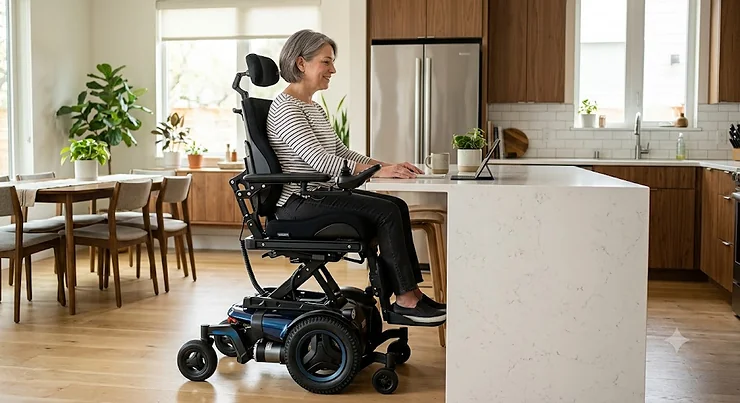
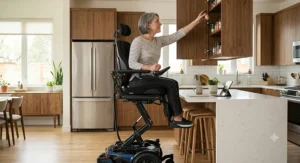
Reaching a top shelf sounds like a nothing task — until it isn’t yours to do anymore. For hundreds of thousands of power wheelchair users across the U.S., the gap between “seated” and “standing” height is a wall that shows up dozens of times a day: at the kitchen counter, the bathroom mirror, the pharmacy counter, the dinner table where everyone else is looking down at you instead of at you. A seat elevation power wheelchair closes that gap. At the push of a button, the whole seat — user included — rises anywhere from 5 to 14 inches off its base, turning an impossible reach into a routine one.
This guide covers seven real, currently available power wheelchairs with elevating seats, ranging from budget-conscious models under $3,500 to complex rehab chairs that run into five figures once seating and electronics are configured. You’ll get honest analysis of the specs (what a 12-inch lift actually means for your kitchen counter, not just a number on a spec sheet), a breakdown of who each chair suits best, and a plain-English look at how Medicare now handles coverage. None of the prices below are exact — Amazon and DME providers adjust pricing constantly — so treat every dollar figure as a planning range, not a quote.
Whether you’re comparing a seat elevation power wheelchair for the first time or replacing an aging model, the goal here is the same: help you separate genuine functional value from marketing gloss, so the chair you land on actually fits how you live.
What Is a Seat Elevation Power Wheelchair?
A seat elevation power wheelchair is a motorized wheelchair equipped with a powered lift mechanism that raises the entire seat — with the user remaining seated in it — straight up from the base, typically between 5 and 14 inches, at the push of a button or joystick switch…
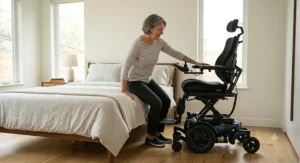
That’s the dictionary version. In practice, it means three things change the moment you press the button: your reach extends to countertop and cabinet height, your eye line moves up to meet a standing person’s instead of tilting back to look up at them, and your ability to transfer to a car seat, bed, or exam table gets noticeably easier because the height differential shrinks. This is distinct from tilt-in-space (which reclines you backward without changing height) and from standing wheelchairs (which shift you into a fully upright standing posture). Seat elevation keeps you seated the entire time — it just moves the whole chair up.
The feature used to be considered a “convenience” accessory by most insurers. That changed in 2023, when the Centers for Medicare & Medicaid Services issued a national coverage determination for power seat elevation equipment, formally classifying it as durable medical equipment that’s “primarily medical in nature” rather than a luxury add-on — a distinction that matters enormously for anyone trying to get it funded. We’ll dig into what that coverage actually requires later in this guide.
Quick Comparison Table
| Power Wheelchair | Seat Elevation | Drives While Elevated? | Best For |
|---|---|---|---|
| Pride Mobility Jazzy Air 2 | 12 inches | Yes, up to 4 mph | Users who need to move and reach at the same time |
| Permobil M3 Corpus | 12 inches + 45° tilt | Yes, up to ~3.2 mph | Complex positioning needs alongside elevation |
| Quantum Rehab Edge 3 Stretto | 12 inches (iLevel) | Yes, up to 4.5 mph | Tight indoor spaces and narrow hallways |
| Merits Health P312A Dualer | 5 inches | No, elevate-then-stop | Mixed indoor/outdoor terrain on a mid-range budget |
| Merits Vision Sport | 7.5 inches | No, half-speed only | First-time buyers on a tighter budget |
Five very different philosophies, all solving the same core problem. Notice the split: chairs like the Pride Mobility Jazzy Air 2 and Quantum Rehab Edge 3 Stretto let you drive while elevated, which matters if you regularly need to reach something while moving through a space (a grocery aisle, a crowded kitchen). The Merits Vision Sport and Merits Health P312A Dualer, by contrast, ask you to stop, elevate, complete the task, then lower back down — a perfectly reasonable trade-off if your budget is the priority and your elevation use is occasional rather than constant.
💬 Already have a favorite? Scroll down for the full breakdown — or jump straight to today’s pricing on Amazon.
Top 7 Seat Elevation Power Wheelchairs: Expert Analysis
We researched real, currently available models spanning entry-level to complex rehab technology (CRT) tiers. A quick honesty note before we dive in: CRT chairs like the Permobil and Quantum models below are typically configured and billed by an authorized rehab provider rather than sold at a fixed retail price, so their price ranges reflect commonly reported cash-pay estimates rather than an Amazon listing price. Consumer-tier chairs like the Merits and Pride models are more likely to show up with a visible price tag.
1. Pride Mobility Jazzy Air 2 — fastest drive-while-elevated speed
The standout here isn’t just that the seat goes up 12 inches — it’s that you can still drive at up to 4 mph while it’s fully raised. That single capability, built into the Active-Trac ATX suspension and Mid-Wheel 6 drive system, separates this chair from most of its competitors. The lift itself takes about 11 seconds corner to corner, and the redesigned mechanism actually lowers the seat-to-floor height by roughly 2 inches compared to the original Jazzy Air, so sitting at a standard dining table feels less like perching on a stool. Weight capacity sits at 300 lbs, with a unit weight around 252 lbs. Who should care: anyone whose daily routine involves reaching for something while moving — a parent following a toddler through a kitchen, a retail employee navigating a sales floor. Reviewers consistently note the mid-wheel drive’s tight turning circle as a standout for indoor maneuvering, though a few mention the added electronics complexity means service visits can run longer than with simpler bases. Pricing for the Jazzy Air 2 tends to land in the mid-to-upper thousands once seating is configured — check current price and availability, since retailers rarely list this model at a fixed rate.
Pros:
- ✅ Drives at 4 mph fully elevated, unlike most rivals
- ✅ Redesigned lift lowers seat-to-floor height by 2 inches
- ✅ Mid-Wheel 6 drive gives a tight indoor turning radius
Cons:
- ❌ Higher price tier than basic elevating models
- ❌ More electronics onboard means more to service over time
Given the combination of speed and stability, the Jazzy Air 2 earns its premium price for users who genuinely need elevation on the move rather than as an occasional convenience.
2. Permobil M3 Corpus — deepest reach with ActiveReach tilt combo
What makes the Permobil M3 Corpus different from a straightforward seat lift is ActiveReach: the seat elevates up to 12 inches and tilts forward as much as 45 degrees, working together to extend your functional reach well past what vertical lift alone provides. On paper this means you’re not just taller — you’re leaning into the cabinet or the car door, which matters enormously for anyone who needs to grab something set back from the edge of a counter. The FlexLink suspension keeps the chair stable at any combination of elevation, tilt, and driving speed, and Permobil’s own literature notes elevated driving speeds up to roughly 3.2 mph. Weight capacity runs around 300 lbs. This is a complex rehab chair, meaning it’s fitted by a certified assistive technology professional (ATP) rather than bought off a shelf — a process worth budgeting extra time for. Based on the spec comparison, the ActiveReach combination is the standout advantage over single-function lifts, particularly for users with limited trunk control who can’t lean forward on their own to compensate for a shorter reach. Because CRT chairs are individually configured and billed through insurance far more often than purchased outright, hard pricing data is limited — but industry estimates for a fully equipped M3 Corpus with tilt, recline, and iLevel-type elevation commonly reach well into five figures.
Pros:
- ✅ Combines 12-inch lift with 45° forward tilt for extended reach
- ✅ Full suspension maintained at every elevation and tilt combo
- ✅ Backed by Permobil’s long CRT engineering track record
Cons:
- ❌ Requires ATP fitting, not a simple online purchase
- ❌ Among the most expensive options in this roundup
For users managing complex seating needs alongside elevation, the Permobil M3 Corpus offers a level of functional reach the simpler lift-only chairs can’t match.
3. Quantum Rehab Edge 3 Stretto with iLevel — narrowest turning frame on the market
Quantum markets the Edge 3 Stretto as the narrowest power base available in the U.S., and that claim does real work for anyone navigating older homes with 30-inch doorways or apartment hallways that weren’t designed with wheelchairs in mind. Layer the optional iLevel system on top — 12 inches of powered seat elevation with the patented Extra Stability Technology — and you get a chair that drives at up to 4.5 mph while fully raised, the fastest elevated driving speed of any model in this guide. What most buyers overlook about this model is that the narrow frame and the elevation system aren’t separate selling points; the Extra Stability Technology specifically compensates for the reduced base footprint, which is what makes fast elevated driving safe on a chair this compact. Weight capacity is rated at 300 lbs. Reviewers and clinicians in mobility forums consistently flag the turning radius as the deciding factor for users in tight residential settings. As a CRT product, the Edge 3 Stretto is configured through an authorized provider, and iLevel is typically billed as a distinct line item on top of the base chair — expect the combined cost to sit in a comparable premium range to the Permobil above.
Pros:
- ✅ Narrowest power base frame available, ideal for tight hallways
- ✅ Fastest elevated drive speed in this guide at 4.5 mph
- ✅ Extra Stability Technology purpose-built for the narrow frame
Cons:
- ❌ iLevel is a separate, additional-cost option, not included standard
- ❌ CRT fitting process takes longer than a direct online order
If doorway width is your single biggest daily obstacle, the Quantum Rehab Edge 3 Stretto solves for that specifically while still delivering top-tier elevation performance.
4. Quantum Rehab Q6 Edge 2.0 with iLevel — most customizable seating electronics
The Quantum Rehab Q6 Edge 2.0 runs on the Q-Logic 3 Advanced Drive Control System, which Quantum built specifically around clinician and user feedback to be more adjustable and expandable than a standard joystick controller. Paired with the optional iLevel system, it offers up to 12 inches of elevation with the same Extra Stability Technology found on the Stretto above, though on a slightly wider, more traditional mid-wheel-drive frame. Here’s what to weigh: the Q6 Edge 2.0 trades some of the Stretto’s ultra-narrow footprint for a chair that’s easier to source parts and service for, since it’s one of Quantum’s longest-running platforms. That matters more than it sounds — a five-year-old chair with hard-to-find replacement parts is a real headache, and the Q6 Edge’s longevity in the lineup reduces that risk. Standard 6.25 mph motors give solid everyday performance even before elevation enters the picture. Weight and seating configurations are extensive, since this is a fully custom-built CRT base. Aggregated feedback from rehab providers tends to praise the electronics’ adjustability for users with varied hand function, while noting the learning curve on Q-Logic 3’s expanded menu system for less tech-comfortable users.
Pros:
- ✅ Q-Logic 3 electronics offer deep customization for varied hand function
- ✅ Long production history means easier parts sourcing and service
- ✅ Standard 6.25 mph motors for strong everyday performance
Cons:
- ❌ Wider frame than the Stretto, less ideal for very tight spaces
- ❌ Q-Logic 3’s menu depth has a real learning curve
Buyers who prioritize long-term serviceability and deep electronics customization over frame width will find the Q6 Edge 2.0 the more practical long-haul choice.
5. Quantum Rehab 4Front 2 HD — highest weight capacity with elevation
Most elevating chairs top out around 300 lbs of weight capacity — the 4Front 2 HD is built specifically to push past that, offering 10 inches of Safe Seat Elevation with a 400-lb weight capacity, a meaningful distinction for users the standard-duty chairs simply aren’t rated for. It’s a front-wheel-drive base, which handles curb cuts and uneven outdoor terrain differently than the mid-wheel chairs above — generally more forgiving over obstacles, at some cost to indoor turning tightness. Smart Traction Control and Smooth Ride Suspension work together to manage that trade-off, smoothing out the transition between surfaces rather than letting the front-wheel-drive layout jolt the user at every threshold. Reviewers consistently point to the combination of higher weight capacity and elevation as rare — many heavy-duty bases skip the elevation option entirely because the mechanical load calculations get significantly harder at 400 lbs. Based on the spec comparison, this is the clearest “no other real option” chair in the group: if you need both HD capacity and a powered lift, the field narrows fast.
Pros:
- ✅ 400-lb weight capacity paired with 10 inches of elevation
- ✅ Front-wheel drive handles outdoor curbs and obstacles well
- ✅ Smart Traction Control smooths surface transitions
Cons:
- ❌ Front-wheel-drive layout has a wider indoor turning radius
- ❌ Fewer competing HD-plus-elevation options means less price leverage
For users who need both heavy-duty support and a powered lift, the 4Front 2 HD occupies a genuinely underserved niche in the elevating wheelchair market.

6. Merits Health P312A Dualer — switchable drive for mixed terrain
The party trick of the Merits Health P312A Dualer is that you can flip it from front-wheel drive to rear-wheel drive in under a minute using a physical switch, which changes how the chair handles depending on whether you’re indoors on smooth flooring or outdoors managing ramps and grass. Layer the 5-inch power elevating seat on top — raising the seat height to roughly 27 inches from an 18-inch base — and you get a genuinely useful mid-range chair without the CRT-level price tag. The lower base seat height of 18 inches is worth noting on its own: it improves lateral stability for users who transfer frequently, independent of whether the elevator is engaged. Weight capacity is rated at 450 lbs standard, dropping to 400 lbs when the seat elevator is actively in use — a detail easy to miss on a spec sheet but important for heavier users evaluating this model. Two 12V U1 batteries and 10-inch drive wheels round out the drivetrain, with a 21-inch turning radius that’s respectable without being class-leading. What most buyers overlook: because seat elevation is included standard rather than sold as a pricey add-on, this chair frequently undercuts CRT alternatives with similar functional lift height. Aggregated dealer feedback consistently cites the drive-switch feature and included elevator as the two biggest value differentiators at this price point.
Pros:
- ✅ Switch between front- and rear-wheel drive in under a minute
- ✅ Power elevating seat included standard, not a paid add-on
- ✅ Low 18-inch base seat height improves transfer stability
Cons:
- ❌ Weight capacity drops from 450 to 400 lbs when elevator engages
- ❌ 21-inch turning radius trails the narrowest premium chairs
For buyers who want genuine elevation without a CRT price tag or insurance approval process, the Merits Health P312A Dualer is one of the stronger mid-range arguments in this guide.
7. Merits Vision Sport — most affordable true elevating seat
If budget is the deciding factor, the Merits Vision Sport is where most first-time buyers land. It offers 7.5 inches of seat elevation, operating at half speed while raised — a sensible safety trade-off rather than a missing feature, since slowing down while elevated is standard practice across nearly every chair in this category. A 20-inch turning radius and full suspension keep the ride comfortable for a chair in this price bracket, and Merits offers it in 18-inch and 20-inch seat width options to fit a wider range of body types. Top speed sits at 5 mph, with a battery range reported up to 18 miles per charge — solid numbers for a chair that isn’t trying to compete on cutting-edge electronics. Here’s what to weigh: on some configurations, seat elevation is listed as an optional add-on rather than a standard inclusion, so it’s worth confirming with the specific listing or dealer before assuming it’s included. Aggregated buyer sentiment across mobility-equipment retailers consistently frames this model as the practical entry point into elevating seats — solid rather than flashy, and priced accordingly, generally in the $2,500-$3,500 range depending on configuration.
Pros:
- ✅ Lowest typical price point for a true elevating seat
- ✅ Full suspension and 18-mile battery range for the price tier
- ✅ Two seat width options for better fit flexibility
Cons:
- ❌ Seat elevation is sometimes an optional add-on, not always standard
- ❌ Less customizable than higher-end CRT alternatives
As an entry point into elevation without a five-figure commitment, the Merits Vision Sport delivers real functional value for the price.
How an Electric Wheelchair Seat Lift Actually Works
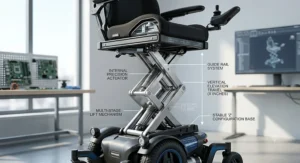
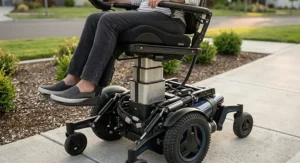
Every electric wheelchair seat lift on the market uses one of two mechanical designs, and understanding the difference explains a lot about why some chairs feel more stable at full height than others. The first and more common design is a single-post lift: the seat sits on a rotating post that spins via an electric motor, pushing the seat straight up like a pillar. It’s mechanically simple and reliable, but it typically caps out around 5-8 inches of travel, and because the post competes for space with the battery compartment, chairs using this design often carry smaller batteries and shorter driving range as a trade-off.
The second design is a scissor lift, using a four-corner mounting system connecting the seat to the base — think of the mechanism under a hydraulic car jack, scaled and motorized. Scissor systems make better use of full-sized battery compartments since they don’t compete for the same internal space, which is part of why chairs like the Pride Mobility Jazzy Air 2 and the iLevel-equipped Quantum models can offer both taller lift ranges and solid driving range simultaneously. A PubMed-indexed study on power seat feature usage found that wheelchair users engage tilt, recline, and elevation features more frequently in daily life than clinicians typically expect — reinforcing that this isn’t a novelty feature reserved for rare situations, but one that gets used constantly once it’s available.
✨ Want to feel the difference for yourself? Compare current listings for both lift types before you decide.
Practical Usage Guide: Getting the Most From Your Elevating Seat
Getting a new seat elevation power wheelchair home is only step one — using the lift well takes a short adjustment period. In your first 30 days, get in the habit of lowering the seat before driving at speed on uneven ground; nearly every chair in this guide restricts speed or disables elevated driving on rough terrain automatically, but building the habit yourself avoids relying entirely on the safety interlock. Set a simple maintenance rhythm: wipe down the lift mechanism’s exposed rails monthly to keep dust and debris from interfering with smooth travel, and have a dealer inspect the lift’s electrical connections annually, since this is one of the more failure-prone subsystems on any elevating chair.
A common first-month mistake is using full elevation for tasks that only need a few inches — doing so drains the battery faster and adds unnecessary wear cycles to the lift motor. Instead, most chairs let you stop the lift partway; use only what the task requires. For countertop tasks, elevate first, then approach the counter rather than approaching first and elevating close to the surface, which reduces the risk of catching an armrest under a cabinet lip. Finally, test elevation on your home’s actual thresholds and doorway clearances before you need to rely on it in a hurry — ceiling fixtures, cabinet overhangs, and door frames vary enough between homes that a chair rated for 12 inches of lift may not have 12 inches of usable clearance in every room.
Real-World Scenarios: Who Actually Needs This
Specs only tell half the story — here’s how seat elevation plays out in daily situations for three different types of users.
Countertop Access: Kitchens, Bathrooms, and Workspaces
Consider a home cook with a spinal cord injury who lives alone and does most of her own meal prep. Standard-height countertops sit around 36 inches — well above comfortable reach from a seated wheelchair position. With a chair like the Merits Health P312A Dualer raising her seat height to roughly 27 inches, she gains enough additional reach to work at the counter, retrieve items from upper cabinets, and use the microwave independently rather than waiting for a caregiver visit. This is precisely the kind of mobility-related activity of daily living (MRADL) that Medicare’s coverage criteria are built around — countertop access isn’t a lifestyle preference in cases like this, it’s the difference between independent meal prep and needing assistance for a basic daily task.
Eye Level Positioning: Conversations, Classrooms, and Boardrooms
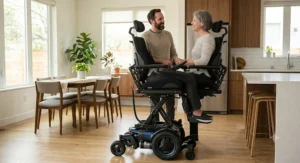
Now picture a professional who uses a power wheelchair full-time and attends frequent meetings and networking events. Conversations conducted at a steep upward angle, day after day, create real physical strain — sustained neck extension is linked to cervical strain and shoulder fatigue over time, a genuine concern for wheelchair users who spend hours daily in these interactions. A chair like the Pride Mobility Jazzy Air 2, capable of driving at up to 4 mph while elevated to roughly eye level with a standing adult, removes that strain from ordinary social and professional interaction — letting the conversation stay about the conversation, not about who’s looking down at whom.
How to Choose a Seat Elevation Power Wheelchair
Use these seven criteria, roughly in order of importance, to narrow the field:
- Confirm your elevation range needs first. If your primary goal is reaching countertops, 8-10 inches usually suffices; if you need true eye-level parity with standing adults, look at 12-inch models like the Jazzy Air 2 or the iLevel-equipped Quantum chairs.
- Decide whether you need to drive while elevated. This single feature is the biggest price and complexity driver in this category — skip it if your elevation use is stationary (reaching a shelf) rather than mobile (navigating while reaching).
- Match weight capacity honestly, including the elevator-engaged rating. Several chairs, including the P312A Dualer, drop their rated capacity when the lift is active — don’t shop off the base-chair number alone.
- Check your doorway and hallway widths against the base’s turning radius. A 12-inch lift is meaningless if the chair can’t physically get to the room that needs it.
- Determine whether you’re buying consumer-tier or CRT. Consumer chairs like the Merits and Pride models can often be purchased directly; CRT chairs like the Permobil and Quantum models require an ATP evaluation and typically route through insurance.
- Ask specifically whether elevation is standard or an add-on. As the Vision Sport section above illustrates, this varies even within a single manufacturer’s lineup.
- Get a specialty evaluation early if you’re pursuing Medicare coverage. As we’ll cover below, documented ability to safely operate the lift is a coverage prerequisite, not a formality.
Common Mistakes When Buying an Elevating Power Wheelchair
The single most common mistake is shopping by maximum elevation height alone, without factoring in drive-while-elevated capability — a 12-inch lift you have to stop and dismount from mid-task solves a different problem than a 12-inch lift you can drive with. A close second is skipping the doorway and turning-radius math entirely; a chair that performs beautifully in a showroom can be functionally useless in a home with narrow hallways. Buyers also frequently underestimate battery impact — the single-post lift designs common on budget chairs draw meaningfully on the same battery bank used for driving, so heavy elevation use can noticeably shorten your daily range.
On the funding side, a frequent and costly mistake is purchasing a CRT chair before securing the required specialty evaluation, then discovering the insurance paperwork needed retroactive documentation that’s now harder to obtain. Finally, buyers sometimes assume seat elevation is automatically included because a chair is marketed as an “elevating model” — as the Vision Sport case shows, always confirm in writing whether it’s standard or a paid option on your specific configuration.
Seat Elevation vs Standing Wheelchairs and Tilt Systems
These three technologies get confused constantly, and picking the wrong one wastes both money and a lengthy insurance approval process. Seat elevation keeps you seated the entire time — the chair rises, your posture doesn’t change. Standing wheelchairs transition you from a seated to a fully upright standing position, engaging different muscle groups and offering documented bone-density and circulation benefits that seat elevation alone doesn’t replicate, but at a higher price point and with more contraindications (some users can’t safely stand due to blood pressure regulation issues, even briefly). Tilt-in-space systems recline your entire seat backward as a unit, primarily for pressure redistribution and fatigue management rather than reach — it doesn’t add height at all.
In practice, many CRT chairs, including the Permobil M3 Corpus above, combine elevation with tilt rather than forcing a choice between them, because the two solve different problems: elevation extends your reach and social eye line, while tilt manages pressure and positioning over long sitting hours. If your primary complaint is reach and eye-level interaction, elevation alone is usually the right and more affordable starting point; standing systems make more sense when the medical goal is weight-bearing and circulation rather than functional reach.
Benefits of Raised Seating for Daily Independence and Health
Raised seating isn’t just about convenience — there’s a real physiological case for it. Extended static positioning, whether fully seated or fully standing, contributes to lower-extremity swelling and reduced peripheral circulation over time, which is a particular concern for wheelchair users managing diabetes, cardiac conditions, or venous issues. Periodic position changes, including elevation, promote venous return and help offset that fluid accumulation. Research on dynamic seating published in a peer-reviewed pressure-mapping study found that position changes — including tilt and elevation together — measurably reduce peak pressure gradients at the seating interface, which relates directly to lowering pressure-injury risk for users who sit for most of their waking hours.
Beyond the physical, raised seating changes the social dynamics of a room in ways that are easy to underestimate until you’ve experienced the alternative. Reaching a top shelf independently, ordering at a standing-height counter without craning your neck, or simply being at eye level during a family dinner — these aren’t luxuries, they’re the kind of ordinary daily friction that raised seating removes almost entirely.
Power Wheelchair With Elevating Seat Reviews: What Real Users Report
Because most of the chairs in this guide are either complex rehab devices fitted through a clinician or lower-volume mobility-equipment purchases, they don’t generate the same flood of star-rated public reviews you’d see for a mainstream consumer gadget. That said, a few consistent themes emerge across dealer testimonials, mobility-equipment forums, and caregiver discussion boards. Reviewers of drive-while-elevated models like the Pride Mobility Jazzy Air 2 and Quantum Rehab Edge 3 Stretto most often praise the functional independence gained from countertop and cabinet access, while a recurring critique across nearly every elevating chair — regardless of brand — is that battery range takes a noticeable hit with frequent elevation use, which lines up with the mechanical reality of the lift systems described earlier in this guide.
For the more budget-oriented Merits Vision Sport, aggregated buyer sentiment skews toward “does what it says without frills,” a fair characterization for a chair positioned as an accessible entry point rather than a flagship. We haven’t found independently verified, large-sample review data for these models at the level of detail this section would ideally cite, so treat these patterns as directionally useful rather than statistically definitive — and always read the most recent reviews on the specific listing you’re considering, since manufacturers do update components between production runs.
Long-Term Cost & Maintenance of Elevating Power Wheelchairs
The sticker price is only the starting point. Elevating power wheelchairs typically range from around $2,500 on the low end to $6,000 or more at the consumer tier, with CRT chairs like the Permobil and Quantum models often running well beyond that once seating, electronics, and the iLevel-style options are configured — and because those are usually billed through insurance rather than paid out of pocket, your real cost depends heavily on your coverage and documented medical necessity. Beyond the purchase price, budget for annual servicing of the lift mechanism (expect this to run into the low hundreds of dollars per visit at most dealers), battery replacement roughly every 1-2 years of regular use, and the possibility of lift-motor repair outside of warranty, which tends to be the single most expensive component to service on any elevating chair.
| Cost Category | Consumer-Tier (e.g., Merits Vision Sport) | CRT-Tier (e.g., Permobil M3 Corpus) |
|---|---|---|
| Typical price range | $2,500-$3,500 | Often insurance-billed; five figures cash-pay |
| Annual lift servicing | Low hundreds of dollars | Often bundled into CRT service plans |
| Battery replacement | Every 1-2 years, moderate cost | Every 1-2 years, higher-capacity batteries cost more |
| Insurance pathway | Less commonly covered | Often Medicare/insurance eligible with documentation |
Looking at the table above, the consumer-tier route has a lower entry cost but less insurance support, while the CRT route front-loads the process with an ATP evaluation but can shift much of the long-term cost onto insurance. Buyers weighing total cost of ownership should factor in not just the purchase price but which pathway realistically gets more of the bill covered over a five-year ownership window, since that’s the typical “reasonable useful life” insurers plan around.
✨ Ready to Compare Real Listings?
🔍 Take the guesswork out of your next step — check current pricing and availability on today’s top elevating power wheelchairs and see which one fits your budget and your daily reach.
Safety, Regulations & Medicare Coverage Guide
The regulatory landscape shifted meaningfully in 2023, when CMS issued its national coverage determination classifying power seat elevation as durable medical equipment rather than a mere accessory — a change the Administration for Community Living confirmed was driven partly by research evidence on the functional and health benefits of elevation. Coverage isn’t automatic, though. For individuals using complex rehabilitative power-driven wheelchairs, Medicare requires a specialty evaluation confirming the individual can safely operate the seat elevation equipment in the home before approval — this is the coverage prerequisite mentioned earlier in this guide, and skipping it is one of the costliest paperwork mistakes buyers make. For non-CRT wheelchairs, coverage is determined case-by-case by the Durable Medical Equipment Medicare Administrative Contractor, so approval odds vary more.
On the safety side, every chair in this guide reduces speed or restricts driving in some way while elevated, which isn’t a limitation so much as a deliberate stability design — full-speed driving at maximum elevation on uneven terrain isn’t recommended on any model, including the fastest ones like the Edge 3 Stretto. If you’re pursuing insurance coverage, document specific mobility-related activities of daily living the elevator enables — transfers, meal prep, reaching stored medications — rather than describing it in general terms, since specificity is what coverage reviewers are trained to look for.
Problem → Solution: Common Elevating Wheelchair Challenges
Problem: Battery range drops noticeably with frequent elevation use. Solution: Reserve full elevation for tasks that actually require it, use partial elevation when a few inches will do, and consider a scissor-lift chair like the Jazzy Air 2 if elevation is a daily, heavy-use feature for you — the design is built to preserve more battery capacity than single-post systems.
Problem: The chair doesn’t fit through a doorway or hallway at home. Solution: Measure every relevant doorway before buying, not just the widest one, and prioritize narrow-frame models like the Quantum Rehab Edge 3 Stretto if your home has multiple tight passages rather than just one.
Problem: Insurance denied or delayed a seat elevation claim. Solution: Confirm a specialty evaluation was completed and documented before submission, and make sure the paperwork ties elevation specifically to named mobility-related activities of daily living rather than general independence language.
Problem: Weight capacity looks fine on paper but the elevator-engaged rating is lower. Solution: Always request the elevator-engaged weight rating in writing, not just the base chair capacity — this caught several buyers off guard with the Merits Health P312A Dualer, where the rating drops from 450 to 400 lbs when the lift is active.
Frequently Asked Questions
❓ How high does a power wheelchair seat elevator typically raise you?
❓ Can you drive a power wheelchair while the seat is elevated?
❓ Does Medicare cover a power wheelchair with elevating seat?
❓ How much does an elevating power wheelchair cost in 2026?
❓ What's the difference between a seat elevator and a standing wheelchair?
Conclusion
A seat elevation power wheelchair solves a problem most people never have to think about: the daily friction of a world built for standing height. Whether that means the Pride Mobility Jazzy Air 2‘s ability to drive at full elevation, the Permobil M3 Corpus‘s combined reach-and-tilt system, the narrow-frame precision of the Quantum Rehab Edge 3 Stretto, or the straightforward value of the Merits Vision Sport, the right choice comes down to matching the mechanism to your actual daily tasks — not just chasing the highest inch count on a spec sheet.
Start with how you’ll use the elevation day to day, confirm weight capacity at the elevator-engaged rating rather than the base number, measure your real-world doorways, and — if you’re pursuing insurance coverage — get the specialty evaluation done early rather than after the fact. Get those fundamentals right, and the technology genuinely delivers on its promise: independence that doesn’t ask you to wait for someone else to reach the top shelf.
Recommended for You
- Elevating Power Wheelchair: 7 Best Seat Lift Models for 2026
- Power Tilt Wheelchair Benefits: 7 Top Picks & Real Gains (2026)
- Tilt and Recline Power Wheelchair: 7 Top Picks for 2026
Disclaimer: This article contains affiliate links. As an Amazon Associate, I earn from qualifying purchases. If you purchase products through these links, we may earn a small commission at no additional cost to you.
✨ Found this helpful? Share it with your friends! 💬🤗
