
In This Article
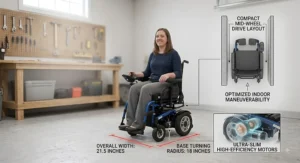
Doorways don’t care that you’re in a hurry. Neither do kitchen islands, bathroom vanities, or that narrow hallway your landlord swears is “standard width.” If you’ve ever three-point-turned a power chair like you were parallel parking a delivery van, you already know why turning radius matters more than almost any other spec on the sheet. A power wheelchair for tight spaces is a battery-powered mobility chair engineered around a small footprint and a short turning radius — usually somewhere between 19 and 33 inches — so it can pivot in hallways, clear 28-32 inch doorframes, and rotate inside a bathroom without a three-point maneuver. That’s the whole ballgame in one sentence, but the details of getting there are where most buyers get tripped up.
This guide exists because “compact” gets slapped on marketing copy for chairs that are anything but. We dug into real specification sheets, cross-referenced turning radii across brands, and pulled in aggregated review sentiment where it’s genuinely verifiable — not invented five-star quotes designed to nudge you toward checkout. What most shoppers overlook is that turning radius and overall width tell two different stories: one is about spinning in place, the other is about squeezing through. You need both numbers before you buy, and we’ll walk through exactly how to read them.
Below, you’ll find seven real power chairs spanning budget, mid-range, and premium tiers, each broken down by specs, honest analysis, and aggregated review sentiment. According to a qualitative study on power wheelchair driving challenges published in Disability and Rehabilitation: Assistive Technology, users consistently cite environmental context — doorways, thresholds, tight turns — as the single biggest source of daily friction, even more than the mechanics of the chair itself. That’s exactly why we built this guide around real-world space constraints instead of just top speed and range.
Quick Comparison Table
| Chair | Turning Radius | Weight Capacity | Best For |
|---|---|---|---|
| Merits P321 EZ-GO | 23″ | 250-300 lbs | Tightest budget |
| SuperHandy GoRide 2 Plus | ~20″ (zero-turn) | 300-330 lbs | Best value zero-turn |
| Golden Technologies Cricket | 22″ | 300 lbs | Lightest carbon-fiber build |
| SuperHandy GoRide CRX | 19.5″ | ~300 lbs | Tightest radius overall |
| Pride Go-Chair | 25.4″-25.5″ | 300 lbs | Trusted mid-range all-rounder |
| Pride Jazzy Elite ES | 24.75″ | 300 lbs | All-day indoor comfort |
| Forcemech Navigator Pro | 33″ | 397 lbs | Indoor-outdoor hybrid, higher capacity |
A quick read of that table tells a story most spec sheets bury: the tightest turning radii cluster around the lightweight, lower-capacity chairs, while the wider-radius Forcemech Navigator Pro trades some indoor nimbleness for nearly 100 extra pounds of weight capacity and true outdoor range. If your home has 28-inch doorframes and 90-degree hallway turns, the SuperHandy GoRide CRX and Golden Technologies Cricket deserve your first look. If you need higher weight capacity and don’t mind a slightly wider swing, the Forcemech Navigator Pro still clears most residential doorways with room to spare.
💬 Found the chair that fits your hallway? Scroll down for the full breakdown — every pro, con, and price range you need before you buy.😊
Top 7 Power Wheelchairs for Tight Spaces: Expert Analysis
1. Merits P321 EZ-GO — tightest turning radius on a budget frame
The Merits P321 EZ-GO proves you don’t need a four-figure premium chair to get genuinely tight maneuverability. Its 23-inch turning radius comes courtesy of a compact steel frame that breaks down into three pieces, with the heaviest section landing well under 40 pounds. The dual 12V batteries deliver up to 9-12 miles of range (depending on the EZ-GO versus EZ-GO Deluxe variant) at a top speed of 4 mph, and the 250-300 lb weight capacity covers most adult users without pushing into bariatric territory. Based on the spec comparison, this chair sacrifices some ground clearance (as low as 1.8 inches) for its low seat height and narrow overall width — a fair trade if your home is flat and carpeted rather than gravel-driveway rugged.
Reviewers consistently note that the modular disassembly is the standout feature: it fits in a sedan trunk without a ramp or lift, which matters if you’re splitting time between an apartment and a car. What most buyers overlook is that “lightweight” doesn’t always mean “easy to carry” — even the lightest single piece here still requires two hands and a bit of core strength. This chair suits budget-conscious buyers and anyone prioritizing trunk-friendly portability over long-range outdoor use.
Pros:
- ✅ 23″ turning radius rivals chairs twice the price
- ✅ Breaks into 3 lightweight pieces for car transport
- ✅ Strong steel frame with a lifetime frame warranty
Cons:
- ❌ Low 1.8″ ground clearance struggles with thresholds
- ❌ 250 lb base capacity is lower than most competitors
Expect this chair to typically land in the $1,400-$1,900 range depending on retailer and battery configuration. For the price, the Merits P321 EZ-GO delivers a legitimately tight turning radius without the carbon-fiber markup — solid value if your space is small and your budget is tighter still.
2. SuperHandy GoRide 2 Plus — best value zero-turn for small apartments
The SuperHandy GoRide 2 Plus leans into zero-turn geometry powered by dual brushless motors, which in practice means it pivots almost in place rather than needing a wide arc to reorient. At 42 pounds without the battery and a 300 lb weight capacity (some listings cite up to 330 lbs), it splits the difference between ultralight travel chairs and sturdier daily-use models. The aluminum frame folds in a single motion, and the electromagnetic braking system provides confident stops on hardwood or tile — surfaces where cheaper mechanical brakes can feel grabby or delayed.
Here’s what to weigh: the standard battery pack tops out around 3.5-4 miles per charge, which is genuinely short next to competitors offering 9-plus miles. That’s a real trade-off, not a footnote — if you’re circling a large apartment complex or heading out for errands, you’ll want the swappable backup battery SuperHandy sells separately, or a different chair entirely. Reviewers who use this indoors report the zero-turn joystick control as the standout, particularly for right- or left-handed users since the mount can flip sides. This is a strong pick for someone who mostly navigates within a single-floor apartment and values quick pivots over long range.
Pros:
- ✅ True zero-turn joystick steering, ambidextrous mount
- ✅ Folds in one step, fits most car trunks
- ✅ Electromagnetic brakes stop cleanly on hard flooring
Cons:
- ❌ Stock battery range is short (roughly 3.5-4 miles)
- ❌ Not airline-approved on the base model
Pricing typically runs in the $1,000-$1,600 range, with bundled cushion packages pushing closer to $1,800. Given that range, the SuperHandy GoRide 2 Plus is arguably the best entry point for apartment-bound buyers who don’t need to go the distance.
3. Golden Technologies Cricket — lightest carbon-fiber build for the tightest turns
Carbon fiber shows up in bike frames and race cars for a reason, and the Golden Technologies Cricket borrows that same logic. At roughly 33 pounds without the battery (about 39 pounds fully loaded), it’s genuinely one of the lightest folding power chairs on the market, and its 22-inch turning radius puts it near the top of the tight-space rankings. The 24V lithium-ion battery is airline-approved, which matters if travel is part of your calculus, and offboard charging means you’re not tethered to wherever the chair happens to be parked.
On paper, this means a chair that folds down to roughly 30 by 22 by 14 inches and can stand on end for closet storage — genuinely useful in a studio apartment where every square foot counts. Reviewers consistently praise the fold-and-stand design and the 300 lb weight capacity, which is generous for something this light. The trade-off, and it’s a real one, is range: about 9.3 miles per charge, which is on the shorter end for all-day outdoor use. This chair is built for someone who spends most of their time indoors or close to home and occasionally travels, not someone covering long outdoor distances daily.
Pros:
- ✅ 22″ turning radius in a sub-40-lb carbon-fiber frame
- ✅ Airline and cruise-approved lithium battery
- ✅ Folds and stands on end for compact storage
Cons:
- ❌ 9.3-mile range is modest for heavy daily outdoor use
- ❌ Premium carbon-fiber construction carries a higher price tag
At the time of research, the Golden Technologies Cricket is typically listed in the $2,700-$3,000 range. It’s not the cheapest chair here, but if raw portability and a tight turning radius top your list, the price buys genuine engineering, not just marketing gloss.
4. SuperHandy GoRide CRX — the tightest turning radius in this lineup
If a single number matters most to you, it’s this one: the SuperHandy GoRide CRX posts a 19.5-inch turning radius, the tightest of any chair in this guide, thanks to a mid-wheel-drive layout that centers the pivot point under the seat rather than at the front or rear axle. Mid-wheel drive is the same design logic used in higher-end rehab chairs, and it shows up here in a more affordable package. Like its GoRide siblings, it uses dual brushless motors and an electromagnetic brake system, and the foldable aluminum frame keeps overall weight manageable for loading into a car.
What the spec sheet won’t tell you, but the underlying engineering suggests, is that mid-wheel-drive chairs tend to feel more stable rotating in place than front- or rear-wheel-drive designs, since the center of mass stays closer to the pivot point — useful in a cramped bathroom where you genuinely cannot afford to clip a doorframe. Because this is a newer addition to the GoRide lineup, independently verified customer review volume is still thinner than on the flagship GoRide 2, so treat early buyer feedback as directional rather than definitive until more reviews accumulate. This chair is best suited to someone whose single biggest pain point is rotating in genuinely cramped rooms — bathrooms, galley kitchens, closets — rather than covering distance.
Pros:
- ✅ 19.5″ turning radius, the tightest in this guide
- ✅ Mid-wheel drive improves in-place rotation stability
- ✅ Foldable frame keeps transport manageable
Cons:
- ❌ Limited independently verified review history so far
- ❌ Detailed range and capacity specs vary by retailer listing
Expect pricing in a similar $1,000-$1,700 range to its GoRide siblings, though you should always check current price and exact specs before buying, since configuration details shift between listings. For pure tight-space rotation, this is the chair to beat.
5. Pride Go-Chair — the trusted mid-range all-rounder
Pride Mobility has been building power chairs long enough that the Pride Go-Chair shows up on nearly every “best travel power chair” list, and the 25.4-25.5 inch turning radius is a big reason why. The chair breaks down into four to six pieces depending on configuration, with the heaviest single piece weighing just 36 pounds — genuinely liftable without a ramp for most users. Dual 18AH batteries push the range to 8.7-13.2 miles depending on rider weight and terrain, and the 300 lb weight capacity covers the vast majority of adult users comfortably.
Based on the spec comparison against lighter competitors, the Go-Chair sits in a sweet spot: not as ultralight as the Golden Technologies Cricket, but sturdier and backed by a much longer track record and dealer network. Reviewers consistently point to the one-year in-home service contract and nationwide Pride dealer network as reasons to pay a bit more here versus a direct-to-consumer brand — when something breaks, you’re not shipping a 128-pound chair back to a warehouse. This chair suits buyers who want proven reliability and easy in-home service more than they want the absolute lightest frame on the market.
Pros:
- ✅ 25.4″ turning radius with feather-touch disassembly
- ✅ Heaviest piece is only 36 lbs, no ramp required
- ✅ Backed by a wide Pride dealer and service network
Cons:
- ❌ Heavier overall (about 128 lbs) than ultralight rivals
- ❌ Turning radius is slightly wider than the tightest models here
At the time of research, the Pride Go-Chair typically runs in the $1,800-$2,600 range depending on seat size and dealer. For buyers who want a name-brand chair with real service infrastructure behind it, that premium over budget alternatives is often worth paying.
6. Pride Jazzy Elite ES — best all-day comfort for full-time indoor use
Not every tight-space chair needs to be an ultralight travel model, and the Pride Jazzy Elite ES makes the case for a sturdier, full-size alternative. Its in-line front-wheel-drive layout produces a 24.75-inch turning radius — tighter than you’d expect from a chair this substantial — while 9-inch solid front tires absorb bumps and threshold transitions that would jolt a lighter frame. The depth-adjustable, limited-recline high-back seat with headrest is built for people who live in their chair for most of the day, not just short indoor errands, and the 300 lb weight capacity plus 13.5-15 mile range gives it real staying power.
Here’s what to weigh: at roughly 162 pounds total, this is not a chair you’re folding into a sedan trunk on a whim. It’s a full-size indoor power chair that happens to turn tighter than its footprint suggests, thanks to the front-wheel-drive geometry rather than any folding or ultralight design. What most buyers overlook is that front-wheel drive tends to climb thresholds and low-pile carpet transitions more smoothly than rear-wheel-drive chairs of similar size, since the drive wheels lead into the obstacle rather than trailing behind the pivot point. This chair is built for someone using it as their primary daily-living chair inside an apartment or house, not for someone who needs to disassemble it for travel.
Pros:
- ✅ 24.75″ turning radius despite full-size build
- ✅ High-back, depth-adjustable seat for all-day comfort
- ✅ Large front wheels smooth out thresholds and bumps
Cons:
- ❌ At roughly 162 lbs, not practical for car-trunk transport
- ❌ Higher price point than folding travel-style chairs
Selling prices typically land in the $3,600-$4,000 range, with manufacturer list pricing shown as high as $5,500 before discounts. If daily comfort matters more than portability, the Pride Jazzy Elite ES earns its premium price with genuinely tight indoor handling in a full-size frame.
7. Forcemech Navigator Pro — best hybrid for indoor tight spaces and outdoor range
The Forcemech Navigator Pro is the outlier in this lineup by design: a 33-inch turning radius that’s noticeably wider than the other six chairs, paired with a 397 lb weight capacity and up to 18 miles of range on dual lithium batteries. Based on the spec comparison, that wider turning radius is the direct trade-off for a bigger, more stable frame — one built to handle grass, gravel, and 12-degree inclines that would stall a lightweight travel chair. The folding frame still collapses to a manageable footprint for car transport at around 60 pounds fully assembled.
What the spec sheet won’t tell you, but the engineering choices suggest, is that this chair is aimed less at someone squeezing through a 28-inch bathroom doorway and more at someone who needs a single chair that handles both a compact apartment hallway and a genuinely uneven backyard or sidewalk. Reviewers consistently cite the higher weight capacity and dual-battery range as the reasons they chose this over lighter, tighter-turning alternatives — a legitimate trade for users who need both indoor access and real outdoor mileage. If your doorways run standard 32-inch ADA width or wider, this chair’s radius won’t be a dealbreaker; if you’re dealing with sub-28-inch vintage-home doorframes, one of the tighter-turning options above will serve you better.
Pros:
- ✅ 397 lb weight capacity, highest in this lineup
- ✅ Up to 18 miles of range on dual lithium batteries
- ✅ Handles inclines and uneven outdoor terrain confidently
Cons:
- ❌ 33″ turning radius is the widest chair in this guide
- ❌ Heavier and pricier than pure indoor-focused models
At the time of research, this model typically sells in the $3,200-$3,600 range. The Forcemech Navigator Pro isn’t the tightest-turning chair here, but for buyers who need both indoor access and genuine outdoor capability, it’s the most versatile option on this list.
Setting Up and Living With Your Power Wheelchair in Small Spaces
Getting the chair through the front door is only step one. During the first 30 days, most new owners make the same handful of mistakes: charging the battery in a hallway where the cord becomes a trip hazard, leaving the chair fully assembled in a doorway “just for now,” and skipping the manufacturer’s recommended 8-12 hour initial charge before first use. Pick one dedicated charging spot — ideally a wall outlet near where the chair naturally parks — and stick to it, so charging never competes with hallway clearance.
Maintenance in a small space is mostly about tire and threshold management. Solid tires (standard on most compact chairs) need less attention than pneumatic ones, but they still pick up debris that can scratch hardwood floors, so a quick wipe-down after outdoor use protects your flooring investment. If your chair’s ground clearance is under 2 inches, as with the Merits P321 EZ-GO, consider low-profile threshold ramps (often under half an inch) rather than pushing through raised thresholds repeatedly, which stresses the front casters over time. Finally, measure your tightest turn before you fully commit to a layout — rearranging furniture six inches can be the difference between a comfortable pivot and a three-point maneuver every single day.

Real-World Scenarios: Matching the Right Chair to Your Living Situation
Picture a studio apartment with a 30-inch bathroom doorway and open-plan living space: here, the SuperHandy GoRide CRX or Golden Technologies Cricket make the most sense, since both prioritize the tightest possible turning radius over long range you likely won’t need within four walls. Now picture a college student living in a dorm who also commutes across campus daily — for that scenario, the Pride Go-Chair balances a genuinely tight radius with enough range and dealer-backed reliability to handle both the dorm room and the quad.
Consider a retiree in a single-story home who spends most of the day in the chair and occasionally heads out to the mailbox or a neighbor’s porch: the Pride Jazzy Elite ES offers the all-day seating comfort that a folding travel chair can’t match, and its front-wheel-drive geometry handles the occasional threshold without drama. And for someone splitting time between a compact condo and an active outdoor routine — gardening, sidewalk walks, visiting family with a longer driveway — the Forcemech Navigator Pro‘s higher capacity and outdoor-ready build outweigh its wider turning radius. Matching chair to lifestyle, not just chair to doorway, is what actually determines satisfaction six months down the line.
✨ Ready to Compare Prices?
🔍 Take the guesswork out of your next power wheelchair purchase. Click on any highlighted model above to check current pricing, availability, and seat configurations. The right chair can hand you back a level of everyday independence a doorway shouldn’t be allowed to take away.
Small-Space Navigation: A Buyer’s Decision Framework
If your home’s tightest doorway measures under 28 inches, prioritize the chairs in this guide with a turning radius under 23 inches — the SuperHandy GoRide CRX, the Golden Technologies Cricket, and the Merits P321 EZ-GO — since width and radius compound in the tightest openings. If your doorways meet the standard 32-inch ADA minimum but your hallways still force sharp 90-degree turns, a 24-26 inch radius chair like the Pride Go-Chair or Pride Jazzy Elite ES will handle the geometry comfortably.
If portability for car travel matters as much as indoor maneuvering, weight becomes the tiebreaker: choose a sub-45-pound frame like the Cricket or either SuperHandy model. If you need to cover real outdoor distance in addition to indoor access, accept a slightly wider turning radius in exchange for range and capacity, and look to the Forcemech Navigator Pro. And if all-day seated comfort outranks portability entirely, the Jazzy Elite ES‘s high-back seat is worth the trade-off in transportability.
How to Choose a Power Wheelchair for Narrow Doorways
Choosing the right chair for narrow doorways comes down to a handful of concrete steps rather than gut instinct:
- Measure your tightest doorway’s clear width, not the nominal door size — the actual usable gap when the door is open 90 degrees is what matters, and per the U.S. Access Board’s accessible routes guidance, accessible doorways provide a minimum of 32 inches of clear width, though older homes often run narrower.
- Subtract 2-3 inches from that measurement to set your maximum acceptable chair width, giving yourself clearance margin for hands and armrests.
- Check the chair’s turning radius against your tightest hallway or room, since a 180-degree turn requires roughly twice the turning radius in clear floor space.
- Confirm weight capacity with a 20-30 pound buffer above your actual body weight to account for bags or seasonal clothing.
- Decide whether portability or comfort matters more — folding, sub-45-pound chairs favor car transport, while full-size chairs favor all-day seating.
- Verify ground clearance if your home has raised thresholds between rooms, since anything under 2 inches may need supplemental ramps.
- Confirm return and service policies before buying, since a chair that measures perfectly on paper can still feel wrong once it’s actually navigating your specific floor plan.
Common Mistakes When Buying a Compact Power Wheelchair
The single most common mistake is buying based on turning radius alone while ignoring overall width — a chair can pivot beautifully in an open room and still fail to clear a narrow doorway if its armrests are too wide. Reviewers and occupational therapists alike consistently flag this gap between “turns tight” and “fits through” as the source of the most frequent post-purchase regret.
A close second mistake is underestimating weight capacity buffers. Buyers often size a chair to their exact current weight, forgetting that winter coats, bags, and normal weight fluctuation eat into that margin fast — building in the 30-40 pound buffer mentioned earlier protects both comfort and battery performance. Third, many buyers skip measuring their actual hallway turns and rely on doorway width alone, not realizing that a 180-degree turn in a narrow hallway requires floor space well beyond the doorway itself. Finally, some shoppers prioritize the lowest sticker price without checking service network coverage — a budget chair with no nearby dealer can turn a simple repair into a weeks-long shipping ordeal.
Power Wheelchairs vs Mobility Scooters for Confined Area Mobility
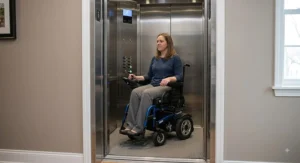
Power wheelchairs and mobility scooters solve similar problems with very different geometry, and for confined area mobility, the difference is stark. A typical three- or four-wheel scooter, even a “zero turn” model, still needs a wider footprint than a power chair because the tiller steering column and seat sit over a longer wheelbase — turning radii on compact scooters commonly range from 28 to 43 inches, noticeably wider than the tightest power chairs in this guide. Power chairs, by contrast, steer via joystick and a shorter wheelbase, letting several of the models above pivot in under 25 inches.
The trade-off runs the other direction outdoors: scooters generally offer more stable ride comfort over longer distances and rougher terrain, while power chairs prioritize indoor precision. If your daily mobility challenge is mostly about navigating a home, apartment, or small office, a power wheelchair built around a tight turning radius will almost always outperform a scooter of similar price. If your primary use case is longer outdoor trips with occasional indoor stops, a scooter’s stability may be worth its wider swing.
Best Indoor Wheelchair for Apartments: What to Expect in Real-World Performance
Spec sheets describe potential; apartments describe reality, and the two don’t always match. A chair rated for a 22-inch turning radius on a smooth showroom floor will feel tighter still on carpet, where added rolling resistance can make pivots feel less crisp than the number suggests. Expect any of the sub-24-inch radius chairs in this guide — the SuperHandy GoRide CRX, Golden Technologies Cricket, or Merits P321 EZ-GO — to handle a typical one- or two-bedroom apartment’s kitchen, bathroom, and hallway turns without repeated back-and-forth maneuvering.
What the spec sheet won’t tell you is how much furniture placement matters day to day. A coffee table pulled six inches closer to a wall, or a floor lamp relocated out of a turning arc, often does more for daily maneuverability than upgrading to a marginally tighter-turning chair. Reviewers who successfully use compact power chairs in apartments consistently mention decluttering low-traffic zones as a bigger quality-of-life change than the chair itself — the equipment and the environment work together, not the equipment alone.
Compact Design Features That Actually Matter (And Those That Don’t)
Not every “compact” marketing claim translates into real-world benefit. Turning radius and overall width genuinely matter — they’re the two numbers directly tied to whether a chair fits your specific space. Ground clearance matters if your home has thresholds or transitions between flooring types; anything under 1.5 inches will catch on many standard thresholds. Disassembly into lightweight pieces matters enormously if you need car transport, but matters far less if the chair lives permanently in your home.
On the other hand, top speed rarely matters indoors — most compact chairs cap out around 3.7-4.5 mph, plenty fast for hallway and room navigation, so an extra half-mile-per-hour on the spec sheet shouldn’t sway a purchase decision. Battery range beyond roughly 10-12 miles is similarly overrated for someone using the chair primarily indoors; you’re not doing a marathon lap around your living room. Focus your comparison budget — mental and financial — on turning radius, overall width, and weight capacity, and treat everything else as a secondary consideration.
Long-Term Cost & Maintenance for Small-Space Power Chairs
The sticker price is rarely the full cost picture. Batteries typically need replacement every 1-2 years of regular use, and depending on the chair’s battery type, that can run a meaningful fraction of the original purchase price. Tires, especially on chairs used indoors and out, wear down over 12-24 months with heavy use. Budgeting a modest annual maintenance reserve — even a few hundred dollars — keeps small repairs from becoming a financial surprise.
Insurance and Medicare coverage can meaningfully offset these costs for qualifying users. Medicare Part B classifies power wheelchairs as durable medical equipment and can help cover the cost when a doctor certifies medical necessity through a face-to-face exam and written order, generally paying a share of the Medicare-approved amount after the annual deductible is met. If you’re weighing a $1,000 budget chair against a $3,600 premium model, checking eligibility and coverage details before you buy can change the math entirely — sometimes dramatically.
Safety, Regulations & Doorway Compliance Guide
If you’re modifying a home around a power chair rather than just buying one, it helps to know the numbers regulators actually use. Colorado State University Extension’s home accessibility guidance notes that a minimum clear width of 36 inches is generally recommended for hallways and 32 inches for doorways, with roughly 60 inches of clear floor space needed for a comfortable 180-degree turn — figures that align closely with the turning radius math used throughout this guide. Anti-tip wheels, present on most of the chairs above, are a genuine safety feature rather than marketing filler, since they reduce the risk of tipping when a front caster catches an unexpected threshold or transition.
Seatbelts, though sometimes skipped by confident users, matter most during tight turns and threshold crossings, where the sudden jolt of an uneven surface is most likely to shift body position. If you’re navigating rental housing, note that swing-away or offset door hinges — a low-cost modification that can add roughly 2 inches of clear doorway width — are often reversible and landlord-approvable in ways that structural changes are not, making them a practical first step before assuming a doorway is simply too narrow to work with.
Frequently Asked Questions
❓ What turning radius do I need for a small apartment?
❓ How narrow can a doorway be for a power wheelchair to fit?
❓ Are lightweight power wheelchairs less durable than full-size models?
❓ Can I use a power wheelchair for tight spaces outdoors too?
❓ Does Medicare cover a compact power wheelchair?
Conclusion
Choosing a power wheelchair for tight spaces isn’t really about finding the single “best” model — it’s about matching a chair’s turning radius, width, and weight capacity to the specific doorways, hallways, and rooms you navigate every day. The SuperHandy GoRide CRX and Golden Technologies Cricket lead on pure turning radius, the Merits P321 EZ-GO and SuperHandy GoRide 2 Plus lead on budget-friendly access, and the Pride Go-Chair, Pride Jazzy Elite ES, and Forcemech Navigator Pro each trade a bit of tightness for reliability, comfort, or outdoor range.
Before you buy, measure your actual doorways and hallway turns rather than relying on memory — the difference between 28 and 32 inches is exactly the difference between a chair that fits and one that doesn’t. Check current pricing directly with retailers, since availability and configuration shift regularly, and factor in service network coverage alongside sticker price. Whichever chair you land on, the goal is the same: a home that stops working against your mobility and starts working with it.
Recommended for You
- Indoor Power Wheelchair: 7 Best Picks for Home Mobility 2026
- Seat Elevation Wheelchair Benefits: 7 Top Picks Compared (2026)
- Seat Elevation Power Wheelchair: 7 Best Picks for 2026
Disclaimer: This article contains affiliate links. As an Amazon Associate, I earn from qualifying purchases. If you purchase products through these links, we may earn a small commission at no additional cost to you.
✨ Found this helpful? Share it with your friends! 💬🤗
