
In This Article
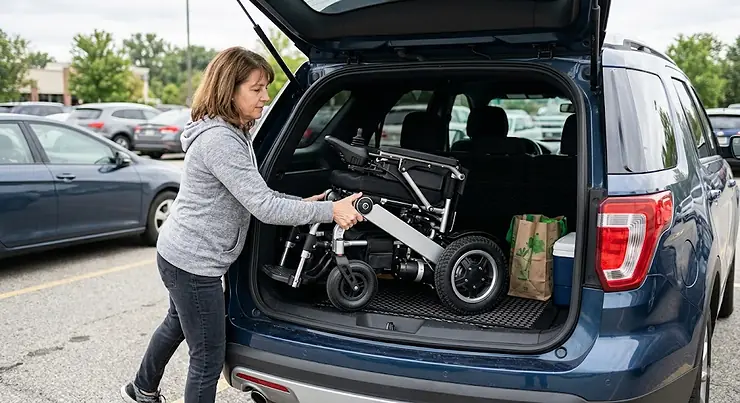
Shopping for a compact power wheelchair usually starts the same way: a hallway that’s narrower than you remembered, a trunk that’s smaller than the last one, or a flight booked for next spring that suddenly makes “will this fit in the overhead bin” a real question. A compact power wheelchair is a battery-powered mobility chair engineered around a smaller footprint, lighter total weight, and a foldable or take-apart frame, built so it can travel in a car, a plane, or a cramped apartment without needing a van lift. That’s the whole category in one sentence, but the differences between models — turning radius, weight capacity, how many pieces it breaks into — are where the real decision happens.
According to CDC data, more than a quarter of U.S. adults report a functional disability, and mobility limitations are among the most common types reported. That’s a lot of people weighing the same trade-offs you probably are right now: range versus weight, comfort versus portability, price versus how often you’ll actually use it. This guide walks through seven real, currently available compact power wheelchairs — from takeapart budget models to feather-touch premium builds — with honest analysis based on published specs and aggregated owner feedback, not marketing copy. We’ll also cover how to choose one, what tight-quarters living actually demands from a chair, and where people commonly get burned when buying.
Quick Comparison Table
| Model | Weight (w/ battery) | Weight Capacity | Turning Radius | Best For |
|---|---|---|---|---|
| Pride Jazzy Passport | ~60 lbs | 250 lbs | 24.25″ | Airline travel |
| Golden Technologies Buzzaround CarryOn | ~74 lbs | 300 lbs | 21″ | Tightest indoor turns |
| Golden Technologies LiteRider Envy | ~91 lbs (disassembled) | 300 lbs | 26″ | Easiest solo loading |
| Merits P321 EZ-GO | ~99–113 lbs | 250–300 lbs | 23″ | Budget buyers |
| EWheels EW-M45 | ~59 lbs | 400 lbs | 31″ | Larger-frame users |
| Journey Zoomer | ~40–50 lbs | 300 lbs | 33.4″–35.5″ | Minimal footprint |
| Pride Go-Chair | ~128 lbs assembled | 300 lbs | 25.5″ | All-around indoor/outdoor use |
A glance at this table tells you most of what matters before you dig into specifics: the Golden Technologies Buzzaround CarryOn wins on turning radius, which matters more than almost anything else if your home has narrow hallways or tight kitchen galleys. The Journey Zoomer is the outlier on total weight, undercutting every other chair here by 10 to 50 pounds, which is why it shows up again and again in “lightest option” conversations. Meanwhile, the EWheels EW-M45 stands apart on weight capacity — at 400 lbs, it accommodates users that several of the other travel-class chairs simply can’t.
💬 Found a model here that fits your life? Bookmark this guide before you compare prices — you’ll want the specs handy.
Top 7 Compact Power Wheelchairs: Expert Analysis
If you’ve spent any time reading small compact power chair reviews online, you already know the category is crowded with near-identical marketing language. What actually separates these seven chairs is turning radius, disassembly weight, and how honestly the manufacturer reports real-world range versus lab-tested range. Here’s the breakdown.
1. Pride Jazzy Passport — most airline-friendly folding travel chair
The Jazzy Passport folds down to a genuinely compact 31″ x 23.5″ x 16″, small enough to clear most sedan trunks and many overhead bins when the battery is removed. Its 250 lb weight capacity and 3.6 mph top speed put it firmly in the “errands and travel” category rather than daily heavy-duty use — the 24.25″ turning radius is respectable but not class-leading, so tight galley kitchens may still require some three-point maneuvering. What most buyers overlook about this model is the battery choice: the 10.4 Ah travel battery keeps total weight near 60 lbs and is airline-compliant, but it trims range to roughly 5-8 miles versus the 18 Ah option’s fuller range — a trade-off worth thinking through before you order.
This chair is built for someone who flies or road-trips several times a year and needs a chair that folds fast at a curb, not someone covering long outdoor distances daily. Aggregated feedback on retailer product pages consistently highlights how quickly it folds and how manageable the under-seat storage bag is for daily items, though a handful of owners note the mesh cup holder and bag feel like afterthoughts rather than durable accessories.
Pros:
- ✅ Folds to genuinely trunk-friendly 31″ x 23.5″ x 16″ dimensions
- ✅ Airline-compliant lithium battery option available
- ✅ Simple few-step folding mechanism, no tools required
Cons:
- ❌ 250 lb capacity is on the lower end of this list
- ❌ Travel battery sacrifices meaningful range for portability
The Pride Jazzy Passport typically lands in the $2,000–$2,700 range depending on battery configuration — always check current pricing, since options and shipping affect the final number. For frequent flyers who prioritize fold time over range, it’s a strong value.
2. Golden Technologies Buzzaround CarryOn — tightest turning radius for indoor precision
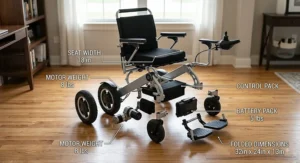
The standout here is the 21″ turning radius — the tightest on this list by several inches, achieved through a center-wheel drive layout rather than the front- or rear-wheel setups used on most travel chairs. In practice, that means pivoting in place inside a small bathroom or turning a corner in a narrow hallway without the multi-point shuffle other chairs require. The 300 lb weight capacity and 12.5-mile range from the airline-friendly lithium battery make it more versatile for daily use than pure “travel-only” models, even though it’s not the lightest chair here at roughly 74 lbs assembled.
Based on the spec comparison, this is the chair to pick if your home layout — not your travel schedule — is the primary constraint. The independent 4-wheel suspension and springless articulating chassis also mean it handles small thresholds and uneven flooring transitions more smoothly than simpler folding frames. Owner sentiment on retailer sites frequently praises the compact 10″ folded height for under-bed or closet storage, with occasional notes that the heaviest 46 lb piece is still a real lift for some caregivers.
Pros:
- ✅ 21″ turning radius, tightest center-wheel design in this roundup
- ✅ 12.5-mile range from an airline-compliant lithium battery
- ✅ Folds to just 10″ tall for closet or under-bed storage
Cons:
- ❌ At ~74 lbs assembled, heavier than several folding alternatives
- ❌ Center-wheel drive has a slightly steeper learning curve for new users
Expect the Golden Technologies Buzzaround CarryOn to run in the $2,400–$3,200 range at the time of research. For hallway-heavy homes, the turning radius alone can justify the premium over lighter but wider-turning competitors.
3. Golden Technologies LiteRider Envy — lightest disassembled pieces for solo loading
The LiteRider Envy takes a different approach to portability: rather than folding as one unit, it disassembles into four pieces, with the heaviest single piece weighing just 35 lbs. That number matters more than total chair weight for anyone loading a trunk without help — being able to lift a 35 lb base rather than a fully-assembled 90+ lb chair is the difference between independent transport and needing a second person every time. The 26″ turning radius is average for this category, and the 300 lb weight capacity gives it more headroom than budget-tier competitors.
Here’s what to weigh: the LiteRider Envy trades folding speed for lift-weight simplicity. Reassembly takes longer than a one-pull fold, but each individual component is manageable for users with limited upper-body strength. Reviewers on Amazon and retailer sites commonly note the stability of the frame once assembled and the straightforward color options, with occasional comments that reassembly instructions could be clearer for first-time buyers.
Pros:
- ✅ Heaviest single piece is only 35 lbs — genuinely solo-liftable
- ✅ 300 lb weight capacity with a stable four-piece frame
- ✅ Multiple color options at a mid-range price point
Cons:
- ❌ Four-piece reassembly is slower than one-pull folding chairs
- ❌ 26″ turning radius trails the tightest chairs in this list
At a typical $2,200–$2,900 range, the Golden Technologies LiteRider Envy makes the most sense for users who transport their chair solo but can’t manage lifting a fully assembled unit.
4. Merits P321 EZ-GO — best budget takeapart compact chair
The EZ-GO’s core pitch is straightforward: a 250 lb (or 300 lb on the Deluxe version) capacity chair that breaks into three pieces, with the heaviest piece around 35 lbs, at a price point noticeably below the Golden Technologies and Pride offerings above. The 9-mile range (12 miles on the Deluxe) and 4 mph top speed are modest but adequate for errands, mall trips, and appointment-to-appointment use rather than long outdoor excursions. The steel frame adds weight compared to aluminum-frame competitors, but it also tends to hold up well under repeated disassembly.
What the spec sheet won’t tell you, but reviewers note, is that the seat back on the EZ-GO is unusually well-padded for a chair in this price tier — a detail that matters enormously for anyone spending several hours a day seated. Aggregated feedback frequently mentions the value-for-money angle explicitly, with buyers comparing it favorably to pricier alternatives on comfort while acknowledging the shorter range and lower top speed as real limitations for outdoor use.
Pros:
- ✅ Noticeably lower price point than comparable travel chairs
- ✅ Well-padded seat back praised in aggregated owner feedback
- ✅ Three-piece breakdown with a manageable 35 lb heaviest piece
Cons:
- ❌ 9-mile base range is shorter than most chairs on this list
- ❌ Steel frame adds bulk versus aluminum competitors
Pricing on the Merits P321 EZ-GO typically falls in the $1,500–$2,000 range, making it one of the more accessible entry points into this category — a strong pick for budget-conscious buyers who mainly need indoor and short-outing mobility.
5. EWheels EW-M45 — highest weight capacity in a folding frame
The EW-M45 stands out on a spec most travel chairs sacrifice for portability: a 400 lb weight capacity, well above every other model in this roundup, while still folding in half to a compact 23″ x 13″ x 31″ and weighing around 59 lbs with batteries. That combination — high capacity plus genuinely light folded weight — comes from dual 180W brushless motors and a pair of 12V/6Ah lithium batteries rather than a single larger unit. The 15.5-mile range is also the longest of any folding chair here, meaningfully more than the Jazzy Passport or Buzzaround CarryOn.
Based on the spec comparison, this is the clearest choice for larger-frame users who’ve been priced or sized out of standard travel chairs, without forcing them into a bulky, non-folding heavy-duty chair. Reviewers on Amazon and retailer pages frequently mention long-distance reliability and describe the fold-in-half mechanism as faster than take-apart competitors, though a few note the 18″ seat width, while generous for a travel chair, still runs narrower than dedicated bariatric power chairs.
Pros:
- ✅ 400 lb weight capacity, the highest folding-frame option here
- ✅ 15.5-mile range, longest of any chair in this roundup
- ✅ Folds in half to 23″ x 13″ x 31″ at just ~59 lbs
Cons:
- ❌ 18″ seat width may be tight for some larger-frame users
- ❌ Dual battery system means two components to keep charged
The EWheels EW-M45 generally runs in the $1,700–$2,300 range, a strong value given the capacity and range figures — worth checking current pricing since EWheels updates configurations periodically.
6. Journey Zoomer — smallest footprint and lightest overall build
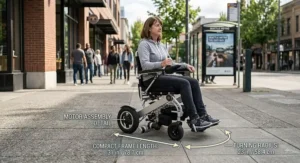
If minimal footprint is the priority, the Zoomer is hard to beat: it weighs roughly 40-50 pounds fully assembled with battery, folds to about 12″ wide with a single pull-cable release, and can further separate into two pieces with a heaviest component under 27 lbs. Journey markets it as a “personal electric vehicle” rather than a traditional power chair, and the framing fits — its 300 lb capacity and 3.7 mph top speed are competitive, but the real differentiator is how little space it occupies folded, in a trunk, or against a wall at home.
The trade-off is range: at roughly 8 miles per charge, the Zoomer covers less ground than the EW-M45 or Buzzaround CarryOn, and its 33.4″-35.5″ turning radius (depending on configuration) is wider than the tightest center-wheel chairs. Aggregated feedback on the manufacturer’s own product pages and third-party retailers repeatedly uses words like “life-changing” for independence around the home, and several reviewers specifically call out the floating footrest design as easier to use during transfers than swing-away footplates on other chairs — a genuine functional difference, not just marketing language.
Pros:
- ✅ Lightest chair in this roundup at roughly 40-50 lbs assembled
- ✅ Folds to just 12″ wide with a single-pull release cable
- ✅ Patented floating footrest simplifies transfers
Cons:
- ❌ 8-mile range trails most other chairs on this list
- ❌ Wider turning radius than the tightest center-wheel options
Expect the Journey Zoomer to price around $1,900–$2,600. For apartment living, small vehicles, or anyone who simply wants the least amount of chair to deal with, it’s the category’s clearest minimal-footprint pick.
7. Pride Go-Chair — best all-around mid-wheel maneuverability
The Go-Chair sits at the premium end of this list, and the spec sheet explains why: a 300 lb capacity, up to 13.2-mile range at lower user weights, a 25.5″ turning radius, and feather-touch disassembly into five or six pieces with a 36 lb heaviest component. Unlike the pure travel-folders above, the Go-Chair is built to function as a genuine daily-use chair that also happens to disassemble well for transport, which shows up in details like the stadium-style adjustable seat and dual under-seat storage compartments.
Here’s what to weigh: the Go-Chair’s ~128 lb assembled weight makes it the heaviest chair on this list once put together, so it’s not the pick for someone who needs to load a fully-assembled chair alone. But for someone who disassembles it occasionally for a car trip while using it fully assembled at home day-to-day, the comfort and range trade-offs work in its favor. Reviewers frequently describe it as a long-time favorite in the Pride lineup, with recurring praise for ride comfort and color options, alongside occasional notes that full reassembly takes more steps than single-fold competitors.
Pros:
- ✅ Up to 13.2-mile range, among the longest here at lower user weights
- ✅ Stadium-style adjustable seat with dual storage compartments
- ✅ Six-color selection and strong daily-comfort reputation
Cons:
- ❌ ~128 lbs assembled, heaviest chair in this roundup
- ❌ Reassembly involves more steps than one-pull folding chairs
The Pride Go-Chair typically runs $2,800–$3,600 depending on seat and color options. It’s the premium pick for buyers who want a chair that performs like a daily driver but still breaks down for the occasional trip.
Practical Usage Guide: Getting Started the Right Way
The first 30 days with a new compact power wheelchair determine a lot about long-term satisfaction, and most of the common mistakes happen early. Start by fully charging the battery before first use — most manufacturers recommend an initial 8-12 hour charge even if the battery arrives partially charged, since undercharging early can shorten a lithium battery’s effective lifespan. Next, practice folding and unfolding the chair on flat, stable ground several times before you need to do it under time pressure at a curb or airport gate; muscle memory here saves real frustration later.
Get familiar with the joystick’s speed settings before venturing outdoors. Nearly every chair in this roundup, including the Pride Jazzy Passport and Journey Zoomer, ships with adjustable speed limits, and starting at the lowest setting indoors lets you learn turning radius and stopping distance without surprises. A common first-month mistake is judging outdoor performance by indoor test drives — carpet, thresholds, and inclines all behave differently than a showroom floor. Finally, establish a simple weekly habit of checking tire condition (for solid tires, look for cracking; for pneumatic, check pressure) and wiping down the frame, since salt, sand, and moisture accelerate wear on joints and folding hinges faster than most owners expect.
Real-World Scenarios: Who Actually Needs This Chair
Picture a retired teacher who flies twice a year to visit grandchildren and otherwise gets around fine with a cane at home — for her, range matters far less than fold time and airline battery compliance, making the Pride Jazzy Passport or Journey Zoomer the logical picks over a longer-range but bulkier chair. Now picture a 280 lb former contractor with post-stroke mobility limitations who needs a chair for daily household use plus occasional car trips to appointments; his priority list flips entirely toward weight capacity and comfort, pointing toward the EWheels EW-M45 or Pride Go-Chair rather than the lightest options on this list.
A third scenario: someone living alone in a studio apartment with narrow doorways and no one around to help lift a chair into a car. For this person, the deciding factors are turning radius and disassembled piece weight — the Golden Technologies Buzzaround CarryOn for hallway navigation, or the Golden Technologies LiteRider Envy for solo loading, both outperform a heavier all-in-one chair regardless of its other features. Research on community-dwelling adults confirms this pattern isn’t rare: a national study following older adults found that mobility device use is often dynamic and situational, meaning the “right” chair genuinely depends on the specific daily environment, not a single best-overall model.
✨ Not sure which scenario fits you? Compare the specs above against your actual daily routine — not the routine you wish you had.
How to Choose a Compact Power Wheelchair
Choosing among these seven models — or any compact power wheelchair — comes down to answering a handful of questions honestly, in this order:
- Measure your tightest doorway and hallway first. A chair’s turning radius only matters relative to your actual home layout, so measure before comparing spec sheets.
- Weigh your real weight capacity need with a margin. Manufacturers rate capacity at the edge of safe operation; buying right at your body weight limits comfort and battery efficiency.
- Decide who’s lifting the chair, and how often. Solo transport favors low disassembled-piece weight; chairs left assembled at home favor comfort features over portability.
- Match range to your actual daily distance, not your best-case outing. An 8-mile range chair is plenty for home and errands; longer outdoor excursions demand the 12-15+ mile options.
- Check the battery type against your travel plans. If you fly, confirm the battery meets current airline lithium-ion limits before you buy, not after.
- Test the seat, not just the frame. Comfort determines how many hours a day you’ll actually use the chair, which affects independence far more than top speed does.
- Budget for accessories and service, not just the chair. Covers, extra batteries, and periodic maintenance add real cost beyond the sticker price.
Compact Power Wheelchair vs Standard Power Wheelchair vs Mobility Scooter
The core trade-off between a compact power wheelchair and a standard (non-folding) power wheelchair is straightforward: standard chairs generally offer higher weight capacities, more seating customization, and longer battery range, but they weigh 150-300+ lbs and require a vehicle lift or ramp for transport. A compact or ultra compact electric wheelchair sacrifices some of that capacity and range specifically to fold, disassemble, or shrink down enough for a car trunk or airplane cargo hold — the entire category exists to solve a transport problem standard chairs don’t address.
Mobility scooters occupy a different niche entirely. Scooters typically offer longer range and a lower price point than comparable power chairs, but they require enough trunk and shoulder strength to steer with handlebars and generally aren’t suited to users who need postural support or all-day seating. For someone who needs a joystick-controlled chair with a supportive seat but still wants folding portability, none of the seven models above are true substitutes for a scooter — and vice versa. The practical rule: choose a power chair (compact or standard) when seating support and joystick control matter, and reserve scooters for users with strong upper-body control who mainly need outdoor range.
Compact Power Wheelchairs for Tight Quarters Mobility
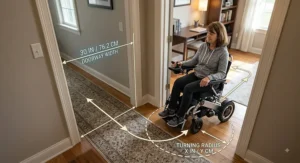
Tight quarters mobility is its own design problem, distinct from travel portability. A chair can fold beautifully for a car trunk and still be miserable to live with daily in a small apartment if its turning radius doesn’t match the space. The Golden Technologies Buzzaround CarryOn‘s 21″ turning radius and the Pride Go-Chair‘s 25.5″ radius both come from mid- or center-wheel drive layouts specifically because that configuration pivots closer to the chair’s own footprint rather than needing forward-and-back maneuvering room.
For studio apartments, senior living facilities, and older homes with narrow prewar hallways, prioritize turning radius and ground clearance over top speed or maximum range — you’ll use the tight-turn capability daily, while the extra 5 mph or 5 miles of range you’re not using sits idle. Door width is the other overlooked factor: most interior doors in U.S. homes run 28-32 inches, and every chair in this roundup fits that range when the armrests are in standard position, but it’s worth measuring your specific doorways before ordering rather than assuming.
Achieving a Minimal Footprint: Small Dimension Wheelchair Picks
When minimal footprint is the top priority — not just for transport but for everyday storage in a small home — three numbers matter more than any others: folded width, folded height, and total assembled weight. The Journey Zoomer leads on all three simultaneously, folding to roughly 12 inches wide at under 50 lbs, which is why it repeatedly comes up as the answer when people specifically search for a small dimension wheelchair rather than just a “lightweight” one. The Golden Technologies Buzzaround CarryOn takes a different minimal-footprint approach, folding to just 10 inches in height, which suits under-bed or closet storage better than under-desk clearance.
It’s worth noting the trade-off pattern here is consistent across every chair on this list: the smaller the folded footprint, the more range and weight capacity tend to shrink. That’s not a flaw in any individual model — it’s physics. Smaller frames generally mean smaller batteries and lighter-duty motors. The honest advice is to rank folded footprint against your actual storage constraint (closet versus trunk versus under a bed) before assuming the smallest chair is automatically the best fit.
Common Mistakes When Buying a Compact Power Wheelchair
The single most common mistake is buying based on total chair weight alone without checking disassembled or folded dimensions — a chair that’s technically “lightweight” at 60 lbs can still be an awkward, bulky single unit to lift into a trunk, while a heavier chair that breaks into manageable pieces may actually be easier to transport solo. A close second is underestimating weight capacity margin; buying a chair rated exactly at your body weight reduces both comfort and battery efficiency, since motors and batteries work harder near their rated limit.
Buyers also frequently skip checking battery airline compliance until the week before a trip, only to discover the installed battery exceeds current watt-hour limits or lacks proper documentation. And a subtler mistake: focusing entirely on top speed and range while ignoring seat comfort, even though seat quality determines how many hours a day the chair actually gets used — a chair with mediocre comfort but great specs often ends up parked more than driven.
Long-Term Cost & Maintenance
The purchase price is only part of total cost of ownership. Budget for a replacement battery every 2-4 years depending on usage frequency and charging habits — lithium battery packs for these chairs generally run a few hundred dollars, and running a battery down to zero repeatedly shortens that lifespan meaningfully. Tires (solid or pneumatic), joystick controllers, and folding-hinge hardware are the next most common wear items, particularly on chairs used outdoors on varied terrain.
If a compact power wheelchair is medically necessary, it’s worth understanding how Durable Medical Equipment coverage works before purchasing out of pocket. Medicare Part B covers power wheelchairs as durable medical equipment when a doctor documents medical necessity and the supplier is Medicare-enrolled, though prior authorization and specific functional criteria apply, and coverage rules for scooters and power chairs differ. Even for buyers not going through insurance, understanding these criteria clarifies what “medically necessary” actually means in practice, which matters if you ever do pursue coverage or appeal a denial down the line.
Safety, Regulations & Airline Compliance Guide
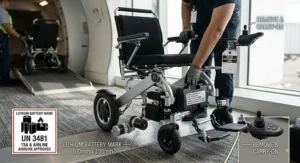
If travel is part of why you’re buying a compact power wheelchair, battery compliance isn’t optional homework — it determines whether your chair can fly with you at all. Under current FAA guidance, lithium-ion batteries in mobility devices are generally limited to 300 watt-hours when installed, with spare batteries capped at 300 Wh for a single spare or 160 Wh each for two spares, and lithium metal (non-rechargeable) batteries aren’t permitted in these devices at all. Several chairs in this roundup, including the Pride Jazzy Passport‘s travel battery option and the Golden Technologies Buzzaround CarryOn, are specifically marketed as airline-friendly because their battery packs fall within these limits — but always confirm the current watt-hour rating on the specific unit you’re buying, since configurations change.
Beyond air travel, basic safety habits matter daily: never exceed the rated weight capacity, keep the chair on hard, flat surfaces when possible, and inspect anti-tip wheels and brakes regularly, especially after folding and unfolding cycles that can loosen hardware over time. Individual airlines may impose stricter rules than the federal minimum, so calling ahead 48-72 hours before a flight to confirm your specific chair and battery are accepted is a habit worth building regardless of how many times you’ve flown with it before.
✨ Ready to Compare Your Top Picks?
🔍 Take a closer look at the models that fit your space, budget, and travel plans. Click through to check current pricing and availability on any highlighted chair above — the right compact power wheelchair should make your daily routine easier, not add one more thing to manage.

Frequently Asked Questions
❓ How much does a compact power wheelchair weigh on average?
❓ Can I take a compact power wheelchair on a plane?
❓ What is the average price of a small compact power chair?
❓ Does Medicare cover a compact power wheelchair?
❓ What turning radius is best for tight indoor spaces?
Conclusion
There’s no single best compact power wheelchair on this list — there’s a best one for your specific hallway width, body weight, travel schedule, and budget. The Golden Technologies Buzzaround CarryOn wins on tight-space maneuverability, the Journey Zoomer wins on minimal footprint and total weight, the EWheels EW-M45 wins on capacity and range for larger-frame users, and the Merits P321 EZ-GO wins on affordability without sacrificing basic comfort. The Pride Jazzy Passport, Golden Technologies LiteRider Envy, and Pride Go-Chair each fill a specific middle ground between those extremes.
The honest takeaway from comparing all seven side by side is that the “compact” label covers a genuinely wide range of trade-offs, and the spec that matters most to you probably isn’t the one manufacturers lead with in their marketing. Measure your actual space, be realistic about who’s lifting the chair and how often, and match range to your real daily distance rather than an occasional best-case outing. Get those three things right, and any of the seven chairs above should serve you well for years.
Recommended for You
- Narrow Power Wheelchair: 7 Best Slim Picks for Doorways (2026)
- 7 Best Power Wheelchairs for Tight Spaces in 2026
- Indoor Power Wheelchair: 7 Best Picks for Home Mobility 2026
Disclaimer: This article contains affiliate links. As an Amazon Associate, I earn from qualifying purchases. If you purchase products through these links, we may earn a small commission at no additional cost to you.
✨ Found this helpful? Share it with your friends! 💬🤗
