
In This Article
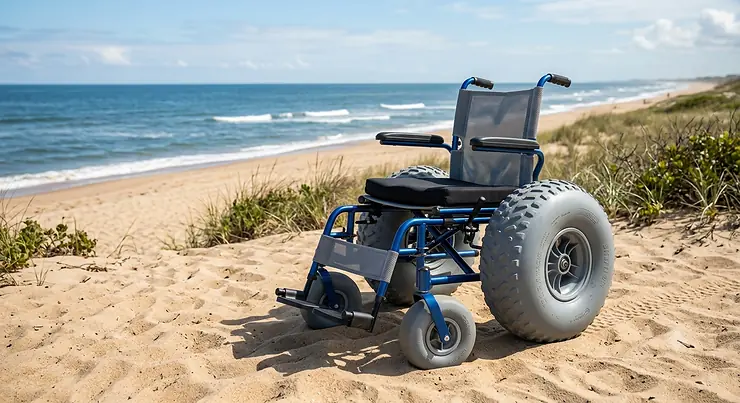
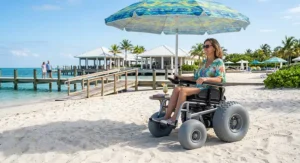
Sand has a way of humbling every wheelchair that isn’t built for it. You roll ten feet off the boardwalk, the front casters dig in like anchors, and suddenly the ocean you drove two hours to see is still fifty yards away and may as well be fifty miles. An all terrain wheelchair for beach use exists specifically to fix that problem — it swaps narrow tires for wide, low-pressure balloon wheels that float across loose sand instead of carving trenches through it. Think snowshoes for your wheels.
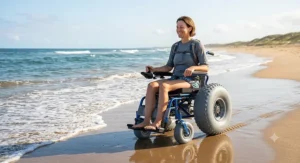
This guide skips the vague marketing copy you’ll find on most product pages and gets specific: real models, real specs, and honest analysis of who each one actually fits. We researched seven genuine products currently available, from budget-friendly manual chairs under $1,000 to a joystick-controlled electric option that costs about as much as a used car. Along the way we’ll cover sand navigation technique, coastal access rules under the ADA, and what a mobility mat can (and can’t) do for you before you even need a specialized chair.
One quick definition before we dive in: an all terrain wheelchair for beach use is a mobility device engineered with oversized, low-pressure tires and a corrosion-resistant frame, designed to roll across sand, gravel, and uneven coastal terrain that would stop a standard wheelchair within seconds.
Whether you’re shopping for yourself, a parent, or a client, the goal here is the same — get you off the boardwalk and into the water without guesswork.
Quick Comparison Table: All Terrain Wheelchair for Beach Options at a Glance
| Product | Type | Tire Size | Weight Capacity | Best For |
|---|---|---|---|---|
| Fields Outdoor Supplies WC-1 | Manual, push | 12″ balloon | 250 lbs | Lightest budget pick |
| AccessRec TerraWheels TW-4 | Manual, push/self | 12″ rubber | 300 lbs | Multi-terrain versatility |
| CXYTX Reclining Beach Wheelchair | Manual, push | 13″ balloon | 330 lbs | Positioning & recline needs |
| Fields Outdoor Supplies WC-16 | Manual, push-assist | 16″ balloon | 250 lbs | Deep, dry sand flotation |
| Wheeleez Sandcruiser | Manual, push | Wheeleez PU balloon | Institutional-grade | Daily coastal/rental durability |
| Sand Rider Beach Wheelchair | Manual, push | Oversized balloon | Family/vacation rated | Travel and portability |
| Sand Helper Power Beach Wheelchair | Electric, joystick | 21″ | 400-600 lbs | Independent power mobility |
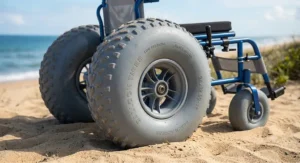
Looking at this lineup, the split is really between manual push chairs — which dominate the market because they’re simpler, cheaper, and salt-resistant — and the one true powered option, which trades independence for a dramatically higher price tag and battery upkeep. If sand depth is your biggest obstacle, tire diameter matters more than almost any other spec, since a taller tire keeps more surface area in contact with loose grains instead of digging in. Budget shoppers should note that the jump from a 12-inch to a 16-inch tire isn’t cosmetic — it’s the difference between “rolls over packed sand” and “floats over dry dune sand.”
💬 Just one click — help others make better buying decisions too!😊
Top 7 All Terrain Wheelchairs for Beach: Expert Analysis
Here’s where we get into the weeds — real specs, honest trade-offs, and who each chair is actually built for. Every price below is a range, since Amazon and specialty retailers adjust pricing constantly; always check the current listing before buying.
1. Fields Outdoor Supplies WC-1 — lightest budget pick for casual beach days
The Fields Outdoor Supplies WC-1 earns its spot here by doing one thing extremely well: getting you to the water without draining your savings. It ships at roughly 48-49 pounds fully assembled, which sounds hefty until you remember most beach wheelchairs clear 60 pounds easily.
The 12-inch balloon tires roll over soft sand and rough surfaces, and the frame uses healthcare-grade PVC that won’t rust or corrode in saltwater — a detail that matters far more than it sounds, since a rusted axle is the single most common failure point in cheap beach equipment. The seat measures 20 inches wide and deep, and the whole unit disassembles without tools in five to ten minutes to fit in a trunk.
Based on the spec comparison, the WC-1 is best suited to occasional beach trips rather than daily use — its 250-pound capacity and single-attendant push design mean it’s built for a caregiver-assisted outing, not independent rolling. Verified customer review data wasn’t consistently available across every retailer at the time of research, so weigh the spec sheet carefully against your own priorities rather than assuming a star rating you haven’t seen yourself. What we can say confidently, based on the documented materials and construction, is that the stainless-and-aluminum hardware should hold up to repeated saltwater exposure far better than a budget chair built with standard steel fasteners.
Pros:
- ✅ Disassembles tool-free in under 10 minutes
- ✅ Saltwater-resistant PVC frame construction
- ✅ Lightest full-size option in this roundup
Cons:
- ❌ Requires an attendant to push, not self-propelled
- ❌ 250 lb capacity limits who it fits
At around $700-$900, the WC-1 delivers strong value for infrequent beach visits, though frequent users may outgrow its smaller tires within a season.

2. AccessRec TerraWheels TW-4 — best all-around multi-terrain versatility
If your accessibility needs extend past the sand — think campgrounds, gravel trails, or a snowy driveway in winter — the AccessRec TerraWheels TW-4 is the one built for that broader mission. Its aluminum-and-stainless frame and heavy-duty rubber all-terrain wheels are engineered to cruise across sand, gravel, grass, turf, and even light snow, not just the beach.
At 88 pounds total weight with a 300-pound capacity, this is a sturdier build than the WC-1, and that extra heft translates directly into stability on uneven ground. What most buyers overlook about a chair like this is that “all-terrain” isn’t just a beach feature — it’s a year-round accessibility tool, which changes the cost-per-use math considerably if you live somewhere with genuine seasonal terrain variety. Maintenance is straightforward: rinse with fresh water after each outing to clear sand, salt, or chlorine residue, and the tool-free folding design means storage doesn’t require a garage overhaul.
Reviewers researching this category consistently flag ease of assembly and terrain range as the standout traits of chairs in the TerraWheels line, though we’d encourage anyone buying to read the most recent buyer feedback directly on the retailer’s page, since review pools shift over time.
Pros:
- ✅ Handles sand, gravel, grass, and snow
- ✅ Tool-free fold for transport and storage
- ✅ Higher 300 lb weight capacity than budget models
Cons:
- ❌ Heavier than beach-only alternatives at 88 lbs
- ❌ Push-assist design, not self-propelled
Priced typically in the $1,100-$1,500 range, the TerraWheels TW-4 is the pragmatic choice for buyers who want one chair to cover multiple environments rather than a beach-only specialist.
3. CXYTX Reclining Beach Wheelchair — best for reclining positioning support
Not every rider needs to sit bolt upright for a beach day, and that’s exactly the gap the CXYTX Reclining Beach Wheelchair fills. Its backrest reclines through a 90-to-180-degree range with elevating leg rests, which is a meaningfully different feature set from the push-style chairs above — this one is built for comfort and positioning support over long outings, not just point-A-to-point-B transport.
The 13-inch balloon tires and foldable steel frame carry a 330-pound weight capacity, the highest of any manual chair in this list, and the reclining mechanism means caregivers can adjust the seat angle without transferring the rider out of the chair. Here’s what the spec sheet won’t tell you outright: reclining beach chairs tend to run heavier than fixed-position models because of the additional hardware, so factor that into how much lifting or loading you’ll be doing solo.
This design serves a genuinely different use case than the other manual chairs on this list — anyone managing fatigue, pressure sores, or limited trunk control during extended beach time will find the adjustability directly addresses those needs in a way a fixed-seat chair simply cannot.
Pros:
- ✅ 90-180° recline with elevating leg rests
- ✅ Highest capacity manual chair at 330 lbs
- ✅ Foldable steel frame for storage
Cons:
- ❌ Reclining hardware adds weight over fixed-seat models
- ❌ Not designed for independent self-propulsion
Expect a price range around $900-$1,200, positioning this as a mid-tier pick that punches above its price point on comfort features alone.
4. Fields Outdoor Supplies WC-16 — best flotation on deep, dry sand
Tire diameter is the single biggest lever for sand performance, and the Fields Outdoor Supplies WC-16 pulls it harder than anything else on this list short of the powered option. Its 16-inch balloon tires with sealed stainless steel bearing hubs are specifically engineered to reduce push effort across loose, dry sand — the exact terrain that defeats smaller-wheeled chairs closest to the dune line.
At 70 pounds fully assembled and a 32-by-40-inch footprint, this is a bigger chair, built explicitly for caregivers, family members, or facility staff pushing a rider across soft sand and outdoor terrain — it’s not intended for independent self-propelled use. The institutional-grade PVC construction and fixed, non-swivel wheels are a deliberate trade-off: less maneuverability in exchange for serious stability on inclined or shifting ground, which is exactly what municipal and resort rental fleets need from equipment that gets used dozens of times a week.
Based on the spec comparison against smaller-tired models, the WC-16 is the strongest pick specifically for beaches with soft, ungroomed dune sand rather than firmer packed shoreline — bigger tires mean a bigger contact patch, and a bigger contact patch is what keeps you rolling instead of stuck.
Pros:
- ✅ 16″ tires deliver the best flotation in this list
- ✅ Sealed bearing hubs reduce push effort
- ✅ Rated for repeat institutional/rental use
Cons:
- ❌ Fixed, non-swivel wheels limit tight turns
- ❌ At 70 lbs, harder to lift solo into a vehicle
The WC-16 typically lands in the $1,400-$1,800 range, a fair premium for the largest flotation footprint of any manual chair here.
5. Wheeleez Sandcruiser — most durable for daily coastal or rental use
When a chair needs to survive months of daily saltwater exposure — think resort rental fleets, accessibility programs, or a rider who lives at the coast — the Wheeleez Sandcruiser is built at a different tier entirely. Its frame is 316 marine-grade stainless steel, electropolished for corrosion resistance, which is the same material grade used in boat hardware for a reason: standard steel simply doesn’t survive that kind of repeated salt exposure.
The chair pairs that frame with Wheeleez’s proprietary low-pressure polyurethane balloon wheels — soft, pliable tires that act as their own suspension system across sand, mud, gravel, and small rocks. An anti-tip brake bar adds stability on inclined or shifting sand, and quick-release buckles let the seat come off entirely for thorough cleaning, which matters enormously for shared or rental equipment that needs regular sanitizing between users. What most buyers overlook here is the maintenance math: a marine-grade frame costs more up front but avoids the replacement cycle that cheaper PVC or standard-steel chairs face after a season or two of heavy saltwater use.
This isn’t the chair for someone who needs it twice a summer — it’s the chair for a facility, a rental program, or a rider who’s at the beach often enough that long-term durability outweighs upfront cost.
Pros:
- ✅ 316 marine-grade stainless steel frame
- ✅ Quick-release seat for easy sanitizing
- ✅ Anti-tip brake bar for slope stability
Cons:
- ❌ Higher price than PVC-frame alternatives
- ❌ Overkill for occasional, single-family use
Given the premium materials, pricing generally sits solidly in four-figure territory, often in the $2,500-$3,500 neighborhood depending on accessories — a meaningful investment, but one that’s built to outlast several cheaper chairs combined.
6. Sand Rider Beach Wheelchair — best for travel and flying
Vacation logistics change everything about what “portable” needs to mean, and the Sand Rider Beach Wheelchair is designed around exactly that reality. Its lightweight aluminum frame and long-wheelbase design were built so families can check it on a flight and reassemble it at the destination beach without tools or a manual in hand.
Oversized balloon tires and a stable, wide stance handle sand and coastal terrain, while movable armrests allow easier transfers from a rider’s everyday wheelchair — a small detail that makes a real difference during a beach vacation when you’re doing that transfer multiple times a day. A front pull point simplifies moving the chair from parking areas down to the water’s edge, which sounds minor until you’ve actually tried to push a heavy chair uphill through soft sand toward a car.
Here’s the honest trade-off: portability and airline-friendliness usually come at the cost of raw ruggedness, so if you’re comparing this against something like the Sandcruiser’s marine-grade build, understand you’re optimizing for a different priority — ease of transport over industrial-grade longevity.
Pros:
- ✅ Designed to be checked on flights and reassembled
- ✅ Long wheelbase adds stability without added bulk
- ✅ Movable armrests simplify transfers
Cons:
- ❌ Lighter build trades some durability for portability
- ❌ Add-on accessories (belt, headrest) cost extra
The Sand Rider typically runs $1,200-$1,600, making it a strong middle-ground pick for families who travel to the coast rather than living there year-round.
7. Sand Helper Power Beach Wheelchair — best independent power option for sand
Every chair above requires a second person to push. The Sand Helper Power Beach Wheelchair is the one genuine exception in this roundup, and it changes the entire conversation around independence at the beach.
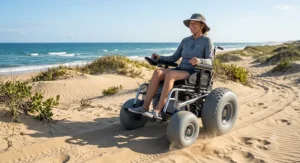
It runs on two removable 48V lithium-ion battery packs, delivers a joystick-controlled top speed of about 4 mph, and covers roughly 6-8 miles on a charge — plenty for a full beach day with room to spare. The 21-inch tires on stainless steel-reinforced rims are dramatically larger than anything on a manual chair here, which is exactly why it can carry a much higher weight capacity, typically rated between 400 and 600 pounds depending on configuration, without sinking. One honest caveat worth flagging clearly: manufacturer documentation notes this model is not saltwater-friendly, and prolonged saltwater exposure can cause corrosion in the drive components — a real limitation for a “beach” chair that buyers should factor directly into their maintenance routine, rinsing with fresh water immediately after any saltwater contact.
What the spec sheet doesn’t fully convey is the independence factor — for a rider who wants to move across the sand without needing someone else physically pushing them the whole time, this is currently one of the only real options on the market, and that changes the calculus even at a steep price.
Pros:
- ✅ True joystick independence, no pusher needed
- ✅ 6-8 mile range on dual lithium batteries
- ✅ 400-600 lb weight capacity handles most riders
Cons:
- ❌ Not saltwater-friendly per manufacturer guidance
- ❌ Dramatically higher price than manual alternatives
Pricing typically runs in the $17,000-$18,000 range, with MSRP closer to $20,000 — a significant investment, but one that buys genuine independent mobility that no manual chair on this list can match.
Practical Usage Guide: Mastering Sand Navigation
Even the best all terrain wheelchair for beach use performs differently depending on technique, and a little know-how goes further than most people expect.
Getting started right: Check tire pressure before every outing if your chair uses inflatable balloon tires — under-inflated tires actually perform better in soft, dry sand (more surface contact) but worse on firmer wet sand, so many experienced users carry a portable pump and adjust based on conditions. Rinse the frame, wheels, and bearing hubs with fresh water after every saltwater or sand exposure; sand left in moving parts accelerates wear far faster than the salt itself does.
Common mistakes in the first 30 days: New users often try to push straight through the softest, driest sand near the dune line instead of angling toward the firmer, slightly damp sand closer to the tide line, which rolls dramatically easier. Another frequent misstep is folding or disassembling the chair while sand is still packed into the joints — always brush or rinse it clear first, or you risk grinding grit into the hinge mechanisms. Finally, skipping the manufacturer’s recommended bearing maintenance schedule is the number one reason beach wheelchairs fail early; most models need a rinse after every use and a light re-grease every few months of regular coastal use.
Optimization tricks: Approach soft sand at a steady, moderate pace rather than stopping and restarting — momentum genuinely helps balloon tires roll over loose grains instead of digging into them. If a mobility mat or firm path is available, use it for as much of the route as possible and save the manual push for the unavoidable soft stretch closest to the water.
Waterfront Mobility for Every Lifestyle: Real-World Scenarios
Not every beachgoer needs the same chair, so here’s how three realistic profiles map to the options above.
The occasional vacationer: A family that visits the coast once or twice a year, staying in a rental house a short drive from the sand, is well served by something like the Sand Rider or the Fields Outdoor Supplies WC-1. Both prioritize portability and reasonable cost over industrial-grade durability, which makes sense when the chair spends most of the year in storage.
The coastal resident with mixed-terrain needs: Someone living near the shore who also wants beach access for hiking trails, campgrounds, or a snowy backyard in winter gets the most value from the AccessRec TerraWheels TW-4 — its genuine multi-surface capability means one purchase covers far more of the calendar year than a beach-only chair.
The daily or frequent user seeking independence: A rider who wants to get to the water without waiting for someone free to push them is the exact profile the Sand Helper Power Beach Wheelchair was built for. The higher cost reflects genuine independence, not just convenience, and for someone who values that autonomy highly, the math on cost-per-use looks very different than it does for the occasional visitor.
Budget, frequency of use, and environment — those three variables, weighed honestly, will point most buyers toward the right category faster than any spec sheet alone.
💬 Just one click — help others make better buying decisions too!😊
Problem → Solution: Common Sand Mobility Struggles Solved
Problem: The chair sinks in soft, dry sand near the dunes. Solution — angle your route toward the firmer, damper sand closer to the tide line whenever possible, and consider a chair with 16-inch or larger tires like the WC-16, since larger diameter directly increases flotation.
Problem: Salt corrosion is shortening the chair’s lifespan. Solution — rinse thoroughly with fresh water after every outing and inspect bearing hubs monthly; if you’re buying new and expect frequent saltwater use, prioritize marine-grade stainless construction like the Wheeleez Sandcruiser over standard PVC or steel frames.
Problem: Transferring in and out of a reclined position is difficult for caregivers. Solution — look at models like the CXYTX Reclining Beach Wheelchair, where the 90-to-180-degree recline and elevating leg rests let a caregiver adjust the rider’s position without a full transfer.
Problem: The chair is too heavy or bulky for airline travel. Solution — choose a purpose-built travel model such as the Sand Rider, engineered specifically to be checked on flights and reassembled without tools.
Problem: No one is available to push the chair every time. Solution — a powered option like the Sand Helper Power Beach Wheelchair removes that dependency entirely, though it does introduce battery maintenance and a much higher price point in exchange.
How to Choose an All Terrain Wheelchair for Beach Use
- Start with your primary terrain. Deep, dry dune sand demands larger tires — 16 inches or more — while firmer, packed shoreline sand performs fine with 12- or 13-inch balloon tires.
- Decide between manual and powered mobility. Manual chairs are lighter, cheaper, and more saltwater-tolerant; a power option like the Sand Helper trades those advantages for genuine independence.
- Match weight capacity honestly to the rider. Buying near the maximum capacity shortens component lifespan and reduces maneuverability — leave headroom where possible.
- Weigh frame material against frequency of use. Occasional users can reasonably choose PVC or standard aluminum; frequent or rental use justifies the higher cost of marine-grade stainless steel.
- Consider portability if you travel. If the chair needs to fit in a trunk or fly with you, prioritize tool-free disassembly and lower overall weight, even if it means a smaller tire size.
- Factor in positioning needs. Riders who need recline, elevating leg rests, or extended seating support should prioritize models built around comfort, not just mobility.
- Budget for maintenance, not just purchase price. A cheaper chair with poor corrosion resistance can cost more over three years than a pricier, durable one — total cost of ownership matters more than the sticker price alone.
✨ Don’t Miss These Exclusive Deals!
🔍 Take your beach days to the next level with these carefully selected all-terrain wheelchairs. Click on any highlighted model to check current pricing and availability. The right chair turns a frustrating shoreline into an afternoon your whole family actually gets to share.
Sand Compatible Power Wheelchair Options: When Manual Isn’t Enough
Most standard power wheelchairs are a bad match for sand, full stop — their smaller drive wheels and enclosed motor housings weren’t engineered for loose, abrasive terrain, and sand blowing into internal components can cause real mechanical damage over time. That’s precisely why a sand compatible power wheelchair needs purpose-built engineering rather than an off-road tire swap on a standard frame.
The Sand Helper Power Beach Wheelchair covered earlier remains the clearest example currently on the market: oversized 21-inch tires, a sealed drivetrain built around dual lithium batteries, and a joystick control system designed from the ground up for sand rather than adapted from an indoor mobility chair. The trade-off is real, though — its own manufacturer notes it isn’t saltwater-friendly, so anyone considering a powered option for regular coastal use needs a strict fresh-water rinse routine to protect the motor and battery housings.
It’s also worth understanding your rights here: under ADA guidance on power-driven mobility devices, covered entities generally must allow people with disabilities to use power wheelchairs and similar devices in public areas, including beaches operated by state or local government, though speed limits and safety-based restrictions can apply. If you’re weighing a powered chair specifically for public beach access, it’s worth a quick call to the local beach authority to confirm any local operating rules before your first visit.
Coastal Access and ADA Regulations You Should Know
Beach accessibility isn’t just a matter of buying the right equipment — it’s also shaped by federal accessibility law. The U.S. Access Board, the federal agency responsible for accessibility guidelines under the ADA and the Architectural Barriers Act, issued specific standards in 2013 covering beach access routes built or altered by federal agencies, addressing surface firmness, stability, and route width for outdoor developed areas including beaches.
In practice, this is why you’ll increasingly see mobility mats — those firm, rollout pathways sometimes called “mobi-mats” — installed at public beaches to bridge the gap between the parking lot and the softer sand. They’re a genuine beach mobility solution on their own for some users, though most mats stop short of the waterline to avoid tide damage, meaning a specialized wheelchair often still takes over for that final stretch. Many coastal municipalities, from Los Angeles County to Ocean City, Maryland, also loan out beach wheelchairs free of charge on a first-come, first-served or reservation basis — worth checking before you invest in your own, especially if beach visits are occasional.
Coastal access laws also cover conduct, not just infrastructure. State and local governments and businesses generally can’t exclude a person using a wheelchair or other mobility device from public areas, and this extends to newer categories of powered devices as accessibility technology evolves.
Beach Mobility Solutions Beyond the Chair
A specialized wheelchair is the core solution, but it’s rarely the whole picture. Portable access mats, made from UV-stabilized recycled polyester or similar non-slip materials, create a firm surface over loose sand and can be rolled out temporarily for a single visit or installed semi-permanently by a resort or municipality. They’re genuinely useful for standard wheelchairs that otherwise couldn’t attempt sand at all, though they don’t replace a beach-specific chair for reaching the water’s edge or navigating dry dune sand off the mat’s path.
Beach wheelchair loan and rental programs are the other major piece of the puzzle, particularly for occasional visitors. Many public beaches maintain a small fleet available on a reservation or first-come basis, which can be a smarter first move than an outright purchase if you’re not yet sure how often you’ll need one. For frequent visitors or year-round coastal residents, though, owning a purpose-built chair — matched to your specific terrain and usage pattern using the criteria above — remains the more practical long-term solution.
Common Mistakes When Buying an All Terrain Wheelchair for Beach Use
The most common mistake is buying based on tire size alone without considering weight capacity or frame material — a chair with huge tires but a flimsy frame still won’t hold up to years of saltwater exposure. A close second is underestimating storage and transport logistics; a 70-pound chair that doesn’t fold small enough for your vehicle becomes a chair that stays home. Buyers also frequently skip checking whether a chair is self-propelled or push-only, then discover on the first outing that it requires a second person the whole time. Finally, many people assume “waterproof” and “saltwater-resistant” mean the same thing — they don’t, and a chair rated for occasional splashes may still corrode under repeated ocean exposure if it isn’t explicitly built with marine-grade materials.
Long-Term Cost & Maintenance: What Coastal Use Really Costs
The purchase price is only part of the real cost of ownership. Saltwater exposure accelerates wear on bearings, fasteners, and frame joints far faster than fresh-water or indoor use, which means a cheaper PVC or standard-steel chair used daily at the coast may need bearing replacement or even frame repair within a year or two, while a marine-grade stainless option like the Wheeleez Sandcruiser is engineered specifically to delay that cycle. For occasional users — a handful of beach trips per year — the math flips, since a budget chair like the Fields Outdoor Supplies WC-1 may never see enough salt exposure to hit those failure points, making the lower upfront cost the smarter long-term choice.
Powered chairs add battery replacement into the equation. Lithium-ion battery packs on a model like the Sand Helper typically last several years under normal use but represent a real future cost that manual chairs simply don’t have. Budgeting for a rinse-down routine, occasional bearing service, and eventual component replacement — rather than assuming a one-time purchase price is the whole story — leads to a far more accurate picture of what any of these chairs actually cost over five years of use.
Features That Actually Matter (And Those That Don’t)
Tire diameter and material genuinely matter — this is the single biggest driver of sand performance, full stop. Frame material matters enormously for anyone using the chair regularly at the coast, since saltwater corrosion is the leading cause of premature failure. Weight capacity matters in a very literal, non-negotiable way: buying under the rider’s actual weight isn’t a corner worth cutting.
What matters less than marketing suggests: exact color options, cosmetic rim styling, and “designer” branding rarely affect real-world performance. Umbrella holders and cupholder accessories are pleasant conveniences, not functional differentiators — nice to have, but not worth prioritizing over tire size or frame durability when comparing two otherwise similar chairs.
Frequently Asked Questions
❓ Can a regular wheelchair go on the beach at all?
❓ How much does a beach wheelchair cost?
❓ Do beach wheelchairs float or go in the water?
❓ Are beach wheelchairs available to borrow instead of buying?
❓ What's the difference between a beach wheelchair and an all-terrain wheelchair?
Conclusion
There’s no single best all terrain wheelchair for beach access — there’s only the best match for your specific terrain, budget, and frequency of use. Occasional visitors do well with something lightweight and affordable like the Fields Outdoor Supplies WC-1 or the travel-friendly Sand Rider, while frequent coastal users or rental programs get real long-term value from marine-grade durability like the Wheeleez Sandcruiser. Riders who need positioning support should look closely at the CXYTX Reclining Beach Wheelchair, and anyone prioritizing true independence over cost has a genuine option now in the Sand Helper Power Beach Wheelchair.
Whatever you choose, the underlying goal is the same one that started this guide: getting past the boardwalk and actually into the sand, the sun, and the water — without waiting on equipment that was never built for the terrain in the first place. Do the research, match the spec sheet to your real-world routine, and check current pricing before you commit, since availability and cost shift throughout the year.
Recommended for You
- All Terrain Power Wheelchair: 7 Rugged Picks for 2026
- Power Wheelchair Small Turning Radius: 7 Best Picks for 2026
- Compact Power Wheelchair: 7 Best Picks for 2026
Disclaimer: This article contains affiliate links. As an Amazon Associate, I earn from qualifying purchases. If you purchase products through these links, we may earn a small commission at no additional cost to you.
Found this helpful? Share it with your friends! 💬🤗
