In This Article
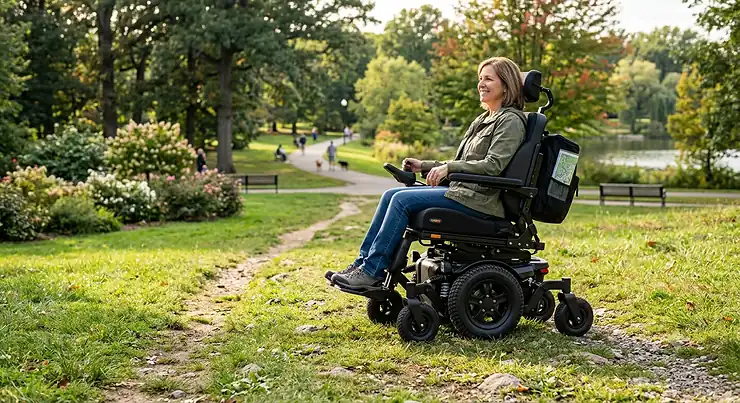
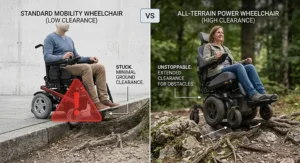
A power wheelchair high ground clearance model is any powered mobility chair engineered with extra distance between its undercarriage and the ground, typically 3 to 7 inches, so it can roll over roots, thresholds, curbs, and rutted dirt without bottoming out. That’s the textbook definition, but if you’ve ever felt your wheelchair lurch to a dead stop on a sidewalk crack that shouldn’t have mattered, you already know why this spec matters more than almost any other number on a spec sheet.
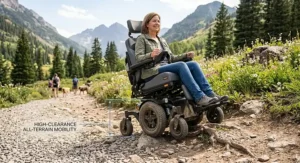
Here’s the thing nobody tells you at the mobility showroom: two wheelchairs can have identical motor wattage and battery range, yet one will sail over a garden hose lying across a path while the other grinds to an undignified halt. The difference usually comes down to a single, boring-sounding measurement most shoppers skip right past. We dug into real product specifications, aggregated customer feedback, and manufacturer documentation to build this guide around seven wheelchairs that actually deliver on the ground clearance promise, from a budget folding model under $1,000 to a genuine 4×4 that costs more than a used car.
Whether you’re shopping for a parent who wants to keep gardening, a veteran who refuses to let a gravel driveway win, or yourself after one too many close calls with a pothole, this guide breaks down what separates a wheelchair that merely claims “all-terrain” on the box from one that backs it up in the driveway, the backyard, and the trailhead parking lot.
Quick Comparison: Power Wheelchair High Ground Clearance at a Glance
| Wheelchair | Ground Clearance | Weight Capacity | Best For |
|---|---|---|---|
| Kerdom DX05 | Approx. 3″ | 400 lbs | Budget-conscious daily outdoor use |
| Forcemech Navigator Pro | 3.5″ | 397 lbs | Lightweight folding portability |
| Shoprider 6Runner 14 | Up to 3″ | 450 lbs | Bariatric stability, six-point contact |
| Porto Mobility Ranger Beast | 3″ | 500 lbs | Heavy-duty pneumatic-tire comfort |
| Quantum Rehab Q6 Edge HD | Insurance-eligible rehab base | 400 lbs (with iLevel) | Medicare-covered complex rehab needs |
| Magic Mobility Extreme X8 | High (4×4 articulating frame) | 400 lbs | True 4×4 off-road adventuring |
| Outrider Coyote 4WD | 6.5″-7″ | ~275 lbs recommended | Extreme trail and backcountry access |
Looking at this lineup, the spread from roughly $900 to well over $20,000 tells its own story: ground clearance alone doesn’t determine price, but the engineering that surrounds it (suspension, motor count, tire design) absolutely does. Budget models like the Kerdom DX05 earn their outdoor reputation through smart tire choices rather than expensive hardware, while something like the Outrider Coyote 4WD treats clearance as just one ingredient in a genuinely off-road-capable platform. Notice, too, that weight capacity and clearance don’t always move together; the Porto Mobility Ranger Beast proves a 500-pound-rated chair can still clear real obstacles when the suspension and tire engineering are right.
💬 Just one click — help others make better buying decisions too!
Top 7 Power Wheelchairs: Expert Analysis
1. Kerdom DX05 — best budget all-terrain value
The Kerdom DX05 proves you don’t need a four-figure budget to get real outdoor capability, and it opens our list as the wallet-friendly entry point. Its dual 250-watt motors (500 watts combined) aren’t flashy, but paired with pneumatic-style fat tires they generate enough torque to climb a 12-degree grade, which covers the overwhelming majority of driveways, curb cuts, and park paths a rider will actually encounter. The 400-pound weight capacity and roughly 20-mile range per charge round out a package that punches well above its price bracket.
Based on the spec comparison, what most buyers overlook about this chair is that its “all-terrain” tag isn’t just marketing filler; the tire profile and motor torque were specifically tuned for grass and gravel rather than only smooth tile. That makes it a smart fit for retirees who mostly need to cross a lawn or gravel path rather than summit a mountain trail. Reviewers consistently note that the chair handles uneven backyard terrain and slightly damp grass without the wheel-spin that plagues cheaper folding chairs, though a few owners mention the frame is heavier to lift into a trunk than the ultralight travel-focused models in this same price range.
Pros:
- ✅ Genuinely capable 12-degree incline rating for the price
- ✅ 400-lb weight capacity is generous for a budget chair
- ✅ Pneumatic-style tires handle grass and gravel confidently
Cons:
- ❌ Heavier to lift than ultralight travel chairs
- ❌ Fewer premium comfort features than mid-range rivals
At around $900-$1,000, check current price before ordering, the DX05 delivers outsized value for anyone whose “outdoor adventure” means the backyard, the sidewalk, and the occasional gravel lot rather than a hiking trail.
2. Forcemech Navigator Pro — lightest folding pick with real clearance
The Forcemech Navigator Pro built its reputation on being the rare folding wheelchair that doesn’t sacrifice outdoor capability for portability, and its 3.5-inch ground clearance backs that up. Dual 250-watt brushless motors and a reinforced aluminum-alloy frame combine to support up to 397 pounds while the whole unit still folds down to 25 by 14 by 31 inches for a car trunk. Two 24V 6.6Ah lithium batteries deliver roughly 18 miles of range, and rear anti-tipping wheels, added in its most recent redesign, address the classic worry about tipping backward on an incline.
What most buyers overlook here is the turning radius: despite its rugged look, wheelchair-junkie-style reviewers note it’s surprisingly nimble in tight apartment hallways, not just open trails. Reviewers consistently report the larger rear wheels and that 3.5-inch clearance give a noticeably steadier feel on park paths and pavement seams than the “budget folding” category typically offers, though several also mention they wish the ground clearance were even a touch higher for deeper yard ruts, and the seat height isn’t adjustable.
Pros:
- ✅ Folds to a compact 25″ x 14″ x 31″ for easy transport
- ✅ Dual batteries deliver about 18 miles of real-world range
- ✅ Rear anti-tip wheels add confidence on uneven ground
Cons:
- ❌ Seat height is fixed, not adjustable
- ❌ Clearance is solid but not class-leading among rivals here
Priced in the $2,800-$3,600 range depending on current promotions, check current price, the Navigator Pro is the chair to buy if portability and outdoor capability need to coexist in one lightweight package.
3. Shoprider 6Runner 14 — best stability for larger riders
The Shoprider 6Runner 14 takes a different approach to terrain confidence: instead of maximizing raw clearance, it maximizes ground contact. Its mid-wheel-drive layout with six points of contact (two large drive wheels plus four support casters) keeps the chair planted on ramps, cambered sidewalks, and thresholds where narrower-stance chairs feel tippy. With up to 3 inches of clearance, a 450-pound weight capacity, and a full suspension system, it was clearly engineered for bariatric users who need both stability and everyday outdoor reach.
Here’s what the spec sheet won’t tell you, but reviewers note: the four-post reclining seat and adjustable armrests matter as much as the drivetrain for people who spend eight-plus hours a day in the chair, because outdoor terrain capability is meaningless if the seating itself causes fatigue. On paper this means the 6Runner 14 trades a bit of raw obstacle-clearing height for a wider, more forgiving footprint, which is exactly the right trade for someone prioritizing tip-over resistance over trail bravado. Owners consistently praise the smooth ride over parking lots and grass, while some mention the top speed, around 3.8 to 5 mph depending on configuration, feels modest next to lighter folding chairs.
Pros:
- ✅ Six-point ground contact adds serious tip-over resistance
- ✅ 450-lb capacity with a full reclining captain’s seat
- ✅ Full suspension smooths bumps on grass and pavement
Cons:
- ❌ Top speed is modest compared to folding rivals
- ❌ Heavier unit weight makes it less travel-friendly
Typically priced from the mid-$5,000s up toward $9,000 depending on battery and seating configuration, check current price, the 6Runner 14 suits users who value planted stability over speed or portability.
4. Porto Mobility Ranger Beast — heavy-duty pneumatic-tire comfort
Nicknamed for a reason, the Porto Mobility Ranger Beast pairs a 500-pound weight capacity with genuinely rugged hardware: dual 400-watt brushless motors, 14-inch air-filled drive tires, a six-shock suspension system, and roughly 3 inches of ground clearance. Its 25-degree incline rating stands out even among dedicated outdoor chairs, and the 39-inch turning radius keeps it usable indoors despite its bariatric-grade frame.
Based on the spec comparison, what separates this chair from lighter folding rivals is the tire choice: air-filled pneumatic tires absorb impact from gravel and roots in a way that solid polyurethane wheels simply can’t, at the cost of needing occasional pressure checks. That’s a fair trade-off for someone whose “outdoor terrain” regularly includes farm gravel or a rutted driveway rather than manicured sidewalks. Reviewers consistently point to the plush ride quality as the standout feature, while a few note that the added shocks and larger tires add noticeable weight, making this less of a grab-and-fold option than the lighter Navigator Pro above.
Pros:
- ✅ 25-degree incline rating leads this entire lineup
- ✅ Air-filled 14″ tires absorb rough-terrain impact
- ✅ Six-point shock suspension smooths gravel and roots
Cons:
- ❌ Heavier build reduces easy portability
- ❌ Pneumatic tires need occasional pressure maintenance
Generally priced in the $4,000-$5,500 range, check current price, the Ranger Beast fits riders who need bariatric-grade capacity without giving up real outdoor comfort.
5. Quantum Rehab Q6 Edge HD — best for Medicare-eligible complex rehab needs
The Quantum Rehab Q6 Edge HD takes a clinical-rehab approach to terrain performance rather than a recreational one. Its ATX suspension system, combining front OMNI-casters with a semi-independent rear caster beam, and Mid-Wheel 6 drive design were engineered to keep all wheels in contact across varied terrain while remaining eligible for Medicare Part B durable medical equipment coverage. The optional iLevel power seat elevation, up to 10 inches, adds a functional dimension no folding travel chair in this list offers: the ability to reach counters and make eye-level conversation happen safely.
What most buyers overlook about this chair is that it isn’t competing on raw ground clearance numbers at all; it’s competing on documented medical necessity and insurance-friendly configurability, which matters enormously for users navigating a formal Certificate of Medical Necessity process with a physician. Based on the spec comparison, the trade-off is procurement complexity: this isn’t an Amazon-checkout purchase, since Quantum Rehab chairs require evaluation by a RESNA-certified Assistive Technology Professional and custom fitting. Reviewers and clinicians consistently note the ride quality and stability outperform typical retail power chairs on cracked sidewalks and transition thresholds, though the ordering timeline is understandably longer.
Pros:
- ✅ ATX suspension keeps wheels grounded across varied terrain
- ✅ iLevel option adds up to 10″ of power seat elevation
- ✅ Medicare Part B eligible with proper physician documentation
Cons:
- ❌ Requires ATP evaluation, not a same-day purchase
- ❌ Configuration and lead times are longer than retail chairs
Pricing commonly runs from about $9,000 to $16,000 depending on seating and electronics, largely billed through insurance, so check current price and coverage with your durable medical equipment supplier.
6. Magic Mobility Extreme X8 — true 4×4 for serious outdoor adventurers
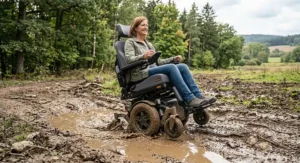
If the previous six chairs stretch the definition of “all-terrain,” the Magic Mobility Extreme X8 delivers on it literally. Four independent 700-watt motors, one per wheel, create genuine 4×4 drive, while an articulating front frame keeps all four low-pressure knobby tires on the ground even across uneven elevation changes. Add a 12-inch power seat elevator, 50-degree tilt-in-space, and a 56-inch turning radius, and you have a chair built for farms, national parks, and rural properties rather than shopping malls.
Here’s what the spec sheet won’t tell you, but owners’ testimonials do: the articulating suspension isn’t just about comfort, it’s what lets all four wheels maintain traction on the kind of rutted, sloped ground that would leave a rigid-frame chair high-centered or spinning a single wheel. On paper this means the X8 trades tight indoor maneuverability, that 56-inch radius is large, for genuine off-road confidence. Reviewers consistently describe the ride as smooth and jolt-free even over rough elevation changes, and the chair has become something of a cult favorite among rural workers and outdoor enthusiasts who tried lighter “all-terrain” chairs first and found them lacking.
Pros:
- ✅ Four independent 700W motors provide true 4×4 traction
- ✅ Articulating suspension keeps all wheels grounded on rough terrain
- ✅ Power seat elevator and tilt add serious functional range
Cons:
- ❌ 56″ turning radius limits tight indoor use
- ❌ Premium price puts it out of reach for casual buyers
Starting retail typically runs from about $19,644 up to $25,525 depending on seating and options, check current price, making the Extreme X8 a serious investment reserved for riders whose lifestyle genuinely demands 4×4 capability.
7. Outrider Coyote 4WD — most extreme ground clearance in this lineup
The Outrider Coyote 4WD isn’t a traditional power wheelchair so much as an accessible off-road vehicle, and it earns its spot here with a class-leading 6.5 to 7 inches of ground clearance, roughly double what most “all-terrain” folding chairs offer. Independent front and rear air-shock suspension, 20-to-22-inch wheels, and a 4WD system powered by a 5-kilowatt hub motor setup let it cross streams up to 3 inches deep, climb rutted trails, and cover up to 140 miles of range on its longest-range battery configuration.
Based on the spec comparison, what separates the Coyote from every other chair on this list is its recumbent, hand-controlled riding position and low center of gravity, engineering choices that prioritize stability at speed (up to 22 mph) over the upright seating most users expect from a power wheelchair. That’s precisely why it suits a very specific rider: someone who wants genuine backcountry access for hunting, fishing, or trail riding, not someone who needs a chair for indoor daily living activities. New Mobility’s real-world review consistently describes the sensation as one of unexpected freedom on terrain that would stop any conventional chair, though the recommended 275-pound rider weight limit and hand-control learning curve are worth knowing upfront.
Pros:
- ✅ Class-leading 6.5″-7″ ground clearance in this lineup
- ✅ True 4WD with independent air-shock suspension front and rear
- ✅ Long-range battery options reach up to roughly 140 miles
Cons:
- ❌ Recommended rider weight capped around 275 lbs
- ❌ Recumbent, hand-control layout requires an adjustment period
Base configurations start around $13,985, with full 4WD and long-range battery builds commonly exceeding $22,000, check current price, positioning the Coyote as the go-to pick for riders chasing genuine backcountry independence rather than everyday sidewalk mobility.
Benefits vs. Traditional Power Wheelchairs
| Factor | High Ground Clearance Chair | Standard Indoor Power Wheelchair |
|---|---|---|
| Typical Clearance | 3″ to 7″+ | 1″ to 2″ |
| Obstacle Handling | Roots, curbs, thresholds, ruts | Smooth floors and low-pile carpet only |
| Tire Type | Pneumatic, knobby, or fat-profile | Solid, narrow, hard-compound |
| Best For | Yards, trails, gravel, rural properties | Apartments, hospitals, tile and hardwood |
The gap in obstacle handling is really the whole story here: a standard indoor chair with 1 to 2 inches of clearance will high-center on the very first tree root or speed bump it meets, while the models in this guide were specifically engineered to clear that same obstacle without hesitation. That said, indoor chairs still win on tight turning radius and lower cost when someone genuinely never leaves smooth flooring, so the “better” choice depends entirely on where a rider actually spends their day.
✨ Don’t Miss These Exclusive Deals!
🔍 Take your outdoor mobility to the next level with these carefully selected wheelchairs. Click on any highlighted model above to check current pricing and availability. The right chair can turn a hesitant trip across the yard into a confident afternoon outdoors your whole family will enjoy!
How to Choose a Power Wheelchair High Ground Clearance Model
Picking the right chair comes down to matching engineering specifics to where you’ll actually drive, not to whichever box uses the word “rugged” the most. Here’s the process worth following.
- Measure your real-world obstacles first. Walk your typical route, driveway, yard, or neighborhood, and estimate the height of the worst curb, root, or threshold you’ll cross regularly; this tells you the minimum clearance you actually need rather than the maximum a salesperson recommends.
- Match tire type to your surface. Pneumatic or knobby tires excel on grass and gravel but need occasional pressure checks, while solid flat-free tires need less maintenance but transmit more shock on rough ground.
- Confirm the weight capacity with margin. Choose a chair rated 50-75 pounds above your actual weight, not its theoretical maximum, since capacity headroom protects the suspension and motor from unnecessary strain over years of use.
- Check the incline rating against your terrain. A 9-degree rating suits gentle ramps; anything steeper than 12 degrees is genuinely needed only if hills are a daily reality, not an occasional one.
- Decide between insurance-billed and retail purchase. If a physician can document medical necessity, a Medicare-eligible complex rehab chair may cost far less out of pocket than a comparable retail model, even if the sticker price looks higher.
- Weigh portability against ruggedness. Folding lightweight chairs trade some clearance and suspension sophistication for trunk-friendly convenience; heavier 4×4 platforms trade portability for genuine backcountry capability.
- Read aggregated review sentiment, not just spec sheets. Real owner feedback consistently surfaces issues, like tipping risk on side slopes or maintenance quirks, that manufacturer marketing copy tends to leave out.
Setting Up Your Elevated Power Wheelchair for Obstacles: A Practical Usage Guide
Getting a raised chassis wheelchair home is only step one; the first 30 days of ownership set the tone for years of reliable outdoor use. Start by fully charging the batteries before the first ride, even if the chair arrives partially charged, since lithium packs perform more predictably after a complete initial cycle. Next, practice on a familiar, low-stakes surface, a driveway or quiet sidewalk, before attempting the gravel path or backyard slope you actually bought the chair for.
Reviewers consistently note that new owners underestimate how differently a higher-clearance chair handles side slopes compared to straight inclines; the added ground clearance raises the center of gravity slightly, so practicing gentle turns on a mild grade before tackling anything steeper is genuinely worth the extra afternoon. Build a simple maintenance rhythm early: check tire pressure weekly if you’re running pneumatic tires, wipe down exposed bearings and joints after muddy or wet outings, and inspect fasteners monthly since rough terrain loosens hardware faster than smooth flooring ever will. Common first-month mistakes include skipping the manual’s recommended break-in period for brakes and assuming maximum incline ratings apply on wet grass, when in practice, wet or loose surfaces meaningfully reduce safe climbing angles regardless of what the spec sheet promises.
Real-World Scenarios: Who Actually Needs High Clearance Electric Wheelchair Reviews to Guide Them
Not every rider needs the same chair, and matching a real-life scenario to a category above often clarifies the decision faster than any spec comparison. Consider three common profiles. First, a retired grandparent living on a half-acre property with a gravel driveway and grass yard: something like the Kerdom DX05 or Forcemech Navigator Pro covers that need affordably without overbuilding for terrain they’ll rarely encounter. Second, a bariatric user in a suburban home who needs daily stability crossing driveways, parking lots, and slightly uneven sidewalks: the Shoprider 6Runner 14 or Porto Mobility Ranger Beast matches that six-point-contact, high-capacity profile far better than a lightweight folding chair would.
Third, a rural property owner, hunter, or outdoor enthusiast who genuinely needs to cross fields, trails, or streams on a regular basis: this is exactly the use case the Magic Mobility Extreme X8 and Outrider Coyote 4WD were engineered for, and trying to make a budget folding chair do that job will only lead to frustration and premature wear. When high clearance electric wheelchair reviews from real owners are read carefully, this pattern shows up again and again: satisfaction correlates far more strongly with matching the chair to the actual terrain than with simply buying the most expensive or most rugged-looking option available.
Common Mistakes When Buying an Elevated Power Wheelchair for Obstacles
The single most common mistake is buying based on marketing language rather than measured specifications; “all-terrain” appears on budget folding chairs and genuine 4×4 platforms alike, so the actual clearance figure, tire type, and motor wattage matter far more than the label. A close second is underestimating maintenance realities: pneumatic tires need periodic pressure checks, and owners who skip this step often blame the chair for performance problems that a five-minute pump session would have solved.
Another frequent error is ignoring turning radius in the excitement over clearance and power; a chair with excellent obstacle-clearing ability but a wide turning radius can become genuinely impractical in a modest home, so measuring your doorways and hallways matters just as much as measuring your yard’s terrain. Buyers also commonly skip the incline rating’s fine print, assuming a 12-degree rating holds on wet grass or loose gravel when, in practice, moisture and loose traction reduce safe climbing angles meaningfully below the rated maximum. Finally, many shoppers overlook whether a chair qualifies for insurance coverage before assuming it’s out of budget, when a Medicare-eligible complex rehab option might actually cost less out of pocket than a comparable retail purchase.
Power Wheelchairs vs. Mobility Scooters for Uneven Terrain Navigation
Terrain navigation performance often gets compared against mobility scooters, and the distinction matters more than shoppers expect. A power wheelchair, particularly a mid-wheel or four-wheel-drive design like several featured above, generally offers a tighter turning radius and better stability on side slopes because its center of gravity and wheelbase are engineered for indoor-outdoor transitions. A mobility scooter, by contrast, typically has a longer wheelbase optimized for straight-line speed and a wider turning circle, which can become a real liability on narrow trails or tight garden paths.
On paper, this means someone who needs to navigate tight backyard gates, narrow sidewalk cuts, or cluttered indoor-outdoor transitions is usually better served by a power wheelchair than a scooter, even though scooters often win on raw top speed and simplicity for open, straight terrain. According to the Centers for Medicare & Medicaid Services documentation on power mobility devices, coverage criteria explicitly distinguish between power-operated vehicles and power wheelchairs based on functional need, which is a useful reminder that this isn’t just a marketing distinction, it’s one insurers formally recognize.
What to Expect: Real-World Terrain Navigation Performance
Spec sheets describe motor wattage and incline degrees, but translating that into what an actual afternoon outdoors feels like is where most buying guides fall short. In practice, a 250-watt dual-motor budget chair with good tires, like the DX05, comfortably crosses dry grass and packed gravel but will noticeably slow, not stop, but slow, when the ground turns soft or muddy. A mid-range chair with 350-to-400-watt motors and pneumatic tires, like the Ranger Beast, handles that same soft ground with far less strain and climbs curb cuts without the rider needing to build up speed first.
At the premium end, the difference isn’t really about crossing a single obstacle at all, it’s about sustained confidence over changing terrain: the Extreme X8’s articulating suspension means a rider crossing a sloped, rutted field doesn’t have to constantly correct course as one wheel loses contact, because all four wheels are independently staying planted. Reviewers consistently describe this as the difference between “getting across” rough ground and genuinely forgetting the ground is rough at all, which is really the entire point of paying for higher-tier engineering in the first place.
Long-Term Cost and Maintenance of a Raised Chassis Wheelchair
A raised chassis wheelchair costs more upfront than a standard indoor model, but the real total cost of ownership depends heavily on tire choice and terrain exposure. Pneumatic tires, common on the mid-range and premium chairs in this guide, need periodic air pressure checks and occasional patching if punctured, an added five-to-ten-minute task every few weeks that solid flat-free tires avoid entirely. Dirt and moisture that come with regular outdoor use also accelerate bearing wear and can corrode electrical connections over time, which is why premium models with sealed components command higher prices but often reduce long-term maintenance costs and downtime.
Battery replacement is the other significant long-term expense to budget for: most lithium packs in this category last several years of regular use before capacity noticeably declines, and replacement packs for folding chairs typically run a modest fraction of the chair’s original price, while complex rehab and 4×4 platforms carry proportionally higher replacement costs. Value-conscious buyers should also factor in warranty length, since frame warranties in this space commonly range from three to five years, and a longer warranty on the frame specifically protects against the exact kind of stress fractures that repeated curb and root impacts can eventually cause.
Safety, Regulations, and Insurance Compliance Guide
Outdoor terrain introduces safety considerations that indoor-only chairs simply don’t face, starting with side-slope stability. The combination of higher ground clearance, which raises the center of gravity, and lateral forces on a cross-slope creates real tipping risk, so riders should learn a chair’s behavior gradually on gentle grades before attempting steeper cross-slope routes. It’s also worth confirming electromagnetic braking engages reliably on a test slope before relying on it during an actual outdoor excursion, since wet or loose surfaces can meaningfully change stopping distance.
On the regulatory side, outdoor accessibility standards for trails and recreational areas on federal land are formally defined by the U.S. Access Board’s outdoor developed areas accessibility guidelines, which set minimum tread widths and surface firmness standards that affect where certain mobility devices can reasonably travel. For funding, Medicare Part B classifies power wheelchairs as durable medical equipment and requires a face-to-face physician examination and documented medical necessity before covering a purchase, so anyone hoping to offset the cost of a complex rehab chair like the Q6 Edge HD through insurance should start that conversation with their doctor early, since the approval process can take several weeks.
Frequently Asked Questions
❓ How much ground clearance does a power wheelchair need for grass and gravel?
❓ Is a high ground clearance power wheelchair covered by Medicare?
❓ What is the best power wheelchair for uneven yards and dirt trails?
❓ Can a high ground clearance power wheelchair go in sand or mud?
❓ How much does a power wheelchair with high ground clearance cost?
Conclusion
Choosing a power wheelchair high ground clearance model really comes down to being honest about where you’ll actually drive it. If your outdoor world is mostly a driveway and a lawn, the Kerdom DX05 or Forcemech Navigator Pro will serve you well without overspending on capability you won’t use. If stability and bariatric-friendly capacity matter most, the Shoprider 6Runner 14 and Porto Mobility Ranger Beast earn their spots through six-point contact and pneumatic-tire comfort. And if your outdoor ambitions genuinely include farmland, trails, or backcountry access, the Quantum Rehab Q6 Edge HD, Magic Mobility Extreme X8, and Outrider Coyote 4WD each represent a different flavor of serious, purpose-built engineering.
None of these chairs are perfect for every rider, and that’s precisely the point: the “best” option here isn’t a single universal winner but whichever model matches your terrain, your budget, and your body honestly. Take the time to measure your real-world obstacles, confirm weight capacity with margin, and check whether insurance coverage might change the math before you commit. Whatever you choose, the right high-clearance chair should feel less like a compromise and more like permission to stop thinking about the ground beneath you at all.
Recommended for You
- All Terrain Wheelchair for Beach: 7 Sand-Ready Picks (2026)
- All Terrain Power Wheelchair: 7 Rugged Picks for 2026
- Power Wheelchair Small Turning Radius: 7 Best Picks for 2026
Disclaimer: This article contains affiliate links. As an Amazon Associate, I earn from qualifying purchases. If you purchase products through these links, we may earn a small commission at no additional cost to you.
✨ Found this helpful? Share it with your friends! 💬🤗
