
In This Article
Buying a power wheelchair is nothing like buying a toaster. Get it wrong and you’re not just out some money — you’re stuck with a machine that can’t get you to the kitchen, or worse, one that strands you three blocks from home with a dead battery. So when people start Googling power wheelchair brands, what they’re really asking is: who can I actually trust with something this important?

Fair question. The mobility equipment industry is crowded with private-label imports, rebadged Chinese frames, and marketing copy that reads suspiciously similar from one “brand” to the next. But underneath the noise, a handful of manufacturers have built genuine engineering track records — decades of R&D, real service networks, and complex rehab technology programs (CRT) that actually go through FDA Class II clearance and insurance-grade documentation. This guide narrows the field to seven of them: Pride Mobility, Permobil, Quantum Rehab, Golden Technologies, Merits Health, Drive Medical, and Invacare.
We’ll walk through what each brand does well, where it falls short, and — because this is a comparison people genuinely need, not just a spec dump — how Pride Mobility vs Permobil power wheelchair debates actually shake out in real use. You’ll also get a look at top wheelchair manufacturers reputation more broadly: who backs their warranties, who ships parts fast, and who leaves you waiting six weeks for a joystick. None of this is guesswork; it’s built from manufacturer documentation, dealer listings, and aggregated user feedback pulled from mobility retailers and forums.
What Is a Power Wheelchair Brand, Really?
A power wheelchair brand is a manufacturer that designs, engineers, and stands behind a line of battery-powered mobility chairs — as opposed to a reseller who slaps a logo on an imported frame. Real brands run their own R&D, maintain FDA-registered manufacturing, and typically hold Medicare/Medicaid HCPCS coding for their products, which is why your durable medical equipment (DME) supplier usually only carries a handful of names.
Quick Comparison: Power Wheelchair Brands at a Glance
| Brand | Known For | Price Range | Best For |
|---|---|---|---|
| Pride Mobility | Broadest lineup, elevating seats | $1,600–$7,500 | Everyday users wanting variety |
| Permobil | Complex rehab, suspension engineering | $9,000–$25,000+ | Users needing power seating |
| Quantum Rehab | Advanced electronics, iLevel | $5,000–$20,000+ | Tech-forward CRT users |
| Golden Technologies | Heavy-duty/bariatric strength | $3,800–$7,300 | Higher weight capacities |
| Merits Health | Value-driven mid-wheel drive | $2,800–$4,000 | Budget-conscious full-size buyers |
| Drive Medical | Affordable folding chairs | $1,600–$2,200 | Occasional/transport use |
| Invacare | Compact indoor maneuverability | $2,500–$6,500 | Tight indoor spaces |
Looking at the spread above, the price gap between a folding Drive Medical chair and a fully configured Permobil rehab base isn’t a rounding error — it reflects genuinely different engineering tiers, not just branding. Complex rehab technology (CRT) brands like Permobil and Quantum Rehab build to accommodate power seating, custom electronics, and clinical documentation for insurance, while value brands like Merits Health and Drive Medical focus on stripped-down reliability at a fraction of the cost. Neither approach is “better” in the abstract; the right pick depends entirely on how complex your seating and mobility needs are.
💬 Just one click — help others make better buying decisions too!😊
Top 7 Power Wheelchair Brands: Expert Analysis
1. Pride Mobility Jazzy Air 2 — elevates 12 inches for eye-level conversations
The standout feature here isn’t subtle: a captain’s seat that powers up 12 inches in 11 seconds, and can keep rising or lowering while you’re driving.
Key specs translate directly into daily-life wins. The chair supports up to 300 pounds and covers roughly 15–16.6 miles on a charge depending on seat height and user weight, while Mid-Wheel 6 drive with Active-Trac suspension keeps six wheels grounded on curbs and uneven pavement rather than tipping onto four like some front-wheel designs. Practically, that means you can reach a top kitchen shelf, make genuine eye contact at a standing-height counter, or roll into a crowd without craning your neck upward the whole time — something flat-seated chairs simply can’t offer.
Based on the spec comparison against other elevating models in this bracket, the Jazzy Air 2 earns its reputation by doing one thing extremely well rather than trying to be everything. It’s a strong fit for home and community use where social interaction and reach matter more than rugged trail performance, and less ideal for someone who mainly needs speed or long-range outdoor travel.
Reviewers consistently report that the elevating function feels smoother and quieter than earlier Jazzy Air generations, though several also flag that the “Heaviest Piece” — around 100 pounds even after breakdown — makes solo car-trunk loading unrealistic without a lift.
Pros:
- ✅ Elevates while driving, unlike most competitors’ locked-seat designs
- ✅ Mid-Wheel 6 stability handles curbs and mixed indoor/outdoor terrain
- ✅ Multiple seat width options for a genuinely custom fit
Cons:
- ❌ Heaviest component still too bulky for unassisted trunk loading
- ❌ Range drops noticeably at max seat elevation and higher user weight
At the time of research, the Pride Mobility Jazzy Air 2 typically lands in the $4,000–$4,700 range through authorized dealers, before insurance. For anyone who genuinely needs the reach-and-reconnect function daily, that price buys real independence — but if elevation isn’t a priority, a non-elevating Jazzy model saves real money for a similar ride.
2. Permobil M3 Corpus — Swedish suspension engineering that stays active in every seat position
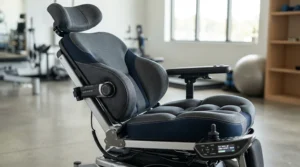
What most buyers overlook about the M3 Corpus is that its FlexLink suspension keeps all six wheels grounded even while tilt, recline, or seat elevation is active — a detail that sounds minor until you’re the one being jostled.
The base delivers up to 6 mph and roughly 12–20 miles of range depending on battery configuration (60Ah standard, 70–85Ah optional), with obstacle-climbing up to about 3 inches. On paper, that range variance matters: a user in a dense apartment building covering short indoor distances will barely notice, but someone commuting outdoors daily should budget for the upgraded battery pack from day one rather than treating it as an afterthought.
Here’s what the spec sheet won’t tell you, but reviewers and clinicians note: most suspension systems on competing chairs lock out once you tilt or recline, which means the ride gets rougher exactly when a user is most vulnerable to pressure and shear forces. Permobil’s decision to keep suspension active through every powered seat function is the kind of engineering choice that mainly benefits users with complex postural or skin-integrity needs — it’s less relevant if you’re an active, able-postured user who just wants a fast indoor/outdoor chair.
Aggregated dealer and clinician commentary consistently describes Permobil’s build quality and long-term durability as a step above mass-market brands, though the tradeoff shows up immediately at checkout.
Pros:
- ✅ Suspension stays fully active through tilt, recline, and elevation
- ✅ MyPermobil app tracks battery range and seat activity data
- ✅ Weight capacity now extends to 330 lbs on current builds
Cons:
- ❌ Custom configuration means pricing is rarely transparent upfront
- ❌ Requires a clinical evaluation, slowing down the buying process
Permobil doesn’t publish flat retail pricing since the M3 Corpus is a build-to-order complex rehab chair, but dealer quotes typically start in the low five figures once seating and batteries are configured — check current price through an authorized Permobil dealer for your specific setup. If you need powered seating that survives years of daily pressure-relief cycling, this is where that investment goes.
3. Quantum Rehab Q6 Edge 3 — Q-Logic 3 electronics with Bluetooth device control
The short version of what sets this chair apart: it’s the power wheelchair equivalent of a smartphone, with a drive control system that also runs your tablet, computer, or phone via Bluetooth.
Specs that matter in practice include a 300–400 lb weight capacity range across configurations, a 6 mph top speed, and Smooth Ride Suspension (SRS) paired with optional iLevel seat elevation up to 12 inches — two more inches than the Jazzy Air 2 above. Base weight sits around 138 pounds, which, combined with ATX front OMNI-casters, gives it noticeably tighter turning in doorways and hallways than heavier bariatric-class chairs.
Based on the spec comparison, the Q6 Edge 3 is squarely aimed at tech-comfortable users who want to control more than just movement from one interface — environmental control units, computer cursors, and smartphone functions can all route through Q-Logic 3. That’s a genuine quality-of-life upgrade for someone with limited hand function who’d otherwise need separate switch-access devices for each task, but it’s overkill (and extra cost) for a user who just wants to drive from room to room.
Reviewers on dealer platforms note the customization depth as a strength, though a few mention a learning curve getting the Q-Logic 3 menus initially configured to personal preference.
Pros:
- ✅ Bluetooth drive control doubles as a computer/phone interface
- ✅ iLevel seat elevation reaches a full 12 inches at walking speed
- ✅ ATX suspension handles varied terrain without sacrificing turning radius
Cons:
- ❌ Menu-heavy electronics take time to fully personalize
- ❌ Complex rehab configuration means longer lead times than off-shelf chairs
Pricing tracks similarly to the Permobil M3, generally in the $10,000+ range once seating and electronics are configured — Medicare/Medicaid coverage often applies for qualifying complex rehab needs, so ask your DME supplier about documentation requirements before assuming this is out of reach.
4. Golden Technologies Compass HD — 450-pound capacity without losing the tight turn
The headline number says it all: a 20-inch turning radius on a chair rated for 450 pounds, which is a genuinely hard engineering balance to strike.
The specs behind that claim include a springless articulating chassis and true center-wheel drive, a 4 mph top speed, roughly 12 miles of range, and 3.5 inches of ground clearance. In practical terms, center-wheel drive on a heavy-duty frame usually sacrifices tight-space maneuverability for stability — the Compass HD is one of the few bariatric-capacity chairs that doesn’t force that tradeoff, so users can still navigate a standard hallway or bathroom doorway.
What most buyers overlook about heavy-duty chairs generally is that weight capacity numbers often come with hidden asterisks around speed and range once you’re near the top of the rated limit; the Compass HD’s 12-mile range should be read as a realistic ceiling for larger users, not a guarantee. Reviewers and dealers consistently flag it as one of the more affordable true heavy-duty options relative to premium bariatric chairs from CRT brands, without noticeably skimping on frame durability.
Pros:
- ✅ 450 lb weight capacity paired with a compact 20-inch turning radius
- ✅ Springless articulating chassis absorbs terrain without a bulkier frame
- ✅ Backed by a 5-year frame warranty and 1-year in-home service
Cons:
- ❌ 4 mph top speed is modest next to lighter-duty competitors
- ❌ 12-mile range shrinks further for users near the weight ceiling
At the time of research, the Golden Technologies Compass HD generally sits in the $3,800–$5,300 range depending on dealer promotions, well under many premium bariatric alternatives — a strong value verdict for buyers who need real capacity without complex rehab pricing.
5. Merits Health Vision Sport — mid-wheel drive and full suspension at a genuinely budget price
The Vision Sport’s standout is simple: it delivers mid-wheel drive maneuverability and full suspension — features usually reserved for pricier chairs — without the premium price tag.
Specs worth knowing: a 300 lb weight capacity, up to 18 miles of range on 35Ah batteries, a 20-inch turning radius, and an optional power-elevating seat that lifts 7.5 inches. In real-world terms, mid-wheel drive gives the tightest turning circle of the three drive-wheel positions, and full suspension smooths out sidewalk cracks and thresholds that would otherwise jolt a rigid-frame budget chair.
On paper this means Merits Health is doing something most budget brands don’t attempt — genuinely matching mid-range ride quality at a lower price point rather than just stripping features down. What the spec sheet won’t tell you, but user reports suggest, is that the semi-reclining 135-degree backrest is a meaningfully comfortable feature for longer outings, not just a checkbox spec.
Pros:
- ✅ Mid-wheel drive and full suspension rarely paired at this price
- ✅ 18-mile range beats several pricier full-size competitors
- ✅ Optional 7.5-inch power seat elevation available on select trims
Cons:
- ❌ Fewer premium customization options than CRT-tier brands
- ❌ Captain’s seat sizing tops out smaller than heavy-duty rivals
Typical pricing runs in the $2,800–$3,700 range at the time of research, positioning the Merits Health Vision Sport as one of the strongest value verdicts in this whole roundup — genuinely competitive ride quality without CRT-level cost.
✨ Don’t Miss These Exclusive Deals!
🔍 Take your mobility upgrade to the next level with these carefully selected picks. Click on any highlighted brand to check current pricing and availability — these chairs help create the independence your family deserves.

6. Drive Medical Cirrus Plus EC — the no-gimmicks folding chair for occasional and transport use
Its defining feature is straightforward portability: a folding carbon steel frame designed to move from home to car trunk without complex disassembly.
Specs include a 300 lb weight capacity, a programmable PG controller, and available seat widths from 18 to 22 inches, all built around a double cross-brace frame for added stability at the higher end of that capacity. In practice, that means the chair adjusts to a wider range of body types than most single-size folding chairs, while still folding down for a sedan trunk rather than requiring a van or ramp.
Based on the spec comparison with other budget folding chairs, the Cirrus Plus EC’s main advantage is that it passed ANSI RESNA testing requirements — the same safety benchmark higher-end chairs must meet — despite its low price point, which isn’t true of every import-brand folding chair on the market. Reviewers consistently note it as reliable for light, occasional use — trips to appointments, short errands — but not built for someone who’s in the chair 10+ hours a day covering real distance.
Pros:
- ✅ Passed ANSI RESNA safety testing at a budget price point
- ✅ Folds for standard car trunk transport without extra tools
- ✅ Four seat width options accommodate different body sizes
Cons:
- ❌ Limited range and speed compared to full-size power chairs
- ❌ Best suited to occasional rather than all-day daily use
Priced around $1,600–$2,200 at the time of research, this is genuinely one of the most accessible entry points into power mobility — the value verdict here is strong specifically for light, occasional users rather than full-time wheelchair users.
7. Invacare Pronto M41 — center-wheel drive built for tight indoor spaces
The Pronto M41’s standout is its compact center-wheel-drive base, engineered specifically to turn on the spot in hallways and doorways most chairs can’t navigate.
Key specs include SureStep suspension for handling everyday thresholds, six-wheel-on-the-ground stability, in-line motors for smoother acceleration, and Modulite seating options that support powered lift, tilt, and recline add-ons. In practice, SureStep suspension means the chair can roll over a raised doorway threshold or a slightly uneven transition strip without the front casters catching — a small detail that matters enormously for daily indoor independence.
Here’s what most buyers overlook: the Pronto M41 is explicitly engineered as an indoor-focused chair with only limited outdoor capability on flat, solid surfaces — it will genuinely struggle on gravel, grass, or steep slopes. Reviewers and dealer descriptions consistently frame it as ideal for assisted living facilities, apartments, and smaller homes, which tracks with Invacare’s decades of institutional and clinical distribution experience.
Pros:
- ✅ Center-wheel drive turns on the spot in narrow hallways
- ✅ Modulite seating supports powered lift, tilt, and recline options
- ✅ Six-wheel stability keeps traction on uneven indoor flooring
Cons:
- ❌ Not designed for regular outdoor or uneven-terrain use
- ❌ Configuration options can extend delivery timelines
At the time of research, the Invacare Pronto M41 generally runs $2,500–$6,500 depending on seating configuration — a solid pick specifically for indoor-first users, though outdoor-focused buyers should look elsewhere on this list.
Top 7 Products Comparison Table
| Product | Weight Capacity | Top Speed | Range | Best For |
|---|---|---|---|---|
| Pride Mobility Jazzy Air 2 | 300 lbs | 4 mph | ~15–16.6 mi | Reach and social elevation |
| Permobil M3 Corpus | Up to 330 lbs | 6 mph | ~12–20 mi | Complex powered seating |
| Quantum Rehab Q6 Edge 3 | 300–400 lbs | 6 mph | Varies by battery | Tech-driven CRT users |
| Golden Technologies Compass HD | 450 lbs | 4 mph | ~12 mi | Bariatric users, tight turns |
| Merits Health Vision Sport | 300 lbs | 5 mph | ~18 mi | Budget-conscious full-size |
| Drive Medical Cirrus Plus EC | 300 lbs | Moderate | Shorter, transport-focused | Occasional/light use |
| Invacare Pronto M41 | 300 lbs+ | Moderate | Indoor-focused | Tight indoor navigation |
Scanning this table, weight capacity and drive type end up mattering more than top speed for most real buyers — a 6 mph chair is meaningless if it can’t turn around in your bathroom doorway. The Golden Technologies Compass HD stands out for combining a genuinely high weight ceiling with surprisingly tight maneuverability, while Permobil M3 Corpus and Quantum Rehab Q6 Edge 3 justify their premium pricing through powered seating and electronics depth rather than raw speed.

Pride Mobility vs Permobil Power Wheelchair: The Real Comparison
This is one of the most searched match-ups in the category, and for good reason — both brands are legitimate, but they’re not really competing for the same buyer.
Pride Mobility’s strength is breadth: dozens of models spanning entry-level folding chairs to elevating Jazzy models, most available without a lengthy custom-build process. That makes Pride the more accessible choice for someone who needs a chair relatively quickly and doesn’t require complex powered seating. Permobil, on the other hand, builds almost exclusively toward complex rehab technology — power tilt, recline, elevation, and suspension that stays active through every seat position — which means longer lead times, mandatory clinical evaluation, and meaningfully higher cost, but a chair engineered for users with more involved postural or medical needs.
Reviewers and clinicians describe Permobil’s reputation for expensive as somewhat overstated once you compare like-for-like configurations against similarly equipped competitors — the price gap narrows considerably once you add Pride’s own powered seating options to a comparable build. For a straightforward daily-use chair without complex seating needs, Pride Mobility is very likely the more practical and affordable choice; for a user whose therapist has recommended powered tilt and recline for pressure management, Permobil’s engineering depth becomes harder to substitute.
Top Wheelchair Manufacturers: What Reputation Actually Means
“Reputation” gets thrown around loosely in mobility marketing, so it’s worth breaking into what actually matters: warranty length and coverage, parts availability, service network size, and how a company handles recalls or defects when they happen — because they sometimes do, across every brand.
Pride Mobility and Golden Technologies both lean on wide U.S. dealer networks, which generally means faster local service and parts. Permobil and Quantum Rehab, as CRT-focused manufacturers, typically route service through specialized rehab technology suppliers rather than general DME stores — slower for simple fixes, but staffed by technicians trained specifically on complex seating systems. Merits Health and Drive Medical compete primarily on price and straightforward reliability rather than service depth, which is a reasonable tradeoff if your chair’s electronics stay simple. Invacare’s institutional and clinical distribution history gives it strong presence in facilities, though individual consumer service experiences vary more by local dealer than by the manufacturer itself.
Brand Comparison: Manufacturer Reputation and Quality Brands Side by Side
| Factor | Pride Mobility | Permobil | Quantum Rehab | Golden Tech | Merits Health | Drive Medical | Invacare |
|---|---|---|---|---|---|---|---|
| Price tier | Low–Mid | Premium | Premium | Mid | Budget–Mid | Budget | Mid |
| Best strength | Model variety | Seating tech | Electronics | Heavy-duty capacity | Value ride quality | Portability | Indoor maneuverability |
| Typical warranty | Multi-year frame | Extensive CRT support | Extensive CRT support | 5-year frame | Lifetime frame | Standard DME | Standard DME |
Reading across this table, the clearest pattern is that CRT brands (Permobil, Quantum Rehab) trade convenience and price for medical-grade customization, while value brands (Merits Health, Drive Medical) trade customization for accessibility. Pride Mobility, Golden Technologies, and Invacare occupy a practical middle ground, each specializing in a specific use case — variety, weight capacity, and indoor precision, respectively — rather than trying to out-engineer the CRT tier.
How to Choose a Power Wheelchair Brand
- Start with your primary environment. Indoor-heavy users should prioritize turning radius and drive type over top speed or long range.
- Be honest about weight capacity needs. Choosing a chair rated close to your actual weight, rather than right at the limit, preserves speed and range over time.
- Decide if you need powered seating. Tilt, recline, and elevation functions point you toward CRT brands like Permobil or Quantum Rehab; without that need, mid-market brands cover most daily use cases.
- Check your insurance pathway early. Medicare and Medicaid coverage criteria differ significantly between standard and complex rehab power wheelchairs, so understanding your coding category before shopping saves time later, per the Centers for Medicare & Medicaid Services power mobility device documentation requirements.
- Weigh dealer proximity against brand prestige. A slightly less “premium” brand with strong local service can outperform a top-tier chair with a distant, slow-to-respond dealer.
- Read aggregated reviews across multiple retailers, not just the manufacturer’s own site, to spot recurring complaints before they become yours.
- Ask specifically about battery and part replacement costs, since these recurring expenses vary more between brands than the sticker price suggests.
Common Mistakes When Buying a Power Wheelchair
Buyers frequently prioritize top speed and headline range numbers over turning radius and drive type — numbers that look impressive on paper but rarely matter if the chair can’t navigate a home’s actual doorways and hallways. Another recurring mistake is skipping a proper seating evaluation to save time, only to discover months later that the base chair can’t be retrofitted with the tilt or recline function that was actually needed. Buyers also often underestimate delivery and configuration timelines for CRT chairs, assuming a quick turnaround similar to ordering a standard folding model, then get frustrated when insurance documentation and custom seating add weeks to the process. Finally, many people skip test-sitting a demo unit entirely, relying solely on online specs — something in-store mobility retailers and DME suppliers almost always offer, and skipping it is a genuinely avoidable risk.
Practical Usage Guide: Getting the Most From a New Power Wheelchair
Setting up a new power chair correctly in the first 30 days makes a measurable difference in both battery lifespan and long-term comfort. Most manufacturer guidance, including Pride Mobility and Drive Medical documentation, recommends charging new batteries daily during a two-week break-in period regardless of how much they were used that day — batteries reach optimal range capacity gradually, not immediately out of the box.
Beyond charging habits, take time in the first week to adjust seat depth, armrest height, and joystick sensitivity rather than accepting factory defaults; most CRT and mid-tier chairs allow more fine-tuning than new users realize, and small adjustments meaningfully reduce fatigue over long use. A common first-month mistake is leaving the controller’s max speed setting at its highest level immediately — dialing it down slightly while building confidence in tight spaces (kitchens, bathrooms, elevators) prevents avoidable collisions with walls and furniture. Finally, schedule your first professional maintenance check around the three-to-six month mark even if nothing seems wrong; tire pressure, joint tightness, and battery terminal corrosion are all easier and cheaper to catch early than after a breakdown.
Real-World Scenarios: Matching Users to Brands
Consider a retired teacher in her seventies living alone in a single-story home with narrow hallways — daily indoor mobility matters far more than range or speed here, making the Invacare Pronto M41 or a standard Merits Health Vision Sport a stronger fit than a CRT chair she doesn’t need. Compare that to a 34-year-old with a spinal cord injury who needs regular pressure-relief tilt and works from home most days — that profile points toward Permobil M3 Corpus or Quantum Rehab Q6 Edge 3, where powered seating isn’t a luxury but a medical necessity for skin protection. A third scenario: a caregiver managing mobility for a bariatric family member who needs both higher weight capacity and reasonably tight indoor turning — the Golden Technologies Compass HD is purpose-built for exactly that combination, while most standard-capacity chairs simply aren’t rated for the job.
What to Expect: Real-World Performance vs Spec Sheets
Manufacturer range figures are typically measured under close-to-ideal conditions — flat ground, moderate temperature, mid-weight rider — so real-world range for most users runs meaningfully lower, especially in cold weather or on inclines. Turning radius numbers translate fairly reliably to real hallway navigation, but door width and furniture placement in an actual home often matter more than the spec itself. Top speed ratings rarely get used at their maximum in daily life; most owners report driving well under the rated top speed indoors simply out of caution around people and obstacles, reserving higher speeds for open outdoor stretches.
Long-Term Cost and Maintenance
Total cost of ownership extends well past the sticker price: batteries typically need replacement every 1–2 years depending on usage intensity, tires (especially foam-filled or solid options) last longer than pneumatic tires but cost more upfront, and joystick or controller repairs can run several hundred dollars outside of warranty. CRT brands like Permobil and Quantum Rehab generally carry higher parts costs but also longer structural warranties, which can offset the gap over a 5-7 year ownership period. Budget brands like Drive Medical keep both upfront and replacement-part costs low, which suits occasional users well but can mean more frequent full-chair replacement for heavy daily users. Factoring in insurance coverage differences between standard and complex rehab HCPCS codes is essential here too, since Medicare’s documentation requirements directly affect out-of-pocket costs over time.
Features That Actually Matter (And Those That Don’t)
Turning radius, drive wheel position, and weight capacity headroom matter enormously and should be non-negotiable priorities. Powered seating functions (tilt, recline, elevation) matter a great deal — but only if a clinician has actually identified a medical need for them; buying these features speculatively adds significant cost without proportional benefit. On the other hand, flashy extras like ambient LED lighting, app connectivity, or premium upholstery colors are genuinely nice-to-haves that shouldn’t sway a decision between two otherwise well-matched chairs. Battery amp-hour rating matters more than manufacturers often emphasize in marketing copy — it’s a more reliable range predictor than the “up to X miles” headline number alone.
Safety, Regulations, and Compliance Guide
Power wheelchairs sold in the U.S. are regulated as FDA Class II medical devices, meaning manufacturers must meet specific safety and performance standards before a chair reaches the market, according to FDA guidance on mobility devices. Chairs intended for airline travel, like Pride’s Carbon series, must also carry airline-compliant lithium batteries meeting FAA transport rules — always confirm this specifically if travel is a priority, since not every lightweight chair qualifies. For Medicare and Medicaid coverage, the Centers for Medicare & Medicaid Services power mobility device criteria require documented mobility limitations, a physician’s order, and proof that a power chair — rather than a cheaper mobility aid — is medically necessary; skipping this documentation is one of the most common reasons claims get denied. ANSI/RESNA testing, referenced by several brands in this guide including Drive Medical, is a voluntary but widely respected safety benchmark covering stability, braking, and electrical safety that’s worth confirming before purchase regardless of brand.

Frequently Asked Questions
❓ Which power wheelchair brand is the most reliable?
❓ Is Permobil better than Pride Mobility?
❓ How much does a power wheelchair cost in 2026?
❓ Does Medicare cover power wheelchairs?
❓ What's the difference between complex rehab and standard power wheelchairs?
Conclusion
There’s no single “best” power wheelchair brand — there’s only the best match for your specific body, home, and daily routine. If you need broad model variety at accessible pricing, Pride Mobility covers more ground than almost anyone else. If a clinician has identified a genuine need for powered seating, Permobil and Quantum Rehab justify their premium through engineering most buyers will never fully test but will deeply appreciate if they need it. Golden Technologies solves the bariatric-capacity-versus-maneuverability problem better than most competitors, Merits Health delivers surprisingly strong ride quality at a budget price, Drive Medical remains the sensible pick for light or occasional use, and Invacare’s indoor-focused engineering fills a specific, real need for smaller living spaces.
Whichever direction you lean, don’t skip the fundamentals covered above: confirm your weight capacity headroom, understand your insurance documentation pathway, and if at all possible, sit in a demo unit before committing thousands of dollars to a chair you’ll depend on every single day.
✨ Ready to compare your options?
Check current pricing and availability on the brands above, and don’t let analysis paralysis delay the independence a well-matched power wheelchair can genuinely offer! 🦽💪
Recommended for You
- Medicare Approved Power Wheelchairs: 7 Top Picks for 2026
- Bariatric Power Wheelchair 600 lb Capacity: 7 Best Picks for 2026
- Power Wheelchair for MS Patients: 7 Best Picks for 2026
Disclaimer: This article contains affiliate links. As an Amazon Associate, I earn from qualifying purchases. If you purchase products through these links, we may earn a small commission at no additional cost to you.
✨ Found this helpful? Share it with your friends! 💬🤗
