
In This Article
Kids don’t read spec sheets before they sprout, and the chair they were fitted for in September can feel like borrowed shoes by spring. A growth-adjustable wheelchair for kids ages 5 to 10 is a pediatric manual wheelchair built to lengthen, widen or raise its seat as the child grows, using built-in frame adjustments or low-cost growth kits instead of a full replacement. The seat, back and footrests stay matched to the body through the fastest-changing school years.

Between kindergarten and fifth grade, a lot happens. According to Permobil’s pediatric seating team, kids typically grow about 2½ inches a year after age 2, so about 3 inches of built-in growth is a sensible planning figure. Girls tend to hit bigger spurts between 8 and 13, boys between 10 and 15. A chair that can’t absorb that is a chair you’ll be fighting, or replacing.
One honest note before we dive in. Most of the chairs below are prescription-fit equipment sold through authorized mobility dealers, not impulse buys. Public review pools for them are thin, and I won’t invent sentiment that I can’t verify. Instead, this guide leans on manufacturer specifications, clinical sources and funding rules, then tells you what each number means for a real child in a real school hallway. Availability and prices change, so treat every price below as a range and check current pricing before you commit.
Here’s the roadmap: a quick comparison, seven chairs in depth, the growth mechanics (depth, width, height), and the funding rules that quietly decide how long a frame has to last.
Quick Comparison: 7 Chairs at a Glance
| Product | Growth Built In | Frame Style | Best For |
|---|---|---|---|
| Drive Medical Wallaby | None (two fixed sizes) | Folding steel | Budget stopgap, travel backup |
| Karman Flexx Junior | Width 10″–14″, adjustable depth and height | Folding | Value-focused families with older kids |
| Zippie GS | About 2″ width, 4″ depth | Folding | Car-trunk-friendly daily chair |
| Zippie Zone | 3″ depth in frame, 2″ more in sling, width via parts | Rigid | Active self-propellers |
| Ki Mobility Little Wave Clik | Width and depth 8″–18″, click-indexed | Rigid | Maximum fine-tuning |
| TiLite Twist | 2″ width, 3″ depth | Lightweight aluminum | Smallest kids, very low seat height |
| Zippie IRIS | Up to 4″ depth, width and extra depth via parts | Tilt-in-space | Positioning and pressure relief |
Read the table as a spectrum. The Drive Medical Wallaby costs the least and grows the least, while the Ki Mobility Little Wave Clik and TiLite Twist invest most in fine-tuning. If your child self-propels, the rigid-frame trio (Zippie Zone, Ki Mobility Little Wave Clik, TiLite Twist) is where active-use thinking lives. If positioning is the priority, the Zippie IRIS is a different tool entirely, and comparing it to the others on price alone would be like comparing a bicycle to a minivan.
💬 Just one click — help others make better buying decisions too!😊
Top 7 Growth-Adjustable Wheelchairs for Kids Ages 5 to 10: Expert Analysis
1. Drive Medical Wallaby — budget stopgap with two fixed sizes
Let’s start with the honest outlier. The Drive Medical Wallaby isn’t growth-adjustable in seat dimensions, since it comes in 12″ × 12″ and 14″ × 14″ versions. It earns its slot because it’s the baseline that shows you what the other six chairs charge extra for.
The steel folding frame weighs about 33 pounds without footrests, which is hefty next to the 12–25 pound ultralights here. It rolls on 22″ rear wheels with 6″ casters. The manufacturer lists a 150-pound capacity, though one distributor lists 80 pounds for the 14″ model, so verify that on the exact listing. Seat-to-floor height is 19″ front and 18″ rear, push handles adjust from 33″ to 39″, and the swing-away footrests adjust in height without tools. It’s also WC19 transit-compliant for users between 50 and 80 pounds when paired with the optional headrest extension.
My analytical take: this is a caregiver-pushed chair first. The large rear wheels are adult-style, so a 5-year-old’s reach to the handrims is a question for a therapist, not a spec sheet. It suits short-term needs, a grandparents’-house backup, or a bridge while funding for a custom chair clears.
Review sentiment: I couldn’t verify an aggregated review summary I’d be comfortable citing, so I’m skipping it. When you shop, scan recent verified-purchase reviews for comments on weight and brake feel.
Pros:
- ✅ Lowest entry cost of the seven
- ✅ Tool-free footrest height adjustment
- ✅ Transit brackets included for bus and van travel
Cons:
- ❌ Seat width and depth don’t grow
- ❌ Heavy for a child’s frame and a parent’s trunk
Price range: roughly $550–$800 depending on seller, so check the current price. Value verdict: a smart bridge, a poor long-term investment.

2. Karman Flexx Junior — widest folding width range for the money
The Karman Flexx Junior is the chair for families who want real adjustability without a fully custom order. Karma says it’s designed for children 7 to 15, so parents of 5- and 6-year-olds should confirm the smallest fit first.
By moving a couple of bolts, you change the seat width from 10″ to 14″, a four-inch span. Nominal seat depth runs roughly 285–365 mm (about 11–14½”), with adjustable backrest angle, armrest height and footplates. It folds to roughly 13–14″ wide and weighs about 14–15 kg (roughly 31–34 pounds), with a 75 kg (165 lb) user limit. Wheel sizes vary by version.
What does this mean in practice? Karma’s own fitting guidance says seat width should be as narrow as comfortably possible, because too wide pushes a child into leaning, and too narrow causes pressure on the thighs. A bolt-based four-inch window lets you chase that fit as hips widen. The trade-off is weight: it’s a folding steel-class chair, not an ultralight.
Review sentiment: no verifiable aggregated review set was available to cite, so I’m not summarizing one.
Pros:
- ✅ Four inches of seat width adjustment via bolts
- ✅ Adjustable depth, backrest angle and armrest height
- ✅ Folds compactly for car travel
Cons:
- ❌ Heavier than rigid ultralights
- ❌ Designed for ages 7–15, so small kids may swim in it
Price range: check the current price; as a configurable model it generally sits well below custom ultralights. Value verdict: the best growth-per-dollar play for 8- to 10-year-olds.
3. Zippie GS — folding frame with real growth built in
The Zippie GS is Sunrise Medical’s folding answer for kids who need to ride in the car trunk as often as the school hallway. One Canadian dealer notes it trades some weight against the Zippie Zone for roughly 2 inches of width growth, 4 inches of depth growth and reverse wheel placement.
Those numbers matter. Depth is the dimension kids outgrow first, as thighs lengthen, and 4 inches covers a lot of ground. The 2 inches of width gives you a modest cushion for hip widening. The GS also qualifies for Sunrise’s True Fit program, which provides one free growth kit within five years on select Quickie and Zippie models. The supplier needs your serial number and must verify no earlier kit was issued.
My analytical take: because I couldn’t pull a full US spec sheet, confirm the exact seat ranges, whether width growth is built-in or parts-based, and current weight on your dealer’s order form. What you’re buying is the folding convenience plus the growth plan.
Review sentiment: no verifiable aggregated reviews to cite here either, which is typical for prescription chairs.
Pros:
- ✅ Roughly 2″ width and 4″ depth growth
- ✅ Folds for trunks, buses and tight closets
- ✅ Eligible for free True Fit growth kit
Cons:
- ❌ Heavier than the rigid Zippie Zone
- ❌ Requires dealer ordering and therapist input
Price range: quote-based and typically several thousand dollars, so confirm with a dealer. Value verdict: strong for families who fold the chair daily.
4. Zippie Zone — lightest Zippie for self-propelling kids
If your child is the kind who treats a hallway like a racetrack, the Zippie Zone is built for them. Sunrise describes it as the lightest Zippie for active kids and teens, a rigid frame of 7000-series aluminum, with transit weight listed from about 6.5 kg (roughly 14 pounds).
The growth math is neat. The frame carries 3 inches of depth growth, and the sling upholstery adds 2 more. Width growth is a parts swap, not a new frame, and a free growth kit appears in several spec listings. Seat width runs 8″–16″, depth 8″–18″, front seat-to-floor height 14″–19″, rear 13″–19″, with a 165-pound capacity.
Why does that matter for a 5- to 10-year-old? A lighter chair makes every push shorter and every curb easier, and seat-to-floor height adjustment within that 13″–19″ window lets you keep the child’s feet planted and their elbows aligned with the wheel. The inset backrest and flip-up footrest are there so kids can reach their own wheels and transfer on their own.
Review sentiment: dealer pages mostly carry service-focused testimonials, not product reviews, so I can’t responsibly summarize chair-specific sentiment.
Pros:
- ✅ Around 14 lb frame for easy pushing
- ✅ 5″ total depth growth (3″ frame + 2″ sling)
- ✅ Wide seat-to-floor height range
Cons:
- ❌ Rigid frame doesn’t fold flat
- ❌ Width growth requires parts and a dealer visit
Price range: quote-based, typically several thousand dollars. Value verdict: excellent for active kids whose families can plan growth kits.
5. Ki Mobility Little Wave Clik — dimple-indexed adjustments for obsessive fitters
The Ki Mobility Little Wave Clik is the chair for parents who want to tune everything. Its Index System puts “dimples” in the frame so width, depth, seat height, center of gravity, caster wing position and upholstery click into marked positions.
Seat width and depth both run 8″–18″ in Ki’s published specs (some dealers list builds as sold at 8″–16″). Front seat height spans about 11.5″–20″, rear up to 20.5″. Weight starts around 12.5 pounds, capacity is 165 pounds, and the chair is WC-19 transit rated. One UK retailer reports 3 inches of built-in depth adjustment plus a free growth kit within five years for 1–3 inches of width and a lifetime frame warranty, so ask a US dealer to confirm those terms. Some dealers sell a “Clik XP” (growth kit included) and “Clik XPe” (without).
What this means: repeatable adjustments reduce the “did we set it right?” anxiety. The adjustable fifth wheel supports kids who are learning to wheel without tipping, and the offset frame leaves room for braces and AFOs.
Review sentiment: not verifiable here; ask your dealer for clinic outcomes instead.
Pros:
- ✅ Index System makes adjustments repeatable
- ✅ Very low seat heights for small kids
- ✅ Accommodates braces and abducted positioning
Cons:
- ❌ Fully custom ordering takes time
- ❌ Many options means more decisions
Price range: quote-based, typically several thousand dollars. Value verdict: best for complex fitting needs.

6. TiLite Twist — tiny seat sizes with growth built in
The TiLite Twist is the chair for the youngest end of the 5–10 window, or any child who sits very low. TiLite says growth is built in, with no extra parts or kits: seat sizes expand from 8″ × 8″ to 15″ × 16″, with 2″ of width and 3″ of depth growth.
The standout is the high-mount footplate system, which gets seat-to-floor height down to as little as 6″ without risers or clamp-on parts. It uses a center-mount anti-tip with a single swivel caster, aluminum construction, and a listed transport weight of 12 (pounds, per the listing) and a 165-pound limit. Camber options run 0° to 12°, and the TiShaft back-release lets you fold the back from any angle.
The practical meaning: a smaller child can sit with feet supported instead of dangling, and growth happens by adjusting what’s already on the chair. That’s the cleanest expression of a wheelchair that grows with your child, though 2″ of width growth is modest, so kids heading into a puberty spurt may still need parts later.
Review sentiment: the dealer page I found had no reviews yet, so there’s nothing to summarize.
Pros:
- ✅ Growth built in with no kits required
- ✅ Seat-to-floor height as low as 6″
- ✅ Highly customizable wheels and camber
Cons:
- ❌ Price listed as “call for price”
- ❌ Width growth limited to about 2″
Price range: quote-based, check current price with a dealer. Value verdict: ideal for smaller kids who need precise fit.
7. Zippie IRIS — tilt-in-space positioning that grows
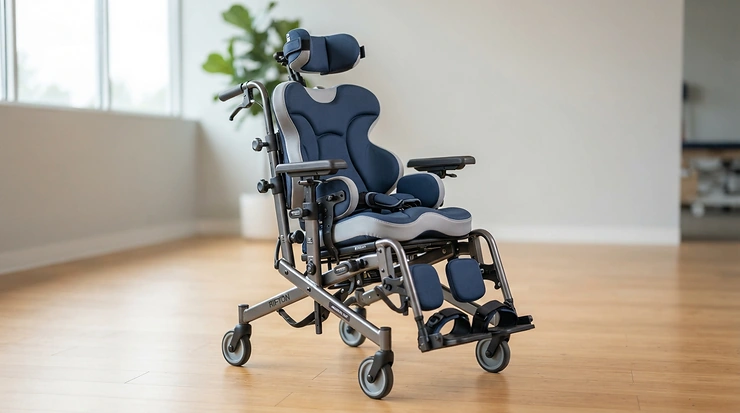
The Zippie IRIS is the specialist. It uses rotation-in-space technology to tilt the seat around the child’s center of gravity, which supports pressure relief, feeding, breathing and head control. Unlike the other six, this is a positioning chair first and a mobility chair second.
Sunrise’s European specs list seat width and depth of 25–46 cm, up to 4 inches of depth adjustment, and “True Fit” growth where width and extra depth are achieved by replacing parts. Tilt options include 40° or 55°. A clinical equipment guide puts the weight in the neighborhood of 40 pounds, and a children’s equipment reuse program lists IRIS chairs for children about 5 to 10 years old.
My analytical take: the spec that matters is how the chair maintains position as the child grows, not how fast it rolls. It’s also the most dependent on a therapist’s judgment, and the growth plan should be built into the seating evaluation from day one.
Review sentiment: no verifiable aggregated reviews; clinical outcomes are better discussed with your seating team.
Pros:
- ✅ Tilt supports pressure relief and positioning
- ✅ Up to 4″ depth adjustment, parts-based width growth
- ✅ Free True Fit growth kit within five years
Cons:
- ❌ Much heavier than active-use chairs
- ❌ Requires a full seating evaluation
Price range: quote-based and typically higher than manual ultralights. Value verdict: the right choice only when positioning is the primary need.
How the Seven Stack Up
| Product | Seat Width Range | Seat Depth Range | Price Range | Best For |
|---|---|---|---|---|
| Drive Medical Wallaby | 12″ or 14″ (fixed) | 12″ or 14″ (fixed) | About $550–$800 | Budget bridge |
| Karman Flexx Junior | 10″–14″ | About 11″–14½” | Check current price | Value growth |
| Zippie GS | Order-form dependent (+2″ growth) | Order-form dependent (+4″ growth) | Quote-based | Folding daily chair |
| Zippie Zone | 8″–16″ | 8″–18″ | Quote-based | Active self-propellers |
| Ki Mobility Little Wave Clik | 8″–18″ | 8″–18″ | Quote-based | Precision fitting |
| TiLite Twist | 8″–15″ | 8″–16″ | Quote-based | Smallest kids |
| Zippie IRIS | About 10″–18″ (25–46 cm) | About 10″–18″ (25–46 cm) | Quote-based | Tilt positioning |
I’ve skipped star ratings here because I couldn’t verify them across sources, and a made-up number is worse than a blank cell. What the table does show is that the Karman Flexx Junior offers the cheapest route to real width growth, while the Ki Mobility Little Wave Clik and Zippie Zone offer the widest adjustment ranges for custom-fit buyers. If your child needs tilt, the Zippie IRIS is the only real answer in this group.
How to Choose a Growth-Adjustable Wheelchair for Kids Ages 5 to 10
- Start with a clinical seating assessment. Custom chairs must be recommended and fit by a PT, OT or ATP. Their measurements shape every decision below.
- Count growth in three directions. Depth, width and seat-to-floor height all change. A chair strong in one but fixed in the others is a partial answer.
- Learn how growth happens. Built-in adjustments are cheapest, growth kits cost a visit, and a new frame costs the most. Ask which applies to each dimension.
- Match frame style to life. Rigid frames are lighter and sportier; folding frames travel better. Pick the one your week actually needs.
- Mind the weight. A 14-pound chair and a 33-pound chair feel like different species at the top of a curb, for the child and for you.
- Verify transit safety. If the chair rides in a car or bus, check for WC19 or ISO 7176-19 crash-test status.
- Check funding rules before ordering. Insurers often expect a frame to last five years, which shapes how much growth you need.

Adjustable Seat Depth Wheelchair for Growing Children: What the Numbers Mean
Seat depth is the first dimension kids outgrow, and it’s the one most parents misjudge. Karma’s fitting guidance gives the clean test: the child sits all the way back, and you should be able to slide about one finger between the front edge of the seat and the back of the knee. Too deep, and the child slides forward into a slouch. Too shallow, and you lose thigh support.
That’s why an adjustable seat depth wheelchair for growing children is the single most valuable feature to demand. Across our seven chairs, depth growth ranges from nothing (Drive Medical Wallaby) to about 4″ (Zippie GS, Zippie IRIS) to 5″ combined (Zippie Zone). The Convaid Rodeo, a tilt-in-space option you may see in clinic, offers about 5″ of seat depth growth, according to its maker.
A subtle point: adjustable seat depth also changes where the child’s weight sits relative to the rear axle. Permobil’s seating team notes that many pediatric chairs are configured for rearward growth, because children have shorter push strokes than adults. Translation: depth adjustments aren’t just about thighs, they’re about whether your child can still reach the wheel.
Practical rule: ask the dealer to show you where the chair sits at its minimum depth today and its maximum depth in three years. If the gap is under 3 inches, plan on a growth kit.
Expandable Seat Width Pediatric Wheelchair: Why an Adjustable-Width Frame Matters
Width is trickier than depth, because narrower is better for propulsion and posture. Karma’s guidance says seat width should be as narrow as comfortable: too wide forces leaning, too narrow squeezes the outer thighs and risks pressure problems.
An expandable seat width pediatric wheelchair solves the tension between “narrow now” and “wide later.” But how the width expands varies a lot. The Karman Flexx Junior moves bolts for a 10″–14″ range. The TiLite Twist adds about 2″ without parts. The Zippie Zone and Zippie IRIS rely on part swaps for width, and the Ki Mobility Little Wave Clik offers a growth kit in its early years.
The phrase to listen for is “adjustable-width frame.” It sounds like one thing but can mean three: bolt-on adjustment, a built-in cross-brace, or a kit that replaces components. Ask which, and ask what the second year looks like. A built-in cross-brace (like the one on the Youngster 3, a folding Sunrise chair sold mainly in the UK, Europe and Australia) offers about 2 cm of width growth with no extra parts, which is modest but reassuring.
A caution: when a growth kit changes the frame, cushion and backrest often need updating separately, because the measurements shift too. Budget for that.
Seat-to-Floor Height Adjustment: The Overlooked Growth Zone
Parents obsess over width and depth and forget the vertical dimension. Seat-to-floor height adjustment determines whether feet rest on footplates, whether a child can reach the wheels, and whether they can get to a desk or table.
Here the chairs diverge dramatically. The TiLite Twist gets as low as 6″ with its high-mount footplate system. The Ki Mobility Little Wave Clik spans roughly 11.5″–20″ at the front. The Zippie Zone offers 14″–19″ front and 13″–19″ rear, while the Drive Medical Wallaby sits fixed at 19″ front and 18″ rear, far too high for many 5-year-olds.
Why it matters: a seat too high leaves feet dangling, which changes pelvic position; a seat too low hampers transfers and reach. Height also shifts the center of gravity relative to the wheel, which affects tipping and push efficiency.
Pro tip: ask for the lowest and highest seat-to-floor settings with your child’s cushion installed. Cushions add height, and that’s the number that counts.
How Often Kids Outgrow Wheelchairs (And What That Means for Your Plan)
The honest answer to how often kids outgrow wheelchairs: it depends on the child, the chair and the stage. According to Mobility Management’s coverage of Nemours guidance, height gain runs about 2.5 inches a year from age 2 until adolescence, with a major spurt at puberty that typically starts between ages 8 and 13 and lasts two to five years. Those are guidelines, not promises.
For a child aged 5 to 10, that suggests two phases. Ages 5 to about 8 usually bring steady, predictable growth, and a chair with 3 or so inches of adjustment should hold. Ages 8 to 10 may bring the first puberty-related changes, and that’s when width and seat height surprises tend to show up.
Seat dimensions aren’t the same as body height, though. Growth in the thighs and hips may lag or lead height, so the only reliable method is rechecking fit. A sensible rhythm is to check at every growth-related appointment and after any visible spurt, using the one-finger depth test and a width check.
Clinical practice adds a wrinkle. One occupational therapy resource notes that wheelchair bases usually last 5 to 7 years, but seating is often replaced several times within that window because growth changes fit. The frame is the long-term bet; the seating is the short-term adjustment.
Setup and the First 30 Days: A Wheelchair That Grows With Your Child
A wheelchair that grows with your child only works if you grow it on time. Here’s a practical routine.
Week one: baseline and documentation
Have the therapist record the child’s measurements and the chair’s settings. Photograph the settings and save your serial number, since Sunrise’s True Fit growth program requires it to verify that no earlier kit was issued.
Weeks two to four: watch for fit drift
Check these monthly:
- Depth: one finger behind the knee
- Width: no pressure on thighs, no leaning
- Footplates: feet fully supported
- Bolts and quick-releases: snug
- Tires and casters: debris-free and aired up
Common mistakes in the first 30 days
- Adjusting width alone, then forgetting the cushion and backrest
- Adjusting by feel instead of measuring
- Skipping the therapist visit because “it looks fine”
- Losing small hardware from a previous setting
When to call the dealer
If your child starts leaning, sliding forward, or reaching awkwardly for wheels, book a fit check rather than waiting for the next appointment. Small fixes stay small.

Real-World Scenarios: Three Kids, Three Chairs
These are illustrative profiles, not real patients, to show how the decision logic plays out.
The playground sprinter (age 6, active self-propeller, private insurance). She wheels around school and plays outside daily, and the family can plan for a five-year frame. The Zippie Zone or Ki Mobility Little Wave Clik fits: lightweight rigid frames, deep growth ranges, and low seat heights. The TiLite Twist is worth a look if she’s on the small side.
The positioning-first student (age 8, needs tilt for comfort and feeding). Mobility is caregiver-led, and pressure relief and head support rank first. The Zippie IRIS is the tool built for this, with its tilt and depth growth. Budget for a seating evaluation and expect a longer ordering process.
The waiting-on-funding kid (age 9, borderline between sizes, approval pending). The family needs something now that can also grow. The Karman Flexx Junior offers bolt-on width and depth adjustments at a lower commitment, and a Drive Medical Wallaby can serve as a travel backup in the meantime.
Notice the pattern: environment (school, home, travel), frequency of use, and funding timing drive the choice more than any single spec.
Growth-Adjustable vs Fixed-Size vs Transport Stroller: What’s Really Different
| Feature | Growth-Adjustable Chair | Fixed-Size Pediatric Chair | Tilt Buggy or Stroller |
|---|---|---|---|
| Seat growth | Built in or kit-based | None | Often depth only |
| Example | Zippie Zone, Karman Flexx Junior | Drive Medical Wallaby | Convaid Rodeo |
| Typical lifespan | Up to five years of frame use | Months to a couple of years | Varies |
| Self-propulsion | Often designed for it | Depends | Typically caregiver-pushed |
| Funding | Usually covered as a wheelchair | Often covered | Some plans exclude transport strollers |
The takeaway: a fixed-size chair is cheaper today and costlier tomorrow, because replacement arrives every time your child hits a growth spurt. A stroller-style buggy like the Convaid Rodeo (up to 45° tilt, about 5″ depth growth, sizes up to 16″ wide) suits positioning-heavy needs, but one state Medicaid policy I found explicitly excludes pediatric transport strollers, so check your own plan. The growth-adjustable chair sits in the middle: higher upfront, lower lifetime cost, and designed for independence.
Common Mistakes When Buying a Growth-Adjustable Wheelchair for Kids Ages 5 to 10
Buying for “someday” instead of now. A chair that’s too big today hurts posture and propulsion. Fit for the present, with growth as a margin.
Confusing “adjustable” with “unlimited.” Every chair has a ceiling, so ask for the max width, depth and height in inches, not marketing words.
Ignoring weight. Chair weight affects push effort, car loading and a child’s endurance more than most specs.
Skipping transit ratings. If the chair rides on a bus or in a van, check crash-test and securement status.
Forgetting the cushion. It changes seat height and sometimes depth, so measure with it installed.
Waiting too long to adjust. Fit drift happens gradually, so schedule checks rather than reacting to complaints.
Insurance, Funding and Safety: The Rules Behind the Replacement Clock
Funding quietly sets how long a frame must survive. The Cleveland Clinic’s mobility team notes that insurance constraints create a five-year commitment to the frame, though seating, brakes and wheels can change within that window, and a new frame can be a sizeable out-of-pocket expense.
Some payers codify growth expectations. One state Medicaid program’s policy limits wheelchair purchases to one every five years and requires pediatric chairs to allow at least 3 inches of growth in both seat width and depth for ages 0–12, and at least 2 inches for ages 13–17. Other plans differ, but the principle is common.
If your child outgrows a chair sooner, you may meet resistance. A parent-advocacy resource notes that insurers might deny early replacement if the usual interval hasn’t passed, and recommends asking your DME provider how they’ve handled early growth spurts, then using your plan’s appeal process if needed. Growth programs like True Fit can fill gaps by offering one free kit within five years on select chairs.
On safety, look for WC19 or ISO 7176-19 transit compliance, and make sure any growth change doesn’t void securement settings. When in doubt, ask the dealer in writing.

FAQ
❓ Can one chair last from age 5 to age 10?
❓ How much seat growth should I look for?
❓ Does a growth kit cost extra?
❓ How can I tell my child has outgrown the chair?
❓ Is a rigid or folding frame better for a growing child?
Conclusion
Growth-adjustable chairs are an investment in not starting over. The Drive Medical Wallaby is a sensible stopgap but doesn’t grow. The Karman Flexx Junior offers the most affordable route to real width and depth adjustment, the Zippie GS brings folding convenience with built-in growth, and the Zippie Zone, Ki Mobility Little Wave Clik and TiLite Twist serve active, self-propelling kids with deeper fine-tuning. The Zippie IRIS stands alone for tilt-in-space needs.
The thread running through all of them: the best growth-adjustable wheelchair for kids ages 5 to 10 is the one that matches your child’s body, routine and funding timeline, with a therapist guiding the fit. Check seat depth, width and height, ask how each grows, and schedule fit checks like you’d schedule shoe shopping.
✨ Ready to move forward?
🔍 Click on any highlighted product above to check current pricing and availability, then take your shortlist to your child’s seating team. The right chair can turn the school years into an adventure, not an obstacle course! 🚀
Recommended for You
- Foldable Electric Wheelchair For Teens: 7 Best Picks For 2026
- Pediatric Wheelchair For School Use: 7 Best Picks (2026)
- High-Speed Mobility Scooter Over 10 mph: 7 Best Picks 2026
Disclaimer: This article contains affiliate links. As an Amazon Associate, I earn from qualifying purchases. If you purchase products through these links, we may earn a small commission at no additional cost to you.
✨ Found this helpful? Share it with your friends! 💬🤗
