

In This Article
Shopping for affordable folding power wheelchairs under $2000 feels a little like buying a car with your eyes closed. Everybody’s shouting about range, weight capacity, and “airline approved” batteries, but almost nobody tells you what those numbers actually mean once you’re rolling down a cracked sidewalk in February. That’s the gap this guide is built to close. An affordable folding power wheelchair is a battery-powered mobility chair, usually weighing 33 to 60 pounds, that collapses into a single unit or a few pieces so it fits in a car trunk, closet, or airline cargo hold without a ramp or a lift…

We spent real hours digging through manufacturer spec sheets, RESNA testing notes, and aggregated owner feedback across seven current models so you don’t have to. Some of these chairs disassemble into pieces you can lift with one hand. Others fold in three seconds flat with the push of a button. None of them will magically climb a snowbank, and we’ll tell you exactly where each one’s limits sit. If you or a family member are shopping with a fixed budget, it also helps to understand what Medicare will and won’t pay toward a power wheelchair before you commit your own cash — a subject we’ll circle back to later in this piece.
Whether you’re comparing a budget folding electric wheelchair for daily errands or hunting for the single cheap folding power chair that survives an airport gate check without falling apart, this guide walks through real specs, honest trade-offs, and the kind of practical advice a spec sheet never volunteers.
Quick Comparison Table
Before diving into the full breakdowns, here’s a fast-reference snapshot of all seven picks so you can narrow your shortlist in under a minute.
| Wheelchair | Weight (no battery) | Range | Weight Capacity | Best For |
|---|---|---|---|---|
| MAJESTIC IQ-7000 | 56-60 lbs | Up to 13-17 mi | 350 lbs | Auto-fold + remote control |
| ComfyGO Glide Care G-5 | 44-46 lbs | Up to 10 mi | 265 lbs | Tightest entry-level budget |
| ComfyGO Glide Care G-5 Pro | 40-42 lbs | Up to 13 mi | 265 lbs | Best upgrade for the money |
| Golden Technologies LiteRider Envy | 37 lbs (heaviest piece) | Up to 15.5 mi | 300 lbs | Indoor maneuverability |
| Drive Medical Cirrus Plus EC | 90 lbs (base) | Up to 10-15 mi | 300+ lbs | Clinically tested durability |
| Merits Health P321 EZ-GO | 35 lbs (heaviest piece) | Up to 9 mi | 250 lbs | Small apartments, easy lift |
| Feather Mobility Featherweight | 33 lbs | Up to 11-13 mi | 250 lbs | Lightest overall (splurge pick) |
Looking at the spread here, the pattern is pretty clear: the lighter a chair gets, the more you typically trade off in either range or weight capacity. The MAJESTIC IQ-7000 sits in the sweet spot for buyers who want auto-folding convenience without stretching past $2,000, while the Feather Mobility Featherweight wins on raw portability but nudges just past the ceiling in most listings. If indoor use and a tight turning radius matter more than raw range, the Golden Technologies LiteRider Envy and Merits Health P321 EZ-GO both punch above their price point.
💬 Found a wheelchair that fits your life? Share this comparison — it might help someone else make a smarter choice too!
💬 Just one click — help others make better buying decisions too!😊
Top 7 Affordable Folding Power Wheelchairs Under $2000: Expert Analysis
Here’s the honest rundown on all seven, based on manufacturer specifications, RESNA testing data where available, and aggregated owner sentiment pulled from verified retailer review sections.
1. MAJESTIC IQ-7000 — auto-folds with a remote, no disassembly needed
The standout here is that the MAJESTIC IQ-7000 folds and unfolds itself at the push of a button on either the joystick or the included remote, which matters enormously if you have limited hand strength or a caregiver helping from a few feet away. Under the hood, dual 250W motors (500W combined) give it a 350-pound weight capacity and enough torque to handle grass, sand, and mild inclines up to roughly 6 degrees — a genuine step up from the 250-300 lb ceiling common at this price tier. Based on the spec comparison, the standard 12Ah battery delivers 13 miles per charge and stays airline-compliant, while the optional 20Ah pack stretches that closer to 17-21 miles but loses airline eligibility, so know which trip you’re packing for before you upgrade.
This chair is built for people who want power-chair convenience without ever bending down to fold anything manually — caregivers assisting an aging parent, or users with arthritis who can’t manage a multi-step fold. Reviewers consistently mention that the automatic fold is the single feature that sold them, alongside a smoother-than-expected ride on grass and gravel. A recurring theme in aggregated feedback is that the reverse-alert beeping can’t be silenced, which some owners find intrusive in quiet settings, and a few note they’d like an optional suspension upgrade for rougher pavement.
Pros:
- ✅ True one-button auto-fold, no disassembly required
- ✅ 350-lb weight capacity beats most rivals in this price range
- ✅ Two battery options let you choose range vs. airline compliance
Cons:
- ❌ Reverse beep alert can’t be disabled or muted
- ❌ At 56-60 lbs, it’s heavier to lift than several rivals here
Typically listed in the $1,600-$1,900 range at the time of research, the MAJESTIC IQ-7000 delivers genuine mid-tier features — remote fold, dual motors, real weight capacity — without crossing into premium territory. For buyers who want the most “hands-off” folding experience on this list, it’s tough to beat.
✨ Don’t Miss These Exclusive Deals!
🔍 Take your mobility search to the next level — click through to check current pricing and availability on any model above before it changes.
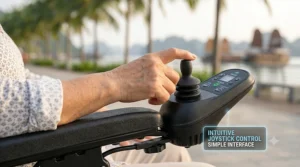
2. ComfyGO Glide Care G-5 — the tightest entry price on this list
What most buyers overlook about the ComfyGO Glide Care G-5 is that it’s essentially the budget floor for a genuinely folding (not disassembling) power chair — a category that usually starts several hundred dollars higher. Dual 250W brushless motors push it to a 4 mph top speed with a 265-pound capacity, and the standard 10Ah lithium battery is rated for roughly 10 miles per charge, which comfortably covers a grocery run or a day at a theme park. The chair folds in one motion and includes a suitcase-style carry handle, a small but genuinely useful detail when you’re wrestling equipment into a trunk in the rain.
This is the pick for first-time buyers who aren’t sure how often they’ll use a power chair and don’t want to gamble a large sum on the category. Aggregated owner feedback highlights how easy the one-step fold is for a single caregiver to manage alone, plus praise for the suitcase handle. On the downside, a common thread in reviews is that the standard seat cushion feels thin for all-day use, and the 9-degree max slope rating means steep driveways are genuinely off-limits.
Pros:
- ✅ Lowest realistic entry price for a true one-piece folder
- ✅ Suitcase-style handle simplifies loading into vehicles
- ✅ Airline and cruise-approved lithium battery included standard
Cons:
- ❌ Standard cushion is noticeably thinner than pricier rivals
- ❌ 9-degree slope limit rules out steep driveways or ramps
Priced around $1,300-$1,500 at most authorized retailers, the ComfyGO Glide Care G-5 is the chair we’d point a cautious first-time buyer toward. It won’t win a spec-sheet contest, but it does everything a folding power chair needs to do without the premium markup.
3. ComfyGO Glide Care G-5 Pro — the upgrade that’s worth the extra money
Here’s what the spec sheet won’t tell you outright: the ComfyGO Glide Care G-5 Pro is essentially the G-5 with the two upgrades most owners wish the base model had — brushless motors for quieter operation and a bundled remote control for caregiver-assisted driving. The 12Ah battery bumps range up to 13 miles, and the frame drops a few pounds versus the standard G-5 despite the added electronics. Climbing ability holds steady at a 10-degree max angle, a small but real improvement for anyone dealing with curb cuts or gentle ramps.
Based on the spec comparison, this model earns its “Pro” label mainly through quality-of-life details rather than raw power — the remote control alone makes it a meaningfully better fit for households where a spouse or adult child sometimes needs to steer the chair for a nervous first-timer. Reviewers frequently mention the smoother, quieter ride from the brushless motors compared to standard DC motors, and the premium seat textile draws specific praise for comfort on longer outings. A recurring complaint is that the remote’s 30-foot range feels shorter than expected in tight indoor hallways with lots of interference.
Pros:
- ✅ Bundled remote control adds real caregiver-assist value
- ✅ Brushless motors run noticeably quieter than base G-5
- ✅ Upgraded seat textile holds up better for all-day comfort
Cons:
- ❌ Remote signal can drop out near dense indoor obstructions
- ❌ Premium price bump may not matter if you rarely need assist mode
Generally found in the $1,500-$1,700 range, the ComfyGO Glide Care G-5 Pro represents the strongest dollar-for-dollar upgrade on this entire list — you’re paying maybe $200 more for features that materially change the day-to-day experience.
4. Golden Technologies LiteRider Envy GP162 — built for tight indoor spaces
The Golden Technologies LiteRider Envy takes a different approach than the auto-folding ComfyGO and Majestic models: instead of folding, it disassembles into four manageable pieces, the heaviest of which weighs only 35-37 pounds. What most buyers overlook here is the payoff of that trade-off — a genuinely tight 28.5-inch turning radius that makes navigating narrow hallways, tight kitchens, and crowded retail aisles noticeably easier than bulkier rivals. Dual 22Ah batteries deliver an impressive 15.5-mile range, among the longest on this list, and the stadium-style seat with a full-size footplate is built for comfort rather than minimalism.
This is the chair for someone who spends most of their time indoors — apartment living, assisted-living communities, or a home with narrow doorways — where a tight turning radius matters more than outdoor range or automatic folding. Owners consistently praise the under-seat storage basket and the six available frame colors, a small personalization touch competitors skip. On the downside, several reviewers note that reassembling all four pieces after a car trip takes a bit of practice and isn’t quite as fast as a true one-motion fold.
Pros:
- ✅ Best-in-class 28.5-inch turning radius for tight indoor spaces
- ✅ 15.5-mile range is among the longest at this price point
- ✅ Six frame colors let you personalize the look
Cons:
- ❌ Four-piece disassembly is slower than one-motion folders
- ❌ 2.5-inch ground clearance limits rougher outdoor terrain
Typically priced in the $1,700-$1,900 range, the Golden Technologies LiteRider Envy earns its keep for indoor-focused buyers who value maneuverability and battery range over a flashy auto-fold mechanism.
5. Drive Medical Cirrus Plus EC — the clinically tested budget classic
The Drive Medical Cirrus Plus EC has been a fixture in home medical equipment catalogs for years, and what most buyers overlook about that longevity is the testing behind it: it has passed ANSI/RESNA durability standards, the same benchmark used for higher-end rehab power chairs. Two 12V batteries power a rear-wheel-drive system rated for up to 15 miles depending on seat width and terrain, and the programmable PG controller can be tuned by a supplier to match a user’s specific strength and reaction speed — a genuinely clinical touch you won’t find on many direct-to-consumer models. Swing-away footrests, an adjustable-tension backrest, and a seat belt come standard rather than as pricey add-ons.
This chair suits buyers who want a manufacturer with a decades-long track record in durable medical equipment and don’t mind a slightly heavier base unit in exchange for that reliability. Reviewers who’ve owned similar Cirrus models over multiple years frequently cite the fact that replacement parts remain widely available long after purchase, a real advantage over newer direct-to-consumer brands. The trade-off is real, though: at roughly 90 pounds for the base frame alone, this is not a chair one person casually lifts into a trunk solo, and the 4-inch ground clearance is on the lower end for uneven outdoor paths.
Pros:
- ✅ ANSI/RESNA-tested durability with a long service history
- ✅ Programmable controller can be tuned to the user’s needs
- ✅ Wide availability of replacement parts for the long haul
Cons:
- ❌ 90-lb base frame is too heavy for most solo caregivers to lift
- ❌ Lower ground clearance limits use on gravel or grass
Pricing typically falls in the $1,400-$1,800 range depending on seat width and battery configuration, though we’d note this varies more by seller than most models on this list, so confirm current availability before you commit. For buyers prioritizing proven clinical durability over ultra-light portability, the Drive Medical Cirrus Plus EC remains a smart, no-surprises choice.

6. Merits Health P321 EZ-GO — the most compact option for small apartments
Weighing just 99 pounds fully assembled and disassembling into three pieces with a 35-pound heaviest part, the Merits Health P321 EZ-GO is built specifically for buyers whose biggest constraint isn’t range or speed — it’s storage space. A steel frame supports up to 250 pounds, and 8-inch solid tires mean flat tires simply aren’t part of the ownership experience, a detail that matters more than it sounds once you’ve dealt with a scooter tire going flat in a parking lot. The standard EZ-GO delivers a 9-mile range at 4 mph, while the EZ-GO Deluxe variant steps up to a 300-lb capacity and 12-mile range with improved 2.25-inch ground clearance.
Based on the spec comparison, this chair is squarely aimed at studio apartments, smaller sedans, and users who need something they can wheel into a coat closet without a second thought. Owners frequently highlight how easy the three-piece breakdown is for a single adult to manage, plus praise for the flip-back armrests that simplify transfers to and from a bed or car seat. A common critique is that the standard model’s 9-mile range and 250-lb capacity feel modest if you’re a heavier user or plan longer outdoor outings — in which case the Deluxe upgrade is worth the extra cost.
Pros:
- ✅ Compact three-piece breakdown fits small closets and sedans
- ✅ Flat-free 8-inch tires eliminate a common failure point
- ✅ Flip-back armrests genuinely simplify transfers
Cons:
- ❌ Standard model’s 250-lb capacity may not suit larger users
- ❌ 9-mile range is on the shorter side for all-day outings
Typically priced in the $1,200-$1,600 range for the standard configuration, the Merits Health P321 EZ-GO is the pick for anyone whose apartment layout or garage space is the real deciding factor, not the spec sheet.
7. Feather Mobility Featherweight Power Chair — the lightest chair here, and a fair stretch pick
At just 33 pounds total — battery included — the Feather Mobility Featherweight Power Chair is genuinely the lightest option on this list, and it folds into one single piece rather than requiring any disassembly at all, collapsing down to roughly 28 by 29 by 14 inches. A single lithium battery delivers up to 11-13 miles at a 4 mph top speed, and 1-inch padded cushions plus flip-back armrests round out the comfort package. Here’s what the spec sheet won’t tell you: aggregated owner reviews consistently mention that the chair feels notably less stable on grass or gravel than on paved surfaces, a direct trade-off for shaving so much weight off the frame.
This is genuinely the right chair for someone whose top priority is lifting it alone into a small car, an SUV, or an airline overhead-adjacent cargo hold — road warriors, frequent flyers, or a caregiver who simply cannot lift anything heavier. Multiple reviewers specifically mention loading it solo into a trunk without help, which is precisely the use case this chair is built around. On the honesty front, we should note that most current retailer listings price the Featherweight in the $2,100-$2,400 range rather than strictly under $2,000 — we’re including it here as a splurge pick because its class-leading weight genuinely can’t be matched by anything that stays under our ceiling, and it’s worth knowing about even if it means stretching the budget slightly.
Pros:
- ✅ Lightest power chair on this entire list at 33 lbs total
- ✅ Folds into one single piece, no disassembly at all
- ✅ Airline-compliant battery is easy to remove and travel with
Cons:
- ❌ Feels noticeably less stable on grass, gravel, or soft ground
- ❌ Typically priced above our $2,000 ceiling in current listings
Usually found in the $2,100-$2,400 range, the Feather Mobility Featherweight Power Chair is our honest splurge recommendation — include it in your comparison shopping only if raw portability outweighs staying strictly under budget.
Setting Up Your New Folding Power Wheelchair: The First 30 Days
Getting a new folding power wheelchair right in the first month prevents most of the frustration that leads to bad reviews down the line. Start by fully charging the battery before first use, even if it arrives showing a partial charge — lithium batteries in these chairs generally need a full initial charge cycle to calibrate their internal gauge accurately. Next, practice folding and unfolding the chair five or six times in a low-stakes setting, like your living room, before you ever need to do it curbside in the rain with groceries in hand.
During the break-in period, most manufacturers recommend charging daily for the first two weeks regardless of how much the chair was used, which helps the battery reach its full rated range faster. A common first-30-days mistake is over-tightening or under-tightening the joystick mount, so take five minutes to adjust it to a comfortable angle rather than accepting the factory default. Finally, locate your serial number now — usually stamped near the footrest or printed on the shipping box — and photograph it, since you’ll need it fast if you ever file a warranty claim.
For ongoing maintenance, wipe down the frame monthly and inspect wheel locks and anti-tip wheels for looseness, since these are the components caregivers most often forget until something rattles. If your model has flat-free tires, you can skip pressure checks entirely, a real time-saver that the Merits Health P321 EZ-GO and similar models offer standard.
Real-World Scenarios: Who Actually Buys a Budget Folding Electric Wheelchair
Matching the right chair to your actual daily life matters more than chasing the highest spec number, so here are three realistic profiles drawn from how these chairs actually get used.
Consider a 74-year-old living alone in a two-bedroom apartment who still drives but struggles with long store aisles. For her, a budget folding electric wheelchair like the Merits Health P321 EZ-GO or the Golden Technologies LiteRider Envy makes the most sense — both prioritize a tight turning radius and manageable piece weight over long outdoor range, since her trips are mostly indoor and under a mile round-trip. Now picture a 45-year-old with multiple sclerosis whose adult daughter visits weekly to help load a chair for outings; here, the auto-folding MAJESTIC IQ-7000 removes the physical strain of manual folding entirely, letting the daughter manage the process from the driver’s seat via remote.
Finally, think about a frequent business traveler managing a spinal cord injury who needs something airline-friendly that a gate agent can stow without drama. The Feather Mobility Featherweight or the ComfyGO Glide Care G-5 Pro both fit that profile, trading a bit of range for genuine one-person portability through security lines and jet bridges. In each case, the “best” chair isn’t the one with the flashiest spec sheet — it’s the one that matches how many miles you’ll actually cover, how much help you’ll have loading it, and how often you’re leaving the house at all.

Common Problems With Cheap Folding Power Chairs (And How to Fix Them)
Even a well-reviewed cheap folding power chair runs into predictable snags, and most of them have straightforward fixes. The first common problem is battery range dropping faster than advertised — this almost always comes down to cold weather, hills, or rider weight near the chair’s capacity ceiling, not a defective battery. The fix is simple: charge fully before every outing in cold months and budget roughly 20-30% less range than the manufacturer’s stated maximum for realistic trip planning.
Second, joystick oversensitivity trips up a lot of first-time users, especially indoors. Most controllers, including the one on the MAJESTIC IQ-7000, let you dial down the maximum speed setting, so start at the lowest speed tier for the first week and increase gradually as confidence builds. Third, squeaky or stiff folding hinges are common after a few months of outdoor use — a small amount of silicone-based lubricant (never oil-based, which attracts grit) applied to the hinge points usually resolves this in seconds.
Fourth, some owners report the wheelchair tipping backward slightly on ramps — this is what anti-tip wheels are designed to prevent, so if yours came without them or they’ve come loose, tightening or adding this accessory should be a top priority rather than an afterthought. Finally, remote-control range dropping out indoors, as noted in the ComfyGO Glide Care G-5 Pro review above, is typically a matter of dense walls or electronic interference rather than a defective unit — sticking to line-of-sight use solves it in most households.
How to Choose an Economical Portable Mobility Chair: 7 Steps
Picking the right economical portable mobility chair comes down to matching seven practical factors to your actual life, not chasing the biggest number on any single spec.
- Measure your doorways and hallways first. A chair with a wide turning radius is useless if it can’t clear your narrowest doorway, so measure before you shop, not after delivery.
- Calculate your real daily mileage, then add 30%. Most users overestimate how far they’ll travel per outing; add a buffer for detours, hills, and cold-weather range loss.
- Weigh your heaviest lifter, not your strongest one. If a spouse or adult child will sometimes load the chair alone, the heaviest single piece needs to match their actual lifting capacity.
- Decide fold vs. disassemble upfront. One-motion folders like the MAJESTIC IQ-7000 save time; disassembling models like the Golden Technologies LiteRider Envy often maneuver tighter indoors.
- Check the weight capacity with a 20-pound buffer. A chair rated right at a user’s weight strains the motor and shortens battery life faster than one with margin to spare.
- Confirm airline compliance if you travel. Not every lithium battery configuration meets FAA rules, so confirm this before booking any flight, not after arriving at the gate.
- Compare warranty length, not just price. A slightly pricier chair with a longer frame and battery warranty often costs less over three years than the cheapest option with a one-year warranty.
Working through these seven steps in order — rather than starting with price — tends to land buyers on a chair they’re still happy with a year later, which is really the whole point.
What Is a Budget Friendly Wheelchair?
A budget friendly wheelchair is a power-assisted mobility chair, typically priced under $2,000, that trades some premium features — like extended range, heavier weight capacity, or advanced suspension — for a lower upfront cost while still meeting core safety and durability standards…
That trade-off doesn’t mean lower quality across the board. As shown throughout this guide, models like the ComfyGO Glide Care G-5 and Merits Health P321 EZ-GO meet the same FDA Class II medical device classification as chairs costing two or three times as much; they simply concentrate their engineering budget on portability and core reliability rather than long-range batteries or premium upholstery. For many buyers, especially those using a chair primarily indoors or for shorter outdoor trips, that’s precisely the right trade-off to make.
Cost Effective Folding Power Wheelchairs vs Traditional Power Wheelchairs
The core difference between cost effective folding power wheelchairs and traditional, non-folding power wheelchairs comes down to one word: transportability. Traditional power wheelchairs, the kind typically covered in full by insurance for daily home use, tend to weigh 100-250+ pounds, require a wheelchair-accessible vehicle or a mechanical lift to transport, and often can’t be broken down at all without professional help.
| Factor | Folding Power Wheelchair | Traditional Power Wheelchair |
|---|---|---|
| Typical weight | 33-90 lbs | 150-300+ lbs |
| Transport method | Trunk, backseat, or overhead bin | Wheelchair van or vehicle lift |
| Typical range | 8-17 miles | 10-25+ miles |
| Best For | Travel, apartments, occasional use | Daily heavy-duty indoor/outdoor use |
Looking at this comparison, the trade-off is straightforward: folding chairs sacrifice some range and heavy-duty ruggedness in exchange for genuine one-person portability, while traditional power wheelchairs sacrifice transportability for maximum durability and capacity. If most of your mobility needs happen inside a single home and a vehicle lift isn’t a dealbreaker, a traditional chair may still serve you better long-term; if travel, apartment living, or car trunk storage matter at all, a folding model is almost always the smarter buy.
💬 Still weighing folding vs. traditional? Bookmark this comparison and share it with anyone else making the same decision!😊
Common Mistakes When Buying an Affordable Folding Power Wheelchair
The single most common mistake is buying based on the lowest listed price alone, without checking whether that price includes the battery, charger, and standard accessories — some retailers list a base price and charge extra for the components you’ll actually need on day one. A close second is skipping the doorway and hallway measurements mentioned earlier; a chair that looks compact in product photos can still be too wide for a narrow bathroom doorway.
Another frequent misstep is assuming any lithium battery is automatically airline-approved. As covered on the FAA’s own guidance for wheelchairs and mobility devices, battery configuration, wattage, and how it’s mounted all affect whether a specific chair can fly with you, so this needs verifying model-by-model rather than assumed from a marketing claim. Buyers also frequently underestimate how much heavier a chair feels with the battery installed versus the “frame only” weight advertised in bold on product pages — always check the fully-assembled weight, not just the lightest single component.
Finally, many first-time buyers skip reading the warranty terms until after a problem arises, only to discover the frame warranty and the battery warranty run on completely different timelines — frequently three to five years for the frame but just one year for the battery and electronics.
Long-Term Cost & Maintenance
The sticker price is only part of the real cost of ownership. Lithium-ion batteries in this category typically last two to four years with proper care, after which a replacement battery — often $150 to $400 depending on the amp-hour rating — becomes the largest recurring expense. Budgeting for one replacement battery over a five-year ownership window is a realistic expectation for most of the models covered here.
Beyond batteries, tires are the next most common wear item, though flat-free tire designs like those on the Merits Health P321 EZ-GO eliminate this cost entirely. Frame warranties on this list typically run three to five years, while electronics and battery coverage usually caps at one year, so factor potential out-of-warranty electronics repairs into your long-term budget starting in year two. It’s also worth remembering that Medicare generally only covers power wheelchairs purchased directly through an approved supplier following a documented medical necessity process, as detailed on Medicare’s official wheelchair and scooter coverage page — most direct-to-consumer folding chairs purchased for convenience or travel, rather than daily in-home mobility, generally fall outside that reimbursement pathway, so plan the purchase as an out-of-pocket expense unless your supplier confirms otherwise.
Looking at total cost of ownership rather than sticker price alone, a $1,600 chair with a five-year frame warranty and a $200 replacement battery every three years often works out cheaper over a decade than a $1,200 chair with a one-year warranty and more frequent part failures.
Safety, Regulations & Airline Compliance Guide
Every chair featured in this guide is classified as an FDA Class II medical device, meaning it’s been engineered and tested to a baseline safety standard rather than sold as a general consumer product. That said, a few practical safety habits matter regardless of which model you choose: always engage anti-tip wheels on ramps, avoid charging batteries in direct sunlight or extreme heat, and never exceed the stated weight capacity even by a small margin, since motor strain and reduced braking performance both increase past that threshold.
For air travel specifically, the rules are more detailed than most buyers expect. According to the Department of Transportation’s regulations that the FAA enforces, a wheelchair battery generally needs to be either non-spillable or properly protected against short circuits to travel as checked baggage, and lithium-ion battery wattage limits apply depending on whether the battery stays installed or gets removed for the flight. If you’re planning to travel with any chair on this list, contact your specific airline 24 to 48 hours before departure to confirm their current battery documentation requirements, since individual carriers can apply stricter rules than the federal minimum.
Medicare’s coverage rules add another regulatory layer worth understanding even if you’re paying out of pocket, since the eligibility criteria — documented mobility limitation, a face-to-face exam, and a supplier enrolled in Medicare — outlined in the CMS power mobility device fact sheet give a useful benchmark for what “medically necessary” actually means, even for buyers purchasing privately.

FAQ
❓ How much does a good folding power wheelchair cost?
❓ Can I bring a folding power wheelchair on a plane?
❓ Does Medicare cover a folding power wheelchair?
❓ How long do folding power wheelchair batteries last?
❓ What's the difference between folding and disassembling power chairs?
Conclusion
Choosing among affordable folding power wheelchairs under $2000 really comes down to matching the trade-offs to your actual routine rather than chasing the single highest spec number. If auto-folding convenience matters most, the MAJESTIC IQ-7000 delivers real value; if tight indoor spaces are your priority, the Golden Technologies LiteRider Envy or Merits Health P321 EZ-GO make more sense; and if you’re willing to stretch slightly past $2,000 for the lightest possible chair, the Feather Mobility Featherweight remains worth a look.
Whichever direction you go, measure your doorways, calculate your real mileage needs honestly, and read the warranty terms before the price tag. A slightly more expensive chair that fits your life well beats the cheapest option that ends up gathering dust in a closet after month three.
✨ Ready to Regain Your Independence?
🔍 Compare current pricing on any model above and take the first step toward easier, more confident mobility today!
Recommended for You
- Folding Power Wheelchairs: 7 Top Picks for 2026 (Airline-Ready)
- 7 High Speed Outdoor Power Wheelchair Picks on Amazon (2026)
- 7 Best Outdoor Rear Wheel Drive Power Wheelchairs 2026
Disclaimer: This article contains affiliate links. As an Amazon Associate, I earn from qualifying purchases. If you purchase products through these links, we may earn a small commission at no additional cost to you.
✨ Found this helpful? Share it with your friends! 💬🤗
