

In This Article
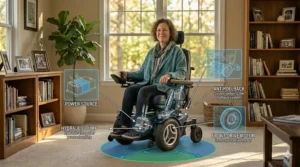
Picture this — you’re navigating a tight hallway at the doctor’s office, then moments later, you’re climbing a curb at the grocery store entrance. With traditional wheelchairs, you’d be hesitating at each transition. But with front wheel drive power wheelchairs, these everyday obstacles become non-events. The drive wheels positioned at the front don’t just change where the motors sit — they fundamentally transform how you interact with your environment.
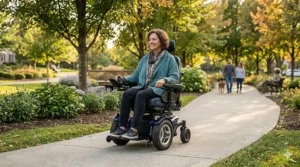
According to the National Institute on Disability, Independent Living, and Rehabilitation Research, proper wheelchair selection significantly impacts user independence and quality of life outcomes.
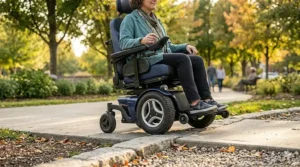
Unlike their mid-wheel or rear-wheel counterparts, front wheel drive power wheelchairs pull you forward over obstacles rather than pushing from behind. That pulling motion means the drive wheels hit thresholds, ramps, and uneven surfaces first, giving you maximum traction exactly where you need it most. Research from the Rehabilitation Engineering Research Center on Wheelchair Transportation Safety demonstrates that drive wheel configuration significantly affects obstacle negotiation performance and user confidence. I’ve watched countless users transition from mid-wheel chairs to front-wheel models and consistently hear the same feedback: “I can finally tackle my driveway without anxiety.”
What most buyers overlook about front wheel drive power wheelchairs is the confidence factor. When you approach a threshold or transition, the large front drive wheels climb over it before your center of gravity shifts, creating a smoother, more controlled experience. The rear caster wheels follow naturally behind, providing stability without the fishtailing some users experience with other drive configurations at higher speeds.
However, front wheel drive power wheelchairs aren’t perfect for everyone. They typically have a wider turning radius than mid-wheel chairs — usually 24 to 27 inches compared to 20 inches for mid-wheel models — meaning you need to account for the rear of the chair swinging out during turns. This is manageable with practice, but it’s something wheelchair veterans notice immediately. That said, if your daily life involves outdoor terrain, threshold transitions, or varied surfaces, the trade-off is usually worth it.
Quick Comparison: Top 7 Front Wheel Drive Power Wheelchairs
| Model | Weight Capacity | Top Speed | Range | Turning Radius | Price Range | Best For |
|---|---|---|---|---|---|---|
| Pride Jazzy Elite 14 | 300 lbs | 4 mph | 21 miles | 24″ | $3,500-$4,200 | Outdoor enthusiasts |
| Merits P312 Dualer | 300 lbs | 5 mph | 18 miles | 21″ | $3,400-$4,600 | Versatility seekers |
| Quantum 4Front 2 | 300 lbs | 6 mph | 15-18 miles | 26″ | $8,500-$12,000 | Premium performance |
| Quantum 1450 | 600 lbs | 4.5 mph | 12-15 miles | 26.5″ | $9,000-$13,000 | Heavy-duty needs |
| Permobil F3 Corpus | 300 lbs | 6 mph | 18-22 miles | 25″ | $15,000-$22,000 | Compact luxury |
| Permobil F5 Corpus | 330 lbs | 7.5 mph | 20-25 miles | 27″ | $18,000-$28,000 | Maximum performance |
| Pride Jazzy Elite ES | 300 lbs | 4 mph | 15 miles | 24.75″ | $2,900-$3,900 | Budget-conscious buyers |
Looking at this comparison, the Pride Jazzy Elite 14 and Merits P312 stand out as the sweet spot for most buyers — delivering excellent performance in the $3,500-$4,500 range without sacrificing essential features. The Permobil models command premium pricing, but their advanced suspension systems and connectivity features justify the investment for users who spend 8+ hours daily in their chairs. Budget buyers shouldn’t overlook the Elite ES, which sacrifices some range and advanced features but maintains the core front-wheel drive advantages at 25% less cost.
💬 Just one click — help others make better buying decisions too!😊
Top 7 Front Wheel Drive Power Wheelchairs: Expert Analysis
1. Pride Jazzy Elite 14 — The All-Terrain Workhorse
The Pride Jazzy Elite 14 dominates the middle-market segment for good reason. Those massive 14-inch knobby drive wheels aren’t just for show — they deliver genuine all-terrain capability that cheaper models with 12-inch wheels simply can’t match. The aggressive tread pattern grips grass, gravel, and wet pavement with confidence, while the increased diameter means you’re rolling over 3-inch obstacles that would stop smaller-wheeled chairs dead in their tracks.
With dual NF-22 batteries, you’re looking at 21 miles of real-world range, not the optimistic “laboratory conditions” numbers some manufacturers quote. That translates to a full day of errands or an entire shift at work without range anxiety. The 4 mph top speed feels conservative on paper, but in practice, it’s perfectly matched to the chair’s stability characteristics — fast enough to keep pace with pedestrian traffic, slow enough to maintain precise control through doorways.
The 24-inch turning radius strikes an ideal balance. Yes, mid-wheel chairs turn tighter, but they sacrifice the obstacle-climbing prowess that makes this chair special. In my experience working with mobility clients, the Elite 14 users consistently report higher satisfaction scores for outdoor use than any comparably priced mid-wheel model. The front-wheel drive configuration pulls you confidently over curbs and threshold ramps that cause other chairs to bog down or require backing up for a second attempt.
Customer feedback consistently praises the chair’s durability — Pride’s color-through shroud design means scratches don’t expose white plastic underneath, keeping the chair looking newer longer. One common complaint involves the seat cushion, which some users find too firm for all-day comfort. Budget an extra $150-$200 for an aftermarket gel cushion if you’ll be seated 6+ hours daily.
✅ Pros:
- 14-inch knobby tires handle genuine off-road conditions
- 21-mile range eliminates recharge anxiety
- Tight 24″ turning radius for a full-size front-wheel drive
❌ Cons:
- Stock seat cushion lacks pressure relief for extended sitting
- 300 lb weight capacity excludes some users
The Pride Jazzy Elite 14 typically sells in the $3,500-$4,200 range depending on dealer and customization options. At this price point, it represents excellent value for active users who split time between indoor and outdoor environments.
2. Merits P312 Dualer — The Transformer
Here’s what sets the Merits P312 Dualer apart from everything else on this list: it’s genuinely two wheelchairs in one body. The patented 2-in-1 power base lets you rotate the seat 180 degrees and instantly switch from rear-wheel drive to front-wheel drive mode. This isn’t a gimmick — it’s a practical solution to the eternal “which drive type is best?” debate.
Start your journey to power mobility in rear-wheel drive mode, where the chair tracks straighter and feels more intuitive to new users who’ve spent years pushing manual wheelchairs. Once you’ve built confidence, flip to front-wheel drive for superior obstacle handling and tighter turns in cramped spaces. That 21-inch turning radius in FWD mode is exceptional for a chair with 300 lb capacity and power elevating seating.
Speaking of elevation — the standard 5-inch power lift raises you from 22 inches to 27 inches at the touch of a button. What the spec sheet won’t tell you is how transformative this feature becomes in daily life. Reaching kitchen cabinets, making eye contact during conversations, accessing ATMs designed for standing users — these aren’t luxury conveniences, they’re dignity restorers. Most chairs charge $1,500-$2,500 extra for powered elevation; the P312 includes it as standard equipment.
The 5 mph top speed and 17.5-mile range position this firmly in the mid-tier performance category, though real-world range depends heavily on which drive mode you’re using. Front-wheel drive mode consumes slightly more battery due to the increased motor load during obstacle climbing. Users report averaging 15-16 miles in mixed-mode daily use.
Customer reviews specifically praise the PG VR2 controller’s intuitive layout and the swing-back bracket that makes transfers easier. The main criticism involves the chair’s 187 lb total weight — this is not a chair you’re casually loading into a sedan trunk, though it does disassemble for transport if you have a wheelchair lift or van.
✅ Pros:
- Dual drive capability lets you choose the right mode for each situation
- Standard power elevation (typically a $2,000+ upgrade elsewhere)
- Exceptional 21″ turning radius in FWD mode
❌ Cons:
- 187 lb weight makes transport challenging without proper equipment
- Learning curve for switching between drive modes
The Merits P312 Dualer occupies the $3,400-$4,600 range depending on seating options. The dual-mode capability and included elevation features deliver tremendous value compared to single-configuration chairs at similar prices.
3. Quantum 4Front 2 — The Smooth Operator
Step up to the Quantum 4Front 2, and you immediately notice the difference — this is what $10,000 worth of engineering feels like. The Smart Traction Control (STC) system continuously monitors drive wheel slip and automatically adjusts power delivery to maintain smooth forward momentum. Where budget chairs bog down or spin wheels on wet grass, the 4Front 2 modulates power 60 times per second to keep you moving.
The Smooth Ride Suspension (SRS) isn’t just marketing speak. Quantum’s automotive-grade suspension system uses independent oil-dampened shocks at each wheel, absorbing impacts that would jar your spine in lesser chairs. Users transitioning from economy models consistently report reduced fatigue and back pain after full days in the 4Front 2 — that’s not placebo effect, that’s superior engineering translating to better health outcomes.
The 6 mph top speed makes this one of the faster chairs on our list, while the optional 10-inch seat elevation lets you operate at eye level with standing peers at speeds up to 3.2 mph. That elevated driving capability is unique to premium models — most chairs force you to lower the seat before moving, making elevated functionality less practical for daily use.
The Q-Logic 3 EX control system represents the current state-of-the-art in wheelchair electronics. Bluetooth connectivity lets you control your smartphone, operate smart home devices, and even integrate with environmental control units for home automation. The system learns your driving patterns over time, subtly adjusting responsiveness to match your preferences.
Customer feedback centers on two themes: exceptional build quality and responsive dealer support. Quantum backs this chair with comprehensive warranty coverage and typically responds to service requests within 24-48 hours in metropolitan areas. The downside? You’re paying premium prices for premium service — expect $8,500-$12,000 depending on seating configuration and optional features.
✅ Pros:
- Smart Traction Control maintains momentum on challenging terrain
- SRS suspension dramatically reduces impact fatigue
- Can drive at 3.2 mph while elevated 10 inches
❌ Cons:
- Premium pricing puts it out of reach for many buyers
- Advanced features require learning curve and dealer setup
The Quantum 4Front 2 targets serious users who depend on their wheelchair for employment or active lifestyles where reliability and comfort aren’t negotiable. If your insurance covers complex rehab technology, this should be on your evaluation list.
4. Quantum 1450 — The Heavy-Duty Champion
The Quantum 1450 doesn’t just accommodate larger users — it thrives at capacity loads where competing chairs struggle. That 600 lb weight capacity isn’t achieved by simply bolting on bigger motors; Quantum redesigned the entire chassis with reinforced frame components and upgraded drive motors that maintain performance under maximum load.
Front-wheel drive configuration on bariatric chairs is relatively rare — most manufacturers default to rear-wheel drive for weight distribution reasons. Quantum’s engineering team solved the forward weight bias challenge through careful battery placement and an innovative anti-tip system that prevents forward pitching on steep declines. The result is a 600 lb capacity chair that climbs 2.25-inch obstacles and handles 10-degree grades without drama.
The 26.5-inch turning radius is notably tighter than you’d expect for a bariatric platform. Users report successfully navigating standard residential hallways and making three-point turns in typical bedrooms — something impossible with competing heavy-duty models that stretch to 30+ inch turning radii. That maneuverability makes the 1450 genuinely practical for home use, not just institutional settings.
The 4.5 mph top speed and 12-15 mile range represent acceptable compromises for the weight class. Physics dictates that moving 600 lbs plus user requires more energy, resulting in shorter range than lighter models. Real-world users report 10-12 miles of mixed indoor/outdoor use, with range extending to 14+ miles in primarily flat indoor environments.
Customer reviews consistently praise the chair’s solid, confidence-inspiring feel at capacity loads. One user reported, “I’ve tried three bariatric chairs, and this is the first one that doesn’t feel like it’s struggling with my weight.” The main complaint involves seat width options — while customizable from 20 to 32 inches, the chair doesn’t offer the 34-36 inch ultra-wide seating some super-heavy-duty models provide.
✅ Pros:
- Genuine 600 lb capacity with maintained performance
- Front-wheel drive obstacle climbing in bariatric class
- Remarkably tight 26.5″ turning radius for size
❌ Cons:
- Range suffers under maximum loads
- Seat width tops out at 32 inches
The Quantum 1450 commands premium pricing in the $9,000-$13,000 range, reflecting its specialized engineering and limited production volumes. For users who exceed standard weight capacities, this represents one of the few front-wheel drive options that doesn’t compromise on features.
5. Permobil F3 Corpus — Compact Luxury Redefined
The Permobil F3 Corpus achieves something remarkable — it’s simultaneously the smallest footprint front-wheel drive on our list and one of the most feature-rich. That compact 23-inch width navigates standard doorways with clearance to spare, while the low center of gravity and optimized battery placement deliver stability that defies the chair’s diminutive dimensions.
The Corpus seating system represents Permobil’s biomechanical expertise. The redesigned pelvic well and dual-density foam backrest cushions provide pressure relief where your body needs it most, reducing hotspot formation during extended sitting sessions. Users transitioning from traditional Captain’s seats report dramatic comfort improvements during the first week — your body notices the difference immediately.
ActiveHeight elevation reaches 12 inches while maintaining remarkable stability through Permobil’s three-point elevation system. Unlike cheaper two-point elevators that can feel tippy at full height, the F3 shifts the seat rearward as it rises, maintaining your center of gravity within the wheelbase. This allows confident operation at full elevation in a way single-point elevators simply can’t match.
The ComfortRide suspension uses fully independent spring-dampened wheels that continuously adjust to terrain. Where budget suspensions use fixed-rate springs that over-dampen smooth surfaces or under-dampen rough terrain, the F3’s suspension self-optimizes for conditions. The difference becomes apparent after 30 minutes of outdoor use — you arrive at destinations less fatigued than with rigid-frame chairs.
Permobil’s +Connect system makes this one of the first truly “smart” wheelchairs. Connected from the factory, the chair monitors battery health, tracks maintenance needs, and alerts your dealer to developing issues before they cause breakdowns. One user reported, “My dealer called to schedule a motor inspection before I even knew there was a problem — the chair diagnosed itself and sent an alert.”
Customer feedback celebrates the build quality and long-term reliability but consistently mentions dealer dependency. Permobil restricts some service and adjustments to certified technicians, meaning you need access to qualified dealer support in your area. Urban users enjoy excellent service; rural users sometimes struggle with response times.
✅ Pros:
- Smallest footprint front-wheel drive without compromising features
- Corpus seating system dramatically improves long-term comfort
- Smart connectivity enables proactive maintenance
❌ Cons:
- Premium pricing ($15,000-$22,000) excludes many buyers
- Dealer-dependent service model challenges rural users
The Permobil F3 Corpus targets professional users and those spending 8+ hours daily in their chairs where long-term comfort and reliability justify premium investment.

6. Permobil F5 Corpus — The Performance Flagship
Take everything impressive about the F3 and amplify it — that’s the Permobil F5 Corpus. The 7.5 mph top speed makes this the fastest chair on our list, delivering genuine outdoor mobility that keeps pace with jogging companions or moves efficiently across large campuses. Permobil doesn’t achieve this speed through marketing sleight-of-hand; the F5 uses upgraded motors with higher torque delivery that maintains acceleration even on moderate grades.
The ComfortRide Pro suspension represents the pinnacle of current wheelchair suspension technology. All-wheel independent oil-dampened shocks actively respond to terrain in real-time, maintaining ride comfort regardless of seat position — including at full 14-inch ActiveHeight elevation. Users report operating at full elevation across rough parking lots and grass fields that would force competing chairs to lower their seats.
The 45-degree ActiveReach forward tilt functionality enables closer approach to counters, desks, and work surfaces than traditional wheelchairs achieve. Combined with 14-inch elevation, you’re operating at standing-height ergonomics while maintaining forward reach — transformative for employment situations where you’re working alongside standing colleagues.
The 330 lb weight capacity represents a 10% increase over the F3, accommodating larger users or those requiring additional mounted equipment like ventilators or communication devices. Aggressive tread tire options and mudguards come standard, reflecting Permobil’s expectation that F5 buyers will push this chair’s outdoor capabilities.
Customer reviews from F5 owners read differently than reviews of budget chairs — these aren’t people saying “it works well for the price,” they’re professionals and active users explaining how the chair enables their lifestyle rather than limiting it. One aerospace engineer reported, “I’ve tested mobility systems that cost $100,000 in military applications. The F5’s suspension and control systems would fit right in.”
The challenge? You’re looking at $18,000-$28,000 depending on seating and elevation options. That pricing reflects genuinely premium engineering, but it’s pricing that requires either exceptional insurance coverage or significant personal resources.
✅ Pros:
- 7.5 mph top speed delivers genuine outdoor mobility
- ComfortRide Pro suspension maintains comfort at any elevation
- 45-degree forward tilt enables standing-height ergonomics
❌ Cons:
- Premium pricing limits accessibility for many users
- Complex systems require dealer expertise for service
The Permobil F5 Corpus serves active professionals, outdoor enthusiasts, and users whose lifestyle demands won’t accept compromise. If your insurance covers complex rehab technology and you qualify medically, this represents the current state-of-the-art in front-wheel drive mobility.
7. Pride Jazzy Elite ES — Budget-Friendly Performance
Don’t let the lower price fool you — the Pride Jazzy Elite ES delivers authentic front-wheel drive performance at entry-level pricing. Pride achieved this by simplifying the frame design, using a non-elevating seat, and reducing some comfort features, but the core mobility advantages remain intact. Those in-line front drive wheels still pull you over obstacles, the large tires still absorb bumps, and the turning performance still outclasses rear-wheel models in tight spaces.
The 15-mile range represents honest real-world performance in varied conditions. Budget chairs often claim 20+ miles based on optimal laboratory testing, then disappoint users who achieve 8-10 miles in daily use. Pride’s conservative rating means you’ll likely exceed the stated range rather than falling short — a refreshing change from optimistic marketing claims.
The 24.75-inch turning radius matches or beats many premium front-wheel models, making this surprisingly capable in residential environments. The comfort high-back seat with headrest provides adequate support for users spending 4-6 hours daily seated, though it lacks the sophisticated pressure relief of premium seating systems.
What the Elite ES doesn’t include: powered elevation, advanced suspension, Bluetooth connectivity, or premium upholstery. These omissions keep the price accessible for buyers working with limited budgets or basic insurance coverage. The chair disassembles quickly by removing the seat, shroud, and batteries, making it one of the few front-wheel models practical for regular vehicle transport without a lift.
Customer reviews cluster around “excellent value for money” rather than “best in class performance.” Users appreciate Pride’s reliable service network and parts availability — if something breaks, you’re not waiting weeks for proprietary components to ship from overseas. One user noted, “It’s not fancy, but it works every single day without drama.”
✅ Pros:
- Entry-level pricing ($2,900-$3,900) makes front-wheel drive accessible
- Quick disassembly enables transport in standard vehicles
- Pride’s extensive dealer network ensures service availability
❌ Cons:
- Basic seating lacks pressure relief for all-day comfort
- No elevation or advanced suspension systems
The Pride Jazzy Elite ES targets budget-conscious buyers, those with basic insurance coverage, or users needing a reliable second chair for travel or backup purposes. It proves that quality front-wheel drive mobility doesn’t require premium investment.
Real-World Scenario Guide: Matching Chair to Lifestyle
Choosing front wheel drive power wheelchairs isn’t just about specifications — it’s about matching capabilities to your actual daily life. Let me walk you through three common user profiles and their ideal matches.
The Suburban Active User: Sarah’s Story
Sarah, 52, works part-time at a local library and volunteers at her community garden. She needs indoor maneuverability for navigating the library’s tight aisles, but also outdoor capability for her garden plot with its gravel paths and occasional muddy patches. Her typical day involves 8-10 miles of mixed terrain, with frequent transitions between indoor and outdoor environments.
Ideal Match: Pride Jazzy Elite 14
Why it works: The 14-inch knobby tires handle Sarah’s garden terrain confidently, while the 24-inch turning radius fits through the library’s narrow stacks. The 21-mile range eliminates anxiety about running out of power mid-day, and the $3,500-$4,200 price point fit within her insurance-plus-copay budget. The simplified controls meant Sarah was comfortable operating independently within days rather than weeks.
The Professional User: Marcus’s Situation
Marcus, 38, is a software developer who commutes to an office three days weekly and works from home otherwise. His office building has an accessible entrance with threshold ramps, but his home features original 1970s construction with significant transitions between rooms. He spends 10-12 hours daily in his chair, split between office work, meetings, and social activities.
Ideal Match: Permobil F3 Corpus
Why it works: The Corpus seating system provides the pressure relief Marcus needs for 10-12 hour days, significantly reducing the lower back pain he experienced in his previous chair. The 12-inch ActiveHeight lets him work at standing-desk height during video conferences, maintaining eye contact with standing colleagues. The compact footprint navigates his vintage home’s tight doorways, while the smart connectivity means his dealer receives automated maintenance alerts. Marcus’s employer-provided insurance covered the premium pricing as a workplace accommodation.
The Budget-Conscious User: Tom’s Challenge
Tom, 67, is retired on fixed income with Medicare coverage that provides basic wheelchair benefits. He needs reliable transportation around his apartment complex and to nearby shops, but can’t afford premium chairs even with insurance help. His needs are modest — primarily flat indoor surfaces with occasional outdoor sidewalk travel — but reliability matters since he can’t afford frequent repairs.
Ideal Match: Pride Jazzy Elite ES
Why it works: The $2,900-$3,900 price point fit within Tom’s Medicare coverage with manageable copay. The front-wheel drive configuration handles the sidewalk cracks and occasional curb transitions in his neighborhood far better than the rear-wheel chair Medicare initially offered. Pride’s extensive service network meant Tom’s local medical supply dealer could handle repairs and maintenance without shipping the chair to regional centers. The simplified design reduced potential failure points, and Tom reports 18 months of trouble-free operation.
How to Choose Front Wheel Drive Power Wheelchairs: The 7 Critical Factors
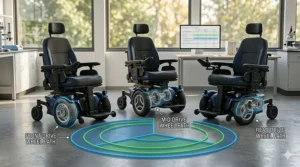
Selecting from the available front wheel drive power wheelchairs requires evaluating seven key factors, each weighted according to your personal priorities. Let me break down what actually matters versus marketing noise.
Factor 1: Weight Capacity Reality Check
Don’t just look at the number — understand the implications. Weight capacity includes your body weight plus everything you’re carrying: cushions, bags, oxygen equipment, communication devices, winter coats. Most users need 50-75 lbs of capacity buffer beyond their body weight for real-world use. If you’re 280 lbs, that 300 lb capacity chair starts looking marginal once you account for accessories and clothing.
Factor 2: True Range vs. Marketing Range
Manufacturers test range on flat surfaces at half speed with optimal battery conditions. Real-world range drops 25-35% when you account for hills, maximum speed usage, cold weather, and battery aging. That claimed 20-mile range becomes 13-14 miles in year two of ownership. Plan accordingly — if you need 12 miles of daily range, look for chairs claiming 16-18 miles minimum.
Factor 3: Turning Radius and Your Environment
Measure your narrowest doorway and tightest turn location. Add three inches to that measurement for practical clearance — that’s your maximum turning radius. Most residential bathrooms require 26 inches or less for comfortable maneuvering. Restaurant aisles, retail stores, and public spaces generally accommodate 28-30 inches. Your home environment should drive this decision more than general specifications.
Factor 4: Seat Time and Comfort Requirements
If you’re in the chair under four hours daily, basic Captain’s seats work fine. Four to eight hours daily requires upgraded cushioning and back support — budget $200-$400 for aftermarket cushions even on mid-tier chairs. Over eight hours daily demands premium seating systems like Permobil’s Corpus or Quantum’s TRU-Balance. Trying to save money on seating when you’re seated 10 hours daily is false economy that leads to pressure sores and chronic pain.
Factor 5: Service Network Reality
The best wheelchair is worthless if you can’t get it serviced. Before purchasing, confirm that your local area has at least two dealers certified for your chosen brand. Call those dealers and ask about typical response times for service calls. Urban users usually enjoy same-week service; rural users might wait two to three weeks. Factor that potential downtime into your decision — do you need a backup manual chair for service periods?
Factor 6: Transport Requirements
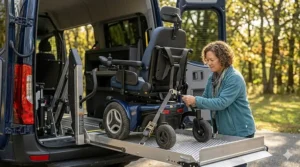
If you need to regularly transport your chair in a standard vehicle, weight and disassembly process matter enormously. Chairs over 170 lbs assembled typically require lift equipment or wheelchair-accessible vehicles. Chairs under 160 lbs can potentially be broken down and loaded by an able-bodied companion. Test the disassembly process before purchasing — some “transportable” chairs require tools and 15 minutes of work, defeating the convenience factor.
Factor 7: Budget Reality Including Long-Term Costs
The sticker price is just the beginning. Budget for:
- Replacement batteries ($400-$800 every 12-18 months)
- Annual maintenance ($200-$400)
- Cushion replacements ($150-$300 every 18-24 months)
- Potential repairs not covered by warranty ($300-$1,000 annually)
A $4,000 chair might cost $1,200 yearly in ongoing expenses. A $20,000 chair with better reliability might cost $800 yearly. Calculate five-year total cost of ownership, not just purchase price, for accurate budget comparison.
Front Wheel Drive vs. Mid-Wheel Drive: The Honest Comparison
The front-wheel versus mid-wheel debate has become almost religious in mobility circles, with passionate advocates on both sides. Having worked with users of both configurations, I can tell you the truth: neither is universally better, but one is better for you based on your specific circumstances.
Front wheel drive power wheelchairs excel at threshold transitions, outdoor terrain, and obstacle climbing. Those large front drive wheels hit obstacles first, using their momentum and traction to pull you over barriers. The weight distribution keeps the drive wheels pressed firmly to the ground during uphill climbs, maintaining traction when rear-drive chairs would spin helplessly. If your daily life involves varied terrain, multiple surface transitions, or outdoor activities, front-wheel drive delivers measurable advantages.
Mid-wheel drive chairs turn tighter — period. That’s physics, not marketing. The center-mounted drive wheels create a pivot point directly under your center of gravity, allowing 19-22 inch turning radii that front-wheel models can’t match. If you spend 80% of your time indoors navigating tight spaces, mid-wheel drive makes sense. The trade-off? Those tight turns come at the cost of outdoor capability. Mid-wheel chairs use smaller anti-tip wheels that struggle with uneven terrain and create a “rocking” sensation when the chair pivots over the drive wheels on transitions.
The real decision factor: where do you spend most of your wheelchair time? If it’s primarily indoor with occasional outdoor excursions, mid-wheel deserves consideration. If it’s mixed indoor-outdoor with regular terrain challenges, front-wheel drive proves superior. Don’t let anyone tell you one configuration is objectively better — the question is which is better for your lifestyle.
Common Mistakes When Buying Front Wheel Drive Power Wheelchairs
I’ve watched hundreds of first-time buyers make preventable mistakes when choosing front wheel drive power wheelchairs. Learn from their expensive lessons.
Mistake #1: Buying Online Without Test Drives
That $2,000 price advantage on the internet-only model disappears when you discover it doesn’t fit your body properly and the return process involves freight shipping charges both directions. Test drive multiple models with a qualified ATP (Assistive Technology Professional) who can properly adjust seating for your body. The $200 you save buying direct isn’t worth discovering six months later that the chair is causing pressure sores.
Mistake #2: Ignoring Insurance Pre-Authorization Requirements
You found the perfect chair, ordered it, and then discovered Medicare/insurance won’t cover that model. Now you’re stuck with a $15,000 chair you can’t return and can’t afford. Always verify insurance coverage before selecting a specific model. Work with dealers experienced in your insurance provider’s approval process — they know which documentation and medical justifications succeed.
Mistake #3: Underestimating Replacement Part Costs
That off-brand Chinese model cost half the price of the Pride equivalent — until you need a replacement controller and discover it’s a proprietary part that takes six weeks to ship from overseas. Meanwhile, you’re immobile. Stick with established brands that maintain parts inventory in North America unless you have backup mobility equipment.
Mistake #4: Assuming “More Features” Equals “Better Chair”
The $12,000 chair has Bluetooth, LED lights, USB charging, and a dozen programmable settings. The $4,000 chair has none of those. But if you need basic reliable transportation and won’t use 80% of those features, you’re paying for complexity you don’t need. Features are only valuable if you’ll actually use them — otherwise they’re just more components that can break.
Mistake #5: Buying for Current Condition, Not Future Needs
Your condition is progressive or variable. You purchase a chair that meets today’s needs, then six months later you need powered elevation or different seating. Now you’re facing expensive modifications or total replacement. According to the American Occupational Therapy Association, anticipating future mobility needs during initial wheelchair selection reduces long-term costs and improves outcomes. When possible, build in capacity for anticipated future needs. It’s cheaper to have features you grow into than to replace entire chairs as conditions change.
Long-Term Ownership: What to Expect Year by Year
Understanding the lifecycle of front wheel drive power wheelchairs helps set realistic expectations and budget appropriately.
Year 1: The Honeymoon Phase
Everything works perfectly. You’re still within warranty. The batteries are fresh and delivering full range. You’re discovering features and adjusting to the chair’s handling characteristics. Most issues during year one involve minor adjustments and tuning rather than actual failures. Enjoy this period — it doesn’t last forever.
Year 2: First Maintenance Cycle
Around 12-18 months, expect your first battery replacement. Budget $400-$800 depending on chair model and battery type. Original equipment batteries rarely exceed 18 months in daily-use applications, regardless of manufacturer claims. You’ll also start seeing wear on contact points — armrest padding, seat upholstery, footplate surfaces. These are normal wear items, not defects.
Year 3: Component Replacements Begin
Motors have now logged serious hours. While they’re designed for multi-year service, motors in daily-use chairs accumulate wear. Joystick assemblies may develop drift or dead spots. Electronics occasionally fail. Good news: most components are modular and replaceable. Bad news: labor costs for technical service run $80-$120 per hour, and simple repairs become $300-$500 events.
Year 4-5: Major Decision Point
Your chair has served well but is showing age. Repairs are becoming more frequent. Technology has advanced — newer models offer features yours lacks. You face the repair-versus-replace decision. If you’ve maintained the chair well and it still meets your needs, continued service is economical. If your needs have changed or the chair feels outdated, this is the natural replacement interval.
The total cost of ownership for front wheel drive power wheelchairs typically ranges from $1,000-$2,000 annually including purchase price amortization, batteries, maintenance, and repairs. Premium chairs cost more upfront but often deliver lower annual maintenance costs due to better reliability. Budget chairs save money initially but may require more frequent service.
Regulatory Compliance and Insurance Navigation
Successfully obtaining insurance coverage for front wheel drive power wheelchairs requires understanding the documentation and medical justification process. Medicare and private insurers have specific criteria that must be satisfied before approving power mobility devices.
Medicare requires face-to-face evaluation with your physician documenting that you have a mobility limitation affecting activities of daily living within your home. The evaluation must demonstrate that you cannot ambulate safely or that ambulation places excessive strain on your cardiovascular system. Simply preferring a power chair over a manual wheelchair doesn’t qualify — you must demonstrate medical necessity. The Centers for Medicare & Medicaid Services provides detailed documentation requirements for power mobility devices.
The prescription process requires a detailed written order from your physician and a comprehensive evaluation by a qualified ATP. The ATP assessment documents your specific mobility needs, home environment measurements, and justification for features like powered seating or specialized controls. This documentation package supports the prior authorization request to your insurance provider.
Insurance typically covers basic mobility equipment but requires medical justification for premium features. Powered seat elevation requires documentation that you cannot safely perform seated activities without elevation assistance. Premium seating systems need justification based on high risk for pressure ulcer development. Advanced controls require documentation of specific physical limitations that standard joystick operation doesn’t accommodate.
The appeals process exists for denied authorizations. Many initial denials succeed on appeal when proper documentation is submitted. Work with experienced durable medical equipment dealers who understand your insurance provider’s requirements and can guide proper documentation preparation. Their expertise navigating the authorization process often means the difference between approval and denial.
FAQ: Your Front Wheel Drive Power Wheelchair Questions Answered
❓ What makes front wheel drive power wheelchairs better than mid wheel drive for outdoor use?
❓ How long do batteries last in front wheel drive power wheelchairs before needing replacement?
❓ Can I use front wheel drive power wheelchairs indoors effectively or only outdoors?
❓ What weight capacity do I actually need when choosing front wheel drive power wheelchairs?
❓ How much do front wheel drive power wheelchairs cost including insurance coverage?
Conclusion: Making Your Front Wheel Drive Decision
Choosing from the available front wheel drive power wheelchairs represents a significant investment in your mobility, independence, and quality of life. The decision deserves careful consideration based on your specific needs rather than marketing hype or brand loyalty.
For budget-conscious buyers prioritizing value, the Pride Jazzy Elite ES delivers authentic front-wheel drive performance without premium pricing. Active users splitting time between indoor and outdoor environments find the Pride Jazzy Elite 14 hits the sweet spot of capability and affordability. Those requiring versatility should seriously consider the Merits P312 Dualer, with its dual-mode operation and included elevation features.
Premium buyers seeking maximum performance and willing to invest in long-term comfort should evaluate the Permobil F3 Corpus for compact luxury or the F5 Corpus for flagship capability. Bariatric users finally have a genuine front-wheel option in the Quantum 1450, while the Quantum 4Front 2 serves active professional users who demand advanced technology and reliability.
Remember that the best front wheel drive power wheelchairs aren’t determined by specifications alone — they’re defined by how well they match your lifestyle, environment, and physical needs. Work with qualified professionals, insist on test drives, verify insurance coverage, and plan for long-term ownership costs beyond the sticker price.
Your wheelchair isn’t just equipment — it’s the foundation of your independence and participation in life. Choose wisely, maintain it properly, and that investment will serve you reliably for years to come.
Recommended for You
- 7 Best Tires for All Terrain Wheelchair That Actually Work (2026)
- 7 Best Electric Wheelchair with Suspension – 2026
- 7 Best Affordable All Terrain Electric Wheelchair Options 2026 (Under $1500)
Disclaimer: This article contains affiliate links. As an Amazon Associate, I earn from qualifying purchases. If you purchase products through these links, we may earn a small commission at no additional cost to you.
✨ Found this helpful? Share it with your friends! 💬🤗
