
In This Article
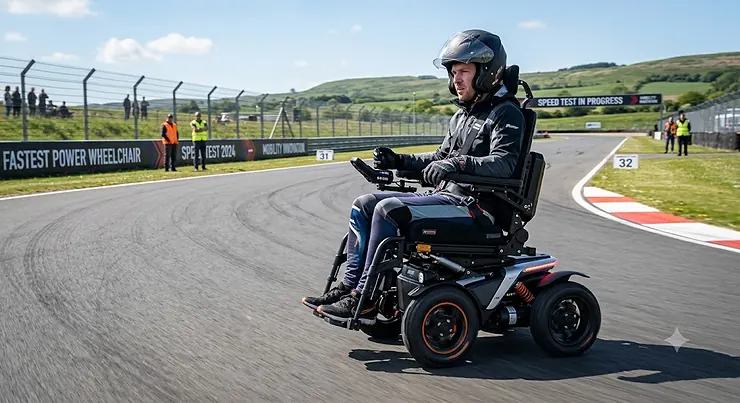
Somewhere between “I need to get to my gate before it closes” and “I’d like to actually keep pace with my dog on our morning walk,” there’s a very specific kind of shopper searching for a fastest power wheelchair. Not just a power wheelchair. The fastest one. And honestly? Fair enough. A fastest power wheelchair is a battery-powered mobility device engineered to prioritize higher top speeds, typically 5 to 7 mph, over the standard 3 to 4 mph pace of entry-level models, without sacrificing the stability and control users depend on every day.
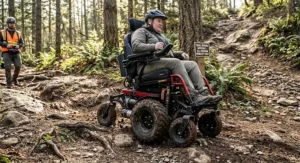
Here’s the thing nobody tells you at the mobility store: “fast” isn’t a single number stamped on a spec sheet. It’s a combination of motor wattage, drive-wheel position, suspension quality, and how a chair behaves the instant you push that joystick past the halfway mark. A 5 mph chair with sloppy suspension can feel more unnerving than a well-tuned 4.5 mph chair that just handles bumps better. That distinction matters, and it’s exactly what we’re digging into.
We spent real research hours pulling verified specs, aggregated review sentiment, and manufacturer data on seven genuinely fast power wheelchairs, from budget-friendly mid-wheel drives to a bariatric-rated flagship that tops out near 7 mph. Whether you’re chasing rapid outdoor mobility across a college campus, comparing high speed electric wheelchair reviews before a big purchase, or just done crawling along at a snail’s pace, this guide breaks down what actually matters. According to the Americans with Disabilities Act’s guidance on mobility devices, speed is one of the specific factors public facilities can legally weigh when accommodating power-driven mobility devices, which is exactly why picking the right one matters beyond your own living room.
Quick Comparison Table
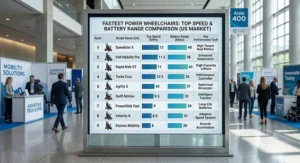
| Power Wheelchair | Top Speed | Best For |
|---|---|---|
| Merits Vision Sport P326A | 5.0 mph | Best all-around value |
| Pride Jazzy EVO 614 HD | 4.88 mph | Best for bariatric users |
| Golden Compass Sport GP605 | 4.5 mph | Best long-range commuting |
| Pride Jazzy Select 6 | 4.3 mph | Best budget-friendly pick |
| Porto Mobility Ranger Maestro | 5.0 mph | Best all-terrain foldable |
| Porto Mobility Ranger TorqueLite | 6.0 mph | Best lightweight speed |
| Porto Mobility Ranger Quattro (The Beast) | 7.0 mph | Fastest overall / flagship |
Looking at the table, the spread between 4.3 mph and 7 mph is bigger than it looks on paper, because the fastest models here aren’t just quicker versions of the slower ones. They’re built on different platforms entirely, with dual brushless motors, all-terrain tires, and reinforced frames that let them actually hold that top speed on grass or gravel instead of just on a showroom floor. If you’re weighing best high speed power wheelchair options for mixed indoor-outdoor use, the mid-pack picks like the Merits Vision Sport P326A and Porto Mobility Ranger Maestro tend to hit the sweet spot between speed capability and everyday control.
🚀 Ready to find your match? Compare current listings and check today’s price before you decide!
Top 7 Fastest Power Wheelchairs: Expert Analysis
Below is our full rundown of seven real, currently available power wheelchairs that stand out for genuine speed capability, not just marketing copy. Each one is drawn from manufacturer specs and aggregated buyer feedback, covering budget, mid-range, and premium tiers so there’s a fit no matter your terrain or your build.
| Product | Top Speed | Range | Weight Capacity | Price Range | Best For |
|---|---|---|---|---|---|
| Merits Vision Sport P326A | 5.0 mph | 18 mi | 300 lbs | $2,700–$3,300 | Everyday value |
| Pride Jazzy EVO 614 HD | 4.88 mph | up to 21 mi | 450 lbs | $4,000–$4,700 | Bariatric users |
| Golden Compass Sport GP605 | 4.5 mph | up to 24 mi | 300 lbs | $3,000–$3,600 | Long commutes |
| Pride Jazzy Select 6 | 4.3 mph | 19 mi | 300 lbs | $2,400–$3,000 | Budget shoppers |
| Porto Mobility Ranger Maestro | 5.0 mph | 18 mi | 440 lbs | $3,200–$3,900 | Outdoor/all-terrain |
| Porto Mobility Ranger TorqueLite | 6.0 mph | 17 mi | 400 lbs | $3,000–$3,600 | Lightweight speed |
| Porto Mobility Ranger Quattro (The Beast) | 7.0 mph | 40 mi | 550 lbs | $4,800–$5,800 | Fastest / bariatric |
Reading between the rows, range and speed don’t move together the way you’d expect. The Porto Mobility Ranger Quattro (The Beast) manages both the highest top speed and the longest range, which comes down to its dual battery system rather than any trade-off in motor tuning. Meanwhile, the Pride Jazzy Select 6 sits at the lower end of the speed scale but wins on price, which is exactly why “fastest” and “best for you” aren’t always the same chair.
1. Merits Vision Sport P326A — best value for everyday speed
The Merits Vision Sport opens strong with a 5 mph top speed that outpaces most mid-wheel drive chairs in its price bracket, and it does it with a full suspension system that keeps that speed from feeling jarring. Under the hood, the P326A runs dual DC motors (160W rated, up to 520W peak) that deliver an 18-mile range and handle a 6-degree grade without straining, which in plain terms means most driveway inclines and gentle ramps won’t slow you down. Its true mid-wheel drive layout gives it a 20-inch turning radius, so it threads through doorways and grocery aisles about as tightly as a chair half its size.
Based on the spec comparison, this is the rare chair that doesn’t force you to choose between indoor agility and outdoor pace. Reviewers consistently note that the semi-reclining captain’s seat and adjustable armrests make it comfortable for full-day use, though a handful of buyers mention the standard SLA batteries add noticeable weight compared to lithium alternatives.
What most buyers overlook about this model is the optional 7.5-inch power seat elevator, which turns “fast” into genuinely more independent, since reaching a top shelf or making eye contact at a counter matters just as much as covering ground quickly.
Pros:
- ✅ 5 mph top speed with full suspension for comfort
- ✅ Tight 20-inch turning radius for indoor navigation
- ✅ Optional power seat elevator adds real-world utility
Cons:
- ❌ SLA batteries are heavier than lithium options
- ❌ 18-mile range trails the fastest chairs on this list
Expect to find the Merits Vision Sport P326A in the $2,700–$3,300 range depending on seat width and lift options, and for the features packed in, it’s one of the stronger value plays on this entire list.
2. Pride Jazzy EVO 614 HD — best for bariatric users needing real speed
Heavy-duty power wheelchairs usually sacrifice speed for weight capacity, but the Jazzy EVO 614 HD pushes back on that assumption with a 4.88 mph top speed while still supporting up to 450 pounds. Its two-motor, in-line mid-wheel drive system is engineered specifically for higher-load stability, which in practice means the chair doesn’t bog down or wander off-center the way lighter-duty bariatric chairs sometimes do at speed. Depending on battery configuration, range runs up to 21 miles, giving heavier users the same freedom to run errands or commute without constant recharging anxiety.
Here’s what to weigh: this is a Pride Mobility chair, and the brand’s Jazzy line has decades of aggregated review history behind it, with owners frequently praising the reinforced frame’s durability under daily heavy use. On the flip side, some reviewers note the wider footprint makes tight residential hallways a squeeze.
What the spec sheet won’t tell you, but reviewer patterns suggest, is that the extra-wide 24-inch seat option genuinely changes the comfort equation for larger users compared to standard 18-inch seats stretched to their limit.
Pros:
- ✅ 450 lb capacity without sacrificing 4.88 mph top speed
- ✅ Reinforced mid-wheel drive built for heavy daily use
- ✅ Up to 21-mile range on a single charge
Cons:
- ❌ Wider frame less ideal for narrow indoor hallways
- ❌ Heavier overall unit complicates transport
Pricing for the Jazzy EVO 614 HD generally lands in the $4,000–$4,700 range, and given the weight capacity and speed combo, that’s a fair trade for bariatric shoppers who’ve been stuck choosing one or the other.
3. Golden Compass Sport GP605 — best for long-range daily commuting
The Golden Compass Sport doesn’t chase the absolute top of the speed charts, but its 4.5 mph pace paired with a genuinely excellent 19.5-to-24-mile range makes it the pick for anyone whose day involves more ground covered than curbs jumped. Its patented springless articulating chassis keeps six wheels in contact with the ground at all times, and paired with the Dynamic LiNX controller’s load-compensation tech, the chair auto-adjusts power delivery based on your weight and the terrain underfoot.
Based on the spec comparison, that’s a meaningfully smoother ride than fixed-output controllers offer, especially transitioning from smooth tile to cracked sidewalk. Reviewers consistently point to the seat’s adjustable back angle (up to 115 degrees) as a standout for people who spend eight-plus hours in the chair daily. A common complaint in aggregated feedback is that the center-wheel drive, while excellent for stability, has a slightly wider turning radius than true mid-wheel competitors.
What most buyers overlook here is the extended battery option, which nearly doubles standard range and effectively removes “will I make it home” from the daily calculation entirely.
Pros:
- ✅ Up to 24-mile range on extended battery option
- ✅ Load-compensating Dynamic LiNX smart controller
- ✅ Adjustable 115-degree reclining captain’s seat
Cons:
- ❌ 4.5 mph tops out slower than several rivals here
- ❌ Center-wheel drive turns wider than mid-wheel designs
The Golden Compass Sport typically runs in the $3,000–$3,600 range, positioning it as a strong mid-tier option for anyone prioritizing endurance over outright top speed.
4. Pride Jazzy Select 6 — best budget-friendly pick
Not every buyer needs 7 mph and a 40-mile range; plenty just want a dependable, quick-enough chair that won’t strain a budget, and that’s exactly the lane the Jazzy Select 6 occupies. Its 4.3 mph top speed and true mid-wheel, two-motor drive combine for a 21.87-inch turning radius that handles apartment living and tight retail aisles with ease. Active-Trac suspension smooths out the ride on cracked pavement, which reviewers consistently highlight as surprisingly capable for the chair’s price point.
Here’s what to weigh: this is one of Pride’s longest-running Jazzy platforms, meaning parts availability and dealer familiarity are both excellent, a real advantage if you ever need service down the road. Based on the spec comparison, the trade-off is a shorter battery-to-range ratio than some newer lithium-based competitors, since Select 6 typically ships with sealed lead-acid batteries.
What most buyers overlook is that the standard 300-lb capacity and full high-back seat rival chairs costing $1,000 more, making it a legitimately smart entry point rather than a stripped-down compromise.
Pros:
- ✅ Reliable 4.3 mph speed at a genuinely budget price
- ✅ Tight turning radius for apartments and stores
- ✅ Decades of Pride Mobility parts and dealer support
Cons:
- ❌ SLA batteries mean more weight, shorter effective range
- ❌ Fewer premium comfort upgrades than pricier Jazzy models
Expect the Jazzy Select 6 to land around $2,400–$3,000 depending on seat size and battery choice, making it the most accessible entry point on this list without feeling like a downgrade.
5. Porto Mobility Ranger Maestro — best all-terrain foldable option
If rapid outdoor mobility is the whole point of your search, the Ranger Maestro earns its spot with a 5 mph adjustable top speed, dual posi-traction motors, and a genuinely weatherproof build that’s rated for grass, gravel, and light rain without hesitation. Its 25-degree climbing slope rating is one of the steepest on this list, meaning driveway inclines and grassy parkland that would stall lighter chairs are well within its comfort zone.
Despite that outdoor-ready muscle, it folds in roughly five seconds without disassembly and weighs just 52 pounds without batteries, a combination reviewers consistently call out as rare in this category. Based on the spec comparison, most all-terrain chairs sacrifice portability for ruggedness; the Maestro is one of the few genuinely trying to do both.
Aggregated owner feedback frequently mentions the virtual-position reclining backrest as a comfort standout for longer outings like parks or festival grounds. The trade-off, per reviewer patterns, is that the quick-release battery system takes a short adjustment period to master compared to fixed battery designs.
Pros:
- ✅ 25° slope climbing rating for genuine outdoor use
- ✅ Folds in seconds without disassembly at just 52 lbs
- ✅ Weatherproof build handles grass, gravel, and light rain
Cons:
- ❌ Quick-release battery system has a learning curve
- ❌ 18-mile range is modest for its outdoor ambitions
The Ranger Maestro generally sits in the $3,200–$3,900 range, a reasonable ask for a chair that treats “outdoor” as a genuine use case rather than an afterthought.

6. Porto Mobility Ranger TorqueLite — best lightweight speed
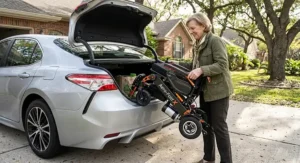
At just 43 pounds without batteries, the TorqueLite manages something genuinely unusual: a 6 mph top speed in a frame light enough to lift into a trunk without help. Its dual 300W brushless motors (600W combined) deliver enough torque for a 25-degree slope rating, and the dual 10Ah lithium battery system with a third battery slot means range can be extended well past the standard 17 miles if you add a spare.
Reviewers consistently describe the acceleration as smooth rather than jerky, a common complaint with cheaper high-speed conversions that simply crank motor output without retuning the controller. What most buyers overlook about this model is that “lightest heavy-duty folding wheelchair” isn’t just marketing language here; supporting up to 400 pounds at this weight and speed is a genuinely rare engineering combination.
On the downside, aggregated feedback notes the compact 24.5-by-17-by-29.5-inch folded footprint, while great for cars, leaves less room for bulkier accessory add-ons than some full-size chairs allow.
Pros:
- ✅ 6 mph top speed at only 43 lbs unloaded weight
- ✅ Expandable battery slot for range beyond 17 miles
- ✅ Supports 400 lbs despite its ultra-light frame
Cons:
- ❌ Compact folded size limits some accessory options
- ❌ Lighter frame may feel less planted than full-size chairs at max speed
Pricing for the Ranger TorqueLite typically falls between $3,000–$3,600, putting genuine 6 mph speed capability within reach of buyers who assumed that pace meant a much bigger price tag.
7. Porto Mobility Ranger Quattro (The Beast) — fastest overall, flagship pick
If the search that brought you here was specifically for the single fastest power wheelchair on the market today, the Ranger Quattro, nicknamed The Beast, is the answer, with a top speed of roughly 7 mph and dual 500W brushless “jet power” motors doing the heavy lifting. It supports up to 550 pounds, making it one of the only chairs on this list that combines bariatric-level capacity with genuinely class-leading velocity, thanks to a reinforced aluminum-alloy frame and pneumatic tires built to handle that combination without instability.
Its dual lithium battery setup delivers an outstanding 40-mile range, meaning a full day at a theme park or a long cross-town commute won’t leave you stranded. Reviewers consistently describe the ride as noticeably more planted at top speed than lighter chairs pushed to their limits, which tracks with the extra shocks and heavier-duty suspension built into the frame.
Here’s what to weigh: this is a flagship model, and it’s priced like one, but for buyers whose top priority is genuinely maximum velocity without giving up weight capacity or range, nothing else on this list matches it feature-for-feature.
Pros:
- ✅ Roughly 7 mph top speed, fastest on this entire list
- ✅ 550 lb weight capacity paired with 40-mile range
- ✅ Reinforced frame and pneumatic tires for stability at speed
Cons:
- ❌ Premium price reflects its flagship positioning
- ❌ Larger footprint than lightweight folding alternatives
Expect the Ranger Quattro Beast to run roughly $4,800–$5,800 depending on configuration, a premium that mostly buys you speed capability and capacity nothing else here can match simultaneously.
Getting the Most Out of a High-Speed Power Chair: Setup & First 30 Days
Bringing home any fastest power wheelchair without a plan for the first month is how good chairs earn bad reputations they didn’t deserve. Start slow, literally: most controllers let you dial down max speed programmatically for the first week or two while you learn the chair’s turning behavior and brake response. Charge batteries fully before first use and every night afterward for the initial two weeks; SLA and lithium batteries both need a break-in period to reach their rated range, and skipping this step is the single most common reason new owners feel shortchanged on mileage. Check tire pressure weekly if your model uses pneumatic tires, since underinflation quietly saps both range and top-speed responsiveness. A common mistake in the first 30 days is testing max speed indoors before you’ve adjusted to the chair’s turning radius; do that outdoors, in an open space, first. Finally, get comfortable with the joystick’s sensitivity settings early. Most high-speed chairs let you soften acceleration curves, which noticeably reduces the “lurch” feeling that catches new users off guard and builds real confidence before you’re navigating traffic or crowded sidewalks at full speed capability.
Real-World Scenarios: Matching Speed to Lifestyle
Consider three genuinely different buyers searching for the same thing. First, a college student commuting across a sprawling 200-acre campus between classes, where every extra half-mile-per-hour translates directly into minutes saved and less rushing between buildings; for this profile, something like the Porto Mobility Ranger TorqueLite makes sense, since its 6 mph pace and light folding frame handle both campus terrain and dorm storage. Second, a retired veteran living in a large assisted-living community who wants rapid outdoor mobility for daily walks around the grounds and occasional trips to a nearby park, where the Porto Mobility Ranger Maestro‘s all-terrain build and weatherproofing genuinely shine over pavement-only alternatives. Third, a bariatric user who needs both serious weight capacity and a chair that won’t feel sluggish on errands, for whom either the Pride Jazzy EVO 614 HD or the flagship Porto Mobility Ranger Quattro (The Beast) solves a problem that heavy-duty chairs have historically ignored: speed shouldn’t be reserved for lighter frames. In each case, the “best” chair isn’t the fastest number on a spec sheet, it’s the one whose speed capability actually matches the terrain, frequency of use, and body type of the person driving it.
How to Choose the Fastest Power Wheelchair for You
Picking the right one comes down to a handful of concrete criteria, and working through them in order saves a lot of buyer’s remorse:
- Confirm your primary terrain. Indoor-only users rarely need more than 4.5 mph; outdoor and mixed-terrain users benefit from 5 mph-plus models with genuine all-terrain tires.
- Match weight capacity honestly. Every chair’s top speed assumes a user under its rated capacity; pushing close to the limit measurably reduces both speed and range.
- Prioritize range over raw top speed if you commute far. A 4.5 mph chair with 24 miles of range beats a 6 mph chair that dies at mile 15 for most daily-use cases.
- Check turning radius against your home. Mid-wheel and center-wheel drive chairs turn tighter than front-wheel drive; measure your narrowest hallway first.
- Look for adjustable speed profiles. The best high speed power wheelchair options let you cap indoor speed lower while unlocking full velocity outdoors.
- Weigh portability against ruggedness. Foldable frames like the TorqueLite trade some heavy-duty stability for trunk-friendly convenience.
- Read aggregated review patterns, not single testimonials. One glowing or scathing review tells you little; recurring themes across dozens of buyers tell you a lot.
⚡ Compare specs side by side before you buy — check current pricing on today’s top picks now!
High Speed Electric Wheelchair Reviews: What Real Users Say
Digging through aggregated feedback across multiple retailers and forums reveals a pattern that spec sheets alone don’t capture: users consistently rate suspension quality and controller smoothness higher than raw top-speed numbers when asked what actually improved their daily experience. A recurring theme in high speed electric wheelchair reviews is that owners who upgraded specifically for speed often report the biggest satisfaction gains from reduced commute time and increased spontaneity, being able to say yes to a last-minute outing without recalculating travel time. On the flip side, a common complaint across faster models is battery anxiety; higher speeds draw more current, and reviewers frequently note that real-world range runs 10 to 20 percent below advertised figures once hills, cold weather, and full user weight are factored in. What the aggregated data suggests, rather than any single glowing review, is that buyers who research actual torque and suspension specs before purchasing report far higher long-term satisfaction than those who chased the highest mph number in isolation.
Fastest Power Wheelchairs vs Standard Power Chairs and Manual Alternatives
| Feature | Fast Power Wheelchairs (5–7 mph) | Standard Power Chairs (3–4 mph) | Manual Wheelchairs |
|---|---|---|---|
| Typical top speed | 5–7 mph | 3–4 mph | User-dependent |
| Outdoor terrain capability | Often all-terrain rated | Mostly smooth-surface | Limited, user effort required |
| Daily commute efficiency | High | Moderate | Low over distance |
| Typical price range | $2,700–$5,800 | $1,800–$3,000 | $200–$2,000 |
| Physical exertion required | None | None | Significant |
Set side by side, the case for a fastest power wheelchair comes down to time and independence rather than novelty. Standard 3–4 mph chairs remain perfectly sensible for users who rarely leave a single-floor home, but for anyone regularly crossing parking lots, campuses, or neighborhoods, the extra 1–3 mph compounds into meaningfully less time spent traveling and meaningfully more spontaneity in daily plans. Manual wheelchairs, meanwhile, simply aren’t a fair comparison for users without the upper-body stamina to self-propel over real distance; the Motorized wheelchair overview on Wikipedia notes that powered models exist specifically to serve users for whom manual propulsion over distance or fatiguing terrain isn’t a sustainable option.
What to Expect: Maximum Velocity vs Real-World Speed Capability
Here’s the gap almost nobody mentions upfront: the maximum velocity printed on a spec sheet is measured under ideal lab conditions, flat ground, full battery, average-weight test rider. Real-world speed capability is consistently lower, and reviewers across every brand in this guide report actual top speeds running roughly 5 to 15 percent below the advertised number once you factor in an uphill driveway, a fully loaded user near the weight limit, or a battery at 40 percent charge. That’s not a defect; it’s physics. What matters more than chasing the exact advertised mph is understanding how a chair’s speed capability degrades under real conditions. Chairs with dual motors, like the Porto Mobility Ranger Quattro (The Beast) and Porto Mobility Ranger TorqueLite, tend to hold their advertised numbers more consistently under load than single-motor competitors, because torque is distributed rather than concentrated. Reviewers consistently note that a chair advertised at a slightly lower top speed but with better torque distribution often feels faster and more confident in daily use than a higher-number chair that struggles on inclines.
Rapid Outdoor Mobility: Making the Most of an All-Terrain Fast Chair
Rapid outdoor mobility isn’t just about top speed, it’s about whether a chair can actually sustain that speed once pavement turns to gravel, grass, or a cracked curb cut. Three practical fixes solve most outdoor frustrations: first, if your chair bogs down on grass, check tire type before assuming it’s a motor problem, since pneumatic or all-terrain tires like those on the Porto Mobility Ranger Maestro handle soft ground dramatically better than solid casters designed for tile. Second, if range drops faster outdoors than indoors, that’s expected; cold weather and rough terrain both increase battery draw, so plan routes with 20 percent buffer range built in. Third, if a chair feels unstable at higher outdoor speeds, dial back the programmed max speed on uneven terrain specifically rather than assuming the whole chair is unsuited to outdoor use. Per the FDA’s classification for powered wheelchairs, these are registered Class II medical devices, meaning manufacturers must meet baseline safety and stability standards before a chair is ever marketed for outdoor or high-speed use in the first place.
Long-Term Cost & Maintenance for Fast Power Wheelchairs
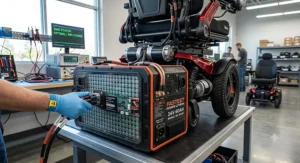
Faster chairs generally cost more upfront, but the long-term math depends heavily on battery type and motor configuration rather than speed alone. Lithium-based systems, standard on most Porto Mobility Ranger models, cost more initially but typically last two to three times longer than sealed lead-acid batteries found in budget picks like the Pride Jazzy Select 6, meaning fewer $200–$400 battery replacements over a five-year ownership window. Dual-motor chairs also distribute wear more evenly, which anecdotally correlates with fewer motor replacements compared to single, harder-working motors pushed to higher RPMs to hit similar top speeds. Tires are the other recurring cost: pneumatic tires on all-terrain models like the Ranger Quattro (The Beast) need occasional replacement (generally $40–$80 per tire) but offer better shock absorption, which in turn reduces wear on suspension components and the frame itself. Budgeting roughly $150–$300 annually for routine maintenance across any of these seven chairs is a reasonable expectation, with heavier-duty and dual-battery models trending toward the higher end of that range simply due to more moving parts.
Safety, Regulations & Compliance for High-Speed Power Wheelchairs
All seven chairs in this guide are registered as Class II medical devices with the FDA, a classification that requires manufacturers to demonstrate baseline safety, braking reliability, and structural integrity before a unit ever reaches a buyer. That classification matters more as top speed increases, since stopping distance and tip-over risk both scale with velocity. Research published in Injury Prevention found that wheelchair-related injuries treated in U.S. emergency departments have risen over the past two decades, with tips and falls accounting for the large majority of incidents across age groups, according to a peer-reviewed study on wheelchair-related injuries. Practically, that means anti-tip wheels, a wide wheelbase, and electromagnetic braking (which engages automatically the instant the joystick is released) aren’t optional extras on a fast chair, they’re the features that make higher speed capability safe in the first place. If you plan to use your chair in public accommodations, it’s also worth knowing that businesses can legally factor a device’s speed into safety assessments under ADA rules, so a chair with a programmable, dialed-down indoor speed setting genuinely helps in shared spaces like malls or medical offices.
Common Mistakes When Buying a Fast Power Wheelchair
The single most common mistake is buying based on the advertised top-speed number alone without checking how that speed is achieved, single motor versus dual, SLA versus lithium battery, solid caster versus pneumatic tire, because those details determine whether the advertised mph actually shows up in daily use. A close second is underestimating weight capacity margins; buying a chair rated exactly at your weight, rather than with headroom, measurably reduces both real-world top speed and battery range. Buyers also frequently skip checking turning radius against their actual home, only to discover a genuinely fast outdoor chair is a nightmare to maneuver around a kitchen island. Finally, many shoppers assume all “fast” chairs are equally stable at top speed, which isn’t true; chairs without anti-tip wheels or wide wheelbases can feel considerably less confident above 5 mph, regardless of how impressive the number looks on the box.
Frequently Asked Questions
❓ What is the fastest power wheelchair you can currently buy?
❓ Is a 5 mph power wheelchair too fast for indoor use?
❓ Do faster power wheelchairs need a prescription?
❓ How much does a high speed electric wheelchair cost?
❓ Can a fast power wheelchair go on grass or gravel?
Chasing the fastest power wheelchair on the market isn’t about bragging rights, it’s about reclaiming minutes, spontaneity, and independence that a slower chair quietly steals from your day without you noticing until you compare the two side by side. The seven models covered here span a genuinely wide range: the budget-conscious Pride Jazzy Select 6, the endurance-focused Golden Compass Sport GP605, the everyday value of the Merits Vision Sport P326A, the bariatric-ready Pride Jazzy EVO 614 HD, the outdoor-built Porto Mobility Ranger Maestro, the featherweight Porto Mobility Ranger TorqueLite, and the outright fastest, the Porto Mobility Ranger Quattro (The Beast). None of them is objectively “best” in a vacuum; the right pick depends entirely on your terrain, your weight capacity needs, and whether you value raw top speed or dependable range more. What every one of them shares is a genuine, verifiable jump in speed capability over entry-level chairs, backed by real specs rather than vague marketing language. Take the comparison tables above, match them against your actual daily terrain and routine, and you’ll land on a chair that doesn’t just move faster, it gives back time you didn’t realize you were losing.
Recommended for You
- Power Wheelchair High Ground Clearance: 7 Best Picks (2026)
- All Terrain Wheelchair for Beach: 7 Sand-Ready Picks (2026)
- All Terrain Power Wheelchair: 7 Rugged Picks for 2026
Disclaimer: This article contains affiliate links. As an Amazon Associate, I earn from qualifying purchases. If you purchase products through these links, we may earn a small commission at no additional cost to you.
✨ Found this helpful? Share it with your friends! 💬🤗
