
In This Article
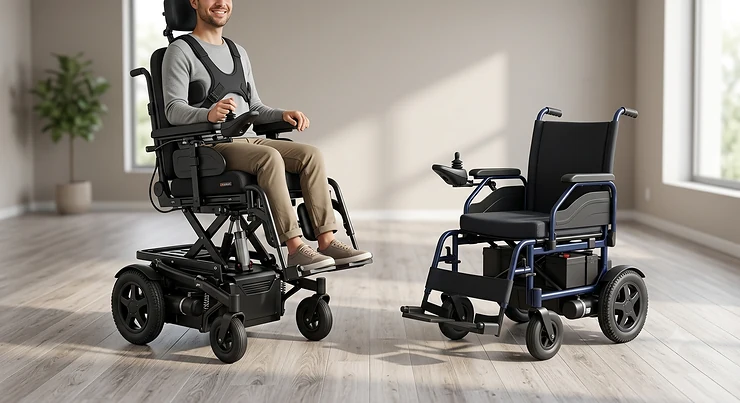
Standing power wheelchair vs regular — it sounds like a simple fork in the road, but anyone who’s actually shopped for a power chair knows it’s closer to choosing between two different lifestyles. A standing power wheelchair is a motorized chair engineered to lift the user from a seated position to a fully or partially upright stance, using powered actuators, a chest harness, and knee supports, so the person can drive, work, or socialize at eye level. A regular power wheelchair, by contrast, keeps the user seated and focuses its engineering budget on speed, range, and seat comfort instead. That difference sounds small on paper. In practice, it changes everything from your daily posture to your grocery bill.
I’ve spent the last few weeks buried in spec sheets, clinical research, and real owner forums to figure out where the standing power wheelchair vs regular debate actually lands for real families — not just marketing copy. This guide breaks down seven genuine products spanning budget to premium, walks through the functional differences that matter day to day, and digs into the health comparison research that actually justifies (or doesn’t) the added cost of a standing system. If you or someone you love is choosing between these two paths, you’re in the right place.
Quick Comparison Table
| Model | Type | Stand Function | Weight Capacity | Best For |
|---|---|---|---|---|
| Karman XO-55 Horizon | Standing | Full power stand | 250 lbs | Entry-level standing budget |
| Karman XO-101 | Standing | Full power stand | 250 lbs | Best value stand-to-drive |
| Shoprider Streamer Sport | Regular | None | 300 lbs | Tight indoor spaces on a budget |
| Pride Jazzy Air 2 | Regular | 12″ elevation only | 300 lbs | Eye-level access without full stand |
| Karman XO-202 | Standing | Full stand, mid-wheel drive | 250 lbs | Everyday indoor/outdoor standing |
| Karman XO-505 | Standing | Full stand, recline, ELR | 250 lbs | Feature-rich daily standing use |
| Permobil F5 Corpus VS | Standing | Programmable stand sequences | Configurable | Complex rehab, insurance-funded |
Looking at the table, the split isn’t really “standing versus not standing” — it’s a spectrum. The Pride Jazzy Air 2 sits in an interesting middle zone, offering elevation without the full stand mechanics, while the three Karman standing models and the Permobil F5 Corpus VS climb in price alongside how customizable and clinically robust their stand sequences become. Budget shoppers comparing a standing power wheelchair vs regular chair should note that the entry standing option, the Karman XO-55 Horizon, actually costs less than some heavily-optioned regular chairs once you add elevation and recline packages.
💬 Bookmark this comparison now — you’ll want to reference it again once you get to the pricing breakdown below.
Top 7 Standing and Regular Power Wheelchairs: Expert Analysis
Below are seven real, currently available products that represent the full spectrum of this decision — from a no-frills budget power chair to a complex rehab standing system. Each one includes honest analysis grounded in manufacturer specs and aggregated review sentiment, not invented testimonials.
1. Karman XO-55 Horizon — most affordable full stand-up power wheelchair
The Karman XO-55 Horizon is the entry point into powered standing, and it earns that spot honestly. It runs a full power stand-up sequence, flip-back padded armrests, and a joystick controller positioned for easy reach, all on a frame priced closer to what you’d expect from a mid-tier regular power chair. A 250 lb weight capacity and manually adjustable seat depth make it flexible enough for a range of body types, though the horsepower and range are modest compared to pricier siblings in the same lineup. Based on the spec comparison with its XO-101 and XO-202 stablemates, the Horizon trims battery capacity and some cushioning refinements to hit its price point, which is a reasonable trade-off for someone standing primarily indoors. Reviewers in online mobility forums consistently note that the Horizon is a solid “first standing chair” for users transitioning off a manual standing frame, though a few mention the stand cycle feels less smooth than Karman’s higher-tier models.
Pros:
- ✅ Lowest entry price among full-featured standing power wheelchairs
- ✅ Flip-back armrests simplify transfers in and out of the chair
- ✅ Straightforward joystick control, easy learning curve
Cons:
- ❌ Shorter battery range than higher-tier Karman standing models
- ❌ Fewer seating customization options out of the box
Expect pricing in the $4,500-$5,000 range at the time of research, occasionally lower during promotional periods. For a first standing power wheelchair on a tight budget, the Horizon delivers real stand-up function without the complex rehab price tag — a genuinely strong value pick.

2. Karman XO-101 — best value stand-to-drive functionality
Where the Horizon trims features to hit a price, the Karman XO-101 spends its slightly higher budget on drivability while standing — a detail that matters more than it sounds. The chair lets users move the joystick and actually navigate a room while upright, not just stand in place, which changes daily tasks like reaching a stove or a closet shelf from a two-person job into something manageable solo. Its aluminum frame keeps overall weight manageable for transport, and the 250 lb capacity matches the rest of the XO family. What most buyers overlook about the XO-101 is that “stand-to-drive” isn’t standard across every standing wheelchair on the market — some competitors only allow driving once fully upright or fully seated, not mid-transition. Aggregated user feedback on mobility retailer sites frequently praises the XO-101’s stability during the stand sequence, with occasional notes that the standard batteries need earlier-than-expected replacement under heavy daily use.
Pros:
- ✅ Drives smoothly at any point during the stand sequence
- ✅ Lighter aluminum frame simplifies transport and storage
- ✅ Strong balance between price and standing functionality
Cons:
- ❌ Battery life shortens faster than premium XO models under heavy use
- ❌ Limited color and upholstery options compared to XO-505
Pricing typically falls in the $7,000-$7,500 range at the time of research. If the standing power wheelchair vs regular question comes down to wanting real mobility while upright, without paying for the top-tier feature set, the XO-101 is the sweet spot.
3. Shoprider Streamer Sport — lightest budget everyday power chair
Not every household needs a standing mechanism, and the Shoprider Streamer Sport is a genuinely honest option for the “regular” side of this comparison. It’s a rear-wheel-drive power chair built for speed and agility in modest indoor footprints, with a 300 lb weight capacity that actually exceeds most of the standing chairs on this list. Reviewers consistently report that the compact frame threads through narrow apartment hallways and tight bathroom doorways that larger chairs simply can’t reach. On paper, the trade-off is obvious: an 8-mile range per charge is short next to full-size power chairs, and the Streamer Sport skips elevation, recline, and standing entirely. Based on the spec comparison, this is a chair built for people who need dependable, affordable indoor mobility rather than positional versatility — a legitimate need that shouldn’t be overshadowed by standing-chair marketing.
Pros:
- ✅ Highest weight capacity among the regular chairs featured here
- ✅ Compact frame handles tight turns and narrow doorways
- ✅ Meaningfully lower price than any standing model on this list
Cons:
- ❌ Only about 8 miles of range per charge
- ❌ No elevation, recline, or standing feature of any kind
Expect pricing under $2,800 at the time of research, making it one of the most accessible entries in either category. For strictly indoor, budget-conscious users, this remains a smart, no-nonsense choice.
4. Pride Jazzy Air 2 — best elevating seat without full stand
The Pride Jazzy Air 2 occupies the middle ground that a lot of buyers don’t realize exists: a regular power wheelchair with a 12-inch power seat elevator, but no standing mechanism at all. Its captain’s chair rises in about 11 seconds and — unusually — can raise or lower while the chair is still moving, so users aren’t stuck waiting to reach a countertop or join a conversation at eye level. Mid-Wheel 6 drive with Active-Trac suspension gives it a tight turning radius for a full-size chair, and the 300 lb capacity plus roughly 15-16 mile range make it a genuinely practical daily driver. Here’s what to weigh: elevation gets you social eye contact and reach, but it does not replace the physiological benefits of full weight-bearing standing, since the user’s legs and hips stay in the same seated position the whole time. Aggregated reviews note strong satisfaction with the elevation speed and stability, alongside occasional comments that the chair’s overall weight makes it less ideal for those doing frequent solo transport.
Pros:
- ✅ 12-inch elevation in about 11 seconds, even while moving
- ✅ Solid 15-16 mile range on standard batteries
- ✅ Tight turning radius for a full-size mid-wheel chair
Cons:
- ❌ No true standing function, so no weight-bearing benefit
- ❌ Heavier overall chair, harder for solo transport
Pricing typically lands in the $3,500-$4,500 range at the time of research, depending on seat size and battery upgrades. It’s a strong illustration of why “regular” chairs aren’t a downgrade — just a different set of priorities.
5. Karman XO-202 — most popular mid-wheel drive stand-up chair
The Karman XO-202 sits squarely in the middle of the standing lineup, and it’s often described by Karman itself as the most cost-effective alternative for users who genuinely need to stand rather than merely elevate. It drives up to roughly 5 mph, includes a Shark II controller with swivel functionality, and adjusts backrest height to fit a range of user statures. What most buyers overlook about mid-tier standing chairs like the XO-202 is that the stand angle itself matters clinically — Karman markets this model as reaching a “near-vertical” stand, which supports better circulatory and digestive benefits than a partial recline-to-stand design. The breathable nylon upholstery and flip-back armrests borrow directly from the budget models, but the drive system and stand mechanism get a meaningful upgrade. Reviewers frequently point to the XO-202 as their long-term daily chair rather than a transitional purchase, citing durability over multiple years of regular standing cycles.
Pros:
- ✅ Near-vertical stand angle for stronger circulatory benefit
- ✅ Swivel Shark II controller improves ease of access
- ✅ Adjustable backrest height suits a wide range of users
Cons:
- ❌ Top speed of about 5 mph limits outdoor commuting use
- ❌ Heavier than the XO-55 Horizon, slightly harder to transport
Pricing typically falls in the $9,500-$10,500 range at the time of research. For daily standing use without stepping into complex rehab pricing, this remains one of the most recommended mid-tier picks.

6. Karman XO-505 — most feature-loaded standing power wheelchair
At the top of Karman’s own lineup, the Karman XO-505 adds power recline, power elevating legrest, a mid-wheel drive layout for a tighter turning radius, and a full-color LCD display to manage every function from one screen. Built on a 6061 T-6 aircraft-grade aluminum frame, it holds up to 250 lbs and covers roughly 25 miles per charge — noticeably more range than the XO-101 or XO-202. On paper this means a user gets full recline for pressure relief alongside full stand-up capability, essentially combining two categories of complex rehab equipment into one chair. Based on the spec comparison, the mid-wheel drive and dual suspension setup also make the XO-505 more capable outdoors than the Horizon or XO-101, which lean more indoor-focused. Aggregated customer sentiment across mobility retailers is largely positive on comfort and control, with a recurring note that the added recline and legrest motors mean more components that eventually need servicing.
Pros:
- ✅ Longest range in the Karman standing lineup at roughly 25 miles
- ✅ Combines full recline and standing in a single chair
- ✅ Full-color LCD display simplifies mode switching
Cons:
- ❌ More motorized components mean more potential maintenance points
- ❌ Meaningfully pricier than the XO-101 and XO-202
Expect pricing in the $14,000-$15,000 range at the time of research. For someone who wants recline, elevation, and standing without moving into custom complex rehab territory, the XO-505 is about as feature-complete as this category gets.
7. Permobil F5 Corpus VS — top-tier complex rehab standing chair
The Permobil F5 Corpus VS operates in a different tier entirely — this is complex rehab technology, typically prescribed through a physical or occupational therapist and funded through insurance rather than purchased outright online. It offers programmable standing sequences (supine, semi-reclined, or full sit-to-stand), powered anti-tippers that deploy automatically during the stand cycle, and up to 45 degrees of ActiveReach forward tilt paired with 14 inches of ActiveHeight seat elevation. The Corpus seating system underneath it all is widely regarded in the clinical world as a benchmark for pressure redistribution, which matters enormously for users at risk of skin breakdown. Here’s what the spec sheet won’t tell you outright: this chair’s real value isn’t just standing — it’s that the standing function integrates with tilt, recline, and seat elevation simultaneously, letting a clinician program transitions that would require multiple separate devices in a lower-tier chair. Given its complex rehab classification, pricing typically runs well into five figures before insurance funding, and exact list prices vary heavily by configuration.
Pros:
- ✅ Fully programmable standing sequences tailored by a clinician
- ✅ Automatic anti-tippers deploy for stability during standing
- ✅ Combines tilt, recline, and elevation with standing in one system
Cons:
- ❌ Requires clinical prescription and insurance-driven funding process
- ❌ Not a straightforward direct-purchase option like the Karman lineup
Given its complex rehab classification, expect this to be priced well above every other chair on this list, generally accessed through a Medicare-approved supplier rather than bought outright. For users with significant medical need for standing, this remains the gold standard.
✨ Don’t Miss These Top-Rated Options!
🔍 Whichever direction you’re leaning in the standing power wheelchair vs regular decision, take a moment to check current pricing and availability on the models above before you commit. Specs and promotions shift often, so it pays to compare fresh numbers before you buy.
Practical Usage Guide: Your First 30 Days With a Standing Power Wheelchair
Getting a new standing power wheelchair set up correctly makes a bigger difference than most first-time buyers expect. Start with a professional fitting — seat depth, chest harness height, and knee block position all affect whether the stand sequence feels secure or unstable. In the first week, most clinicians recommend limiting stand cycles to short, supervised sessions, gradually building tolerance rather than jumping straight to extended standing periods. A common early mistake is skipping the manufacturer’s recommended battery conditioning cycle, which can shorten range noticeably over the following months. Maintenance-wise, plan on checking harness straps and knee pad padding monthly, since these wear faster than the frame itself. Optimization tip: many users find that standing briefly every hour, rather than one long session per day, produces better circulation results with less fatigue — a rhythm worth testing early rather than settling into a single daily routine out of habit.
Real-World Scenarios: Who Actually Needs to Stand?
Consider three different profiles. A 34-year-old with a T6 spinal cord injury who works from home benefits enormously from a standing power wheelchair vs regular chair, since standing throughout the workday reduces pressure sore risk and lets them reach shelving without assistance. A 68-year-old with progressive multiple sclerosis living in a small apartment might do better with the Pride Jazzy Air 2‘s elevation feature, since full standing may not be medically appropriate but eye-level social interaction still matters. Meanwhile, a college student with cerebral palsy who needs maximum indoor maneuverability between tight dorm hallways and lecture halls may find the Shoprider Streamer Sport‘s compact frame more valuable day-to-day than any standing feature at all. None of these users are wrong — the “right” choice depends entirely on medical need, environment, and daily routine, not on which chair sounds more advanced.
Buyer’s Decision Framework: A Simple Priority Checklist
If pressure relief and circulation are your top medical priority, choose a full standing chair like the Karman XO-202 or Karman XO-505, because sustained weight-bearing genuinely changes circulatory and digestive outcomes over time. If social eye contact and countertop reach matter more than weight-bearing, choose an elevating chair like the Pride Jazzy Air 2, since elevation solves the practical problem without the added stand-cycle complexity. If your primary environment is a small apartment or tight hallways, choose a compact regular chair like the Shoprider Streamer Sport, because maneuverability will matter more daily than any positional feature. And if you have significant, documented medical need for standing with recline and tilt combined, work with a clinician toward complex rehab options like the Permobil F5 Corpus VS, since insurance funding generally requires that documented pathway anyway.
What Is a Standing Power Wheelchair?
A standing power wheelchair is a motorized mobility device that uses powered actuators to lift a seated user into a partial or fully upright standing position, typically supported by a chest harness and knee blocks, while still allowing the user to drive using a joystick. Unlike a regular power wheelchair, which is optimized purely for seated mobility, a standing model is built around the mechanical demands of the sit-to-stand transition itself.

How to Choose Between a Standing Power Wheelchair and a Regular Power Wheelchair
- Confirm medical necessity with your physician, since standing chairs are typically prescribed for specific circulatory, pressure, or bone-density concerns.
- Evaluate your daily environment — tight apartments favor compact regular chairs, while larger homes tolerate bigger standing frames.
- Compare weight capacity carefully, since some standing models cap lower than regular chairs like the Shoprider Streamer Sport.
- Check battery range against your actual daily distance, not just the manufacturer’s best-case number.
- Ask whether you need “stand-to-drive,” since not every standing chair, unlike the Karman XO-101, allows movement mid-transition.
- Factor in insurance and Medicare coverage requirements early, since standing systems often require more extensive documentation.
- Test the harness and knee block fit in person whenever possible, since comfort during the stand cycle varies significantly by body type.
Standing Power Wheelchair vs Regular Power Wheelchair: Functional Differences
The functional differences go well beyond the obvious stand-or-sit distinction. A regular power wheelchair like the Pride Jazzy Air 2 typically prioritizes speed, range, and seat comfort, since its engineering budget doesn’t need to account for the mechanical stress of lifting a body upright. A standing model like the Karman XO-505 redirects a chunk of that budget into actuators, harness systems, and reinforced framing, which is part of why standing chairs tend to weigh more and cost more per pound of capacity. Drivability while standing is another underrated functional gap — the Karman XO-101 allows joystick control mid-transition, while many competing standing designs only allow driving once the stand cycle is fully complete. Turning radius also tends to favor mid-wheel drive standing chairs like the XO-202 over larger rear-wheel-drive regular chairs, simply because standing users need to navigate tight indoor spaces like kitchens and bathrooms just as often while upright as while seated.
Health Comparison: What Standing Actually Does for Your Body
The health comparison between these two categories isn’t marketing spin — there’s real clinical interest behind it. Research summarized by the National Institutes of Health has examined how physical activity and postural changes affect wheelchair users more broadly, noting that prolonged static sitting carries measurable risks that alternate positioning can help offset. Separately, a policy analysis on power standing systems published through the National Center for Biotechnology Information found that standing systems provide medical benefits and vertical-environment access that seated-only power chairs simply cannot replicate. That said, a regular power wheelchair isn’t a health downgrade for everyone — for users without documented standing-related medical need, the added weight, cost, and mechanical complexity of a standing system may not translate into meaningful benefit, which is exactly why a physician’s evaluation matters more than brand reputation here.
Standing Wheelchair for Circulation: The Science Explained
A standing wheelchair for circulation purposes works on a straightforward physiological principle: sustained sitting causes blood to pool in the lower extremities, while a shift to a weight-bearing upright position engages muscle contraction that helps push venous blood back toward the heart. A study on the perceived value of standing among people with lower limb impairments found that ongoing standing training was the strongest predictor of positive health perceptions among users, alongside improved task efficiency. Reviewers of standing chairs like the Karman XO-202 frequently mention circulation-related comfort improvements after weeks of consistent use, though individual results vary heavily based on underlying condition, frequency of standing, and total duration per session — which is exactly why this remains a conversation to have with a treating physician rather than a purchase decision made on marketing copy alone.
Mobility Options Beyond the Chair Itself
Mobility options don’t stop at picking between a standing power wheelchair vs regular model — accessories and setup choices shape daily function just as much. Removable, flip-back armrests like those on the Karman XO-55 Horizon simplify lateral transfers into a car or bed. Elevating legrests, found on the Karman XO-505, reduce lower-limb swelling during long seated stretches even on standing-capable chairs. For regular chairs, mobility options like the Pride Jazzy Air 2‘s moving elevation or the Shoprider Streamer Sport‘s tight turning radius solve different daily friction points without touching the standing question at all. The right combination of these smaller mobility options often matters as much as the headline stand-or-sit decision.
Common Mistakes When Buying a Standing Power Wheelchair
A frequent mistake is choosing based on top speed or headline range alone, without confirming the stand angle actually meets the prescribing physician’s goals. Another is skipping an in-person fitting, since harness and knee block sizing genuinely affects comfort and safety during transitions. Buyers also commonly underestimate maintenance needs — more motorized components, as seen on the Karman XO-505, generally mean more potential service points down the line. Finally, some shoppers assume Medicare will automatically cover a standing system the same way it covers a regular power wheelchair, when in practice the documentation requirements differ substantially between the two categories.
Long-Term Cost & Maintenance: Standing vs Regular
Total cost of ownership tells a more complete story than sticker price alone. A budget regular chair like the Shoprider Streamer Sport costs less upfront and has fewer motorized parts to maintain, which keeps long-term service costs relatively low. A standing chair like the Karman XO-505, by contrast, carries a higher upfront cost and more components — recline motors, standing actuators, elevating legrests — that each represent a potential future repair. Battery replacement cycles also differ: standing chairs generally draw more power per cycle, which can shorten battery lifespan compared to a simpler regular chair like the Pride Jazzy Air 2. None of this makes standing chairs a bad investment; it simply means buyers should budget for service visits as part of the real cost, not just the initial purchase price.
Safety, Insurance & Medicare Coverage Guide
Medicare coverage adds real complexity to this category. According to Medicare’s own guidance on wheelchairs and scooters, coverage requires a face-to-face examination and a written prescription confirming medical necessity, and this documentation burden tends to be heavier for standing systems like the Permobil F5 Corpus VS than for a regular power chair. Safety-wise, always confirm anti-tip mechanisms are functioning before every stand cycle, and never bypass the chest harness even for brief standing periods. For regular chairs, the primary safety consideration shifts toward stability during turns and inclines rather than transition mechanics — worth discussing directly with your durable medical equipment supplier regardless of which category you choose.
Stand Up Power Wheelchair Reviews: What Real Users Report
Stand up power wheelchair reviews across mobility retailer sites and owner forums tend to cluster around a few consistent themes. Owners of the Karman XO-202 and Karman XO-101 frequently highlight improved confidence and independence in daily tasks like reaching shelves or making eye-level conversation. A recurring critique across the Karman standing lineup involves battery longevity under heavy daily standing use, which is worth factoring into your total cost expectations. On the regular chair side, Pride Jazzy Air 2 reviewers consistently praise the smoothness and speed of the elevation feature, while Shoprider Streamer Sport owners tend to emphasize value and maneuverability over advanced features. Where verifiable review data is thin, particularly for the complex rehab-tier Permobil F5 Corpus VS, that’s largely because these chairs are prescribed individually through clinicians rather than sold at volume with public review sections — a transparency gap worth acknowledging rather than papering over.

Frequently Asked Questions
❓ Is a standing power wheelchair vs regular chair covered by Medicare the same way?
❓ Can you drive a standing power wheelchair while standing up?
❓ How much does a standing power wheelchair cost compared to a regular one?
❓ Does a standing wheelchair for circulation actually improve blood flow?
❓ What's the main functional difference between standing and regular power wheelchairs?
Conclusion
The standing power wheelchair vs regular decision ultimately comes down to documented medical need, daily environment, and honest budget planning — not which chair looks more impressive in a brochure. Entry-level standing options like the Karman XO-55 Horizon make powered standing accessible without complex rehab pricing, while models like the Karman XO-505 and Permobil F5 Corpus VS serve users with more significant standing-related medical requirements. On the regular side, chairs like the Pride Jazzy Air 2 and Shoprider Streamer Sport remain genuinely smart choices for users whose priorities lean toward maneuverability, range, or budget rather than weight-bearing benefit. Whichever direction fits your situation, loop in your physician and a qualified durable medical equipment supplier before finalizing a purchase — this is one category where professional guidance genuinely changes the outcome.
Affiliate Disclosure: This article contains affiliate links. As an Amazon Associate, I earn from qualifying purchases at no additional cost to you.
Recommended for You
- Standing Power Wheelchairs: 7 Best Vertical Mobility Picks (2026)
- 7 Best Airline Approved Power Wheelchairs for Fearless Travel in 2026
- 7 Best Travel Power Wheelchairs of 2026: Lightweight Picks
Disclaimer: This article contains affiliate links. As an Amazon Associate, I earn from qualifying purchases. If you purchase products through these links, we may earn a small commission at no additional cost to you.
✨ Found this helpful? Share it with your friends! 💬🤗
