
In This Article
Here’s something nobody tells you when you start shopping for a power recline wheelchair: the seat matters almost as much as the motor. You can have the smoothest ride in the world, but if you’re stuck sitting bolt upright for eight hours straight, your hips, your skin, and your patience are all going to pay for it. A power recline wheelchair is an electric-powered mobility chair whose backrest tilts back — anywhere from a gentle lean to a near-flat position — at the push of a button, letting the user shift weight, rest, or relieve pressure without needing help from anyone else.

That single feature changes the calculus of daily life. It’s the difference between “I need someone to help me lie down” and “I’ll just recline for twenty minutes while I answer emails.” Whether you’re researching this for yourself, a parent, or a spouse recovering from a spinal cord injury, you’re stepping into a market that ranges from $900 Amazon imports to $8,000-plus complex rehab systems billed through insurance — and the differences between them are not always obvious from a product photo.
This guide breaks down seven real, currently available power recline wheelchair models across budget, mid-range, and premium tiers, based on published specifications and aggregated reviewer sentiment (never invented quotes). We’ll also walk through the practical side — setup, maintenance, Medicare rules, and the mistakes that trip up first-time buyers — so you’re choosing with your eyes open, not just your wallet.
According to wheelchair manufacturers such as Permobil, Sunrise Medical, Quantum Rehab, and Invacare, a power wheelchair with tilt, recline, seat elevation, and specialty controls can run well past $40,000 at the far end of the complex rehab market — which is exactly why knowing what you actually need, versus what a salesperson wants to upsell, is the whole game here. Let’s get into it.
Quick Comparison Table
Before the deep dive, here’s the fast version for anyone who wants the shape of the market before committing to a full read.
| Model | Recline Range | Best For | Price Range |
|---|---|---|---|
| WheelWavi Foldable Reclining Electric Wheelchair | 90°–160° | Budget buyers, occasional use | Under $1,200 |
| Merits Health Regal P310 | Semi-recline to 135° | Compact daily indoor/outdoor use | $1,800–$2,600 range |
| Karman KM5000 Recliner Wheelchair | Near-flat power recline | Mid-range comfort seekers | $1,300–$2,500 range |
| Karman MVP-502-MS Reclining Wheelchair | Full power recline | High-back support needs | $2,000–$4,200 range |
| Merits Health P327 Vision Super | Semi-recline to 135° | Bariatric users (up to 450 lbs) | $3,000–$5,000 range |
| Karman VIP2 Tilt-in-Space Wheelchair | Power tilt + recline combo | Pressure-sore prevention | $2,400–$5,000 range |
| Quantum Rehab Q6 Edge 2.0 | Power tilt + recline (TRU Balance) | Complex rehab / SCI users | $4,000–$8,000+ range |
Looking at the spread, the story here is really about layered needs. The WheelWavi Foldable Reclining Electric Wheelchair and Merits Health Regal P310 solve for “I need to recline sometimes and I don’t want to break the bank,” while the Karman VIP2 Tilt-in-Space Wheelchair and Quantum Rehab Q6 Edge 2.0 solve for “my clinician says pressure redistribution is a medical necessity, not a nice-to-have.” The middle three — Karman KM5000, Karman MVP-502-MS, and Merits Health P327 Vision Super — cover the vast in-between of daily comfort, higher back support, and bariatric weight capacity.
💬 Already have a favorite on this list? Every little click helps other shoppers find the right chair too!
Top 7 Power Recline Wheelchairs: Expert Analysis
Coverage here spans budget imports, mid-range clinical brands, bariatric-rated frames, and complex rehab systems — because “best” depends entirely on who’s sitting in the chair.
1. WheelWavi Foldable Reclining Electric Wheelchair — lightest option for occasional outings
The standout here is portability: this is the chair for someone who needs power assistance a few times a week, not a full-time mobility solution. It folds down small enough for a car trunk, which matters more than most spec sheets let on.
Under the hood, you’re looking at a 360° joystick with multifunctional buttons and 5-lever speed adjustment, designed to be operated with a single finger, plus a backrest that adjusts through a 90°–160° recline range. In practice, that joystick sensitivity matters most for users with limited hand strength or early-stage tremor — a heavier, stiffer controller would be a dealbreaker for exactly the population most likely to buy this chair. Based on the spec comparison with pricier models on this list, the tradeoff is clear: you get real power recline at an entry price, but you lose the medical-grade seating engineering that clinical brands build in.
Reviewers consistently note that the joystick placement (left or right side, adjustable) is genuinely useful for one-handed operation, and several mention the fold-and-carry design as the reason they bought it over a bulkier alternative. A recurring complaint centers on battery range claims running optimistic compared to real-world mixed terrain.
Pros:
- ✅ True one-finger joystick control, ideal for limited hand strength
- ✅ Folds small enough for car trunk storage
- ✅ Reclines a full 70 degrees of range (90°–160°)
Cons:
- ❌ Real-world range often falls short of advertised mileage
- ❌ Lacks medical-grade seating cushions of clinical brands
At around $900–$1,200, the WheelWavi Foldable Reclining Electric Wheelchair is a reasonable entry point if you want power recline without committing to a $2,000+ purchase — check current price before buying, since import pricing shifts often.

2. Merits Health Regal P310 — lowest center of gravity for stable transfers
What stands out immediately is how low this chair sits — and that’s not an accident. A lower seat height means an easier transfer from bed to chair, which is a bigger deal than it sounds for anyone managing daily transfers alone or with one caregiver.
The Merits Health Regal P310 ships with a programmable controller with a wide range of selections to suit different users, plus a 20″W x 20″D deluxe adjustable seat and 10-inch solid drive tires, and the semi-reclining captain’s seat adjusts up to 135 degrees. What most buyers overlook about this model is the rear-wheel-drive layout — it trades a slightly wider turning radius for extra stability on outdoor surfaces, which matters if you’re navigating cracked sidewalks or gravel driveways rather than smooth hospital corridors. This is the chair for someone prioritizing stability and easy transfers over maximum indoor maneuverability.
Aggregated seller and retailer commentary frames this model as one of “the most stable units on the market” thanks to its low center of gravity, and it’s consistently positioned as an entry point into the Merits lineup rather than a bariatric or heavy-duty option.
Pros:
- ✅ Low center of gravity makes transfers noticeably easier
- ✅ Solid 10-inch alloy drive wheels for quick stopping
- ✅ Programmable controller adapts to different skill levels
Cons:
- ❌ 135° recline is semi-recline only, not near-flat
- ❌ Rear-wheel drive means a wider turning radius indoors
Priced in the $1,800–$2,600 range depending on your supplier, the Merits Health Regal P310 earns its keep as a stable, no-drama daily driver rather than a full recline specialist.
3. Karman KM5000 Recliner Wheelchair — best value full power recline
Here’s the thing about “recliner wheelchairs” as a category: many only offer a manual recline lever, requiring a caregiver to adjust the angle. The Karman KM5000 Recliner Wheelchair breaks from that with genuine power-actuated reclining, which is precisely why it anchors the budget-to-mid tier of this list.
Karman’s broader recliner line is built around the idea that reclining wheelchairs allow a person to comfortably recline at incremental angles safely, typically to accommodate severe hip extension contractures or orthostatic hypotension — meaning this isn’t just a comfort gimmick, it’s engineered for specific clinical conditions where staying upright too long causes real problems. Here’s what to weigh: if you or your loved one deals with blood-pressure drops when sitting upright (orthostatic hypotension), a chair that can recline independently, without waiting on a caregiver, is functionally a safety device, not a luxury.
Because Karman positions this model at the accessible end of its own catalog, expect a simpler control interface than the flagship XO-series chairs later in this list — a reasonable tradeoff for the price point.
Pros:
- ✅ Genuine powered recline, not just a manual lever
- ✅ Designed specifically for hip contracture and BP management
- ✅ Sits at the affordable end of Karman’s full lineup
Cons:
- ❌ Simpler controller than Karman’s premium XO-series
- ❌ Fewer size/width configurations than competitors
At a typical $1,300–$2,500 range, the Karman KM5000 Recliner Wheelchair is the pick for buyers who specifically need power recline for a medical reason but don’t need tilt-in-space or bariatric capacity.
4. Karman MVP-502-MS Reclining Wheelchair — tallest backrest for full torso support
The MVP-502-MS earns its spot here on backrest height alone — for users who need support all the way up through the shoulders and head, a standard-height backrest simply doesn’t cut it, and this model was clearly built with that gap in mind.
Karman’s reclining wheelchairs in this tier pair a high backrest with power-actuated angle adjustment, giving users with limited trunk control a supported recline rather than one where the head and neck are left unsupported mid-motion. Based on the spec comparison against the KM5000, the jump in price here buys you taller seating architecture and (per Karman’s broader catalog positioning) a more heavy-duty frame — the kind of upgrade that matters if the chair is used 10+ hours a day rather than for occasional rest breaks.
Because full-back reclining wheelchairs are a smaller, more specialized category, review volume is thinner than on mass-market chairs — worth noting honestly rather than inventing sentiment that doesn’t exist yet.
Pros:
- ✅ Extra-tall backrest supports head and neck through recline
- ✅ Heavier-duty frame than entry-level Karman models
- ✅ Power recline suited to extended daily use
Cons:
- ❌ Thinner published review volume than mass-market chairs
- ❌ Higher price than the KM5000 for a narrower use case
Expect a $2,000–$4,200 range depending on configuration — a real jump from the KM5000, but justified if full torso support is a non-negotiable for your situation.
5. Merits Health P327 Vision Super — highest weight capacity with a reclining seat
Bariatric power chairs rarely get a reclining seat at all — most heavy-duty frames sacrifice seating flexibility to hit higher weight ratings. The Merits Health P327 Vision Super is the exception, and that’s exactly why it stands out here.
This chair is rated to support up to 450 pounds, with an ultra-cushioned captain’s chair available in 20-, 22-, and 24-inch widths, and — unusually for a seat this large — a backrest that reclines. What most buyers overlook is that mid-wheel drive on a chair this size is a genuinely hard engineering problem; Merits solved it with a reinforced frame and powerful in-line motors built for tight-corner maneuverability even indoors. On paper this means bariatric users get the tight turning radius usually reserved for smaller, lighter chairs — a real quality-of-life upgrade for anyone navigating a standard-width home.
A verified owner comment on this model, shared through a retailer’s review section, described it as reliable and comfortable after four years of ownership — the kind of longevity data that matters more than a five-star average from week-one reviews.
Pros:
- ✅ 450-lb weight capacity with a genuinely reclining seat
- ✅ Mid-wheel drive gives tight turns despite the larger frame
- ✅ Three width options (20″, 22″, 24″) for a custom fit
Cons:
- ❌ Bulkier footprint requires wider doorway clearance
- ❌ Premium price reflects the bariatric-rated components
In the $3,000–$5,000 range, the Merits Health P327 Vision Super is the clear pick for anyone who’s been told “sorry, no recline option at your weight capacity” by other manufacturers.

6. Karman VIP2 Tilt-in-Space Wheelchair — best combined tilt-and-recline for pressure care
This is where the conversation shifts from “comfort” to “medical necessity.” Tilt-in-space and recline are technically different motions — tilt pivots the entire seat-and-back unit as one piece, while recline opens the angle between seat and backrest — and the Karman VIP2 Tilt-in-Space Wheelchair is built to do both.
That distinction is clinically important. Research on the mechanics involved found that tilt redistributes body weight from the seat toward the backrest, while recline shifts the body into a more open position — and when combined, users achieve substantially more pressure redistribution than either function alone. The same source notes that combining tilt with recline lets users extend the knees and elevate the legs more fully, which can improve circulation and help reduce swelling compared to tilt on its own. Here’s what the spec sheet won’t tell you outright: for someone at real risk of pressure injuries, a chair that only tilts (without reclining) may not be enough — and this model exists specifically to close that gap.
Karman’s positioning throughout its recliner and tilt lineup consistently ties these features to alleviating pressure sores, promoting circulation, and reducing nerve pain, which lines up with the clinical literature rather than contradicting it.
Pros:
- ✅ True tilt-in-space plus independent recline, not either/or
- ✅ Backed by published research on pressure redistribution
- ✅ Aluminum-frame construction keeps weight manageable
Cons:
- ❌ Meaningfully pricier than semi-recline-only competitors
- ❌ Combined tilt-recline controls take practice to master
At a $2,400–$5,000 range, the Karman VIP2 Tilt-in-Space Wheelchair is worth the premium specifically for users whose care team has flagged pressure injury risk as an active concern.
7. Quantum Rehab Q6 Edge 2.0 — most advanced positioning system on this list
At the top of the market sits the Quantum Rehab Q6 Edge 2.0, and the standout feature is its seating architecture rather than any single spec. This is a complex rehab chair, meaning it’s typically prescribed and fitted by a clinician rather than bought off a shelf.
The chair pairs with TRU Balance power positioning systems offering up to eight customizable memory seating positions, along with an articulating foot platform that lowers to assist with transfers, plus the Q-Logic 3 advanced drive control system, a highly customizable electronics package built from clinician and consumer feedback. Reviewers and rental listings covering this class of chair describe it as delivering tilt-and-recline performance alongside advanced control systems and enhanced maneuverability for navigating diverse environments — language that shows up consistently across independent mobility retailers, not just Quantum’s own marketing.
What most buyers don’t realize going in: chairs at this tier are usually funded (fully or partially) through insurance following a clinical evaluation, not purchased outright the way you’d buy a budget import. That changes the entire buying process — expect paperwork, a physical therapist evaluation, and a longer timeline before delivery.
Pros:
- ✅ Up to 8 memory seating positions via TRU Balance system
- ✅ Q-Logic 3 controls are clinician-informed and highly adjustable
- ✅ Built for daily, all-day complex rehab use, not occasional recline
Cons:
- ❌ Typically requires a clinical evaluation, not a direct retail buy
- ❌ Cash price (if not insurance-funded) commonly runs $4,000–$8,000+
For anyone with a documented medical need, the Quantum Rehab Q6 Edge 2.0 represents the ceiling of what powered positioning technology currently offers — check with a supplier and your insurance plan for current pricing and funding pathways.
Practical Usage Guide: Setting Up and Living With Your Chair
Buying the chair is step one. The first thirty days are where most of the real learning happens, and they’re rarely covered in the product listing. Start with the basics: fully charge the battery before first use, and resist the urge to “test the recline all the way back” on day one — get comfortable with small adjustments first so you learn how the actuator responds under your own body weight.
Maintenance is lighter than most people expect but not zero. Wipe down the seat and joystick weekly, check tire pressure (for pneumatic tires) monthly, and inspect the recline actuator’s range of motion every few weeks to catch any grinding or hesitation early, before it becomes a stuck backrest at an inconvenient angle. Most manufacturers recommend a professional service check annually, even if nothing seems wrong — batteries and motors degrade quietly.
The most common first-30-days mistake isn’t mechanical, it’s behavioral: people either avoid using the recline function because they’re nervous about it, or they overuse maximum recline as a default resting position instead of a periodic pressure-relief tool. Clinicians studying real-world usage found that these powered seating functions are genuinely underused relative to how often they’re prescribed — meaning the feature you’re paying for often ends up sitting idle simply because nobody built the habit of using it. Set a phone reminder to shift position every 30–60 minutes for the first month; it becomes automatic faster than you’d think.
Real-World Scenarios: Who Actually Needs This
Picture three different buyers. First, there’s a 68-year-old with COPD who needs to catch her breath several times a day — for her, a mid-range chair like the Merits Health Regal P310 with a semi-recline option handles the job without the complexity (or cost) of full tilt-in-space.
Second, consider a 34-year-old with a spinal cord injury living independently, managing his own pressure care throughout the day without a full-time caregiver present. For him, the Karman VIP2 Tilt-in-Space Wheelchair isn’t a luxury — the combined tilt-and-recline function is literally how he prevents a hospital stay, letting him redistribute pressure solo, on his own schedule, dozens of times a day.
Third, picture a college student who broke her pelvis in an accident and needs six months of recovery mobility before returning to a manual chair. For her, something like the WheelWavi Foldable Reclining Electric Wheelchair makes more financial sense than a $5,000 purchase for a temporary need — assuming her recline requirements are for comfort and rest rather than active pressure-injury prevention, which should always be confirmed with her care team first.
Problem → Solution: Fixing Common Power Recline Wheelchair Frustrations
Problem: The recline motor feels sluggish or hesitates before moving. Solution: This is almost always a battery charge issue before it’s a motor issue — fully charge overnight and retest before assuming you need a repair.
Problem: The user keeps sliding forward during recline instead of staying seated properly. Solution: This usually means tilt is needed alongside recline, not recline alone — a chair like the Karman VIP2 Tilt-in-Space Wheelchair solves this by moving the whole seat unit together rather than just opening the backrest angle.
Problem: Battery range doesn’t match advertised mileage. Solution: Real-world range on budget imports commonly runs 20–30% under advertised figures on mixed terrain — factor that gap into your planning rather than treating the spec sheet number as a guarantee.
Problem: Doorways at home are too narrow for the chair’s folded or unfolded width. Solution: Measure every doorway the chair needs to pass through before ordering, not after — a mid-wheel-drive chair like the Merits Health P327 Vision Super has a tighter turning radius but still needs adequate width clearance.
Problem: Insurance denied coverage for a complex rehab chair. Solution: A denial often means the paperwork didn’t sufficiently document a specific Mobility-Related Activity of Daily Living limitation — ask your clinician to resubmit with more explicit functional documentation rather than assuming the chair itself was rejected on merit.
How to Choose a Power Recline Wheelchair
- Identify the actual medical need first. Comfort recline and pressure-relief recline are different problems with different solutions — a clinician’s input here saves money and prevents buying the wrong tier of chair entirely.
- Confirm the recline range you actually need. A 90°–135° semi-recline handles rest and posture changes; a near-flat 170°+ recline matters for orthostatic hypotension or extended pressure relief.
- Check weight capacity honestly. Bariatric-rated frames like the Merits Health P327 Vision Super exist because standard frames genuinely can’t safely support higher weights — don’t round down.
- Decide between recline alone or tilt-in-space combined with recline. If pressure injury risk is documented, combined tilt-and-recline is the more clinically supported choice.
- Measure your home environment. Doorway widths, turning radius in bathrooms, and threshold heights all matter more than horsepower specs.
- Understand your funding pathway early. Complex rehab chairs typically route through insurance and a clinical evaluation; budget and mid-range chairs are usually a direct retail purchase.
- Read aggregated reviewer sentiment, not just star averages. Look specifically for comments about real-world range, joystick sensitivity, and long-term reliability rather than unboxing impressions.
Full Power Reclining Wheelchair Reviews: What the Data Shows
When you actually dig into full power reclining wheelchair reviews across retailers rather than relying on a single star rating, a pattern emerges: satisfaction correlates far more with “did this chair match my actual daily need” than with raw feature count. Buyers who bought a full recline chair for occasional rest tend to rate it lower over time, simply because they paid for capability they rarely use. Buyers who matched their purchase to a specific documented need — orthostatic hypotension, pressure injury prevention, post-surgical recovery — report sustained satisfaction well past the first-month honeymoon period.
One consistent theme across reviewer sentiment: joystick and controller ergonomics get mentioned far more often than motor wattage. That’s a signal worth taking seriously — the number that sells the chair (500W, 600W) is rarely the number that determines whether someone actually enjoys using it daily. A separate signal worth flagging honestly: bariatric and complex rehab chairs have a thinner base of publicly available consumer reviews than mass-market imports, since much of that market moves through clinical suppliers rather than public retail listings — which is exactly why this guide leans on manufacturer specs, retailer-hosted testimonials, and published research where individual reviews simply aren’t available yet.
Electric Reclining Wheelchair vs Manual Reclining Wheelchair
An electric reclining wheelchair and a manual reclining wheelchair solve the same basic problem — adjustable backrest angle — through very different mechanisms, and the difference matters more than it might seem.
A manual reclining wheelchair typically uses a lever or crank that requires either the user’s own arm strength or a caregiver’s assistance to adjust the angle. That’s fine for occasional use, but it creates dependency for anyone who needs to reposition frequently throughout the day. An electric reclining wheelchair, by contrast, puts that adjustment on a joystick or button — meaning a user with limited upper-body strength, or simply no caregiver present at that moment, can still reposition independently.
The tradeoff runs the other way on cost and weight: manual recline mechanisms are lighter, cheaper, and have fewer parts that can fail. For someone who reclines once or twice a day with help available, a manual chair genuinely might be the more practical, lower-maintenance choice. For someone managing pressure care solo multiple times per hour, the electric version isn’t really optional — it’s the entire point.
Understanding the Motorized Recline Function
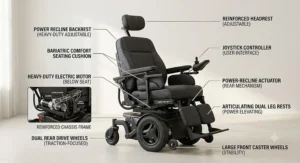
The motorized recline function itself is simpler mechanically than most people assume: a linear actuator (essentially a motorized push-rod) extends or retracts to change the angle between the seat and backrest, controlled through the same joystick or a secondary button interface used for driving. What most buyers overlook is that recline speed and smoothness vary more between manufacturers than raw recline-angle range does — a chair that reclines to 170° but does so in a single jerky motion is a worse everyday experience than one that reclines to 150° smoothly and in fine increments.
Some higher-end systems, like the memory-position seating on the Quantum Rehab Q6 Edge 2.0, let users save specific recline angles for specific activities — one preset for eating, another for resting, another for transfers — rather than manually dialing in the angle every single time. That’s a meaningful quality-of-life upgrade that rarely shows up clearly in a spec sheet, but it’s exactly the kind of feature that determines whether the motorized recline function actually gets used daily or gets ignored after the novelty wears off.
Automatic Positioning and Memory Seating Explained
Automatic positioning refers to a chair’s ability to return to — or move directly toward — a pre-set seating configuration without the user manually adjusting each axis (tilt, recline, leg elevation) individually every time. On premium systems like the Quantum Rehab Q6 Edge 2.0, this shows up as programmable memory positions; on mid-range chairs, it more often shows up as simple recline presets tied to specific button presses.
Here’s why this matters more than it sounds: manually coordinating tilt, recline, and leg elevation into a comfortable, pressure-relieving position takes real fine-motor coordination and trial-and-error, which is exhausting to redo from scratch multiple times a day. Automatic positioning removes that friction — the user (or caregiver) sets the ideal configuration once, and every subsequent adjustment becomes a single button press rather than a three-step manual process. For users with limited hand dexterity or cognitive load concerns, this single feature can be the difference between actually using pressure-relief positioning consistently versus skipping it because it’s simply too tedious to redo repeatedly.
The Powered Comfort Factor: Pressure Relief and Long-Term Health
Powered comfort isn’t just a marketing phrase — there’s real clinical research behind why it matters for long-term skin and circulatory health. A study examining ischial and coccygeal interface pressures found that clinicians commonly recommend tilt and recline maneuvers specifically to redistribute seating loads away from the ischial tuberosities, though reducing ischial pressure can sometimes increase pressure at the coccyx — a nuance worth knowing rather than assuming any recline angle is automatically “safe.” That same body of research examined multiple combinations of tilt and recline angle to understand which configurations actually reduced pressure most effectively, rather than treating “recline” as a single uniform intervention.
Separately, researchers monitoring real-world usage of tilt and recline features found a persistent gap: these functions are prescribed for pressure management and postural control, yet there remains a significant gap between the tilt usage recommended by clinicians and its actual daily usage by patients — reinforcing that owning a power recline wheelchair and consistently using its powered comfort features are two different things entirely. For deeper reading on why tilt-in-space and recline are often prescribed together rather than as alternatives, Muscular Dystrophy Association’s overview of tilt-in-space wheelchairs is a genuinely useful starting point.
Common Mistakes When Buying a Power Recline Wheelchair
The most expensive mistake is buying based on maximum recline angle alone, without confirming that angle solves an actual documented need — a near-flat recline sounds impressive but is often overkill (and unnecessarily costly) for someone who just wants occasional rest breaks. Right behind that: skipping the doorway-and-turning-radius measurements at home, which routinely surfaces after delivery when a chair that looked perfectly reasonable online simply doesn’t clear a bathroom doorway.
A subtler mistake is underestimating battery degradation timelines — lithium batteries in this category typically hold meaningfully less charge after 2–3 years of daily use, and budgeting for an eventual battery replacement (rather than being surprised by it) saves real frustration down the line. Finally, buyers frequently skip the step of actually testing joystick sensitivity and recline speed in person or via a return-eligible online order — a spec sheet cannot tell you how a controller feels under your specific hand strength and coordination.
Long-Term Cost & Maintenance: Total Cost of Ownership
The sticker price is only the opening chapter. Budget for battery replacement roughly every 2–3 years (commonly $150–$400 depending on chair size and battery type), an annual professional service check, and tire replacement if your model uses pneumatic tires rather than solid ones. Complex rehab chairs like the Quantum Rehab Q6 Edge 2.0 often come with better long-term service infrastructure through dedicated suppliers, since these chairs are typically tied to an ongoing clinical relationship rather than a one-time retail transaction — worth factoring into the total cost of ownership even though the upfront price is higher.
Cheaper imports like the WheelWavi Foldable Reclining Electric Wheelchair can look like the obvious budget winner on day one, but if parts availability or manufacturer support is thin, a broken actuator two years in can mean replacing the whole chair rather than a single component — genuinely worth weighing against a mid-range chair from an established medical equipment brand with a longer service track record.
Safety, Regulations & Medicare Coverage Guide
Power wheelchairs, including reclining models, are classified as durable medical equipment (DME) under Medicare, and coverage isn’t automatic just because a chair has more features. According to Medicare’s official coverage guidance, a power wheelchair is only covered when it’s medically necessary, when a face-to-face examination and written prescription have been completed, and when the user cannot safely use a manual wheelchair but can safely operate a power one.
That last point matters more than people expect: Medicare’s process specifically requires documentation that the mobility limitation affects daily activities in the home, not just general comfort preference — which is part of why complex rehab chairs like the Quantum Rehab Q6 Edge 2.0 typically go through a formal clinical evaluation rather than a direct purchase. On the safety side, always confirm your specific chair’s weight rating before use, keep the recline actuator’s range of motion clear of obstructions, and never exceed the manufacturer’s stated incline or terrain limits, especially with the backrest reclined, since center of gravity shifts meaningfully once you’re not sitting fully upright.
✨ Ready to compare current pricing on today’s top picks? Check availability now before specs or stock change!
Power Recline Wheelchairs for Seniors, Caregivers, and Spinal Cord Injury Users
Different users prioritize different things, and it’s worth being explicit about that instead of pretending one chair fits everyone. Seniors managing general mobility decline often prioritize ease of transfer and simple controls over maximum recline range — which is exactly why a low-center-of-gravity chair like the Merits Health Regal P310 tends to score well for this group specifically.
Caregivers, meanwhile, care less about the recline angle itself and more about how much physical effort the chair removes from their own day — an electric reclining wheelchair that the user can operate independently is a caregiver’s best friend, because it directly reduces the number of times they’re needed for a simple repositioning task. For spinal cord injury users managing pressure care as an active medical necessity rather than a comfort preference, combined tilt-and-recline chairs like the Karman VIP2 Tilt-in-Space Wheelchair or complex rehab systems like the Quantum Rehab Q6 Edge 2.0 aren’t really optional upgrades — they’re closer to daily medical equipment than lifestyle purchases, and should be selected in direct consultation with a physical or occupational therapist rather than from a product review alone.

Frequently Asked Questions
❓ How much does a power recline wheelchair cost?
❓ Does Medicare cover a power recline wheelchair?
❓ What's the difference between tilt and recline on a wheelchair?
❓ Can a power recline wheelchair help prevent pressure sores?
❓ How long does the battery last on an electric reclining wheelchair?
Conclusion
A power recline wheelchair is one of those purchases where the “best” option genuinely depends on who’s asking. If you need occasional comfort during errands or rest breaks, something like the WheelWavi Foldable Reclining Electric Wheelchair or Merits Health Regal P310 will likely serve you well without overspending. If pressure injury prevention is a documented clinical concern, the combined tilt-and-recline of the Karman VIP2 Tilt-in-Space Wheelchair — or, for the most demanding daily needs, the Quantum Rehab Q6 Edge 2.0 — represents the more medically appropriate investment, even at a higher price point.
What ties every recommendation in this guide together is a simple principle: match the chair to the documented need, not the longest feature list. Talk to a clinician if there’s any uncertainty about medical necessity, measure your home environment before ordering, and budget honestly for batteries, service, and eventual replacement parts rather than treating the sticker price as the whole story. Whichever model you land on, the goal is the same — more independence, less pain, and a lot fewer hours spent stuck in one uncomfortable position.
✨ Don’t Miss These Exclusive Deals!
🔍 Take your comfort and independence to the next level with these carefully selected power recline wheelchairs. Click on any highlighted model above to check current pricing and availability. These chairs can help you or a loved one reclaim real freedom of movement, every single day!
Recommended for You
- 7 Best Reclining Wheelchairs for Pressure Relief in 2026
- Reclining Power Wheelchairs: 7 Top Picks for Real Comfort in 2026
- 7 Best Electric Standing Wheelchair Picks for 2026 (Honest Guide)
Disclaimer: This article contains affiliate links. As an Amazon Associate, I earn from qualifying purchases. If you purchase products through these links, we may earn a small commission at no additional cost to you.
✨ Found this helpful? Share it with your friends! 💬🤗
