
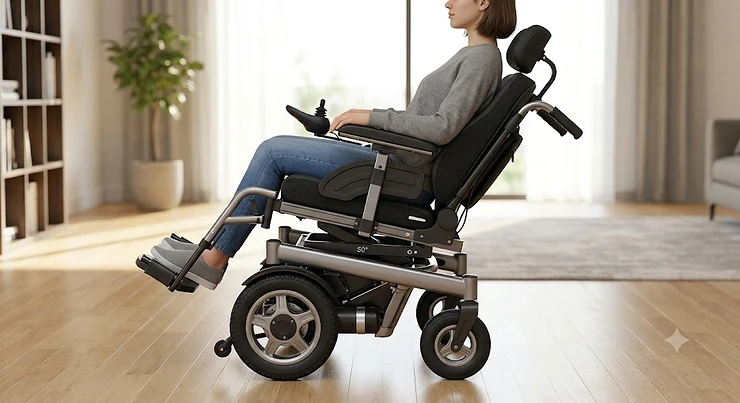
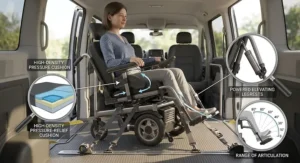
Here’s the thing nobody tells you when a clinician first says the words “power tilt wheelchair”: it sounds like a comfort feature, and it is one, but that’s almost beside the point. A power tilt wheelchair is a powered mobility base that lets the entire seat-and-backrest unit pivot backward as a single piece — unlike recline, which only opens the seat-to-back angle — so the user’s weight shifts off the sitting bones without changing their hip or knee position at all. That single mechanical distinction is the difference between a seating system that just feels nice and one that’s doing real medical work every single hour of the day.
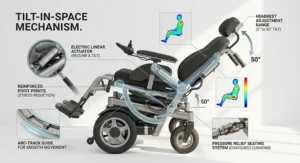
If you’re researching a power tilt wheelchair for yourself or for someone you’re caring for, you’ve probably already noticed the landscape is a maze — Group 2 versus Group 3 devices, competing seating platforms from Permobil, Quantum Rehab, Invacare, and Sunrise Medical, and a dizzying spread of tilt ranges, recline pairings, and elevating leg rests. This guide breaks down seven real, currently available power tilt wheelchair systems, weighs them against each other on the things that actually matter (tilt range, weight capacity, drive configuration, and what independent research says tilt does for skin health), and gives you a framework for narrowing the field before you ever sit down with an ATP or rehab therapist. As research on power tilt-in-space systems explains, these devices are designed to serve several clinical purposes at once — pressure management, postural control, and pain management — which is exactly why the “right” chair depends heavily on your specific situation.
In This Article
Quick Comparison Table
| Product | Tilt Range | Drive Type | Weight Capacity | Best For |
|---|---|---|---|---|
| Permobil M3 Corpus | Up to 50° posterior / 20° anterior | Mid-wheel | 330 lbs | Best overall pressure relief range |
| Quantum Rehab Q6 Edge 3 | Full power tilt + recline | Mid-wheel 6 | 300 lbs (450 lbs HD) | Best all-around daily driver |
| Invacare TDX SP2 | Up to 50° CG tilt | Mid-wheel | 300+ lbs | Best shear reduction (LiNX tech) |
| Quickie QM-710 | SPOT power tilt/recline | Mid-wheel | 300 lbs | Best value multi-power base |
| Pride Jazzy 614 HD | Power tilt option | Rear-wheel | 400+ lbs | Best heavy-duty tilt chair |
| Merits Vision Sport | Optional power tilt | Mid-wheel | 300 lbs | Best budget-friendly entry point |
| Quantum 4Front 2 | Full power tilt | Front-wheel | 300–450 lbs | Best outdoor stability with tilt |
Looking at the spread above, you’ll notice tilt range and drive configuration move independently of each other — a chair with a huge 50-degree tilt arc isn’t automatically the most stable one outdoors, and a front-wheel-drive base built for curb-climbing isn’t necessarily the lightest or most compact. The Permobil M3 Corpus and Invacare TDX SP2 lead on raw tilt degrees, which matters most for users managing an active pressure injury, while the Merits Vision Sport trades some of that range for a dramatically lower price of entry. If daily terrain (carpet, gravel driveways, curb cuts) is your bigger concern than maximum tilt angle, the drive-type column deserves just as much attention as the tilt numbers.
💬 Already narrowing down your favorite? Tap the product name above to check current availability!
Top 7 Power Tilt Wheelchairs: Expert Analysis
1. Permobil M3 Corpus — deepest tilt range for pressure-sensitive users
The M3 Corpus is the chair clinicians reach for when a client’s skin integrity is the top priority, and its ActiveReach feature is a big reason why. Beyond the huge tilt arc, the base can angle up to 20 degrees forward, which sounds like a party trick until you realize it also helps with reaching into cabinets and easing transfers — small conveniences that add up when you’re in the chair 12+ hours a day. Key specs with real-world meaning: the chair now supports users up to 330 pounds, offers 0–50 degrees of posterior tilt plus 5, 10, and 20-degree anterior tilt presets, and pairs with up to 14 inches of optional seat elevation. In practice, that combined range means a caregiver or user can chase a genuine pressure-relieving position (typically 30+ degrees held for a full minute) without also needing a separate recline cycle every time. Based on the spec comparison against its mid-wheel competitors, the Permobil M3 Corpus simply offers more usable tilt degrees before recline is even factored in, which is the single spec that matters most for someone managing an existing pressure injury or at high Braden Scale risk. Reviewers and clinicians consistently note the FlexLink suspension keeps the compact base stable over door thresholds and uneven flooring, though a recurring theme in aggregated user feedback is that the connected “MyPermobil” companion features take some onboarding to use well.
Pros:
- ✅ Widest combined tilt range in this lineup (up to 50°)
- ✅ ActiveReach forward tilt aids transfers and reaching tasks
- ✅ FlexLink suspension keeps ride stable on rough terrain
Cons:
- ❌ Premium price puts it at the top of the funding conversation
- ❌ Compact mid-wheel base has a learning curve for new drivers
Expect this chair to land in the mid-$20,000s to upper-$30,000s range when fully configured with rehab seating, though your actual out-of-pocket cost depends heavily on insurance coverage — check current pricing and coverage details with a supplier before assuming a number.
2. Quantum Rehab Q6 Edge 3 — most versatile everyday power base
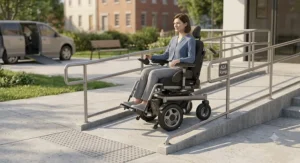
If the M3 Corpus is the specialist, the Q6 Edge 3 is the generalist that does almost everything well. Its Mid-Wheel 6 platform is built around six points of ground contact instead of the usual four, which noticeably smooths out the ride over cracked sidewalks and gravel — the kind of terrain that turns a smaller-wheelbase chair into a bumpy mess. Key specs with real-world meaning: it ships with power tilt, power recline, and power articulating leg rests as standard, a 300-pound weight capacity (450 in the HD configuration), and an optional iLevel seat-elevation system rated to drive at up to 4.5 mph while fully raised. That last detail matters more than it sounds — being able to safely move at eye level with standing adults, rather than needing to lower the seat first, changes how comfortably someone participates in a kitchen conversation or a grocery store aisle. What most buyers overlook about this model is that the Q-Logic 3 electronics package is highly programmable, letting a seating clinic fine-tune drive sensitivity as a user’s strength or coordination changes over time — a detail that matters enormously for progressive conditions. Aggregated reviewer sentiment frequently praises the SRS suspension and USB charging port, while a recurring complaint centers on the base’s turning radius feeling large in tight apartment hallways compared to true mid-wheel competitors.
Pros:
- ✅ Optional iLevel seat elevation drives at up to 4.5 mph
- ✅ Six-point Mid-Wheel 6 platform smooths rough terrain
- ✅ Highly programmable Q-Logic 3 electronics for changing needs
Cons:
- ❌ Turning radius runs larger than some direct mid-wheel rivals
- ❌ HD weight-capacity version adds meaningfully to base cost
Price sits in a broad $15,000–$28,000 range depending on seating and electronics package — always confirm current configuration pricing rather than assuming last year’s numbers still hold.
3. Invacare TDX SP2 — best shear reduction technology
Shear force is the quiet villain in pressure-injury conversations — it’s the sliding, dragging friction between skin and seat surface that happens whenever someone repositions, and it does as much skin damage as raw pressure does. The TDX SP2 was engineered specifically around minimizing it. Key specs with real-world meaning: the chair delivers up to 50 degrees of center-of-gravity tilt for pressure relief and up to 168 degrees of recline, using Extended Shear Reduction technology so the backrest actually shifts to reduce skin drag as it opens rather than simply hinging like a cheap recliner. Paired with Invacare’s LiNX drive electronics, the base also self-corrects for uneven surfaces like thick rugs or slight side slopes, which keeps tilt cycles from feeling jarring mid-transition. Based on the spec sheet, this combination of deep tilt and shear-managed recline makes the TDX SP2 a strong pick for anyone with an active or recently healed pressure ulcer where skin fragility is a real concern, not just a theoretical one. What the spec sheet won’t tell you, but user reports suggest, is that the touchscreen remote option significantly simplifies life for caregivers who need to operate seating functions on someone else’s behalf.
Pros:
- ✅ Extended Shear Reduction technology on recline cuts skin drag
- ✅ LiNX electronics auto-correct for slopes and soft surfaces
- ✅ Touchscreen remote option simplifies caregiver-assisted use
Cons:
- ❌ Advanced electronics package adds to total configured cost
- ❌ Some configurations report a steeper first-week learning curve
Typical configured pricing runs in the high-teens to mid-$20,000s; ask your supplier for a current quote rather than relying on older listings.
4. Quickie QM-710 — best value multi-power option base
Not every user needs every powered function running simultaneously, and the QM-710 is built around that reality. Its “SPOT” (Single Power Option Tilt) and multi-power configurations let a clinic spec exactly the functions a specific user needs — tilt only, tilt plus recline, or the full multi-power stack — rather than paying for a maxed-out electronics package nobody will use. Key specs with real-world meaning: the SpiderTrac suspension uses independent movement across all six wheel points, the base reaches speeds up to 6 mph, and battery range runs up to 15–18 miles depending on configuration, which comfortably covers a full day of errands and appointments without a midday charge. Here’s what to weigh: because the QM-710 comes in base, single-power, and multi-power variants, the honest analytical take is that it’s less about raw tilt-angle bragging rights and more about right-sizing cost to actual need — a genuinely useful option for someone whose primary requirement is tilt for pressure relief without needing independent recline as well. Aggregated buyer feedback consistently highlights the SpiderTrac ride quality on rough pavement, while a repeated critique in used-market listings is that older units can show battery-range drop-off faster than newer Group 3 competitors.
Pros:
- ✅ Configurable SPOT tilt lets you pay only for functions you need
- ✅ SpiderTrac suspension smooths rough outdoor terrain
- ✅ Strong daily battery range for a full day of use
Cons:
- ❌ Base and single-power configurations lack recline entirely
- ❌ Older units on the resale market show more battery wear
New configured units generally land in the $9,000–$18,000 range depending on power options selected; used and refurbished units can run considerably lower — verify condition and warranty status before buying secondhand.
5. Pride Jazzy 614 HD — best heavy-duty tilt option
Bariatric seating is a category that gets overlooked constantly in wheelchair buying guides, and it shouldn’t be, because pressure injury risk doesn’t decrease with higher body weight — if anything, interface pressure over bony prominences can be just as severe, just distributed differently. The Jazzy 614 HD was built to close that gap. Key specs with real-world meaning: this rear-wheel-drive base is rated well above 400 pounds in its heavy-duty trim, with a power tilt option available for exactly the pressure-management reasons discussed throughout this guide, plus reinforced casters and a wider wheelbase for stability at that load range. Reviewers consistently report the extra ground clearance and wider footprint make the 614 HD notably more stable on ramps and uneven driveways than standard-capacity chairs pushed past their rated limits. Honest analytical take: this chair is squarely for buyers whose primary filter is weight capacity first and tilt range second — it won’t out-tilt the M3 Corpus or TDX SP2, but among heavy-duty rear-wheel-drive bases with a genuine power tilt option, it’s one of the more established choices on the used and new markets alike.
Pros:
- ✅ Weight capacity well above standard-duty competitors
- ✅ Wider wheelbase adds real stability on ramps and slopes
- ✅ Reinforced casters built for sustained heavier daily use
Cons:
- ❌ Tilt range is more modest than premium rehab-grade rivals
- ❌ Rear-wheel drive turning radius is larger indoors
Expect a broad $2,900–$8,000 range on the used and refurbished market, with new heavy-duty configurations running higher — always confirm current listing condition and tilt-actuator functionality before purchase.

6. Merits Health Vision Sport — most accessible entry point
Every category needs a chair that doesn’t require a five-figure conversation before someone can even test-sit it, and the Vision Sport fills that role reasonably well among power wheelchairs offering an optional tilt configuration. Key specs with real-world meaning: this mid-wheel-drive base offers roughly 18 miles of ride time on a charge, is available in 18, 20, or 22-inch seat widths, and can be paired with a seat elevator on the 18-inch configuration that raises seat height up to 30.5 inches — genuinely useful for reaching kitchen counters or high shelves. On paper this means Merits positioned the Vision Sport as a bridge between basic Group 2 power chairs and true Group 3 complex rehab bases, and that positioning is honest: the tilt option here is a genuine, functional pressure-relief tool, just without the extended tilt-and-recline choreography of the premium rehab chairs above it. What most buyers overlook is that “optional tilt” on a Group 2-adjacent chair still needs to be specifically ordered and, in some cases, separately justified to insurers — it isn’t always bundled the way it is on complex rehab bases, so confirm the tilt configuration is actually included before ordering.
Pros:
- ✅ Meaningfully lower price of entry than complex rehab bases
- ✅ Strong 18-mile battery range for daily errands
- ✅ Optional seat elevator adds real functional reach
Cons:
- ❌ Tilt range and shear-management tech trail premium rehab chairs
- ❌ Tilt option must be specifically confirmed, not assumed standard
Price commonly falls in the $4,000–$8,000 range depending on tilt and seat-width configuration — a genuinely useful starting point if your clinical need doesn’t yet call for a full complex-rehab base.
7. Quantum 4Front 2 — best front-wheel drive with tilt
Front-wheel drive gets a bad reputation for tight-space maneuvering, but it earns its keep the moment a user spends real time outdoors, because front casters climbing over a curb or transitioning onto a ramp simply track more predictably than mid-wheel designs do in that scenario. Key specs with real-world meaning: the 4Front 2 pairs Quantum’s Tru-Balance power positioning system with a front-wheel-drive base rated between 300 and 450 pounds depending on trim, and it’s compatible with the same iLevel seat-elevation option found on the Q6 Edge 3. Based on the spec comparison, the honest tradeoff here is indoor tightness versus outdoor confidence: front-wheel drive bases generally need a bit more room to pivot in a hallway, but they reward that with noticeably steadier handling on gravel, grass, and sloped driveways — a real consideration if the user spends significant time outside a single-story home. Reviewers frequently mention the large front wheels handle small obstacles like door thresholds and sidewalk cracks with less jolt transmitted to the seat, which matters directly for skin and joint comfort during a full-tilt pressure-relief cycle.
Pros:
- ✅ Front-wheel drive tracks confidently over curbs and uneven ground
- ✅ Compatible with iLevel power seat elevation
- ✅ Large front casters absorb bumps before they reach the seat
Cons:
- ❌ Larger turning footprint than mid-wheel rivals indoors
- ❌ Weight-capacity trims are priced noticeably differently
Configured pricing typically runs $16,000–$27,000 depending on trim and seating package; confirm the specific weight-capacity version before comparing quotes.
Practical Usage Guide: Getting the Most From Your Tilt System
Owning a power tilt wheelchair and actually using the tilt function correctly are two different things, and the gap between them is where a lot of preventable skin problems happen. In the first 30 days, the most common mistake is under-tilting — new users often nudge the joystick to a shallow 10 or 15 degrees because it feels less disorienting, when meaningful pressure relief typically requires 30 degrees or more held for at least a minute. A reasonable early routine is tilting every 15 to 30 minutes during waking hours, gradually working toward whatever schedule your clinician recommends based on your specific skin-risk profile. Maintenance-wise, tilt and recline actuators are mechanical components that benefit from a quick monthly check: listen for grinding or hesitation during the tilt cycle, and keep the seat-to-back pivot points free of debris, since carpet fibers and pet hair have a way of working into hinge points over months of daily use. One optimization trick rehab therapists mention often: pairing a scheduled tilt routine with a phone alarm or the chair’s built-in reminder feature (where available) dramatically improves actual adherence compared to relying on memory alone, especially for users managing cognitive fatigue alongside mobility needs.
Real-World Scenarios: Who Actually Needs a Power Tilt Wheelchair
Picture three different people, because the “right” chair genuinely depends on which of these sounds familiar. First, a 34-year-old with a T6 spinal cord injury who works full-time from a home office and drives a full day in the chair — for this person, deep tilt range and a compact mid-wheel base like the Quantum Rehab Q6 Edge 3 or Permobil M3 Corpus make sense, since indoor maneuverability around a desk matters as much as pressure management. Second, a 68-year-old with late-stage multiple sclerosis living in a single-story rural home with gravel paths to the mailbox and garden — here, the outdoor stability of the Quantum 4Front 2 or the heavier-duty Pride Jazzy 614 HD (if weight capacity is also a factor) starts to outweigh a slightly smaller tilt arc. Third, a budget-constrained user recently transitioned off a manual chair after a progressive neuromuscular diagnosis, whose insurance approval is still pending — the Merits Vision Sport or a single-power Quickie QM-710 configuration offers a genuinely functional tilt option without the five-figure commitment of a full complex-rehab base while that process plays out.
Problem → Solution: Common Pressure Sore and Positioning Challenges
Five problems come up constantly in power tilt wheelchair ownership, and each has a fairly specific fix. Problem one: forgetting to tilt during busy days — solution: set a recurring phone or chair-based alarm rather than relying on willpower. Problem two: shallow, ineffective tilt cycles — solution: confirm your clinician’s recommended angle and hold-time, since 15 degrees for 10 seconds does essentially nothing for interface pressure. Problem three: skin redness that doesn’t fade within 20–30 minutes of pressure removal — solution: this is a signal to contact your seating clinic promptly, not to simply tilt more often on your own. Problem four: a tilt actuator that’s grinding or slow to respond — solution: this is a mechanical service issue, not a settings problem, and should go to a certified technician quickly since a failing actuator can leave someone unable to reposition. Problem five: outgrowing a chair’s tilt range as a condition progresses — solution: this is exactly the conversation to raise at annual seating reviews, since Group 3 rehab chairs like the Invacare TDX SP2 or Permobil M3 Corpus exist specifically for users whose needs have grown beyond a Group 2 base’s capabilities.
How to Choose a Power Tilt Wheelchair
- Start with your clinical need, not the catalog. Your seating clinician’s assessment of skin risk, sitting tolerance, and diagnosis progression should drive tilt-range requirements before you compare specific models.
- Match drive type to your actual environment. Mid-wheel excels indoors; front-wheel drive rewards outdoor stability; rear-wheel drive often pairs with higher weight capacities.
- Confirm weight capacity with margin, not at the limit. A chair rated exactly at someone’s current weight leaves no room for fluctuation.
- Check tilt-and-recline pairing, not just tilt alone. Combined shear-reduction technology, like Invacare’s ESR, matters more than a headline tilt-degree number in isolation.
- Ask about battery range for your actual daily routine, not a manufacturer’s best-case estimate.
- Get a funding and insurance pre-check before falling in love with a specific model, since Medicare and private insurers classify tilt features differently by device group.
- Test-sit before committing whenever possible — no spec sheet fully substitutes for how a base actually feels crossing your own thresholds and ramps.
Tilt In Space Power Wheelchair Reviews: What Real Users Report
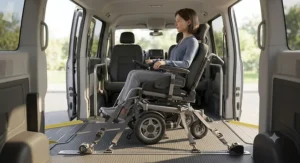
Aggregated review sentiment across tilt in space power wheelchair owners tends to cluster around a few consistent themes rather than wild disagreement. Reviewers across nearly every brand in this guide mention that the adjustment period for trusting a full 40–50 degree tilt takes a few weeks — it feels more dramatic than recline initially, even though it’s mechanically gentler on the skin. A second consistent theme: caregivers frequently report that touchscreen or simplified remote controls (available on the TDX SP2, among others) meaningfully reduce the friction of assisted seating adjustments compared to older toggle-switch controllers. On the critical side, a recurring complaint across brands involves service turnaround time for actuator repairs, since complex rehab technicians aren’t as widely available as general wheelchair repair shops in every region — something worth researching locally before purchase, not after a breakdown.
Best Tilt Wheelchair for Pressure Sores: What the Research Shows
This is the section worth reading slowly if pressure injury prevention is your primary reason for considering a power tilt wheelchair at all, because the research here is genuinely instructive rather than just marketing language. A controlled study on tilt-in-space and recline function measured sitting interface pressure and ischial blood flow and found that nearly every tested tilt-and-recline combination produced a significant pressure decrease compared to an upright position, with blood flow improving most reliably at the larger angles tested. Translated into buying advice: a chair capable of reaching the higher end of the tilt range — 30 to 45 degrees and beyond — isn’t overkill for someone with an active or recent pressure injury; it’s closer to the clinically supported minimum for meaningful blood-flow benefit. That’s exactly why the Permobil M3 Corpus and Invacare TDX SP2, both capable of tilt in the 45–50 degree range, tend to be the models seating clinics reach for first when pressure sore history is part of someone’s chart, while shallower-tilt or optional-tilt chairs like the Merits Vision Sport are typically positioned for lower-risk users instead.
Tilt Positioning System vs Recline: What’s the Difference
People use “tilt” and “recline” interchangeably in casual conversation, but a tilt positioning system and a recline system solve different mechanical problems, and mixing them up leads to real disappointment post-purchase. Recline opens the angle between the seat and backrest — think of a recliner chair at home — which changes hip angle and can actually increase shear force against the skin as the back panel slides slightly during the motion, unless the base includes shear-reduction engineering like Invacare’s ESR. Tilt, by contrast, rotates the entire seat-and-back unit as one rigid piece, so hip and knee angles never change; only the whole-body orientation relative to gravity shifts. The practical upshot: recline is generally better for stretching hip flexors and managing fatigue, while tilt is the feature doing the heavy lifting for genuine pressure redistribution. Most complex rehab chairs in this guide, including the Quantum Rehab Q6 Edge 3 and Quickie QM-710 multi-power configuration, pair both functions specifically because clinicians typically recommend using them together — a moderate recline combined with a deep tilt reduces shear more effectively than either function used to its maximum alone.
Pressure Redistribution: Features That Actually Matter (And Those That Don’t)
Not every spec sheet line item translates into a meaningful pressure-redistribution benefit, and it’s worth separating hype from substance here. What actually matters: total achievable tilt angle, dwell-time comfort at that angle, shear-reduction engineering during recline, and cushion compatibility, since even a perfect tilt cycle can’t compensate for the wrong seat cushion underneath someone. What matters less than marketing suggests: top drive speed beyond a comfortable walking pace, since almost nobody needs a power wheelchair that outruns pedestrian traffic, and cosmetic upholstery color options, which obviously matter for personal preference but do nothing for skin health. A RESNA-published field study that attached sensors to a user’s power wheelchair for ten days found that pressure-reducing seating positions were accessed roughly 80 percent of the time using only small tilt and recline angles — a finding worth sitting with, because it suggests real-world tilt habits often undershoot the angles needed for maximum benefit, which circles back to why choosing a chair with generous tilt range, and then actually using it, both matter enormously.
Therapeutic Tilt: Clinical Benefits Beyond Pressure Relief & Common Buying Mistakes
Therapeutic tilt earns its name because pressure relief is really just one benefit among several. Clinicians also prescribe tilt for postural fatigue management, easing spasticity in some neurological conditions, assisting digestion by allowing gravity-assisted repositioning after meals, and even managing orthostatic blood pressure changes in some users by adjusting body angle gradually rather than abruptly. Given how much therapeutic value sits inside a single mechanical function, it’s worth naming the buying mistakes that undercut it most often. The most common: choosing tilt range based purely on today’s needs without accounting for a progressive condition, which forces an expensive early upgrade. A close second: skipping a proper seating evaluation and self-selecting a chair based on price alone, which risks landing on a base that technically has tilt but lacks the shear-reduction or cushion compatibility a specific diagnosis actually requires. A third recurring mistake is underestimating battery and service logistics in rural areas, where actuator repair turnaround can stretch into weeks — a real problem if tilt becomes unusable in the meantime.
Insurance, Medicare & Funding: What to Know Before You Order
Power tilt wheelchairs generally fall under Medicare’s Group 3 complex rehab technology category when tilt is medically justified by a documented condition, which typically requires a face-to-face mobility evaluation, a written prescription, and supporting clinical notes demonstrating why a standard power chair wouldn’t meet the same need. With an estimated 15% of community-dwelling wheelchair users in North America relying on a power wheelchair and pressure ulcers remaining a major ongoing problem for that population, funding bodies increasingly recognize tilt as medically necessary rather than a luxury upgrade — but the paperwork burden still falls heavily on the prescribing team and the user. Private insurers vary widely in coverage percentage and pre-authorization requirements, so it’s worth requesting a written funding estimate from your durable medical equipment supplier before finalizing a specific model, since switching chairs mid-process after a denial can add months to the timeline.
Frequently Asked Questions
❓ How often should someone tilt in a power tilt wheelchair?
❓ Is a power tilt wheelchair covered by Medicare?
❓ What's the difference between tilt and recline on a power wheelchair?
❓ Can a power tilt wheelchair actually prevent pressure sores?
❓ How much does a power tilt wheelchair cost?
Conclusion
A power tilt wheelchair isn’t a single product category so much as a spectrum of engineering tradeoffs — tilt range against drive stability, shear-reduction sophistication against price, weight capacity against turning radius. The Permobil M3 Corpus and Invacare TDX SP2 sit at the deep-tilt, high-shear-management end for users managing serious skin risk; the Quantum Rehab Q6 Edge 3 and Quantum 4Front 2 balance tilt with everyday drivability indoors and out; and the Quickie QM-710, Pride Jazzy 614 HD, and Merits Vision Sport each solve for a specific constraint — configurability, weight capacity, or price, respectively. None of these seven is objectively “best” in a vacuum; the right one is whichever matches your specific clinical need, home environment, and funding path, ideally worked out alongside a qualified seating clinician rather than reverse-engineered from a spec sheet alone.
This article discusses medical equipment and pressure injury prevention for general informational purposes. It isn’t a substitute for an individualized seating evaluation — please work with your physician or seating clinic to determine the right device for your specific needs.
✨ Don’t Miss These Exclusive Deals!
🔍 Take your mobility setup to the next level with these carefully selected products. Click on any highlighted item to check current pricing and availability. These tools will help you build a genuinely comfortable, pressure-safe daily routine your body will thank you for!
Recommended for You
- Power Recline Wheelchair: 7 Best Picks for Real Comfort in 2026
- 7 Best Reclining Wheelchairs for Pressure Relief in 2026
- Reclining Power Wheelchairs: 7 Top Picks for Real Comfort in 2026
Disclaimer: This article contains affiliate links. As an Amazon Associate, I earn from qualifying purchases. If you purchase products through these links, we may earn a small commission at no additional cost to you.
✨ Found this helpful? Share it with your friends! 💬🤗
