
In This Article
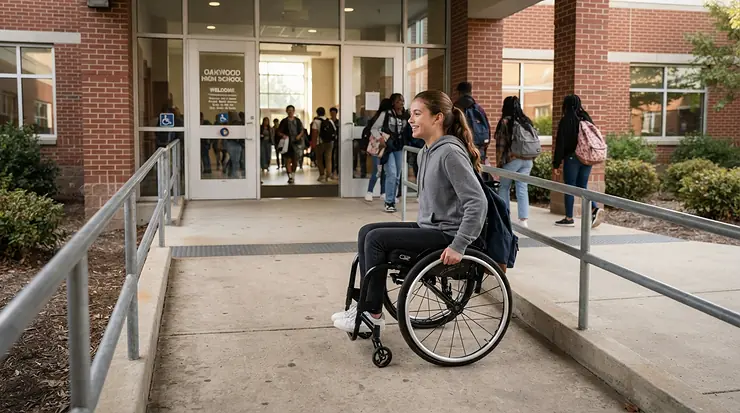
Picture the four minutes between second and third period. Lockers slam, a cluster of sophomores has colonized the water fountain, somebody’s trombone case is cruising at hip height, and you’re sixteen, rolling toward chemistry with the late bell on your heels. That’s the real exam for a compact teen wheelchair for high school hallways. It isn’t the spec sheet or the showroom floor, but those four chaotic minutes.

On paper, the rules are generous. The ADA’s accessible-route standards call for 36 inches of continuous clear width for a single wheelchair (32 inches at a point, like a doorway) and 60 inches when two chairs need to pass. Hallways in real life? They shrink the moment the bell rings. Backpacks bulge, friends drift, and suddenly your chair’s overall width, its caster behavior, and where your bag hangs matter more than any brochure adjective.
So I dug into published specifications and dealer documentation for seven real youth and small-adult chairs from Ki Mobility, Quickie (Zippie), and TiLite. Then I translated the numbers into hallway terms: narrow frames, seat width for adolescents, backpack hooks, locker accessibility, and yes, style.
A straight-talk note before we roll: I haven’t sat in or tested any of these chairs, and public consumer reviews of custom pediatric chairs are genuinely scarce. What you’ll get is spec analysis and reasoning, not invented testimonials. Prices are ballparks only, so check current pricing and loop in your teen’s OT, PT, or ATP before buying.
Quick Comparison: 7 Chairs for Tight School Corridors
| Model | Type & Published Weight | Seat Width Range | Ballpark Price | Best For |
|---|---|---|---|---|
| Ki Mobility Little Wave Clik | Folding; about 12.5 lb transport | 8–16 or 8–18 in. (varies by listing) | $2,500–$4,000 | Growing teens who ride in a family car |
| Ki Mobility Little Wave XP | Rigid; about 10.8 lb transport | Confirm with dealer | $2,500–$4,000 | Self-propellers wanting a lighter rigid frame |
| Quickie Zippie Zone | Rigid; from about 14 lb (frame only) | 8–16 in. | $2,500–$4,000 | Smaller teens in packed hallways |
| Quickie Zippie XCape | About 19 lb | 8–18 in. | $2,000–$3,000 | Fast-growing teens needing one flexible chair |
| Quickie Zippie 2 | About 25 lb | 12–16 in. | $1,500–$2,500 | Budget-conscious mid-size teens |
| TiLite Aero Z | Rigid; about 12.4 lb transport | 10–20 in. | $2,500–$4,000+ | Older, larger teens |
| TiLite ZR Series 2 | About 9.3 lb listed | 10–20 in. | $3,000–$5,000+ | Performance-minded older teens |
Prices are editorial ballparks for planning, not quotes. Custom-configured chairs are usually priced through dealers, so check current price and availability.
Looking at the table, the Quickie Zippie Zone and Ki Mobility Little Wave Clik cover the smallest seat widths, which matters if your teen is on the slimmer side or still growing. The TiLite Aero Z and TiLite ZR Series 2 start at 10 inches but stretch to 20, so they suit older teens approaching adult size. Budget buyers should note that the Quickie Zippie 2 gives up weight and size range for a lower likely cost.
💬 Just one click — help others make better buying decisions too!😊
Top 7 Compact Teen Wheelchairs for High School Hallways: Expert Analysis
1. Ki Mobility Little Wave Clik — folds and grows without drama
The standout feature is the fold. Most youth rigid frames stay stubbornly rigid, so the Ki Mobility Little Wave Clik earns attention by collapsing for the family sedan while still behaving like an active-user chair.
Published transport weight is about 12.5 lb. Ki weighs it with the rear wheels and armrests removed, so expect more on the scale in daily trim. Seat width is listed as 8–16 or 8–18 inches depending on the distributor, so confirm the range for your exact build. That sweep covers a slim young teen through a broader-framed one without a new chair. Ki’s Index System turns adjustments into repeatable settings, and the compound offset frame leaves extra room for braces and AFOs. That’s a quiet hallway win, since feet and ankles are what clip door frames.
Based on the spec comparison, this suits a teen with real growing left to do and a car that has to cooperate. The catch is a published weight capacity of 165 lb, a ceiling some older teens will hit.
Review sentiment: public consumer reviews are thin. The testimonials I found praise a dealer’s service rather than the chair, so I won’t dress them up as product feedback.
Pros:
- ✅ Folding frame simplifies car transport
- ✅ Wide, indexed growth adjustments
- ✅ Extra room for braces and AFOs
Cons:
- ❌ 165 lb capacity limits older teens
- ❌ Folding frames are usually less rigid than fixed ones
Ballpark price: roughly $2,500–$4,000 depending on options; check current price. Verdict: strong value if growth and car transport top your list.

2. Ki Mobility Little Wave XP — the lighter, no-fold sibling
Think of it as the Clik’s leaner cousin. The Ki Mobility Little Wave XP drops the folding mechanism for a rigid frame, and a Canadian distributor lists transport weight at about 10.8 lb, noticeably lighter than the Ki Mobility Little Wave Clik.
Why that matters in a hallway: rigid frames don’t flex or soak up the push the way hinged ones can, so more of each stroke becomes forward motion. A lighter chair also pivots and stops with less shoulder effort, which counts when a crowd closes in. Ki’s FDA 510(k) summary notes an index of holes for mounting the backrest and growth kits for adding size, so the chair can stretch with your teen instead of being replaced. I could not verify a published seat-width range, so get exact numbers from Ki or a dealer before comparing it to the others.
Here’s the honest analysis: this is for a self-propelling teen who lives in the chair all day and doesn’t need it to fold. The trade-off is convenience. The chair needs its wheels off to ride in a car, which gets old at 7:15 a.m.
Review sentiment: I found no meaningful public review pool, so I’m leaving sentiment out rather than guessing.
Pros:
- ✅ Rigid frame transfers push efficiently
- ✅ Lighter than the folding Ki option
- ✅ Growth kits extend usable life
Cons:
- ❌ Doesn’t fold for tight car storage
- ❌ Seat-width range hard to verify online
Ballpark price: roughly $2,500–$4,000; check current price. Verdict: worthwhile if lightness beats convenience.
3. Quickie Zippie Zone — narrowest footprint for packed hallways
Narrow is the headline. A distributor describes the Quickie Zippie Zone as an ultralight, option-rich rigid chair for active kids and teens, and the numbers back the pitch.
Seat width runs 8–16 inches, seat depth 8–18, and back height 6–18. Overall width, the number your hallway cares about, is listed at 20–24 inches. In a 36-inch corridor, that leaves 12 to 16 inches of spare room; at a 32-inch doorway, 8 to 12. Frame weight starts around 6.5 kg (about 14 lb) in its lightest configuration, without wheels or seating. Depth gains 2 inches of growth built into the frame, but extra width needs additional parts, so budget for that if your teen is mid-growth spurt. The listed user weight limit is 75 kg (about 165 lb). Note that these specs come from an Australia/New Zealand distributor, so verify U.S. details.
My read: this is the pick for a smaller or slighter teen whose main enemy is tight traffic, not distance.
Review sentiment: I couldn’t find a sizable independent review pool, so I’m not characterizing owner opinions.
Pros:
- ✅ 20–24 in. overall width fits tight spaces
- ✅ Very light frame in minimal configuration
- ✅ Built-in depth growth
Cons:
- ❌ Width growth requires extra parts
- ❌ 165 lb capacity limits larger teens
Ballpark price: roughly $2,500–$4,000; check current price. Verdict: best for narrow-corridor priority.
4. Quickie Zippie XCape — most flexible sizing range
If your teen’s growth is unpredictable, flexibility is the feature. The Quickie Zippie XCape stretches wider in both width and depth than most chairs here.
A Syracuse University resource sheet lists it at roughly 19 lb, with seat width of 8–18 inches, depth of 8–20, and seat-to-floor height of 13–18.5. In practice, that 20-inch depth ceiling helps long-legged teens whose thighs would hang off a shorter seat, and the broad width range means one frame can bridge several years of growth. At around 19 lb it sits about five pounds above the published figure for the Quickie Zippie Zone, which is the price of that versatility.
Analysis time. If you’re buying one chair that has to last through a growth spurt and possibly a body-shape change, the Quickie Zippie XCape looks like the safer bet on paper. Ask your dealer about frame style and overall width, because I couldn’t verify either.
Review sentiment: nothing substantial surfaced in public reviews, so treat claims here as spec-based.
Pros:
- ✅ 8–18 in. seat width range
- ✅ Up to 20 in. seat depth
- ✅ Low seat-to-floor options
Cons:
- ❌ Heavier than lightest rigid picks
- ❌ Overall width not published in my sources
Ballpark price: roughly $2,000–$3,000; check current price. Verdict: great value for rapid growers.
5. Quickie Zippie 2 — sturdy workhorse for a tighter budget
Sometimes the right answer is the one that doesn’t pretend to be featherweight. The Quickie Zippie 2 trades grams for ruggedness and, usually, price.
The same Syracuse resource lists it at about 25 lb, with seat width of 12–16 inches, depth of 12–18, and seat-to-floor height of 15–20. That 12-inch floor is the practical limit: very small teens fall below it, while broader ones outgrow the 16-inch ceiling. Extra weight means more stability and more effort. In a crowded hallway that translates to slower starts and harder pivots, but fewer wobbles on thresholds.
Here’s what I’d weigh: this chair makes sense for a mid-size teen with a reliable helper for car transfers and a tighter budget. It makes less sense for someone self-propelling all day through a sprawling campus, where every extra pound shows up in the shoulders by sixth period.
Review sentiment: I found no verifiable review pool, so I’m not summarizing opinions.
Pros:
- ✅ Sturdy build suits daily wear
- ✅ Likely lower cost than ultralight picks
- ✅ Higher seat-to-floor options
Cons:
- ❌ Heaviest chair on this list
- ❌ Narrow 12–16 in. seat range
Ballpark price: roughly $1,500–$2,500; check current price. Verdict: solid budget value if weight isn’t critical.

6. TiLite Aero Z — adult-quality adjustability for older teens
This is the chair for the teen who’s nearly full-grown. The TiLite Aero Z is a rigid, mono-tube aluminum frame built to measure, with an open design that makes lifting it onto a car seat easy.
Dealer listings show seat width and depth of 10–20 inches (one brochure lists 12–20), a total chair width of 23 inches, and a transport weight around 12.4 lb. The center of gravity adjusts across roughly five inches, which is a big deal: moving the axle changes how tippy or stable the chair feels, so you can tune it as your teen gains skill. Weight limit is 265 lb, so it won’t run out of capacity as a teen fills out. Camber options of 0–6 degrees add stability but widen the stance, so ask for hallway-friendly settings.
My view: a 23-inch overall width leaves roughly 13 inches in a 36-inch hallway. That’s workable, but not dramatically narrower than the Quickie Zippie Zone‘s upper range.
Review sentiment: dealer pages I found showed no reviews yet, so I’ll stay with specs.
Pros:
- ✅ Infinite fit adjustment system
- ✅ 265 lb weight limit
- ✅ Open frame loads easily into cars
Cons:
- ❌ 10 in. minimum seat width excludes small teens
- ❌ Camber widens overall stance
Ballpark price: roughly $2,500–$4,000+ depending on build; check current price. Verdict: a long-term investment.
7. TiLite ZR Series 2 — featherweight for performance-minded teens
Light is the whole pitch. A retailer listing shows the TiLite ZR Series 2 at about 9.3 lb with seat widths of 10–20 inches, which is the lightest published figure in this roundup.
Confirm what that weight includes, since manufacturers often quote frame-only numbers. Even so, the direction is clear: a lighter chair means less effort per push, quicker turns in a crowd, and easier lifting into a trunk. Listed weight capacity of 265 or 300 lb gives headroom for growth. Like its siblings, it uses the Tru-Fit adjustment approach rather than pre-set holes, so a clinician can fine-tune the fit.
Here’s the honest trade-off: the performance comes with a premium price and the same 10-inch minimum seat width as the TiLite Aero Z. For a teen who’s an athlete or simply tired of shoulder fatigue by lunch, the TiLite ZR Series 2 looks like the most efficient frame here. For a smaller teen, the Quickie Zippie Zone is the more realistic fit.
Review sentiment: no meaningful public review pool surfaced, so I won’t characterize owner feedback.
Pros:
- ✅ Lightest published weight in this roundup
- ✅ Precise, infinite fit adjustment
- ✅ High weight capacity
Cons:
- ❌ Premium price likely
- ❌ 10 in. minimum seat width
Ballpark price: roughly $3,000–$5,000+; check current price. Verdict: best for performance seekers with the budget.
What Is a Compact Teen Wheelchair for High School Hallways?
A compact teen wheelchair for high school hallways is a youth- or small-adult-sized manual wheelchair with a narrow overall width, a short, maneuverable wheelbase, and adjustable seating, built to move through crowded school corridors, doorways, and elevators while fitting a growing adolescent.
Notice what’s not in that definition: the word “transport.” A standard transport chair is designed for a caregiver to push and is typically a lighter, foldable chair, while a teen-focused active chair is built to be self-propelled and tuned to the user. That difference shapes everything from wheel placement to adjustability.
| Feature | Compact Teen Active Chair | Standard Transport Chair |
|---|---|---|
| Who moves it | The teen, using push rims | Usually a caregiver |
| Adjustability | Seat, back, center of gravity | Often fixed or minimal |
| Growth planning | Built-in or kit-based | Typically replaced |
| Weight | Roughly 9–25 lb depending on model | Often under 30 lb |
| Best For | Independent school-day mobility | Occasional outings with a helper |
Reading the table, the biggest gap is independence. A teen who wants to navigate hallways alone needs reachable push rims, tunable balance, and a width that matches their body. Transport chairs rarely deliver those. They suit occasional trips, not an eight-period school day.

How to Choose a Compact Teen Wheelchair for High School Hallways
Choosing well means working backward from the building, not forward from the brochure. Here’s the sequence I’d follow.
- Start with a professional assessment. Dealer listings for pediatric chairs repeatedly stress that custom chairs must be recommended and fitted by a PT, OT, or ATP. Their measurements beat any online chart.
- Check overall width, not just seat width. Compare it against the 36-inch hallway and 32-inch doorway benchmarks.
- Decide rigid or folding. Rigid frames, like the Quickie Zippie Zone, tend to be lighter and more efficient. Folding frames, like the Ki Mobility Little Wave Clik, win on car logistics.
- Plan for growth. Ask which adjustments are built in and which need parts or kits.
- Verify weight capacity and transit ratings. Several pediatric chairs top out at 165 lb, which some teens will pass.
- Plan how the bag rides. Backpack hooks, side bags, and tipping risk belong in the buying conversation.
- Walk the building. Ask the school for a hallway, locker, and elevator walk-through before the chair arrives.
Seat Width for Adolescents: How to Get the Fit Right
Seat width for adolescents is the measurement that quietly decides whether a chair feels like a tool or a trap. The standard method is simple: measure across the widest point of the hips or thighs while your teen sits on a firm, flat surface, then add a little room. Hesperian’s guide to fitting the chair to the child suggests about half an inch per side, and clinical guides from seating specialists commonly say one to two inches total.
Why not just go bigger? Because a seat that’s too wide makes self-propelling harder, pushing the arms outward and the shoulders into awkward angles. Too narrow, and hips get compressed, which can cause discomfort and pressure problems. It’s a Goldilocks measurement.
Adolescence complicates things. Teens can add inches in months, and hip width doesn’t always follow height. That’s why growth range matters. The Quickie Zippie XCape at 8–18 inches and the Ki Mobility Little Wave Clik at 8 to 16 or 18 give breathing room, while the Quickie Zippie 2 at 12–16 offers a narrower window. Measure while your teen wears typical school clothes, and ask your clinician how often to recheck during growth spurts.
One more hallway-specific tip: seat width isn’t overall width. Armrests, wheels, and camber all add inches, so always ask for both numbers.
Narrow Wheelchair for Teens in Crowded Hallways: What Actually Fits
A narrow wheelchair for teens in crowded hallways is a numbers game, so let’s play it. The ADA benchmark is 36 inches of continuous clear width, dropping to 32 inches at a point no deeper than 24 inches. Here’s what different overall widths leave you.
| Overall Width | Spare Room in 36 in. Hallway | Spare Room at 32 in. Doorway | Best For |
|---|---|---|---|
| 20 in. | 16 in. | 12 in. | Tightest corridors (low end of the Quickie Zippie Zone range) |
| 23 in. | 13 in. | 9 in. | Typical listed width for the TiLite Aero Z |
| 24 in. | 12 in. | 8 in. | High end of the Quickie Zippie Zone range |
| 26 in. | 10 in. | 6 in. | Larger frames with wider camber |
| 28 in. | 8 in. | 4 in. | Doorways become a hand-scraping exercise |
Remember the spare room is total, not per side, so halve it. And your hands live on the rims, which stick out past the frame. At a doorway with 4 inches to spare, those knuckles are in play.
The takeaway: below about 24 inches overall, you stop thinking about doorways at all. Above 26, you’ll feel every frame. Hallway crowds don’t follow ADA diagrams, either, so pair a narrow chair with smart habits. Ask teachers about releasing your teen a minute before the bell, and learn which elevators and side corridors stay quiet.
Stylish Wheelchair for Teenagers: Because Looks Matter
A stylish wheelchair for teenagers isn’t vanity. If a teen hates how the chair looks, they’ll avoid it, hide it, or fidget with it, and none of that helps mobility. Style is part of buy-in.
What’s actually available? A distributor lists color options for the Quickie Zippie Zone, plus spoke guard choices that double as customization. TiLite markets the TiLite Aero Z in a variety of colors, and its brochures emphasize a clean, minimal look with slim tubing. Used Ki frames in donation inventories show light-up casters, which tells you the personalization ceiling is high. Outside the U.S., Ottobock markets the Ottobock Avantgarde Teen2 as stylish and lightweight, though I couldn’t verify U.S. availability.
My advice: let your teen weigh in on frame color, wheel guards, and caster style during the fitting. Match the chair to their world. A black frame with a bold spoke guard reads very differently than a pastel one, and that’s their call. Style choices rarely change specs, so there’s little downside to letting them lead.
Teen Wheelchair With Backpack Hooks: Carry Your Stuff Without Tipping
A teen wheelchair with backpack hooks sounds like a small feature until you’ve dragged forty pounds of textbooks to fourth period. Here’s the part brochures skip: where the bag hangs changes how the chair balances.
The Quickie Wheelchair Backpack is built with hoops that hang from push handles or backposts, and its seller warns that overloading it can raise the risk of tipping backward. That’s physics, not marketing. A heavy bag behind the rear axle pulls the chair rearward, and chairs with adjustable center of gravity, like the TiLite Aero Z, can be tuned to compensate. Anti-tip tubes are another layer of protection.
Real-world snags exist, too. In a wheelchair forum thread, one user found that hanging a backpack on the handles pressed on the brake cable and made pushing difficult. Another commenter slings the straps over the backrest and leans against them, or prefers bags with built-in loops so the pack hangs straight instead of sagging. The same commenter called Quickie-branded bags poor quality, which is one person’s opinion, not a verdict.
Practical ideas: choose a bag with loops or clips rather than relying on shoulder straps, keep weight low and centered, and consider an armrest-mounted side bag for daily essentials. Budget side bags are widely sold in the low-double-digit range. Digital textbooks or a second set at home cut the load fast.

Locker Accessibility: What Schools Must Do and What You Can Ask For
Locker accessibility is where good intentions meet a very tall steel box. The federal framework is clear in principle. Public schools must provide access under Section 504 and the ADA, and a 504 plan can list specific accommodations. The University of Washington’s DO-IT program explains that a 504 plan is developed to give students with disabilities access to the learning environment, with wheelchair-accessible facilities among the examples.
For lockers, the practical numbers come from ADA design standards. An approach space is typically 30 by 48 inches of clear floor, and accessible reach ranges run from about 15 to 48 inches off the floor. Anything outside that range, like a top-row locker, is a daily obstacle.
So what can you ask for?
- A locker in the middle of the reach range, ideally at the end of a row for easy approach.
- A modified or half-height locker if standard ones don’t work.
- A lock your teen can operate without tight grasping, such as a keyless or large-dial design.
- Classroom storage for heavy items.
Pair that with chair choices. A narrower frame like the Quickie Zippie Zone approaches a locker bank more easily, and a lighter chair like the TiLite ZR Series 2 repositions with less effort.
✨ Ready to Find the Right Fit?
🔍 Take your school-day mobility to the next level with these carefully selected chairs. Click on any highlighted product to check current pricing and availability. These options can help you create smoother hallway days your teen will love!
Real-World Scenarios: Three Teens, Three Chairs
These are illustrative profiles, not real people. Use them as a template for your own situation.
Maya, 14, freshman. Smaller frame, still growing, rides in the family car daily, and the school has crowded 36-inch hallways. She needs a narrow, growth-friendly chair. The Quickie Zippie Zone fits the width story, while the Ki Mobility Little Wave Clik adds folding for the car. Budget runs higher, but the chair should last years. Frequency of use: all day, every day.
Devon, 17, senior. Nearly adult-sized, athletic, and tired of shoulder fatigue. His priority is efficiency over a large campus. The TiLite ZR Series 2 targets exactly that, while the TiLite Aero Z is the sturdier, easier-to-adjust alternative. Hallway width matters less than push efficiency, though he’ll still want to check camber.
Priya, 15, shared between two households. Budget is tight, insurance limits are firm, and she needs one durable chair. The Quickie Zippie 2 or Quickie Zippie XCape are sensible starting points, with the Quickie Zippie XCape better for fast growth. Weight is a trade-off she can live with if helpers assist at car time.
Hallway Problems, Solved
Here are the five snags I’d expect and what to do about each.
- Getting pinned by a crowd. Request an early-release pass before the bell, and choose a chair at or below 24 inches overall, such as the Quickie Zippie Zone.
- Bag pressing on brakes or tipping the chair. Use loops or clips, keep weight low, and ask your clinician to adjust the center of gravity. The TiLite Aero Z offers roughly five inches of adjustment.
- Lockers out of reach. Ask for a middle-height, end-of-row locker or classroom storage in writing.
- Outgrowing the chair mid-year. Favor growth-friendly frames like the Ki Mobility Little Wave XP with its growth kits, and schedule a refit check.
- A slow-moving school. The U.S. Department of Education’s Office for Civil Rights explains in a resolved investigation that Section 504 and Title II judge older buildings by overall program accessibility, while newly built or altered facilities must meet specific design standards. Know which category your school falls into before you advocate.
Features That Actually Matter (And Those That Don’t)
Marketing loves a long feature list. Hallways love three things.
What matters:
- Overall width. Seat width fits your teen; overall width fits the building.
- Weight. A chair near 10 lb, like the TiLite ZR Series 2, asks less of the shoulders than one near 25 lb, like the Quickie Zippie 2.
- Adjustability. Center-of-gravity tuning, growth ranges, and repeatable settings pay off for years.
- Weight capacity and transit ratings. Check the number against your teen’s projected size.
What matters less:
- Exotic frame materials. A titanium-versus-aluminum debate rarely changes a hallway day as much as a correct fit.
- Light-up casters. Fun, and good for style points, but not performance.
- Endless accessory bundles. Buy what you’ll use, then add.
If a feature doesn’t change width, weight, fit, or growth, treat it as a bonus, not a reason.

FAQ
❓ How much does a compact teen wheelchair cost?
❓ Can a teen wheelchair fit through a standard school doorway?
❓ Does insurance cover a lightweight teen wheelchair?
❓ How do I attach a bag to a teen wheelchair with backpack hooks?
❓ How often should seat width for adolescents be rechecked?
Conclusion
Choosing a compact teen wheelchair for high school hallways comes down to a few honest questions. How wide is the chair overall, how heavy is it, how well does it grow, and does it work with a bag, a locker, and a teenager’s sense of style?
Among the seven chairs here, the Quickie Zippie Zone leads on narrow footprint, the Ki Mobility Little Wave Clik on folding convenience, and the Quickie Zippie XCape on sizing range. The TiLite Aero Z and TiLite ZR Series 2 make the most sense for older, larger teens who want adult-grade adjustability and low weight. The Ki Mobility Little Wave XP is the lighter rigid option, and the Quickie Zippie 2 is the sturdy, budget-friendlier workhorse.
Two reminders. First, these are spec-based comparisons, not hands-on tests, and public reviews of custom pediatric chairs are limited, so lean on your clinician and a dealer trial. Second, the building matters as much as the chair. Walk the hallways, measure the doorways, request a reachable locker, and document accommodations in a 504 plan or IEP.
✨ Ready to roll into the next school year with confidence?
🔍 Compare your shortlist, click any highlighted product to check current pricing and availability, and give your teen a chair that fits their body, their school, and their style! 🚀
Recommended for You
- Pediatric Transport Chair Vs Self-Propelled Kids Wheelchair 2026
- Foldable Kids Wheelchair For Airplane Travel: 7 Best Picks (2026)
- Lightweight Toddler Wheelchair For Cerebral Palsy: 7 Best Picks 2026
Disclaimer: This article contains affiliate links. As an Amazon Associate, I earn from qualifying purchases. If you purchase products through these links, we may earn a small commission at no additional cost to you.
✨ Found this helpful? Share it with your friends! 💬🤗
