
In This Article
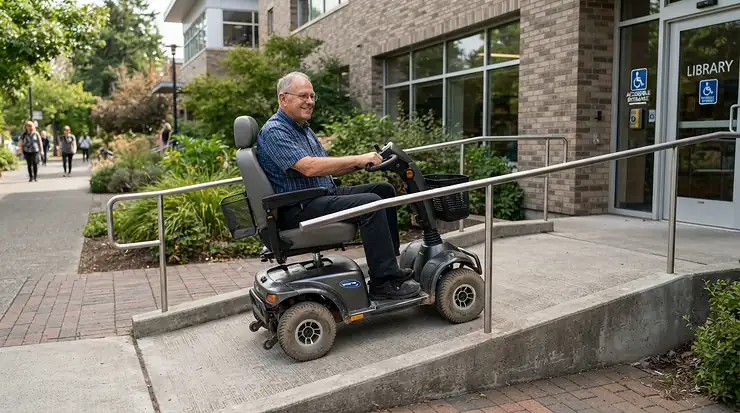
A bariatric mobility scooter for plus-size riders is a seated, battery-powered scooter built with a reinforced frame, a stronger motor, and a wider seat. It is typically rated for 400 to 600 pounds, versus the roughly 300-pound ceiling of standard models. Its job is simple: keep larger riders stable, comfortable, and independent.

Here’s what nobody mentions at the start of this search. Plenty of listings say “heavy duty,” but a scooter running at the edge of its rating is quietly wearing itself out. Motors strain, batteries sag, and the seat starts to feel like a park bench. A mobility scooter is, at heart, a seat on three to five wheels with a tiller up front. Scale that idea for a larger body and everything changes: frame gauge, motor torque, seat dimensions, brake power, even where the weight sits over the wheels.
This guide compares seven real models you can find on Amazon, from a 600-pound-rated all-terrain machine to a folding travel scooter. Along the way we’ll unpack extra wide seat mobility scooter sizing, bariatric scooter comfort features, seat cushioning, wide-base stability, and the wider world of bariatric mobility aids.
One honest note first. I’m working from manufacturer specs, listing details, and aggregated review feedback, not personal hands-on testing. Where something can’t be verified, I’ll say so.
Quick Comparison: 7 Bariatric Mobility Scooters at a Glance
| Product | Listed Capacity | Top Speed | Listed Range | Best For |
|---|---|---|---|---|
| LAGTOM 500-lb | 500 lb | 15 mph | Up to ~35 mi | All-round outdoor use |
| Mobicyc MS09 MAX | 500 lb | 15 mph | Up to 32 mi | Seat fit and long range |
| Xmatch 600-lb | 600 lb | 15.5 mph | Up to 35 mi | Riders near or above 500 lb |
| VEVOR LUNAR | 500 lb | 15 mph | Up to 21.5 mi | Hills and lockable storage |
| SKRT 800W | 500 lb | 15 mph | Up to 25 mi | Comfort-first, mid-range budgets |
| Rascal Conquest | 350 lb | 6 mph | Up to 17 mi | Warranty and FDA Class II listing |
| Mbxcooter 45-Mile | 300 lb | 7 mph | Up to 45 mi | Car-friendly folding travel |
Five of the seven share the same 15 mph, 500-pound headline, so the real separation lies in seat adjustability, unit weight, and long-term support. If you’re anywhere near 500 pounds, the Xmatch 600-lb is the only entry with genuine headroom. The Mbxcooter 45-Mile trades capacity for a footprint you can actually lift into a car. Treat “listed range” as a best case, because heavier riders commonly report 20 to 40 percent less in real conditions.
💬 Just one click — help others make better buying decisions too!😊
Top 7 Bariatric Mobility Scooters for Plus-Size Riders: Expert Analysis
A quick pricing note: Amazon prices move constantly, so I’m not quoting figures. For context, dealer-network bariatric scooters from established brands were listed roughly from the low $2,000s to over $7,000 at the time of research. Always check current price before deciding.
1. LAGTOM 500-lb Heavy Duty 4-Wheel Scooter — best all-rounder for mixed terrain
The standout here is balance. The LAGTOM 500-lb pairs a 1000W motor with a reclining captain’s seat and a full lighting kit (headlight, taillight, turn signals), which is rarer in this category than it should be.
On paper, a 500-pound rating gives a 300-to-350-pound rider roughly 150 to 200 pounds of breathing room. The 1000W motor means fewer stalls on ramps and driveway lips. The 15 mph ceiling is more than sidewalks need, but the adjustable speed control lets you creep through doorways at walking pace. Add a key-fob anti-theft alarm and a locking glove box, and it feels built for real errands.
Based on the spec comparison, this suits a 300-to-450-pound rider who wants street-visible lighting and hill power. The catch is a wide turning radius: expect three-point turns in narrow hallways. Aggregated review feedback praises the near-ready-to-ride assembly and strong hill performance. Recurring complaints are a loud reverse beeper and cushion fatigue after multi-hour rides.
Pros:
- ✅ Full lighting package with turn signals
- ✅ Reclining captain’s seat with armrests and seatbelt
- ✅ Strong 1000W motor for inclines
Cons:
- ❌ Wide turning radius struggles indoors
- ❌ Cushion tires out on long rides
Price range: not stable enough to quote, so check current price. The value case rests on the safety kit and power, not the sticker.

2. Mobicyc MS09 MAX — six-point adjustable seat and built-in GPS
Fit is the story with the Mobicyc MS09 MAX. The listing describes six adjustment points: seat height, seat depth, armrest width, armrest angle, backrest recline, and tiller angle. For a bigger body, armrest width is the sleeper feature, because thighs pressing against fixed armrests is the classic complaint in this category.
Other specs matter too. A 1000W motor, 500-pound rating, and up to 32 miles of listed range put it among the longer-legged options. Full suspension and roughly 4.3 inches of ground clearance help on gravel and curbs. A GPS tracker adds theft recovery and family peace of mind.
What the spec sheet won’t tell you, but reviewers note, is that seat height reportedly can’t be changed after initial setup. That makes trying the fit early important, especially for very tall or short riders. At around 265 pounds, the unit itself needs a lift or strong helper for transport. The listing’s ratings look excellent, but the review pool is comparatively small, so I’d read that as promising rather than proven.
Pros:
- ✅ Six-point seat adjustability for custom fit
- ✅ Long listed range with GPS tracker
- ✅ Full suspension smooths rough surfaces
Cons:
- ❌ Seat height fixed after initial setup
- ❌ Heavy unit needs a lift for transport
Price range: check current price. It’s a premium-feeling feature set, so weigh it against the LAGTOM 500-lb, which offers storage and more established feedback.
3. Xmatch 600-lb 4-Wheel Scooter — real headroom for riders near 500 pounds
If you weigh 450 pounds or more, most of the market politely shows you the door. The Xmatch 600-lb is the exception: a 600-pound rating in a category where 500 is the usual ceiling.
The motor is described as a 1000W differential brushless setup, meaning both rear wheels get independent power. In practice that generally helps traction on grass, gravel, and wet pavement. ATV-style AT16x8-7 tubeless tires and a listed 20 percent incline rating support its all-terrain pitch. The adjustable bucket seat is listed as fitting riders up to 6.5 feet tall, a genuine plus for tall plus-size riders whose knees hit the tiller on other models.
Dealer guidance generally pairs a 600-pound rating with riders near or above 500 pounds, and that’s where this scooter earns its keep. The trade-off is weight: about 320 pounds, the heaviest of the seven, which effectively demands a lift. Reviewer feedback is thin because the listing is newer. Themes so far include a firm backrest that transmits vibration over bumps and a throttle that’s touchy until you learn to feather it.
Pros:
- ✅ Highest capacity of the seven at 600 pounds
- ✅ Differential motor helps rough-surface traction
- ✅ Seat fits taller riders up to 6.5 feet
Cons:
- ❌ Heaviest unit, needs a vehicle lift
- ❌ Firm backrest can feel harsh on bumps
Price range: check current price. It’s overkill under 450 pounds, but a bargain in peace of mind above it.
4. VEVOR LUNAR Heavy Duty Scooter — lockable trunk plus hill-climbing muscle
The VEVOR LUNAR answers a question most scooters ignore: where do your things go when you park? It has a hard-shell lockable rear trunk, far more secure than a soft basket at a trailhead or shop.
Under the shell is a 1000W brushless motor, a 500-pound rating, front and rear disc brakes, and three speed settings from 6 to 15 mph. Disc brakes matter more for heavier riders, since stopping distance scales with mass and a downhill grade is unforgiving. A key-fob alarm and all-around lighting round out the package. The listed range is 21.5 miles, shorter than the 32-mile competitors, but brushless efficiency may hold up better under load.
Based on the specs, this fits riders with hilly streets or rural roads who park outside often. At roughly 257 pounds it still needs a lift. Aggregated feedback is mixed: it carries the lowest rating in at least one roundup, but the complaints skew toward post-delivery customer service rather than product failures. If support responsiveness matters to you, read recent reviews and seller Q&A first.
Pros:
- ✅ Lockable hard-shell trunk secures valuables
- ✅ Front and rear disc brakes
- ✅ Powerful 1000W brushless motor
Cons:
- ❌ Shorter listed range than rivals
- ❌ Customer service complaints appear in reviews
Price range: check current price. The value depends on whether you’ll use that trunk daily.
5. SKRT 800W Heavy Duty Scooter — leather seat and all-terrain tires on a mid-range footing
The SKRT 800W is the comfort-first pick. It has a leather seat with an adjustable backrest angle, which lets you recline slightly for pressure relief.
Its 800W brushless motor is the smallest of the 500-pound tier, but the listing still claims 20-degree slope capability. Fat tires plus rear shock absorbers target grass, gravel, and packed dirt. A three-speed control tops out at 15 mph, and an LCD panel shows speed and battery level. It arrives assembled, and a listed range of about 25 miles suits daily errands.
I’d point this at riders who want a 500-pound rating with softer seating and don’t need the longest range. Honest caveats: the review pool is small, so long-term durability is unproven. Reviewers mention no paper manual in the box (a PDF is available), some damaged anti-roll wheels in shipping, and a reminder to engage the parking brake on slopes, since it can roll otherwise.
Pros:
- ✅ Leather seat with adjustable recline angle
- ✅ Fat tires and rear shocks for soft terrain
- ✅ LCD shows speed and battery
Cons:
- ❌ Small review pool, limited long-term data
- ❌ No paper manual; shipping damage reported
Price range: check current price. It positions as mid-range value, but verify seller support before buying.
6. Rascal Conquest 4-Wheel Scooter — the warranty-backed, FDA Class II-listed option
The Rascal Conquest is not a true bariatric-tier machine, and that’s fine. It’s a 350-pound-rated scooter aimed at plus-size riders who prioritize documentation and warranty over raw capacity.
Roundup coverage lists it as an FDA Class II medical device, which matters when you talk to insurers or a supplier. Verify that directly with the manufacturer. The reported warranty is generous: three years on the frame, two on the drivetrain, and six months on batteries. Specs include an alloy steel frame, swivel seat, regenerative braking, LED headlight, rearview mirror, a 6 mph top speed, and about 17 miles of listed range.
Using the headroom rule, a 350-pound rating suits riders up to roughly 250 to 300 pounds. At around 158 pounds it’s the lightest full-size 4-wheeler here, though still not trunk-friendly. Its 10-inch wheels favor sidewalks and indoor use over gravel. Feedback highlights build quality and warranty, with rougher ride quality on uneven ground.
Pros:
- ✅ Strong reported frame and drivetrain warranty
- ✅ Swivel seat simplifies transfers
- ✅ Regenerative braking for smooth stops
Cons:
- ❌ 350-pound capacity limits heavier riders
- ❌ Small wheels struggle on rough ground
Price range: check current price. Value comes from warranty and paperwork, not power.
7. Mbxcooter 45-Mile Portable Scooter — folds into four pieces for car transport
The Mbxcooter 45-Mile is the lone travel scooter on this list, and it comes with an important caveat. At 300 pounds, it’s not truly bariatric. It’s a plus-size-friendly folding scooter best suited to riders around 250 pounds and under, once you respect the headroom rule.
Within that lane, the practical details are strong: about 85.5 pounds total, a four-piece fold, a detachable lithium battery you can charge indoors, a rotating seat, GPS, USB charging, and dual baskets. The 350W motor and 7 mph speed suit sidewalks and errands, not steep hills or long gravel stretches.
If you drive a sedan or live upstairs, the lift-free design solves a problem the heavier models create. Reviewers appear more numerous here than for most rivals, and common themes are seat comfort fading over long sessions, a wide turning radius, and modest speed.
Pros:
- ✅ Folds into four pieces for sedan trunks
- ✅ Detachable battery charges indoors
- ✅ Rotating seat eases transfers
Cons:
- ❌ 300-pound capacity is below bariatric tier
- ❌ 350W motor limits hill performance
Price range: check current price. It’s the budget-friendly entry point, provided your weight leaves real headroom.
Side-by-Side: Weight, Comfort and Fit
| Product | Reported Unit Weight | Comfort Highlight | Best For |
|---|---|---|---|
| LAGTOM 500-lb | Roughly 275 lb (reported) | Reclining captain’s seat | Mixed-terrain daily use |
| Mobicyc MS09 MAX | About 265 lb | Six-point adjustable seat | Custom seat fit |
| Xmatch 600-lb | About 320 lb | Bucket seat for tall riders | Riders near 500+ lb |
| VEVOR LUNAR | About 257 lb | Padded seat, flip-up armrests | Hills and secure storage |
| SKRT 800W | Not stated in sources | Leather seat, adjustable recline | Comfort-first riders |
| Rascal Conquest | About 158 lb | Swivel seat, adjustable tiller | Documentation and warranty |
| Mbxcooter 45-Mile | About 85.5 lb | Rotating seat | Car and apartment living |
Notice how weight and capacity move together: every step up in strength costs you portability. Only the Mbxcooter 45-Mile avoids a vehicle lift, and only the Xmatch 600-lb offers true 600-pound headroom. For comfort, the Mobicyc MS09 MAX and SKRT 800W lead on paper, but paper isn’t a cushion, so read on.
Setup and First 30 Days: A Practical Guide to Your New Scooter
Amazon listings tell you what the scooter is. They rarely tell you how to live with it, so here’s the missing manual.
Before delivery: Measure every doorway, hallway turn, and the delivery path. Wide four-wheelers commonly need three-point turns in a 36-inch hallway, so know where you’ll park and charge. Confirm who will unbox a 250-plus-pound crate, because these arrive heavy.
Day one: Charge fully before the first ride, following the manual. Set seat depth so there’s a couple of fingers of space behind your knees, then adjust armrest width so nothing presses your thighs. Set the speed dial to its lowest position and practice stopping and reversing in an empty lot.
Week one: Practice slow turns. Approach slopes straight-on, and always engage the parking brake when stopped on a grade (some reviewers of rolling models report the scooter drifting when left in neutral). Check tire pressure weekly if the tires are pneumatic.
Weeks two to four: Check bolts and fasteners, since some buyers report loose hardware on arrival. Wipe down electrical connections, avoid running the battery flat, and don’t overload baskets.
Common first-month mistakes include riding at top speed on crowded sidewalks, skipping cushion adjustments until soreness sets in, and ignoring the reverse beeper’s loudness in quiet neighborhoods.

Real-World Scenarios: Matching Riders to the Right Scooter
Specs are abstract. Here’s how three riding situations play out.
If you’re a 380-pound rider on a sloped gravel driveway: Priority one is headroom and traction. The Xmatch 600-lb offers the most margin, and the LAGTOM 500-lb is a more conventional 500-pound alternative. Budget for a vehicle lift, because neither is portable.
If you’re a 240-pound apartment dweller who drives a sedan: The Mbxcooter 45-Mile solves the transport problem, and its detachable battery charges indoors. The Rascal Conquest offers better warranty and a sturdier feel, but it’s not trunk-friendly.
If you’re a 300-pound retiree hoping for insurance help: Start with your doctor and a Medicare-enrolled supplier before browsing Amazon. The Rascal Conquest‘s reported FDA Class II listing is the kind of credential that helps that conversation, though coverage still depends on medical necessity and supplier rules.
If comfort is your dominant worry: Compare the Mobicyc MS09 MAX (six-point adjustability) and SKRT 800W (leather seat, recline). Then plan for an aftermarket cushion regardless.
✨ Don’t Miss These Exclusive Deals!
🔍 Take your search for the right bariatric mobility scooter for plus-size riders to the next level with these carefully selected products. Click on any highlighted item to check current pricing and availability. The right fit means more outings, more independence, and a lot less back pain!
How to Choose a Bariatric Mobility Scooter for Plus-Size Riders
- Set a capacity with real headroom. Many guides suggest 50 to 100 pounds above your weight; dealer guidance runs more conservative, pairing 400-pound models with riders near 350 and 600-pound models with riders near or above 500. Extra load (bags, oxygen, groceries) counts too.
- Check Medicare’s weight classes if coverage matters. The Medicare coverage fact sheet groups scooters as standard (up to 300 pounds), heavy duty (301 to 450), and very heavy duty (451 to 600), a useful vocabulary for shopping.
- Match the wheelbase to your terrain. Four wheels beat three for stability outdoors; three wheels turn tighter indoors.
- Confirm seat width, depth, and armrest clearance. Advertised capacity says nothing about whether you’ll fit.
- Plan transport before you buy. Full-size units in this list run roughly 250 to 320 pounds.
- Discount the range claim. Assume 20 to 40 percent less with a heavier rider or hills.
- Vet support. Read recent reviews for shipping damage, missing parts, and warranty responsiveness.
Extra Wide Seat Mobility Scooter: What Seat Width Really Buys You
An extra wide seat mobility scooter isn’t a luxury feature. It’s the difference between riding for an hour and riding for a day. Bariatric scooters commonly offer seat widths of roughly 18 to 25 inches or more, compared with about 14 to 17 inches on standard models. One dealer-listed 500-pound model advertises a 22-inch captain’s seat.
Here’s the catch: cushion width and usable width aren’t the same. Armrest spacing decides whether your thighs get pinched, and that’s why adjustable armrest width on models like the Mobicyc MS09 MAX matters as much as raw inches. A common seating guideline is to leave modest clearance, an inch or two total, rather than a snug wedge, since too tight causes pressure points and too loose lets you slide and tilt.
Seat depth matters too. Too long presses behind the knees; too short concentrates load on the tailbone. Unfortunately, many Amazon listings and roundups I reviewed don’t state seat width clearly, which is a genuine red flag. Ask the seller, check the dimensions section, and measure yourself seated, hip to hip, before you commit. A tall rider should also care about legroom, which is why the Xmatch 600-lb seat’s stated fit for riders up to 6.5 feet stands out.
Bariatric Scooter Comfort Features and Seat Cushioning That Actually Matter
Marketing loves the word “comfort.” Here’s what actually changes your day.
Features worth paying for: flip-up armrests for transfers, a swivel or rotating seat (the Rascal Conquest and Mbxcooter 45-Mile both list one), adjustable tiller angle, recline, and suspension with pneumatic tires. Reclining backrests like those on the SKRT 800W and LAGTOM 500-lb are useful for shifting weight during long rides.
Why cushioning deserves a budget line: Seating research is clear about the stakes. StatPearls’ seating and wheelchair evaluation notes that pressure ulcers come from prolonged pressure over bony prominences and are well documented in long-term wheelchair users. It also says pressure-relief maneuvers (forward and side leans) and pressure-reducing cushions are important for people who spend much of the day seated. A separate rapid review of spinal-cord-injury studies found air cushions more consistently effective than gel or foam, though that population differs from most scooter riders.
Scooter seats aren’t wheelchair seating systems, and a recurring theme in roundups is cushions that flatten after a few hours. Two practical implications follow. First, aftermarket cushions raise seat height, which matters on models where height can’t be adjusted, like the Mobicyc MS09 MAX, and can nudge your center of gravity upward. Second, if you have skin fragility, diabetes, or reduced sensation, talk to a clinician or occupational therapist before choosing a cushion.
Stable Wide-Base Scooter Design: Wide-Base Stability Explained
A stable wide-base scooter earns its keep in the moments you hope never happen: a fast turn, an emergency stop, a sloped curb cut. Stability comes from four things: wheel track (width), wheelbase (length), how low the mass sits, and how the weight is distributed.
Four-wheel designs generally beat three-wheel ones for wide-base stability outdoors, because a three-wheeler’s narrow front triangle can tip in sharp turns, especially with heavier riders. The price is turning radius. Every full-size four-wheeler here needs space, and several reviewers report three-point turns indoors.
Read incline claims carefully, too. Some listings say “20 degrees” while others say “20 percent,” and they are wildly different. Twenty degrees is roughly a 36 percent grade, far steeper than typical driveways and well above the 1:12 (about 8 percent) slope commonly used for accessible ramps. Treat any 20-degree claim skeptically until independent riders confirm it.
Practical stability habits help more than specs: approach slopes straight, avoid side-slope parking, engage the parking brake every time, and slow down before turning. Roofed or high-mounted accessories raise the center of gravity, so be cautious on cross-slopes.
Bariatric Scooter vs Standard Mobility Scooter: What Changes for Larger Riders
| Feature | Bariatric Scooter | Standard Scooter | Best For |
|---|---|---|---|
| Capacity | About 400–600 lb | About 300 lb | Bariatric: riders above ~250 lb |
| Seat width | Roughly 18–25+ in | Roughly 14–17 in | Bariatric: fit and pressure relief |
| Frame and motor | Reinforced, higher torque | Lighter build | Bariatric: hills, longer use |
| Portability | Heavy; lift often needed | Often disassembles easily | Standard: car transport |
| Indoor turning | Wider radius | Tighter | Standard: small homes |
| Cost | Higher | Lower | Standard: light, occasional use |
The pattern is clear: bariatric scooters spend your money on strength, seat width, and stability, and charge you in weight and turning space. If you’re above roughly 250 pounds, a standard scooter’s motor and battery work harder than designed, which shortens range and component life. Dealer sources note that running at maximum load stresses motors and batteries. Under 250 pounds with a small home and a sedan, the Mbxcooter 45-Mile or Rascal Conquest may fit better than a 500-pound tank.
Bariatric Mobility Aids Beyond the Scooter
A scooter rarely works alone, and the right bariatric mobility aids around it make the difference between a purchase that works and one that sits in the garage.
Transport aids: Hitch-mounted platform lifts or a rated ramp make heavy scooters like the Xmatch 600-lb or VEVOR LUNAR transportable. Check the lift’s rating against scooter plus rider combined. A 320-pound scooter carrying a 400-pound rider is 720 pounds on the ramp.
Comfort aids: Aftermarket seat cushions, lumbar supports, and seat belts. Confirm compatibility with adjustable seats before buying.
Indoor aids: Because wide scooters turn poorly inside, many plus-size riders pair a scooter with a bariatric rollator or walker for the house and use the scooter outdoors.
Home aids: Threshold ramps, wider door hinges, and a dedicated charging spot with an outlet near where you park.
Safety aids: Reflective flags, rearview mirrors, and a lockable storage area. The VEVOR LUNAR builds in a trunk; on others you’ll add a basket or bag.
Think of it as an ecosystem: the scooter is the engine, and these aids are the drivetrain that gets it to work.
Long-Term Cost, Coverage and Maintenance
The sticker price is only chapter one. The recurring costs are batteries (usually the biggest), tires, lighting, and eventually seat replacements. Overloading shortens motor and battery life, so buying at the edge of capacity costs more over time, not less.
Coverage is where many buyers get surprised. Medicare Part B covers power wheelchairs and scooters only when they’re medically necessary, and it requires a face-to-face exam and a written prescription from a treating provider. Doctors and suppliers must be Medicare-enrolled, and after your Part B deductible you pay 20 percent of the approved amount if the supplier accepts assignment. An Amazon marketplace purchase generally doesn’t follow that path, so confirm before assuming reimbursement. Private insurance, HSAs, and FSAs vary, so ask your plan.
Warranty terms matter more than brochures suggest. The Rascal Conquest‘s reported multi-year frame coverage is a real long-term-value argument, while newer Amazon-direct listings like the SKRT 800W and Xmatch 600-lb have thinner track records. Also budget for a lift, a cushion, and a spare charger.
Common Mistakes When Buying a Bariatric Mobility Scooter
Buying at the ceiling. A 350-pound rider on a 350-pound scooter has no margin for groceries, gear, or a steep hill.
Trusting the range number. Advertised range assumes a light rider on flat ground.
Skipping the doorway test. Measure hallways and turns; wide four-wheelers need space.
Forgetting transport. Returning or moving a 260-pound scooter is a logistics project.
Confusing scooter types. A standing electric commuter scooter isn’t a mobility scooter; seated, tiller-steered models are the ones built for posture support.
Ignoring support. Some listings draw complaints about shipping damage, missing manuals, or slow customer service. Read recent reviews.
Assuming comfort is automatic. Plan for a cushion and seat fit, especially on models with fixed seat heights.

FAQ
❓ Is a 500 lb capacity enough for a 350 lb rider?
❓ Will Medicare pay for a bariatric mobility scooter bought on Amazon?
❓ How much does a bariatric mobility scooter cost?
❓ Can a bariatric mobility scooter fit in a car trunk?
❓ How far will a bariatric scooter really go on one charge?
Conclusion
Choosing a bariatric mobility scooter for plus-size riders comes down to matching four things: capacity with real headroom, a seat that truly fits, a stable wide base for your terrain, and support you can trust after delivery.
For the best all-round outdoor pick, the LAGTOM 500-lb balances power, lighting, and security. If seat customization is your priority, the Mobicyc MS09 MAX leads. For riders near or above 500 pounds, the Xmatch 600-lb is the standout, while the VEVOR LUNAR suits hills and secure storage. The SKRT 800W offers a soft, mid-range comfort play. The Rascal Conquest is the warranty-first option, and the Mbxcooter 45-Mile works for lighter riders needing a car-friendly fold.
Whatever you choose, remember the boring-but-vital homework: measure your seat width, plan your transport, budget for cushioning, and confirm coverage before you click. Prices and stock change often, so check current price and read recent reviews.
Recommended for You
- Heavy-Duty Mobility Scooter: 7 Best Picks For 2026, Compared
- Mobility Scooter vs Power Wheelchair: 7 Best Picks 2026
- All-Terrain 4-Wheel Mobility Scooter: 7 Best Picks For 2026
Disclaimer: This article contains affiliate links. As an Amazon Associate, I earn from qualifying purchases. If you purchase products through these links, we may earn a small commission at no additional cost to you.
✨ Found this helpful? Share it with your friends! 💬🤗
