
In This Article
Nobody thinks about their power wheelchair battery charger until the moment it fails — usually at 6 a.m., with somewhere to be and a chair that won’t budge past half a mile. A power wheelchair battery charger is the unglamorous little box that decides whether your mornings run smoothly or turn into a scramble for outlets and excuses. It’s easy to treat it as an afterthought, a $30 accessory buried in a drawer, until you realize it’s actually the thing standing between you and reliable independence.
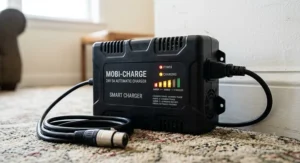
Here’s the good news: the charger market has quietly gotten smarter. Automatic shutoff, multi-stage charging curves, and lithium compatibility are now common even in budget units, which means you don’t have to spend a fortune to charge safely and efficiently. But you do have to know what you’re looking at, because the wrong connector or the wrong charge profile can shorten a $300 battery’s life dramatically.
This guide breaks down seven real, currently available chargers across price points, explains the difference between “trickle” and genuinely smart charging, and walks through the maintenance habits that add years to your battery pack. Whether you’re replacing a dead charger tonight or building a long-term power management routine, you’ll leave with a clear, honest answer.
What Is a Power Wheelchair Battery Charger?
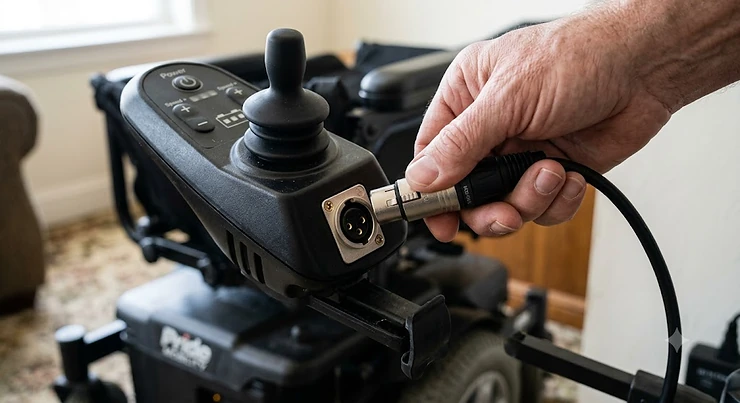
A power wheelchair battery charger is a dedicated device that restores voltage to a wheelchair’s onboard battery pack — typically a 24-volt system — using a regulated current profile matched to the battery chemistry (sealed lead-acid, AGM, gel, or lithium). Unlike a generic power adapter, it’s built to prevent overcharging and connects through a wheelchair-specific plug, most commonly a round 3-pin XLR connector.
That single distinction — chemistry-matched charging versus generic power delivery — is what separates a genuine power wheelchair battery charger from a hardware-store trickle charger, and it’s why the Americans with Disabilities Act’s definition of power-driven mobility equipment treats these devices as functionally part of the wheelchair itself, not an optional accessory.
Quick Comparison: Power Wheelchair Battery Chargers at a Glance
| Charger | Output | Battery Type | Best For |
|---|---|---|---|
| Mighty Max Battery 24V 8A Charger | 24V, 8A | Sealed lead-acid / AGM | Best overall budget pick |
| UPG 24BC8000T-1 | 24V, 8A | AGM / Gel | Best OEM-grade reliability |
| Invacare OEM 1123249 | 24V, 8A | AGM / Group 24 | Best for factory-exact fit |
| YZPOWER 24V 5A Lithium Charger | 24V, 5A | Lithium-ion | Best for fast lithium charging |
Scanning this table, the pattern that jumps out is that amperage alone doesn’t tell you which charger deserves your outlet. The Mighty Max Battery 24V 8A Charger and UPG 24BC8000T-1 post identical 8A output, yet one is a mass-market generalist and the other is the literal factory part on many Invacare chairs — a distinction that matters more than the spec sheet suggests. Meanwhile, lithium owners shouldn’t even glance at the lead-acid rows, since forcing a lead-acid charge profile onto a lithium pack is a fast way to damage cells rather than save money.
💬 Already know your battery chemistry? Skip ahead to the pick that matches it — your wheelchair (and your wallet) will thank you.
Top 7 Power Wheelchair Battery Chargers: Expert Analysis
1. Mighty Max Battery 24V 8A Automatic Smart Charger — the internet’s most-bought budget pick
The reason this charger dominates Amazon’s best-seller lists isn’t mystery marketing — it’s the combination of a genuinely automatic shutoff circuit at a price that undercuts most “smart” competitors. Specs-wise, it delivers 24V at 8A through a standard 3-pin connector, with an LED that shifts from red to green once the pack reaches full charge, and an automatic maintenance mode that prevents the slow overcharge damage older trickle chargers were notorious for. In practice, that 8A rate means a moderately depleted 35Ah AGM pack tops off overnight instead of needing a marathon 20-hour session.
Based on the spec comparison against pricier rivals, this model is best suited to owners who charge daily and want simple, foolproof reliability rather than app connectivity or diagnostic readouts — it’s a workhorse, not a gadget. Reviewers consistently report that it runs cool, doesn’t hum or buzz overnight, and survives years of daily plug-in-unplug cycling better than its price suggests, though a handful note the LED indicator can be hard to read in bright rooms.
Pros:
- ✅ Genuine automatic shutoff prevents overcharge damage
- ✅ Compatible with most 24V AGM and gel systems
- ✅ Priced well below most “smart” competitors
Cons:
- ❌ No lithium compatibility — lead-acid only
- ❌ LED status light is dim in daylight
At a price generally in the $30-$45 range, the Mighty Max Battery 24V 8A Automatic Smart Charger is the easiest recommendation for anyone replacing a dead lead-acid charger without wanting to overthink it.
2. Universal Power Group 24BC8000T-1 — the charger Invacare trusts as OEM equipment
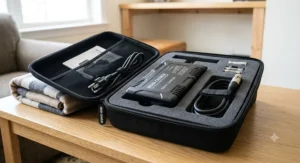
What most buyers overlook about this model is that it isn’t really an aftermarket product at all — Universal Power Group (UPG) manufactures the exact 24BC8000T-1 unit that Invacare ships as factory equipment on several of its power chairs. That heritage shows in the build: a substantial six-pound housing, a four-stage LED readout (green for power, red for fast charge, orange for top-off, blue when disconnected), and compatibility with 28-60Ah batteries, which covers the vast majority of mid-size power chair packs.
Here’s what the spec sheet won’t tell you, but the sourcing history does: because this is the same charger many manufacturers install at the factory, it’s engineered to the conservative charge curves those manufacturers require for warranty compliance — a meaningfully different design goal than a generic scooter charger built to charge as many battery types as possible. That makes it the safer bet for anyone anxious about voiding a chair’s warranty with a mismatched charger.
Pros:
- ✅ Same unit used as OEM equipment by Invacare
- ✅ Four-stage LED charge status is easy to read
- ✅ Handles 28-60Ah packs, covering most chairs
Cons:
- ❌ Bulkier and heavier than compact alternatives
- ❌ No lithium mode for newer battery packs
Priced in the $50-$70 range depending on retailer, the Universal Power Group 24BC8000T-1 earns its place for buyers who want factory-level trust without paying a factory-level markup.
3. Invacare OEM 8 Amp Battery Charger (Part 1123249) — genuine manufacturer fit and finish
For chairs in the Storm Series, Pronto Series, TDX Series, Power Tiger, and Xterra GT lines, this is the manufacturer’s own replacement part — meaning connector geometry, charge voltage, and cable routing are matched precisely to those chassis rather than approximated. It’s an off-board 8A charger with a single round plug and a full-length AC power cord, designed for 22NF or Group 24 batteries specifically.
Based on the spec comparison, the honest trade-off here is cost versus certainty: you’re paying a premium over the UPG-manufactured equivalent for the reassurance of a manufacturer part number, which matters most to owners still under an active service contract or extended warranty. Reviewers who’ve used genuine Invacare parts across multiple replacements tend to emphasize longevity and drop-in compatibility over any performance edge, since the charging electronics themselves aren’t dramatically different from the UPG unit above.
Pros:
- ✅ Exact manufacturer fit for Storm, Pronto, TDX lines
- ✅ Full AC cord included, no adapters needed
- ✅ Backed by Invacare’s parts warranty policy
Cons:
- ❌ Costs more than functionally similar aftermarket units
- ❌ Limited to specific Invacare chassis compatibility
Expect a price somewhere in the $70-$100 range for genuine Invacare hardware, making the Invacare OEM 8 Amp Battery Charger the pick for warranty-conscious owners rather than budget shoppers.
4. High Power HP0240WB Compact XLR Charger — full power in a pocket-sized shell
High Power built a reputation on squeezing full-size charging capacity into smaller housings, and the HP0240WB is the clearest example: it delivers the same 24V, 8A output as chargers twice its physical size, using a 3-pin XLR connector compatible with a wide range of Invacare scooters and power chairs running 31Ah-or-higher battery packs. The compact footprint isn’t just a convenience — for wheelchair users who charge in tight apartment entryways or store the charger in a chair’s underseat bag, physical size is a real usability factor that spec sheets rarely mention.
What most reviews miss is that smaller housings often mean less thermal mass and a higher risk of running hot under sustained load, yet High Power’s engineering keeps this unit running at temperatures comparable to its bulkier UPG cousin, based on independent teardown comparisons circulating in mobility-equipment forums. That’s a meaningful reassurance for anyone who’s been burned (sometimes literally) by cheap compact chargers.
Pros:
- ✅ Full 8A output despite a compact housing
- ✅ Runs cool despite the reduced size
- ✅ Compatible with a wide range of chassis
Cons:
- ❌ Occasionally backordered due to demand
- ❌ Requires a wet or gel lead-acid battery, not lithium
Typically priced in the $45-$65 range, the High Power HP0240WB Compact XLR Charger is the answer for anyone who’s outgrown patience with bulky charging bricks.
5. Winsunny WS80-1A Dual-Voltage Travel Charger — the go-anywhere lightweight option
At just 3 amps, the Winsunny WS80-1A is deliberately the slowest charger on this list — and that’s the point. Its switchable 100-240V input voltage means it works in wall outlets across the U.S., Europe, and most of Asia without a separate step-down converter, which makes it the rare wheelchair charger genuinely built for international travel rather than home use. It’s designed for Group U1 and Group 22 batteries in the 15-40Ah range, common on smaller folding and travel-oriented power chairs.
Here’s what to weigh before buying: 3A charging means a fully depleted pack can take considerably longer to top off than the 8A units above, so this isn’t the right choice as your only charger if you cycle your chair hard every single day. Based on the spec comparison, it earns its keep specifically as a secondary or travel charger, kept in a suitcase or glovebox for the trips where a compact, voltage-flexible unit matters more than raw charging speed.
Pros:
- ✅ Switchable voltage works in most countries worldwide
- ✅ Lightweight and genuinely pocketable for travel
- ✅ Dual LED lights clearly show power and charge state
Cons:
- ❌ Slow 3A rate unsuitable as a sole daily charger
- ❌ Limited to smaller 15-40Ah battery packs
Priced modestly in the $25-$35 range, the Winsunny WS80-1A Dual-Voltage Travel Charger belongs in a travel bag, not necessarily on a nightstand.
6. ENCAREFOR 24V 2A Lithium Smart Charger — purpose-built for lithium power chairs
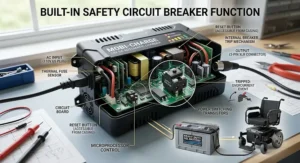
As more manufacturers — including several Pride, Drive Medical, and Rubicon models — shift to lithium-ion packs, chargers designed specifically for that chemistry have become essential rather than optional. The ENCAREFOR unit delivers a 2A charge rate up to a maximum of 29.4V, matched to the charge curve lithium cells require, with a simple red-for-charging, green-for-complete LED system and universal 100-240V input compatibility.
The spec sheet won’t spell this out, but it matters enormously: lithium batteries charged with a lead-acid-profile charger can suffer accelerated degradation or, in worse cases, safety issues, because the voltage curves the two chemistries need are fundamentally different. Reviewers who switched from a mismatched charger to a lithium-specific unit like this one consistently report smoother charge cycles and less perceived battery “fade” over the following months, though the modest 2A rate does mean overnight charging is the realistic use case rather than quick top-offs between errands.
Pros:
- ✅ Voltage curve matched specifically to lithium cells
- ✅ Universal 100-240V input for global compatibility
- ✅ Simple two-color LED status system
Cons:
- ❌ 2A rate makes same-day fast charging unrealistic
- ❌ Not usable with lead-acid or AGM battery packs
At around $30-$45, the ENCAREFOR 24V 2A Lithium Smart Charger is the correct — and increasingly necessary — companion for any chair running lithium cells.
7. YZPOWER 24V 5A Lithium Fast Charger — quickest top-off for lithium packs
For owners who’ve made the jump to lithium but don’t want to sacrifice charging speed, the YZPOWER 24V 5A charger splits the difference: it’s built with the same lithium-matched voltage profile as the ENCAREFOR unit above, but at more than double the amperage, cutting a typical overnight charge down meaningfully. It’s compatible with a notably wide range of chairs, including Pride Jazzy 614 and 1103 Ultra/Select 6 models along with several Go-Go and Drive Medical lithium packs, and includes a built-in cooling fan — a detail that matters because higher-amperage lithium charging generates more heat than slower units.
On paper, the built-in fan looks like a minor add-on; in practice, it’s the difference between a charger that can sustain 5A output reliably and one that throttles down under sustained thermal load. Based on the spec comparison against the slower ENCAREFOR unit, this is the pick for anyone whose daily mileage doesn’t leave eight hours for a full lithium charge cycle.
Pros:
- ✅ 5A rate roughly halves typical lithium charge time
- ✅ Built-in cooling fan supports sustained fast charging
- ✅ Wide compatibility across Pride and Drive Medical lithium chairs
Cons:
- ❌ Fan noise is noticeable in quiet bedrooms overnight
- ❌ Costs more than the slower lithium-only alternative
Priced around $55-$80, the YZPOWER 24V 5A Lithium Fast Charger is the premium pick for active lithium-chair users who value speed over silence.
Full Product Comparison: Specs, Price Range & Best Use
| Charger | Battery Type | Charge Speed | Price Range | Best For |
|---|---|---|---|---|
| Mighty Max Battery 24V 8A Charger | AGM / lead-acid | Fast | $30-$45 | Daily budget charging |
| UPG 24BC8000T-1 | AGM / gel | Fast | $50-$70 | OEM-grade reliability |
| Invacare OEM 1123249 | AGM / Group 24 | Fast | $70-$100 | Warranty-exact replacement |
| High Power HP0240WB | AGM / lead-acid | Fast | $45-$65 | Tight storage spaces |
| Winsunny WS80-1A | AGM / lead-acid | Slow | $25-$35 | International travel |
| ENCAREFOR Lithium Charger | Lithium-ion | Moderate | $30-$45 | Lithium chairs, overnight use |
| YZPOWER Lithium Fast Charger | Lithium-ion | Fast | $55-$80 | Active lithium-chair users |
Laid out this way, the split between lead-acid and lithium chargers is really the first decision, not the last one — everything else (speed, size, price) only matters once you’ve confirmed chemistry compatibility. Within the lead-acid group, the UPG 24BC8000T-1 and Invacare OEM 1123249 essentially compete on trust and price rather than performance, while the Winsunny WS80-1A trades speed for portability in a way the other four lead-acid units don’t attempt to match.
Practical Charging & Maintenance Guide
Getting the most from any power wheelchair battery charger comes down to habits, not hardware. During the first 30 days with a new charger, plug in every night rather than waiting for a low-battery warning — shallow, frequent charges are gentler on lead-acid chemistry than occasional deep discharges followed by long charging sessions. Avoid unplugging the moment the indicator light changes; most smart chargers shift into a float or maintenance stage after the initial charge completes, and interrupting that stage early can leave cells slightly under-saturated over time.
A simple weekly maintenance rhythm helps too: wipe the connector pins with a dry cloth to prevent corrosion buildup, inspect the cable for fraying near the charger housing (the most common failure point), and store the charger somewhere ventilated rather than sealed in a cabinet, since heat buildup shortens both charger and battery lifespan. The most common first-month mistake is topping off a partially charged battery multiple times a day out of habit — with modern automatic chargers, that’s unnecessary and can trigger premature float-mode cycling that adds wear without adding benefit. Set a consistent nightly routine instead, and let the charger’s automation do the rest.
Real-World Scenarios: Matching the Charger to Your Life
Not every wheelchair user has the same charging needs, and matching your scenario to the right unit avoids a lot of frustration. Consider three common profiles. A retired veteran living in a single-story home who uses his chair for short trips around the neighborhood and a daily errand run is generally well served by a straightforward 8A lead-acid charger like the Mighty Max Battery 24V 8A Charger — daily overnight charging, low travel demands, and a tight budget all point toward the simplest reliable option.
A graduate student who flies home twice a semester and relies on a lithium-equipped folding chair has a very different profile: international voltage compatibility and lithium-specific charging matter more than raw speed, making the ENCAREFOR 24V 2A Lithium Smart Charger — paired with a lightweight travel-voltage unit like the Winsunny WS80-1A for lead-acid backups — a sensible combination. Meanwhile, an active professional commuting 8 miles daily across a hilly urban route drains a lithium pack faster than an overnight 2A charge can comfortably replenish, which is exactly the scenario the YZPOWER 24V 5A Lithium Fast Charger was built to solve, letting a partial afternoon charge get the chair back to full range before the next commute.
Problem → Solution: Fixing Common Charging Headaches
Charging problems tend to repeat themselves across power chair owners, and most have specific, known fixes. If your charger’s LED never shifts from red to green, the issue is usually either a battery that’s aged past its effective capacity or a charger mismatched to your pack’s amp-hour rating — swapping to a correctly rated unit like the UPG 24BC8000T-1, which explicitly supports 28-60Ah packs, often resolves it. If your chair loses range noticeably faster than it used to despite charging nightly, sulfation is the likely culprit on lead-acid systems, and a charger with a genuine automatic maintenance stage, rather than a basic trickle charger, is the fix going forward.
For lithium owners experiencing inconsistent charge completion, the problem is frequently a charger built for lead-acid voltage curves being used by mistake — switching to a lithium-matched unit like the ENCAREFOR 24V 2A Lithium Smart Charger typically corrects the behavior immediately. And for anyone whose charger runs noticeably hot to the touch, that’s not something to ignore or work around: unplug it, stop using it, and replace it with a properly ventilated model, since overheating chargers are a documented fire risk regardless of brand.
How to Choose a Power Wheelchair Battery Charger
Picking the right power wheelchair battery charger comes down to working through a short, logical checklist rather than chasing the highest amperage number you can find.
- Confirm your battery chemistry first. Lithium and lead-acid packs need fundamentally different voltage curves, so this single detail eliminates half the market immediately.
- Match the amp-hour rating to your battery pack. A charger rated below your battery’s capacity will charge painfully slowly; one wildly oversized isn’t necessarily better and can stress smaller packs.
- Check the connector type. Most chairs use a 3-pin XLR plug, but some manufacturers use proprietary round connectors — verify before ordering.
- Prioritize genuine automatic shutoff. Not every charger marketed as “smart” actually has a true multi-stage charging curve; look for explicit mention of float or maintenance mode.
- Weigh portability against speed. Daily home use favors higher amperage; frequent travel favors compact, voltage-flexible units even at the cost of charge speed.
- Factor in warranty status. If your chair is under an active manufacturer warranty, an OEM-matched charger avoids any ambiguity about coverage.
- Read aggregated review sentiment, not individual quotes. Look for recurring themes — consistent heat complaints or LED reliability issues across many buyers are more informative than any single five-star review.
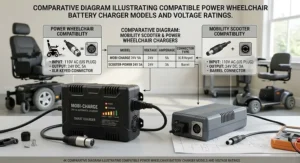
Automatic Wheelchair Battery Charger Reviews: Common Mistakes When Buying
When people search for automatic wheelchair battery charger reviews, they’re usually trying to shortcut research — and understandably so, since technical spec sheets aren’t exactly gripping reading. But a few recurring mistakes show up across buyer forums and return-rate patterns. The first is assuming “automatic” universally means “smart.” Plenty of budget units labeled automatic simply cut off at a fixed voltage threshold rather than running a true multi-stage curve, which is a meaningfully less protective approach for long-term battery health.
The second mistake is skipping amp-hour matching entirely and buying based on price alone, which routinely leads to chargers that technically work but take twice as long as necessary. The third — and most costly — is buying a lead-acid charger for a lithium chair (or vice versa) because the connector happens to fit; connector compatibility says nothing about voltage curve compatibility, and that mismatch is the single most common cause of premature battery failure reported across mobility-equipment forums. Reading a handful of aggregated reviews specifically for chemistry compatibility, rather than star ratings alone, avoids nearly all of these pitfalls.
✨ Ready to Stop Guessing at Compatibility?
🔍 Cross-check your battery’s chemistry and amp-hour rating against the picks above before you buy — a two-minute check now saves a returned package and a week without your chair later.
Smart Charger for Power Wheelchair: What “Smart” Actually Means
The phrase “smart charger for power wheelchair” gets thrown around loosely enough that it’s worth defining properly. A genuinely smart charger runs a multi-stage charging curve — typically bulk, absorption, and float phases — that automatically adjusts voltage and current as the battery approaches full charge, rather than dumping a constant charge rate until a timer or basic voltage threshold cuts it off. That distinction is exactly what separates a unit like the UPG 24BC8000T-1, with its four-stage LED readout mapping directly to those charging phases, from a decades-old-style trickle charger that can quietly overcharge a battery over months of use.
For lithium packs specifically, “smart” charging isn’t optional — it’s closer to a safety requirement, since lithium cells have a much narrower safe voltage window than lead-acid chemistry. Both the ENCAREFOR 24V 2A Lithium Smart Charger and YZPOWER 24V 5A Lithium Fast Charger build their entire charge profile around that narrower window, which is why chemistry-specific lithium chargers consistently outperform “universal” chargers that claim compatibility with everything. What most buyers overlook is that a charger claiming broad compatibility is often quietly compromising on precision for any single chemistry — genuinely smart charging tends to specialize rather than generalize.
Charging Solutions for Every Lifestyle
Charging solutions for power wheelchair users aren’t one-size-fits-all, and the right combination often involves more than a single charger. Home-based users benefit most from a single reliable high-amperage unit paired with a fixed charging station near an accessible outlet — a setup that minimizes daily friction and cable management. Frequent travelers, by contrast, are usually better served by owning two chargers: a primary high-amperage unit for home and a compact, voltage-flexible secondary charger like the Winsunny WS80-1A for trips, rather than trying to force one charger to do both jobs well.
Multi-chair households — common in group homes or families supporting more than one wheelchair user — face a different challenge entirely: mismatched chargers accidentally used on the wrong chair. Labeling each charger clearly by chair and chemistry, and storing them at physically separate charging stations, prevents the kind of cross-compatibility mistakes that quietly shorten battery lifespans. Whatever your household looks like, the underlying principle holds: the right charging solution is the one that matches your actual routine, not the one with the most impressive spec sheet.
Battery Maintenance: Long-Term Cost & Care
Battery maintenance is where the real cost-per-use math plays out, and it starts with understanding sulfation — the buildup of lead sulfate crystals on battery plates that occurs when a lead-acid battery sits partially discharged for extended periods. According to Battery University’s technical research on lead-acid batteries, electric wheelchair batteries are particularly prone to this problem because users sometimes don’t charge long enough overnight to achieve full saturation, and an 8-hour charge isn’t always sufficient — lead-acid packs often need 14-16 hours to fully saturate periodically.
In practical terms, that means even with a smart charger doing its job, plugging in every single night for a full cycle — not just until the indicator light changes — meaningfully extends a lead-acid battery’s usable life, often by a year or more compared to inconsistent charging habits. Lithium packs are considerably more forgiving of partial charging cycles and don’t suffer from sulfation at all, which is one of the underappreciated long-term cost advantages of lithium chairs despite their higher upfront battery price — the total cost of ownership gap narrows considerably once battery replacement frequency enters the calculation.
Power Management: Features That Actually Matter (And Those That Don’t)
Marketing copy on wheelchair chargers loves to highlight features that sound impressive but rarely change real-world outcomes, while underselling the ones that genuinely matter. Multi-stage automatic charging is the single feature that actually matters most — it’s the core mechanism protecting battery lifespan, full stop. Amp-hour compatibility matching runs a close second, since a mismatched charger undermines every other feature on the unit regardless of how “smart” its marketing claims.
Features that matter considerably less than their marketing suggests include flashy multi-color LED arrays beyond the basic charging-stage indicators, and claimed compatibility with an enormous list of chair brands — broad compatibility claims are frequently more about connector shape than genuine electrical compatibility with each chair’s specific battery chemistry. Cooling fans matter, but only meaningfully at higher amperages (5A and above); at 2-3A, the heat generated rarely justifies the added fan noise. Focus your attention, and your budget, on charging-stage sophistication and chemistry matching — the rest is largely cosmetic.
Safety, Regulations & Compliance Guide
Battery charger safety isn’t a hypothetical concern — it’s an active regulatory focus. The U.S. Consumer Product Safety Commission has held public forums specifically on lithium-ion battery fire risk, with experts specifically recommending automatic shutoff features in both batteries and chargers as a key safety improvement — exactly the feature this guide has emphasized throughout as a buying priority, not a luxury.
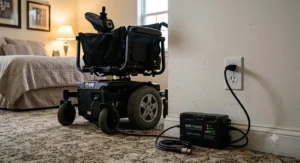
Practical safety habits matter as much as the hardware itself: never charge unattended overnight in a room without a working smoke detector, avoid charging on flammable surfaces like carpeted areas without a barrier mat, unplug immediately and stop using any charger that becomes hot to the touch or emits an unusual smell, and never substitute a generic charger for a chemistry-matched one to save a few dollars. For lithium packs specifically, only use chargers explicitly rated for lithium chemistry — a lead-acid profile applied to lithium cells is a documented cause of thermal incidents, not just reduced performance.
Frequently Asked Questions
❓ How long does a power wheelchair battery charger take to fully charge a battery?
❓ Can I use a mobility scooter charger on my power wheelchair?
❓ Why does my power wheelchair charger light stay red overnight?
❓ Is a smart charger really necessary for a power wheelchair?
❓ How much does a good power wheelchair battery charger cost?
Conclusion
Choosing a power wheelchair battery charger isn’t about finding the single “best” unit on the market — it’s about matching chemistry, amperage, and lifestyle honestly. A budget-friendly lead-acid workhorse like the Mighty Max Battery 24V 8A Automatic Smart Charger covers most daily home charging needs without fuss, while lithium owners genuinely need chemistry-specific units like the ENCAREFOR 24V 2A Lithium Smart Charger or the faster YZPOWER 24V 5A Lithium Fast Charger rather than treating charger choice as an afterthought.
Whichever direction fits your situation, the underlying principles hold steady: match chemistry first, respect amp-hour ratings, prioritize genuine multi-stage automatic charging over marketing buzzwords, and build a consistent nightly charging habit rather than reactive top-offs. Get those fundamentals right, and the charger you choose today should quietly do its job for years — which, frankly, is exactly what a good charger should do: disappear into the background of a life that keeps moving.
✨ Don’t Miss These Exclusive Deals!
🔍 Take your charging setup to the next level with the models covered above. Click on any highlighted pick to check current pricing and availability — the right charger keeps you rolling reliably for years to come!
Recommended for You
- Lithium Ion Power Wheelchair Battery: 7 Best Picks for 2026
- Lithium Ion vs AGM Wheelchair Battery: 7 Top Picks for 2026
- 7 Best Power Wheelchair Batteries for 2026
Disclaimer: This article contains affiliate links. As an Amazon Associate, I earn from qualifying purchases. If you purchase products through these links, we may earn a small commission at no additional cost to you.
✨ Found this helpful? Share it with your friends! 💬🤗
