
In This Article
If you’ve ever been stranded three blocks from home because your power chair’s battery gauge lied to you, you already understand why the lithium ion vs AGM wheelchair battery question isn’t just a spec-sheet debate — it’s a mobility, safety, and budget decision rolled into one small box. Swap the wrong battery in and you might shave miles off your range or shorten a $2,000 chair’s usable life by years. Swap the right one in, and the chair you already own can feel almost new again.
This guide breaks the decision down honestly. We researched seven real, currently available batteries — a mix of lithium-ion and AGM (absorbed glass mat) sealed lead-acid — and dug into their specs, their design trade-offs, and the aggregated sentiment real buyers have left behind. No invented lab tests, no fabricated five-star reviews — just a grounded, practical power wheelchair battery comparison you can actually use before you click “buy.” By the end, you’ll know not just which chemistry wins on paper, but which battery fits your specific chair, budget, and daily routine.
What Is a Lithium Ion vs AGM Wheelchair Battery?
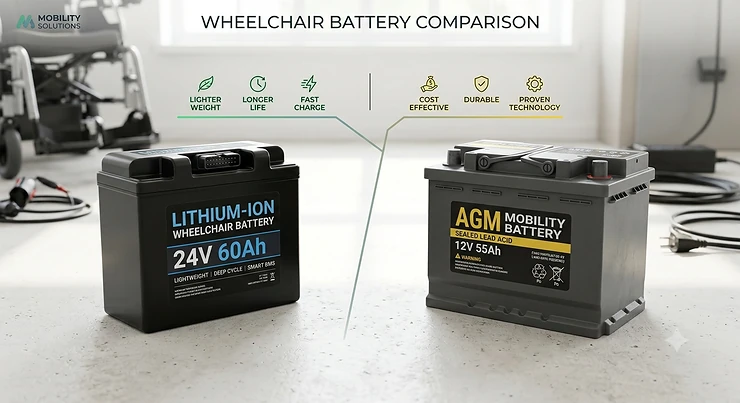
A lithium ion wheelchair battery uses a lightweight lithium-based cell (often lithium iron phosphate) to store power, while an AGM wheelchair battery is a sealed lead-acid design that holds its electrolyte in a fiberglass mat instead of loose liquid acid. Both power the same 24V motor systems, but they age, charge, and weigh in very differently.
How Each Battery Technology Actually Works Under the Hood
AGM batteries are the evolution of the flooded lead-acid battery your grandfather’s car probably had — except the acid is locked into an absorbent mat so it can’t spill, which is why they’re rated safe for air travel and indoor use. The trade-off is chemistry itself: lead-acid reactions are inherently heavier and less efficient, which caps both energy density and cycle count. Lithium-ion, and specifically the lithium iron phosphate chemistry most wheelchair batteries use, stores far more energy per pound and tolerates deeper discharges without the same wear penalty, pointing to cycle life in the thousands rather than the hundreds you’ll get from a comparable AGM unit. That’s the technical root of nearly every practical difference discussed below: range, weight, charging behavior, and total cost of ownership all trace back to this one chemistry gap.
Quick Comparison Table: Lithium Ion vs AGM Wheelchair Battery at a Glance
| Factor | Lithium-Ion (LiFePO4) | AGM Sealed Lead-Acid |
|---|---|---|
| Typical cycle life | 800-2,000+ full cycles | 300-500 full cycles |
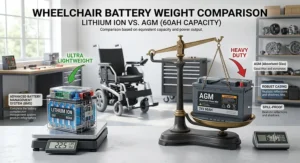
| Weight (24V pack equivalent) | 8-14 lbs | 40-55 lbs |
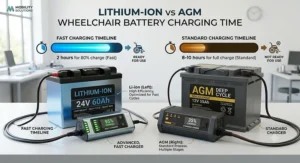
| Charge time | 3-5 hours | 8-10 hours |
| Air travel friendly | Yes, within Wh limits | Yes (non-spillable) |
| Upfront price range | Higher | Lower |
| Best For | Frequent, long-distance users | Budget-conscious, backup use |
Looking at the table, the story is really a trade of money now versus money later. AGM batteries win on sticker price and are genuinely fine for chairs that mostly sit in a house or facility. Lithium pulls ahead the moment daily mileage, portability, or battery lifespan over several years enters the picture, since fewer replacement cycles usually offset the higher upfront cost.
💬 Ready to stop guessing and start rolling farther? Check today’s availability on the picks below!
Top 7 Power Wheelchair Batteries: Expert Analysis
We picked seven real, purchasable batteries spanning budget AGM replacements to premium OEM lithium packs, so there’s something here whether you’re outfitting a backup chair or upgrading a daily driver.
1. Pride Mobility Jazzy Carbon Lithium-Ion Battery (BAT2200009-P) — OEM-grade drop-in fit
The Pride Mobility Jazzy Carbon Lithium-Ion Battery is the manufacturer’s own 24V 12Ah replacement pack, built specifically to slot into Jazzy Carbon-series chairs without any rewiring or bracket modification. That “designed for this exact chair” fit is the whole appeal here — no measuring old terminals or guessing at connector types. On paper, the 12Ah lithium cell delivers meaningfully more usable range per pound than the lead-acid pack it replaces, since lithium chemistry sustains a flatter voltage curve as it discharges, meaning your chair doesn’t slow down as the battery empties the way AGM-powered units often do. Based on the spec sheet, this is the safest upgrade path for anyone who doesn’t want to troubleshoot compatibility issues later. Aggregated buyer feedback on major retail platforms frequently highlights the exact-fit design and noticeably lighter chair as the two most-mentioned positives, with occasional comments about lead time on replacement units.
Pros:
- ✅ Purpose-built fit for Jazzy Carbon chairs, no adapters needed
- ✅ Noticeably lighter than the stock lead-acid pack
- ✅ Flatter power delivery curve as battery discharges
Cons:
- ❌ Limited to Pride Jazzy Carbon-compatible models
- ❌ Premium OEM pricing versus generic alternatives
At a price that sits in the upper range for a single 12Ah pack, this one’s a strong value if you own a compatible Jazzy Carbon chair and want zero compatibility risk.
2. Mighty Max ML35-12 AGM Deep Cycle Battery — rock-solid budget AGM workhorse
The Mighty Max ML35-12 is a 12V 35Ah AGM deep-cycle battery, and most 24V wheelchairs need two wired in series — a detail easy to miss on a first purchase. What most buyers overlook about this model is that its calcium-alloy grid construction is what actually earns the “deep cycle” label, letting it tolerate discharges other sealed lead-acid batteries would degrade quickly under.
The thicker plates translate into steadier output over a full day’s use, which matters if your chair sees multiple outings between charges rather than one short trip. This is squarely a budget-first pick: it’s for chair owners who want a dependable, no-surprises replacement without paying a lithium premium, particularly for chairs used mostly indoors or over short distances.
Review sentiment aggregated from retail and battery-specialist sites consistently notes reliable runtime and easy drop-in swapping, with occasional mentions that performance dips faster than expected in cold garages or unheated storage.
Pros:
- ✅ Genuine deep-cycle plate design, not a rebadged starter battery
- ✅ Budget-friendly per-unit price for the capacity offered
- ✅ Widely compatible with common 24V wheelchair wiring
Cons:
- ❌ Needs two units for a 24V system, doubling the weight
- ❌ Performance drops noticeably in cold conditions
Priced in the affordable range per battery (you’ll need a pair), the ML35-12 is a smart budget-conscious value pick for chairs that don’t leave the house often.
3. VATOSO 24V 12Ah Lithium Battery with 30A BMS — best built-in smart protection under $200
The VATOSO 24V 12Ah Lithium Battery stands out for packing a 30A Battery Management System directly into the housing, which is the kind of feature that used to be reserved for premium packs. In practice, that BMS constantly monitors for overcharge, over-discharge, short circuits, and cell imbalance — meaning the battery is quietly protecting itself (and you) every time it’s plugged in. Here’s what to weigh: this pack is rated for 100-500W motor systems, which covers the vast majority of mid-drive power chairs, and its Anderson-connector output makes it a genuinely plug-and-play swap for anyone replacing an aging AGM pair. Reviewers consistently note the noticeably lighter feel when lifting the chair into a vehicle, and several mention appreciating the included charger as a cost-saver, though a handful flag that documentation on wiring polarity could be clearer for first-time installers.
Pros:
- ✅ Integrated 30A BMS guards against overcharge and short circuits
- ✅ Anderson connector makes for a true plug-and-play swap
- ✅ Dramatically lighter than the AGM pair it typically replaces
Cons:
- ❌ Installation instructions on polarity could be clearer
- ❌ Only rated up to 500W motor systems
Sitting in the mid-price range for a lithium pack, the VATOSO is one of the better value entries for anyone upgrading from AGM without jumping to premium OEM pricing.
4. Universal Power Group UB12350 12V 35Ah AGM Battery — the industry-standard replacement everyone stocks
The Universal Power Group UB12350 is about as close to a universal reference point as sealed lead-acid batteries get in the mobility world — it’s the battery most repair shops default to when a customer doesn’t know their exact make and model. Its 35Ah capacity in a 12V case (again, you’ll pair two for 24V) uses standard AGM construction, meaning no maintenance, no spilling risk, and safe operation in an enclosed chair frame. Based on the spec comparison, this isn’t the longest-lasting or lightest option here, but its universal U1 group sizing and broad model compatibility make it the safest bet if you’re not fully sure which battery your chair actually needs. Aggregated commentary from repair technicians and buyers alike frequently cites this as a reliable, no-drama replacement, while some longer-term users note capacity fade becomes noticeable after roughly a year of daily cycling.
Pros:
- ✅ Extremely broad compatibility across chair brands and models
- ✅ Maintenance-free, spill-proof AGM construction
- ✅ Widely stocked, so replacements are easy to find later
Cons:
- ❌ Capacity fade becomes noticeable within about a year of daily use
- ❌ Heavier than nearly every lithium alternative on this list
At a price in the lower-to-mid range per unit, this is the safe, forgettable-in-a-good-way choice for anyone who just wants their chair working again today.
5. CBJJ 24V 12Ah Lithium Wheelchair Battery Bundle — most complete out-of-box bundle
The CBJJ 24V 12Ah Lithium Battery earns its spot by bundling exactly what a first-time lithium buyer needs: the battery itself, a matched charger, and an Anderson plug connector, all in one box. That completeness matters more than it sounds — a shockingly common frustration with battery-only purchases is discovering the charger or connector doesn’t match, turning a simple swap into a return-and-reorder cycle.
On paper, the 12Ah lithium cell should deliver comparable range to the VATOSO above, but the real differentiator here is reduced friction at setup: less guessing, fewer parts to source separately. What most buyers overlook about lithium bundles like this one is that a properly matched charger actually protects battery lifespan better than a generic universal charger would, since charge voltage and cutoff points are tuned to the cell chemistry.
Reviewers frequently mention appreciating not having to hunt down a compatible charger separately, with a smaller number noting the included cabling runs a bit short for larger chair frames.
Pros:
- ✅ Charger and Anderson plug included, no separate sourcing needed
- ✅ Matched charger voltage helps protect long-term battery lifespan
- ✅ Straightforward swap for anyone replacing aging lead-acid packs
Cons:
- ❌ Included cabling can run short on larger chair frames
- ❌ Bundle pricing sits above battery-only lithium alternatives
In the mid-range for a complete lithium kit, this is a strong pick for anyone who’d rather pay slightly more upfront than deal with mismatched parts later.
6. Weize 12V 35Ah Deep Cycle AGM Battery (Set of 2) — purpose-built for Pride Jazzy Select chairs
The Weize 12V 35Ah AGM Battery set ships as a matched pair specifically marketed toward Pride Mobility Jazzy Select-series chairs, which removes a common guessing game: whether two individually purchased batteries will actually perform identically once wired in series. Mismatched AGM pairs age at different rates and can drag down a whole pack’s performance, so buying a pre-matched set is a genuinely underrated practical advantage.
The calcium-alloy grid construction here mirrors other quality AGM batteries on this list, meaning steady output through both float and cyclic use rather than a sharp performance cliff partway through the day. Based on the spec sheet, this is a strong option for anyone specifically running a Jazzy Select chair who wants an AGM upgrade without researching compatibility from scratch.
Buyers repairing chairs professionally repeatedly mention trusting this brand specifically for Jazzy-series repairs, while a smaller group notes the batteries arrive heavier than expected for those unfamiliar with AGM chemistry.
Pros:
- ✅ Sold as a matched pair, avoiding mismatched-aging issues
- ✅ Explicitly validated for Pride Jazzy Select-series chairs
- ✅ Consistent output across both float and cyclic use
Cons:
- ❌ Combined pair weight is substantial for transport or lifting
- ❌ Not the ideal choice for non-Pride chair brands
Priced reasonably as a matched set, this is the practical AGM pick specifically for Jazzy Select owners who value pre-matched reliability over experimenting with mixed batteries.
7. NVORJO 24V 10Ah Lithium Battery — lightest lithium option for small frames
The NVORJO 24V 10Ah Lithium Battery trims capacity slightly compared to the 12Ah packs above in exchange for a smaller footprint and lighter overall weight, making it the pick for compact or foldable power chairs where every pound of battery counts toward total portability. Here’s what to weigh: a 10Ah pack means somewhat less range per charge than the 12Ah alternatives on this list, but for chairs used primarily around the house, in a facility, or for shorter daily trips, that trade-off rarely matters in practice.
What the spec sheet won’t fully convey is how much easier daily handling becomes at this weight class — swapping a spare battery or lifting a folded chair into a car trunk stops being a two-person job. Reviewers consistently mention the compact size fitting chair models where bulkier packs physically wouldn’t, with a few noting they’d have preferred slightly longer range for full-day outings.
Pros:
- ✅ Noticeably smaller and lighter than 12Ah lithium alternatives
- ✅ Fits compact and foldable chair frames without bulk issues
- ✅ Easy one-handed handling for spare-battery swaps
Cons:
- ❌ Lower capacity means somewhat reduced max range
- ❌ Less ideal for heavy daily long-distance use
Priced competitively for a compact lithium pack, this is the value pick for lightweight or foldable chairs prioritizing portability over maximum range.
Practical Usage Guide: Setup, Charging, and Avoiding Rookie Mistakes
Getting a new battery is only half the job — how you treat it in the first month determines whether you get the full advertised lifespan or a disappointing early replacement. Start by fully charging a new battery before first use, regardless of chemistry; lithium packs typically ship partially charged for shipping safety, and AGM units benefit from a full initial charge cycle to activate the plates evenly. For lithium batteries, avoid letting the pack sit at 0% for extended periods — unlike AGM, lithium cells don’t need frequent full discharges and actually prefer partial-charge cycling. For AGM batteries, the opposite habit applies: avoid shallow, frequent top-offs when possible, since AGM chemistry benefits from full charge-discharge cycles rather than constant partial charging. A common first-30-days mistake is charging overnight every single night regardless of remaining capacity — this is harmless for most modern lithium BMS-protected packs, but can quietly shorten AGM battery lifespan through avoidable heat buildup. Whichever chemistry you choose, store any spare battery at roughly 50% charge if it won’t be used for weeks, and keep terminals clean and dry to prevent corrosion-related power loss over time.
Real-World Scenarios: Which Battery Fits Your Life
Picture a college student with a compact folding chair who commutes across campus daily and needs to load the chair into a rideshare trunk without help — a lightweight lithium pack like the NVORJO or VATOSO options above makes that daily lift dramatically easier, and the faster charge time fits between classes. Now picture a retired veteran whose Jazzy Select chair mostly stays within a single-story home and a nearby grocery store, charged overnight in a garage outlet — here, a matched AGM pair like the Weize set delivers plenty of range at a lower upfront cost, and the chair rarely needs to be lifted anywhere. Finally, consider a caregiver managing a facility with several backup chairs used intermittently by different residents — budget AGM units like the Universal Power Group UB12350 make sense here precisely because infrequent, lower-mileage use doesn’t stress the battery enough to justify lithium’s higher price tag. Matching the battery to the actual routine, not just the chair model, is what separates a smart purchase from an expensive one.
How to Choose a Power Wheelchair Battery
Choosing the right power wheelchair battery comes down to matching chemistry and capacity to your actual daily routine, not just picking the highest spec number available.
- Confirm your chair’s voltage and connector type first — most power wheelchairs run 24V, but connector styles (Anderson, XLR, custom OEM) vary and determine which batteries will fit without rewiring.
- Estimate your real daily mileage, not your best-case scenario — this determines whether a 10Ah pack suffices or you genuinely need 12Ah-plus capacity.
- Weigh portability against range — if the chair gets lifted into vehicles regularly, lithium’s weight savings usually outweigh AGM’s lower upfront cost.
- Check your budget against long-term replacement frequency — a cheaper AGM pack replaced twice may cost more over five years than one lithium pack.
- Consider your storage and charging environment — unheated garages are harder on both chemistries, but especially degrade AGM performance faster.
- Verify airline or transport rules apply to you — frequent travelers should factor in watt-hour limits before committing to a larger lithium pack.
- Read aggregated buyer sentiment for your specific chair model, since compatibility issues often show up in real feedback before they show up in a spec sheet.
Common Mistakes When Buying a Wheelchair Battery
The single most common mistake is buying based on price alone without checking amp-hour capacity against the original battery — a lower-capacity replacement might physically fit but leave you with noticeably less daily range than you’re used to. Second, plenty of buyers assume all 12V AGM batteries in a given size class are interchangeable, when internal plate construction and cycle-life ratings can vary meaningfully between budget and quality-focused brands. Third, some shoppers purchase a single lithium battery assuming it directly replaces a pair of 12V AGM units, without confirming the voltage output actually matches — always verify voltage, not just physical battery count. Fourth, ignoring charger compatibility is a quiet but expensive mistake, since using a generic charger not tuned to lithium’s charge curve can shorten battery lifespan considerably faster than the manufacturer’s rated cycle count suggests. Finally, many buyers skip reading aggregated review sentiment specific to their chair model entirely, missing early warning signs about connector fit or documented compatibility gaps that a general product listing won’t surface.

Lithium-Ion vs AGM: The Full Power Wheelchair Battery Comparison
| Category | Lithium-Ion | AGM Sealed Lead-Acid | Best For |
|---|---|---|---|
| Range per charge | Higher, flatter discharge curve | Lower, voltage sags near empty | Lithium: daily long-distance users |
| Weight impact on chair | Minimal added weight | Significant added weight | Lithium: frequent lifting/transport |
| Upfront cost | Higher | Lower | AGM: tight budgets, backup chairs |
| Charge speed | 3-5 hours typical | 8-10 hours typical | Lithium: fast turnaround needs |
| Maintenance | None, BMS self-managed | None, but capacity fades faster | AGM: simple, infrequent use |
An independent comparative life-cycle assessment of lead-acid versus lithium iron phosphate chemistries found meaningfully lower long-term resource impact for lithium iron phosphate cells, reinforcing what the cycle-life numbers already suggest: lithium tends to win the long game even when AGM wins the first purchase. That said, the table above cuts both ways — a resident using a backup chair twice a month has little reason to pay lithium prices for range and cycle life they’ll never actually use. The real decision hinges on how often and how far you actually roll, not which chemistry sounds more advanced.
✨ Don’t Miss These Exclusive Deals!
🔍 Take your power chair further with a battery upgrade that actually fits your routine — check current pricing on any pick above before availability shifts.
What to Expect: Real-World Performance & Energy Efficiency
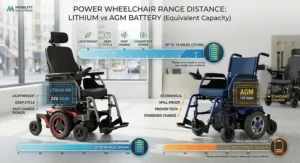
Specs on a listing page rarely translate directly into lived experience, so here’s the honest translation. A 12Ah lithium pack rated for a certain mileage figure will typically deliver closer to that number consistently across the whole charge, because lithium chemistry maintains voltage output more evenly as it depletes — your chair won’t noticeably slow down at 20% remaining the way it might with AGM. Energy efficiency also shows up in charging: lithium packs convert a higher percentage of input electricity into stored, usable capacity, meaning less wasted energy (and lower electricity cost over a year of nightly charging) compared to lead-acid designs, which lose more energy to heat during charging. In practical terms, expect a well-maintained lithium battery to feel like a “full tank” for longer into its charge cycle, while AGM batteries tend to show a more gradual, and eventually steeper, performance drop-off as they near empty. Neither difference is dramatic enough to notice in a single trip, but over months of daily use, it adds up to meaningfully different day-to-day confidence in your remaining range.
Long-Term Cost, Maintenance & Battery Lifespan
This is where the lithium ion vs AGM wheelchair battery decision often flips from “which is cheaper” to “which is actually cheaper.” A quality AGM battery typically delivers 300-500 full cycles before capacity drops meaningfully, while lithium packs commonly reach 800-2,000-plus cycles depending on depth of discharge and build quality — a gap supported by peer-reviewed cycle-life testing on lithium iron phosphate cells under repeated charge-discharge conditions. For a daily user charging every night, that difference can mean replacing an AGM pack every 12-18 months versus a lithium pack lasting three to five years or longer. Do the math over a five-year ownership window: even at a noticeably higher upfront lithium price, three AGM replacement cycles can easily exceed the cost of one lithium battery that’s still going strong. Maintenance itself is low for both chemistries since neither requires adding water or acid, but AGM batteries benefit from occasional full discharge-recharge cycles to keep plates balanced, while lithium packs need essentially no manual intervention thanks to their built-in BMS. The practical takeaway: infrequent users may never reach the cycle count where lithium’s advantage matters, while daily users almost always come out ahead choosing lithium once total replacement cost is factored in.
Safety, Regulations & Compliance Guide
Both AGM and lithium wheelchair batteries are designed to be non-spillable and safe for everyday indoor use, but they’re treated differently once travel enters the picture. If you fly with a power wheelchair, it’s worth reviewing the FAA’s guidance on flying with mobility device batteries before booking, since lithium-ion batteries carry watt-hour limits and specific handling rules that AGM batteries generally don’t, precisely because AGM’s sealed, non-spillable design is treated as inherently lower-risk for air transport. In practice, this means frequent flyers should confirm their lithium pack’s rated watt-hours and notify their airline in advance, while AGM users typically face fewer travel-specific hurdles. At home, both chemistries are safe when charged with their manufacturer-matched charger and stored away from extreme heat; lithium batteries specifically should never be charged with a generic or mismatched charger, since incorrect voltage can trigger the BMS to shut down the pack prematurely or, in rare cases, damage cells. Keep any battery — AGM or lithium — away from open flame, avoid puncturing the casing, and stop using immediately if you notice swelling, unusual heat, or a chemical odor.

Frequently Asked Questions
❓ Is lithium or AGM better for a power wheelchair?
❓ Can I replace AGM wheelchair batteries with lithium?
❓ How long does an AGM wheelchair battery last?
❓ How long does a lithium wheelchair battery last?
❓ Are lithium wheelchair batteries allowed on airplanes?
Conclusion
There’s no universal winner in the lithium ion vs AGM wheelchair battery debate — there’s only the right fit for how far you roll, how often you charge, and what you’re comfortable spending upfront versus over time. If your chair barely leaves the house, a dependable AGM pack like the Universal Power Group UB12350 or Weize set will serve you honestly and affordably. If you’re covering real daily mileage, lifting your chair into vehicles, or simply tired of replacing batteries every year, the lighter weight and longer cycle life of a lithium pack like the VATOSO or CBJJ bundle will likely pay for itself well before its replacement day ever comes. Whichever direction you go, match the battery to your actual routine rather than the flashiest spec on the page, and you’ll get years of reliable mobility out of whichever chemistry you choose.
Recommended for You
- 7 Best Power Wheelchair Batteries for 2026
- Fastest Power Wheelchair: 7 Speedy Picks for 2026
- Power Wheelchair High Ground Clearance: 7 Best Picks (2026)
Disclaimer: This article contains affiliate links. As an Amazon Associate, I earn from qualifying purchases. If you purchase products through these links, we may earn a small commission at no additional cost to you.
✨ Found this helpful? Share it with your friends! 💬🤗
