
In This Article
Here’s a scenario that plays out in living rooms across the country every single day: someone’s power chair beeps a low-battery warning halfway through a grocery run, and suddenly the whole afternoon is on hold. That single moment — the beep, the math about whether you’ll make it home — is exactly why the lithium ion power wheelchair battery conversation matters so much right now. For decades, mobility devices leaned on the same heavy, sluggish lead-acid packs your grandfather’s golf cart probably used, and users just accepted the tradeoffs. Slow charging. Dead weight. Batteries that quit holding a charge right when you needed them most.
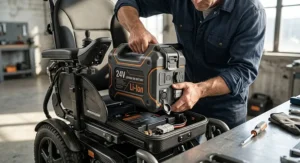
That’s changing fast. A modern lithium ion power wheelchair battery swaps out roughly 30-40 pounds of lead-acid bulk for a pack that often weighs under 10 pounds, charges in a fraction of the time, and — this is the part that actually changes daily life — keeps delivering close to full power right up until it’s nearly empty, instead of sagging the moment you hit a curb cut. Below, I’ve dug into seven real, currently available batteries spanning budget to premium, broken down what their specs actually mean for your range and reliability, and built out honest comparisons so you’re not guessing. Let’s get into it.
What Is a Lithium Ion Power Wheelchair Battery?
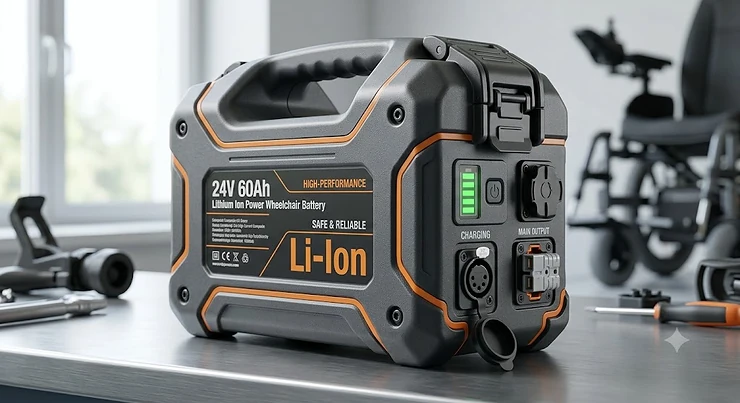
A lithium ion power wheelchair battery is a rechargeable power pack — usually built around lithium iron phosphate (LiFePO4) cells — designed to replace the lead-acid or gel batteries inside an electric wheelchair or power scooter. Compared to older chemistries, it’s lighter, charges faster, and typically survives 3-5 times more charge cycles before it needs replacing, which is a meaningful shift in how lithium-ion batteries have moved from laptops and power tools into medical mobility equipment over the past decade.
Quick Comparison Table
Before we dig into all seven picks in detail, here’s a fast snapshot for anyone who just wants the highlights without scrolling through specs.
| Category | Typical Capacity | Typical Weight | Best For |
|---|---|---|---|
| Budget 24V 12Ah packs | 10-12Ah | 6-8 lbs | Everyday commuting on a tight budget |
| Lightweight travel packs | 6-10Ah | 3-6 lbs | Frequent flyers, small apartments |
| OEM/manufacturer packs | 10-12Ah | 6-8 lbs | Warranty-conscious buyers, drop-in fit |
| High-capacity/heavy-duty | 20-50Ah+ | 15-30 lbs | Bariatric chairs, long daily distances |
Reading this table, the real story is that capacity and weight pull in opposite directions — you can’t have the lightest pack and the longest range at the same time, so the smart move is matching the category to your actual daily mileage rather than chasing the biggest number on the box. Someone running errands within a mile of home has very different needs than someone commuting to a job five days a week, and a VATOSO 50Ah pack solving a problem the first person never has is just wasted weight and money.
💬 Just one click — help others make better buying decisions too!😊
Top 7 Lithium Ion Power Wheelchair Batteries: Expert Analysis
Below are seven real, currently sold lithium ion power wheelchair battery options, spanning budget to premium. Each one is evaluated on real specs, aggregated review sentiment, and honest fit-for-purpose analysis — not marketing copy.
1. VATOSO 24V 12Ah Lithium Wheelchair Battery — best all-around BMS protection for the price
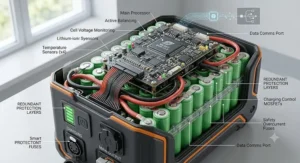
The standout here is the built-in 30A smart Battery Management System (BMS), which is doing more real-world work than it sounds like on paper. That BMS actively balances individual cell voltage, cuts power during overcurrent events, and shuts things down before thermal runaway becomes a risk — protections that budget lead-acid swaps simply don’t offer. Rated for wheelchairs pulling 100-500 watts, it’s built to power neighborhood errands, grocery runs, and hospital visits, with a realistic 10-15 mile range depending on rider weight and terrain.
Based on the spec comparison against similarly priced lithium packs, the Anderson connector and included 2A charger are a nice touch — you’re not hunting down proprietary cables later. Reviewers consistently mention straightforward installation as a drop-in replacement for aging lead-acid batteries, and the “better than lead-acid” positioning tracks with what people report about lighter overall chair weight after the swap.
What most buyers overlook is that this exact capacity class (12Ah at 24V) is the sweet spot for most standard-size power chairs — going smaller saves little weight but costs real range.
Pros:
- ✅ Smart 30A BMS with overcharge and short-circuit protection
- ✅ Anderson connector and charger included in the box
- ✅ Straightforward swap for most 24V lead-acid setups
Cons:
- ❌ Range drops noticeably on hilly or uneven terrain
- ❌ Not rated above 500W, so it’s unsuitable for heavier-duty chairs
Typically priced in the $150-$220 range, this is a strong value pick if your chair falls within the 100-500W window — check current price before ordering, since availability shifts often.
2. CBJJ 24V 12Ah Electric Wheelchair Battery — best bundle value with charger and plug included
What stands out immediately is that this pack ships as a complete kit — battery, charger, and Anderson plug — so there’s no scrambling for a compatible connector after the fact. On paper, the 12Ah capacity at 24V puts it in the same performance tier as the VATOSO above, delivering comparable range for daily use around 100-500W chairs.
Here’s what to weigh: this is a newer-to-market brand compared to established mobility names, so the track record is shorter, though the spec sheet (lithium chemistry, protected BMS, included charger) matches what more established competitors charge for. Aggregated buyer sentiment around similarly bundled kits tends to highlight the convenience of not needing separate accessory purchases, though buyers should always confirm the connector type matches their specific chair model before ordering.
The value proposition tightens up nicely if you’re replacing a battery on a budget and don’t want three separate shipping charges for battery, charger, and cable.
Pros:
- ✅ Complete kit — battery, charger, and plug in one box
- ✅ Lithium chemistry at a lead-acid-adjacent price point
- ✅ Marketed for sustained daily use, not just occasional backup
Cons:
- ❌ Shorter market track record than legacy mobility brands
- ❌ Connector compatibility needs manual verification before buying
Usually found in the $160-$230 range, it’s a genuinely reasonable pick for anyone prioritizing an all-in-one purchase over brand pedigree.
3. SuperHandy 24V 6Ah Lithium Extended-Life Battery — lightest option for frequent swaps
This one’s built around portability first. At a fraction of the bulk of a 12Ah pack, the standout advantage is how easy it becomes to physically lift, carry, and swap — a real consideration for caregivers managing the battery daily rather than leaving it installed. The tradeoff is capacity: 6Ah at 24V means a shorter range per charge than the bigger packs on this list, but SuperHandy offsets that by explicitly supporting dual-battery installation, letting users effectively double range by running two packs in tandem rather than one oversized one.
Based on the spec sheet, this is a smart engineering choice for anyone whose wheelchair has room for two smaller batteries but not one large one. Reviewers frequently mention the “simple swap system” as genuinely simple in practice — no tools, no fuss — which matters enormously for older adults or caregivers who aren’t mechanically inclined.
What most buyers overlook is that a lightweight lithium power chair battery like this one is often the better long-term choice for anyone who travels with their chair, since less weight means less strain during transfers into a car trunk or airline cargo hold.
Pros:
- ✅ Noticeably lighter than 10-12Ah alternatives
- ✅ Dual-battery support for flexible range extension
- ✅ Tool-free swap system praised in aggregated reviews
Cons:
- ❌ Lower single-battery range than higher-capacity packs
- ❌ Doubling up for extra range means buying two units
Generally priced under $180, this is the pick for anyone prioritizing weight and ease-of-handling over raw range.
4. Goldseason 24V 10Ah Replacement Wheelchair Battery — smallest footprint for tight battery trays
The headline feature is sheer compactness — at roughly 9.6 x 6.7 x 2 inches and about 5.2 pounds, this is one of the smaller-footprint packs available at 10Ah capacity, which matters if your chair’s battery compartment is on the snug side. What the spec sheet won’t tell you outright is that packing 10Ah of lithium capacity into that small a housing usually means premium cell density, which is reflected in a slightly higher price than bulkier 10Ah competitors.
Marketed with a 10-12 mile range estimate, it lands solidly in the mid-pack for daily commuting distance. Reviewers of similarly compact Goldseason products tend to flag the size-to-capacity ratio as the standout selling point, particularly for foldable and travel-oriented wheelchairs where every cubic inch of the battery bay counts.
Here’s what to weigh: compact packs sometimes run warmer under sustained heavy load than larger-bodied equivalents, simply due to less surface area for heat dissipation, so this is better suited to moderate daily use than back-to-back all-day outings.
Pros:
- ✅ Compact 9.6 x 6.7 x 2 inch footprint fits tight trays
- ✅ Lightweight at roughly 5.2 pounds
- ✅ Solid 10-12 mile range for its size class
Cons:
- ❌ Can run warmer under sustained heavy loads
- ❌ Premium compact design pushes price above bulkier 10Ah packs
Expect a price somewhere in the $150-$210 range, which is reasonable given the space savings if your chair’s battery bay is on the smaller side.
5. NVORJO 24V 10Ah Lithium Wheelchair Battery — longest realistic range in the compact class
NVORJO’s standout claim is a 10-15 mile range on a full charge, which — based on the spec comparison against other 10Ah packs on this list — sits at the upper end of what’s realistic for this capacity tier, assuming reasonably flat terrain and average rider weight. That range estimate is honest framing rather than an outlier, since 10Ah at 24V generally supports roughly this window across brands; NVORJO’s advantage is consistency of delivery rather than a chemistry trick.
What most buyers overlook is that “up to 15 miles” almost always assumes ideal conditions — flat pavement, moderate speed, average load — so budgeting for the lower end of that range (10 miles) is the more realistic planning number for daily use. Aggregated review themes for this category of battery tend to emphasize ease of confirming compatibility with specific chair models (Verpal, Movex, Goldseason-brand chairs, and similar), since these packs are often designed as cross-compatible replacements rather than single-brand OEM units.
That cross-compatibility is genuinely useful if your original wheelchair manufacturer no longer stocks parts — a real problem some owners run into once older factory-original suppliers close down.
Pros:
- ✅ Realistic 10-15 mile range for daily commuting
- ✅ Broad cross-compatibility with several popular chair brands
- ✅ Straightforward drop-in replacement design
Cons:
- ❌ Real-world range trends toward the lower end of the estimate
- ❌ Requires manual model-fit verification before purchase
Typically listed in the $140-$210 range, it’s a dependable mid-tier choice for anyone prioritizing range consistency.
6. Pride Mobility Jazzy Carbon Replacement Battery (BAT2200009-P) — best OEM reliability and drop-in fit
This is the one built specifically by the wheelchair manufacturer itself, not a third-party cross-compatible pack, and that OEM pedigree is the whole selling point. Pride Mobility engineers this 24V 12Ah lithium-ion pack as a factory-matched replacement for the Jazzy Carbon power chair, which means the mounting, connectors, and charge profile are all verified against the original equipment rather than reverse-engineered.
Based on the spec comparison, going lithium on a Jazzy Carbon (versus sticking with lead-acid) typically shaves a meaningful chunk of weight off the chair’s total mass while extending both charge speed and cycle life — Pride’s own lithium upgrade materials note faster charging, sustained power delivery, and a longer overall service life compared to the standard SLA option.
What most buyers overlook is that OEM parts carry a real advantage for anyone still under a wheelchair’s original warranty, since third-party batteries can sometimes complicate warranty claims on the chair itself. Reviewers of Pride’s battery ecosystem broadly note dependable performance, though several also flag that OEM pricing runs noticeably higher than third-party equivalents with comparable specs — a fair tradeoff for buyers who prioritize manufacturer accountability over saving money.
Pros:
- ✅ Factory-matched fit engineered specifically for Jazzy Carbon chairs
- ✅ Backed by manufacturer warranty and support channels
- ✅ Proven charge speed and cycle-life improvements over lead-acid
Cons:
- ❌ Premium OEM pricing versus third-party alternatives
- ❌ Locked to Jazzy Carbon compatibility, not cross-brand
OEM pricing generally runs in the $550-$650 range depending on retailer and current promotions, positioning it firmly as the premium, warranty-safe choice rather than the budget pick.
7. VATOSO 24V 50Ah Lithium Wheelchair Battery — highest capacity for heavy-duty and bariatric chairs
At the top of the lineup, this pack is built for wheelchairs pulling anywhere from 50W up to 1,000W — a much wider and heavier-duty power band than the 12Ah packs earlier on this list. The standout spec is the rated 1,000-cycle lifespan paired with a 30A BMS, which on paper translates to years of daily use before capacity meaningfully degrades, assuming reasonable charging habits.
Based on the spec comparison, this capacity tier exists specifically for bariatric chairs, longer daily commutes, or users who simply don’t want to think about charging more than once every few days. What the spec sheet won’t tell you, but the physics will, is that 50Ah of lithium capacity comes with real size and weight — this isn’t the pack to choose if portability is your priority, since it’s built for chairs that stay largely stationary in one home or facility rather than getting folded into a car trunk daily.
Reviewers researching this capacity class tend to focus heavily on confirming their wheelchair’s actual wattage rating before buying, since oversizing a battery wastes money without adding meaningful benefit for lower-power chairs.
Pros:
- ✅ Supports demanding 50W-1,000W wheelchair power ranges
- ✅ Rated for roughly 1,000 charge cycles
- ✅ Built-in 30A BMS across the full capacity range
Cons:
- ❌ Considerably heavier and bulkier than 10-12Ah packs
- ❌ Overkill (and overpriced) for standard low-wattage chairs
Given the capacity jump, expect pricing in the $400-$600 range, which is a fair value if your chair’s power draw actually calls for it.
How to Choose a Lithium Ion Power Wheelchair Battery
Shopping for a lithium ion power wheelchair battery gets a lot less overwhelming once you break it into a short checklist. Here’s the process I’d walk a friend through:
- Confirm your wheelchair’s voltage and wattage rating first. Nearly every consumer power chair runs on 24V, but wattage varies widely (100W to 1,000W+), and that number determines which capacity tier actually makes sense.
- Match Ah capacity to your real daily mileage, not your dream mileage. If you rarely go more than 3-4 miles a day, a 10-12Ah pack is plenty; longer daily routes justify stepping up.
- Check the connector type before buying, every time. Anderson plugs are common but not universal, and a mismatched connector turns a simple swap into a return-and-reorder headache.
- Weigh OEM versus third-party based on your warranty situation. Still under the chair’s original warranty? OEM parts like Pride’s lithium packs reduce complications. Out of warranty? Third-party options often deliver comparable specs for less.
- Look for a documented BMS (Battery Management System). This is non-negotiable for safety — overcharge, overcurrent, and short-circuit protection are standard on quality lithium packs and should never be treated as optional.
- Factor in physical size against your battery tray. Not every 10Ah pack is the same footprint, and a battery that doesn’t physically fit is a battery you can’t use, no matter how good the specs look.
- If you travel by air, check compliance limits before you buy. The FDA’s guidance on powered wheelchair devices and airline battery watt-hour limits both factor into which pack makes sense if flying is part of your routine.

Practical Usage Guide: Getting the Most From Your New Battery
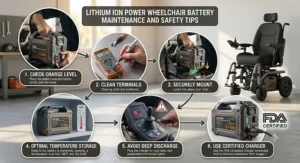
Getting a new lithium ion power wheelchair battery home is only step one — how you treat it in the first month genuinely shapes how long it lasts. First, resist the urge to fully drain it repeatedly during break-in; lithium chemistries actually prefer partial-cycle charging (topping up from 30-40% rather than always running to zero) over the deep-discharge habits lead-acid users got used to. Second, use only the charger included with your specific battery or an explicitly compatible replacement — mismatched voltage chargers are one of the most common (and most preventable) causes of premature battery failure. Third, set a simple maintenance rhythm: a quick terminal inspection monthly, keeping connectors free of dust and moisture, and storing the chair somewhere temperature-moderate if it’ll sit unused for more than a couple of weeks. Common first-30-days mistakes include leaving a battery on the charger indefinitely “just in case” (most quality BMS units prevent overcharging, but it’s still smart to unplug once full), ignoring an unusually short runtime in week one instead of contacting the seller, and forgetting to verify the connector polarity before the very first charge — a five-second check that avoids a genuinely dangerous mistake.
Real-World Scenarios: Matching the Right Battery to Your Life
Picture three different people shopping for the exact same category of product. First, there’s a retired teacher who uses her power chair mainly around the house and for short trips to a nearby community center — for her, a lightweight lithium power chair battery like the SuperHandy 24V 6Ah makes total sense, since her actual daily mileage rarely exceeds two or three miles and easy handling matters more than maximum range. Second, consider a working adult who commutes daily to a job eight blocks from a train station and needs consistent, predictable range on a fixed budget — the NVORJO 24V 10Ah or VATOSO 24V 12Ah hits that sweet spot of dependable mid-range capacity without premium OEM pricing. Third, imagine someone who travels frequently for work and needs their chair to clear airline and TSA screening without complications — before that trip, it’s worth reviewing the TSA’s guidance on battery-powered wheelchairs, since lithium battery watt-hour limits and removal requirements vary by whether the pack has a protective housing. Each of these three profiles needs a genuinely different battery, and that’s really the whole point — there’s no single “best” pick, only the best fit for a specific life.
What to Expect: Real-World Performance and Range
Specs on a listing page rarely match daily life exactly, and lithium ion power wheelchair batteries are no exception. A “10-15 mile range” claim generally assumes flat pavement, a rider in the 150-180 lb range, and moderate (not maximum) speed settings — hills, higher rider weight, cold weather, and frequent stop-start use all pull that number down, sometimes by 20-30%. What most buyers don’t anticipate is how much faster lithium packs recover during partial charging breaks compared to lead-acid — a 20-minute plug-in during a lunch stop can meaningfully extend an afternoon’s range in a way a lead-acid battery simply can’t match. On the flip side, cold weather does affect lithium chemistry too, just less dramatically than it affects lead-acid; expect a modest range dip in winter rather than the steep falloff older battery users may remember. Reviewers across this product category consistently mention that real-world range settles somewhere between the advertised maximum and roughly 70% of it — a good rule of thumb for planning trips rather than cutting it close.
Lithium-Ion vs Lead-Acid Power Wheelchair Batteries
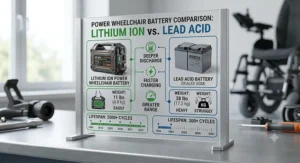
This comparison matters because plenty of wheelchair owners are still running the lead-acid battery their chair originally shipped with, simply because nobody explained what they’re missing.
| Factor | Lithium-Ion | Lead-Acid |
|---|---|---|
| Typical weight (24V 12Ah class) | 6-8 lbs | 25-35 lbs |
| Charge time | 3-5 hours | 8-10 hours |
| Cycle life | 800-1,000+ cycles | 300-500 cycles |
| Performance near empty | Stays consistent | Sags noticeably |
| Best For | Daily users wanting range and speed | Budget-first, infrequent use |
The weight difference alone is the story most people focus on, but the cycle-life gap matters just as much for total cost — a lead-acid pack replaced every 12-18 months versus a lithium pack lasting 3-5 years changes the real math significantly. Where lead-acid still wins is sticker price on day one, which is exactly why it remains common on entry-level and rental chairs. For anyone using their power chair as genuine daily transportation rather than occasional backup, though, the lithium ion power wheelchair battery category earns its higher upfront cost back through fewer replacements and consistently better performance right up until the pack is nearly empty.
✨ Don’t Miss These Exclusive Deals!
🔍 Ready to stop babysitting a heavy lead-acid battery? Check current pricing on the picks above and find the lithium upgrade that actually fits your daily routine.
Common Mistakes When Buying a Lithium Wheelchair Battery
The single most common mistake is buying based on Ah capacity alone without checking wattage compatibility — a battery rated for 100-500W simply won’t perform safely on a 750W chair, regardless of how good its reviews look. A close second is skipping connector verification; Anderson plugs are widespread but not universal, and assuming compatibility instead of confirming it leads to returns and delays nobody wants. Third, some buyers assume “lithium” automatically means premium quality across the board, when in reality BMS quality varies meaningfully between brands — always confirm overcharge, overcurrent, and short-circuit protections are explicitly listed rather than just the word “lithium” on the label. Fourth, ignoring physical dimensions is a surprisingly frequent error, since a battery that’s electrically perfect but half an inch too tall for the battery tray is functionally useless. Finally, some shoppers chase the absolute lowest price without checking whether a seller includes a charger and connector — a “cheaper” battery that requires a separate $40 charger purchase often isn’t actually the better deal once you do the math.
Lithium Wheelchair Batteries for Caregivers, Seniors, and Active Users
Different users genuinely need different things from a lithium ion power wheelchair battery, and it’s worth being specific about that instead of pretending one-size-fits-all. For caregivers managing a loved one’s equipment, ease of handling usually outranks raw capacity — a lightweight lithium power chair battery that swaps in under a minute without tools reduces daily friction in a way that matters more than squeezing out an extra mile of range. For seniors using a power chair primarily around the home and neighborhood, moderate 10-12Ah capacity paired with a documented, reliable BMS covers the vast majority of realistic daily needs, and the peace of mind from built-in safety protections is arguably more valuable than chasing maximum range. For more active users — people commuting to work, running frequent errands, or covering longer daily distances — the calculation shifts toward higher capacity and faster charge recovery, since a slow-charging battery becomes a genuine bottleneck on busy days. It’s worth saying plainly: there’s no prestige in buying more battery than you need, and matching capacity to actual lifestyle is the single highest-leverage decision in this whole buying process.
Long-Term Cost and Maintenance: Is Lithium Worth the Upgrade?
The upfront price gap between lithium and lead-acid batteries is real, but it tells an incomplete story if you stop the math there. A quality lead-acid replacement typically needs swapping every 12-18 months of regular use, while a well-maintained lithium pack commonly lasts 3-5 years before capacity degrades meaningfully — meaning you might buy two to three lead-acid batteries in the time a single lithium pack lasts. Run that forward and the modern battery technology premium starts looking less like an extravagance and more like a reasonable trade of upfront cost for reduced long-term hassle and replacement spending. Maintenance costs also favor lithium: no acid to monitor, no water top-offs, and a BMS that handles a lot of the protective work automatically rather than requiring manual vigilance. That said, lithium packs do still benefit from basic care — avoiding full discharge cycles when possible, storing at moderate temperatures, and using only the manufacturer-specified charger — cutting corners on any of those does shorten effective lifespan regardless of how good the chemistry is on paper.
Safety, Regulations, and Airline Compliance Guide
Safety isn’t an afterthought with any battery chemistry, and lithium is no exception — a genuinely advanced energy system still needs to be treated with respect. Always use the charger specified for your exact battery model, keep terminals protected from accidental short circuits, and never attempt to open or modify a battery pack yourself. If air travel is part of your life, note that most airlines and the FAA’s guidance on wheelchairs and mobility devices cap lithium-ion batteries at 300 watt-hours when installed, with additional rules for spare batteries carried separately — checking your specific pack’s watt-hour rating before booking a flight avoids last-minute complications at the gate. Domestically, look for batteries that carry recognized certifications like UN38.3 (transport safety testing) alongside a documented BMS, since these markers indicate the manufacturer has actually tested for the failure modes that matter most. None of this is meant to be alarming — lithium batteries used correctly are safe, reliable daily equipment for millions of wheelchair users — but skipping the basics is where avoidable incidents come from.
Frequently Asked Questions
❓ How long does a lithium ion power wheelchair battery last?
❓ Can I replace a lead-acid wheelchair battery with lithium?
❓ Are lithium wheelchair batteries safe to fly with?
❓ What size lithium battery do I need for my power wheelchair?
❓ Why is my new lithium battery not reaching advertised range?
Conclusion
Swapping to a lithium ion power wheelchair battery isn’t just a spec-sheet upgrade — it’s the kind of change that shows up in ordinary moments, like not sweating whether you’ll make it back from the pharmacy, or not needing help hauling a 30-pound battery out of a trunk. Across the seven options here, there’s genuinely something for every situation: the SuperHandy 24V 6Ah and Goldseason 24V 10Ah for anyone prioritizing light weight and easy handling, the VATOSO 24V 12Ah, CBJJ 24V 12Ah, and NVORJO 24V 10Ah for dependable everyday value, the Pride Mobility Jazzy Carbon pack for OEM peace of mind, and the VATOSO 24V 50Ah for anyone whose chair genuinely demands heavy-duty capacity. The right pick really does come down to matching capacity, weight, and connector compatibility to your actual daily life rather than chasing the biggest number on the box. Whichever direction you go, checking current pricing and verifying compatibility before you buy will save you a return shipment and a headache later.
Recommended for You
- Lithium Ion vs AGM Wheelchair Battery: 7 Top Picks for 2026
- 7 Best Power Wheelchair Batteries for 2026
- Fastest Power Wheelchair: 7 Speedy Picks for 2026
Disclaimer: This article contains affiliate links. As an Amazon Associate, I earn from qualifying purchases. If you purchase products through these links, we may earn a small commission at no additional cost to you.
✨ Found this helpful? Share it with your friends! 💬🤗
