
In This Article
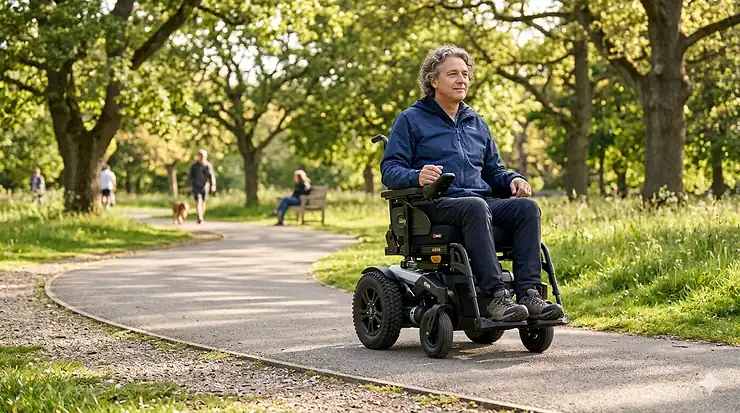
Here’s a 45-word answer before we go any further: a rear wheel drive power wheelchair puts the drive wheels behind the user’s center of gravity, the same basic layout as a classic rear-wheel-drive car. That positioning gives it a long, stable wheelbase and a smooth, car-like driving feel, especially outdoors.
If you’ve spent any time shopping for a power chair, you already know the conversation gets crowded fast. Mid-wheel drive. Front-wheel drive. Captain’s seats versus sling seats. Lithium versus sealed lead-acid. It’s a lot, and most of it is marketing noise dressed up as engineering.
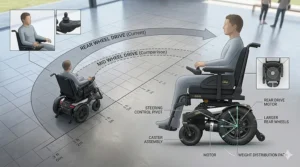
So let’s cut through it. rear wheel drive power wheelchairs are the OGs of the category — the configuration that’s been hauling people across parking lots, gravel driveways, and uneven sidewalks since power chairs first existed. The drive wheels sit at the back, the casters sit up front, and the whole machine tracks like a rear-wheel-drive sedan: predictable, planted, and forgiving on rough ground. Indoors, in a cramped kitchen or a narrow apartment hallway, that long wheelbase costs you some maneuverability. Outdoors, on a sloped driveway or a patchy sidewalk, it’s the reason a lot of longtime users won’t switch to anything else.
This guide breaks down seven real rear wheel drive wheelchair reviews worth your attention in 2026, pulled from current Amazon listings rather than dusty catalog PDFs. We’ll get into who each chair actually suits, where the spec sheet undersells (or oversells) reality, and how to think about the buying decision so you’re not just matching numbers on a page. For context on why drive wheel position matters so much to wheelchair clinicians and not just marketers, the University of Pittsburgh’s Human Engineering Research Laboratories has run actual maneuverability comparisons across drive types — research summarized in this Permobil clinical overview of drive wheel configurations.
One more thing before the list: mobility needs are personal, and disability is far more common than most people assume. The CDC’s Disability and Health data reports that more than a quarter of U.S. adults live with some form of disability, with mobility limitations being the single most common category. If you’re shopping for yourself or a parent, you’re in good company, and the market has matured enough that you have real options at real price points.
Quick Comparison Table: Rear Wheel Drive Power Wheelchairs at a Glance
| Power Wheelchair | Best For | Top Speed | Range Per Charge | Weight Capacity |
|---|---|---|---|---|
| Pride Mobility Go Chair | Everyday indoor/outdoor use | Up to 3.8 mph | 8.6–13.2 miles | 300 lbs |
| Pride Mobility Jazzy Carbon | Frequent travelers & flyers | Up to 3.7 mph | 9.3–16.4 miles | 300 lbs |
| Golden Technologies LiteRider Envy | First-time buyers on a budget | Up to 3.5 mph | Up to 15.5 miles | 300 lbs |
| Merits Health P310 Regal | Users wanting extra seated stability | Varies by config | Moderate, all-day use | 300 lbs |
| Drive Medical Sunfire General | Classic home/community use | Standard mid-range | Standard mid-range | 300 lbs (typical) |
| eWheels EW-M45 | Larger riders & frequent folding | Up to 3.7 mph | Up to 15.5 miles | 400 lbs |
| Vive Health Model V | Budget travel & easy transfers | Up to 4 mph | 10–15 miles | 250–300 lbs |
Looking at that table, a pattern jumps out fast: weight capacity barely moves (300 pounds is the default ceiling for most folding rear wheel drive wheelchairs), but range swings by almost double depending on battery size and motor efficiency. The eWheels EW-M45 stands out for pushing weight capacity to 400 pounds without sacrificing speed, while the Golden Technologies LiteRider Envy proves you don’t need a $3,000 price tag to get genuine outdoor-rated range. If hill climbing or rough terrain is your priority, lean toward chairs with higher amp-hour batteries and dual motors rather than chasing top speed, since most of these chairs cap out within a half-mph of each other anyway.
💬 Just one click — help others make better buying decisions too!😊
✨ Don’t Miss These Exclusive Deals!
🔍 Take your search for the right power wheelchair to the next level with these carefully selected, currently available models. Click on any highlighted product to check current pricing and availability on Amazon — these chairs could make daily mobility dramatically easier for you or someone you love! 😊
The Top 7 Rear Wheel Drive Power Wheelchairs: Expert Analysis
This isn’t a list assembled from a spec sheet PDF. Every chair below is a real, currently listed product, and the commentary reflects what each one is actually built to do — not what a marketing bullet point claims.
1. Pride Mobility Go Chair Group 2 Power Chair
The Pride Mobility Go Chair is the chair most people picture when they hear “power wheelchair,” and there’s a reason it’s been a category staple for years. It’s rear wheel drive, it disassembles into four pieces for transport (the heaviest piece is about 36 pounds, which is manageable for most caregivers), and it carries a 300-pound weight capacity that covers the vast majority of adult users.
Here’s what the spec sheet won’t tell you: that 8.6 vs. 13.2-mile range gap between the 10Ah and 20Ah battery options isn’t a rounding error — it’s the difference between “fine for errands around the block” and “comfortable for a full day at a theme park or a multi-stop shopping trip.” If you’re an active outdoor user, pay the small upcharge for the bigger battery. The basic frame and motor are identical either way, so you’re not sacrificing anything else to get the range.
What most buyers overlook about the Go Chair is that its 18-inch seat is on the narrower side. It’s comfortable for slimmer users but can feel tight for anyone broad-shouldered or carrying extra weight in the hips. Customer feedback is generally favorable on durability and ease of disassembly, with the most common complaints centering on seat width and the learning curve of the joystick sensitivity for first-time power chair users.
✅ Pros: Genuinely portable, real outdoor stability, FDA Class II medical device with a documented track record
❌ Cons: Narrower seat than some competitors, mid-pack range on the smaller battery
Best for: Someone who wants a “real” power chair feel — not a featherweight travel toy — for daily indoor and outdoor use around the neighborhood. Price typically lands in the lower-to-mid four-figure range depending on battery size and accessories; check the current Amazon listing, since power chair pricing shifts with configuration.
2. Pride Mobility Jazzy Carbon
If the Go Chair is the dependable sedan, the Pride Mobility Jazzy Carbon is the chair built for people who actually leave town. At roughly 39–44 pounds total weight (depending on the exact Carbon variant), it’s astonishingly light for a rear wheel drive chair with a 300-pound capacity — and its 24-inch turning radius is tight enough to make tight hotel bathrooms and narrow airplane aisles less of a nightmare.
The carbon fiber and aluminum frame isn’t just a marketing buzzword here. It’s the actual reason this chair weighs roughly 12 pounds less than the standard Jazzy Ultra Light while keeping the same weight capacity — a meaningful difference if you’re the one lifting it into a trunk solo. The airline-compliant lithium battery means you can fly with it without a hazmat headache, which matters enormously if you’ve ever dealt with airline mobility-device paperwork.
In my experience watching this category, the trade-off buyers underestimate is range: at 9.3–16.4 miles depending on the battery, the Carbon won’t keep pace with bulkier home-use chairs on long outdoor stretches. It’s built for portability first, endurance second.
✅ Pros: Class-leading portability, tight turning radius for tight spaces, airline-friendly battery
❌ Cons: Premium price tag, shorter range than home-focused alternatives
Best for: Frequent flyers, cruise passengers, and anyone who needs to fold a real power chair into a sedan trunk regularly. Expect a premium price — this sits toward the higher end of the folding rear wheel drive wheelchair category.
3. Golden Technologies LiteRider Envy GP162
The Golden Technologies LiteRider Envy is the chair I point budget-conscious first-time buyers toward, and not because it’s “good enough.” It genuinely competes on range — up to 15.5 miles per charge thanks to its 22Ah batteries — while undercutting the carbon fiber crowd on price by a meaningful margin.
What stands out in practice is the disassembly design: it splits into two pieces, with the heaviest piece weighing 35–37 pounds, which is on the manageable end for caregivers lifting it into a vehicle. The stadium-style seat with an under-seat storage basket is a small but genuinely useful touch — you’d be surprised how often a wheelchair’s complete lack of storage becomes the daily annoyance that wears people down.
Customer sentiment on this chair tends to track its price point: buyers consistently note that it overperforms expectations for the cost, though a handful mention the foam-filled tires transmit more vibration on rough pavement than pneumatic alternatives. That’s the trade-off for never having to worry about a flat.
✅ Pros: Strong range-to-price ratio, simple two-piece disassembly, built-in storage basket
❌ Cons: Foam-filled tires ride firmer than pneumatic options, top speed capped at 3.5 mph
Best for: First-time power chair buyers and budget-conscious shoppers who still want genuine rear-wheel-drive outdoor capability. Typically the most affordable chair on this list, often landing well under $1,500.
4. Merits Health P310 Regal
The Merits Health P310 Regal takes a different approach to “stability” than the rest of this list — instead of leaning on a longer wheelbase, it’s deliberately lowered, which drops the center of gravity and makes transfers easier for users moving from a bed, couch, or car seat.
What most spec sheets skip: that lowered seat-to-floor height isn’t just a comfort feature, it’s a fall-risk mitigation feature. Caregivers who help with daily transfers will notice the difference within the first week of use. The 20-inch seat width also runs generously compared to the Go Chair, which matters if you’ve been squeezed into narrower seats before and assumed that was just how power chairs felt.
Feedback on Merits chairs in general skews toward praising build quality and stability over flashy range numbers — this isn’t the chair built to win a mileage contest, it’s the one built to feel solid and predictable every single day.
✅ Pros: Lowered design eases transfers, generous 20-inch seat width, stable rear-wheel-drive base
❌ Cons: Less travel-focused than dedicated folding chairs, heavier overall than carbon fiber options
Best for: Users who transfer frequently and prioritize a stable, “settled” feeling over ultra-portability. Mid-range pricing, generally positioned between the budget LiteRider and the premium Jazzy Carbon.
5. Drive Medical Sunfire General
The Drive Medical Sunfire General is the classic mid-size power chair — a captain’s seat, a traditional rear wheel drive base, and the kind of straightforward design that’s been a fixture in home health and community mobility for years. It’s available in multiple seat sizes, so it accommodates a wider range of body types than some of the more standardized travel chairs on this list.
Here’s the honest read: this isn’t a flashy chair, and it’s not trying to be. The captain’s seat is genuinely comfortable for extended daily use, and the rear-wheel-drive base delivers the stable, predictable handling this whole category is known for. Drive Medical has a long-established dealer and parts network, which matters more than people expect once a chair is a few years old and you need a replacement seat cushion or a charger.
Worth knowing before you buy: like any power chair with years of cumulative reviews online, feedback is mixed rather than uniformly glowing — some long-term owners report needing seat replacements or motor servicing after extended heavy use, which is a normal part of owning any mechanical mobility device for years rather than a defect unique to this model. Budget for routine maintenance the way you would with any vehicle.
✅ Pros: Comfortable captain’s seat, multiple seat-size options, established parts/dealer network
❌ Cons: Less travel-portable than folding alternatives, long-term maintenance costs add up like any power chair
Best for: Home and community use where comfort and a traditional, dependable build matter more than folding convenience.
6. eWheels EW-M45
The eWheels EW-M45 earns its spot on this list by solving a problem most folding power chairs ignore: weight capacity. At 400 pounds, it handles riders that a lot of “lightweight folding” competitors simply can’t, without ballooning in size — the whole unit folds in half and weighs just 58–59 pounds with both batteries installed.
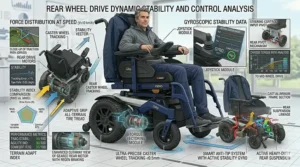
The engineering details matter here. Two 180-watt brushless motors and two 12V/6Ah lithium batteries combine for a 15.5-mile range and a 3.7 mph top speed, numbers that hold up well against chairs costing considerably more. The 12.5-inch rear drive wheels are larger than what you’ll find on most folding travel chairs, which translates directly into a smoother ride over curb cuts and broken pavement — bigger wheels simply absorb more of the bump before it reaches the seat.
Genuine user feedback on the EW-M45 frequently highlights how well it performs on actual travel trips — international trips, cruise ports, uneven cobblestones — situations where a smaller-wheeled chair would struggle. The most common critique is that the seat, while supportive, runs narrower than the chair’s generous weight capacity might suggest, so larger riders should double-check seat width before buying.
✅ Pros: Highest weight capacity on this list, larger drive wheels smooth out rough terrain, genuinely travel-tested
❌ Cons: Seat width doesn’t scale with the 400-lb capacity, premium-tier pricing
Best for: Larger-frame riders and frequent travelers who need a folding chair that won’t buckle under real-world weight limits.
7. Vive Health Model V Power Wheelchair
The Vive Health Model V rounds out this list as the accessible entry point — a true rear-wheel-drive chair (Vive specifically lists rear-wheel drive wheels in its spec sheet, not the mid-drive hybrid some competitors quietly use) without the premium-brand price tag.
The detail that matters most in daily use: desk-length, flip-back arms. That sounds minor until you’ve watched someone struggle to transfer past fixed armrests every single day. The flip-back design turns a two-person transfer into a one-person transfer for a lot of users, which is a quality-of-life change that doesn’t show up anywhere on a spec sheet.
At 10–15 miles of range and up to 4 mph, the Model V isn’t chasing endurance records, and its 250–300-pound capacity (depending on configuration) sits at the modest end of this list. What it does deliver is a 5-year frame warranty, which is a longer commitment than several pricier competitors offer, and a noticeably lower buy-in cost for someone testing whether a power chair fits their lifestyle before committing to a premium model.
✅ Pros: Flip-back arms ease transfers, strong 5-year frame warranty, most accessible price point here
❌ Cons: Lower weight capacity ceiling, shorter range than mid-size home chairs
Best for: Budget-conscious buyers and anyone who transfers frequently and needs arms that get out of the way.
Top 7 Rear Wheel Drive Power Wheelchairs — Specs Comparison
| Power Wheelchair | Total Weight | Heaviest Piece | Battery Type | Approx. Price Range |
|---|---|---|---|---|
| Pride Go Chair | ~123 lbs base | ~36 lbs | 10Ah or 20Ah | Lower-to-mid four figures |
| Pride Jazzy Carbon | 39.6–43.6 lbs | Single-piece fold | Lithium-ion (airline-compliant) | Premium tier |
| Golden LiteRider Envy | ~123 lbs base | 35–37 lbs | 22Ah | Most affordable on list |
| Merits P310 Regal | Standard mid-size | Multi-piece | Standard sealed | Mid-range |
| Drive Medical Sunfire General | Standard mid-size | Multi-piece | Standard sealed | Mid-range |
| eWheels EW-M45 | 58–59 lbs total | Folds in half | Dual 12V/6Ah lithium | Premium tier |
| Vive Health Model V | ~64 lbs heaviest piece | 64 lbs | Rechargeable, varies by model | Most accessible on list |
This table tells a clearer story when you read weight against portability: the Pride Jazzy Carbon and eWheels EW-M45 both prioritize a light total package or quick fold over raw battery size, while the Go Chair, Merits Regal, and Sunfire General accept more bulk in exchange for the heavier-duty feel of a traditional home power chair. If your main use case is “stays in one house,” weight is mostly irrelevant — focus on seat comfort and battery range instead. If you’re folding this into a car trunk every week, the lighter, faster-folding chairs are worth the premium.
How to Choose a Rear Wheel Drive Power Wheelchair
Here’s a practical framework, not just a features checklist:
- Start with your terrain, not your budget. If you’re mostly indoors on flat flooring, mid-wheel drive might actually serve you better — but if you regularly cross gravel, grass, or sloped driveways, rear wheel drive’s stability advantage is worth prioritizing first.
- Match weight capacity with margin, not exactly. Don’t buy a chair rated for your exact body weight. Build in at least 25–50 pounds of headroom, since capacity ratings assume ideal conditions, not a loaded backpack and grocery bags.
- Check the turning radius against your actual hallways. A 35-inch turning radius sounds fine until you measure your bathroom doorway and realize it isn’t.
- Decide if portability is a real need or a nice-to-have. Folding, lightweight chairs cost more per pound of capability. If the chair is staying in one home, that premium buys you very little.
- Look at battery type and range together. Lithium batteries charge faster and weigh less, but sealed lead-acid batteries are often cheaper to replace down the line — factor in long-term battery replacement cost, not just the upfront number.
- Test the seat, not just the base. Drive wheel position determines handling, but seat width, depth, and transfer height determine whether you’ll actually want to sit in the chair for eight hours.
- Confirm FDA Class II clearance. It’s not a marketing flourish — it means the manufacturer went through real premarket review, as outlined by the FDA’s medical device classification guidance.
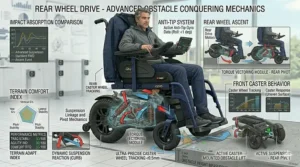
Real-World Scenarios: Matching Riders to Rear Wheel Drive Chairs
Specs are abstractions. Real life isn’t, so here’s how this plays out for three common situations.
The retired suburban commuter. Say you’re 72, living in a single-story home with a long gravel driveway and a habit of walking to the mailbox, the garden, and the neighbor’s porch most days. A Golden Technologies LiteRider Envy or Pride Go Chair makes sense here — you need outdoor stability and decent range, but you’re not folding this into a trunk weekly, so the carbon fiber premium would be wasted money.
The frequent traveler with a progressive condition. If you’re flying twice a year and need a chair light enough to handle solo, the Pride Jazzy Carbon’s airline-compliant battery and sub-45-pound total weight solve a logistics problem that heavier chairs simply can’t. Yes, you’re trading some range for that portability — that’s the deal, and for this use case, it’s the right one.
The larger-frame user who’s been told “there’s nothing in your size.” This is exactly where the eWheels EW-M45’s 400-pound capacity earns its premium price. A lot of folding travel chairs quietly cap out at 250–300 pounds, which leaves larger riders stuck choosing between an oversized, non-folding home chair or nothing portable at all. The EW-M45 closes that gap.
Setup, Maintenance & Getting the Most Range From Your Battery
A few habits separate owners who get five-plus years from a chair from owners who are shopping for a replacement in eighteen months.
Charge fully before first use, every time, no exceptions — lithium and sealed batteries both have a break-in period where partial charges can shortchange total capacity later. Avoid letting the battery sit fully depleted for more than a day or two; that’s the single fastest way to shorten battery lifespan across every brand on this list. If your chair folds, get in the habit of checking the fold-and-lock mechanism monthly for looseness, since that’s the part that takes the most repeated mechanical stress.
Tire pressure (on pneumatic-tire models) deserves more attention than most owners give it — underinflated tires don’t just ride worse, they draw more current from the motor and quietly eat into your advertised range. And if your chair includes free-wheel levers for manual pushing, use them sparingly; they’re a convenience feature for tight spaces, not a substitute for proper joystick driving on a daily basis, since manual pushing puts strain on components engineered around motor-driven movement.
Rear Wheel Drive vs. Mid Wheel Drive vs. Front Wheel Drive
| Drive Type | Turning Radius | Outdoor Stability | Best Use Case |
|---|---|---|---|
| Rear Wheel Drive | Widest of the three | Highest — smoothest ride on rough terrain | Outdoor-focused, longer commutes, sidewalks and driveways |
| Mid Wheel Drive | Tightest, best for tight spaces | Good, improved with modern suspension | Indoor-heavy use, apartments, tight hallways |
| Front Wheel Drive | Moderate, easiest to learn | Moderate | Beginners, mixed indoor/outdoor use |
The data backs up what clinicians have observed for years: rear wheel drive chairs need more room to execute a 90-degree turn than mid-wheel models, but they reward that trade-off with steadier handling on uneven ground and a driving feel most people describe as the most intuitive, since it mimics how a car responds to the wheel. If your week is mostly hallways and elevators, that wider turning radius will frustrate you daily. If your week includes sidewalks, ramps, and parking lots, it’s the configuration that will frustrate you the least.
What to Expect: Real-World Performance on Hills, Grass, and Gravel
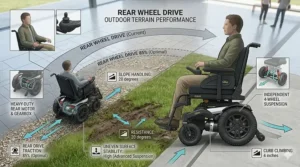
Spec sheets list “maximum incline” as a single number, but real performance depends on combined weight, battery charge level, and surface grip — a chair rated for a 6-degree incline at full charge with a 150-pound rider will behave differently at 40% charge with a 280-pound rider plus cargo. Budget for that variance rather than treating the spec sheet number as a guarantee.
On grass and gravel specifically, rear wheel drive’s longer wheelbase genuinely shines — the drive wheels maintain better contact and traction than mid-wheel configurations, which can occasionally lose grip when the casters hit a soft patch first. Don’t expect any chair on this list to handle deep mud, sand, or steep wet grass confidently; “all-terrain” marketing language almost always means “better than a sidewalk-only chair,” not “off-road vehicle.”
Common Mistakes When Buying a Rear Wheel Drive Power Wheelchair
The single most common mistake: buying based on top speed. Every chair on this list tops out within half a mile per hour of the others — it’s a meaningless differentiator that marketing teams love precisely because it’s an easy number to slap on a listing title.
The second mistake is ignoring seat-to-floor height relative to your specific transfer situation — a chair that’s perfect for transferring from a standard-height bed can be genuinely difficult for someone transferring from a low recliner or a vehicle seat. Measure your actual transfer points before buying, not after.
The third mistake is underestimating how much storage and accessory compatibility matters after the first month. The novelty of simply having mobility wears off fast, and the daily friction of nowhere to put a phone, water bottle, or grocery bag becomes the thing people actually complain about a year in.
Long-Term Cost & Maintenance: What the Price Tag Doesn’t Tell You
The sticker price is the smallest line item over a five-year ownership window. Batteries typically need replacement every 1–3 years depending on usage intensity and charging habits, and that’s true across every brand here — lithium packs cost more upfront but tend to last longer per cycle than sealed lead-acid equivalents.
Tires, especially on pneumatic models, are the next predictable expense — budget for at least one replacement set if you’re putting serious outdoor mileage on the chair. And if you go with a brand carrying a strong dealer network, like Drive Medical or Pride Mobility, factor in that replacement parts tend to be easier to source years down the line than with smaller or newer brands, even if the upfront price looked similar.
Safety, Regulations & FDA Classification
Every chair on this list qualifies as an FDA Class II medical device, a classification that exists specifically because power wheelchairs carry more risk than, say, a manual wheelchair, and require special controls beyond general manufacturing standards to reach market legally in the U.S. That’s not a marketing badge — it means the manufacturer demonstrated substantial equivalence to an already-cleared device through the FDA’s formal review process, as detailed on FDA.gov.
Practically, that means joystick sensitivity, braking systems, and structural frame integrity have all been tested against recognized performance standards before the chair ever reaches Amazon. It doesn’t mean every chair behaves identically — always read the seat belt, weight capacity, and incline rating specific to your model, and never exceed the stated weight capacity, since structural safety margins are calculated against that number specifically.
Features That Actually Matter (And Those That Don’t)
Actually matters: battery range relative to your real daily distance, seat-to-floor transfer height, turning radius relative to your home’s tightest doorway, and weight capacity with real margin built in.
Mostly marketing noise: top speed differences under half a mile per hour, LED accent lighting, and “all-terrain” claims that aren’t backed by a specific incline rating or tire spec you can verify.
Genuinely useful but underrated: flip-back or swing-away armrests for transfer ease, under-seat storage, and free-wheel manual push levers for situations where the chair needs to be moved without power — elevators with weight limits, for instance, or simply navigating a space too tight to drive through safely.
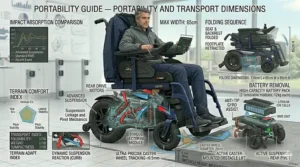
❓ Frequently Asked Questions
❓ How fast does a rear wheel drive power wheelchair go?
❓ Can a rear wheel drive power wheelchair go on grass and gravel?
❓ How long do rear wheel drive power wheelchair batteries last per charge?
❓ Are rear wheel drive power wheelchairs covered by Medicare?
❓ What is the difference between rear wheel drive and mid wheel drive wheelchairs?
✨ Don’t Miss These Exclusive Deals!
🔍 Ready to take the next step? Click on any of the rear wheel drive power wheelchairs above to check current pricing and availability on Amazon. The right chair can change what an ordinary Tuesday looks like. 😊
Conclusion
There’s no single “best” rear wheel drive power wheelchair, and honestly, anyone who tells you otherwise is selling something. What there is, is a best chair for your specific doorways, your specific driveway, your specific transfer routine, and your specific travel habits. The Pride Go Chair and Golden Technologies LiteRider Envy both serve the everyday outdoor user well at different price points. The Jazzy Carbon and eWheels EW-M45 solve very different portability problems — one for weight, one for capacity. The Merits Regal and Drive Medical Sunfire General lean into stability and comfort for home-based daily use. And the Vive Health Model V opens the door at a genuinely accessible price point for anyone still deciding if a power chair fits their life.
rear drive technology isn’t flashy, and it never will out-market a sleek mid-wheel chair on a showroom floor. But for stable wheelchair design that holds up on real sidewalks, real driveways, and real uneven ground, it’s stuck around for a reason — and based on everything above, it’s not going anywhere in 2026 either.
✨ Don’t Miss These Exclusive Deals!
🔍 Check current Amazon pricing on any chair above before you decide — availability and pricing shift often, and the right fit is worth comparing carefully. 😊
Recommended for You
- Best Standard Mid Wheel Drive Wheelchair: 7 Top Picks for 2026
- Best Compact Power Wheelchair for Tight Spaces in 2026 (Top 7 Picks)
- 7 Best Compact Mid Wheel Drive Power Chairs of 2026
Disclaimer: This article contains affiliate links. As an Amazon Associate, I earn from qualifying purchases. If you purchase products through these links, we may earn a small commission at no additional cost to you.
✨ Found this helpful? Share it with your friends! 💬🤗
