
In This Article
Here’s a thing that surprises a lot of first-time power chair buyers: the chair that glides beautifully across a tile floor in the showroom can turn into a nervous, hesitating mess the second it meets a driveway slope. Indoors, everything is flat. Outdoors, gravity gets a vote.
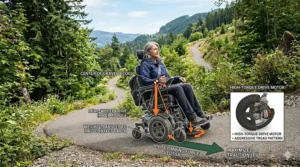
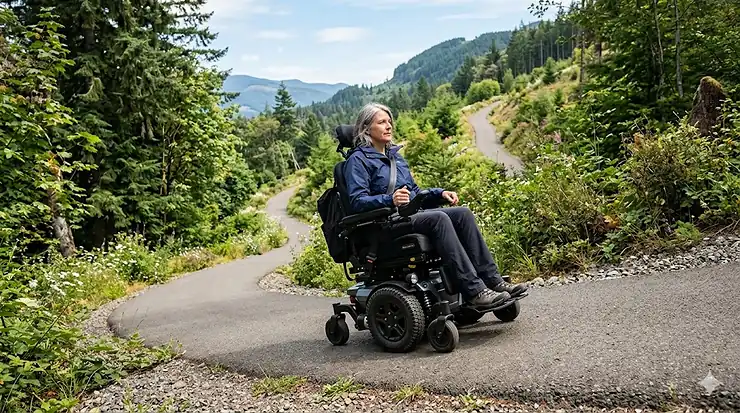
That’s the whole reason “drive wheel position” matters so much more than most spec sheets let on. A rear wheel drive wheelchair for hills puts its two big drive wheels behind your center of gravity, with steering casters out front — the same basic layout as a rear-wheel-drive car, and for the same reason. Weight shifts backward onto the drive wheels going uphill, which is exactly when you need traction the most. Rear-wheel drive power wheelchairs generally track well at higher speeds, tend to have solid suspension, and offer the most ground clearance of the three drive layouts, which is why they’re considered the strongest choice for outdoor mobility — sidewalks, sloped driveways, gravel paths, the whole unglamorous terrain of actual neighborhoods.
The tradeoff, and it’s a real one, is indoor agility. Because the front casters need room to swing, rear-wheel drive chairs have the widest turning radius of the three layouts and can feel clumsy in tight kitchens or narrow hallways. So this guide isn’t “rear-wheel drive wins, full stop.” It’s about matching the chair to the hill, the budget, and the doorway width you’re actually dealing with — using seven models you can find on Amazon today, not discontinued ghosts from a 2019 product database.
A quick note before we dive in: power wheelchair prices shift constantly depending on seller, color, and bundled accessories, so every figure below is a typical range at the time of research, not a locked-in price. Always check the current Amazon listing before you buy.
Quick Comparison: 7 Rear-Wheel-Drive Chairs at a Glance
| Chair | Weight Capacity | Top Speed | Range | Typical Price Range | Best For |
|---|---|---|---|---|---|
| Pride Mobility Go Chair | 300 lbs | 3.8 mph | up to 13.2 mi | $1,700–$2,300 | Travelers who disassemble for the car |
| Drive Medical Cobalt X23 | 250 lbs | 4 mph | up to 8 mi | $1,300–$1,900 | Lightweight everyday outdoor use |
| EWheels EW-M34 | 300 lbs | 4.5 mph | up to 10 mi | $900–$1,300 | Budget-conscious neighborhood cruising |
| Drive Medical Cirrus Plus | 300–400 lbs | 5–5.5 mph | up to 15 mi | $1,400–$2,000 | Folding portability with real power |
| Vive Folding Electric Wheelchair | 220–265 lbs | 3.7–4 mph | up to 12 mi | $900–$1,400 | First-time buyers, mild slopes |
| EWheels EW-M51 | 400 lbs | 5 mph | up to 15 mi | $1,900–$2,600 | Larger riders, steeper grades |
| Merits Gemini P301 | 450 lbs | 5 mph | up to 20 mi | $3,200–$4,800 | Daily heavy-duty outdoor commuting |
A pattern jumps out immediately: range and weight capacity climb together, and so does price. The EW-M34 and the Vive chair are the entry point — fine for mild slopes and short errands, but not the chairs you want on a steep driveway every single day. The Gemini sits at the opposite end, built for someone who’s outdoors for hours and needs the suspension and motor headroom to match. The middle tier — Cobalt X23, Cirrus Plus, EW-M51 — is where most hill-dwelling buyers actually land, because it balances grade performance against a price that doesn’t require financing a used car.
💬 Just one click — help others make better buying decisions too! 😊
Why Drive Wheel Position Decides Whether You Stall on a Slope
It helps to understand what’s physically happening under you on an incline, because it explains every recommendation in this article.
On a rear-wheel drive base, the drive wheels sit behind the user’s center of gravity with casters up front, giving predictable handling and stability — though that larger footprint can make tight indoor spaces harder to navigate. Climbing a slope shifts your weight rearward, onto those drive wheels, which presses them harder into the pavement and improves traction right when you need it. Front-wheel drive does the opposite: weight shifts away from the drive wheels going uphill, which is part of why front-wheel drive chairs tend to be stable with a tight turning radius but can fishtail or be harder to keep straight at speed on uneven ground. Mid-wheel drive splits the difference and is excellent indoors, but its smaller wheelbase generally can’t match rear-wheel drive’s ground clearance once the pavement gets rough.
There’s a useful real-world yardstick for “how steep is too steep.” A standard ADA-compliant ramp has a maximum slope of 1:12 — one inch of rise for every twelve inches of length — which works out to roughly an 8.3% grade, or about 4.8 degrees. So when a spec sheet says a chair can climb an 8-degree grade — true of the EWheels EW-M51, for instance — that’s nearly double the steepest slope you’re legally guaranteed to find on a public ramp. That’s the gap between “fine on sidewalks” and “fine on Grandma’s actual front yard, which nobody graded to code.”
The 7 Rear Wheel Drive Wheelchairs Worth Buying in 2026
1. Pride Mobility Go Chair — Best for Travelers Who Need to Disassemble It
The Pride Mobility Go Chair is the chair most people picture when they imagine a “portable” power wheelchair, and for good reason. It breaks down into four pieces for transport, with the heaviest single piece weighing just 36 pounds — meaning a moderately strong adult can load it into a trunk without a ramp or hoist. What that portability costs you is range: it travels up to 8.6 or 13.2 miles per charge depending on battery configuration, which is plenty for errands but not for an all-day outdoor excursion.
Here’s what most buyers overlook: the Go Chair’s rear-wheel drive layout means it actually holds a slope better than its compact size suggests, since the motor weight sits low and behind the rider. It’s not a chair I’d send up a steep gravel driveway daily, but for sidewalks, sloped curb cuts, and the occasional moderate incline on a trip, it’s dependable.
Pros: Easy four-piece disassembly · Compact turning footprint for its drive type · FDA Class II medical device with broad parts support
Cons: Shorter range than full-size chairs · Lower top speed (3.8 mph) limits how fast you cover ground
Price: Typically $1,700–$2,300. Best for someone who travels with their chair more often than they take it off-road.

2. Drive Medical Cobalt X23 — The No-Frills Lightweight Workhorse
The Cobalt X23 doesn’t try to dazzle anyone with features. It runs on two 24V x 120W motors and a pair of 12V 21Ah batteries, with 9-inch rear drive wheels — modest numbers, but the chair has been around long enough that parts and service support are easy to find, which matters more than people expect once something breaks two years in.
What this chair gets right is weight distribution. At roughly 121 pounds fully assembled and explicitly marketed as a full-size-performance, rear-wheel drive standard power wheelchair, it strikes a reasonable balance between being light enough to load and stable enough to hold a line on a cracked sidewalk. Don’t expect it to be a hill-climbing specialist; this is the chair for someone whose “hills” are mild driveway slopes, not San Francisco.
Pros: Simple, well-documented design with wide aftermarket parts availability · Genuinely lightweight for a rear-drive base · Comfortable adjustable armrests
Cons: Modest 4 mph top speed · Lower weight capacity (250 lbs) than several competitors
Price: Typically $1,300–$1,900. Best for light, everyday outdoor use rather than aggressive terrain.
3. EWheels EW-M34 — The Budget Pick for Mild Slopes
If you’ve never owned a power chair and aren’t sure how much “outdoor capability” you’ll actually use, the EW-M34 is a sensible place to start. It’s rear-wheel drive with a 300-pound weight capacity, a 4.5 mph top speed, and roughly a 10-mile range, and it disassembles into manageable pieces for a car trunk.
The honest take: this chair is built more like a travel scooter with a wheelchair seat than a dedicated outdoor power chair, so its ground clearance and suspension travel are limited compared to the heavier-duty entries on this list. It’ll handle a gentle slope to the mailbox or a flat park path without complaint. A steep, rutted hill is where it starts to feel out of its depth.
Pros: Low price relative to the rest of this list · Genuinely portable, disassembles in five steps · Reasonable 10-mile range for the price tier
Cons: Less suspension travel than dedicated outdoor chairs · Smaller front casters can catch on rough pavement transitions
Price: Typically $900–$1,300. Best for buyers who want to test the power-chair waters before investing in a heavy-duty model.
4. Drive Medical Cirrus Plus — Folding Power With Real Muscle
The Cirrus Plus line earns its spot here because it manages something a lot of folding chairs don’t: real weight capacity without sacrificing the rear-wheel drive’s outdoor manners. The 22-inch version supports up to 400 pounds, hits 5 mph, and covers up to 15 miles on a charge, while still folding down for transport once the batteries come out.
What buyers consistently like about this one, based on patterns across owner discussions, is the seating — the adjustable-tension back and included cushion make longer outdoor stretches more tolerable than the bare sling seats found on some budget folding chairs. The tradeoff is base weight: without batteries it’s still a substantial frame, so this isn’t the chair for someone who needs to lift it solo into a sedan trunk every day.
Pros: Strong weight capacity-to-portability ratio · 15-mile range is generous for a folding design · Adjustable, padded seating
Cons: Heavier base than ultra-portable models · Some configurations show inconsistent stock availability
Price: Typically $1,400–$2,000. Best for users who want folding convenience without giving up outdoor stamina.
5. Vive Folding Electric Wheelchair — Best Entry-Level Option
Vive Health built this chair around accessibility in the financial sense, not just the physical one. Dual motors drive large rear tires designed to handle grass, gravel, pavement, and other everyday outdoor terrain, and the whole unit folds down for travel.
What most first-time buyers don’t realize about a chair in this price bracket: the dual-motor rear-drive setup genuinely outperforms its sticker price on mild grades, but the modest 220-pound weight capacity and 4 mph top speed mean it’s not engineered for steep or sustained climbs. Think “neighborhood sidewalks and gently sloped driveways,” not “the hill behind the cabin.”
Pros: Among the more affordable rear-drive options here · Folds compactly for car trunks and travel · USB charging port on the joystick is a nice everyday touch
Cons: Lower weight capacity than mid-tier and premium chairs · Not rated for steep or loose-surface inclines
Price: Typically $900–$1,400. Best for first-time buyers easing into power mobility on mostly mild terrain.

6. EWheels EW-M51 — Built Specifically for Bigger Riders and Steeper Ground
This is the chair on the list explicitly engineered around grade performance. The EW-M51 is rear-wheel drive with a 400-pound weight capacity, a 5 mph top speed, 9-inch front and 14-inch rear tires for traction, and a stability suspension system, and the manufacturer rates it for an 8-degree climbable grade — roughly double the steepest ADA-compliant public ramp, as noted earlier.
The bigger rear tires aren’t just for looks; they’re doing real mechanical work, spreading the chair’s weight over more contact patch so it doesn’t bog down on grass or loose gravel the way smaller-wheeled chairs can. If your daily route includes an actual hill rather than a gentle slope, this is the chair on this list purpose-built for that job.
Pros: Explicit 8-degree grade rating, among the highest of any chair here · Large 400-pound weight capacity · Reclining captain’s seat with swing-away joystick
Cons: Heavier and bulkier than the travel-oriented chairs above · Premium-leaning price for a non-rehab chair
Price: Typically $1,900–$2,600. Best for larger riders or anyone whose daily terrain includes a genuine hill, not just a ramp.
7. Merits Gemini P301 — The Premium, Go-the-Distance Option
The Gemini P301 is the chair to consider if a power chair isn’t an occasional convenience but your primary way of getting around outdoors, every day, for years. It’s a heavy-duty rear-wheel-drive base rated for 450 pounds, with a unique suspension system and 14-inch aluminum cast drive wheels for maneuverability, and it reaches 5 mph with a 20-mile range on a full charge — easily the longest range on this list.
What separates the Gemini from the rest isn’t a single spec, it’s the combination: full suspension plus the highest weight capacity here plus genuine all-day range. That trio is what a daily outdoor commuter actually needs on hilly terrain, and it’s reflected in the price. This isn’t an impulse buy; it’s closer to choosing a reliable used car.
Pros: Highest weight capacity and range on this list · Full front-and-rear suspension smooths rough terrain · Five-year frame warranty
Cons: Significantly pricier than every other entry here · Larger footprint means a wider turning radius indoors
Price: Typically $3,200–$4,800 depending on configuration. Best for daily, all-weather outdoor users who need the chair to be as reliable as a vehicle.
How to Choose a Rear Wheel Drive Wheelchair for Hills (Without Guessing)
- Measure your actual slope, don’t eyeball it. A driveway that “feels steep” walking might be 5 degrees; one that genuinely worries you in a chair could be 8–10. Knowing the real number tells you whether a Go Chair will do, or whether you need an EW-M51 or Gemini.
- Match weight capacity to total load, not just body weight. Add the weight of bags, oxygen tanks, or anything else riding along. A 300-pound-capacity chair carrying 280 pounds of rider plus gear is working at its limit on a hill, which is exactly when you don’t want a chair working at its limit.
- Check ground clearance before tire size. Bigger tires help, but published ground clearance (often 3–4 inches on these models) tells you more directly whether the chair will scrape on a rutted transition or raised curb cut.
- Be honest about indoor doorways. Rear-wheel drive chairs need more turning room. If your home has narrow halls, measure them against the chair’s turning radius before falling in love with the outdoor specs alone.
- Buy range you won’t regret. If your route includes a hill, climbing eats battery faster than flat ground. A chair rated for 15 miles on pavement might give you noticeably less on a hilly daily loop — buy a margin above what you think you need.
- Read the grade rating literally. Compare it to the ADA’s roughly 4.8-degree maximum ramp slope. If your hill is steeper than that — and many residential driveways are — prioritize chairs with an explicit grade-climbing spec, like the EW-M51, over ones that don’t publish one at all.
Mistakes Buyers Commonly Make
The single most common one: buying based on indoor showroom maneuverability and only discovering the outdoor limitations after the return window closes. A chair that turns beautifully in a 20-foot-wide showroom aisle tells you nothing about how it handles a cracked, sloped sidewalk.
The second: underestimating how much weight capacity matters on a slope specifically. A chair near its weight limit doesn’t just feel cramped — its climbing torque and stability margin both shrink, which is the opposite of what you want when gravity is already working against you.
The third, and probably the most expensive mistake: skipping a real-world test on an actual hill before buying. Parking-lot test drives are flat by design. If a dealer or seller can arrange even a short test on a genuine slope, take it — fifteen minutes there will tell you more than any spec sheet.
What an 8-Degree Climb Actually Feels Like
Spec sheets list grade ratings like they’re abstract numbers, but the difference is very physical. On a roughly 5-degree slope — about what you’ll find on a standard ADA ramp — most of these chairs feel almost identical: steady, predictable, no drama. Push past that toward 8 degrees, which is where a residential driveway or a poorly graded path can land, and the gap between a budget chair and a chair like the EW-M51 or Gemini becomes obvious. The motor has to work harder, the suspension has to absorb more uneven load, and the rear-wheel drive’s natural advantage — weight shifting onto the drive wheels uphill — starts to matter in a way it simply doesn’t on flat ground. That’s the entire argument for matching grade rating to your actual terrain instead of buying on price alone.
Living With an Outdoor Power Chair: A Practical Maintenance Routine
Outdoor use is harder on a chair than most people expect, and a little routine maintenance buys a lot of reliability:
- Check tire pressure or tread monthly on pneumatic models; underinflated rear drive tires lose traction exactly where you need it most, on a slope.
- Clean debris from caster wheels weekly if you’re regularly on grass or gravel — small stones jammed in a caster housing are a common, preventable cause of steering drag.
- Charge fully after hill use, not just to “enough.” Climbing draws more current than flat-ground driving, and partial charges shorten battery life faster when the chair is regularly working against gravity.
- Inspect suspension hardware seasonally on chairs like the Cirrus Plus or Gemini that rely on it; loose suspension bolts are subtle until they suddenly aren’t.
- Avoid wet grass and mud on tires you don’t intend to clean immediately — caked debris adds weight and can affect motor load on a climb.
Who Actually Needs Which Tier: Three Real Scenarios
The daily neighborhood walker who takes mild slopes to the mailbox, a corner store, or a nearby park doesn’t need the Gemini’s 20-mile range or 450-pound capacity. The Vive chair or EW-M34 covers this use case comfortably and saves several thousand dollars.
The suburban commuter with one genuinely steep driveway or a hilly subdivision, who’s outdoors most days but not all day, sits squarely in the middle tier — the Cobalt X23 for lighter builds, the Cirrus Plus or EW-M51 for higher weight capacity needs. This is the most common real-world profile, and it’s where the bulk of this list is concentrated for a reason.
The all-day outdoor user — someone whose chair is their primary transportation for work, errands, and social life across genuinely variable terrain — is the person the Gemini P301 is built for. The higher price reflects a chair designed to be used eight hours a day for years, not an occasional convenience.
Frequently Asked Questions
❓ Is rear-wheel drive actually better than front-wheel drive for hills?
❓ What grade (incline) can a typical rear-wheel drive power chair handle?
❓ Do rear-wheel drive wheelchairs work well indoors too?
❓How much does a rear wheel drive wheelchair for hills typically cost?
❓Can I take a rear-wheel drive power chair on grass or gravel?
The Bottom Line
There’s no single “best” rear wheel drive wheelchair for hills — there’s a best match for your specific slope, weight, and daily routine. If you’re testing the waters or dealing with mild grades, the Vive chair or EW-M34 won’t break the bank. If your terrain includes a real hill and you need the chair to work eight hours a day, the EW-M51 or Merits Gemini P301 are built for exactly that job. Everyone else will likely land in the comfortable middle with the Go Chair, Cobalt X23, or Cirrus Plus.
Whatever you choose, measure your actual slope before you measure anything else. Everything else on this list follows from that one number.
For more on how drive wheel position affects everyday function, the United Spinal Association’s wheelchair selection guide and the Model Systems Knowledge Translation Center’s power wheelchair guide are both excellent, independent starting points.
Recommended for You
- 7 Best Rear Wheel Drive Power Wheelchairs in 2026
- Best Standard Mid Wheel Drive Wheelchair: 7 Top Picks for 2026
- Best Compact Power Wheelchair for Tight Spaces in 2026 (Top 7 Picks)
Disclaimer: This article contains affiliate links. As an Amazon Associate, I earn from qualifying purchases. If you purchase products through these links, we may earn a small commission at no additional cost to you.
Found this helpful? Share it with someone who’s hill-shopping for a chair too.
