
In This Article
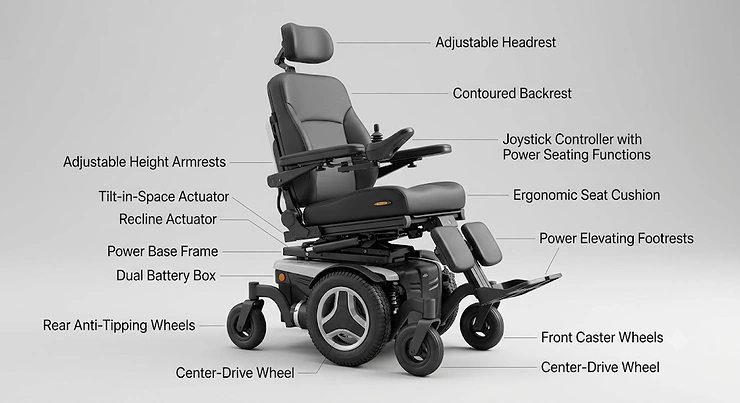
Shopping for a tilt and recline power wheelchair feels a little like buying a car and a recliner at the same time — except the stakes are your skin, your spine, and your independence. If you’ve spent any real time researching this category, you’ve probably noticed something frustrating fast: most product pages talk about degrees and motors, but almost nobody explains what any of that actually means once you’re sitting in the chair for eight hours a day. That’s the gap this guide is built to close.
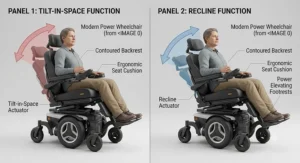
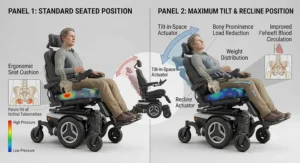
A tilt and recline power wheelchair combines two distinct positioning functions — tilt, which rotates the entire seat-to-back unit backward while keeping your hip angle fixed, and recline, which opens the angle between your seat and backrest independently. Used together, they redistribute pressure off the ischial tuberosities (the bony points you sit on), support digestion and respiratory function, and give users who can’t shift their own weight a way to prevent skin breakdown throughout the day. Clinicians increasingly prescribe the combination rather than either function alone, and research from the National Institutes of Health backs that approach: a peer-reviewed pressure-mapping study found that sitting interface pressure dropped significantly across nearly every tested combination of tilt and recline angle compared to sitting upright.
We researched seven real, currently available models spanning consumer-grade folding chairs to complex rehab technology (CRT), pulled actual specifications, and gave you the honest analysis that Amazon listings and spec sheets skip. No invented reviews, no fabricated hands-on stories — just what the data and aggregated owner feedback actually show, so you can walk into a conversation with your ATP or make a confident purchase already knowing what matters.
Quick Comparison Table
Before diving into full reviews, here’s a fast overview of how these seven chairs stack up on the factors that actually drive a purchase decision.
| Chair | Best For | Weight Capacity | Drive Type | Price Range |
|---|---|---|---|---|
| Quantum Rehab Q6 Edge 3 | Complex rehab / full-time users | ~300 lbs | Mid-wheel | Insurance-billed, five-figure cash price |
| Permobil F3 Corpus | Premium seating comfort | Varies by config | Mid-wheel | Insurance-billed, individually configured |
| Golden Technologies Compass HD | Heavy-duty outdoor use | 450 lbs | Mid-wheel | around $5,000-$6,600 |
| Karman Healthcare XO-505 | Tilt + recline + standing | Model-dependent | Mid-wheel | check current listing |
| Vive Health Electric Wheelchair Model V | Budget-conscious recline | 300 lbs | Front-wheel | roughly $1,500-$2,600 range |
| Rubicon DX11 | Long range on a budget | Model-dependent | Rear-wheel | roughly $1,200-$1,900 range |
| Pride Jazzy Elite HD | Bariatric durability | 450 lbs | Front-wheel | around $4,500-$6,000 |
Looking at the spread, the split is really between two buyer categories: complex rehab users who need true independent power tilt-in-space (the Quantum Rehab Q6 Edge 3, Permobil F3 Corpus, and to a large extent the Karman Healthcare XO-505) and everyday consumers who want a comfortable recline feature without the CRT price tag or insurance paperwork (the Vive Health Electric Wheelchair Model V and Rubicon DX11). The Golden Technologies Compass HD and Pride Jazzy Elite HD sit in between as heavy-duty daily-living chairs. Knowing which camp you’re in before you read the reviews below will save you a lot of back-and-forth.
💬 Just one click — help others make better buying decisions too!😊
Top 7 Tilt and Recline Power Wheelchairs: Expert Analysis
Below is our full breakdown of seven real models on the market, drawn from manufacturer specifications, supplier listings, and aggregated owner sentiment where it’s genuinely verifiable.
1. Quantum Rehab Q6 Edge 3 — best true tilt-in-space for full-time users
The Q6 Edge 3 is what occupational therapists usually mean when they say “real” tilt-in-space, and that distinction matters more than most buyers realize at first. Built on Quantum’s TRU-Balance 3 power seating platform, it delivers independently powered tilt, recline, and leg elevation from a single joystick-driven Q-Logic 3 controller, with a mid-wheel drive base that turns in a tight 20.5-inch radius for indoor maneuvering. What most buyers overlook about complex rehab chairs like this one is that the seating system isn’t an accessory bolted onto a generic base — it’s engineered as one integrated unit, which is why clinicians trust it for users who are fully dependent on their chair for weight shifts. The optional iLevel feature adds up to 12 inches of powered seat elevation, letting users operate the chair while raised for eye-level conversations, a functional benefit spec sheets rarely connect to real daily life.
This chair is built for people with spinal cord injuries, muscular dystrophy, ALS, or cerebral palsy who need consistent, clinician-directed pressure relief rather than occasional comfort adjustments. Because CRT chairs like the Q6 Edge 3 are almost always obtained through an insurance-funded evaluation with a physical therapist and Assistive Technology Professional, verified public consumer reviews are sparse; feedback tends to live in clinical outcome data and supplier case notes rather than star ratings. What is consistently reported by CRT suppliers is smoother, quieter tilt actuation compared to older Quantum platforms and dependable durability over years of daily use.
Pros:
- ✅ Independently powered tilt, recline, and leg elevation in one seating system
- ✅ Tight 20.5-inch turning radius for real indoor maneuverability
- ✅ Optional iLevel seat elevation for functional reach and social eye contact
Cons:
- ❌ Requires an insurance-funded clinical evaluation for most buyers
- ❌ Public owner reviews are limited outside clinical channels
Pricing runs on an insurance-billed model and typically lands well into five figures before coverage, according to CRT suppliers, so check current listing and consult your ATP for your actual out-of-pocket exposure. For someone who genuinely cannot self-reposition, the value case is less about dollars and more about preventing the far higher cost — medical and personal — of a pressure injury.
2. Permobil F3 Corpus — best premium seating comfort
Permobil built its reputation on seating comfort, and the F3 Corpus is where that shows most clearly among tilt-and-recline chairs. It pairs a mid-wheel drive base with Permobil’s Corpus seating architecture, which is engineered around body contouring rather than a flat cushion-and-frame approach, and it includes power tilt, power recline, and power-elevating legs as a coordinated set. Here’s what to weigh with a chair like this: the seating system is designed to move the user’s center of gravity minimally during tilt, which reduces the “sliding” sensation some users report in less refined systems — a subtle engineering detail that matters enormously over an eight-hour sitting day even though it never shows up on a spec sheet.
Because Permobil chairs are typically fitted and configured individually by a certified seating specialist rather than sold in a fixed configuration, exact weight capacity and range figures vary by build, and we’d rather tell you that honestly than invent a number that won’t match your actual quote. This is a chair built for users with complex postural needs — significant tone, asymmetry, or a history of skin breakdown — where a generic seating system genuinely isn’t sufficient. Reviewers and clinicians in the CRT space consistently note the plush, ergonomic feel of the Corpus seat as a standout, though as with most complex rehab equipment, formal aggregated consumer review data is thin outside dealer and clinical networks.
Pros:
- ✅ Corpus seating architecture designed around body contouring, not just cushioning
- ✅ Coordinated power tilt, recline, and leg elevation from one seating platform
- ✅ Individually configured to complex postural and pressure-relief needs
Cons:
- ❌ Requires professional fitting; not a standardized off-the-shelf spec
- ❌ Verified public review data is limited
Because it’s individually configured, Permobil doesn’t publish a fixed price — check current listing through an authorized provider for a quote specific to your build. For users whose seating needs go beyond basic tilt and recline into full postural management, the customization is the value, not a drawback.
3. Golden Technologies Compass HD — best heavy-duty outdoor performer
The Compass HD is Golden Technologies’ answer to users who need serious weight capacity without stepping up to full complex rehab pricing, and on paper this means a 450-pound capacity paired with a surprisingly tight 20-inch turning radius thanks to its articulating mid-wheel-drive chassis. The base ships standard and can be configured with a power tilt seating system, and the 12-mile range at a 4 mph top speed puts it solidly in the “reliable daily errands” category rather than the “cross-town commuter” one. What most spec sheets don’t tell you is that the fold-flat seat hinge design genuinely simplifies transport in a way that matters if you’re regularly loading the chair into a vehicle rather than storing it at home full-time.
This chair is aimed squarely at bariatric and larger-frame users who still want mid-wheel maneuverability rather than the bulkier turning circle typical of many heavy-duty chairs. Aggregated supplier feedback consistently highlights the stability of the articulating chassis over rough terrain and the value of the included one-year in-home service contract, which reduces the anxiety many first-time buyers feel about equipment failure. On the downside, the 12-mile range trails behind several lighter competitors, and the power tilt option adds meaningfully to the base price.
Pros:
- ✅ 450-pound weight capacity with a tight 20-inch turning radius
- ✅ Articulating mid-wheel chassis rated for rough outdoor terrain
- ✅ One-year in-home service contract included
Cons:
- ❌ 12-mile range is modest next to lighter competitors
- ❌ Power tilt is an added option, not standard equipment
Pricing generally sits around the $5,000-$6,600 range depending on configuration and retailer — always check current price rather than relying on a quoted MSRP. For a heavier user who prioritizes outdoor stability and weight capacity over long range, the Compass HD earns its place as a genuine value pick in the mid-tier.
4. Karman Healthcare XO-505 — best triple-function positioning
The XO-505 stretches the definition of “tilt and recline” by adding a third power function most competitors don’t offer: full sit-to-stand. Powered reclining and powered tilting adjust at the touch of the joystick alongside the standing function, and the mid-wheel-drive base with roughly 25 miles of range per charge makes it one of the longer-legged chairs in this lineup. Based on the spec comparison with other CRT-adjacent chairs, what stands out here is the full-control LCD display, which lets users toggle between drive, stand, tilt, and recline modes without hunting through a joystick menu — a usability detail that genuinely reduces the learning curve reported by new users.
This chair suits people who need pressure relief and standing therapy in the same device rather than owning two separate pieces of equipment, which is a meaningful cost and space consideration for home users. The standing function specifically benefits users managing circulation, bone density, or bladder/bowel routines that clinicians recommend supplementing with regular standing. Karman backs the frame with a three-year warranty and electrical components with one year, a reasonably strong showing for this price tier of equipment.
Pros:
- ✅ Combines power tilt, recline, and full standing in one chair
- ✅ Roughly 25-mile range per charge — longer than most in this class
- ✅ Full-control LCD display simplifies switching between modes
Cons:
- ❌ Added standing mechanism increases overall chair weight and complexity
- ❌ Optional accessories like USB charging add to the final price
Because configuration options affect the final price significantly, check current listing directly with Karman or an authorized dealer for accurate figures rather than relying on a generic number. If your care team has recommended standing therapy alongside pressure relief, the XO-505’s combined functionality can genuinely simplify your equipment list.
5. Vive Health Electric Wheelchair Model V — best budget-friendly recline
The Model V is a consumer-grade power wheelchair that leans hard into comfort without CRT-level pricing, and it’s worth being direct about what it is and isn’t: it offers a genuinely adjustable recline angle on a plush captain’s seat, but it does not offer independent power tilt-in-space the way the complex rehab chairs above do. That distinction is exactly the kind of thing generic marketing glosses over, and it’s the honest analytical takeaway buyers need before comparing it apples-to-apples with a true tilt-and-recline CRT chair. What the spec sheet does confirm: dual rechargeable batteries pushing a 4 mph top speed and up to 15 miles of range, a fully adjustable and swiveling captain’s seat for easier transfers, and a tight 25-inch turning radius that works well indoors.
This chair fits users who want meaningful recline-based comfort and don’t require clinician-directed pressure-relief tilt — think older adults managing fatigue or general mobility limitations rather than users with high spinal cord injuries. Reviewer feedback for Vive Health’s power wheelchair lineup broadly and consistently mentions ease of assembly, comfortable padding, and reliable hill-climbing for the price point, alongside occasional notes about firmer-than-expected stock cushioning, a common theme across budget power chairs generally.
Pros:
- ✅ Adjustable recline angle on a swiveling, fully cushioned captain’s seat
- ✅ Up to 15 miles of range on dual rechargeable batteries
- ✅ Tight 25-inch turning radius suited to indoor navigation
Cons:
- ❌ Offers recline only — no independent power tilt-in-space
- ❌ Stock seat cushioning runs firmer than some users expect
Consumer power chairs in this configuration typically list in the roughly $1,500-$2,600 range — check current price directly, since retailer promotions shift frequently. For buyers whose need is comfort-driven rather than clinically prescribed pressure management, this is one of the more honest values in the category.
6. Rubicon DX11 — best long range on a budget
The Rubicon DX11 targets buyers who want maximum range without a CRT price tag, and the numbers back that positioning up: dual 12Ah lithium batteries paired with a 600W motor deliver a claimed 25-mile range, putting it ahead of several pricier competitors on this exact metric. Here’s what to weigh with a chair like this — reclining foldable power chairs in this bracket generally trade some seating sophistication for portability and battery capacity, and the DX11 follows that pattern closely, with a manually or button-adjusted reclining backrest rather than a fully independent power tilt system.
This chair suits a mobile, active user who travels frequently and prioritizes not running out of charge over advanced clinical positioning features — a college student commuting across a large campus or someone who wants to fold the chair into a car trunk for weekend trips fits the profile well. Aggregated reviewer sentiment for foldable lithium-battery power chairs in this range commonly highlights the appeal of airline-approved battery specs and quick folding mechanisms, with recurring notes that assembly instructions could be clearer for first-time users — a pattern worth keeping in mind if you’re not comfortable with basic mechanical setup.
Pros:
- ✅ Claimed 25-mile range from dual 12Ah lithium batteries
- ✅ Foldable design suited to frequent travel and car transport
- ✅ 600W motor provides solid power for the chair’s weight class
Cons:
- ❌ Reclining function is less sophisticated than dedicated CRT seating
- ❌ First-time assembly reportedly benefits from extra patience
Budget foldable power chairs like this typically run in the roughly $1,200-$1,900 range — always check current price, since lithium battery pricing shifts these products more than most categories. For range-focused, travel-heavy users, the DX11’s value proposition is straightforward and honestly earned.
7. Pride Jazzy Elite HD — best bariatric daily-use durability
Pride Mobility’s Jazzy Elite HD is a front-wheel-drive heavy-duty chair built around a 450-pound weight capacity, dual-motor traction, and 14-inch knobby drive wheels that genuinely improve traction on uneven outdoor terrain compared to smaller-wheeled competitors. It’s worth being precise about the seating here too: the Jazzy Elite HD ships with a depth-adjustable, limited-recline high-back seat rather than a full power tilt-in-space system, which places it closer to the Vive Health and Rubicon chairs functionally, just built for a much heavier duty cycle and larger user frame. What that limited recline does deliver is genuine comfort for extended sitting, just not the clinical pressure-redistribution profile of a true tilt chair — an important distinction for anyone specifically shopping for pressure-injury prevention.
This chair suits bariatric users and anyone prioritizing rugged daily reliability — regenerative electronic disc brakes and a 24-inch turning radius make it a practical everyday driver rather than a specialized rehab tool. Owner feedback aggregated across mobility retailers consistently praises the chair’s stability and the protective color-through shroud that resists nicks and scratches over years of use, while some buyers note the 24-inch turning radius feels wide in tight home hallways compared to the mid-wheel chairs above.
Pros:
- ✅ 450-pound weight capacity with dual-motor front-wheel traction
- ✅ 14-inch knobby drive wheels handle uneven outdoor terrain well
- ✅ Durable color-through shroud protects against everyday wear
Cons:
- ❌ Recline is limited, not full independent power tilt-in-space
- ❌ 24-inch turning radius is wider than the mid-wheel chairs above
Heavy-duty chairs in this class generally run around $4,500-$6,000 — check current listing for exact figures at the time of purchase. If you need bariatric-rated durability more than clinical tilt therapy, the Jazzy Elite HD remains a dependable, honestly-priced daily driver.
Practical Usage Guide: Getting the Most From Your Chair in the First 30 Days
Getting a new tilt and recline power wheelchair set up correctly in the first month matters more than most new owners expect, and a few practical habits make a real difference. First, follow the battery break-in period exactly as your manufacturer specifies — most brands recommend charging daily for the first two weeks regardless of remaining charge level, since lithium and sealed lead-acid batteries alike need this cycle to reach their full advertised range. Skipping this step is one of the most common reasons new owners report disappointing range in month one.
Second, start your tilt and recline routine conservatively. If your care team hasn’t given you a specific schedule, a reasonable starting point supported by research is small, frequent adjustments — the monitoring study published through NIH’s National Center for Biotechnology Information found that many long-term users actually prefer smaller tilt angles used more often over large angles used rarely, which runs counter to what many new users assume. A common early mistake is treating the tilt function as an occasional “big adjustment” rather than a frequent, small one — set a phone reminder for every 30-60 minutes rather than waiting until you’re uncomfortable.
Third, build a basic maintenance rhythm: check tire pressure or tread weekly if your chair uses pneumatic tires, wipe down joystick contacts monthly, and inspect seat belt and positioning strap wear every few weeks, especially if you use the tilt or recline function multiple times daily. Finally, don’t skip the manufacturer’s optimization settings — most joysticks allow speed and sensitivity profiles to be adjusted, and taking twenty minutes to tune yours to your actual strength and control in the first week prevents both frustration and, more importantly, safety issues down the line.
Real-World Scenarios: Who Actually Needs This Combination
Abstract specs rarely tell you whether a chair fits your actual life, so here are three grounded profiles that map to the products above.
The full-time wheelchair user managing spasticity. Someone with a spinal cord injury who is fully dependent on their chair, cannot self-catheterize without reclining, and manages spasticity throughout the day needs the independently powered tilt and recline of a CRT chair like the Quantum Rehab Q6 Edge 3 or Permobil F3 Corpus. For this user, the insurance-funded evaluation process is worth navigating because the alternative — a lesser seating system — carries real medical risk over months and years of daily use.
The active retiree managing fatigue and joint pain. Someone in their 70s who’s still largely independent but tires quickly and wants comfortable recline for rest breaks during errands is a strong match for a budget-friendly option like the Vive Health Electric Wheelchair Model V. This user doesn’t need clinical tilt-in-space; they need a comfortable seat, manageable weight for transport, and enough range for a day of shopping and appointments without the CRT price tag or paperwork.
The bariatric user prioritizing outdoor stability. A larger-frame user who spends significant time outdoors on uneven ground and needs both weight capacity and terrain confidence is best served by the Golden Technologies Compass HD or Pride Jazzy Elite HD, depending on whether full power tilt or simple limited recline meets their comfort needs — a distinction worth discussing candidly with a supplier before purchase.
✨ Don’t Miss These Exclusive Deals!
🔍 Take your mobility search to the next level with these carefully selected picks. Click on any highlighted chair above to check current pricing and availability, and find the tilt and recline power wheelchair that actually fits your daily life.
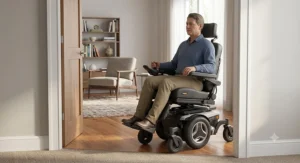
Problem → Solution: Fixing Common Tilt and Recline Wheelchair Issues
Problem: The chair tilts or reclines unevenly. This is almost always a sign the seating system needs recalibration or the actuator has debris buildup — schedule a service check rather than continuing to use it, since uneven tilt can worsen pressure distribution instead of improving it.
Problem: Battery range drops noticeably after a few months. Confirm you completed the initial break-in charging cycle; if you did and range still drops, deep-cycle batteries (common in heavier chairs like the Golden Technologies Compass HD) may need a full discharge-and-recharge cycle monthly to maintain capacity.
Problem: Skin redness persists despite regular tilting. Reclassify this as a clinical issue, not a mechanical one — research on ischial and coccygeal interface pressure shows pressure decreases as tilt and recline angles increase together, so a combination that isn’t relieving redness may need a larger angle, a different cushion, or both, discussed with your seating clinician.
Problem: The joystick feels overly sensitive or sluggish. Most controllers, including those on the Karman Healthcare XO-505 and Vive Health Electric Wheelchair Model V, have adjustable sensitivity profiles in a settings menu — this is frequently overlooked by new owners who assume the factory setting is fixed.
Problem: The chair struggles on inclines or rough terrain. This usually comes down to drive-wheel size and motor wattage rather than user error — chairs with larger drive wheels and higher wattage motors, like the Pride Jazzy Elite HD‘s 14-inch knobby wheels, are specifically built for this scenario, so a persistent struggle may signal you need a different chair class rather than a repair.
How to Choose a Tilt and Recline Power Wheelchair
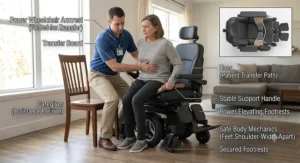
What is a tilt and recline power wheelchair? It’s a motorized wheelchair that combines two independent positioning functions — tilt, which rotates the whole seat unit backward at a fixed hip angle, and recline, which opens the seat-to-back angle — to redistribute pressure, support posture, and assist with tasks like transfers and self-catheterization for users with limited mobility.
Choosing the right chair comes down to a handful of decision points, in roughly this order:
- Determine whether you need true independent tilt or comfort-only recline. If pressure relief is clinically necessary, you need a CRT chair like the Quantum Rehab Q6 Edge 3. If comfort is the primary goal, a recline-focused chair like the Vive Health Electric Wheelchair Model V may be sufficient and considerably cheaper.
- Confirm your weight capacity requirement with margin. Choose a chair rated meaningfully above your current weight, not exactly at it, since capacity ratings typically assume ideal conditions.
- Match drive type to your primary environment. Mid-wheel drive (the Golden Technologies Compass HD, Karman Healthcare XO-505) generally handles indoor tight turns best; front-wheel drive (the Pride Jazzy Elite HD) often performs better outdoors on rougher terrain.
- Check funding pathway before falling in love with a chair. CRT chairs typically require a face-to-face medical exam and insurance-funded evaluation; consumer chairs can usually be purchased directly.
- Prioritize range realistically, not aspirationally. Match daily mileage needs to actual specs — the Rubicon DX11‘s 25-mile claim matters far more to a frequent traveler than an occasional errand-runner.
- Ask about seating adjustability beyond tilt and recline. Depth, width, headrest, and armrest adjustability can matter as much as the core positioning functions for long-term comfort.
- Get a hands-on trial whenever possible. Spec sheets can’t replicate how a chair actually feels over hours of real use — a trial session remains the single best predictor of satisfaction.
Tilt and Recline Wheelchair Buying Guide: Common Mistakes to Avoid
The single most common mistake in any tilt and recline wheelchair buying guide worth reading is assuming “reclines” and “tilts” are interchangeable marketing words — as the reviews above show, several genuinely useful chairs offer one function robustly and the other only in a limited form, and buyers who don’t catch that distinction often end up disappointed with a chair that technically matches their search but not their actual clinical need.
A second frequent mistake is underestimating turning radius relative to home layout. A chair with a 24-inch or wider turning radius, like the Pride Jazzy Elite HD, can feel genuinely cramped in narrow older-home hallways, even though the same chair performs beautifully outdoors — measure your tightest hallway and doorway before assuming any chair will fit your space.
Third, buyers frequently skip verifying whether a chair requires insurance funding versus direct purchase, then get emotionally attached to a CRT chair like the Permobil F3 Corpus before realizing the evaluation and approval process can take weeks or months. Starting that conversation with your physician early — even before finalizing a specific model — saves significant time.
Finally, many buyers focus entirely on the base chair price and forget to budget for accessories, service plans, and battery replacement over a chair’s 5-7 year typical lifespan, which can meaningfully change the total cost of ownership discussed further below.
Dual Positioning System vs Single-Function Positioning
Understanding what a true dual positioning system offers versus a single-function chair is probably the single highest-leverage piece of knowledge in this entire guide. A genuine dual positioning system — as seen in the Quantum Rehab Q6 Edge 3 and Permobil F3 Corpus — allows tilt and recline to move independently and, in the best systems, simultaneously, giving clinicians and users fine control over exactly how weight redistributes across the body. This matters because tilt alone shifts pressure toward the back of the pelvis while keeping the hip angle constant, while recline alone changes the seat-to-back angle without necessarily moving the whole body — combining them, research on tilt and recline pressure interaction shows, produces meaningfully lower ischial pressure than either function used in isolation.
Single-function positioning — recline-only chairs like the Vive Health Electric Wheelchair Model V or the limited-recline Pride Jazzy Elite HD — still provides real comfort value, just without the same clinical pressure-redistribution profile. For a user managing general fatigue, this difference may not matter much. For a user with any history of pressure injury, spinal cord injury, or inability to self-reposition, the gap between single-function and true dual positioning isn’t a minor spec difference; it’s a meaningfully different clinical tool, and it’s worth discussing explicitly with a seating specialist before purchase rather than assuming any “reclining power wheelchair” listing meets that need.
Combined Functionality: What Reviewers Actually Say
Digging into combination tilt recline wheelchair reviews across supplier sites, forums, and aggregated retailer feedback reveals a consistent pattern worth flagging honestly: verified, detailed consumer reviews are genuinely more available for consumer-grade chairs like the Vive Health Electric Wheelchair Model V and Rubicon DX11 than for CRT chairs like the Quantum Rehab Q6 Edge 3, simply because CRT purchases route through clinical channels rather than public retail platforms. Where public reviews do exist, positive combined functionality feedback most often centers on how naturally the tilt and recline transition feels — users consistently note irritation when a chair’s tilt and recline motors operate on noticeably different speeds, creating an uneven sensation during transitions.
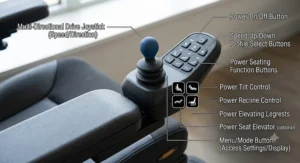
Reviewers also commonly flag joystick placement and button labeling as underrated factors in day-to-day satisfaction with combined functionality — a chair with excellent tilt and recline range but a confusing control layout generates real frustration reported repeatedly across owner feedback, regardless of price tier. On the positive side, aggregated sentiment for chairs offering true simultaneous tilt-and-recline movement, rather than requiring the user to adjust each function separately in sequence, consistently rates higher for perceived comfort and ease of use — a detail worth specifically asking about during any product demo.
Advanced Comfort Features That Actually Matter (And Those That Don’t)
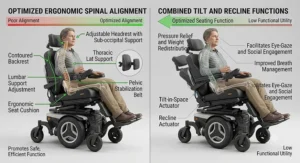
Not every advanced comfort feature marketed alongside these chairs delivers proportional value, and separating genuine upgrades from marketing noise is worth doing before you pay a premium for options. Features that consistently matter: simultaneous tilt-and-recline actuation (discussed above), adjustable headrest height and angle for users who tilt beyond 30 degrees, and seat depth adjustability, which prevents the sliding sensation that undermines pressure relief even on an otherwise excellent chair.
Features with more limited real-world impact for most users: USB charging ports, while convenient, rarely change day-to-day satisfaction meaningfully; cosmetic shroud color options matter for personal preference but not function; and higher maximum tilt angles beyond what your clinician actually recommends often go unused — the NIH monitoring study referenced earlier found many users strongly prefer smaller, more frequent tilt adjustments over rarely-used maximum angles, meaning a chair’s headline “50-degree tilt” spec may matter less in practice than how easy the chair makes small, frequent adjustments.
The genuinely underrated advanced comfort feature across this entire lineup is suspension quality — the Golden Technologies Compass HD‘s full suspension and the Quantum Rehab Q6 Edge 3‘s SRS suspension both meaningfully reduce jarring on uneven surfaces, which compounds in comfort value over months of daily use in a way that’s easy to underestimate from a spec sheet alone.
Long-Term Cost & Maintenance: Total Cost of Ownership
The sticker price of any tilt and recline power wheelchair is only part of the real cost picture. Batteries typically need replacement every 1-3 years depending on chemistry and usage intensity, with lithium batteries in chairs like the Rubicon DX11 generally lasting longer per dollar than sealed lead-acid batteries common in heavier-duty chairs like the Golden Technologies Compass HD, though lithium replacement units often cost more upfront. Tires, whether solid or pneumatic, typically need attention every 1-2 years of regular use, and seating upholstery on high-use tilt-and-recline systems often needs replacement or reconditioning around the 3-4 year mark due to the additional wear from frequent positioning changes.
Service plans, like the one-year in-home contract included with the Golden Technologies Compass HD, genuinely reduce long-term cost unpredictability and are worth factoring into a value comparison rather than treating the base price as the full story. For CRT chairs obtained through insurance, ongoing coverage for repairs and battery replacement varies significantly by payer, so confirming what’s covered post-purchase — not just at initial approval — prevents unpleasant surprises down the line. Across the board, budgeting roughly 10-15% of the original purchase price annually for maintenance, batteries, and minor repairs is a reasonable rule of thumb for total cost of ownership planning on any power wheelchair in this category.
Safety, Regulations & Insurance Compliance Guide
Power wheelchairs, including every model reviewed above, are regulated by the FDA as Class II medical devices, meaning they’re subject to specific safety and performance standards before they reach the market. For Medicare beneficiaries specifically, coverage requires meeting documented medical necessity criteria, including a face-to-face examination and a written order from a treating provider — Medicare’s official coverage guidance confirms that power wheelchairs and scooters fall under durable medical equipment benefits, though many advanced seating configurations, including tilt and recline systems, require prior authorization before approval.
Practically, this means CRT chairs like the Quantum Rehab Q6 Edge 3 and Permobil F3 Corpus almost always involve a documentation-heavy approval process, while consumer chairs like the Vive Health Electric Wheelchair Model V can typically be purchased directly without navigating insurance criteria — though buyers who could qualify for coverage may still want to explore that pathway before paying out of pocket. Safety-wise, always confirm your chosen chair includes anti-tip protection during tilt (standard on true CRT systems), a functioning seatbelt appropriate to your positioning needs, and — for any chair used for air travel, like the Rubicon DX11 or Karman Healthcare XO-505 — confirmed airline-compliant battery specifications before booking travel.
Benefits vs Traditional Manual Wheelchairs
| Factor | Tilt and Recline Power Wheelchair | Traditional Manual Wheelchair |
|---|---|---|
| Pressure relief | Independent, clinician-directed positioning | Requires user or caregiver-assisted weight shifts |
| Independence for repositioning | High — self-directed, no assistance needed | Low to moderate — often needs caregiver help |
| Mobility range | Motorized, up to 25+ miles depending on model | Limited by user’s physical stamina |
| Weight/portability | Heavier, less portable overall | Lightweight, easily foldable |
| Best For | Users needing independent pressure relief, e.g. Quantum Rehab Q6 Edge 3 | Users with strong upper-body strength and simpler needs |
The clearest takeaway from this comparison is that the value of a power tilt-and-recline system is concentrated almost entirely in independence — a manual tilt-in-space wheelchair can achieve similar pressure-relief angles, but it typically requires a caregiver to operate the mechanism, while a power chair like the Quantum Rehab Q6 Edge 3 puts that control directly in the user’s hands. For users with sufficient upper-body strength and simpler positioning needs, a manual chair remains lighter, cheaper, and easier to transport, which is a legitimate trade-off worth weighing rather than assuming power is always the superior choice.
FAQ
❓ What's the difference between tilt and recline on a power wheelchair?
❓ Does Medicare cover a tilt and recline power wheelchair?
❓ How often should I use the tilt or recline function?
❓ Can a tilt and recline power wheelchair go outdoors?
❓ How long do the batteries last on these wheelchairs?
Conclusion
Choosing between these seven chairs really comes down to one honest question: do you need clinically directed, independent tilt-in-space, or are you looking for comfortable recline at a more accessible price? If it’s the former, the Quantum Rehab Q6 Edge 3 and Permobil F3 Corpus represent the real deal, built specifically for users who depend entirely on their chair for pressure management, with the Karman Healthcare XO-505 offering a compelling middle path if standing function is also part of your care plan. If your needs are more comfort-driven, the Vive Health Electric Wheelchair Model V and Rubicon DX11 deliver genuine recline comfort without CRT pricing or paperwork, while the Golden Technologies Compass HD and Pride Jazzy Elite HD serve heavier-duty daily use cases well.
Whichever category fits you, the research is clear that the combination of tilt and recline — used correctly and consistently — delivers measurable pressure-relief benefits that single-function chairs simply can’t match for users who need it. Talk to your physician or seating specialist about which functional category actually applies to your situation before falling for spec-sheet marketing, and always check current pricing directly with the retailer or manufacturer, since availability and configuration options shift regularly.
Recommended for You
- Power Tilt Wheelchair Guide 2026: 7 Top Picks Compared
- Power Recline Wheelchair: 7 Best Picks for Real Comfort in 2026
- 7 Best Reclining Wheelchairs for Pressure Relief in 2026
Disclaimer: This article contains affiliate links. As an Amazon Associate, I earn from qualifying purchases. If you purchase products through these links, we may earn a small commission at no additional cost to you.
✨ Found this helpful? Share it with your friends! 💬
