
In This Article
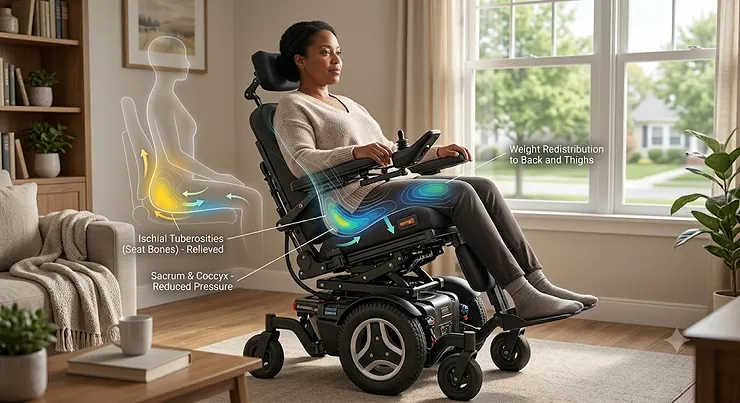
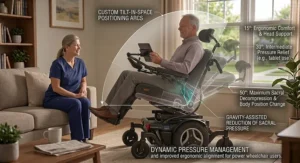
Sitting still sounds simple until your body is the one doing the sitting, hour after hour, day after day. That’s the quiet math behind power tilt wheelchair benefits: a seating system that can rotate your whole body — seat and backrest together, in the same fixed angle relative to each other — takes weight off the exact spots where skin breakdown starts. What is a power tilt wheelchair? It’s a powered mobility device that shifts the entire seat-and-back unit backward (or occasionally forward) as one rigid piece, unlike recline, which only opens the seat-to-back angle. That single mechanical difference changes how pressure, blood flow, and fatigue behave across a whole day of sitting.
If you’ve spent any time researching power tilt wheelchair benefits for yourself or someone you care for, you already know the internet is split between marketing copy and dense clinical papers. Neither one tells you which chair to actually buy. This guide sits in the middle — published seating research confirms tilt-in-space systems are routinely prescribed specifically to redistribute pressure away from high-risk seated areas, and we’ll translate that finding into plain language while walking through seven real, currently available power tilt wheelchairs spanning budget to premium. You’ll also get a straight comparison of tilt versus recline, the therapeutic and positioning benefits clinicians actually care about, and a buyer’s framework you can use today. No fluff, no invented reviews — just what the research and the spec sheets actually say.
Quick Comparison Table: Power Tilt Wheelchairs at a Glance
Before the deep dive, here’s the fast version for anyone comparing options on a lunch break.
| Model | Tilt Range | Weight Capacity | Best For |
|---|---|---|---|
| Merits Health Vision Ultra Power Tilt | Standard power tilt + reclining back | 300 lbs | Budget-conscious first-time buyers |
| Permobil M300 | Power tilt + recline | 300–450 lbs (HD) | Everyday value from a top rehab brand |
| Invacare TDX SP2 | Power tilt via Motion Concepts ULM | 300–450 lbs | Users who want onboard diagnostics |
| Quickie Q700 M | Power tilt + recline + seat elevate | Standard/HD variants | Users who need eye-level independence |
| Permobil M3 Corpus | Up to 45° ActiveReach tilt | Up to 330 lbs | Complex positioning needs, mid-wheel base |
| Permobil F3 Corpus | Up to 45° ActiveReach tilt | Up to 330 lbs | Tight indoor spaces, front-wheel base |
| Quickie QM-710 | Power tilt + recline + power legs | Custom rehab seating | Chin-control and alternative access users |
A quick read of the table already tells a story: tilt range and weight capacity don’t move together in a straight line, and neither does price. The Merits Health Vision Ultra Power Tilt proves you don’t need a five-figure rehab platform to get genuine pressure-relieving tilt, while the Permobil M3 Corpus and Permobil F3 Corpus show what happens when a manufacturer chases tilt angle and functional reach as the primary design goal. If your priority is simply “does it tilt and is it affordable,” the Merits and Invacare options are your shortlist; if you need clinically documented positioning for a complex diagnosis, the Corpus and Quickie QM-710 platforms earn their higher price tags.
💬 Which of these fits your situation best? Keep reading — the full breakdown is right below!😊
Top 7 Power Tilt Wheelchairs: Expert Analysis
Seven real, currently sold models, covering budget through premium, plus one built specifically for alternative-access drivers. Every entry below leans on published specs and aggregated review sentiment — never invented quotes.
1. Merits Health Vision Ultra Power Tilt — most affordable true power-tilt entry point
The standout here is right in the name: this is a genuine power-tilt chair, not a semi-recline dressed up as one, at a price point well below most rehab-grade competitors. The Merits Health Vision Ultra Power Tilt supports up to 300 pounds, tops out around 4 mph, and delivers roughly 18 miles of range per charge — plenty for a full day of errands, therapy appointments, and time around the house. The captain’s seat comes in 16-inch and 18-inch widths with a reclining backrest and adjustable headrest, and dual in-line motors keep the ride stable on mixed indoor-outdoor terrain.
Based on the spec comparison, this chair earns its spot for buyers who need pressure-relief tilt without committing to a full complex rehab technology (CRT) evaluation and price tag — think early-stage users, secondary chairs for travel, or anyone whose insurance approval process is still underway. Reviewers consistently note the chair feels sturdy and well-built for its price class, with several calling out easy handling and a comfortable ride; a recurring minor gripe is the lack of small conveniences like a cup holder, which doesn’t affect the seating function itself.
Pros:
- ✅ Genuine power tilt at a below-average entry price
- ✅ Reviewers consistently describe it as sturdy and easy to handle
- ✅ Simple 16″/18″ seat width options keep ordering straightforward
Cons:
- ❌ 300 lb capacity limits fit for larger users
- ❌ Fewer positioning add-ons than full CRT platforms
At the time of research, expect a price in the low-to-mid thousands, well under most rehab-grade tilt systems — a strong value verdict for anyone whose primary need is pressure relief without deep customization.

2. Permobil M300 — best all-around mid-wheel tilt/recline value from a top rehab brand
The Permobil M300 earns its heading tag by doing something a lot of chairs claim but few deliver: dependable everyday tilt and recline from a manufacturer with four decades of rehab-seating credibility, without the premium price of Permobil’s newer Corpus line. Seat depth adjusts from 14 to 22 inches, seat-to-floor height starts at a low 17.25 inches for easier transfers, and the heavy-duty variant extends weight capacity up to 450 pounds with a widened, extended base.
What most buyers overlook about this model is that its R-net joystick and electronics are shared with Permobil’s higher-end chairs, so the actual seating-function control experience feels nearly identical to models costing considerably more. That’s a meaningful practical difference: you’re not paying extra just for a nicer joystick interface. Aggregated feedback from clinics and users points to reliable long-term durability and straightforward service, which matters enormously for a device you’ll depend on daily; some buyers do note the base styling feels a step behind Permobil’s newest platforms.
Pros:
- ✅ Low 17.25″ seat-to-floor height eases transfers
- ✅ HD variant scales to 450 lb weight capacity
- ✅ Shares R-net electronics with pricier Permobil models
Cons:
- ❌ Styling and base tech trail Permobil’s newest Corpus line
- ❌ Seat depth range may not suit very petite or very tall users without customization
Price sits in the mid-range for rehab power chairs — check current price with a supplier, since insurance-funded units vary — and the value verdict is strong for anyone who wants Permobil reliability without Corpus-level cost.
3. Invacare TDX SP2 — smartest onboard diagnostics for tilt system health
The Invacare TDX SP2 leads with Invacare’s LiNX technology, an insight-driven control system that lets clinicians configure and monitor the chair’s electronics with more precision than older platforms allowed. Paired with the DuraWatt motor — sealed against water ingress and quieter than earlier designs — and the Motion Concepts Ultra Low Maxx power positioning system, this chair bundles tilt, elevate, and power legrests into one seating package. Battery range runs up to about 20 miles, with weight capacity spanning 300 to 450 pounds depending on configuration.
Here’s what to weigh: LiNX’s diagnostic layer means service techs can often pinpoint tilt-actuator issues remotely instead of guessing, which cuts downtime for users who depend on the chair daily. That’s a real-world advantage the spec sheet won’t spell out directly, but it’s the kind of detail seating clinics mention when explaining why they keep recommending TDX-series bases. User and clinic feedback aggregated across dealer listings consistently highlights ride quality and turning radius as strong points; the tradeoff some note is that the Motion Concepts add-on seating raises the total package price versus Invacare’s simpler tilt options.
Pros:
- ✅ LiNX electronics support faster remote diagnostics
- ✅ DuraWatt motor sealed against water ingress
- ✅ Tilt, elevate, and legrests bundled in one seating system
Cons:
- ❌ Motion Concepts seating package adds to total cost
- ❌ 9-degree incline capability trails some heavy-duty competitors
At the time of research, pricing runs in the $350–450-range-per-month territory for financed units, or higher as an outright purchase — a solid value verdict for users prioritizing serviceability over raw price.
4. Quickie Q700 M — seat elevate to 12 inches for eye-level independence
Sunrise Medical built the Quickie Q700 M around one particularly practical feature: a power seat elevate function that raises the user a full 12 inches, closing the gap between “sitting in a wheelchair” and “standing at the counter to make coffee.” Add power tilt, recline, and power legs — including a leg rest capable of extending all the way to the floor — and this mid-wheel-drive chair covers nearly every seating function a rehab evaluation might call for. Six-wheel suspension keeps the ride smooth over curbs and uneven pavement.
Based on the spec comparison, the seat-elevate range is the genuine differentiator here — most competitors top out several inches lower, which sounds minor until you’re the one reaching a high shelf or making eye contact across a standing conversation. What most buyers overlook is that the floor-reaching leg rest also simplifies transfers for caregivers, since legs can be lowered flush to the ground rather than staying elevated during a transfer. Aggregated dealer and clinic feedback describes the chair as feature-dense and versatile; the tradeoff is a steeper learning curve for new users juggling four separate power seating functions at once.
Pros:
- ✅ 12″ power seat elevate for eye-level interaction
- ✅ Leg rest extends fully to the floor for easier transfers
- ✅ Six-wheel suspension smooths curb and terrain transitions
Cons:
- ❌ Four power seating functions mean a longer learning curve
- ❌ Fully-loaded configurations push toward the higher end of pricing
Expect this chair to land in the higher mid-range to premium bracket depending on options selected — the value verdict favors users who genuinely need all four powered functions, not just tilt alone.
5. Permobil M3 Corpus — deepest forward-tilt range for functional reach
Most “tilt” conversations focus on backward tilt for pressure relief, but the Permobil M3 Corpus flips that assumption with up to 45 degrees of forward ActiveReach tilt, paired with up to 14 inches of ActiveHeight seat elevation. Built on Permobil’s Corpus Seating System with FlexLink suspension, this mid-wheel-drive chair is engineered around one core idea: proper positioning shouldn’t come at the cost of functional independence.
What the spec sheet won’t tell you, but occupational therapists note, is that forward tilt combined with seat elevation dramatically changes what a user can do independently — reaching into a car, working at a kitchen counter, or leaning into a task without losing trunk support. That’s transformation-grade functionality, not just comfort. The MyPermobil smartphone app adds real-time battery and seating-position data, a genuinely useful layer for users managing complex daily routines. Reviewers and clinicians consistently flag reduced driving fatigue as a standout benefit of the Corpus platform’s ergonomic design; the honest downside is that this level of engineering carries a premium price and typically requires a full CRT evaluation to access through insurance.
Pros:
- ✅ Up to 45° forward tilt plus 14″ seat elevation
- ✅ MyPermobil app adds real-time seating and battery data
- ✅ FlexLink suspension reduces driving fatigue over long days
Cons:
- ❌ Premium pricing typically requires a full CRT insurance pathway
- ❌ Advanced feature set has a real learning curve for new users
Check current price with a Permobil-authorized provider — as a premium CRT chair, exact figures vary widely by seating package, but the value verdict is excellent for users whose independence genuinely depends on functional reach.
6. Permobil F3 Corpus — smallest footprint for tight indoor navigation
The Permobil F3 Corpus takes the same Corpus Seating System found on the M3 and mounts it on a front-wheel-drive base engineered specifically for tight spaces. It’s the most compact chair in the F-series lineup, supporting users up to 330 pounds while still delivering the same up-to-45-degree ActiveReach tilt and up-to-14-inch ActiveHeight elevation. A low center of gravity and fully adjustable ComfortRide suspension keep it stable on inclines despite the compact frame.
On paper, this means apartment dwellers, users in older homes with narrow hallways, or anyone navigating a cluttered workplace gets full-featured power positioning without sacrificing maneuverability — a combination that’s genuinely hard to find elsewhere in the premium tier. Reviewers and clinicians consistently point to the tight turning radius as the chair’s defining real-world advantage over its M3 sibling, while acknowledging that front-wheel-drive handling has a different feel that some experienced users need a short adjustment period to master.
Pros:
- ✅ Smallest footprint in Permobil’s F-series lineup
- ✅ Full 45° ActiveReach tilt despite the compact base
- ✅ Low center of gravity aids incline stability
Cons:
- ❌ Front-wheel-drive handling requires a brief adjustment period
- ❌ 330 lb capacity is lower than several HD competitors
Pricing sits in the premium CRT bracket, similar to the M3 Corpus — the value verdict is strongest for users whose home or work environment genuinely demands a tighter turning radius.
7. Quickie QM-710 — chin-control access for users with limited hand function
The Quickie QM-710 exists for a specific and often underserved group: users who can’t reliably operate a standard joystick and need an alternative drive interface. Its signature feature lets the entire chair — driving and every seating function — be operated via chin control, with an attendant joystick available as a backup. Seating functions include power seat elevate, tilt, recline, power legs, and power extending legs, covering essentially the full range of positioning options in one chair.
Here’s what to weigh: alternative-access chairs like this one are frequently the difference between independent mobility and full dependence on a caregiver for users with high-level spinal cord injuries, ALS, or certain neuromuscular conditions. That’s not a marketing angle — it’s the entire reason Medicare’s Group 3 power wheelchair criteria specifically account for drive-control interfaces beyond standard joysticks. Aggregated feedback from clinics fitting alternative-access users describes the chin-control interface as intuitive after an initial training period, while noting that the customization process takes longer than a standard rehab evaluation because of the specialized fitting involved.
Pros:
- ✅ Full chin-control operation of driving and seating functions
- ✅ Covers seat elevate, tilt, recline, and dual leg functions in one chair
- ✅ Attendant joystick backup adds a safety layer
Cons:
- ❌ Longer, more specialized fitting process than standard chairs
- ❌ Custom rehab seating pushes cost toward the top of the market
As a specialized CRT chair, pricing depends heavily on the exact seating and access configuration — check current price through a rehab technology supplier, but the value verdict is exceptional for the specific population it’s built for.
Practical Usage Guide: Getting the Most From Your First 30 Days
Bringing home a power tilt wheelchair benefits you most when the tilt feature actually gets used — not left at zero because it feels unfamiliar. Start with small angles. Most seating clinicians recommend beginning around 15 to 20 degrees of tilt for 10-15 minutes every hour rather than jumping straight to a full 45-degree recline session; your body needs to adjust to the shifted center of gravity, and so does your sense of balance while driving in a partially tilted position.
Set a repeating reminder — a phone alarm, a smartwatch buzz, or an app like the one Permobil bundles with its Corpus line — because the single biggest first-month mistake is simply forgetting to tilt. Research backs this up directly: tilt-in-space wheelchairs serve pressure management, postural control, and pain management, yet clinicians and researchers have documented a persistent gap between how often tilt is recommended and how often it actually gets used day to day. Closing that gap is almost entirely a habit-building problem, not a hardware problem.
Maintenance-wise, check the tilt actuator’s range of motion weekly for the first month — listen for grinding or hesitation, which usually signals a mechanical adjustment is needed before it becomes a bigger repair. Keep the pivot points free of debris, especially if you’re using the chair outdoors, and confirm your cushion is still seated correctly after every tilt cycle, since cushions can shift slightly over repeated use. Finally, schedule your first follow-up with your seating clinician or ATP around the six-week mark — early tuning of tilt range and speed settings makes a measurable difference in whether the feature gets used consistently for years, not just weeks.

Real-World Scenarios: Who Actually Benefits Most
Maria, 34, spinal cord injury, works full-time from a home office. Maria needs tilt primarily for pressure management since she has no sensation below her injury level, but she also can’t afford long “down time” sessions during her workday. A chair like the Permobil M3 Corpus, with its combination of forward tilt for desk work and backward tilt for scheduled pressure relief, fits her routine of short, frequent tilt breaks between video calls rather than one long recline session.
Robert, 71, post-stroke with limited trunk control living with his daughter’s family. Robert’s biggest risk isn’t pressure injury yet — it’s postural collapse and fatigue by early afternoon. A budget-conscious option like the Merits Health Vision Ultra Power Tilt gives his family genuine tilt-based pressure relief and posture support without the cost or evaluation complexity of a full CRT chair, since his mobility needs are more moderate.
Devon, 19, ALS diagnosed two years ago, losing fine motor control in both hands. Devon’s situation calls for an alternative drive interface before tilt angle even becomes the deciding factor — a chair like the Quickie QM-710 with chin control lets him retain independent mobility and seating adjustment even as hand strength declines further, which standard-joystick chairs simply can’t accommodate.
Buyer’s Decision Framework: A Simple Priority Checklist
If pressure injury prevention is your top clinical priority, choose a chair with proven tilt range of at least 25-35 degrees combined with recline, because that combination is the one supported by the pressure-mapping research cited throughout this guide. If functional reach and daily independence matter more than pure pressure relief, prioritize forward-tilt and seat-elevation range like the Corpus platform offers. If budget is the primary constraint and your mobility needs are moderate, a genuine power-tilt chair in the lower price tier — rather than a semi-recline chair marketed loosely as “tilt” — is worth the difference in real therapeutic value. If you can’t reliably operate a standard joystick, alternative drive access should override every other spec on this list, since none of the comfort features matter if the chair can’t be safely operated in the first place. And if you’re unsure which category you fall into, that uncertainty itself is the signal to request a formal seating evaluation before purchasing anything.
Why Choose a Tilt Wheelchair Over Standard Seating?
The case for choosing a tilt wheelchair over a standard rigid or reclining seat comes down to one mechanical fact: tilt changes the angle of your entire body relative to gravity without changing the angle between your hips and your spine. That distinction matters more than it sounds. A standard wheelchair — even a comfortable one — holds you in one fixed seated posture for as long as you’re in it, which means the same tissue stays under the same pressure for hours. Clinicians prescribe tilt-in-space and recline features specifically for wheelchair users who are vulnerable to pressure sores or who struggle to change posture on their own, and the financial stakes back up why that prescription pattern exists: research on wheelchair seating costs estimates well over a billion dollars is spent annually on pressure sore care in the U.S. alone.
Beyond pressure, tilt genuinely changes daily comfort. Reviewers and clinicians consistently note that users report less mid-day fatigue and improved ability to rest without leaving the chair, which matters enormously for anyone who spends the bulk of their waking hours seated. What most buyers overlook is that choosing tilt isn’t an either-or decision against recline — the two features solve overlapping but distinct problems, which brings us to the next comparison.
Tilt vs Recline Wheelchair: The Real Comparison
This is the single most common point of confusion in the tilt vs recline wheelchair comparison, so let’s be precise: tilt rotates the entire seat-and-backrest unit as one rigid piece, keeping the hip angle constant, while recline only opens the angle between the backrest and the seat, keeping the seat itself level. Both redistribute pressure, but they do it differently. A published biomechanics study found that combining a modest recline angle with a modest tilt-in-space angle reduced both normal force and shear force in the gluteal region more effectively than either feature used alone.
Here’s what that means in practice: tilt is generally the safer default for pressure relief because it doesn’t create shear forces the way recline alone can — when you recline without tilting, your body tends to slide slightly forward against the seat surface, dragging skin against fabric and creating friction injury risk. Tilt avoids that by moving your whole body as one unit. Recline, on the other hand, is better suited to opening the hip angle for comfort, rest, or specific medical needs like managing autonomic dysreflexia or aiding digestion. On paper, most seating clinicians recommend chairs offering both functions together whenever budget and insurance allow, precisely because they solve different halves of the same problem, and the evidence-based sweet spot researchers point to is a combined setup — roughly 25 to 35 degrees of tilt paired with 100 to 120 degrees of recline for effective pressure reduction — numbers that are difficult to hit with recline or tilt alone.
Therapeutic Advantages Clinicians Actually Care About
Beyond pressure relief, the therapeutic advantages of power tilt extend into circulation, respiratory function, and pain management — areas that rarely make it into consumer marketing copy. A peer-reviewed study on tilt and recline angles measuring sitting interface pressure and ischial blood flow found that nearly every tested tilted position significantly decreased sitting pressure compared to sitting fully upright, confirming that tilt isn’t a placebo comfort feature — it’s a measurable physiological intervention.
Blood flow tells a slightly different story than pressure alone. That same research found ischial blood flow increased significantly only at larger tilt-and-recline combinations, meaning small, frequent adjustments matter most for preventing cell-level tissue damage, while larger angle changes support blood flow returning to already-affected tissue. In practical terms: use small tilt adjustments throughout the day for prevention, and reserve larger tilt-and-recline combinations for actual rest periods or when addressing existing skin concerns. Pain management follows a similar logic — separate focus-group research found wheelchair users cited comfort, rest, relaxation, posture, and functional independence as their actual daily reasons for tilting far more often than pressure ulcer prevention specifically. That’s a genuinely useful reframe: tilt is a daily comfort and function tool first, and a medical safeguard second — both are legitimate reasons to prioritize it.
Positioning Benefits: Posture, Pain, and Independence
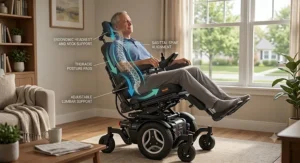
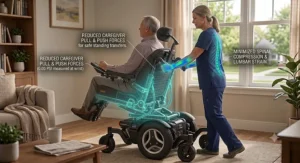
Positioning benefits go well beyond “sitting up straight.” For users with limited trunk control, tilt provides passive postural support that would otherwise require constant caregiver repositioning throughout the day — every tilt cycle effectively resets the body to a supported, symmetrical position without anyone lifting a finger. That reduces caregiver strain as much as it improves user comfort, a two-sided benefit that’s easy to overlook when specs only describe the user’s experience.
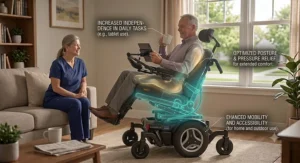
For pain specifically, positioning changes reduce the constant micro-fatigue of holding a single posture against gravity for hours, which matters enormously for conditions involving muscle spasticity or chronic pain syndromes. Tilt-monitoring research has found that users tend to rely on small angles under 15 degrees and medium angles up to about 30 degrees far more often than large angles above that, which suggests the biggest day-to-day positioning payoff often comes from modest, frequent adjustments rather than dramatic reclines. Independence benefits round out the picture: seat elevation paired with tilt, as seen on the Quickie Q700 M and both Permobil Corpus models, lets users reach, transfer, and interact at eye level without asking someone else to physically reposition them — arguably the most under-marketed of all the positioning benefits on this list.
Clinical Features That Separate Rehab-Grade Chairs from Basic Power Chairs
Not every feature that sounds clinical actually changes outcomes, and separating genuine clinical value from marketing language matters when you’re comparing price tags this different. A programmable tilt range with adjustable speed settings is a real clinical feature — it lets a seating clinician calibrate exactly how fast and how far the chair tilts based on a user’s specific tolerance and diagnosis, which off-the-shelf semi-recline chairs simply can’t replicate. Onboard diagnostics, like the LiNX system in the Invacare TDX SP2, matter clinically too, since faster troubleshooting means fewer days without a functioning tilt system for users who depend on it daily.
What doesn’t matter nearly as much as marketing suggests: maximum tilt angle alone, divorced from recline pairing and speed control. A chair advertising 50 degrees of tilt isn’t automatically better than one offering 35 degrees if the second chair pairs that tilt with proper recline and a documented pressure-mapping evaluation. Seating clinicians and ATPs — the RESNA-certified professionals required for Medicare’s more advanced power wheelchair categories — exist precisely because matching the right combination of features to an individual’s diagnosis produces better outcomes than simply buying the chair with the biggest number on the spec sheet.
How to Choose a Power Tilt Wheelchair: 7 Expert Steps
- Get a formal seating evaluation first. A physical or occupational therapist with rehab-seating experience should assess your specific pressure risk, trunk control, and functional goals before any chair gets selected.
- Match tilt range to your actual risk level. Users at high pressure-injury risk should prioritize chairs supporting deeper tilt-and-recline combinations, while moderate-risk users may do fine with a standard power-tilt-only chair.
- Confirm drive-control compatibility. If a standard joystick isn’t reliable for you, alternative access — like chin control on the Quickie QM-710 — should shape your shortlist before any other spec.
- Check weight capacity with a margin, not a match. Choose a chair rated comfortably above your current weight to avoid future replacement costs if weight fluctuates.
- Prioritize seat-to-floor height if transfers are frequent. Lower seat-to-floor heights, like the 17.25 inches on the Permobil M300, meaningfully ease daily transfers.
- Weigh seat elevation if independence is a goal. Reaching shelves, counters, and eye-level conversation independently is a genuine quality-of-life factor, not a luxury add-on.
- Confirm your insurance pathway before finalizing a model. Medicare and most private insurers require documented medical necessity and, for advanced options, an ATP-involved fitting — starting that process early avoids delays.
Common Mistakes When Buying a Power Tilt Wheelchair
The most frequent mistake is buying based on maximum tilt angle alone, without considering recline pairing, speed settings, or seat-to-floor height — three factors that shape daily usability far more than a single headline number. A close second is skipping the formal seating evaluation to save time, which often backfires as insurance denials or a chair that doesn’t match the user’s actual diagnosis and risk profile. Buyers also frequently underestimate weight capacity margins, choosing a chair that matches current weight exactly rather than leaving room for natural fluctuation, medical equipment additions, or seasonal clothing differences.
Another overlooked mistake: ignoring caregiver ergonomics entirely. A chair that’s perfect for the user but awkward for a caregiver to transfer someone into, or difficult to load into a vehicle, creates daily friction that erodes the chair’s actual benefit over time. Finally, many buyers treat tilt as a “set once and forget it” feature rather than building a habit around scheduled use — as the earlier research on usage gaps showed, the chair’s therapeutic value depends entirely on actually using the tilt function consistently, not simply owning a chair capable of it.
Long-Term Cost & Maintenance: What Tilt Actually Costs Over Time
Total cost of ownership for a power tilt wheelchair extends well past the sticker price. Battery replacement typically runs every 12-18 months with regular use, and tilt actuators — being mechanical, moving parts under constant load — generally need professional service checks annually even without visible problems. Budget-tier chairs like the Merits Health Vision Ultra Power Tilt tend to have simpler tilt mechanisms with fewer proprietary parts, which can mean lower long-term repair costs, while premium CRT platforms like the Corpus line carry higher parts costs but often come with stronger dealer service networks and longer warranty coverage on the base frame.
Cost-per-use math favors tilt chairs surprisingly well when you factor in avoided medical costs: a single stage III or IV pressure ulcer can require weeks of wound care, and annual U.S. spending on pressure sore care alone runs into the billions — a figure that reflects just how expensive the alternative to effective tilt use can become. Insurance coverage substantially shifts the ownership math too, since Medicare and most private payers cover a meaningful share of a properly documented power tilt wheelchair, leaving the buyer responsible mainly for coinsurance, upgraded seating options beyond medical necessity, and ongoing maintenance not covered under warranty.
Safety, Regulations & Medicare Compliance Guide
Power tilt wheelchairs sit in a heavily regulated space, and understanding that regulation actually helps buyers rather than complicating things. According to Medicare’s coverage policy for wheelchair seating options, a power seating system — tilt only, recline only, or a combination — with or without power elevating legrests can be covered when specific medical-necessity criteria are met. Group 3 power wheelchairs, which include many of the higher-end chairs in this guide, are generally covered when a beneficiary’s mobility limitation stems from a neurological condition, myopathy, or congenital skeletal deformity, combined with either an alternative drive-control need, a qualifying power tilt or recline system, or an onboard ventilator.
Practically, this means your path to coverage almost always runs through a documented medical evaluation, not a direct purchase decision. For higher-tier power options, a specialty evaluation performed by a licensed or certified medical professional such as a physical therapist is generally required, and the supplying company typically needs a RESNA-certified Assistive Technology Professional directly involved in the fitting. Safety-wise, always confirm your chair’s anti-tip and stability features are rated for your specific tilt range — a chair tilted to its maximum angle shifts your center of gravity substantially, and stability engineering differs meaningfully between models, which is exactly why the seating evaluation process exists in the first place.
✨ Ready to Compare These Models Side-by-Side?
🔍 Take the guesswork out of your next mobility decision. Click through to check current pricing and availability on the models above, and bring your shortlist to your next seating evaluation appointment for a truly informed choice!
FAQ: Power Tilt Wheelchair Benefits
❓ What is the main benefit of a power tilt wheelchair?
❓ How often should you tilt a power wheelchair?
❓ Is tilt or recline better for pressure relief?
❓ Does Medicare cover power tilt wheelchairs?
❓ How much does a power tilt wheelchair cost?
Conclusion
Power tilt wheelchair benefits aren’t a single feature — they’re a stack of overlapping advantages spanning pressure relief, circulation, pain management, posture, and independence, all backed by genuine clinical research rather than marketing language. Whether your priority is the budget-friendly entry point of the Merits Health Vision Ultra Power Tilt, the everyday reliability of the Permobil M300, the diagnostic edge of the Invacare TDX SP2, the eye-level independence of the Quickie Q700 M, the functional reach of the Permobil M3 Corpus and Permobil F3 Corpus, or the alternative-access design of the Quickie QM-710, the right chair genuinely depends on your specific diagnosis, environment, and daily routine — which is exactly why a formal seating evaluation belongs at the start of this process, not the end.
The research is consistent on one point above all else: tilt only delivers its benefits when it’s actually used, consistently, as part of a daily routine rather than an occasional adjustment. Build that habit early, revisit your settings with your clinician as your needs change, and the chair you choose today can genuinely support your comfort, health, and independence for years ahead.
Recommended for You
- Tilt and Recline Power Wheelchair: 7 Top Picks for 2026
- Power Tilt Wheelchair Guide 2026: 7 Top Picks Compared
- Power Recline Wheelchair: 7 Best Picks for Real Comfort in 2026
Disclaimer: This article contains affiliate links. As an Amazon Associate, I earn from qualifying purchases. If you purchase products through these links, we may earn a small commission at no additional cost to you.
✨ Found this helpful? Share it with your friends! 💬🤗
