

In This Article
Shopping for folding power wheelchairs feels a little like shopping for a car you’ll never test-drive. You’re reading spec sheets, squinting at “22-mile range” claims, and trying to guess whether a chair that looks great in a product photo will actually survive your driveway, your bathroom doorway, and your next flight home to see family. A folding power wheelchair is a battery-powered mobility chair that collapses into a single, compact unit — usually in seconds — so it fits in a car trunk, a closet, or an airline cargo hold without being taken apart into pieces. That single-fold design is what separates it from bulkier power chairs and from transportable models that need to be broken down piece by piece before every trip
This guide is built around genuine product research rather than recycled marketing copy. We looked at seven real models — from a sub-40-lb budget chair to a 400-lb-capacity heavy-duty option — and dug into what their specs actually mean for daily life, not just what’s printed on the box. You’ll also get a straight comparison table, a practical setup and maintenance walkthrough, real-world buyer scenarios, and a rundown of the FAA and Medicare rules that quietly determine whether a chair works for your life. If you’ve been collecting lightweight folding power wheelchair reviews in browser tabs for weeks, this should save you the rest of that research.
Quick Comparison Table
Before the deep dive, here’s the condensed version — the kind of table you’d screenshot and send to a family member helping you decide.
| Product | Weight (w/ battery) | Range | Weight Capacity | Best For |
|---|---|---|---|---|
| VERPAL 32-lb Lightweight | 32 lbs | ~12.5 miles | 330 lbs | Budget-conscious first-time buyers |
| Hassky Electric Wheelchair | Mid-range for class | ~15 miles | 350 lbs | All-terrain value |
| Aotedor 22-Mile | 39 lbs | Up to 22 miles | 220 lbs | Longest range, frequent errands |
| Journey Air (2026 Model) | 37 lbs | Manufacturer-stated only | Not published | Ultra-light single-fold travel |
| Pride Jazzy Ultra Light | 38 lbs | ~16 miles | 300 lbs | Trusted brand, carbon-fiber build |
| ComfyGo Phoenix Carbon Fiber | 35 lbs | Manufacturer-stated only | 240 lbs | Premium build & airline travel |
| Forcemech Navigator Pro | 60 lbs | Manufacturer-stated only | 400 lbs | Bariatric support & rough ground |
Looking at this lineup, the split isn’t really “cheap versus expensive” — it’s “light versus rugged versus heavy-duty,” and honestly, no single chair wins all three. The Aotedor and VERPAL trade some weight capacity for range and portability, while the Forcemech gives up 20-plus pounds of portability in exchange for supporting nearly double the body weight of the lighter models. If you’re comparing top rated folding electric wheelchairs strictly on paper, capacity and range pull in opposite directions more often than marketing pages let on.
💬 Just one click — help others make better buying decisions too!😊
💬 Found a chair that fits your life in this table already? Scroll down to the full breakdown before you decide — the pros and cons matter more than the spec sheet.
Top 7 Folding Power Wheelchairs: Expert Analysis
This is the meat of the guide — seven real, currently sold models, each broken into what the spec means in practice, who reviewers say it actually works for, and where it falls short. These aren’t the only lightweight folding power wheelchair reviews worth reading, but they’re a representative cross-section of budget, mid-range, and premium options currently available.
| Product | Motor | Battery / Range | Price Range | Best For |
|---|---|---|---|---|
| VERPAL 32-lb | 360W dual motor | 6Ah / ~12.5 mi | around $900–$1,200 | Tight budgets |
| Hassky | 500W (2x250W) | Not publicly listed / ~15 mi | around $1,300–$1,700 | Rough terrain on a budget |
| Aotedor 22-Mile | Not publicly listed | Dual 10Ah / up to 22 mi | around $1,400–$1,800 | Longest range |
| Journey Air (2026) | Not publicly listed | Not publicly listed | $2,100–$2,700 range | Featherweight single-fold |
| Pride Jazzy Ultra Light | Not publicly listed | Not publicly listed / ~16 mi | around $2,900–$3,300 | Established brand support |
| ComfyGo Phoenix | 500W (2x250W) | 2×6.6Ah | premium tier, typically $3,000+ | Airline-approved premium build |
| Forcemech Navigator Pro | Not publicly listed | Not publicly listed | upper-mid, roughly $2,200–$2,800 | 400-lb capacity |
A quick note on the “not publicly listed” cells: rather than invent a number to fill a gap, we’re flagging exactly what the manufacturer does and doesn’t disclose. That’s a genuinely useful data point in itself — a company that publishes motor wattage, cell chemistry, and Wh rating up front is usually easier to get warranty support from later, too.
1. VERPAL 32-lb Lightweight Electric Wheelchair — lightest true budget pick
The standout here is the 32-lb total weight, which is light enough for many caregivers to lift into a trunk one-handed without help. Under the hood, it runs a 360W dual-motor setup paired with a 6Ah battery, delivering roughly 12.5 miles of range on a charge — modest, but realistic for errands, medical appointments, and short neighborhood outings rather than all-day touring. Its 16.5-inch seat and 330-lb weight capacity put it comfortably in the “average adult, average-width doorway” category rather than the bariatric or oversized-user category. Based on the spec comparison against pricier models, the VERPAL earns its lower price by trimming range and capacity, not by using a noticeably weaker frame — the dual-motor layout is actually a feature usually reserved for mid-range chairs. This model is best suited for buyers who mostly travel indoors and around town, want their first power chair without a big financial commitment, and don’t need multi-mile range. Reviewers consistently report solid value for the price point and easy folding, though a common thread in feedback is that the smaller battery means planning trips around charge level more than pricier alternatives require.
Pros:
- ✅ Among the lightest chairs in this class at 32 lbs
- ✅ Dual-motor drivetrain unusual at this price
- ✅ Compact 16.5″ seat fits narrow doorways easily
Cons:
- ❌ Shorter 12.5-mile range limits all-day outings
- ❌ 330-lb capacity excludes larger-frame users
2. Hassky Electric Wheelchair (2026 Upgrade) — best all-terrain value for the money
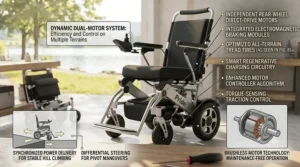
What jumps out first is the 350-lb weight capacity paired with a 500W combined motor output (two 250W units), which is genuinely more muscle than most chairs in its price tier offer. In practice, that motor pairing means it handles gravel driveways, grass, and uneven sidewalk transitions with less hesitation than lighter-motored competitors — reviewers note it holds its line on slopes rated up to 12 degrees, which covers the overwhelming majority of residential curb cuts and ramps. The electromagnetic braking system engages automatically the moment the joystick is released, a detail that matters far more on a hill than in a showroom. Based on the spec comparison, this is the chair for someone who splits time between indoor tile floors and outdoor terrain and doesn’t want to own two mobility devices. Aggregated reviewer sentiment describes it as a meaningful quality-of-life upgrade for users recovering from surgery or managing progressive mobility loss, with the 360-degree joystick praised for being usable by first-time power-chair operators without a learning curve.
Pros:
- ✅ 500W combined motor handles hills and rough ground
- ✅ 350-lb capacity above the category average
- ✅ Automatic electromagnetic braking on release
Cons:
- ❌ Manufacturer doesn’t publish exact battery Wh rating
- ❌ Heavier build than ultra-light travel-focused models
3. Aotedor 22-Mile Electric Wheelchair — longest range in this lineup
The headline number is 22 miles per charge from dual 10Ah lithium batteries, which is close to double what most folding power wheelchairs in this price bracket offer. What the spec sheet won’t tell you, but the aviation-grade aluminum frame construction suggests, is that Aotedor prioritized durability-per-pound over sheer minimal weight — the frame is rated at roughly 1.5 times the strength of standard aluminum alloy while the whole chair still lands at 39 lbs. The 360-degree joystick can be remounted to either armrest, a small but genuinely useful detail for users with dominant-side weakness. Here’s what to weigh: the 220-lb weight capacity is noticeably lower than several competitors on this list, so heavier users should look elsewhere regardless of how attractive the range figure is. Reviewers who prioritize long-distance, multi-errand days without a midday recharge consistently single this model out, and the backing warranty — three years on the main body plus a lifetime warranty on accessories — reflects unusual manufacturer confidence for this price range.
Pros:
- ✅ 22-mile range doubles many rivals in this guide
- ✅ Reinforced aviation-grade aluminum frame
- ✅ Repositionable joystick for left- or right-hand use
Cons:
- ❌ 220-lb weight capacity is lower than most listed here
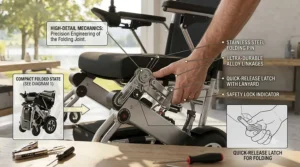
- ❌ Folding mechanism reportedly takes practice to master
4. Journey Air (2026 Model) — one of the lightest folding power chairs available
Journey Health & Lifestyle built this chair around a single priority: minimizing weight for people who fold and lift their chair multiple times a day. At 37 lbs with the battery installed, it sits near the bottom of the weight scale for this entire category, which in practice translates to less strain on a caregiver’s back and an easier one-person lift into a sedan trunk. Here’s what to weigh honestly: the manufacturer’s publicly available materials don’t break out motor wattage or exact mile range the way some competitors do, so if those numbers matter to your decision, it’s worth requesting spec documentation directly from Journey before buying — that’s a case where hedging honestly beats guessing. What we can say with confidence is that the single-fold, one-piece design (rather than a multi-part transportable chair) is squarely aimed at frequent travelers who want to avoid disassembly at every curb. Buyers drawn to this model are typically less focused on rugged terrain performance and more focused on portability above nearly everything else.
Pros:
- ✅ 37-lb total weight near the top of this list
- ✅ Single-fold design avoids multi-piece disassembly
- ✅ Marketed specifically toward frequent travelers
Cons:
- ❌ Motor wattage and mile-range not published by the manufacturer
- ❌ Premium price for the portability it delivers
5. Pride Jazzy Ultra Light — best-known brand backing a carbon-fiber build
Pride Mobility is one of the longest-standing names in powered mobility, and the Jazzy Ultra Light leans on that reputation with an all-carbon-fiber frame that weighs 38 lbs with the battery installed (33 lbs without it). The carbon-fiber construction is doing real work here, not just marketing work — it’s what allows a 300-lb weight capacity and roughly 16-mile range without pushing total weight past 40 lbs, a balance that’s genuinely hard to hit. Based on the spec comparison with newer, less-established brands on this list, the trade-off is a higher price tag, but that premium buys an established parts and service network, which matters enormously three years into ownership when a controller or caster needs replacing. This chair suits buyers who want the reassurance of a legacy medical-equipment manufacturer and plan to keep the chair long enough that manufacturer support becomes relevant. Reviewers frequently cite Pride’s dealer network and warranty responsiveness as the deciding factor over marginally cheaper alternatives.
Pros:
- ✅ Established manufacturer with wide dealer/service network
- ✅ Full carbon-fiber frame at a competitive 38 lbs
- ✅ Solid 300-lb capacity for the weight class
Cons:
- ❌ Higher price than newer direct-to-consumer brands
- ❌ 16-mile range trails the category’s longest-range options
6. ComfyGo Phoenix Carbon Fiber Folding Electric Wheelchair — best premium build for airline travel
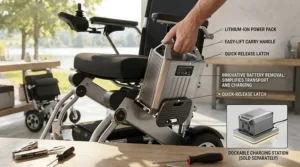
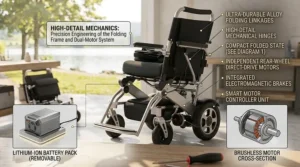
The Phoenix is engineered around a very specific use case: air travel without compromise. Its carbon-fiber primary frame weighs just 26 lbs, and with the controller, footrests, and cushion added, the chair (excluding batteries) comes in at 29 lbs; each of its two 6.6Ah lithium batteries adds roughly 3 lbs, bringing the fully assembled, battery-equipped chair to about 35 lbs. Two 250W brushless motors provide 500W combined output — quiet by design, which matters more than most buyers expect the first time they roll through a hotel hallway at night. What most buyers overlook about this model is the quick-release battery mechanism paired with dual standard lithium-ion batteries, both individually rated well under typical airline lithium thresholds, which is precisely why this chair shows up repeatedly in lightweight folding power wheelchair reviews focused on flying. The 18.5-inch seat and 240-lb capacity are respectable but not class-leading, and there’s no headrest or locked storage compartment included — legitimate trade-offs for the weight savings. This is the chair for someone who flies multiple times a year and wants a single travel-optimized chair rather than a general-purpose one.
Pros:
- ✅ Full carbon-fiber frame at just 35 lbs with batteries
- ✅ Dual quick-release batteries built for air travel
- ✅ Quiet 500W brushless dual-motor system
Cons:
- ❌ No headrest or locked storage compartment
- ❌ 240-lb capacity is modest for a premium-priced chair
7. Forcemech Navigator Pro — best for bariatric support and rough ground
Most folding power wheelchairs top out around 300–350 lbs of capacity; the Navigator Pro breaks that ceiling entirely with a 400-lb rating while still weighing only 60 lbs — a genuinely notable engineering ratio for this category. Its traction-tuned tires are built to handle grass, ramps, sand, and mud, and the one-hand fold mechanism is designed to collapse compactly enough to be wheeled through an airport like rolling luggage rather than carried. Reviewers describe successfully using it in genuinely demanding environments, including beach and uneven-outdoor settings that would stall lighter, smaller-wheeled chairs entirely. The trade-off for that capability is the 60-lb total weight, meaningfully heavier than every other model on this list, which matters if you’re regularly lifting the folded chair into a vehicle without a ramp or hoist. What sets it apart on paper is the warranty structure — five years on the frame, three years on motors, and one year on electronics and batteries — a notably longer commitment than most competitors publish. This is the clear pick for larger-frame users or anyone who needs a chair that won’t buckle on unpaved terrain.
Pros:
- ✅ Industry-leading 400-lb weight capacity
- ✅ Traction tires rated for grass, sand, and mud
- ✅ Five-year frame warranty, longest in this lineup
Cons:
- ❌ 60-lb weight is the heaviest chair in this guide
- ❌ One-hand fold still challenging for some smaller-frame caregivers
Price Range & Value Analysis
Spread across this lineup, prices roughly track three tiers: budget models like the VERPAL sit around $900–$1,200, mid-range all-terrain and long-range chairs like the Hassky and Aotedor land in the $1,300–$1,800 range, and premium carbon-fiber or heavy-duty builds like the Pride Jazzy Ultra Light, ComfyGo Phoenix, and Forcemech Navigator Pro run from roughly $2,200 up toward $3,300 and beyond. It’s worth stressing that these are price ranges only — always check current price on the retailer’s page before buying, since availability and pricing shift frequently and prices may vary by color, battery configuration, or bundled accessories.
Value doesn’t scale in a straight line with price, though. The jump from budget to mid-range typically buys real capability — longer range, higher weight capacity, better terrain handling — while the jump from mid-range to premium increasingly buys weight savings, brand reputation, and travel-specific engineering rather than raw performance. If your daily reality is mostly indoor and short-distance, the mid-range tier likely delivers 90% of the premium experience for 60% of the price.
Practical Usage Guide: Setting Up and Living With Your Folding Power Wheelchair
Getting a new foldable mobility device home is only the beginning. Before first use, fully charge the battery per the manual — most lithium packs in this category ship partially charged and benefit from one full charge cycle before regular use. Check that the seat width, armrest height, and footrest position are adjusted to your body before your first drive, not after; ill-fitted footrests are one of the most common sources of pressure sores reported by long-term users. In the first 30 days, the most common mistake isn’t mechanical at all — it’s overestimating range on a single charge and getting stranded. Build a habit of charging nightly rather than waiting for a low-battery warning.
For maintenance, wipe down the frame and joystick housing weekly, especially after outdoor use, since grit in the folding hinge is the single most common cause of a “stuck” fold reported in owner forums. Check tire pressure or tread monthly if your model uses pneumatic tires, and inspect battery terminals for corrosion every few months, particularly if you live somewhere humid. A folding power wheelchair’s biggest long-term enemy isn’t the motor — it’s neglected hinges and batteries left to fully drain repeatedly, which shortens lithium cell lifespan faster than normal daily use ever would.
Real-World Scenarios: Who Actually Buys a Folding Power Wheelchair
The frequent flier. A 68-year-old retired teacher with two grandchildren living out of state flies four times a year. She needs a genuinely portable power solution that a rental-car attendant or grandchild can fold in under 10 seconds, with batteries that clear airline lithium limits without a fight at the gate. The ComfyGo Phoenix or Journey Air fit this profile far better than a heavier, longer-range chair ever would — for her, weight and airline compliance outrank raw mile range.
The suburban commuter. A 45-year-old with a progressive mobility condition needs to get to a mailbox, a detached garage, and a weekly grocery run on mixed pavement and grass. Range and terrain handling matter more than shaving off the last five pounds, making the Hassky or Aotedor stronger fits than an ultra-light travel chair.
The larger-frame user recovering from surgery. A 300-plus-lb patient needs a chair that won’t be capacity-limited during a months-long recovery, on both hardwood floors and an uneven backyard path. The Forcemech Navigator Pro’s 400-lb rating and rugged tires solve a problem the lighter chairs on this list simply can’t.
Buyer’s Decision Framework
If portability and air travel are your top priority, choose an ultra-light model like the ComfyGo Phoenix or Journey Air, because every pound saved directly reduces lifting strain and airline friction. If your weight capacity needs exceed 300 lbs, choose the Forcemech Navigator Pro, because it’s the only model here engineered specifically around bariatric support without sacrificing outdoor capability. If your budget is under $1,500 and your use is mostly indoor or short-distance, choose the VERPAL, because its trimmed range and capacity won’t be felt in that use case. If you split time between pavement and yard or trail, choose the Hassky or Aotedor, because their motor output and tire design are built for exactly that transition. And if brand longevity and dealer support matter more to you than shaving off a few pounds, choose the Pride Jazzy Ultra Light, because Pride’s service network is difficult for newer brands to match.
How to Choose a Folding Power Wheelchair
Narrowing down the field comes down to a handful of decision points, in roughly this order of importance:
- Weight capacity first. Confirm the chair’s rated capacity comfortably exceeds your body weight — manufacturers rate to a maximum, not a comfortable cruising weight, so build in a margin.
- Total folded weight second. If you or a caregiver will lift it regularly, every five pounds matters more than it sounds like on paper.
- Range against your actual daily distance. Don’t buy 22 miles of range if your longest regular trip is two miles; that capacity comes with added battery weight you may not need.
- Terrain reality, not terrain fantasy. Be honest about whether “all-terrain” claims apply to your actual sidewalks, or whether you’re mostly indoors on smooth flooring.
- Battery documentation, especially if you fly. A collapsible wheelchair with clearly published watt-hour ratings is dramatically easier to clear through airline check-in than one with vague specs.
- Warranty length and manufacturer track record. Longer warranties (like Forcemech’s five-year frame coverage) often signal manufacturer confidence, not just marketing.
- Seat width and adjustability against your body and your doorways. A chair that doesn’t fit through your narrowest interior doorway defeats the purpose of “portable” entirely.
Folding Power Wheelchairs vs Traditional Power Wheelchairs
A traditional (non-folding) power wheelchair typically offers a larger battery, higher top speed, and more adjustable seating — but it usually can’t be lifted by one person and often requires a wheelchair-accessible vehicle or ramp-equipped van to transport. A folding power wheelchair trades some of that raw performance for a single-piece design that collapses small enough for a standard sedan trunk, making it a genuinely different tool rather than simply a lighter version of the same one.
| Factor | Folding Power Wheelchair | Traditional Power Wheelchair |
|---|---|---|
| Typical total weight | 30–60 lbs | 100–250+ lbs |
| Vehicle needed | Standard car/sedan | Wheelchair-accessible vehicle |
| Airline travel | Often airline-compliant | Frequently impractical |
| Typical range | 12–22 miles | Often 15–25+ miles |
| Best for | Travel, moderate daily use | Full-time, heavy daily use |
The practical takeaway: a folding power wheelchair rarely beats a traditional power wheelchair on raw range or seating customization, but it wins decisively on transportability. If you’re primarily comparing this to a manual wheelchair or a mobility scooter rather than a bulkier power chair, the calculus shifts again — scooters typically offer longer range per charge but are harder to fold into a single compact unit, and manual chairs demand physical strength that a power chair removes from the equation entirely.
✨ Don’t Miss These Exclusive Deals!
🔍 Ready to Compare Current Prices?
Take your mobility search to the next level with the models covered in this guide. Click through to check current pricing and availability on any highlighted chair above — these picks are built to help you move through daily life with more independence and less friction. 🚗💨
Common Mistakes When Buying a Folding Power Wheelchair
The most common misstep is buying based on the lightest weight number alone, then discovering the chair’s capacity or range doesn’t match actual daily needs — chasing “lightest possible” often means accepting a lower weight limit or shorter range than the buyer realizes until it’s too late. A second frequent mistake is skipping a doorway and hallway measurement at home before ordering; a chair rated for tight turning radii on paper can still be too wide for a 1970s-era bathroom doorway. Third, many buyers overlook battery documentation entirely until they’re standing at an airline check-in counter being asked for a watt-hour rating they can’t produce — a problem entirely avoidable by reading the spec sheet before travel, not during it. Fourth, some buyers assume “foldable” automatically means “one-person foldable,” when several rugged, higher-capacity models genuinely benefit from two-person folding assistance, at least until the user builds familiarity with the mechanism. Finally, don’t ignore return and warranty policies; a mobility purchase this significant deserves a manufacturer that stands behind it for more than 90 days.
Folding Power Wheelchairs for Seniors and Frequent Travelers
For seniors, the priority list usually differs from a younger, more active user’s: ease of folding without significant upper-body strength, a stable low-speed setting, and dealer or service-network proximity for repairs tend to matter more than top-end range or rugged terrain handling. Models like the Pride Jazzy Ultra Light or Hassky, with their automatic braking and manageable learning curves, fit that profile well. For frequent travelers, airline compliance becomes the dominant factor — a chair’s battery must fall within FAA and airline watt-hour limits, and the U.S. Department of Justice’s ADA guidance confirms that covered public facilities and transportation must accommodate wheelchairs and other power-driven mobility devices, which is worth knowing if a hotel or venue ever questions your right to bring one in (ADA.gov guidance on wheelchairs and mobility aids). Chairs like the ComfyGo Phoenix or Journey Air, built specifically around minimal weight and documented battery specs, tend to reduce friction at security checkpoints and gate check-in far more than heavier, less-documented alternatives.
Long-Term Cost & Maintenance
The sticker price is rarely the full cost story. Replacement batteries for lithium-powered chairs typically run a meaningful fraction of the original chair price every few years, and tire or caster replacement adds smaller but recurring costs over a chair’s lifespan. For eligible users, it’s worth knowing that Medicare Part B can cover power wheelchairs as durable medical equipment when a doctor certifies medical necessity following a face-to-face exam, which can substantially offset total cost of ownership for qualifying buyers (Medicare.gov coverage details for wheelchairs and scooters). Buyers paying out of pocket should weigh a longer manufacturer warranty — like Forcemech’s five-year frame coverage — against a shorter one, since an unexpected frame or motor failure outside warranty can cost nearly as much as a battery replacement. Total cost of ownership, not sticker price, is the number that should actually drive a budget-conscious decision.
Safety, Regulations & Airline Compliance Guide
Lithium-ion batteries in folding power wheelchairs are federally regulated for air travel: the FAA limits installed lithium-ion batteries in mobility devices to 300 watt-hours, with spare batteries capped at 300Wh (one spare) or 160Wh each (two spares), and requires that batteries be protected from short circuits and, in many cases, removed and carried in the cabin rather than checked as cargo (FAA PackSafe guidance on wheelchairs and mobility devices). Individual airlines can apply stricter rules on top of the federal floor, so confirming your specific airline’s policy 48–72 hours before a flight is genuinely worth the ten minutes it takes. Beyond air travel, general safety practice includes never operating a folding power wheelchair with a battery showing signs of swelling or damage, keeping charge cables away from tripping paths, and confirming any slope or ramp you regularly use falls within your specific chair’s rated incline before relying on it daily.
FAQ
❓ Are folding power wheelchairs airline approved?
❓ How much do folding power wheelchairs weigh?
❓ Can I get a folding power wheelchair through Medicare?
❓ What's the difference between a folding power wheelchair and a scooter?
❓ How long do folding power wheelchair batteries last?
Conclusion
There isn’t a single “best” folding power wheelchair — there’s a best one for your body weight, your travel habits, and the ground you actually roll over most days. If you fly often, weight and documented battery specs should outrank almost everything else; if you need serious weight capacity or rough-terrain capability, the Forcemech Navigator Pro earns its extra bulk; and if you’re simply looking for a dependable, well-supported chair for daily errands, the Hassky or Pride Jazzy Ultra Light both make a strong case. Whichever direction you lean, treat this guide’s top rated folding electric wheelchairs as a shortlist to verify against your own doorways, your own daily mileage, and your own airline’s current battery rules — not a substitute for that final check. A genuinely portable power solution is one that fits your actual life, not just an impressive spec sheet.
✨ Ready to Find Your Fit?
🔍 Compare current pricing on any of the seven chairs above, check availability with your preferred retailer, and take the next step toward a folding power wheelchair that actually matches how you live. 🚗♿
Recommended for You
- 7 High Speed Outdoor Power Wheelchair Picks on Amazon (2026)
- 7 Best Outdoor Rear Wheel Drive Power Wheelchairs 2026
- Bariatric Rear Wheel Drive Power Wheelchair: 7 Best 2026 Picks
Disclaimer: This article contains affiliate links. As an Amazon Associate, I earn from qualifying purchases. If you purchase products through these links, we may earn a small commission at no additional cost to you.
✨ Found this helpful? Share it with your friends! 💬🤗
