In This Article
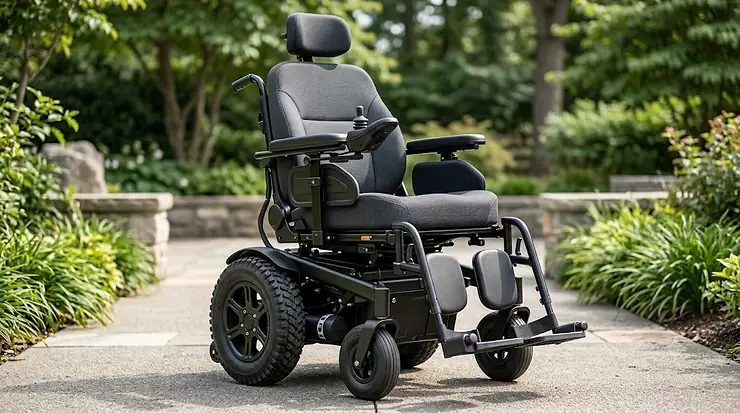
A bariatric rear-wheel-drive power wheelchair is a motorized wheelchair built with reinforced frames and higher weight capacities — usually starting around 350–400 lbs and going up past 600 lbs — paired with drive wheels mounted at the back of the base instead of the middle or front. That rear placement is what gives these chairs their long, stable wheelbase, strong outdoor tracking, and the kind of straight-line confidence that makes them a popular choice for heavier-duty, longer-distance use.
This matters more than it sounds like it should. Roughly 40% of U.S. adults now live with obesity, including nearly 1 in 10 with severe obesity, according to the most recent CDC data covering August 2021 through August 2023. That’s a lot of people for whom a “standard” 250-lb-rated power chair simply isn’t an option — and it’s why bariatric mobility equipment has shifted from a niche medical category to a mainstream one, with everything from clinical-grade powerbases to budget folding chairs now showing up directly on Amazon.
This guide focuses specifically on the rear-wheel-drive (RWD) configuration because it’s the layout most heavy-duty and outdoor-oriented bariatric chairs use, and because “rear wheel drive” handles very differently than the mid-wheel-drive chairs you’ll see recommended for tight indoor spaces. We dug into seven real, currently listed bariatric rear-wheel-drive power wheelchairs on Amazon — pulling actual weight capacities, motor specs, and drive configurations rather than marketing copy — so you can see how they actually compare.
💬 Quick note: Power wheelchairs are medical equipment. Nothing here replaces a fitting from a physical therapist or Assistive Technology Professional (ATP), especially for bariatric sizing, but you’ll be a much better-informed shopper after reading this.
Quick Comparison: 7 Bariatric Rear-Wheel-Drive Power Wheelchairs at a Glance
| Chair | Weight Capacity | Top Speed | Range (mfr. rated) | Foldable | Best For |
|---|---|---|---|---|---|
| Merits Health Atlantis P710 | 600 lbs | 5 mph | Up to 32 mi | No | Highest capacity & range, clinical-grade base |
| EWheels EW-M51 | 400 lbs | 5 mph | Up to 15 mi | No | Reclining captain’s seat, travel power chair |
| ComfyGo Majestic 440 HD Plus | 440 lbs | 4 mph | 12–25 mi (battery dependent) | Yes | Airline-compliant, travel-friendly bariatric |
| Porto Mobility Ranger Quattro “The Beast” | 550 lbs | Up to 7 mph | Up to 40 mi | Yes | Highest-capacity foldable outdoor chair |
| Porto Mobility Ranger Reclinable | 400 lbs | 5 mph | Up to 18 mi | Yes | Reclining backrest in a folding frame |
| Eagle HD Bariatric Folding Chair | 400 lbs | ~3.75 mph | Up to 22 mi | Yes | Lightest folding bariatric option (~50 lbs) |
| Electra 7 HD Wide Bariatric | 400 lbs | ~3.75–4 mph | Dual battery packs | Yes | Widest stock seat (21″) without an extension kit |
A few things jump out here. The non-folding “clinical” bases — the Atlantis P710 and EW-M51 — win on weight capacity, range, and ride quality, but they ship via freight and aren’t something you fold into a trunk. The foldable chairs trade some of that capacity and smoothness for portability, and “The Beast” is the outlier: a folding chair that still claims a 550-lb rating, which is unusually high for that category. Notice, too, that several of the budget folding chairs land at nearly identical specs — that’s not a coincidence, and we’ll get into why below.
💬 Just one click — help others make better buying decisions too!😊
✨ Don’t Miss the Details
🔍 Scroll down for a full breakdown of all seven chairs, including the trade-offs the spec sheets don’t spell out for you.
Benefits of Rear-Wheel Drive vs. Other Power Wheelchair Configurations
| Drive Type | Indoor Turning | Outdoor Stability | Typical Use Case |
|---|---|---|---|
| Rear-wheel drive (RWD) | Widest turning radius of the three | Best — tracks straight, handles longer distances well | Outdoor use, longer commutes, heavier-duty chairs |
| Mid-wheel drive (MWD) | Tightest turning radius | Can lose traction on soft or uneven ground (“high-centering”) | Indoor navigation, tight hallways, frequent pivots |
| Front-wheel drive (FWD) | Moderate — needs more room to turn | Good obstacle-climbing, but rear end can swing during turns | Mixed indoor/outdoor, climbing curbs and thresholds |
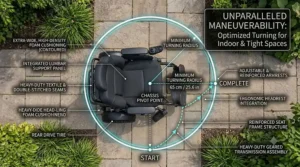
Independent turning-performance testing out of the University of Pittsburgh’s Human Engineering Research Laboratories found that mid-wheel-drive chairs needed measurably less space to complete a 360-degree turn than front- or rear-wheel-drive models, while rear- and front-wheel drive chairs performed about the same as each other on most other turning tasks. In plain terms: rear-wheel drive gives up some of that tight-pivot convenience in exchange for a longer, lower center of gravity — which is exactly the trade most bariatric chair manufacturers are willing to make, since stability under a heavier load and a longer wheelbase matter more once you’re carrying 400+ lbs at speed outdoors.
The 7 Best Bariatric Rear-Wheel-Drive Power Wheelchairs
1. Merits Health Atlantis P710
The Atlantis is built and sold specifically as a “Super Heavy Duty RWD Powerbase” — Merits isn’t being subtle about the drive type, and the spec sheet backs it up. It carries a 600-lb weight capacity, a 24-inch extra-wide, extra-high captain’s seat, and dual high-torque inline motors that handle 10-degree inclines without strain. Full front-and-rear suspension and 12-inch drive wheels keep the ride composed even at its 5-mph top speed.
What the spec sheet doesn’t say outright: at 600 lbs of capacity, this isn’t a folding travel chair — it’s a non-folding clinical base that ships on a pallet via freight, and it’s built for users who need both the highest possible capacity and real outdoor range (up to 32 miles per charge is well beyond what most folding bariatric chairs can manage). This is the chair to consider if you’ve outgrown the 400-450 lb tier other options top out at, or if a long battery range genuinely matters for your day.
✅ Pros: Highest capacity in this list · longest range · full suspension and adjustable seat depth
❌ Cons: Not foldable · heavier delivery and setup logistics · premium-tier pricing for the segment
Best for: Users near or above 450 lbs who need a long-range, clinical-grade rear-wheel-drive base rather than a travel chair.
2. EWheels EW-M51
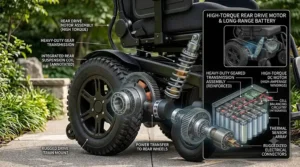
EWheels markets the EW-M51 plainly as a “2 Motor Rear-Wheel Drive” chair, and the build matches that description: 14-inch rear wheels paired with smaller 9-inch front casters, a stability-tuned suspension system, and a 22-inch reclining captain’s chair with a swing-away joystick mount. It’s rated for 400 lbs, hits 5 mph, and covers up to 15 miles per charge.
The base unit alone weighs over 150 lbs before batteries, which is the real story here — this is a “travel power chair” in the sense that it’s not meant to live in a clinic, but it’s also not something you’re folding into a sedan trunk. Where it earns its keep is the reclining captain’s seat, which is a genuine comfort upgrade over the basic high-back seats on most folding bariatric chairs, and the suspension system, which smooths out the kind of uneven sidewalks and driveway transitions that can rattle lighter chairs.
✅ Pros: True 2-motor RWD with stability suspension · reclining captain’s seat · solid 5 mph top speed
❌ Cons: Heavy to lift or transport · shorter range than the Atlantis or “The Beast”
Best for: Someone who wants a sturdy, non-folding rear-wheel-drive chair with reclining comfort, without stepping up to the Atlantis’s size and price tier.
3. ComfyGo Majestic 440 HD Plus
ComfyGo’s listing is explicit about the drive configuration, describing the 440 HD Plus as a “rear-wheel drive powerchair” with 12-inch rear wheels and 8-inch front wheels — and at a 440-lb capacity with a folding frame, it’s hitting a combination that’s genuinely hard to find. Dual 250W brushless motors (500W combined) power it to a 4-mph top speed, and you get a real choice on batteries: a 12Ah pack that’s airline- and cruise-approved for around 12 miles of range, or a 26Ah pack that stretches to roughly 25 miles but loses travel-battery compliance.
The trade-off for that 440-lb rating in a foldable frame is top speed — 4 mph is noticeably more conservative than the EW-M51 or “The Beast.” If you split your time between home and travel and don’t need to go fast, that’s a reasonable trade. If you’re covering real outdoor distance regularly, it’ll feel slow.
✅ Pros: 440-lb capacity in a 61.5-lb foldable frame · airline-compliant battery option · 3-year frame warranty
❌ Cons: Lower top speed than other RWD options here · larger 26Ah battery isn’t travel-approved
Best for: Travelers who need a high weight capacity and a battery they can actually take on a plane or cruise.
4. Porto Mobility Ranger Quattro (“The Beast”)
This is the highest-capacity folding chair in the lineup by a wide margin: a 550-lb bariatric rating, dual 500W brushless motors, a 14-inch rear / 9-inch front wheel setup consistent with the rest of Porto’s rear-drive Ranger line, and a manufacturer-claimed top speed up to 7 mph with a range up to 40 miles on its dual lithium batteries. For a chair that still folds, that’s a genuinely unusual spec sheet.
Here’s the part worth knowing before you buy: a verified Amazon customer review of this exact model flags that the motors aren’t “soft-start” — meaning power comes on abruptly rather than ramping in smoothly, which the reviewer described as producing jerky, hard-to-control movement at low speed in tight indoor spaces like doorways and furniture. That’s a real, useful data point: this chair’s strengths (raw power, high top speed, long range) are outdoor strengths, and the same motors that make it capable on grass and gravel can make slow, precise indoor maneuvering trickier than the spec sheet alone would suggest.
✅ Pros: Highest capacity of any folding chair here · long range · genuinely strong outdoor performance
❌ Cons: Reported jerky low-speed control indoors · heaviest and most powerful chair to manage in tight spaces
Best for: Bariatric users who prioritize outdoor range and capacity over delicate indoor maneuvering.
5. Porto Mobility Ranger Reclinable
The Reclinable shares Porto’s folding Ranger platform but adds a virtual-position reclining backrest — a feature that’s surprisingly rare in lightweight folding power chairs. It’s rated for 400 lbs, uses dual 250W brushless motors driving 12.5-inch rear wheels (versus 8-inch fronts, the clearest visual tell of its rear-wheel-drive setup), reaches 5 mph, and covers up to 18 miles per charge on its dual lithium battery packs.
The recline feature is the differentiator worth weighing: if you spend long stretches of the day in the chair, being able to shift position to relieve pressure matters more than another mile of range or another half-mph of top speed. It folds in seconds and is airline-and-cruise-travel-oriented, similar to the rest of the Ranger line, but the recline mechanism does add a bit of mechanical complexity compared to a fixed-back folding chair.
✅ Pros: Reclining backrest in a foldable frame · solid 5 mph speed and 18-mile range · quick fold
❌ Cons: Recline mechanism adds complexity versus simpler fixed-back folders · 400-lb cap is mid-pack, not top-tier
Best for: Users who need pressure-relief recline and portability more than maximum weight capacity.
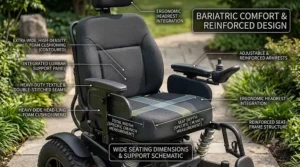
6. Eagle HD Bariatric Folding Electric Wheelchair
The Eagle HD is built around a simple pitch: bariatric capacity (400 lbs) without bariatric bulk. At roughly 50 lbs, it’s one of the lightest chairs in this entire list, built on dual 250W motors and large rear drive tires paired with smaller front casters — the same rear-heavy wheel sizing pattern you see across this whole budget folding category. It includes a wireless remote for caregiver-assisted operation, a USB-charging joystick, and a memory-foam seat.
The honest way to frame this chair: it’s not trying to compete with the Atlantis or “The Beast” on raw power or range. It’s competing on the question “how light can a 400-lb-rated power chair actually be?” — and the answer, at around 50 lbs, is genuinely impressive for this weight class. The seat ships at roughly 19 inches wide with an included extension kit to reach 24 inches, so check listing variants carefully if seat width is your priority.
✅ Pros: Exceptionally light for its weight rating · wireless remote and USB joystick charging · folds quickly
❌ Cons: Lower top speed (~3.75 mph) than RWD chairs in higher tiers · base seat needs the extension kit for full width
Best for: Buyers who need 400-lb capacity but can’t manage lifting a heavy chair into a vehicle.
7. Electra 7 HD Wide Bariatric Foldable Wheelchair
The Electra 7 HD is close enough to the Eagle HD in chassis design, motor specs, and weight that they’re almost certainly built on the same general manufacturing platform — which is worth knowing, because it means the real decision between them comes down to one thing: seat width. The Electra 7 HD ships with a 21-inch memory-foam seat standard (expandable to 24 inches between armrests with the included kit), versus the Eagle HD’s narrower stock width before its own extension kit.
Beyond that, the rest of the package matches its sibling closely: 400-lb capacity, dual 250W motors, large rear drive tires, dual battery packs for extended range, a wireless remote, and a freewheel/neutral mode so a caregiver can push it manually if the battery runs out. If hip room is your main constraint and you don’t want to deal with an extension kit out of the box, this is the more practical pick of the two.
✅ Pros: Widest stock seat in the folding bariatric category · dual battery packs · freewheel mode for manual pushing
❌ Cons: Nearly identical underlying chassis to cheaper competitors · same modest top speed as the Eagle HD
Best for: Buyers who specifically need extra hip width and don’t want to rely on an add-on extension kit.
✨ Don’t Miss These Picks!
🔍 Tap any “View on Amazon” link above to check current availability and pricing before they change.
Measuring Your Home Before You Buy
A bariatric rear-wheel-drive chair has a longer wheelbase than a standard power chair, and that changes what “fits through the door” actually means. Before you buy:
- Measure your narrowest doorway’s clear width, not the frame-to-frame width — door hardware and trim eat into usable space. For reference, the ADA’s accessible-route standard calls for a minimum 32-inch clear doorway width and a 36-inch continuous hallway width, which is a reasonable benchmark even in a private home, per the U.S. Access Board’s guide to accessible routes.
- Check your tightest turning point — bathrooms and kitchen galleys are the usual culprits. Rear-wheel-drive chairs need more room to pivot than mid-wheel chairs, so a hallway that “just barely” fits a standard wheelchair may not work the same way here.
- Measure threshold heights at every doorway leading outside; anything over about half an inch can be a real obstacle for a heavier chair.
- Confirm your charging setup — clinical bases like the Atlantis charge in place, while several folding chairs let you pull batteries for indoor charging at a counter or table.
- If you drive, check your vehicle’s ramp or lift rated capacity against the chair’s loaded weight (chair plus batteries plus rider), not just the chair’s empty weight.
Real-World Scenarios: Matching the Right Chair to Your Life
The mostly-at-home user. If 80% of your time in the chair is indoors — kitchen, bedroom, bathroom — a true mid-wheel-drive chair will usually serve you better than anything on this list. But if you’re committed to rear-wheel drive for its outdoor stability and you still need to get around the house, look at the narrower-wheelbase folding options here (the Eagle HD or Electra 7 HD) over the longer, more powerful Beast.
The active outdoor user. Someone who’s regularly out on sidewalks, at parks, or covering real distance benefits most from the chairs built with outdoor performance as the priority: the Merits Atlantis P710 for maximum range and a smooth clinical suspension, or “The Beast” if you need that same outdoor capability in a chair that still folds for occasional storage.
The frequent traveler. If you fly, cruise, or simply need to load a chair into a car trunk regularly, airline-battery compliance and fold time matter more than top-end range. The ComfyGo Majestic 440 HD Plus (with its 12Ah airline-approved battery option) and the Porto Mobility Ranger Reclinable are both built with this exact use case in mind.
How to Choose a Bariatric Rear-Wheel-Drive Power Wheelchair
- Build in a weight-capacity buffer. Don’t shop right at your body weight’s edge — a chair rated close to your actual weight ages faster and performs worse under load. Many mobility retailers suggest choosing a capacity rating at least 25–30 lbs above your weight.
- Measure seat width and depth, not just the weight rating. Two chairs rated for the same 400 lbs can have very different seat dimensions, as the Eagle HD and Electra 7 HD comparison above shows.
- Decide how much you actually need outdoors. Rear-wheel drive is the right call for outdoor stability and speed; if you live in a smaller, tightly laid-out home, weigh that against the tighter turning radius you’d get from mid-wheel drive instead.
- Match portability to your real lifestyle. Folding chairs are easier to store and transport but generally cap out lower on weight capacity and ride quality than fixed clinical bases.
- Check the real battery range you need, not the rated one — see the section below on real-world performance.
- Look at the seat type. Captain’s chairs (common on the higher-capacity models here) tend to offer more lateral support than basic sling seats, which matters more as capacity goes up.
- If cost or insurance matters, check the Medicare coding tier your weight falls into before you fall in love with a specific chair — see the Medicare section below.
Common Mistakes When Buying a Bariatric Power Wheelchair
- Buying on weight capacity alone. A 600-lb-rated chair with a narrow 20-inch seat may fit a heavier user’s weight limit but not their actual body width — capacity and seat dimensions are two separate specs.
- Ignoring the drive type entirely. Plenty of buyers pick a chair on looks or price and only discover the turning-radius trade-offs of rear-wheel drive after it’s hard to maneuver in their kitchen.
- Assuming “foldable” means “lightweight.” Some foldable bariatric chairs still weigh 60+ lbs unfolded and require real effort to lift into a vehicle.
- Overlooking battery type. Sealed lead-acid batteries (common on older or lower-cost units) are heavier and need more frequent replacement than the lithium packs increasingly standard on newer folding chairs.
- Skipping the doorway-measuring step. This is the single most common return reason cited by mobility retailers — the chair works fine, it just doesn’t fit through the bathroom door.
Rear-Wheel Drive vs. Mid-Wheel Drive: Which Fits a Heavier-Duty Chair?
Manufacturers default to rear-wheel drive for most bariatric and heavy-duty chairs for a structural reason as much as a performance one: a longer wheelbase with the drive wheels at the back spreads a heavier frame’s weight more evenly and keeps the chair tracking straight at speed, which matters more once you’re moving 400+ lbs of combined chair-and-rider weight outdoors. Mid-wheel drive’s tight turning radius is genuinely better for navigating indoors, but it relies on caster wheels at both the front and back of the drive wheel — and on soft or uneven ground, those casters can dig in and cause the main drive wheel to lose contact entirely, a problem rear-wheel-drive chairs are far less prone to.
The honest takeaway: if your daily life is mostly hallways and doorways, don’t force yourself into rear-wheel drive just because it’s common in the bariatric category — a mid-wheel bariatric chair exists and may suit you better. If outdoor distance, speed, and stability on uneven ground are real priorities, rear-wheel drive earns its place as the default for a reason.
What to Expect: Real-World Speed, Range & Ride Comfort
The numbers on a spec sheet and the numbers you’ll actually experience aren’t quite the same thing. A 4–5 mph top speed is roughly a brisk walking pace — comfortable for sidewalks and store aisles, but not fast enough to keep up with vehicle traffic, which is why most of these chairs are built for sidewalks and paths rather than roads.
Range is where expectations need the most adjustment. Manufacturer-rated ranges are measured under close-to-ideal conditions — flat ground, moderate temperature, a lighter test rider. Real-world range on a bariatric chair, carrying a heavier rider over mixed terrain, commonly comes in 15–25% lower than the rated figure. So a chair rated for 22 miles is more realistically a 16–19 mile chair on an average day — still plenty for most errands and outings, but worth knowing before you plan a long trip around the spec-sheet number.
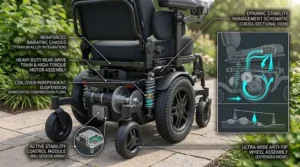
Ride comfort tracks closely with suspension. The clinical bases (Atlantis P710, EW-M51) include full or partial suspension systems designed to absorb bumps before they reach the seat; most budget folding chairs rely on tire cushioning alone, which is fine on smooth pavement but noticeably rougher over cracked sidewalks, gravel, or grass.
Medicare, Insurance & the Real Cost of Ownership
Medicare classifies power wheelchairs by weight capacity using HCPCS codes, and the bariatric tier is split into clear bands. According to Medicare’s published wheelchair and scooter coverage guide, Group 2 power wheelchairs are coded by capacity as follows:
| HCPCS Code | Classification | Weight Capacity |
|---|---|---|
| K0824 / K0825 | Heavy duty | 301–450 lbs |
| K0826 / K0827 | Very heavy duty | 451–600 lbs |
| K0828 / K0829 | Extra heavy duty | 601 lbs and up |
This matters for two reasons. First, it tells you which capacity “tier” the equipment world already treats as standard — the 400–450 lb chairs in our list (EW-M51, ComfyGo 440 HD Plus, Eagle HD, Electra 7 HD) sit in the same band Medicare calls “heavy duty,” while the Atlantis P710’s 600-lb rating lands at the very top of “very heavy duty.” Second, if you’re hoping for any insurance contribution, Medicare’s power mobility device coverage requires a face-to-face mobility exam, a written order from your physician, and documentation that the chair is primarily needed for use inside the home — criteria spelled out in CMS’s power mobility device coverage policy. Equipment purchased directly off Amazon generally isn’t billed through Medicare’s DME benefit, so if insurance coverage matters to you, that’s a conversation to have with a durable medical equipment (DME) supplier and your physician before you buy retail.
Ongoing costs to budget for beyond the purchase price: battery replacement (lithium packs on folding chairs typically last longer than sealed lead-acid batteries on older-style units, but both wear out), tire replacement on chairs that see regular outdoor use, and the cost of a professional ATP fitting if you go that route instead of buying off the shelf.
Features That Actually Matter (and a Few That Don’t)
Matters a lot:
- Suspension quality, especially at higher weight capacities where unsuspended ride quality degrades fastest
- Seat-to-floor height and seat type (captain’s chair vs. sling) for comfort and lateral support
- A freewheel/neutral mode, so the chair can be pushed manually if the battery dies away from an outlet
- Swing-away or flip-up armrests, which make transfers in and out of the chair meaningfully easier
- Anti-tip wheels, particularly on any chair you’ll use on ramps or slopes
Matters less than it looks:
- Frame color options — purely cosmetic
- Cup holders, phone mounts, and similar accessories — nice extras, not buying criteria
- Top speed beyond about 5 mph for most users — few situations call for it, and higher speed at higher weight increases stopping distance
- Marketing language like “all-terrain” — useful as a general signal, not a substitute for checking the actual incline rating and tire type
Safety & Weight-Capacity Rules Worth Knowing
Don’t buy a chair rated right at your current body weight — weight tends to fluctuate, and a chair operating consistently near its limit wears out its motor, frame, and suspension faster than one with headroom. Always confirm a chair’s total width (including armrests) against your doorways, not just the seat width, since several inches get added on each side for the frame and arms.
If a chair advertises a specific incline or grade rating, take it as a ceiling, not a target — manufacturer climbing-angle ratings are typically tested under controlled conditions, not on a wet driveway. And if you ever swap or replace a battery, stick to the manufacturer’s specified type and rating; mixing in an uncertified or mismatched battery pack on a power mobility device is a real fire and performance risk, not just a warranty issue.
None of this replaces a proper fitting. A bariatric chair interacts with body shape, transfer ability, home layout, and medical needs in ways a spec sheet can’t fully capture — a physical therapist or ATP can flag issues a self-directed purchase might miss entirely.
Frequently Asked Questions
❓ What weight capacity counts as 'bariatric' for a power wheelchair?
❓ How fast do bariatric rear-wheel-drive power wheelchairs go?
❓ Can a rear-wheel-drive power wheelchair be used indoors?
❓ Does Medicare cover a bariatric rear-wheel-drive power wheelchair?
❓ How do I know what size bariatric power wheelchair I actually need?
Final Thoughts
There’s no single “best” bariatric rear-wheel-drive power wheelchair — there’s a best one for your home, your daily distance, and your body. If you need the highest capacity and longest range and don’t mind a non-folding clinical base, the Merits Atlantis P710 is the clear ceiling of this list. If portability matters more, the ComfyGo Majestic 440 HD Plus and Porto Mobility Ranger Reclinable both manage real bariatric capacity in frames built to travel. And if raw outdoor power in a folding chair is the priority, “The Beast” delivers it — with the tight-space caveat worth weighing first.
What matters most across all seven: measure your doorways before your weight capacity, check the real-world range math before the rated number, and treat the spec sheet as a starting point rather than the whole story.
✨ Found the right chair? 💬
🤗 Check current pricing and availability on Amazon using the links above before you decide.
Keep Exploring
- 7 Best Heavy Duty Rear Wheel Drive Wheelchairs in 2026
- 7 Best Rear Wheel Drive Wheelchairs for Hills That Actually Climb (2026)
- 7 Best Rear Wheel Drive Power Wheelchairs in 2026
Disclaimer: This article contains affiliate links. As an Amazon Associate, I earn from qualifying purchases. If you purchase products through these links, we may earn a small commission at no additional cost to you.
✨ Found this helpful? Share it with your friends! 💬🤗
