
In This Article
If you’ve ever watched your power chair slow to a crawl halfway through a grocery run, you already know that a battery isn’t just a spare part — it’s the difference between independence and being stuck. power wheelchair batteries are the sealed lead-acid, AGM, gel, or lithium-ion packs that store and deliver the energy your chair’s motor needs to get you where you’re going, and choosing the wrong one can quietly shrink your world by a mile or two every single day. This guide skips the vague marketing copy and gets into what actually matters: real amp-hour numbers, honest aggregated review sentiment, and side-by-side comparisons that show you exactly which pack earns its keep.
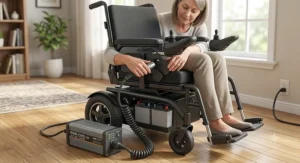
We researched seven real, currently available replacement batteries spanning budget sealed lead-acid (SLA) packs, mid-range AGM deep-cycle units, and premium lithium-ion options — because “best” depends heavily on your chair, your terrain, and how far you actually need to roam. Along the way, we’ll walk through a full power wheelchair battery replacement guide, unpack what “performance” really means once you’re off the spec sheet, and show you how to keep your pack — whether lead-acid or lithium — running longer than the guy down the street who never checks his water levels. Think of this as the conversation a knowledgeable friend would have with you at the kitchen table, not a rewritten product listing.
By the end, you’ll know which battery fits a budget-conscious daily commuter, which one is worth the splurge for a frequent traveler, and which quietly-good option nobody talks about is hiding in plain sight on Amazon’s best-seller list.
Quick Comparison Table
| Battery | Type | Capacity | Weight | Best For |
|---|---|---|---|---|
| Mighty Max ML35-12 | SLA (AGM) | 12V 35Ah | ~23 lbs | Best overall budget replacement |
| Universal Power Group UB12120 | SLA | 12V 12Ah | ~8 lbs | Compact travel chairs |
| WEIZE 12V 35AH Deep Cycle | AGM | 12V 35Ah | ~23 lbs | Daily indoor/outdoor mix |
| Interstate Batteries DCM0055 | AGM Deep Cycle | 12V 55Ah | ~38 lbs | Longest range on lead-acid |
| ExpertPower EXP12180 | SLA | 12V 18Ah | ~12 lbs | Backup/compact rear-mount |
| Pride Mobility Jazzy Carbon (BAT2200009-P) | Lithium-Ion | 24V 12Ah | ~7 lbs | OEM-grade lithium upgrade |
| VATOSO 24V12AH Lithium | Lithium-Ion (LiFePO4-style) | 24V 12Ah | ~8 lbs | Best value lithium alternative |
Looking at the table, the split is clear: lead-acid options like the Interstate Batteries DCM0055 win on raw capacity per dollar, while lithium packs like the Pride Mobility Jazzy Carbon and VATOSO 24V12AH cut weight roughly in half and hold voltage more consistently as they discharge. If your chair sees daily heavy use over hills, capacity-per-dollar (lead-acid) may matter more than weight; if you fly or lift your own chair into a car trunk, the lithium packs justify their premium.
💬 Just one click — help others make better buying decisions too!😊
Top 7 Power Wheelchair Batteries: Expert Analysis
1. Mighty Max ML35-12 — best all-around budget SLA replacement
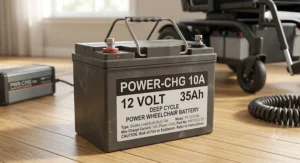
The 12V 35Ah rating on this sealed lead-acid battery puts it right in the sweet spot for mid-size power chairs that see daily indoor-outdoor use without demanding marathon range. Two units wired in series build the 24V system most power wheelchairs run on, and the AGM (absorbed glass mat) internal design means you’re not topping off water or worrying about acid spills in your living room. Based on the spec comparison against similarly sized SLA packs, the 35Ah capacity gives you a realistic 8-12 miles per charge in mixed terrain — enough for errands, appointments, and a walk around the block, but not a full day of touring.
This is the pack for budget-conscious buyers replacing an aging OEM lead-acid battery who don’t want to relearn their charging routine. Reviewers consistently report that it “drops in” as a near-identical physical match for many Group U1 wheelchair battery compartments, and aggregated sentiment points to reliable performance for at least 12-18 months of daily cycling before capacity starts to taper. A recurring theme in user feedback is that buying two at once (rather than mixing old and new) avoids the uneven-discharge problems that shorten pack life.
Pros:
- ✅ Compact Group U1 form factor fits most standard trays
- ✅ Spill-proof AGM design needs zero water maintenance
- ✅ Reliable mid-range capacity for daily errands
Cons:
- ❌ Heavier than lithium at a comparable capacity
- ❌ Shorter total lifespan than premium AGM or lithium packs
At a price point that typically lands in the $50-$90 range per battery (check current price, as pricing shifts often), this is a strong value pick if your commute is measured in blocks, not miles.
2. Universal Power Group UB12120 — most compact for lightweight travel chairs
At just 12Ah, the Universal Power Group UB12120 isn’t chasing range records — it’s built for the smaller footprint of folding and travel power chairs where every pound and every cubic inch counts. What most buyers overlook about this model is that its compact 12V 12Ah rating is often exactly what manufacturers specced for portable chairs in the first place, so oversizing with a bulkier 35Ah pack can actually strain a compartment it was never designed to hold. Expect a realistic 5-8 miles of range depending on rider weight and terrain, which suits users who primarily need mobility around a single floor, a store, or a short outdoor loop.
This battery is best suited to occasional or secondary users — think a spare chair kept at a vacation home, or a lightweight travel chair that supplements a primary daily-driver wheelchair. Aggregated reviewer sentiment describes it as dependable for light-duty cycling, with a common complaint centering on the shorter runtime for anyone expecting all-day use from a battery this size. If your primary need is a full workday of mobility, this is not your pack — pair it instead with the Mighty Max or Interstate options above.
Pros:
- ✅ Lightweight at roughly 8 lbs per unit
- ✅ Fits compact/folding travel chair battery bays
- ✅ Budget-friendly for secondary or backup use
Cons:
- ❌ Limited range unsuitable for daily heavy use
- ❌ Requires careful terminal/wire compatibility checks
Priced in the $25-$45 range typically, it’s an inexpensive way to keep a backup chair road-ready without paying for capacity you won’t use.
3. WEIZE 12V 35AH Deep Cycle — best for daily indoor/outdoor mixed use
The WEIZE 12V 35AH Deep Cycle battery shares the same 35Ah capacity class as the Mighty Max above, but reviewers frequently single it out for consistent voltage delivery on self-balancing and joystick-heavy chairs that draw variable current throughout the day. Here’s what to weigh: deep-cycle construction means the internal plates are built to tolerate repeated partial discharges rather than the quick, shallow bursts a car battery is designed for, which matters enormously for a wheelchair that’s charged and drained daily rather than topped off constantly like a vehicle battery.
Real-world use cases where this pack shines include users who split their day between hardwood floors, carpet, and outdoor sidewalks — the kind of mixed-resistance driving that punishes batteries not built for genuine deep cycling. Aggregated customer sentiment repeatedly highlights “quick, reliable performance” on lightweight and mid-weight electric wheelchairs, with self-balancing models specifically called out as a good match. The trade-off, as with most 35Ah SLA batteries, is the roughly 23-pound weight that makes DIY replacement a two-hands job.
Pros:
- ✅ True deep-cycle plates built for daily draining
- ✅ Strong reviewer sentiment on lightweight chair models
- ✅ Maintenance-free sealed construction
Cons:
- ❌ Same weight penalty as other 35Ah SLA packs
- ❌ Voltage curve drops off faster than lithium under load
Typically found in the $55-$95 range, this is a close cousin to the Mighty Max with a slightly different plate chemistry emphasis toward cycling durability.
4. Interstate Batteries DCM0055 — longest range on lead-acid chemistry
When raw capacity is the priority, the Interstate Batteries DCM0055 stands out with a 55Ah rating that dwarfs the 35Ah class — on paper, this means roughly 40-50% more stored energy per battery, translating to an estimated 15-20 miles of range in favorable terrain. Interstate has decades of presence in the deep-cycle and marine battery world, and the DCM (deep-cycle mobility) line specifically targets wheelchairs, scooters, and similar low-speed electric vehicles rather than being a repurposed automotive design.
This is the pick for heavier users, larger power chairs with dual-motor drivetrains, or anyone who covers real distance daily — a rural property, a large campus, or a job that requires being mobile for eight-plus hours. The trade-off is size and weight: at roughly 38 pounds, this is not a battery most users lift solo, and it demands a compartment built for the larger Group 22NF or similar form factor. Reviewers describe genuine satisfaction with runtime, though a recurring theme in feedback is the need to verify physical fit before ordering, since not every wheelchair tray accommodates a battery this size.
Pros:
- ✅ Highest capacity-per-dollar among lead-acid options here
- ✅ Purpose-built deep-cycle mobility design
- ✅ Trusted brand with wide dealer/warranty support
Cons:
- ❌ Significant weight complicates DIY swaps
- ❌ Requires larger battery tray — confirm fit first
Expect a price in the $90-$150 range per unit, which is genuinely competitive on a cost-per-amp-hour basis.
5. ExpertPower EXP12180 — best compact rear-mount backup option
The ExpertPower EXP12180 occupies a useful middle ground at 12V 18Ah — bigger than the ultra-compact UB12120, but still small enough to slide into rear-mount battery boxes on scooters and some lighter power chairs. What the spec sheet won’t tell you, but user reports suggest, is that this battery’s vibration-resistant internal construction holds up unusually well on chairs that regularly bump over curb cuts and uneven sidewalks, a stress test that shortens the life of cheaper compact SLA units.
This is a sensible pick for users whose power chair sits between the small-travel and full-size categories, or for anyone keeping a properly sized spare on hand rather than a mismatched 35Ah unit that won’t physically fit. Aggregated review sentiment is generally positive around dimensional accuracy and vibration tolerance, with occasional notes about double-checking terminal orientation (screw vs. post/flag terminals) before purchase, since mismatched connectors are the single most common return reason across this battery category.
Pros:
- ✅ Vibration-resistant build for rough sidewalks
- ✅ Mid-size capacity bridges compact and full-size needs
- ✅ Reasonable weight for solo installation
Cons:
- ❌ Terminal type must be manually verified before buying
- ❌ Mid-tier range won’t satisfy heavy daily users
Pricing generally falls in the $35-$60 range, making it a fair middle-tier value option.

6. Pride Mobility Jazzy Carbon Replacement Battery (BAT2200009-P) — best OEM-grade lithium upgrade
Pride Mobility’s own 24V 12Ah lithium-ion pack, built specifically for the Jazzy Carbon line, represents what “Original Equipment Manufacturer” lithium actually looks like rather than a generic aftermarket substitute. Based on the spec comparison, the headline number is weight: at roughly 7 pounds, this single 24V pack replaces what would otherwise be two 12V lead-acid batteries weighing a combined 40-plus pounds — a genuinely transformative difference for anyone who lifts their own chair into a car trunk or up a set of stairs.
This battery is squarely aimed at frequent flyers, travelers, and anyone prioritizing the lightest possible setup, since lithium-ion chemistry also holds voltage far more steadily through the discharge curve than lead-acid — meaning your chair won’t gradually slow down as the charge depletes the way SLA-powered chairs do. Reviewers consistently note the ease of airline travel with this configuration (it’s built to fall within FAA-compliant watt-hour limits for mobility device batteries), and the trade-off is a meaningfully higher upfront cost compared to any lead-acid option on this list.
Pros:
- ✅ Roughly 80% lighter than equivalent lead-acid pairs
- ✅ Consistent voltage output through the full discharge curve
- ✅ OEM fit and warranty backing for Jazzy Carbon models
Cons:
- ❌ Premium price relative to lead-acid alternatives
- ❌ OEM lithium commands a brand premium over generic lithium
Expect pricing in the $300-$450 range, reflecting both the OEM fit guarantee and genuine lithium-ion cost premiums.
7. VATOSO 24V12AH Lithium Wheelchair Battery — best value lithium alternative
The VATOSO 24V12AH Lithium battery delivers the same 24V 12Ah spec as the OEM Pride Mobility pack above, but as a generic aftermarket unit built around a 30A built-in battery management system (BMS) that actively guards against overcharge, over-discharge, and short circuits. What most buyers overlook about this model is that the BMS isn’t a minor add-on — it’s the component that makes lithium chemistry safe to drop into a wheelchair in the first place, automatically balancing individual cells so the pack ages evenly rather than developing a weak cell that drags down the whole battery.
This is the pick for buyers who want lithium’s weight and range advantages without paying OEM prices, provided their wheelchair’s power electronics (100W-700W range, per the manufacturer’s compatibility notes) are a match. Aggregated sentiment on generic lithium replacements like this one is generally favorable on weight and charge speed, with the honest caveat that generic lithium packs typically carry shorter or more limited warranties than OEM-branded equivalents, and users should confirm their chair’s charger is lithium-compatible before switching chemistries entirely.
Pros:
- ✅ Full-featured 30A BMS for cell balancing and safety
- ✅ Roughly half the price of comparable OEM lithium
- ✅ Includes charger and Anderson connector for easy swap
Cons:
- ❌ Shorter warranty window than brand-name OEM lithium
- ❌ Must confirm charger compatibility before switching from SLA
Typically priced in the $180-$260 range, this is where lithium’s benefits become accessible without the full OEM markup.
✨ Don’t Miss These Exclusive Deals!
🔍 Take your power wheelchair batteries search to the next level with these carefully researched picks. Click on any highlighted item to check current pricing and availability. These batteries will help you build a mobility setup your daily routine can actually depend on!
Power Wheelchair Battery Replacement Guide: Setup, Care & the First 30 Days
Swapping a wheelchair battery isn’t complicated, but the first month sets the tone for how long your new pack actually lasts. Start with a full initial charge — most SLA and AGM batteries want 8-12 hours before their first real use, while lithium packs typically reach full charge in 3-6 hours, and skipping this step is one of the most common reasons a “defective” new battery underperforms right out of the box. Before installing, double-check terminal type (post, flag, or screw) and polarity against your old battery, since a surprising number of returns in this category trace back to a terminal mismatch rather than an actual product defect.
For the first 30 days, avoid letting the battery drain below 20% whenever practical — deep discharges are harder on a fresh pack than on one that’s already broken in, and this habit alone meaningfully extends total lifespan for lead-acid chemistries. Charge after each significant outing rather than waiting for a full depletion, and resist the temptation to “condition” a lithium battery with repeated full drains — unlike older nickel-based chemistries, lithium has no memory effect, and shallow, frequent charges are actually better for it. A common first-month mistake is mixing an old battery with a new one to save money; reviewers and manufacturers alike flag this as a near-guaranteed way to shorten the new unit’s life, since the weaker battery drags down the pair’s combined performance.
Set a simple maintenance rhythm: for lead-acid and AGM batteries, a monthly terminal cleaning with a dry cloth prevents the corrosion buildup that causes voltage drops, while lithium packs need essentially no physical maintenance beyond keeping the casing dry and free of physical damage. If your chair sits unused for more than two weeks, charge it anyway — sulfation in lead-acid plates begins forming during prolonged discharge, and it’s one of the few forms of battery damage that can’t be reversed once it sets in.
Which Battery Fits Your Life? Real-World Scenarios
Picture a college student commuting roughly a mile across campus several times a day between classes: for that use case, a compact lithium option like the VATOSO 24V12AH Lithium or the OEM Pride Mobility Jazzy Carbon pack makes real sense, since the light weight matters when a dorm room or accessible shuttle van has limited storage, and the consistent voltage curve avoids the mid-charge slowdown that can turn a five-minute walk between buildings into an eight-minute one right when class is starting.
Now picture a retiree who primarily uses their power chair around a single-story home and the occasional trip to a nearby store — daily mileage is modest, budget matters more than shaving pounds, and a straightforward SLA option like the Mighty Max ML35-12 or WEIZE 12V 35AH covers the need without the lithium price tag. Finally, consider a rural user covering long gravel driveways and uneven yard terrain multiple times daily: here, raw capacity wins, and the Interstate Batteries DCM0055‘s 55Ah rating provides the buffer needed for hills and softer ground that draw more current than flat pavement.
The throughline across all three profiles is the same: match battery capacity and chemistry to actual daily mileage and lifting requirements, not to whichever pack has the flashiest marketing copy. Buying more capacity than your commute needs mostly adds weight and cost; buying less than you need means running out of charge exactly when you can least afford to.
How to Choose Power Wheelchair Batteries
What is the best way to choose a power wheelchair battery? The short answer: match voltage and Ah capacity to your chair’s manual, then pick chemistry (SLA/AGM vs. lithium) based on your weight-lifting tolerance and budget. Here’s the fuller breakdown:
- Confirm voltage and terminal type first. Most power chairs run 24V (two 12V batteries in series); mismatched terminals are the top cause of “wrong battery” returns.
- Match Ah capacity to real daily mileage, not aspirational trips — a 35Ah pack covers most daily errands, while 55Ah-plus suits longer commutes or hillier terrain.
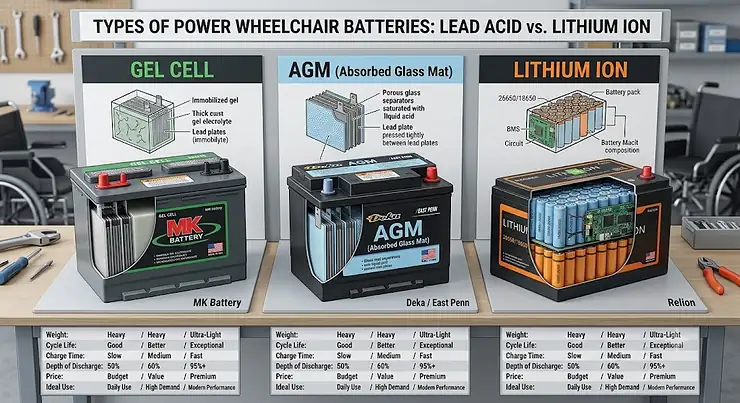
- Weigh chemistry trade-offs honestly. SLA/AGM is cheaper upfront and heavier; lithium costs more but weighs roughly 70-80% less and holds voltage more consistently.
- Check physical dimensions against your battery tray before ordering, since even correctly-rated batteries sometimes won’t physically fit.
- Buy in matched pairs, replacing both batteries in a 24V system together rather than mixing old and new.
- Factor in warranty length and brand support — OEM and name-brand packs often include longer coverage than generic imports.
- Consider your lifting capacity. If you or a caregiver regularly lift the chair (car transfers, stairs), lithium’s weight savings may outweigh its price premium.

Battery Performance: What the Spec Sheet Doesn’t Tell You
Amp-hour ratings and voltage numbers tell you how much energy a battery can theoretically store, but real-world battery performance depends heavily on discharge behavior under load — and this is exactly where lead-acid and lithium chemistries diverge most sharply. A 35Ah SLA battery and a lithium pack rated for similar usable capacity won’t feel the same at hour six of a long outing: lead-acid voltage sags gradually as it drains, meaning your chair’s top speed and torque quietly decrease well before the battery is technically “empty,” while lithium maintains a much flatter voltage curve and delivers close to full power until it’s genuinely near depletion.
Temperature is another performance factor rarely mentioned on packaging. Cold weather measurably reduces usable capacity in lead-acid batteries — reviewers frequently note noticeably shorter range in winter months — while lithium chemistries handle cold somewhat better, though extreme cold still reduces any battery’s output. Terrain matters just as much: climbing inclines or crossing thick carpet draws significantly more current than flat, smooth pavement, and a battery that comfortably delivers advertised range on a sidewalk may fall short across a gravel driveway or a sloped ramp. What most buyers overlook is that manufacturer range estimates assume flat terrain and moderate rider weight — real performance for a heavier rider on mixed terrain typically lands 15-25% below the advertised figure, which is worth building into your capacity planning rather than discovering the hard way.
Power Duration and Energy Storage: How Far Will You Really Go?
Power duration — how long your chair actually runs before needing a recharge — comes down to a straightforward relationship between energy storage capacity (measured in watt-hours, or voltage multiplied by amp-hours) and how much current your chair’s motor draws to move you across whatever terrain you’re covering. A 24V 35Ah lead-acid pack stores roughly 840 watt-hours, while a 24V 12Ah lithium pack stores about 288 watt-hours — on paper the lead-acid number looks larger, but lithium’s more efficient discharge and lighter overall system weight (meaning the motor works less hard to move the same rider) often narrows the real-world duration gap more than raw watt-hour math would suggest.
Here’s what to weigh when estimating your own duration needs: a typical power chair motor draws somewhere between 100W and 700W depending on speed, incline, and load, so a 300Wh-equivalent battery might deliver anywhere from 25 minutes of continuous hard climbing to several hours of light, flat-ground cruising. This wide range is exactly why manufacturer “mile” estimates should be treated as a ceiling, not a guarantee. For anyone planning a specific daily route — a commute, a regular errand loop — the practical move is to test your current battery’s real range on that exact route, then size any replacement to comfortably exceed it rather than just matching the old spec on paper.
Long Lasting Power Wheelchair Batteries: What Actually Extends Lifespan
The single biggest lifespan factor for long lasting power wheelchair batteries isn’t brand — it’s depth of discharge habits. Lead-acid and AGM batteries are rated for a specific number of charge cycles (commonly 300-500 for standard SLA, higher for premium AGM/gel), and that cycle count assumes moderate discharge depth; consistently draining a lead-acid battery to near-zero before recharging can cut its usable lifespan roughly in half compared to recharging at 40-50% remaining. Lithium batteries handle deep discharges considerably better and typically rate for 1,000+ cycles, which is a major contributor to their longer 3-5 year typical service life versus 1-2 years for daily-use lead-acid.
Beyond discharge habits, a few concrete practices meaningfully extend any battery’s working life: charge consistently rather than sporadically, avoid leaving a battery sitting discharged for extended periods (which causes irreversible sulfation in lead-acid plates), store the wheelchair in a temperature-controlled space rather than a hot garage or freezing shed, and always replace batteries in matched pairs rather than mixing ages. Reviewers who report the longest service life consistently mention a simple, boring routine: charge every night regardless of remaining percentage, keep terminals clean, and avoid letting the chair sit unused and undercharged for weeks at a time. There’s no magic long-lasting chemistry that skips these fundamentals — even premium lithium packs degrade faster under poor charging habits.
Power Wheelchair Batteries vs. Mobility Scooter Batteries
Power wheelchair batteries and mobility scooter batteries often look interchangeable — many share the same 12V SLA or AGM form factors — but the comparison isn’t quite apples to apples once you look closer at duty cycle and typical use patterns. Wheelchairs are frequently used indoors on carpet and hardwood at low, steady speeds for shorter bursts throughout the day, which is a gentler discharge pattern than scooters, which tend to see longer continuous outdoor rides at higher sustained speeds and correspondingly higher current draw.
This difference matters when shopping: a battery marketed primarily for mobility scooters may emphasize sustained high-current delivery, while a wheelchair-optimized pack like several on this list prioritizes steady output for frequent stop-start use and tight-turn maneuvering. In practice, most quality deep-cycle SLA, AGM, and lithium batteries in the 12Ah-55Ah range work well across both device types as long as voltage and physical dimensions match — the real differentiator is duty cycle expectations, not some fundamental chemistry difference between “wheelchair” and “scooter” batteries. If your device sees genuine mixed use (a chair that also does long outdoor scooter-style trips), lean toward the higher-capacity options like the Interstate Batteries DCM0055 rather than a compact pack built primarily for short indoor bursts.
Common Mistakes When Buying Power Wheelchair Batteries
The most expensive mistake buyers make is guessing at capacity instead of checking their wheelchair’s manual or existing battery label for the exact voltage and Ah rating — ordering based on “what looked similar” online is the number one driver of returns in this category. A close second is purchasing a single replacement battery for a 24V system instead of replacing both units as a matched pair; even a slightly older second battery drags down the new one’s performance and can shorten its lifespan.
Buyers also frequently overlook physical dimensions and terminal type, assuming that matching voltage and Ah automatically means a battery will fit — it doesn’t, and a battery that’s an eighth of an inch too tall for the tray is a battery you’re shipping back. Another recurring misstep is switching from lead-acid to lithium without confirming charger compatibility; lithium batteries require lithium-specific chargers with different voltage curves, and using an old lead-acid charger on a lithium pack can damage the battery or trigger its safety cutoffs prematurely. Finally, chasing the lowest listed price without checking seller reputation or return policy is a common regret — a battery that arrives dead on arrival is only a good deal if it’s easy to return.
🚀 Ready to Stop Guessing About Your Battery?
⚡ Match your wheelchair’s exact voltage and Ah rating to one of the picks above, and you’ll spend less time wondering why your range keeps shrinking and more time actually getting where you’re going.
Safety, Air Travel & Battery Regulations Guide
Traveling by air with a power wheelchair battery involves specific federal rules, and getting them wrong can mean a battery gets confiscated at the gate. According to the FAA’s official guidance on wheelchairs and mobility devices, lithium-ion batteries installed in a mobility aid are capped at 300 watt-hours, and if the battery is removable, it generally must be taken into the cabin as carry-on rather than checked, with terminals protected against short circuit. Spillable (flooded) lead-acid batteries are treated differently — they’re often permitted to remain installed as long as the housing protects them from damage and they stay upright during transport, per the TSA’s guidance on battery-powered wheelchairs and mobility devices.
Beyond air travel, everyday safety comes down to basic handling discipline: never puncture, crush, or expose any lithium battery to water, and if a battery ever shows swelling, unusual heat, or a chemical smell, stop using it immediately and contact the manufacturer rather than attempting a repair. When a battery finally reaches end of life, proper disposal matters — lithium and lead-acid batteries alike should never go in household trash, and the EPA’s guidance on recycling used lithium-ion batteries recommends bagging terminals and using a certified recycler or manufacturer take-back program rather than curbside bins, since damaged batteries in the waste stream are a genuine fire risk. Understanding basic deep-cycle battery construction — thicker plates designed for sustained partial discharge rather than short high-current bursts — also helps explain why automotive “starter” batteries are a poor substitute for a purpose-built wheelchair battery, a distinction covered in more technical depth on Wikipedia’s deep-cycle battery overview.
Long-Term Cost & Maintenance: The True ROI
On paper, lead-acid batteries win the upfront price comparison every time — a pair typically costs a fraction of an equivalent lithium replacement. But total cost of ownership tells a different story once you factor in replacement frequency: at a 1-2 year typical lifespan for daily-use SLA/AGM versus 3-5 years for lithium, a lead-acid user may buy two to three replacement sets in the time a single lithium pack lasts, which narrows — and in some heavy-use cases erases — the upfront savings.
Maintenance costs favor lithium as well, since there’s no water top-off, no equalization charging, and generally no terminal corrosion to manage, whereas lead-acid batteries benefit from monthly attention that, while inexpensive in materials, does require ongoing time and diligence. The honest ROI calculation depends on usage intensity: light, occasional users may never recoup lithium’s price premium over the practical life of their chair, while daily heavy users covering real mileage often find that lithium’s longer service life and lower maintenance burden pay for the difference within a few years. If your insurance or funding source covers battery replacement, that calculation shifts again — check what’s actually reimbursable before assuming the sticker price is what you’ll pay out of pocket.

Frequently Asked Questions
❓ How long do power wheelchair batteries last?
❓ Can I replace just one battery in a 24V wheelchair system?
❓ Are lithium power wheelchair batteries safe to fly with?
❓ What's the difference between AGM and gel batteries for wheelchairs?
❓ How do I know what voltage and capacity battery my wheelchair needs?
Recommended for You
- Fastest Power Wheelchair: 7 Speedy Picks for 2026
- Power Wheelchair High Ground Clearance: 7 Best Picks (2026)
- All Terrain Wheelchair for Beach: 7 Sand-Ready Picks (2026)
Disclaimer: This article contains affiliate links. As an Amazon Associate, I earn from qualifying purchases. If you purchase products through these links, we may earn a small commission at no additional cost to you.
✨ Found this helpful? Share it with your friends! 💬🤗
