

In This Article
Multiple sclerosis doesn’t move in a straight line, and neither should your mobility plan. One week you’re managing fine with a cane, and the next, fatigue or a flare-up makes even a short walk across the kitchen feel like a marathon. That unpredictability is exactly why so many people start researching a power wheelchair for MS patients long before they expect to need one — and honestly, that’s smart timing, not surrender.
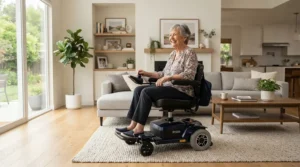
What is a power wheelchair for MS patients? It’s a battery-powered mobility device, controlled by a joystick or alternative input, engineered to conserve energy, support fluctuating muscle weakness, and adapt seating (tilt, recline, elevation) as neurological symptoms change over time.
This guide isn’t a rehash of spec sheets you could find on any Amazon listing. It’s a genuine comparison of seven real chairs — from ultralight travel models to fully custom rehab bases — built around what actually matters for MS, and for related conditions like cerebral palsy and ALS, where mobility needs overlap more than people expect. According to the National Multiple Sclerosis Society’s mobility and accessibility guide, choosing the right device is rarely about the disease label alone; it’s about strength, coordination, and how your day actually unfolds. We’ll walk through real specs, honest analysis, and practical scenarios so you can make a confident, informed choice about a power wheelchair for MS patients — not just a purchase.
Quick Comparison Table: Top Power Wheelchair Picks at a Glance
| Chair | Best For | Weight Capacity | Price Range |
|---|---|---|---|
| Vive Lightweight Electric Wheelchair | Tight budgets & small vehicles | 225-265 lbs | $1,500-$2,200 range |
| Pride Mobility Jazzy Carbon | Flying & frequent travel | 300 lbs | $2,500-$3,600 range |
| Golden Technologies Compass Sport GP605 | Longest daily range | 300 lbs | $3,300-$4,000 range |
| Merits Health Vision Sport Lift P326D | Reach & eye-level access | 300 lbs | $3,500-$4,500 range |
| Quantum Rehab Q6 Edge 2.0 | Progressive positioning needs | 400-450 lbs | $6,000-$12,000+ range |
Looking at this snapshot, notice how price climbs alongside seating complexity rather than raw speed — the Quantum Rehab Q6 Edge 2.0 costs more because it’s solving a different problem (pressure relief and positioning) than the Vive Lightweight Electric Wheelchair, which is solving portability. If your MS symptoms are still mild-to-moderate and mostly fatigue-driven, a mid-tier chair like the Golden Technologies Compass Sport GP605 likely delivers better day-to-day value than either extreme.
💬 One click can save you months of trial and error — compare current availability on today’s top picks!
Top 7 Power Wheelchairs for MS Patients: Expert Analysis
1. Vive Lightweight Electric Wheelchair — lightest frame for car trunks
The standout here is genuinely the weight: some configurations drop the heaviest liftable piece to well under 40 pounds. Built from a magnesium or carbon-fiber frame, it supports users between roughly 225 and 265 pounds depending on the exact model, folds without tools, and fits most sedan trunks in seconds — a real advantage when MS fatigue makes loading a heavier chair feel impossible some days. What most buyers overlook about ultralight chairs is the trade-off: smaller batteries mean shorter range, often under 10 miles, so this is an errands-and-appointments chair rather than an all-day outdoor cruiser.
Reviewers consistently note that the fold-and-lift design is the single biggest quality-of-life change for caregivers who previously wrestled with a bulkier chair. On the flip side, some feedback in the lightweight-chair category flags that smaller frames can feel snug for taller users, so checking the seat width and height range before buying matters more here than with full-size models.
Pros:
- ✅ Frame weighs light enough for most caregivers to lift alone
- ✅ Folds without disassembly for quick car storage
- ✅ Noticeably lower cost than full-size rehab chairs
Cons:
- ❌ Shorter battery range limits all-day outdoor use
- ❌ Lower weight capacity than heavy-duty alternatives
Typically found in the $1,500-$2,200 range, it’s a strong value pick if your main goal is regaining independence for errands rather than replacing a rehab-grade base.

2. Pride Mobility Jazzy Carbon — most airline-friendly folding chair
The Jazzy Carbon’s headline feature is its carbon-fiber frame, which keeps the unit around 39 pounds without the battery while still supporting a 300-pound capacity. That combination — light enough to check as luggage, sturdy enough for daily use — is genuinely rare in this category. Front suspension smooths out sidewalk cracks and door thresholds, and the removable joystick with a built-in USB charger is a small but practical touch for anyone juggling a phone and a mobility device on a travel day.
Based on the spec comparison, the 3.7 mph top speed and roughly 9.3-mile range make this a chair for controlled indoor/outdoor use rather than long neighborhood loops, which lines up with how most MS patients actually use a secondary travel chair. Aggregated feedback on ultralight folding power chairs in this class tends to praise the portability and flag that the compact seat can feel tight for larger frames — worth test-sitting before committing.
Pros:
- ✅ Carbon-fiber frame is genuinely airline and car-trunk friendly
- ✅ Front suspension smooths thresholds and uneven sidewalks
- ✅ Backed by a lifetime limited-frame warranty
Cons:
- ❌ Modest 9.3-mile range versus full-size chairs
- ❌ Narrower seat may not suit larger body frames
Prices typically fall in the $2,500-$3,600 range depending on battery configuration and seller, making it a mid-tier investment for anyone who travels often.
3. Golden Technologies Compass Sport GP605 — longest range for active daily use
What sets the Compass Sport apart is its Dynamic Linx smart controller, which continuously adjusts motor output based on terrain, incline, and rider weight — in plain terms, it keeps the ride predictable even when MS-related coordination issues make joystick control less precise. With a reported range up to roughly 19-24 miles per charge and a 4.5 mph top speed, this mid-wheel-drive chair is built for people who are out and about most of the day, not just running quick errands.
Here’s what to weigh: the captain’s seat adjusts its back angle up to 115 degrees, which helps manage the fatigue-driven need to shift position without needing a full power-recline system. Reviewers of mid-wheel-drive Golden Technologies chairs commonly highlight the tight turning radius as a genuine advantage indoors, while some note the center-wheel-drive turning motion takes a short adjustment period compared to front-wheel-drive chairs.
Pros:
- ✅ Long per-charge range supports full active days
- ✅ Dynamic Load Compensation smooths uneven terrain
- ✅ Tight turning radius for indoor maneuvering
Cons:
- ❌ Center-wheel-drive turning feel takes brief adjustment
- ❌ Heavier base than folding travel chairs
Expect this model in the $3,300-$4,000 range, positioning it as one of the strongest all-around value picks in this lineup.
4. Merits Health Vision Sport Lift P326D — best seat elevation for everyday reach
The defining feature is the power elevating seat, which raises a full 7.5 inches at the push of a button. What most buyers overlook about seat elevation is how much it changes daily independence — reaching a top kitchen shelf, making eye contact at a standing conversation, or safely transferring to a couch all get easier. The chair automatically halves its drive speed while elevated, a smart safety design choice that reduces tip risk without eliminating the feature’s usefulness.
With a 5 mph top speed, roughly 18-mile range, full suspension, and a 20-inch semi-recline captain’s seat, this mid-wheel-drive chair is genuinely competitive on raw performance too. The spec sheet won’t tell you this, but user reports on seat-elevation chairs consistently mention that the feature reduces caregiver strain during transfers — though the ALS Association’s own survey work notes that seat elevation is frequently not covered by insurance, so budget for it as an out-of-pocket add-on.
Pros:
- ✅ 7.5-inch power seat lift genuinely aids daily reach
- ✅ Strong 18-mile range for a mid-size chair
- ✅ Full suspension smooths outdoor pavement
Cons:
- ❌ Seat elevation is rarely covered by insurance
- ❌ Half-speed lift mode adds a small learning curve
Pricing generally sits in the $3,500-$4,500 range, reflecting the added engineering behind the lift mechanism.
5. Golden Technologies Compass HD GP620 — most stable heavy-duty base on a budget
The Compass HD’s patented springless articulating chassis is the standout: it lets all wheels stay grounded over bumps and thresholds without the mechanical complexity (and cost) of a full suspension system. Paired with a 450-pound weight capacity and a compact 20-inch turning radius, it’s built for users who need heavy-duty stability but don’t necessarily need full rehab-level seating. Reviewers consistently note that Golden Technologies’ center-wheel-drive chairs handle carpet transitions and door thresholds noticeably better than budget competitors in the same price bracket.
On paper, this means MS patients experiencing significant leg weakness or higher body weight get genuine reliability without paying rehab-chair prices. A common theme in heavy-duty power chair feedback is that the roughly 12-mile range is the trade-off for the reinforced frame — plan shorter outings or a spare battery if you’re routinely away from an outlet.
Pros:
- ✅ 450 lb capacity with genuinely reinforced frame
- ✅ Tight 20-inch turning radius for its size class
- ✅ Adjustable back angle up to 115 degrees
Cons:
- ❌ Shorter 12-mile range than the Compass Sport
- ❌ Heavier base makes transport more difficult
Typically priced in the $3,500-$5,300 range depending on seat width and accessories chosen.

6. Pride Jazzy Elite HD — toughest traction for outdoor terrain
The Jazzy Elite HD’s front-wheel drive and 14-inch knobby drive wheels are the standout combination here — that tire size is genuinely larger than most chairs in this weight class, and it shows in how the chair handles grass, gravel, and uneven driveways. A 450-pound capacity, 3-inch ground clearance, and a 60-amp controller round out a chair built for users who spend real time outdoors, not just on smooth sidewalks.
What most buyers overlook is that front-wheel drive changes the chair’s turning behavior compared to mid-wheel-drive models like the Compass Sport — it pulls rather than pivots, which some MS patients with hand tremor or coordination challenges find easier to predict. Aggregated owner feedback on heavy-duty Jazzy models frequently praises the outdoor traction and notes that the 24-inch turning radius, while tight for a heavy-duty chair, is still wider than compact mid-wheel-drive alternatives.
Pros:
- ✅ Large 14-inch drive wheels excel on rough terrain
- ✅ Front-wheel drive offers predictable, intuitive handling
- ✅ 450 lb capacity with a reinforced frame
Cons:
- ❌ Wider turning radius than mid-wheel-drive competitors
- ❌ Range varies significantly (roughly 9.8-14.4 miles) by battery choice
Most listings place it in the $3,900-$4,300 range, making it a premium heavy-duty option worth comparing directly against the Compass HD.
7. Quantum Rehab Q6 Edge 2.0 with iLevel — most advanced positioning for progressive symptoms
This is the chair built for the reality that MS, ALS, and cerebral palsy can all progress or fluctuate over time. The Mid-Wheel 6 design keeps six wheel contact points on the ground for stability, while TRU-Balance 3 power positioning adds power tilt, recline, and articulating leg rests — features that matter enormously for pressure relief and breathing comfort, not just convenience. The optional iLevel seat elevation adds up to roughly 10-12 inches of height while maintaining Quantum’s Extra Stability Technology during transfers and reaching tasks.
Based on the spec comparison, the 6.25 mph top speed and Q-Logic 3 electronics (with Bluetooth device access) put this chair well ahead of standard power chairs in raw capability — but honesty matters here: chairs at this level are typically custom-configured through a rehab equipment supplier and billed through insurance, rather than purchased outright online. Quantum Rehab’s own clinical materials note that power positioning options are specifically recommended as multiple sclerosis symptoms progress, since the seating system should be “easily adaptable” as needs change.
Pros:
- ✅ Full tilt, recline, and leg-elevation positioning system
- ✅ Six-wheel stability design for varied terrain
- ✅ Highly configurable to progressive neurological symptoms
Cons:
- ❌ Rarely available for direct online purchase
- ❌ Significantly higher cost than standard power chairs
Configured pricing commonly runs from $6,000 to $12,000 or more depending on the seating package, though insurance frequently covers the majority of that cost when medical necessity is documented.
Practical Usage Guide: Your First 30 Days with a New Power Wheelchair
Getting a power wheelchair for MS patients set up correctly in the first month prevents most of the frustration people report later. Start by charging the battery fully before first use, even if the chair arrives partially charged — most lithium batteries perform better long-term when they aren’t cycled from a low starting point. Next, have an occupational therapist or the equipment vendor confirm seat depth, backrest angle, and joystick sensitivity; MS-related hand tremor or spasticity often means factory joystick settings are too twitchy right out of the box.
A common first-month mistake is over-tightening the daily charging schedule out of anxiety — most modern chairs handle a nightly top-off fine, and letting the battery fully drain repeatedly actually shortens its lifespan faster than a partial daily charge would. Practice tight turns and doorway navigation in a low-stakes space (an empty hallway, an empty parking lot) before attempting your regular routes, and log any unusual noises or drifting during the first two weeks — most warranty claims are easiest to process early.
Maintenance-wise, wipe down tires weekly if you’re rolling over grass or gravel, since debris in the caster wheels is the single most common cause of unexpected sticking or veering. Set a recurring reminder to check tire pressure (on pneumatic models) and inspect armrest and joystick mounting bolts monthly, since daily vibration loosens hardware gradually.

Real-World Scenarios: Matching the Right Power Wheelchair to Your Life
Consider three people navigating the same diagnosis differently. First, a 34-year-old graphic designer with relapsing-remitting MS who works from a downtown apartment and travels for client meetings a few times a year — for her, the Pride Mobility Jazzy Carbon or the Vive Lightweight Electric Wheelchair makes more sense than a heavy-duty base, since portability and airline compliance outweigh raw range.
Second, a 58-year-old retired teacher with secondary-progressive MS who spends most days gardening and walking her dog around a suburban block — the Golden Technologies Compass Sport GP605 fits her pattern well, since its longer range and adjustable seating support a mostly-outdoor, all-day routine without the cost of custom rehab seating.
Third, a 45-year-old parent managing advancing MS alongside caregiving duties for a child with cerebral palsy, who needs both reach for household tasks and pressure-relief positioning for long sitting periods — here, the Merits Health Vision Sport Lift P326D or the Quantum Rehab Q6 Edge 2.0 genuinely earns its higher price tag, because seat elevation and power positioning solve problems that a standard chair simply can’t.
Problem → Solution Guide: Common Power Wheelchair Frustrations
Problem: Fatigue makes transfers exhausting. Solution: prioritize chairs with power seat elevation, like the Merits Health Vision Sport Lift P326D, which reduces the vertical distance between the chair seat and a bed, couch, or car seat.
Problem: Hands shake too much for precise joystick control. Solution: ask your equipment provider about adjustable joystick sensitivity and dampening settings, available on most mid-range and premium bases including the Golden Technologies Compass Sport GP605 and the Quantum Rehab Q6 Edge 2.0.
Problem: The chair is too heavy to lift into a car. Solution: switch to an ultralight folding model such as the Vive Lightweight Electric Wheelchair or the Pride Mobility Jazzy Carbon, both designed around trunk-friendly weight limits.
Problem: Sitting all day causes pressure sores or discomfort. Solution: a power tilt-and-recline system, standard on the Quantum Rehab Q6 Edge 2.0, redistributes pressure without requiring a manual transfer.
Problem: Outdoor terrain (gravel, grass, curb cuts) stalls the chair. Solution: opt for larger, knobby drive wheels and higher ground clearance, both hallmarks of the Pride Jazzy Elite HD.
How to Choose a Power Wheelchair for MS, ALS, or CP
- Confirm your current and near-future symptoms with a neurologist or physiatrist. Power wheelchair needs for neurological condition mobility change fast, so plan one step ahead of where you are today.
- Prioritize seating function over top speed. Tilt, recline, and elevation matter more day-to-day than an extra mile per hour.
- Test drive indoors and outdoors before buying. Turning radius and drive-wheel type feel very different in practice than on a spec sheet.
- Match weight capacity honestly to your body and equipment. Underrating this compromises safety and voids some warranties.
- Ask about insurance coverage limits early. Many plans, per Medicare’s own guidance, only fund one mobility device every five years.
- Plan for portability if you travel. A second lightweight chair is often more practical than trying to make one chair do everything.
- Loop in an occupational therapist for the final fitting. Professional seating assessments catch problems a self-guided purchase often misses.
Power Wheelchair for Cerebral Palsy: What Families Need to Know
A power wheelchair for cerebral palsy differs from an MS-focused chair mainly in timeline and growth planning. Cerebral palsy is a group of disorders affecting movement, balance, and posture that is present from early childhood and, according to the CDC’s overview of cerebral palsy, is the most common motor disability in childhood — though the condition itself does not progress over time the way MS often does. That distinction matters enormously for equipment planning: families choosing a power wheelchair for cerebral palsy are usually optimizing for growth accommodation (adjustable seat depth, width expansion) rather than the fluctuating, unpredictable positioning needs common in adult-onset neurological conditions.
Where the two audiences genuinely overlap is seating complexity. Kids and adults with cerebral palsy frequently need the same tilt, recline, and lateral trunk support systems found on chairs like the Quantum Rehab Q6 Edge 2.0, specifically to manage muscle tone fluctuations and prevent pressure injuries during long school or work days. Reviewers and clinicians alike consistently flag that a rushed seating fitting is the single most common regret among CP families — take the extra weeks for a proper clinical seating evaluation rather than rushing to a standard configuration.
ALS Patient Mobility: Why Power Positioning Changes Everything
ALS patient mobility planning looks different again, because ALS is typically the fastest-progressing of these three conditions. The ALS Association’s guidance on mobility and ALS recommends considering features like a high-reclining back, headrest, and elevating leg rests specifically because these features anticipate rapid muscle weakness rather than reacting to it after the fact. This is exactly the philosophy behind chairs like the Quantum Rehab Q6 Edge 2.0 — buying ahead of current need, not behind it.
Here’s what to weigh financially: because ALS patient mobility often requires alternate drive controls (chin joysticks, sip-and-puff systems) as hand strength declines, choosing a base that’s electronically upgradable from day one avoids a costly, disruptive re-purchase later. Rehab technology specialists consistently note that power tilt and recline aren’t luxury features for ALS patient mobility — they’re functional tools for managing fatigue and breathing comfort throughout the day, which is a meaningfully different framing than how MS patients typically approach the same features.
🔍 Ready to compare current listings side by side? Take a closer look at the models covered above and check today’s availability before symptoms outpace your equipment.
Disease Specific Wheelchair Features: Matching the Base to the Condition
Not every disease specific wheelchair decision comes down to the same checklist. MS-focused buyers often prioritize energy conservation and fatigue management, meaning longer battery range and simpler controls tend to win out. ALS-focused buyers prioritize anticipatory seating and alternate drive controls, since strength changes fast and unpredictably. Cerebral palsy-focused buyers, especially for growing children, prioritize adjustability and growth accommodation over raw speed or range.
What most buyers overlook when shopping for a disease specific wheelchair is that drive-wheel position (front, mid, or rear) genuinely changes usability by condition. Front-wheel drive, as seen on the Pride Jazzy Elite HD, tends to suit users who value outdoor traction and predictable pulling motion. Mid-wheel drive, as seen on the Golden Technologies Compass Sport GP605 and Merits Health Vision Sport Lift P326D, tends to suit users who prioritize indoor maneuverability and tight turning. Matching drive type to daily environment — not just to diagnosis — is the detail generic buying guides frequently skip.

Medical Mobility Solutions and Insurance: Long-Term Cost & Maintenance
Medical mobility solutions rarely end at the purchase price, so total cost of ownership deserves real attention. Per Medicare’s official coverage guidelines for wheelchairs and scooters, Part B covers power wheelchairs and scooters only when they’re medically necessary, requiring a face-to-face examination and a written prescription from a treating provider before coverage kicks in. Beyond that hurdle, batteries typically need replacement every 1-3 years (budget $150-$400 per pair), tires wear based on terrain and mileage, and upholstery or cushions often need refreshing every 2-4 years for pressure management.
Long-term value calculations should weigh purchase price against expected lifespan and coverage. A Golden Technologies Compass HD GP620 at a lower upfront cost but shorter 12-mile range may cost more in cumulative charging inconvenience than a Golden Technologies Compass Sport GP605 with nearly double the range, depending on your daily mileage. Since Medicare typically only funds one piece of equipment addressing at-home mobility issues at a time, choosing well the first time carries real financial weight — a detail medical mobility solutions shoppers should factor in well before checkout.
Common Mistakes When Buying a Power Wheelchair for Neurological Conditions
The most frequent mistake in neurological condition mobility purchases is buying based on today’s symptoms alone, ignoring the likely trajectory a neurologist could help forecast. A close second is skipping a professional seating evaluation to save time, which frequently results in returns, refitting costs, or discomfort that limits actual daily use. Buyers also commonly underestimate transport needs — choosing a heavy-duty chair like the Pride Jazzy Elite HD without confirming it fits an accessible vehicle or home doorway.
Another overlooked mistake: assuming all “power wheelchair” listings are interchangeable in review quality. Amazon reviews for mobility equipment vary widely in relevance, since ratings often blend feedback across multiple seat sizes, battery configurations, and even shipping experiences rather than the chair’s actual performance — read carefully rather than trusting the star average alone.
Features That Actually Matter (And Those That Don’t)
Features that actually matter: adjustable seat depth and back angle, drive-wheel type suited to your typical terrain, realistic battery range for your actual daily distance, and a turning radius that fits your home’s tightest doorway. These directly affect daily usability for a power wheelchair for MS patients, regardless of brand.
Features that matter less than marketing suggests: top speed above 4-5 mph (rarely usable indoors or in most communities), flashy LED lighting packages, and oversized touchscreen controllers that add cost without meaningfully improving daily function for most users. Based on the spec comparison across all seven chairs above, the genuinely differentiating features were seating positioning options and real-world range — not headline speed numbers.
Benefits vs Traditional Alternatives
| Feature | Power Wheelchair | Manual Wheelchair | Mobility Scooter |
|---|---|---|---|
| Energy required from user | Minimal | High (upper body) | Low |
| Best For | Fatigue-driven neurological conditions | Users with strong upper-body strength | Mild mobility limitations, outdoor use |
| Indoor maneuverability | Excellent (tight turning models) | Good | Often limited |
| Seating customization | Extensive (tilt/recline available) | Limited | Minimal |
For most MS, ALS, or cerebral palsy patients experiencing genuine fatigue or weakness, a power wheelchair simply asks less of the body than a manual wheelchair does — a critical distinction, since propelling a manual chair can itself trigger MS-related exhaustion. Mobility scooters remain a reasonable middle ground for milder symptoms, but they typically lack the seating customization that becomes essential as neurological symptoms progress.
Price Range & Value Analysis
| Budget Tier | Price Range | What You Get | Best Use Case |
|---|---|---|---|
| Entry | $1,500-$2,600 range | Lightweight folding frames, basic seating | Errands, occasional use |
| Mid-Range | $3,300-$4,500 range | Longer range, adjustable seating, seat lift options | Daily active use |
| Premium/Rehab | $6,000-$12,000+ range | Full tilt/recline, custom positioning, iLevel | Progressive or complex neurological needs |
The jump from mid-range to premium reflects seating engineering, not marketing markup — power positioning systems genuinely cost more to design and manufacture. Buyers whose main challenge is fatigue rather than pressure management or rapid progression will typically find the mid-range tier delivers the best return on investment.

FAQ: Power Wheelchair for MS Patients
❓ How much does a power wheelchair for MS patients typically cost?
❓ Does insurance cover a power wheelchair for MS patients?
❓ What's the difference between chairs for MS versus cerebral palsy or ALS?
❓ Can a power wheelchair for MS patients be used outdoors?
❓ How do I choose between a folding travel chair and a full-size power chair?
Conclusion
Choosing a power wheelchair for MS patients isn’t a one-size-fits-all decision, and honestly, it shouldn’t be. Someone managing early-stage fatigue has genuinely different needs than someone navigating advancing ALS patient mobility challenges or a family planning years of growth around a power wheelchair for cerebral palsy. What ties all seven chairs in this guide together is that each one solves a specific, real problem — portability, range, seat elevation, heavy-duty stability, outdoor traction, or full positioning support — rather than trying to be everything at once.
If you take one thing from this guide, let it be this: match the chair to your actual daily environment and your near-future trajectory, not just today’s symptoms. Loop in a neurologist, an occupational therapist, and — where possible — a rehab equipment specialist before finalizing your decision on any disease specific wheelchair. The right medical mobility solutions investment pays for itself many times over in restored independence, reduced fatigue, and genuine day-to-day freedom.
Recommended for You
- 7 Best Power Wheelchairs for Seniors With Limited Mobility in 2026
- Power Wheelchair Battery Charger: 7 Best Picks for 2026
- Lithium Ion Power Wheelchair Battery: 7 Best Picks for 2026
Disclaimer: This article contains affiliate links. As an Amazon Associate, I earn from qualifying purchases. If you purchase products through these links, we may earn a small commission at no additional cost to you.
✨ Found this helpful? Share it with your friends! 💬🤗
