In This Article
You’ve probably been down this road before — parked in front of a product page, squinting at specs that mean absolutely nothing to you. “Turning radius: 24 inches.” Great. Is that good? Bad? About the size of a dining table? Here’s the deal: picking the right power wheelchair isn’t just about specs. It’s about understanding how a drive system changes the experience of living your actual life.
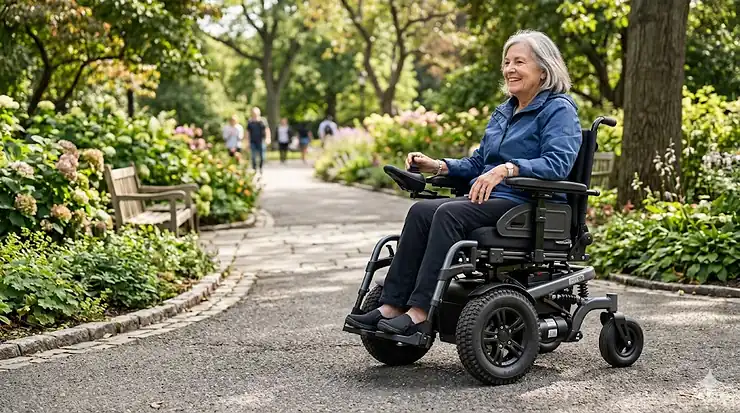
When it comes to front wheel drive wheelchair pros and cons, the conversation is surprisingly nuanced. FWD (front wheel drive) power chairs position the large motorized wheels at the front of the base, which means the chair pulls you forward rather than pushing from behind. In roughly 40–60 words: a front wheel drive power wheelchair has its drive wheels mounted at the front, enabling better traction over obstacles and uneven terrain, a natural obstacle-climbing advantage, and excellent lower-extremity positioning — but with a wider turning footprint that requires rear-swing awareness in tight corridors.
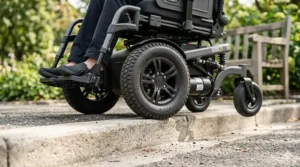
That pulling action sounds like a small detail. It isn’t. It changes how the chair handles thresholds, grass, gravel, and ramps in ways that rear-wheel drive simply can’t match without brute-forcing the terrain. According to clinical occupational therapists writing for Numotion, front wheel drive wheelchairs “meet obstacles with the drive wheel and are able to climb with less impact on the user” — which translates to less jarring, fewer stuck moments, and more confidence outdoors.
But it’s not the perfect system for everyone. In this guide, I’m breaking down exactly who benefits most from FWD, what the tradeoffs look like in real life, and reviewing seven real models currently available on Amazon — from budget-friendly entry chairs to heavy-duty hospital-grade powerhouses.
Quick Comparison: Top 7 Front Wheel Drive Wheelchairs at a Glance
| Model | Drive Type | Weight Cap. | Top Speed | Best For | Price Range |
|---|---|---|---|---|---|
| Drive Medical Titan (TITAN18CS) | FWD | 300 lbs | 4 mph | Budget/Travel | $900–$1,200 |
| Drive Medical Titan X16 | FWD | 300 lbs | 4 mph | Versatile Daily Use | $1,100–$1,500 |
| Pride Jazzy Elite ES | In-line FWD | 300 lbs | 4 mph | Reliable Mid-Range | $1,500–$2,000 |
| Pride Jazzy Elite 14 | FWD | 300 lbs | 4 mph | Outdoor Performance | $2,000–$2,500 |
| Pride Jazzy Elite HD Group 2 | FWD | 450 lbs | 4 mph | Heavy-Duty Users | $2,500–$3,200 |
| FH10 M16-1 (16″ FWD) | FWD | 330 lbs | ~3.7 mph | All-Terrain/Budget | $600–$900 |
| Pride Jazzy Elite HD + Setup | FWD | 450 lbs | 4 mph | Turnkey Premium | $3,000–$4,000 |
What the table tells you: The FH10 M16-1 wins on pure affordability for outdoor use, but the Jazzy Elite 14 delivers meaningfully better build quality and brand reliability for roughly double the price. The heavy-duty Jazzy Elite HD models stand alone in weight capacity — if you’re over 300 lbs, they’re not optional, they’re necessary. The “Turnkey Premium” package (#7) justifies its premium primarily through included in-home professional setup and an extended 5-year warranty, not raw hardware differences.
💬 Just one click — help others make better buying decisions too! 😊
✨ Don’t Miss These Exclusive Deals!
🔍 Take your mobility to the next level with these carefully selected front wheel drive wheelchairs. Click on any highlighted product name to check current pricing and availability. Finding the right chair could change everything about your daily independence!
Top 7 Front Wheel Drive Wheelchairs: Expert Analysis
1. Drive Medical Titan Transportable FWD Power Wheelchair (TITAN18CS)
The Titan TITAN18CS is the workhorse that launched a thousand therapy clinic recommendations — and for good reason.
Its front-wheel drive system positions the drive wheel forward of the user’s center of gravity, which is engineering-speak for “it doesn’t nose-dive on doorway thresholds the way rear-drive chairs do.” The 10 × 3-inch flat-free drive wheels handle small obstacles without drama. For people navigating a home with mixed flooring — hardwood to carpet to tile transitions — that matters enormously. The programmable controller is a quiet hero here: therapists can dial in responsiveness to match the user’s cognitive and motor ability, which you simply won’t get on cheaper generic imports.
What most buyers overlook about this model is the tool-free disassembly. The heaviest single piece still weighs around 42–45 lbs, which isn’t light, but it’s manageable for a caregiver loading into a sedan or SUV. The interchangeable red/blue color panels are a small touch that new users genuinely appreciate — having choice over appearance matters psychologically.
Customer reviews consistently praise the straightforward assembly and solid build; common complaints center on the relatively short battery range (around 10–12 miles per charge) and the basic seat padding, which benefits from a third-party pressure-relief cushion.
✅ Tool-free disassembly for transport
✅ Programmable controller for personalized sensitivity
✅ Flat-free tires — zero maintenance puncture risk
❌ Shorter range limits all-day outings
❌ Basic seat cushion; upgrade recommended for pressure care
Price range: Around $900–$1,200. Solid entry-level FWD value.

2. Drive Medical Titan X16 Front Wheel Power Wheelchair
Think of the Titan X16 as the Titan TITAN18CS’s more ambitious sibling — same DNA, but with bigger wheels, wider seat options, and a noticeably smoother outdoor performance curve.
The 16-inch front drive wheels are the headline feature here. Compared to the 10-inch wheels on the standard Titan, those extra 6 inches of diameter translate to a real-world difference when crossing rough pavement, gravel driveways, or worn-out sidewalks. Obstacles that would slow or jolt a 10-inch wheel get rolled over far more confidently. The Titan X16 also offers multiple seat width configurations, which matters if you’re between sizes and hate feeling squeezed or uncentered in a standard 18-inch chair.
This is genuinely the model I’d recommend for someone who spends equal time indoors and outdoors — say, commuting between a home, a suburban medical office, and a grocery store. It’s versatile without being overly complex. The same tool-free disassembly remains, and Drive Medical’s parts network is one of the most accessible in the country, meaning service calls don’t turn into multi-week nightmares.
Buyers report that the Titan X16 feels noticeably more stable on side slopes than the base model, which is a critical real-world win for uneven suburban terrain.
✅ 16-inch front drive wheels for confident obstacle crossing
✅ Multiple seat width options for proper fit
✅ Wide Drive Medical service network
❌ Heavier than base Titan — slightly harder to transport
❌ Still limited on true off-road (grass, mud) performance
Price range: $1,100–$1,500.
3. Pride Mobility Jazzy Elite ES Power Chair (In-Line FWD)
The Jazzy Elite ES is the definition of a “do no harm” purchase — it’s not flashy, it doesn’t have the biggest wheels or the longest range, but it delivers a refined, reliable experience that cheaper competitors stumble over.
The “in-line” front wheel drive configuration is what sets it apart from a standard FWD layout. In-line FWD tucks the drive wheels more compactly under the chair’s footprint, producing a tighter arc when turning. In practical terms: doorways that feel close become passable, and navigating through a crowded waiting room or apartment hallway requires fewer point-corrections. The 15-mile range is genuinely usable — not a stretch spec that requires riding at 2 mph on flat concrete to achieve. The PG GC3 controller manages acceleration and braking with a refinement that generic joystick controllers can’t replicate.
Pride Mobility has been building power chairs since 1986, and that institutional knowledge shows in the serviceability of this model. The main frame design is intentionally simple — fewer proprietary parts, more standard components. For users who rely on their chair for independence, “I can get it serviced without a 6-week wait” is worth real money.
Buyers frequently highlight the high-back comfort seat and how forgiving the controller feels for users still developing joystick precision.
✅ In-line FWD for tighter turns than standard FWD
✅ 15-mile range that holds up in mixed condit
✅Simple frame design = easier and cheaper to service
❌ Basic seating system — limited customization out of the box
❌ Lower weight capacity (300 lbs) than HD alternatives
Price range: $1,500–$2,000.
4. Pride Mobility Jazzy Elite 14 Front Wheel Drive Power Chair
If outdoor performance is your top priority, the Jazzy Elite 14 is the model that most under-budget buyers eventually wish they’d started with.
The 14-inch knobby front drive wheels are the defining feature — and they’re not just bigger for aesthetic reasons. Knobby tread grips grass, gravel, and slightly muddy surfaces the way smooth tires physically cannot. When your doctor says “get outside more,” this chair actually lets you do that with confidence rather than anxiety. The front anti-tip wheels add a critical safety backstop for grade transitions: coming off a ramp, crossing a street curb, or navigating an uneven parking lot lip without lurching forward. According to Quantum Rehab’s clinical resource, the greater force distribution on FWD systems “increases traction, enabling the chair to perform well when driving over soft terrain, grass or uneven gravel” — and the Elite 14’s hardware is purpose-built around exactly that advantage.
The 17-mile range is the best in this mid-tier bracket. For a user who takes a daily outing — to the park, to a friend’s house, to a community center — that range provides actual psychological freedom, not just theoretical miles.
Reviewers consistently call this the “step up I should have made immediately” model. The tradeoff is weight; it’s not the easiest to transport.
✅ 14-inch knobby tires for genuine outdoor traction
✅ Front anti-tip wheels for safe grade transitions
✅ Best-in-class range at this price tier (17 miles)
❌ Heavier build limits easy vehicle transport
❌Premium pricing over the Elite ES
Price range: $2,000–$2,500.
5. Pride Mobility Jazzy Elite HD Group 2 Power Chair (Front Wheel Drive, 450 lbs)
The spec sheet doesn’t tell you the most important thing about the Jazzy Elite HD: it’s built for users who’ve been quietly underserved by “standard” 300-lb chairs their entire lives.
Four hundred fifty pounds of weight capacity isn’t a marketing number — it’s a structural promise backed by Pride’s Active Trac ATX Suspension, reinforced frame, and 14-inch knobby drive tires. Most comparable chairs cap at 300–350 lbs and use that limit as a hard engineering ceiling, not a soft guideline. The Jazzy Elite HD is certified to 450 lbs as a Group 2 Medicare-classified device, which is significant: it means the engineering was evaluated against clinical standards, not just marketing claims. The full suspension system absorbs shocks rather than transmitting them to the user’s spine, which over hours of daily use adds up to a meaningful quality-of-life difference.
The 12.5-mile range is slightly reduced compared to lighter HD alternatives — heavier users and heavier chairs demand more battery for the same distance, and Pride is being honest about that rather than padding the spec. Plan for 8–10 real-world miles of mixed terrain use.
This chair is essentially mandatory for plus-size users who also need outdoor capability. There is no adequate substitute at this weight class for FWD performance.
✅ 450-lb capacity with Group 2 Medicare classification
✅ Active Trac ATX Suspension for a notably smoother ride
✅ 14-inch knobby tires for indoor/outdoor versatility
❌ 12.5-mile range lower than standard-capacity alternatives
❌ Larger footprint; not ideal for very tight indoor spaces
Price range: $2,500–$3,200.
6. FH10 M16-1 Upgraded 16″ Big Front Wheel Electric Wheelchair
Here’s the budget wildcard that actually earns its place on this list — the M16-1 (marketed under the FH10 designation) is an all-terrain FWD machine at a price that makes traditional power chair brands visibly uncomfortable.
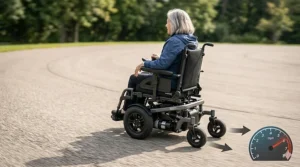
The 16-inch front drive wheels dominate the design, and they perform exactly as advertised: the manufacturer claims a 28% improvement in maneuverability and 23% increase in comfort over comparable wheelchairs at this tier, and while those percentages are self-reported, the real-world user feedback supports the general direction. The 360° swiveling rear wheels are the clever engineering move here — they provide a minimal turning radius that compensates for one of FWD’s traditional weaknesses in tight spaces. Dual electromagnetic and manual brakes mean the chair locks solid when you release the joystick, whether you’re on a flat floor or a gentle slope. The rear control panel for caregivers is a thoughtful addition for users who share driving responsibility.
The 20-inch wide seat is notably generous for this price category — most budget chairs at this tier squeeze users into 17–18 inch seats that feel punishing within hours.
What I’d caution: the long-term durability record for this brand doesn’t have the 15-year track record that Drive Medical or Pride Mobility have built. It’s an excellent buy for users who need all-terrain FWD capability on a genuinely constrained budget, but set expectations accordingly on post-warranty service support.
✅ 16-inch FWD wheels with genuine all-terrain performance
✅ 360° rear swivel wheels for tight-space flexibility
✅ 20-inch wide seat is unusually generous at this price
❌ Brand support and long-term durability less proven than industry leaders
❌ Heavier than comparable standard FWD chairs
Price range: $600–$900.
7. Pride Jazzy Elite HD + Professional In-Home Setup Package
The same engineering core as the Jazzy Elite HD above — but this listing exists for a specific type of buyer who I’d argue isn’t well-served by any of the other six options: someone who has never owned a power wheelchair, has no AT professional actively involved in their care, and doesn’t have a knowledgeable person in their support network to handle setup and adjustment.
What you’re paying for in the premium over the standard HD listing is professional in-home assembly and custom fitting by a technician who comes to your residence, plus a 5-year warranty (versus the standard manufacturer warranty) and a memory foam comfort seat upgrade. These aren’t small additions. A power wheelchair delivered in boxes, improperly adjusted for a user’s posture and seating needs, can actively cause harm — pressure injuries, poor postural support, unsafe tipping risk. The in-home fitting service catches those issues before they become medical problems.
The Active Trac ATX Suspension, 450-lb capacity, and 14-inch knobby FWD tires carry over from the standard Elite HD. The practical difference is the support structure around the chair, not the chair itself.
If you’re an experienced power chair user or have an OT/ATP involved in your care, skip this listing and save money. If you’re purchasing a first chair for a family member without clinical support, this package pays for itself in avoided complications.
✅ Professional in-home fitting removes setup risk for new users
✅ 5-year warranty provides exceptional long-term protection
✅ Memory foam seat upgrade included
❌ Significant price premium over standard HD purchase
❌ Same chair specs as the standard listing; premium is support, not hardware
Price range: $3,000–$4,000.
Real-World Scenarios: Which FWD Chair Fits Your Life?
The spec sheet is the easy part. Matching a chair to the actual texture of a person’s daily life is where most buyers — and honestly, most generic review sites — fall completely flat. Here are three real user profiles and my honest recommendation for each.
Profile 1: Maria, 58, suburban home with a deck, dog walks twice daily, shops at Target once a week. Maria needs a chair that handles the threshold between her back door and the deck without drama, navigates Target’s shopping cart chaos without requiring 15-point turns, and won’t alarm her when the parking lot has a gentle slope. She doesn’t need 25 miles of range. She does need confidence and reliability. → Pride Jazzy Elite 14 is the answer. The anti-tip wheels eliminate deck threshold anxiety, the 14-inch knobby tires handle the occasional gravel or soft dirt of a dog walk, and Pride’s service network means a local tech can fix it without shipping the chair to a warehouse.
Profile 2: Derek, 34, 420 lbs, works from home, occasional outdoor use, lives in an apartment with 30-inch doorways. Derek’s immediate challenge isn’t terrain — it’s that most power chairs are not built for him. The 300-lb weight limit on budget and mid-range models isn’t a suggestion. → Pride Jazzy Elite HD Group 2 (listing #5) is the only correct answer here. The in-line FWD geometry keeps the turning radius tighter than a rear-drive bariatric chair would, the Active Trac suspension protects his back during use, and the Group 2 classification gives him a clinical path to insurance reimbursement.
Profile 3: James, 72, recovering from stroke, in-home PT twice weekly, family member available for setup and adjustments, on a Medicare fixed budget. James needs a programmable, reliable FWD chair that his PT can tune to his current motor function — and he needs it at a price point where Medicare coverage might close the gap. → Drive Medical Titan Transportable (TITAN18CS) fits this profile. The programmable controller lets his PT set conservative speed and sensitivity parameters early in recovery, with room to adjust as function improves. The Drive Medical parts network means his home health aide can source replacement components easily.
Problem → Solution: The 5 Biggest FWD Wheelchair Frustrations (And How to Fix Them)
Problem 1: “My chair fishtails at top speed.” This is the most cited FWD drawback, and it’s real. Front wheel drive wheelchairs are not optimized for high-speed straight-line tracking the way rear-wheel drive chairs are. The solution isn’t to replace your chair — it’s to use your controller’s speed governor to cap daily speed at 70–80% of maximum. You lose nothing in functional mobility and gain substantially in stability and steering feel.
Problem 2: “I keep bumping walls when turning in my hallway.” Unlike mid-wheel drive, FWD chairs require the user to account for rear swing — the tail end of the chair sweeps wider than the front during a turn. The fix is spatial habit-building, not a hardware upgrade. Practice the “look back before you turn” technique: glance at your rear quarters before initiating any turn in confined spaces. Most users adapt within 2–3 weeks of deliberate practice.
Problem 3: “The chair won’t climb the curb cut at my pharmacy.” If your curb approach angle is too steep or the cut is too abrupt, you need to approach at a slight angle rather than head-on — this lets one drive wheel climb first, distributing the force. If that doesn’t solve it, the FH10 M16-1’s 16-inch drive wheels handle curb cuts more forgivingly than 10-inch alternatives.
Problem 4: “The front anti-tip wheels catch on transitions.” Some FWD models have anti-tip wheels mounted too low, causing them to drag on uneven pavement. Your AT technician or a local mobility dealer can often adjust the anti-tip wheel height with a simple wrench. Don’t skip this adjustment — it’s not cosmetic.
Problem 5: “My indoor turning radius feels worse than my neighbor’s mid-wheel chair.” It is, honestly. FWD has a wider turning radius than mid-wheel drive, full stop. If your primary environment is a small apartment with 28–30-inch doorways and lots of furniture, a mid-wheel drive may genuinely serve you better. That’s not a failure of FWD — it’s a drive system match problem. Use the decision framework in the next section to double-check your choice.
How to Choose a Front Wheel Drive Power Wheelchair: 6-Step Decision Framework
Step 1: Map your primary terrain. Where does your chair spend 80% of its time? If the answer is “outdoors and mixed surfaces,” FWD is your category. If it’s “small urban apartment, primarily indoors,” revisit mid-wheel drive before committing.
Step 2: Identify your weight capacity needs honestly. Add 20–30 lbs to your actual weight to account for clothing, a bag, and weight fluctuation. If that number approaches 300 lbs, move immediately to the HD tier. Using a chair at the ceiling of its rated capacity shortens drivetrain life and raises genuine safety risk.
Step 3: Calculate your real daily mileage. Track your movements for one typical day and estimate distance. Most home-based users travel 4–6 miles daily; active community users may double that. Double your estimate and choose a chair whose rated range exceeds that number — rated range is typically achieved at moderate speed on flat ground, not real-world mixed conditions.
Step 4: Evaluate your transport situation. Do you load the chair into a vehicle regularly? If yes, the heaviest single piece specification matters enormously. Tool-free disassembly (Drive Medical Titans) is a real quality-of-life feature for caregivers and solo users alike.
Step 5: Consider your service support situation. A $600 FH10 M16-1 is an excellent chair until something breaks and the nearest service center is 400 miles away. If local AT (Assistive Technology) support matters to you — and it should — factor brand service network density into your final decision.
Step 6: Involve a therapist if this is a first chair or a post-medical-event chair. The FDA classifies power wheelchairs as Class II medical devices, meaning they carry the same category of regulatory oversight as certain diagnostic equipment. A certified ATP (Assistive Technology Professional) evaluation isn’t bureaucratic box-ticking — it prevents pressure injuries, prevents falls, and often opens insurance reimbursement pathways that dramatically reduce out-of-pocket cost.
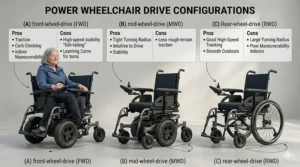
Front Wheel Drive vs Mid-Wheel Drive vs Rear-Wheel Drive: The Real Comparison
This table tells part of the story — but only part.
| Feature | FWD | Mid-Wheel Drive | Rear-Wheel Drive |
|---|---|---|---|
| Obstacle Climbing | ⭐⭐⭐⭐⭐ | ⭐⭐⭐ | ⭐⭐ |
| Indoor Turning Radius | ⭐⭐⭐ | ⭐⭐⭐⭐⭐ | ⭐⭐ |
| High-Speed Stability | ⭐⭐⭐ | ⭐⭐⭐⭐ | ⭐⭐⭐⭐⭐ |
| Soft Terrain Performance | ⭐⭐⭐⭐⭐ | ⭐⭐⭐ | ⭐⭐ |
| Lower Extremity Positioning | ⭐⭐⭐⭐⭐ | ⭐⭐⭐ | ⭐⭐ |
| Learning Curve | Medium | Low | Low |
| Best For | Mixed indoor/outdoor, terrain variety | Compact urban, tight apartments | High-speed, extended paved surfaces |
What the table can’t convey: mid-wheel drive chairs are intuitive to drive precisely because the center-pivoting motion feels almost like the chair “turns in place.” FWD requires the user to develop spatial awareness of that rear-swing arc. Rear-wheel drive feels the most car-like in directional stability but becomes genuinely problematic on any surface that isn’t flat and firm.
According to clinical occupational therapist resources published by Numotion, mid-wheel drive “tends to be the most stable of all bases” but is also “most at-risk to high-center on rough terrain.” FWD sacrifices some of that rotational elegance in exchange for terrain confidence that mid-wheel can’t match on uneven ground. For most users who live real lives that include driveways, sidewalk cracks, and the occasional lawn, that tradeoff lands in FWD’s favor.
Features That Actually Matter (And the Ones That Don’t)
Matters enormously: Drive wheel diameter. This is the single spec that most affects real-world obstacle performance. A 14-inch drive wheel on the Jazzy Elite 14 handles obstacles the 10-inch Titan base model simply cannot. If outdoor use is in your life, don’t accept smaller drive wheels to save $300.
Matters enormously: Suspension system. Active Trac ATX (Pride Mobility) versus no suspension is not a comfort preference — it’s a spinal health consideration for daily users. Hours in an unsuspended chair on imperfect surfaces accumulates real physical stress.
Matters: Controller programmability. Not just for new users learning to drive. As a user’s condition changes — whether improving post-rehabilitation or progressing with a diagnosis — a programmable controller adapts the chair to them rather than the other way around.
Doesn’t matter much: Color options. Yes, it’s nice. It’s not worth compromising on a more important feature to get it.
Doesn’t matter much: Exact top speed in mph. The difference between 3.7 mph and 4.0 mph is irrelevant to daily quality of life. The difference between 10-mile and 17-mile range, however, is significant.
Marketing fluff to ignore: “Improved comfort by X%.” Self-reported manufacturer percentages comparing their own product to unnamed competitors are not clinical data. Evaluate suspension systems and seat designs on their actual engineering merits.
Common Mistakes When Buying a Front Wheel Drive Power Wheelchair
Mistake #1: Buying without trying. A power wheelchair is not a commodity product. If at all possible, arrange a demo through a local mobility dealer. The way a chair feels under your body — how the joystick responds, how the seat distributes pressure — cannot be conveyed by any review, including this one.
Mistake #2: Choosing by weight capacity “ceiling” instead of realistic load. Users right at the edge of a 300-lb capacity chair put every component under maximum stress at all times. Moving to the 450-lb Jazzy Elite HD if you’re between 260–300 lbs isn’t overkill — it’s buying engineering headroom that pays off in longevity and reliability.
Mistake #3: Ignoring the home environment. A chair that performs beautifully in a showroom may not fit through your bathroom doorway, negotiate your kitchen layout, or handle your specific type of floor transition. Measure your narrowest doorways before choosing. The standard door width in American homes is 32 inches; most power chairs need 26–30 inches of clearance minimum.
Mistake #4: Skipping the ATP evaluation for complex seating needs. According to the Centers for Medicare & Medicaid Services, complex power wheelchairs require a face-to-face physician evaluation and often an ATP assessment for Medicare coverage. Skipping this process doesn’t just risk coverage rejection — it risks ending up with a chair that doesn’t actually support your clinical needs.
Mistake #5: Buying used without professional inspection. Battery degradation, motor wear, and controller issues are invisible to the naked eye. A used power chair at 60% of the original price with 40% of its battery life remaining is not a deal. Budget for a professional inspection or factor battery replacement cost into the “deal” price.
Long-Term Cost and Maintenance: What Your FWD Chair Actually Costs Over 5 Years
The sticker price is just the beginning. Here’s what I’ve seen play out over real ownership cycles:
Batteries are the biggest recurring cost. Lead-acid batteries (common in Drive Medical Titan models) typically need replacement every 12–18 months under daily use, at around $100–$200 per pair. Lithium-based systems last longer but cost more upfront. Over 5 years, budget $300–$600 for battery replacements alone.
Tires on flat-free models (Drive Medical Titans) require no maintenance and last the life of the chair under normal use — that’s genuinely one of the best arguments for flat-free tires over pneumatics. Pneumatic tires perform better on very rough terrain but introduce puncture risk and require periodic inflation checks.
Controller and electronics are the expensive repair category. A PG GC3 controller replacement runs $200–$400 for parts alone, and Pride-authorized labor adds to that. This is where brand service network density matters — models from manufacturers with dense dealer networks (Pride, Drive Medical) have meaningfully lower effective repair costs than imports with limited U.S. service infrastructure.
Annual maintenance through a mobility dealer — basically a checkup on motor brushes, battery health, fastener integrity, and tire condition — runs $75–$150 and is worth every dollar for chairs used daily. Think of it like a car oil change: you can skip it, until you can’t.
Total realistic 5-year ownership cost: $1,200–$2,000 above the purchase price for a daily-use FWD chair, depending on brand, usage intensity, and whether you have insurance coverage for repairs.
FAQ: Front Wheel Drive Wheelchair Pros and Cons
❓ What is the main advantage of a front wheel drive power wheelchair?
❓ Is front wheel drive harder to learn than mid-wheel drive?
❓ Can a front wheel drive wheelchair go on grass and gravel?
❓ Does Medicare cover front wheel drive power wheelchairs?
❓ What is the difference between front wheel drive and rear wheel drive power wheelchairs?
Conclusion: Is a Front Wheel Drive Wheelchair Right for You?
Here’s the honest summary: front wheel drive wheelchair pros and cons are not abstract engineering concepts — they map directly onto the textures of real lives. The pros are genuinely compelling. Better obstacle climbing. Superior soft-terrain traction. Excellent lower-extremity positioning. The ability to cross a doorway threshold, a cracked sidewalk, or a gentle gravel path without holding your breath. These aren’t minor quality-of-life improvements. For the right user, they’re the difference between engaging with the world and feeling stranded in it.
The cons are real too. The rear-swing arc takes adjustment. High-speed straight-line tracking isn’t FWD’s strength. In a genuinely compact urban apartment with 28-inch doorways and furniture everywhere, mid-wheel drive may serve you better.
But for the mixed-terrain, indoor-outdoor, real-American-life use case? Front wheel drive is a deeply practical system backed by decades of clinical refinement. The seven models on this list — from the accessible FH10 M16-1 to the clinical rigor of the Pride Jazzy Elite HD Group 2 — cover every realistic buyer profile from budget-conscious to bariatric. Use the decision framework in this guide, involve a therapist if this is your first chair, and don’t let the spec sheet intimidate you. The right chair is the one that makes your specific life better.
✨ Ready to Make Your Move?
🔍 Click any product above to check current pricing, read verified customer reviews, and check availability. Your independence upgrade is one click away!
Recommended for You
- 7 Best Front Wheel Drive Wheelchairs for Rough Terrain in 2026
- Best Front Wheel Drive Wheelchair for Small Spaces in 2026
- 7 Best Indoor Front Wheel Drive Wheelchairs for Tight Spaces 2026
Disclaimer: This article contains affiliate links. As an Amazon Associate, I earn from qualifying purchases. If you purchase products through these links, we may earn a small commission at no additional cost to you.
✨ Found this helpful? Share it with your friends! 💬🤗
