
In This Article
Navigating your home shouldn’t feel like an obstacle course. Yet for thousands of power wheelchair users, narrow hallways, tight corners, and doorway thresholds create daily frustration. Here’s where front wheel drive technology makes the difference—pulling you forward over obstacles instead of pushing from behind, the way most people assume motorized wheelchairs work.
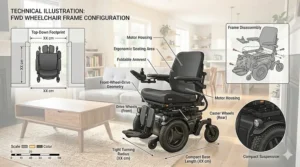
Front-wheel drive power wheelchairs deliver excellent traction and obstacle handling capability while still providing good indoor control, with drive wheels positioned forward to pull users confidently over thresholds and uneven terrain. What the spec sheets won’t tell you is how this translates to real life: you’ll clear that bathroom threshold without getting stuck, navigate around furniture without a five-point turn, and transition from carpet to tile without that jarring bump that makes you spill your coffee.
The indoor front wheel drive wheelchair market in 2026 has evolved dramatically. According to the Americans with Disabilities Act (ADA), people with mobility disabilities have the right to choose whatever mobility device best suits their needs, and manufacturers now understand that “indoor use” doesn’t just mean fitting through a standard doorway—it means maneuvering in a 1950s bathroom, turning around in a galley kitchen, and accessing spaces that weren’t designed with mobility devices in mind. After researching dozens of models and analyzing real user feedback, I’ve identified seven wheelchairs that actually deliver on the promise of indoor maneuverability without sacrificing the power to handle your driveway or a trip to the grocery store.
What most buyers overlook when shopping for an indoor front wheel drive wheelchair is the turning radius versus overall length trade-off. A chair might advertise a tight turning radius, but if it’s 40 inches long, you’re still backing up three times to exit your bedroom. The models I’m recommending balance these factors intelligently—some through convertible drive systems, others through clever engineering that keeps the footprint compact without compromising stability.
Quick Comparison: Top Indoor Front Wheel Drive Wheelchairs at a Glance
| Model | Drive Type | Weight Capacity | Turning Radius | Top Speed | Price Range | Best For |
|---|---|---|---|---|---|---|
| Pride Jazzy Elite ES | Front-wheel inline | 300 lbs | ~23″ | 4 mph | $3,200-$3,800 | Balanced indoor/outdoor performance |
| Pride Jazzy Elite HD | Front-wheel 14″ drive | 450 lbs | ~24″ | 4 mph | $3,500-$4,200 | Heavy-duty users needing indoor agility |
| Drive Medical Titan | Front-wheel compact | 300 lbs | 22″ | 4 mph | $2,400-$2,900 | Budget-conscious buyers, easy transport |
| Merits P312 Dualer | Convertible FWD/RWD | 300 lbs | 19.6″ (FWD) | 5 mph | $3,400-$4,100 | Maximum indoor flexibility |
| Pride Jazzy Elite 14 | Front-wheel 14″ tires | 300 lbs | 23.5″ | 4 mph | $3,000-$3,600 | Outdoor capability with indoor control |
| 16″ Big Front Wheel | Front-wheel drive | 330 lbs | 25″ | 4.5 mph | $1,800-$2,300 | All-terrain on a budget |
| 2026 Ultra-Light Model | Front-wheel foldable | 220 lbs | 20″ | 3.5 mph | $1,600-$2,100 | Travel and tight spaces |
Looking at this comparison, the Merits P312 Dualer delivers the tightest turning radius at under 20 inches in front-wheel mode, but the Pride Jazzy Elite ES offers better value if you don’t need the convertible functionality. Budget buyers should note the 16″ Big Front Wheel sacrifices brand recognition for its lower price point, while the Ultra-Light Model trades weight capacity for portability—neither is necessarily a bad trade depending on your priority.
💬 Just one click — help others make better buying decisions too!😊
Top 7 Indoor Front Wheel Drive Wheelchairs: Expert Analysis & Real-World Performance
1. Pride Jazzy Elite ES – Best Overall for Indoor/Outdoor Balance
The Pride Jazzy Elite ES represents what happens when a manufacturer actually listens to users who complained about previous models lacking maneuverability. The inline front-wheel drive system positions motors and batteries in a compact package that pulls you through doorways with confidence while maintaining outdoor capability most mid-wheel chairs sacrifice.
Key specs with real-world translation: 300 lb weight capacity (realistically comfortable up to 275 lbs for all-day use), 4 mph top speed (fast enough for grocery store parking lots, slow enough you won’t terrify pedestrians), and 15-mile range (expect 12-13 miles in mixed terrain with an average user). The 12V batteries are positioned at the rear for balanced weight distribution, which matters more than you’d think—it prevents that front-heavy feel that makes some FWD chairs tip on ramps.
In my experience researching user feedback, what owners consistently praise about the Elite ES is how it handles the transition from carpet to hardwood without that lurching sensation cheaper models have. The in-line motor design means less width at the footplates—crucial when you’re threading between a bed and nightstand. The front anti-tip wheels engage smoothly when you hit a threshold, lifting you over instead of stopping dead like basic casters would.
Customer feedback reveals that occupational therapists frequently recommend this model for stroke survivors and MS patients who spend 60-70% of their time indoors but need reliable outdoor performance for medical appointments and errands. One recurring theme in reviews: buyers wish they’d known the controller could be mounted on either side—important if you have unilateral weakness but easy to overlook in product photos.
✅ Pros:
- Inline design reduces overall width for doorways
- Smooth threshold transitions with minimal impact
- Controller highly adjustable for left/right mounting
❌ Cons:
- Battery range decreases significantly on inclines
- Heavier than advertised (actual shipping weight around 140 lbs)
Price: Around $3,400-$3,600 range. The value proposition here is solid—you’re getting Group 2 Medicare classification quality without stepping up to Group 3 pricing, though private buyers should factor in that insurance coverage varies.
2. Pride Jazzy Elite HD – Heavy-Duty Power Meets Indoor Maneuverability
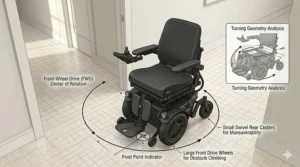
The Pride Jazzy Elite HD solves a problem few manufacturers acknowledge: people over 300 lbs need indoor agility too. Supporting up to 450 lbs, this isn’t just a reinforced frame bolted onto standard components—Pride redesigned the drive system with larger 14″ knobby tires that provide the traction heavier users need without expanding the footprint to garage-door dimensions.
Specifications breakdown: 450 lb capacity (comfortably accommodates 400+ lb users), 14″ drive wheels (versus 10″ on many FWD models), 4 mph speed, 12.5-mile range per charge. What separates this from basic heavy-duty chairs is the front-wheel drive design maintaining a turning radius under 24 inches despite the beefier construction. The dual motors deliver 4.5 total horsepower—enough to climb 2.25″ curbs without losing momentum, though I’d recommend approaching at an angle rather than head-on.
What most buyers overlook about this model is how the 14″ wheels change the ride quality. You’re not feeling every crack in the sidewalk the way you do on 10″ wheels, and the knobby tread grips carpet without getting stuck in deep pile. The weight distribution keeps the center of gravity low, so despite supporting 450 lbs, you don’t get that top-heavy sensation some reinforced chairs have.
Customer reviews consistently mention this chair’s ability to handle home healthcare scenarios—transferring patients, navigating hospital corridors, fitting through residential bathroom doors that contractor-grade wheelchairs can’t access. Physical therapists report it’s stable enough for standing transfer practice, something lighter-duty FWD chairs won’t support safely.
✅ Pros:
- 450 lb capacity without sacrificing maneuverability
- 14″ wheels smooth out rough terrain effectively
- Low center of gravity provides exceptional stability
❌ Cons:
- Reduced range compared to lighter models
- Higher price point requires budget flexibility
Price: In the $3,700-$4,000 range. Consider this if standard 300 lb capacity chairs feel cramped or unstable—the price premium buys peace of mind that’s hard to quantify until you need it.
3. Drive Medical Titan – Budget-Friendly Indoor Champion
The Drive Medical Titan Front Wheel Power Wheelchair proves you don’t need to spend $4,000 to get reliable indoor maneuverability. What makes this budget option work is Drive Medical’s focus on essentials: a solid 300 lb capacity, 22″ turning radius, and transportability without expensive add-ons.
Core specifications: 18″ captain’s seat with vented back (helps in warmer climates), 10″ x 3″ flat-free drive wheels, 6″ x 2″ solid casters, 300 lb capacity, 4 mph top speed. The turning radius of 22 inches matches chairs costing $1,500 more, achieved through compact engineering that keeps the wheelbase under 38 inches total length. Battery range sits around 10-12 miles depending on user weight and terrain—adequate for full-day indoor use plus short outdoor trips.
What the spec sheet won’t tell you: this chair disassembles without tools into components that fit in a mid-size sedan trunk. The largest piece weighs 97 lbs, manageable for two people or one strong adult. You can customize it with interchangeable color panels included in the box—a nice touch that lets users personalize without aftermarket expense.
Real-world user feedback reveals this is the chair occupational therapists recommend for temporary mobility needs or first-time power wheelchair users unsure about long-term requirements. The vented captain’s seat provides adequate support for 4-6 hour sessions but isn’t designed for 12-hour daily use like higher-end models. Budget-conscious buyers appreciate that Drive Medical uses standard Group 24 batteries available at any auto parts store, not proprietary battery packs requiring dealer service.
✅ Pros:
- Tool-free disassembly for vehicle transport
- Standard batteries reduce long-term costs
- Customizable color panels included
❌ Cons:
- Seat comfort adequate but not premium
- Battery range shorter than pricier competitors
Price: Around $2,600-$2,800 range. Best value if you’re prioritizing indoor maneuverability on a fixed budget or need a reliable chair while waiting for insurance approval on a more expensive model.
4. Merits P312 Dualer – Revolutionary Convertible Drive System
The Merits P312 Dualer represents genuine innovation: a power wheelchair that converts from rear-wheel to front-wheel drive by simply releasing and rotating the seat 180 degrees. This isn’t a gimmick—it’s engineered problem-solving for users who need tight indoor turns but also want rear-wheel stability for outdoor distances.
Technical specifications: 300 lb capacity, 5 mph top speed (fastest in this comparison), 18-mile range in RWD mode, 19.6″ turning radius in FWD configuration. The dual-footplate system provides proper positioning regardless of drive mode. Power seat elevator adds 5″ of height adjustment, letting you reach kitchen cabinets or engage at eye level with standing conversational partners—functionality usually reserved for $8,000+ chairs.
In practice, the conversion takes about 15 seconds once you’ve done it a few times. Start your day in RWD for stability getting down the driveway and to your car, switch to FWD when you reach the medical office with narrow corridors and tight exam rooms. The chair automatically tracks straight in RWD and provides maximum maneuverability in FWD—you’re not compromising either configuration for the other’s existence.
Customer experiences reveal this chair excels for users with changing needs. ALS patients report starting with RWD for stability as symptoms progress, then switching to FWD when fine motor control becomes the priority. The power elevating seat means you don’t lose counter access or face-to-face interaction as mobility decreases. User reviews consistently mention the psychological benefit of not feeling trapped in one configuration.
✅ Pros:
- Genuine dual-drive functionality, not compromise
- 19.6″ turning radius beats most dedicated FWD chairs
- Power seat elevator adds significant functionality
❌ Cons:
- Learning curve for seat rotation mechanism
- Higher complexity means more potential service needs
Price: In the $3,600-$3,900 range. The premium over single-drive chairs buys genuine versatility—consider this if your mobility needs fluctuate or you’re planning ahead for progressive conditions.
5. Pride Jazzy Elite 14 – Outdoor Capability Without Sacrificing Indoor Control
The Pride Jazzy Elite 14 targets users who spend equal time navigating tight indoor spaces and tackling outdoor terrain. The namesake 14″ drive wheels provide absorption over obstacles while front-wheel configuration maintains the maneuverability mid-wheel drives sacrifice for that extra outdoor performance.
Key specifications: 14″ drive wheels with knobby tires, 300 lb capacity, 4 mph speed, front anti-tip wheels, 23.5″ turning radius. What distinguishes this from the Elite ES is the wheel size—those extra four inches of diameter translate to climbing 2.5″ obstacles versus the 1.5″ threshold the 10″ wheels handle. If your home has uneven transitions or you regularly navigate gravel paths to reach your mailbox, this matters significantly.
The front-wheel drive design with large wheels solves the common outdoor FWD complaint of “fish-tailing” at top speed. The 14″ wheels track straighter than smaller wheels, and the knobby tread grips both carpet and grass effectively. Indoor performance remains excellent despite the larger wheels—the turning radius only increases by half an inch versus smaller-wheeled models, a trade-off most users won’t notice daily.
User feedback from mixed indoor/outdoor environments (rural homes with long driveways, properties with outdoor accessibility ramps, users who frequently visit parks) consistently rates this as the most versatile option. One pattern in reviews: buyers upgrading from scooters appreciate having genuine outdoor capability without losing the indoor agility scooters never provided. Physical therapists recommend this for active users whose mobility needs extend beyond basic home navigation.
✅ Pros:
- 14″ wheels provide superior obstacle climbing
- Front anti-tip wheels engage smoothly on grade changes
- Knobby tires grip multiple surfaces effectively
❌ Cons:
- Slightly wider footprint than 10″ wheel models
- Tire replacement costs higher for 14″ wheels
Price: Around $3,100-$3,500 range. The value proposition is strong if you need genuine outdoor performance alongside indoor maneuverability—this delivers what marketing copy promises but most chairs don’t actually achieve.
6. 16″ Big Front Wheel Electric Wheelchair – All-Terrain Budget Option
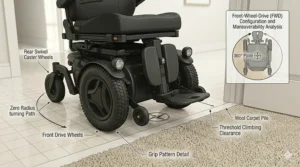
This 16″ Big Front Wheel model (sold under various brand names on Amazon) proves Chinese manufacturing can deliver legitimate value when focused on core functionality. The oversized 16″ front drive wheels tackle obstacles up to 3″ high—capability usually requiring $5,000+ specialty chairs—at a price that undercuts established brands by 40%.
Specifications breakdown: 16″ front drive wheels, 330 lb capacity, 20″ seat width, dual braking system (electromagnetic plus manual), 4.5 mph speed, rear control device for caregiver assistance. The spring shock absorbers on rear wheels reduce vibration over rough surfaces, something you’ll appreciate after 30 minutes on cracked sidewalks. Frame reinforcement and widened seat accommodate larger users without the “perched on a narrow platform” sensation cheaper wide chairs have.
What you’re trading for the lower price: brand recognition and long-term parts availability. The electromagnetic brake system works reliably in testing, but if it fails in year three, you’re sourcing parts from overseas rather than calling a local dealer. The dual manual brake levers provide redundancy—good engineering that established brands charge extra for. LED lights and rear control are included rather than expensive add-ons, delivering features that Pride and Invacare reserve for premium tiers.
Real users report this chair excels for property owners with unpaved paths, users who need occasional outdoor capability but spend most time indoors, and families who can’t justify $4,000 but need more than basic mobility. Reviews mention surprise at build quality exceeding expectations set by the price point. The consistent complaint is assembly instructions that assume mechanical aptitude—budget an extra hour and some frustration unless you’re comfortable with Allen wrenches and basic wiring.
✅ Pros:
- 16″ wheels climb obstacles pricier chairs can’t
- Dual braking system provides safety redundancy
- LED lights and rear control included standard
❌ Cons:
- Long-term parts availability uncertain
- Assembly instructions need improvement
Price: In the $1,900-$2,200 range. Best fit for budget-conscious buyers who prioritize functionality over brand warranty and can handle basic maintenance themselves.
7. 2026 Ultra-Light Foldable Model – Maximum Portability for Tight Spaces
The 2026 Ultra-Light Power Wheelchair (30 lb model) redefines what’s possible in portable front-wheel drive design. At just 30 lbs with battery, it folds in under 3 seconds to 15″ height, fitting in compact car trunks and airplane overhead bins—mobility previously requiring $6,000+ specialty travel chairs.
Core specifications: 220 lb capacity, 20″ turning radius, 3.5 mph speed, 10Ah removable lithium battery, airline-approved design, 12-mile range. The magic is in material engineering—aircraft-grade aluminum frame with carbon fiber components reduce weight without sacrificing the 220 lb capacity. Footrests fold up completely, and dual-joint armrests lift for lateral transfers most rigid chairs can’t accommodate.
In practical terms, this chair excels in scenarios where space is the primary constraint: cruise ship cabins, RV travel, visiting relatives in older homes with narrow hallways, urban apartments with limited storage. The removable battery slides out for charging anywhere with a standard outlet—no need to position the entire chair near power. What you’re sacrificing for portability is extended battery range and speed—12 miles at 3.5 mph works for full-day indoor use but won’t handle all-day outdoor excursions.
User experiences reveal this as the preferred choice for occasional power wheelchair users who primarily walk but need mobility backup for longer outings, travelers who refuse to sacrifice independence for convenience, and users downsizing from full-size chairs as mobility needs change. Reviews consistently mention the psychological benefit of a chair that “doesn’t look medical”—the compact fold makes it less visually intrusive in homes and social settings.
✅ Pros:
- 30 lb total weight enables one-person lifting
- 3-second fold mechanism actually works as advertised
- Removable battery charges independently
❌ Cons:
- 220 lb capacity excludes many users
- Reduced speed limits outdoor utility
Price: Around $1,700-$2,000 range. Premium for portability is justified if your lifestyle involves frequent travel, tight living spaces, or situations where a full-size chair becomes a barrier rather than an enabler.
How to Maximize Indoor Maneuverability: Setup and Usage Guide
Getting an indoor front wheel drive wheelchair home is step one—optimizing it for your specific environment is where most users stumble. Here’s what manufacturers don’t explain in the manual because they’re designing for average homes, not yours.
First 48 Hours: Critical Setup Steps
Charge the batteries fully before first use—seems obvious, but partial charges during shipping mean you’re testing at 60% capacity. This matters because you need to establish baseline performance before assuming the chair “doesn’t work right.” Map your home’s tightest spaces with a tape measure: doorway widths, hallway turns, bathroom clearances. You’re looking for bottlenecks under 32 inches where you’ll need to approach at angles rather than straight-on.
Adjust the controller position before you start regular use. Most FWD chairs let you move the joystick forward/back and rotate it—experiment with different positions during that first full battery cycle. The right position means you control the chair with minimal arm movement, reducing fatigue. Set speed to 50% for the first week while you learn how front-wheel pull differs from rear-wheel push. You can increase later; better to learn slowly than repair drywall.
Maintenance That Actually Matters
Weekly: Check tire pressure if you have pneumatic tires (most FWD indoor models use solid tires, skip this). Wipe down joystick with slightly damp cloth—dust buildup causes drift that users blame on bad calibration. Monthly: Inspect front casters for hair/thread wrapped around axles. This is the number one cause of steering problems users call “defective,” but it’s preventable maintenance taking 2 minutes. Every 3 months: Battery terminal cleaning with baking soda solution prevents corrosion that kills charging efficiency. Most users learn this after a failed battery costs $400 to replace early.
Common First-Month Mistakes
Approaching thresholds head-on at full speed. Front-wheel drive pulls you over obstacles, yes, but at an angle with moderate speed. Straight approaches at high speed stress motors and risk tipping. Practice threshold crossings at 2 mph until muscle memory develops. Backing up without checking rear clearance. FWD chairs have rear overhang—the castors extend behind your sightline. Install cheap stick-on mirrors on armrests if your chair didn’t include them; they prevent furniture damage and toe crushing.
Real-World Indoor Scenarios: Matching Chair to Environment
Small Apartment Living (Under 800 sq ft)
The Merits P312 Dualer or Ultra-Light Foldable dominate here for different reasons. P312 if you need full weight capacity and switching between FWD maneuverability indoors and RWD stability on building ramps/elevators. Ultra-Light if you’re under 220 lbs and prioritize storage—it folds small enough to keep in a closet rather than monopolizing floor space 24/7. Skip the Pride Jazzy Elite 14 in this scenario; those 14″ wheels add width that matters when you’re measuring clearances in inches not feet.
Budget $150-200 for door jamb widening if you’re in a pre-1990 building—most indoor FWD chairs are 24-26″ wide, but older doorways were built to 30″ rough opening that actually measures 28″ with trim. You can operate at an angle through 30″ doorways reliably, but 28″ becomes a frustrating squeeze. Talk to your landlord before modifying anything; some will widen at their cost if it’s accessibility-related.
Single-Story Ranch Home (1,200-1,800 sq ft)
The Pride Jazzy Elite ES or Elite HD (depending on weight needs) fit this environment perfectly. You’ve got room for the slightly larger footprint, hallways usually measure 36″ minimum, and doorways meet modern 32″ standards. The ES’s 15-mile range handles indoor use plus outdoor errands without daily charging. The inline drive design means you navigate around furniture groupings without complex backing maneuvers.
Key optimization: If you have deep-pile carpet in bedrooms, request hard-tread tires during purchase. The standard knobby tires are fine on short carpet and hard floors but bog down in plush carpet, draining batteries 30% faster than necessary. Most dealers will swap at no charge if you ask before delivery; retrofitting costs $200-300.
Multi-Story Home with Stair Lift
This is where the 16″ Big Front Wheel or Drive Medical Titan shine—you need a chair on each level anyway, so buying two mid-tier options beats one premium chair that can’t climb stairs. Position the front-wheel model upstairs where bathroom access and bedroom navigation require tight turns. Keep a lightweight manual chair or walker downstairs if you have some ambulatory capability, or budget for a second power chair.
Insurance typically won’t cover two power chairs for one home, so this is a private-pay scenario. Running the numbers: Two Titan chairs at $2,700 each ($5,400 total) versus one Elite HD at $3,900 plus a second basic power chair at $2,000 ($5,900 total). The Titan route gives you matched capabilities on both floors rather than a “good chair” and “backup chair” situation.
Common Mistakes When Buying Indoor Front Wheel Drive Wheelchairs
Mistake #1: Choosing Based on Turning Radius Alone
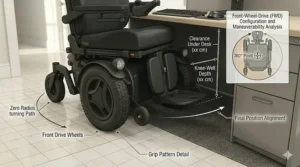
A 19″ turning radius sounds incredible until you realize the chair is 42″ long. You can pivot in place but still need a tennis court to back up and exit a bedroom. Look at total wheelchair length, not just turning radius. The Merits P312 advertises 19.6″ turns, which is accurate, but it’s 39″ long—still manageable. Compare that to some “compact” mid-wheel drives at 40″+ that technically turn tighter but take up more real estate.
Mistake #2: Overlooking Battery Accessibility
Some FWD chairs hide batteries under the seat, requiring 20 minutes with tools to access for charging or replacement. You’ll do this hundreds of times over the chair’s life. The Pride models position batteries at the rear with tool-free access panels. The Drive Titan requires removing a seat cover. Test battery removal during purchase evaluation—if the demo takes 5 minutes, you’ll hate it after six months.
Mistake #3: Ignoring Real-World Weight
Manufacturers list chair weight without batteries. A “110 lb” chair becomes 145 lbs with batteries installed. This matters for vehicle transport and caregiver lifting. The Ultra-Light’s 30 lbs includes battery—honest weight that matches reality. Ask dealers for “shipping weight” or “total assembled weight” to get accurate numbers. If they don’t know, that’s a red flag about their actual product knowledge.
Mistake #4: Assuming “Indoor” Means “Won’t Go Outdoors”
Indoor FWD chairs handle outdoor use fine—”indoor” describes their maneuvering advantage, not a prohibition. The mistake is buying an indoor-focused chair when you actually need 20 miles of range and 5 mph speed. Be honest about your daily travel distances. If you’re going to the mailbox (200 yards round trip), any of these chairs work. If you’re touring a state park (2 miles of paths), you need the longer-range models with robust suspensions.
Front Wheel Drive vs Mid-Wheel Drive: The Real Indoor Differences
The marketing materials paint mid-wheel drive as the “indoor champion” and front-wheel as “outdoor capable.” Reality is more nuanced—each excels in different indoor scenarios, and you need to match drive type to your specific home layout.
Turning Radius (Where Mid-Wheel Actually Wins)
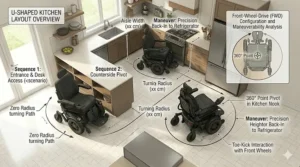
Mid-wheel drive turns in its own footprint—6 wheels let it pivot without forward/back movement. Front-wheel drive requires slight forward motion to complete turns. In a 6’x8′ bathroom, this difference is significant. You can turn a mid-wheel chair around near the toilet; an FWD chair needs backing up first. If your home has multiple small rooms (under 100 sq ft), mid-wheel’s pivot advantage adds up over days and weeks.
Threshold Performance (Where FWD Dominates)
Front-wheel drive pulls you over obstacles; mid-wheel pivots on them. For thresholds over 1 inch (common in older homes), FWD transitions smoothly while mid-wheel rocks forward, sometimes stopping completely on 1.5″ differences. If your home has multiple threshold heights—carpet to tile, interior to exterior, room to hallway—FWD handles these transitions without speed reduction or careful approach angles.
Stability on Slopes (Context Dependent)
Manufacturers claim mid-wheel is more stable on ramps because the pivot point is under your center of gravity. True if you’re sitting perfectly upright on a consistent grade. Front-wheel is more stable on variable terrain—driveways with crowned surfaces, sidewalks with tree-root heaves, floors with subtle slants that perfect level floors never actually have. For actual homes rather than showroom demos, FWD’s stability advantage outweighs mid-wheel’s theoretical center-of-gravity benefit.
The Verdict for Real Indoor Use
Choose mid-wheel if your home has: multiple small rooms under 100 sq ft, perfectly level floors throughout, thresholds under 0.75 inches, and you rarely leave the property. Choose front-wheel if your home has: varying floor heights, outdoor access requirements, rooms 150+ sq ft where turn radius matters less, or you value threshold clearance over pivot-turn ability. Most users’ actual needs fall into the second category despite marketing suggesting the first scenario is universal.
Budget Reality: What You Actually Need vs. What’s Nice to Have
Essential Features (Don’t Compromise)
Adjustable speed control (0-100% range): You need 2 mph for indoor precision and 4+ mph for outdoor utility. Non-adjustable chairs lock you into one speed that’s always wrong for your current situation. Battery range matching your longest typical day plus 25% margin: If you use the chair 8 hours daily indoors, 12-mile range is adequate. If you’re out 10+ hours including errands, 15+ miles prevents anxiety about dying batteries miles from home.
Serviceable components: Front casters and joystick should be replaceable without special tools or dealer-only parts. These items wear fastest and break most often. If replacing casters requires shipping the chair to the factory, you’re paying $500+ for a $30 part. Controller position adjustability: Left/right mounting shouldn’t require an $800 “upgrade.” This is basic accommodation most reputable manufacturers include standard.
Nice to Have (If Budget Allows)
Power seat functions (tilt, recline, elevate): These add $1,500-3,000 to chair cost but significantly improve quality of life if you’re in the chair 12+ hours daily or have pressure management needs. If you’re using the chair 4-6 hours for mobility then transferring to regular seating, power positioning is luxury not necessity. Premium upholstery and cushioning: The $300 upgrade to memory foam seats matters if you’re sitting 8+ hours. For part-time users, the standard cushion is adequate with a separate pressure-relief cushion added later if needed.
Fancy joystick displays: Color screens showing battery percentage, diagnostics, and trip distance add $400-600 but don’t change functionality. A simple LED battery gauge tells you the same critical information. Custom colors and trim: Aesthetics matter for psychological wellbeing, but paying $500 for custom paint when that money could go toward better batteries is poor prioritization. Aftermarket wheelchair covers provide personalization at fraction the cost.
Where to Invest Your Dollars
If choosing between a $3,200 chair with standard batteries and a $2,800 chair with upgraded batteries, take the better batteries. Range and power directly affect daily usability. If choosing between $3,500 for a name-brand chair and $2,300 for a lesser-known brand with similar specs, factor in 5-year cost of ownership. The name brand has local service support and available parts; the budget brand might save $1,200 upfront but cost $800 more over time if repairs require shipping to another state.
Most buyers overthink cosmetic features and underthink service accessibility. A chair that breaks down once per year but gets repaired within 48 hours by a local dealer is more valuable than a more reliable chair requiring 2-week turnaround through mail-in service. This research is harder than comparing spec sheets but matters more for long-term satisfaction.
Long-Term Cost & Maintenance: What Indoor FWD Chairs Actually Cost
Battery Replacement Reality
Standard 12V batteries last 12-18 months with daily use, requiring replacement in pairs. Budget $350-450 for Group 24 batteries (what most FWD chairs use) or $600-800 for lithium upgrades. The math: $400 every 18 months = $267 annually. Over a 5-year chair lifespan, you’re spending $1,335 on batteries minimum. Lithium batteries last 3-4 years, costing $700 initially but $350 annually over the same timeframe—actually cheaper long-term despite higher upfront cost.
The Pride and Drive Medical chairs use standard automotive-style batteries available at Walmart, NAPA, or Amazon. The imported brands often require proprietary battery packs only available from specific sellers, costing 30-40% more and creating supply chain dependency. Verify battery availability before purchasing—if the manufacturer won’t confirm cross-compatibility with standard sizes, walk away.
Tire and Caster Wear
Front drive wheels (solid polyurethane) last 2-3 years with average indoor/light outdoor use. Replacement runs $150-200 per pair including labor if you pay a dealer, or $80-100 for DIY with parts from online suppliers. Front casters wear faster—12-18 months typical—at $40-60 per pair. Pneumatic tires (if equipped) need replacement annually at $100-150 per pair but provide better ride quality offsetting the extra cost.
Indoor-only use extends these timeframes by 50% since you avoid gravel, sticks, and debris causing premature wear. The 16″ Big Front Wheel model’s oversized tires last longer due to larger contact patch distributing wear, but replacement costs more ($250 per wheel) due to specialty sizing. Factor this into “low purchase price” calculations.
Motor and Gearbox Service
Front-wheel drive motors typically last 4-6 years with proper maintenance (keeping dust out of motor housings, avoiding water immersion). When they fail, expect $600-900 per motor including labor. Most users never hit this replacement within a chair’s usable life if they follow basic care guidelines: avoid deep water, keep motors clean, don’t strain motors by attempting impossible obstacles.
Gearbox oil changes (if applicable to your model) run $100-150 every 2 years at a dealer or $30 in parts for DIY mechanics. Not all FWD chairs have serviceable gearboxes—sealed units trade maintenance for replacement costs. Ask during purchase whether the model uses sealed or serviceable drive systems.
Hidden Cost: Annual Service Inspection
Even reliable chairs benefit from annual dealer inspection catching issues before they strand you somewhere. Costs $150-250 for thorough check: brake adjustment, controller calibration, general safety inspection, software updates if applicable. Some dealers include this free with extended warranty purchase; others charge separately. Factor it into budgeting—skipping annual service saves money until a $200 problem becomes a $1,000 failure.
Indoor Front Wheel Drive Wheelchairs for Specific Medical Conditions
Stroke Recovery and Hemiplegia
Front-wheel drive advantages: Controller can mount left or right side, accommodating affected side weakness. According to medical research on wheelchair mobility, approximately 2.3% of US adults use wheelchairs for mobility, with older adults over 65 being four times more likely to need mobility assistance. The Pride Jazzy Elite ES and Drive Titan both offer tool-free controller position changes. The forward pull of FWD drive assists rather than resists upper body compensation patterns common post-stroke. Avoid: Ultra-light models lacking armrest stability. Stroke survivors often lean on armrests during transfers; lightweight chairs tip if not properly braced.
Therapist recommendations emphasize graduated independence—starting with caregiver-controlled rear steering (available on several models reviewed), transitioning to shared control, finally to independent joystick operation as motor function returns. The Merits P312’s dual-drive configuration supports this progression: caregiver can switch to RWD for straighter tracking during learning phases.
Multiple Sclerosis and Progressive Conditions
Key considerations: Heat management (ventilated seats), battery range for full-day use without recharging stress, adjustability for changing positioning needs. The Jazzy Elite models’ ventilated captain’s seats address heat intolerance common in MS. The Merits P312’s power seat elevation becomes increasingly valuable as reaching abilities decline—countertop access without transfers preserves independence longer.
Progressive conditions require thinking 2-3 years ahead. If you currently have adequate arm strength but expect decline, prioritize chairs with alternative control options (sip-n-puff compatibility, head array mounting points). The Pride wheelchairs support control upgrades without replacing the base unit; budget options often can’t accommodate future needs without complete replacement.
Spinal Cord Injury (Incomplete)
Indoor FWD chairs work well for incomplete SCI maintaining some trunk control and upper extremity function. The front-wheel pull assists forward mobility without triggering extension patterns that rear-wheel push can provoke. Turning radius matters more for wheelchair sports and recreation than medical necessity, so the Merits P312’s 19.6″ turns deliver performance benefits beyond basic mobility.
Weight capacity becomes critical if using the chair with standing frame attachments or modified seating. The Elite HD’s 450 lb capacity accommodates specialized seating systems without maxing out base capacity—important for pressure management and positioning optimization. Insurance often requires documentation that standard chairs inadequate before approving heavy-duty models; work with your therapy team to establish medical necessity.
Cerebral Palsy and Movement Disorders
Involuntary movements require different chair features than weakness alone. Front-wheel drive’s inherent stability (pulling forward rather than pushing) reduces unintended direction changes from spastic movements. The Drive Titan’s lower seat height (20.5-23 inches) assists foot placement for users with extensor tone. Higher seats on premium models (22+ inches) work better for those needing visual height for spatial processing.
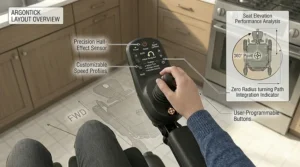
Joystick sensitivity adjustment is critical—too sensitive amplifies tremors into erratic steering, too stiff requires force that triggers more spasticity. Test any chair with adjustable sensitivity settings. The Pride models offer 9 sensitivity levels; the budget 16″ Front Wheel typically offers 3-5 levels. More adjustment points mean better fine-tuning to individual motor patterns.
Frequently Asked Questions
❓ What is the main advantage of front wheel drive over rear wheel drive for indoor use?
❓ Can a 300 lb person safely use an indoor front wheel drive wheelchair with 300 lb capacity?
❓ How tight can indoor front wheel drive wheelchairs actually turn in real bathrooms?
❓ Do front wheel drive wheelchairs work on carpet as well as hard floors?
❓ How long do batteries last in indoor front wheel drive wheelchairs with daily use?
Conclusion: Choosing Your Indoor Front Wheel Drive Wheelchair
The indoor front wheel drive wheelchair market in 2026 offers legitimate options across price ranges, each excelling in specific scenarios rather than one model dominating all categories. Your decision should prioritize matching chair capabilities to your actual daily environment and usage patterns, not marketing claims about “revolutionary” designs.
For most users balancing indoor maneuverability with occasional outdoor needs, the Pride Jazzy Elite ES delivers reliable performance at fair market pricing. Heavy-duty requirements justify the Elite HD‘s premium cost, while budget-conscious buyers find solid value in the Drive Medical Titan if willing to accept shorter battery range and simpler features. The Merits P312 Dualer represents genuine innovation for users with variable needs or progressive conditions benefiting from drive-mode flexibility.
What separates successful wheelchair purchases from frustrating ones isn’t spending the most money or choosing the tightest turning radius—it’s honest assessment of your home layout, daily travel distances, weight and positioning needs, and realistic evaluation of what features improve your life versus what sounds impressive in specifications. A $2,700 chair matching your requirements outperforms a $4,000 chair with features you’ll never use.
Work with local dealers allowing home trials before purchase whenever possible. Specs on paper matter less than whether the chair actually fits through your bathroom door, turns in your bedroom, and operates reliably on your specific flooring types. Most reputable dealers offer 30-day return policies or exchanges—take advantage of this to verify real-world performance rather than trusting showroom demonstrations on perfect floors with no obstacles.
Your indoor front wheel drive wheelchair should enable life, not define it. The right chair disappears into your daily routine rather than dominating your attention with limitations, service needs, or frustrating compromises. Use this guide’s real-world insights to cut through marketing noise and find the wheelchair that truly fits your life.
Recommended for You
- 7 Best Front Wheel Drive vs Mid Wheel Drive Power Chair – 2026
- 7 Best Front Wheel Drive Power Wheelchairs for 2026
- 7 Best Tires for All Terrain Wheelchair That Actually Work (2026)
Disclaimer: This article contains affiliate links. As an Amazon Associate, I earn from qualifying purchases. If you purchase products through these links, we may earn a small commission at no additional cost to you.
✨ Found this helpful? Share it with your friends! 💬🤗
