
In This Article
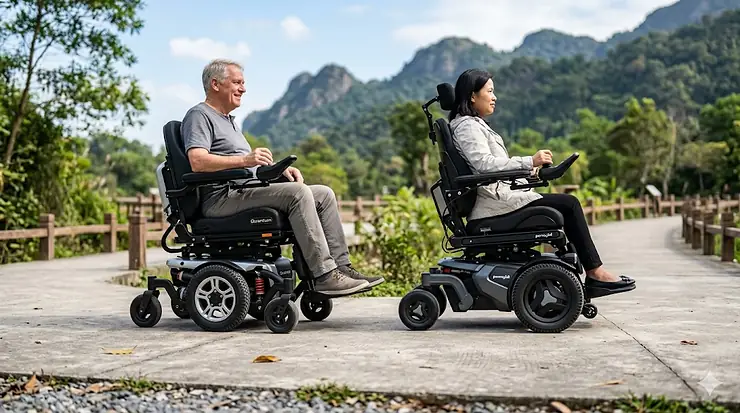
Choosing between front wheel drive vs mid wheel drive power chair configurations isn’t just about specs on a page—it’s about matching your daily reality to the right machine. I’ve watched countless buyers get this decision wrong, and it almost always comes down to one thing: they focused on features instead of lifestyle fit. The truth most dealers won’t tell you? A $8,000 mid-wheel chair with all the bells and whistles can be a complete disaster if you’re navigating outdoor trails regularly, while a $4,500 front-wheel model might be overkill for someone who rarely leaves their apartment.
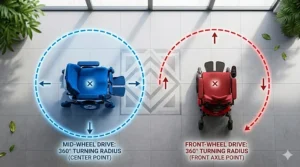
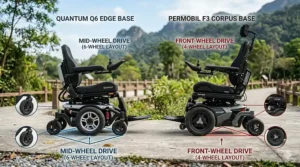
Here’s what most people overlook when comparing these drive systems: the placement of those powered wheels changes everything about how the chair behaves in real-world conditions. Front wheel drive positions the motors ahead of your center of gravity, essentially pulling you forward—think of it like a tractor yanking a wagon over obstacles. Mid-wheel drive, by contrast, puts those motors directly beneath you, creating a pivot point that lets you spin almost in place but can get finicky on uneven terrain. Understanding the front wheel drive vs mid wheel drive power chair distinction means understanding which compromises you can actually live with, day in and day out.
The stakes are higher than you might think. Medicare classifies power wheelchairs as Durable Medical Equipment, and once you commit to a specific drive type through insurance, you’re typically locked in for five years. That’s 1,825 days of living with your decision. Whether you’re navigating tight apartment hallways, tackling outdoor terrain, or splitting time between both environments, this guide breaks down exactly what each drive configuration delivers—and more importantly, what it doesn’t.
Quick Comparison: Front Wheel Drive vs Mid Wheel Drive Power Chair at a Glance
| Feature | Front Wheel Drive | Mid Wheel Drive |
|---|---|---|
| Turning Radius | 24-28 inches (wider) | 19-24 inches (tighter) |
| Obstacle Climbing | Excellent (pulls over 3-4″ obstacles) | Good (1.5-2.5″ obstacles) |
| Indoor Maneuverability | Good | Excellent |
| Outdoor Performance | Excellent | Good to Very Good |
| Stability on Slopes | Very Good | Excellent |
| Best For | Outdoor enthusiasts, mixed terrain | Indoor navigation, tight spaces |
| Typical Price Range | $3,500-$12,000 | $4,000-$15,000 |
Looking at this comparison, the choice becomes clearer when you map it to actual use cases. If you’re spending 70% of your time outdoors—think driveways with cracks, sidewalks with roots, grass, gravel—that front-wheel advantage in obstacle climbing isn’t a luxury, it’s a necessity. The 3-4 inch clearance means you’re not getting stuck on curb transitions or hesitating at door thresholds. Conversely, if you live in a smaller home or apartment where you’re constantly pivoting in bathrooms, kitchens, and hallways, that mid-wheel’s 19-inch turning radius literally opens up spaces that a 27-inch front-wheel chair simply can’t access comfortably.
The price overlap tells an interesting story too: you’ll notice mid-wheel chairs often command a premium at the high end, and that’s because they pack more engineering into that six-wheel design (front casters, drive wheels, rear casters) to compensate for their inherent ground contact challenges. Budget buyers can find solid front-wheel options starting around $3,500, but expect to invest closer to $5,000+ for mid-wheel reliability that won’t leave you stuck on minor terrain variations.
💬 Just one click — help others make better buying decisions too! 😊
Top 7 Front Wheel Drive vs Mid Wheel Drive Power Chair: Expert Analysis
1. Drive Medical Titan Front Wheel Power Wheelchair
The Drive Medical Titan represents the accessible entry point into front-wheel drive territory, and what it lacks in premium features it compensates for with straightforward reliability. With 10-inch drive wheels positioned forward and a disassemble-without-tools design, this chair prioritizes portability over power—something the spec sheet won’t explicitly state but becomes obvious after your first curb attempt.
The 18-inch captain’s seat with lower back cutout provides decent support for users up to 300 pounds, though the floor-to-seat height range of 20.5-23 inches limits customization for taller individuals. What makes this front-wheel configuration work in practice: those forward-positioned motors pull you confidently over door thresholds and small obstacles (think 1.5-2 inch transitions) that would stop smaller-wheeled competitors cold. Customers consistently praise the chair’s stability during outdoor use, with several noting it handles grass and gravel better than expected for this price point.
The trade-off? Indoor turning requires planning—you’ll need to account for that rear swing when navigating tight corners. Several users mention the turning radius feels noticeably wider than mid-wheel alternatives they tested. The interchangeable color panels are a nice cosmetic touch, but don’t mistake this for a high-performance mobility solution; it’s designed for occasional outdoor use and basic transportation, not all-day expeditions.
Pros:
✅ Tool-free disassembly for car transport
✅ Stable front-wheel traction over small obstacles
✅ Budget-friendly entry into powered mobility
Cons:
❌ Limited seat height adjustment
❌ Wider turning radius than mid-wheel models
Price & Value: Around $3,400-$4,200 range. For budget-conscious buyers who prioritize outdoor capability over indoor agility, this delivers solid value—just don’t expect premium components or long-range battery performance.
2. Pride Mobility Jazzy 600 ES (Mid-Wheel Drive)
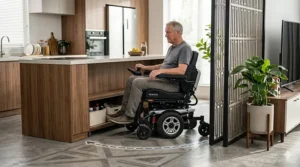
The Pride Mobility Jazzy 600 ES showcases why mid-wheel drive dominates the medical equipment market—it’s engineered specifically for the reality most power chair users actually face: spending 80% of their time indoors navigating spaces designed for able-bodied people. The patented Mid-Wheel 6 technology combined with Active-Trac ATX Suspension addresses the classic mid-wheel problem: maintaining ground contact on uneven surfaces.
This chair features dual motors delivering up to 4 mph, which sounds modest until you realize that’s precisely the speed Medicare considers “safe and reasonable” for indoor use. The six-wheel layout (two 14-inch drive wheels centered under your seat, flanked by 6-inch omni-casters front and rear) creates a turning radius of just 20.5 inches—for context, that’s tight enough to pivot inside most residential bathroom doorways. What the spec sheet won’t tell you: this configuration means you’re essentially spinning on your center of gravity, which takes some acclimation if you’re transitioning from a front-wheel or manual chair.
Real-world feedback reveals two consistent themes: users love the maneuverability in confined spaces (one reviewer mentioned navigating their crowded kitchen for the first time in years), but some report a slightly “bouncy” feel on sidewalk cracks compared to front-wheel alternatives. The ATX suspension helps mitigate this, but physics is physics—those center-mounted drive wheels will react more noticeably to surface irregularities than wheels positioned at the extremes of the base.
Battery performance delivers up to 16.65 miles per charge with the standard NF-22 batteries, though expect closer to 12-14 miles in real-world mixed use with frequent stopping and starting. The chair’s 300-pound weight capacity and 24.5-inch overall width make it Medicare Group 2 compliant, which matters significantly if you’re pursuing insurance coverage.
Pros:
✅ Industry-leading 20.5″ turning radius for indoor navigation
✅ ATX suspension improves stability on varied terrain
✅ Medicare Group 2 classification aids insurance coverage
Cons:
❌ More reactive to surface changes than front-wheel alternatives
❌ 4 mph top speed limits outdoor range excursions
Price & Value: In the $5,200-$6,800 range. The premium over budget front-wheel chairs reflects genuine engineering investment in that six-wheel stability system. If your primary environment is indoor with occasional outdoor jaunts, this represents excellent value—the tight turning radius alone justifies the cost for small-space dwellers.
3. Permobil F5 Corpus (Front-Wheel Drive)
The Permobil F5 Corpus sits at the opposite end of the spectrum from budget options—this is what happens when a Swedish manufacturer decides price is no object and engineering excellence is the only goal. With a 7.5 mph top speed and ComfortRide Pro suspension featuring all-wheel independent, oil-dampened shocks, this front-wheel drive chair redefines what powered mobility can deliver.
The Corpus seating system offers 14 inches of ActiveHeight elevation and 45 degrees of ActiveReach forward tilt, which translates to real-world capability that’s hard to overstate: imagine conducting a face-to-face conversation with someone standing, reaching items on high shelves, or positioning yourself optimally at counters and workstations. That elevated drive speed of 3.2 mph while raised is an engineering achievement most competitors can’t match—cheaper chairs force you to lower before moving.
What sets this front-wheel configuration apart from mid-range alternatives: the patented ESP (Enhanced Steering Performance) gyroscope tracking technology compensates for the natural tendency of front-wheel drive chairs to fishtail at high speeds. Without this feature, driving a 7.5 mph front-wheel chair would feel sketchy on any surface with camber or slope. With ESP engaged, the chair tracks straight even on side slopes that would make lesser models wander.
The new high-power LED headlights (twice the brightness of previous generations) matter more than you’d think for outdoor evening use—visibility is safety, and being seen by drivers is crucial. With 330-pound weight capacity, aggressive tread tires as standard, and mud guards, the F5 Corpus targets users who refuse to let mobility limitations define their boundaries. Customer feedback centers on the transformative nature of the power positioning features; multiple reviewers mention regaining independence in kitchen tasks and social interactions.
The downside? This capability comes at a price that puts it out of reach for many buyers. Additionally, the sophisticated electronics require occasional software updates and professional servicing—this isn’t a “set it and forget it” mobility device.
Pros:
✅ 7.5 mph top speed with ESP gyroscope stability
✅ 14″ ActiveHeight elevation maintains functionality while raised
✅ ComfortRide Pro suspension delivers exceptional ride quality
Cons:
❌ Premium pricing excludes budget-conscious buyers
❌ Complex electronics require professional maintenance
Price & Value: Expect $18,000-$25,000+ depending on customization. This represents the pinnacle of front-wheel drive engineering. For users with complex positioning needs who spend significant time both indoors and outdoors, the investment can be life-changing—but only if the budget permits.
4. Pride Mobility Jazzy Select (Mid-Wheel Drive)
The Pride Mobility Jazzy Select occupies the sweet spot in Pride’s mid-wheel lineup—more capable than entry-level models, less complex than flagship options. With dual in-line motors and a 23.76-inch turning radius, it delivers mid-wheel agility without the premium price tag of six-figure competitors.
The high-back memory foam seat with depth adjustment and limited recline addresses comfort for extended sitting, which matters more than many first-time buyers realize. What often gets overlooked in specifications: that “limited recline” (typically 10-15 degrees) isn’t meant for napping; it’s about pressure relief and posture variation during long sitting periods. Users with lower back issues specifically mention this feature as a key differentiator from fixed-position budget chairs.
The mid-wheel drive platform here provides the stable center of gravity that makes this configuration appealing for users with balance concerns. Unlike front-wheel chairs where weight shifts forward during acceleration or when climbing obstacles, the Select keeps your center of mass over the drive wheels consistently. Real-world translation: less anxiety about tipping, especially for users transitioning from manual chairs or dealing with vertigo-related conditions.
Battery range hits 19 miles with standard batteries—respectable but not industry-leading. The 4.3 mph top speed again reflects the Medicare-compliant “safe indoor speed” philosophy. What customers appreciate: the flip-up foot platform with adjustable height and angle lets you customize leg positioning for circulation, which becomes critical during multi-hour sitting sessions.
One consistent criticism from reviews: the chair’s weight (base plus seat totals around 175 pounds) makes it challenging for caregivers to lift or maneuver when powered off. If you anticipate needing to transport this frequently via vehicle ramps or lifts, factor that heft into your decision.
Pros:
✅ Memory foam high-back seat with pressure-relief recline
✅ Stable mid-wheel center of gravity reduces tipping anxiety
✅ Adjustable foot platform improves circulation during extended use
Cons:
❌ 175-pound total weight challenges transportation
❌ Limited 4.3 mph speed restricts outdoor range ambitions
Price & Value: Around $5,800-$7,400 range. This hits the mid-tier pricing that often represents the best compromise between features and affordability. If you need genuine comfort features and mid-wheel maneuverability without premium pricing, the Select delivers.
5. Golden Technologies Compass Sport GP605 (Mid-Wheel Drive)
The Golden Technologies Compass Sport GP605 brings Dynamic Linx controller technology to the mid-wheel drive conversation, and this matters more than it initially sounds. Dynamic Load Compensation allows the electronics to adjust motor speed in real-time, compensating for weight distribution changes, terrain variations, and momentum shifts—essentially making the chair behave more intuitively than fixed-parameter controllers.
With a 19.5-inch turning radius, this represents one of the tightest-turning mid-wheel options on the market. For users navigating older homes with narrow hallways or doorways, those extra few inches of turning clearance versus competitors can mean the difference between independent navigation and requiring assistance. The six-wheel mid-wheel layout delivers continuous ground contact across varied terrain, though like all mid-wheel designs, it’s more reactive to sudden surface changes than front-wheel alternatives.
What sets this apart from Pride’s mid-wheel offerings: Golden Technologies historically builds for smaller dealer networks with higher service standards, meaning you’re more likely to get personalized setup and ongoing support versus big-box medical supply stores. Multiple reviewers mention their local dealers spending extra time on controller calibration and seat positioning—details that dramatically impact daily usability.
The chair handles both indoor and outdoor environments competently, though it clearly prioritizes tight-space maneuverability over rough-terrain capability. One user mentioned it handles sidewalk transitions and gentle grass slopes well but struggles on gravel or unpaved paths where a front-wheel drive chair would pull through more confidently.
Pros:
✅ 19.5″ turning radius enables navigation in extremely tight spaces
✅ Dynamic Linx controller provides intuitive, responsive handling
✅ Golden Technologies dealer network emphasizes service quality
Cons:
❌ Less capable on gravel or unpaved outdoor terrain
❌ Smaller dealer network limits availability in some regions
Price & Value: Typically $6,200-$8,500 range. The Dynamic Linx technology alone justifies a slight premium over basic mid-wheel competitors. For users prioritizing precision indoor control and ongoing dealer support, this represents strong value.
6. Drive Medical Titan AXS Mid-Wheel Power Wheelchair
The Drive Medical Titan AXS attempts to deliver mid-wheel maneuverability at front-wheel pricing, and the results are mixed. The engineering challenge is real: creating a stable six-wheel platform with the tight turning radius buyers expect from mid-wheel drive, while keeping costs accessible for budget-conscious buyers. Drive Medical achieves this partly through simplified suspension and lighter-duty components.
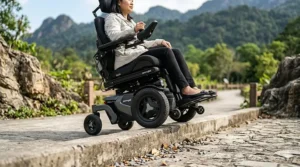
The turning radius delivers the expected mid-wheel agility—you can spin this chair in remarkably confined spaces. Where it falls short, according to actual user feedback: threshold tolerance and small obstacle handling. Multiple Amazon reviews mention the chair catching on minor elevation changes that shouldn’t pose problems. One reviewer specifically noted “catches on the smallest cracks or elevation differences,” which suggests the front caster suspension isn’t absorbing irregularities the way more expensive mid-wheel models do.
The reality of budget mid-wheel engineering: those front casters need sophisticated articulation to maintain ground contact while the center drive wheels navigate terrain changes. When manufacturers cut costs, that suspension system is often where compromises happen. The result? A chair that works beautifully on perfectly smooth surfaces but becomes frustrating on real-world sidewalks and transitions.
For users whose environment is predominantly indoor with well-maintained surfaces—think newer assisted living facilities, modern apartments, or recently renovated homes—this can represent solid value. For anyone facing older infrastructure with uneven thresholds and cracked sidewalks, the frustration factor may outweigh the cost savings.
Pros:
✅ Budget-friendly entry into mid-wheel maneuverability
✅ Tight turning radius for confined spaces
✅ Lightweight design aids vehicle transport
Cons:
❌ Front casters prone to catching on small obstacles
❌ Simplified suspension struggles with uneven surfaces
Price & Value: Around $3,800-$4,800. The lowest-cost mid-wheel option examined here, but buyer beware: you’re trading threshold tolerance for that price point. Only suitable for very smooth, well-maintained environments.
7. Pride Mobility Jazzy Elite HD (Front-Wheel Drive)
The Pride Mobility Jazzy Elite HD addresses a specific niche often underserved in power chair marketing: heavier users who need front-wheel outdoor capability. With 450-pound weight capacity and heavy-duty construction, this chair accommodates bariatric needs without sacrificing the front-wheel drive advantages for outdoor terrain.
The front-wheel configuration here delivers exactly what you’d expect: confident pulling power over obstacles, stable performance on slopes and transitions, and that characteristic wider turning radius that’s the trade-off for outdoor capability. What’s noteworthy about this particular model: Pride didn’t just enlarge a standard chair; they reinforced the frame, upgraded the motors, and specified heavy-duty batteries to maintain performance under load.
Real-world battery range hits approximately 12.5 miles, which represents honest engineering—you can’t increase weight capacity without impacting efficiency, and Pride doesn’t pretend otherwise. The 4 mph top speed, while not exciting, reflects appropriate caution for a high-capacity chair; faster speeds with heavier loads create momentum that’s harder to control safely.
User feedback focuses on build quality and reliability under sustained use. Unlike lighter-duty chairs that may show strain when supporting higher weights, the Elite HD handles its rated capacity without mechanical complaints. The wider 24-inch seat provides genuine comfort rather than just tolerance for larger body sizes.
The consideration that doesn’t appear in specifications: this is a substantial piece of equipment weighing over 200 pounds even before the user. Transportation requires proper vehicle lifts or ramps; this isn’t a “disassemble and load in the trunk” chair.
Pros:
✅ 450-pound capacity with reinforced heavy-duty construction
✅ Front-wheel drive handles outdoor terrain confidently at max load
✅ Honest engineering maintains performance under weight
Cons:
❌ 200+ pound chair weight requires vehicle lift for transport
❌ Wider profile challenges narrow doorways in older buildings
Price & Value: Expect $7,500-$9,800 range. For bariatric users needing reliable outdoor capability, this represents appropriate investment. The heavy-duty components aren’t just marketing; they’re engineered for longevity under demanding conditions.
Real-World Scenario Guide: Matching Drive Type to Your Lifestyle
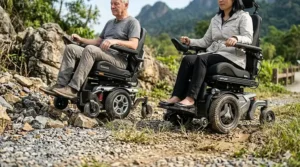
The difference between choosing correctly and struggling daily often comes down to mapping your actual environment to drive capabilities. Let me walk you through three common user profiles and why their drive choice matters:
Profile 1: The Suburban Multi-Terrain User
Lives in a single-family home with garage access, regularly navigates driveway expansion joints, sidewalks with tree root disruption, and occasionally ventures onto grass or gravel paths. Indoor spaces are generous—36-inch doorways, open-concept living.
Best Choice: Front-wheel drive (Permobil F5 Corpus or Pride Elite HD depending on budget and weight capacity needs). Here’s why: those outdoor transitions from driveway to sidewalk, the inevitable curb cuts with 2-3 inch lips, and grass navigation all favor the pulling power of front-wheel drive. The generous indoor space means the wider turning radius isn’t a daily frustration. One client in this category told me switching from a mid-wheel to front-wheel chair “felt like finally having the right tool”—outdoor confidence increased dramatically.
Profile 2: The Urban Apartment Dweller
Lives in a 900-square-foot apartment with 32-inch bathroom door, narrow galley kitchen, and elevator access to lobby. Outdoor use is limited to smooth sidewalks, occasional restaurant visits, and accessible public transportation.
Best Choice: Mid-wheel drive (Pride Jazzy 600 ES or Golden Compass Sport). The math is simple: that bathroom door becomes impassable with a 27-inch turning radius front-wheel chair when you account for approach angle. Mid-wheel’s ability to pivot almost in place means navigating kitchen to living room to bedroom without that constant three-point-turn dance. The smooth urban sidewalks don’t demand front-wheel obstacle climbing, and the tight indoor maneuverability matters every single day.
Profile 3: The Active Outdoor Enthusiast
Wants to maintain trails, park visits, and outdoor activities despite mobility limitations. Indoor environment is secondary—wheelchair is transportation between meaningful outdoor experiences.
Best Choice: Front-wheel drive with premium suspension (Permobil F5 Corpus). The aggressive tread tires, enhanced obstacle climbing, and high-speed stability via ESP technology transform outdoor capability. Mid-wheel chairs technically can handle some outdoor terrain, but the experience gap is substantial. Every root, rock, and uneven surface that makes a mid-wheel chair hesitate or bounce becomes a non-event with properly engineered front-wheel drive.
How to Choose Between Front Wheel Drive vs Mid Wheel Drive Power Chair: The Decision Framework
Start with environment audit, not features. Too many buyers get seduced by spec sheets and miss the fundamental question: where will this chair actually spend its time? Grab a measuring tape and document your narrowest doorway, your bathroom’s turning space, your hallway width, and the most challenging outdoor obstacle you regularly face. Now map those measurements against drive configurations:
Choose front-wheel drive if:
✓ Your primary environment includes outdoor terrain with obstacles over 2 inches
✓ You regularly navigate cracked sidewalks, grass, gravel, or unpaved surfaces
✓ Indoor turning space exceeds 36 inches in your most constrained area
✓ You value straight-line stability at higher speeds
✓ Outdoor confidence and capability rank above indoor agility
Choose mid-wheel drive if:
✓ 70%+ of your time is spent indoors navigating tight spaces
✓ Your bathroom, kitchen, or hallway width approaches 32 inches
✓ You need to pivot in place for positioning at sinks, counters, or tables
✓ Your outdoor use is limited to well-maintained sidewalks and paved surfaces
✓ You prioritize the smallest possible turning radius above all else
The second decision layer involves your physical considerations. Users with balance sensitivity or vertigo often prefer mid-wheel’s stable center of gravity—that centered pivot point reduces the sensation of the chair “swinging” around them. Conversely, users with spasticity or vibration-sensitive conditions may find front-wheel drive’s smoother absorption of terrain irregularities more comfortable.
Third consideration: transportation logistics. If you need to load this chair into a vehicle regularly, front-wheel models with disassembly features (like the Drive Medical Titan) or lightweight folding options offer practical advantages over heavy mid-wheel platforms. However, if the chair stays at home and you use other transportation methods when traveling, this factor drops in priority.
Finally, the budget reality check. Quality mid-wheel drive starts around $5,000 for genuine capability; budget options under $4,000 often disappoint with threshold catching and surface reactivity. Front-wheel drive offers more reliable entry-level options around $3,500-$4,000, though premium outdoor performance requires $8,000+ investment. According to Medicare’s coverage guidelines, insurance may cover basic models but rarely premium features, so budget accordingly.
Common Mistakes When Buying Front Wheel Drive vs Mid Wheel Drive Power Chair
Mistake #1: Testing on Perfect Showroom Floors
The biggest disservice dealers do is demonstrating chairs exclusively on their smooth, level showroom flooring. That mid-wheel chair that spins effortlessly in the store? Wait until you hit your first sidewalk crack or door threshold. Always insist on testing both configurations on surfaces that mirror your actual environment—bring the dealer to your home if possible, or at minimum test on outdoor sidewalks with realistic irregularities.
Mistake #2: Prioritizing Speed Over Suitability
I’ve watched buyers get excited about 7 mph top speeds when their primary need is navigating a 950-square-foot apartment. That faster speed comes with wider turning radius (physics doesn’t negotiate) and higher costs. Conversely, some buyers accept slow 3.5 mph chairs when they actually need outdoor range capability that requires sustained higher speeds. Match speed to your lifestyle, not your ego.
Mistake #3: Ignoring the Maintenance Reality
Front-wheel drive systems typically have simpler maintenance profiles—fewer wheels in contact means fewer bearings, casters, and wear points. Mid-wheel’s six-wheel setup requires more frequent attention to front and rear caster condition. Budget chairs (regardless of drive type) cut corners on sealed bearings and quality components. That $3,800 mid-wheel chair saving you $2,000 upfront may cost you $600 annually in increased maintenance versus a $5,800 model with quality components. Factor lifecycle costs, not just purchase price.
Mistake #4: Underestimating Weight and Transport Challenges
That 175-pound mid-wheel chair with the best turning radius won’t matter if you can’t actually get it into your vehicle. If you lack a permanent vehicle lift, the transportability advantage of lighter front-wheel models (or folding designs) becomes crucial. I’ve seen buyers commit to the “perfect” chair only to discover they’re effectively homebound because transporting it is impractical.
Mistake #5: Accepting Dealer “One Size Fits All” Recommendations
Dealers develop preferences based on their service capabilities, profit margins, and inventory. A dealer heavily stocked with Pride mid-wheel models will naturally steer you toward mid-wheel solutions regardless of your actual environment. Similarly, dealers lacking certified technicians for complex electronics may push simpler front-wheel designs even when mid-wheel better suits your needs. Your environment and lifestyle should drive the decision, not their business model.
Front Wheel Drive vs Mid Wheel Drive Power Chair: Technical Performance Differences
Understanding what happens mechanically explains why these drive types behave so differently. Power wheelchairs are classified as Durable Medical Equipment with specific engineering requirements for stability and safety, which impacts drive configuration design.
Weight Distribution and Center of Gravity
Front-wheel drive positions motors and batteries forward of your seating position, creating a longer wheelbase with weight distributed across the entire platform. This configuration naturally resists tipping during hill climbs or when approaching obstacles—the weight behind you acts as a counterbalance. The trade-off? That longer wheelbase requires more space to change direction, because you’re essentially pivoting around a point closer to your rear casters.
Mid-wheel drive concentrates weight directly beneath your seating position, creating the shortest effective wheelbase possible. This is why mid-wheel chairs can achieve turning radii under 20 inches—they’re literally rotating around your body’s center of mass. The challenge: maintaining stability requires careful engineering of front and rear caster suspension to prevent the chair from “see-sawing” when the drive wheels encounter elevation changes.
Obstacle Climbing Mechanics
When a front-wheel chair approaches a 3-inch threshold, the large drive wheels contact the obstacle first and pull the entire chair upward—the weight behind acts as traction against the obstacle. It’s mechanically efficient for climbing. Mid-wheel chairs must rely on momentum to carry the front casters over obstacles, then the drive wheels follow. If momentum is insufficient or the obstacle is too high, the chair stalls with front casters hung up. This is why front-wheel drive consistently outperforms mid-wheel on obstacle climbing despite similar motor power.
Turning Radius Physics
The turning radius difference between drive types comes down to which wheels are powered and where they pivot. Front-wheel chairs turn by steering the powered front wheels while the rear casters trail—this creates a wide arc because you must account for rear swing. Mid-wheel chairs turn by counter-rotating the drive wheels while front and rear casters passively follow the arc—minimal swing width because the pivot point is centralized. This isn’t adjustable through electronics or settings; it’s fundamental physics.
According to research documented on Britannica’s electric wheelchair page, modern direct-drive systems use dynamic braking that engages when you release the joystick, providing precise control regardless of drive type. However, the responsiveness of that braking varies with drive configuration—mid-wheel chairs with centralized weight stop more abruptly, while front-wheel platforms have more momentum to arrest.
Power Chair Drive Types for Different Mobility Conditions
Matching drive configuration to medical condition requires understanding how different diagnoses impact balance, coordination, and environmental navigation needs. Medicare acknowledges this in their coverage criteria, requiring face-to-face evaluations that assess specific functional limitations.
Conditions Favoring Mid-Wheel Drive:
Users with limited trunk control or balance impairments often benefit from mid-wheel’s centered stability. Conditions like cerebral palsy, multiple sclerosis progression, or significant balance deficits may feel more secure with the stable pivot point beneath them rather than the forward-weight distribution of front-wheel drive. The predictable, centered turning also aids users with spatial processing challenges—you’re rotating around yourself rather than sweeping a wider arc.
Users who experience fatigue from extensive daily wheelchair use appreciate mid-wheel’s effortless indoor navigation. Every unnecessary three-point turn or wide approach angle adds to daily energy expenditure. For progressive conditions where energy conservation matters, mid-wheel’s efficiency in tight spaces reduces cumulative fatigue.
Conditions Favoring Front-Wheel Drive:
Users with spasticity or vibration-sensitive conditions (certain types of cerebral palsy, spinal cord injuries with preserved sensation) often find front-wheel drive’s smoother ride quality more comfortable. The forward weight distribution and typically larger drive wheels dampen terrain irregularities better than mid-wheel’s more reactive center-mounted configuration.
Active users maintaining outdoor lifestyles despite mobility limitations—think incomplete spinal cord injuries, amputations, or late-stage muscular dystrophy where upper body function remains strong—often choose front-wheel for its outdoor confidence. The psychological impact of feeling “unstoppable” on varied terrain versus constantly conscious of surface limitations shouldn’t be underestimated.
Condition-Neutral Considerations:
Users requiring power positioning features (tilt, recline, elevation) will find both drive types available with these options, though the implementation differs. Front-wheel chairs like the Permobil F5 Corpus can maintain elevated speeds while raised because the forward weight distribution remains stable. Mid-wheel chairs typically reduce speed when elevated to prevent tipping—the centered weight becomes less stable when raised above the drive wheel level.
Long-Term Ownership: Maintenance and Total Cost Analysis
The five-year ownership cost of a power wheelchair varies dramatically based on drive configuration, build quality, and your usage patterns. Medicare’s typical replacement cycle is five years, meaning this total cost matters significantly if you’re out-of-pocket for any portion.
Front-Wheel Drive Maintenance Profile:
Simpler mechanical configuration means fewer points of wear. A quality front-wheel chair (think Pride Elite HD or mid-tier Permobil) might require annual caster wheel replacement ($80-$150), bi-annual motor brush inspection ($0-$100 if under warranty), and battery replacement every 2-3 years ($300-$600 depending on battery type). Total five-year maintenance estimate: $1,200-$2,000 beyond initial purchase.
Budget front-wheel chairs (like the Drive Medical Titan) often use unsealed bearings and lighter-duty components. Expect more frequent caster replacement (twice annually), potential motor replacement ($400-$700) around year three, and electronics issues from moisture intrusion. Five-year estimate: $2,500-$4,000 in maintenance—potentially approaching half the chair’s original cost.
Mid-Wheel Drive Maintenance Profile:
Six wheels means more frequent caster attention. Quality mid-wheel chairs (Pride Jazzy 600 ES, Golden Compass Sport) with sealed bearings might need front and rear caster replacement annually ($200-$300), suspension system inspection ($100-$200 annually), and the same battery replacement schedule as front-wheel. Five-year estimate: $2,000-$3,200.
Budget mid-wheel chairs face compounded wear because those front casters are constantly absorbing impacts. Annual replacement of multiple caster sets becomes routine, and the suspension articulation points wear faster. Add electronics issues from complexity, and five-year costs can hit $3,500-$5,500—sometimes exceeding the chair’s purchase price.
The Insurance vs. Private Pay Reality:
Medicare Part B covers power wheelchairs when medically necessary, but coverage often defaults to Group 2 base models (typically $4,000-$6,000 chairs). Premium features, specialized drive configurations, or upgraded components rarely get covered. The Medicare coverage guidelines require extensive documentation of medical necessity, and drive type preference alone doesn’t qualify—you must demonstrate functional need for specific capabilities.
If you’re paying privately or supplementing insurance coverage, that total cost of ownership calculation becomes crucial. A $5,800 quality mid-wheel chair costing $2,200 in five-year maintenance ($8,000 total) may represent better value than a $3,800 budget front-wheel chair with $4,000 in maintenance ($7,800 total)—but only if the mid-wheel drive actually suits your environment.
Safety Considerations: Drive Configuration and Risk Factors
Different drive types present distinct safety profiles based on their mechanical behavior. Understanding these risks helps you choose appropriately and use your chair safely.
Front-Wheel Drive Safety Factors:
The forward weight distribution makes front-wheel chairs inherently stable when climbing slopes or obstacles, but creates tip-back risk during aggressive braking on downhill grades. Quality models include anti-tip casters that automatically engage, but some budget chairs skimp on this feature. Always verify anti-tip wheels are present and properly adjusted—they should contact ground before the chair can tip backward.
The wider turning radius means you need spatial awareness of your rear swing when navigating tight corners. Users transitioning from manual chairs or first-time power chair users often misjudge this, resulting in doorframe impacts or furniture strikes. Practice in open areas before attempting challenging spaces.
High-speed front-wheel models (above 6 mph) can experience what’s called “understeer” on cambered surfaces—the chair wants to drift downhill despite joystick input. This is why premium models like the Permobil F5 include ESP gyroscope tracking. Budget front-wheel chairs at higher speeds require constant steering correction on slopes.
Mid-Wheel Drive Safety Factors:
The center-mounted drive wheels create susceptibility to see-sawing on abrupt elevation changes. When you transition from flat ground to a sloped surface, the chair’s weight can momentarily concentrate on only the two drive wheels, lifting front or rear casters off the ground. This feels unstable and can be frightening for users with balance anxiety. Quality mid-wheel chairs use sophisticated suspension to minimize this; budget models may exhibit pronounced see-sawing.
The tight turning radius that makes mid-wheel chairs appealing also means they can spin unexpectedly if you accidentally deflect the joystick while stationary. Newer controllers include sensitivity adjustments to prevent this, but it remains a learning curve for new users.
Mid-wheel chairs approaching doorway thresholds at an angle can “high-center” if the threshold contacts the center of the base between drive wheels. Front-wheel and rear-wheel chairs naturally climb or descend, but mid-wheel chairs can become stuck balanced on their center point. Approach thresholds straight-on, not at angles.
Universal Safety Practices:
Regardless of drive type, follow these essentials: Never exceed your chair’s rated weight capacity (this degrades performance and safety margins). Maintain tire pressure according to manufacturer specs (under-inflated tires reduce stability and range). Replace batteries before they reach failure state (sudden power loss creates hazards). Have annual professional inspections even if nothing seems wrong (intermittent electronics issues can suddenly become critical failures).
FAQ: Front Wheel Drive vs Mid Wheel Drive Power Chair Questions
❓ What is the main difference between front wheel drive vs mid wheel drive power chair configurations?
❓ Can a mid wheel drive power chair handle outdoor terrain effectively?
❓ Which drive type is better for tight indoor spaces like small apartments?
❓ How does Medicare coverage differ between front wheel and mid wheel drive power chairs?
❓ What is the typical lifespan difference between front wheel and mid wheel drive power chairs?
Conclusion: Making Your Front Wheel Drive vs Mid Wheel Drive Power Chair Decision
After examining seven diverse models and analyzing the fundamental differences in front wheel drive vs mid wheel drive power chair configurations, the decision framework becomes clear: neither drive type is universally “better”—they’re optimized for different environments and priorities. Your choice should flow directly from honest assessment of where and how you’ll actually use this mobility device daily.
If your life centers on indoor activities within smaller spaces, if you navigate tight hallways and compact bathrooms regularly, if your outdoor use stays primarily on smooth, maintained surfaces—mid-wheel drive’s unmatched maneuverability justifies its maintenance complexity and higher entry cost. The ability to pivot in place isn’t just convenient; it’s often the difference between independence and requiring assistance in confined areas.
Conversely, if outdoor terrain is part of your daily reality, if you encounter curbs, thresholds, grass, or gravel regularly, if your indoor spaces are generous enough to accommodate wider turns—front-wheel drive’s obstacle-conquering capability and smoother ride quality become essential, not optional. The psychological confidence of knowing your chair won’t hesitate at obstacles transforms your relationship with the environment.
The budget reality deserves final emphasis: quality matters more than drive type. A well-engineered front-wheel chair outperforms a poorly built mid-wheel chair even in indoor spaces, and vice versa for outdoor use. If budget forces choosing between premium front-wheel and budget mid-wheel (or the reverse), lean toward whichever drive type matches your primary environment, then invest in the highest quality your budget permits within that category. The maintenance savings and reliability of quality components quickly offset higher initial costs.
Remember that Medicare or insurance may cover baseline models, but rarely covers the premium features that maximize either drive type’s potential. Plan your budget accordingly, and don’t hesitate to supplement insurance coverage for features that genuinely impact your daily function. This chair will be your mobility for the next five years minimum—invest wisely in the configuration that serves your actual life, not the theoretical spec sheet winner.
Recommended for You
- 7 Best Front Wheel Drive Power Wheelchairs for 2026
- 7 Best Tires for All Terrain Wheelchair That Actually Work (2026)
- 7 Best Electric Wheelchair with Suspension – 2026
Disclaimer: This article contains affiliate links. As an Amazon Associate, I earn from qualifying purchases. If you purchase products through these links, we may earn a small commission at no additional cost to you.
✨ Found this helpful? Share it with your friends! 💬🤗
