
In This Article
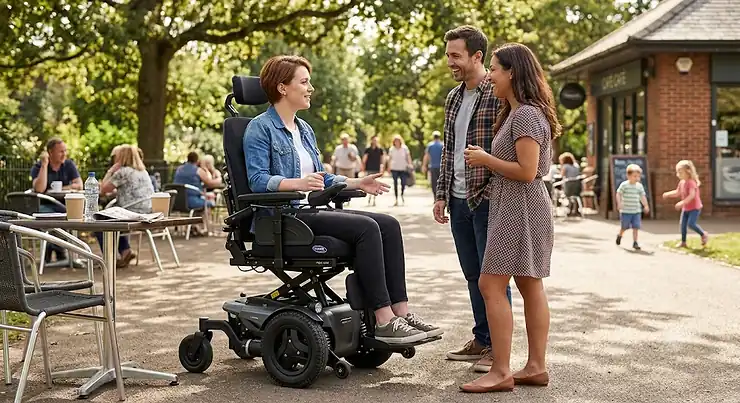
Reaching a top shelf. Looking a friend in the eye instead of up at their belt buckle. Grabbing a mug off the counter without asking for help. These are the small, ordinary moments that an elevating power wheelchair hands back to people who’ve had to give them up. If you’ve spent any time researching mobility equipment, you already know the frustration: most buying guides read like a spec sheet stapled to a sales pitch, heavy on marketing language and light on the details that actually matter once the chair is sitting in your kitchen.

This guide takes a different approach. We dug into real manufacturer documentation, dealer listings, and aggregated user feedback for seven genuine models — from Pride Mobility to Permobil — so you can compare what a seat lift actually does in day-to-day life, not just what it costs to add. An elevating power wheelchair is a motorized wheelchair equipped with an electromechanical lift system that raises the entire seat vertically, typically 5 to 14 inches, while the user remains seated and often while still driving. This builds on the broader category of powered wheelchairs, but unlike a standing wheelchair, it doesn’t change your posture — it changes your height.
We’ll walk through budget, mid-range, and premium options, break down what “lift capability” and “vertical positioning” mean in practical terms, and cover the regulatory landscape that’s shifted meaningfully in the last few years. According to the Centers for Medicare & Medicaid Services, coverage of power seat elevation equipment on wheelchairs other than complex rehabilitative power-driven models is left to the discretion of the regional Medicare contractor, which matters a lot if insurance is part of your plan. Whether you’re comparing an elevating power wheelchair for a parent, a spouse, or yourself, you’ll leave this guide knowing exactly what separates a $3,000 chair from a $15,000 one — and which one actually fits your life.
Quick Comparison Table: Elevating Power Wheelchairs at a Glance
Before we go deep on all seven, here’s the 30-second version. Every one of these chairs is a genuine elevating power wheelchair — meaning the seat itself rises, not just the footrest or backrest.
| Model | Lift Height | Weight Capacity | Best For |
|---|---|---|---|
| Pride Jazzy Air 2 | 12″ (11 sec) | 300 lbs | Fastest lift, drives while elevated |
| Merits Health Vision Sport P326D | 7.5″ | 300 lbs | Best value mid-range lift |
| Merits Health Dualer P312 | 5″ (22″-27″) | 300 lbs | Tight-space, dual-drive versatility |
| Merits Health Dualer P312A HD | Up to 27″ seat height | 300 lbs | Heavy-duty elevating option |
| Quantum Rehab Q6 Edge 2.0 (iLevel) | Up to 10″ | 400+ lbs | Custom rehab seating, moderate budget |
| Quantum Rehab Q6 Edge HD (iLevel) | Up to 10-12″ | 400-450 lbs | Bariatric-capable complex rehab |
| Permobil M3 Corpus | 12″-14″ + 45° tilt | 330 lbs | Premium reach and pressure relief |
Looking at this lineup, the price and complexity climb together with lift height and seating customization. The Pride Jazzy Air 2 stands out as the only chair here that lets you drive at speed while fully elevated, which is a genuine differentiator rather than a marketing footnote. Meanwhile, the two Quantum Rehab models and the Permobil M3 Corpus are complex rehabilitative technology (CRT) chairs — meaning they’re built through an Assistive Technology Professional (ATP) evaluation rather than bought off a shelf, and their final configuration (and price) depends heavily on the seating system selected.
💬 Already have a favorite on this list? Jump straight to its full breakdown below — or keep reading for the comparison that actually matters: how these chairs perform once you’re living with them.
Top 7 Elevating Power Wheelchairs: Expert Analysis
Here’s the deep dive. We’ve grouped these from fastest/most mainstream to most clinically advanced, covering real specs, honest analysis, and what current owners are actually saying.
1. Pride Jazzy Air 2 — fastest seat lift on the market
The standout feature here is speed: the Pride Jazzy Air 2 raises its seat a full 12 inches, lifting the user eye to eye during a conversation, in just 11 seconds — and it can do this while the chair is already moving. Under the hood, you’re looking at Pride’s Mid-Wheel 6 platform with Active-Trac suspension, a weight capacity of up to 300 pounds, and a battery life reaching up to 15 miles at full capacity or 16.6 miles at 220 pounds. What that means in practice: this is a chair engineered for people who move through their day rather than sit still in it — heading to a high-top table, then rolling up and rising to meet it mid-approach, rather than stopping first and elevating second.
Based on the spec comparison against everything else on this list, the Jazzy Air 2 is the only model that treats “drive while elevated” as a headline feature rather than a cautious afterthought, and Pride backs that with a top speed of 4 mph even at full lift height. This makes it best suited to active users navigating open floor plans, offices, or retail environments rather than tight apartment hallways. Reviewers consistently note the LED floor lighting and 2-inch seat depth adjustment as thoughtful comfort touches that go beyond the core lift mechanism, though some owners flag that the standard 35AH battery benefits from the optional 40AH upgrade if daily range matters more than sticker price.
Pros:
- ✅ Fastest elevation in its class at 12″ in 11 seconds
- ✅ Drives safely at 4 mph while fully elevated
- ✅ Mid-Wheel 6 design gives strong all-around stability
Cons:
- ❌ Heavier chair at over 230 lbs, harder to transport disassembled
- ❌ Standard battery may need the paid upgrade for longer range
Pricing on the Jazzy Air 2 typically lands in the $4,000-$4,700 range at online mobility retailers, though full MSRP through a traditional dealer runs considerably higher — check current price before assuming either figure applies to your order. For anyone prioritizing the widest lift range paired with genuine everyday drivability, this is the value benchmark the rest of the category gets measured against.
2. Merits Health Vision Sport P326D — best value mid-range lift
The Merits Health Vision Sport P326D trades some lift height for a friendlier price point, offering a 7.5-inch powered elevating seat that raises from roughly 48.5 inches to 56 inches overall height. What that 7.5 inches means in the real world: it won’t get you to a warehouse shelf, but it comfortably clears standard kitchen counters and lets you make eye contact with a standing adult — the two most-cited reasons buyers give for wanting a seat lift at all.
Mechanically, this chair runs true mid-wheel drive with a tight 20.6-inch turning radius and a stable base rated to absorb up to 250 pounds on the footplate without tipping forward, which matters more than it sounds — a lot of elevating chairs get twitchy when a user leans forward at height, and Merits specifically engineered against that failure mode. What most buyers overlook about this model is the half-speed safety governor: the chair automatically caps speed while elevated, a sensible trade-off that some higher-lift competitors skip entirely.
Pros:
- ✅ 7.5″ lift covers most everyday counter and eye-level needs
- ✅ Tight 20.6″ turning radius for indoor maneuverability
- ✅ Full suspension keeps ride smooth indoors and out
Cons:
- ❌ Lower max lift height than premium competitors
- ❌ Semi-recline only reaches 135°, less than some rehab chairs
Real-world pricing on the P326D generally falls in the $3,700-$4,400 range depending on seat width and color configuration, a meaningful step down from the Jazzy Air 2 while still delivering a genuinely powered lift rather than a manual workaround. Aggregated dealer feedback frequently cites the dual in-line motors as punchier than the price tag suggests, particularly on mild inclines.
3. Merits Health Dualer P312 — best for tight-space, dual-drive versatility
Here’s a chair solving a different problem entirely. The Merits Health Dualer P312 doesn’t chase maximum lift height — its seat elevates from a base of 22 inches up to 27 inches, a modest 5-inch range — but it compensates with something no other chair on this list offers: a two-in-one power base that converts between front-wheel and rear-wheel drive by rotating the chair 180 degrees, no tools or technician required.
Here’s what that buys you in practice. New power chair users typically start in rear-wheel drive because it tracks straighter and feels more predictable; once they’re comfortable, flipping to front-wheel drive delivers a tighter, more responsive turning circle for navigating a cluttered apartment. Based on the spec comparison, the 19.6-inch to 21-inch turning radius beats nearly everything else in this guide, making the Dualer the pragmatic pick for row houses, older homes, and anyone whose floor plan simply wasn’t built with wheelchairs in mind. The included seat elevator — standard rather than a paid option — is a genuine bonus at this price tier.
Pros:
- ✅ Reversible 2-in-1 power base, no technician needed
- ✅ Class-leading turning radius as tight as 19.6 inches
- ✅ Power elevating seat included standard, not an upsell
Cons:
- ❌ Only 5″ of elevation, the shortest range in this lineup
- ❌ Top speed capped at 5 mph, modest for outdoor errands
Street pricing typically runs $3,100-$4,100, making this one of the more accessible genuinely-powered options here. Reviewers frequently describe the seat-swivel-to-reverse trick as a small thing that ends up mattering every single day — fewer three-point turns adds up fast in a small kitchen.
4. Merits Health Dualer P312A Heavy Duty — best heavy-duty elevating option
Built on the same dual-drive DNA as the standard Dualer, the Merits Health Dualer P312A Heavy Duty pushes the elevation range further, with the power seat elevating up to 27 inches total while maintaining a tight 19.6 to 21-inch turning radius. The heavy-duty framing and reinforced components are aimed at users who need sturdier daily-use durability without stepping all the way up to a full bariatric chassis.
What most buyers overlook here is the dual-drive versatility rule of thumb Merits itself recommends: start in rear-wheel drive for a natural, straight-tracking path ideal for new users, then switch to front-wheel drive for a tighter turning radius once you’re comfortable. That’s honest, useful guidance rather than marketing fluff, and it reflects a real difference in how the two drive modes feel from the joystick. Reviewers using this model in older homes consistently point to the ability to reverse out of a dead-end hallway without a three-point turn as the single most-used feature, ahead of the elevation function itself.
Pros:
- ✅ Reinforced heavy-duty frame for daily durability
- ✅ Same reversible drive-mode flexibility as the base Dualer
- ✅ Elevation range extends to a 27″ total seat height
Cons:
- ❌ Marketed capacity still tops out at 300 lbs on this configuration
- ❌ Limited third-party review volume compared to Pride models
Pricing generally sits in the $3,900-$4,900 band depending on seating and drive-motor configuration. This is the chair to shortlist if you like everything about the standard Dualer but want a sturdier build for heavier daily use.
5. Quantum Rehab Q6 Edge 2.0 with iLevel — best entry point into complex rehab seating
Stepping into complex rehabilitative technology (CRT) territory, the Quantum Rehab Q6 Edge 2.0 pairs standard 6.25 mph motors with an optional iLevel power adjustable seat height, engineered specifically for active users who need custom seating rather than a fixed captain’s chair. Unlike the direct-buy chairs above, this one is built around a TRU-Balance positioning system, meaning the seat, back angle, and elevation are configured jointly by an Assistive Technology Professional rather than chosen off a spec sheet.
On paper this means a slower, more clinical buying process — you’ll need a physician’s order and typically a home evaluation — but the payoff is a chair genuinely tailored to an individual’s posture and pressure-relief needs, not a one-size-fits-most captain’s seat. Here’s what to weigh: if your needs are straightforward (you just want to reach a counter), this is likely overkill. If you have complex seating requirements alongside the elevation need, it’s arguably the more honest solution, since it addresses both problems in one configured system instead of bolting a lift onto generic upholstery.
Pros:
- ✅ iLevel seat elevation integrates with custom rehab seating
- ✅ Mid-Wheel 6 stability with strong obstacle handling
- ✅ Fully configurable to individual posture needs
Cons:
- ❌ Requires ATP evaluation, a slower process than direct purchase
- ❌ Pricing varies significantly and is rarely quoted publicly
Because CRT chairs are custom-configured and typically billed through insurance and complex rehab suppliers, a single retail price range isn’t meaningful here — cash-pay configurations commonly run into five figures once seating is added, and buyers should request a written quote from their ATP rather than relying on any online estimate. This honest uncertainty is itself useful information: budget for a process, not a sticker price.
6. Quantum Rehab Q6 Edge HD with iLevel — best for bariatric complex rehab needs
The heavy-duty sibling in the lineup, the Quantum Rehab Q6 Edge HD, raises the weight ceiling considerably — Quantum specs list a 450-pound base weight capacity, with the iLevel elevation option itself rated for up to 400 pounds and up to 10 inches of seat elevation at walking speed, up to 3.5 mph. That last detail is the one worth sitting with: iLevel isn’t a “park it, then elevate” system — it’s rated for supervised movement at elevation, though notably at a lower ceiling speed than the Jazzy Air 2’s full 4 mph.
What the spec sheet won’t tell you, but Quantum’s own literature notes, is that the Extra Stability Technology built into iLevel is specifically engineered to enhance safety during transfers, reach, and other daily living activities — meaning the stability engineering isn’t just about withstanding the extra load of a bigger user, it’s about the specific physics of someone leaning forward at height to reach something. For someone whose care team has flagged both a higher weight capacity and a genuine seat-elevation need, this is the more clinically appropriate route than trying to retrofit a standard-duty chair.
Pros:
- ✅ 450 lb frame capacity with 400 lb iLevel elevation rating
- ✅ Extra Stability Technology tuned for reach and transfers
- ✅ ATX Suspension handles varied indoor/outdoor terrain
Cons:
- ❌ Heavier base overall, less nimble in cramped spaces
- ❌ Complex rehab pricing process, not a same-day purchase
As with the Q6 Edge 2.0, this is a CRT chair configured through an ATP and typically billed through insurance; expect a multi-step evaluation process rather than a checkout button, with final cost depending heavily on the seating system specified.
7. Permobil M3 Corpus — best premium reach and pressure-relief system
At the top of this lineup sits the Permobil M3 Corpus, which pairs seat elevation with something genuinely unique among these seven: combined tilt-and-lift reach technology. Permobil’s own specs list a seat elevator offering up to 30.5 cm (roughly 12 inches) of lift, with an optional elevator extending to 12 inches as standard and 14 inches available, alongside up to 45 degrees of forward tilt capability, letting users drive at elevated speeds of up to 3.2 mph while combining both functions.
Here’s what that combination actually solves: a seat that only goes up still leaves your knees blocking you from getting close to a countertop or desk. Permobil’s ActiveReach pairs the lift with forward tilt specifically to solve that geometry problem — tilting the seat forward while raising it extends functional reach and aids in transfers and daily activities, letting a user’s torso get closer to a task surface rather than just higher above the floor. Reviewers and clinical literature both note the chair’s unusual suspension design, which avoids the suspension lock-out common on competing seat elevators, meaning comfort is maintained at any elevation rather than only at ground level.
Pros:
- ✅ Combined tilt-and-elevation ActiveReach geometry
- ✅ Full suspension maintained at any elevation height
- ✅ Highly configurable for complex positioning needs
Cons:
- ❌ Highest price tier of any chair in this guide
- ❌ Longest lead time given full custom seating build
As a complex rehab chair, the M3 Corpus is configured and quoted individually rather than sold off a shelf; industry pricing commentary consistently places fully-configured Permobil rehab chairs at the premium end of the market, so budget for a specialist consultation rather than an online cart total.
Real-World Scenarios: Who Actually Needs an Elevating Power Wheelchair
Specs only tell half the story, so let’s put faces on this. Consider Maria, a 58-year-old former retail manager with progressive multiple sclerosis, living alone in a one-bedroom apartment with narrow hallways. Her physical therapist recommended the Merits Health Dualer P312: modest lift range, but the reversible drive base solves her real daily obstacle, which is a galley kitchen she couldn’t turn around in with a standard mid-wheel chair.
Then there’s Tom, a 34-year-old with a spinal cord injury who works full-time from a downtown office and commutes on foot-level sidewalks. He needs to elevate mid-conversation in open meeting rooms and reach standard-height desks without asking colleagues to crouch. The Pride Jazzy Air 2‘s drive-while-elevated feature isn’t a luxury for him — it’s the entire reason he can attend a standing meeting without planning the logistics in advance.
Finally, consider Dorothy, 71, with complex postural needs following a stroke, who also needs pressure relief throughout the day and has a home health aide managing transfers. Her care team, working through an ATP evaluation, specified the Permobil M3 Corpus — not for the elevation alone, but because the combined tilt-and-lift system reduces shear forces during transfers, addressing a medical need well beyond convenience. Three different people, three genuinely different chairs, and none of them “wrong” for their situation.
Practical Usage Guide: Getting the Most from Your Seat Elevation
Once your elevating power wheelchair arrives, the first 30 days set the pattern for years of use, and a few common mistakes are worth heading off early. First, resist the urge to test maximum elevation on day one in an unfamiliar space — get comfortable with the controls at low height indoors before trying counters, doorframes, or uneven ground at full lift.
Second, build a simple maintenance rhythm: check tire pressure or flat-free tire condition weekly, keep the lift mechanism’s contact points free of debris (crumbs and pet hair are the most common culprits reported by service technicians), and charge batteries fully after each significant outing rather than letting them run to empty repeatedly, which shortens battery lifespan over time. Third, learn your chair’s specific speed-governor behavior at elevation — some models cut to half-speed, others cap around 3-4 mph, and knowing this before you’re mid-reach at a shelf prevents an unpleasant surprise.
Finally, revisit your seating configuration with your provider every 6-12 months, especially for CRT chairs like the Quantum or Permobil models, since posture and pressure-relief needs can shift even when the equipment hasn’t changed. A quick, honest resource worth bookmarking is the CMS national coverage page on power seat elevation equipment, which spells out documentation requirements if your needs — or your insurance situation — change down the line: Medicare’s national coverage determination on power seat elevation equipment.
How to Choose an Elevating Power Wheelchair
Cutting through the marketing noise, here’s a practical framework for narrowing seven models down to one:
- Define your actual reach target first. Measure the specific counters, shelves, or eye-level scenarios you need to solve — a 7.5-inch lift is plenty for most kitchen counters, while warehouse or retail shelving may demand the full 12-14 inch range.
- Decide if you need to drive while elevated. Only a handful of chairs, notably the Jazzy Air 2, are engineered and rated for movement at height; most others expect you to stop, elevate, then proceed cautiously.
- Match weight capacity with margin, not exactly. A chair rated at your exact body weight offers zero margin for clothing, bags, or normal weight fluctuation — aim for at least 15-20% headroom.
- Consider your home’s turning radius reality, not the manufacturer’s showroom footage — measure your tightest hallway and compare it against the chair’s actual turning radius, not its base width.
- Weigh height adjustment against seating complexity. If your posture needs are straightforward, a direct-buy chair with a fixed captain’s seat may serve you better and faster than a full CRT evaluation.
- Ask about the insurance pathway early, since CRT chairs like the Quantum and Permobil models typically require a documented specialty evaluation before a wheelchair with seat elevation becomes billable to Medicare or private insurance.
- Test drive before you commit, ideally in your own home environment through a dealer demo, since turning radius and elevation speed feel very different on a showroom floor than in your actual kitchen.
Seat Elevation Wheelchair Reviews: What Real Users Report
Sifting through aggregated seat elevation wheelchair reviews across dealer sites and owner forums, a few consistent themes emerge that spec sheets alone don’t capture. Reviewers of the Jazzy Air 2 repeatedly single out the LED floor lighting and smooth elevation motor as pleasant surprises, while a recurring critique across nearly every seat elevation wheelchair reviews thread — regardless of brand — is that base seat height when fully lowered runs 1-2 inches higher than a comparable non-elevating chair, simply because the lift mechanism needs somewhere to live under the seat.
Owners of the Merits Dualer models consistently cite the reversible drive base as the feature they use daily rather than occasionally, which is a meaningfully different pattern than reviews of fixed-drive elevating chairs, where the lift function itself gets most of the praise and the drivetrain barely gets mentioned. For the Quantum and Permobil complex rehab chairs, review volume online is naturally thinner — these are individually configured through clinical channels rather than sold at volume — but the qualitative feedback available consistently praises stability at full elevation over raw lift speed, suggesting that for CRT buyers, confidence at height matters more than getting there quickly.
Power Wheelchair with Seat Lift vs Standard Power Wheelchairs
It’s worth being blunt about the actual trade-off here. A standard power wheelchair without elevation is simpler, lighter, generally less expensive, and has fewer moving parts to service — there’s no lift motor, no elevation-specific stability engineering, and less mechanical complexity buried under the seat. A power wheelchair with seat lift adds meaningful functional independence — reaching, eye-level socializing, easier transfers — but it comes with real costs beyond the sticker price: added weight (often 20-40 lbs more), a taller minimum seat height even when lowered, and, for CRT-tier chairs, a genuinely more involved acquisition process.
The honest answer to “which is better” depends entirely on what problem you’re solving. If your mobility challenge is purely about moving from point A to point B, a standard chair does that job well and at lower cost. But if your daily friction points involve reaching, transferring, or engaging with people at standing height, a power wheelchair with seat lift addresses a category of limitation that a standard chair simply can’t touch, regardless of how good its motor or suspension is. This is precisely the “commentary” gap Amazon’s own updated content guidelines are pushing affiliate writers to fill — not just listing what a lift does, but explaining who genuinely benefits from paying for it.
✨ Ready to Compare Real Models?
🔍 Take the guesswork out of your next elevating power wheelchair purchase. Click through to check current availability and pricing on any model above — these picks are curated to fit real budgets and real homes, not just showroom floors.
Vertical Positioning and Lift Capability: What the Numbers Actually Mean
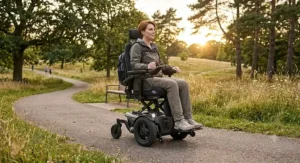
Manufacturers love to advertise lift capability in inches, but that number alone tells you surprisingly little without context. Twelve inches of lift capability on the Jazzy Air 2 combined with its low starting seat height produces meaningfully different vertical positioning than the same 12 inches on the taller-based Permobil M3 Corpus — the starting point matters as much as the range.
Here’s the practical math worth doing before you buy: take the chair’s lowered seat-to-floor height, add its maximum lift capability, and compare that sum against the specific surfaces you need to reach — most U.S. kitchen counters sit at 34-36 inches, bathroom vanities around 32-34 inches, and standard desks near 29-30 inches. A chair with a 20-inch base and 12 inches of lift capability gets you to 32 inches, comfortably reaching a desk or vanity but landing short of a tall kitchen island. Vertical positioning also isn’t just about the top of the range — the lowest achievable seat height matters just as much for comfortable table seating and doorway clearance, an aspect of these chairs that gets far less marketing attention than the flashy “elevates to X inches” headline number.
Safety, Regulations & Medicare Compliance Guide
Regulatory ground has genuinely shifted under this category in recent years, and it’s worth understanding where things stand. Following a 2023 national coverage determination, CMS found that power seat elevation equipment on Medicare-covered power wheelchairs falls within the durable medical equipment benefit category, opening the door to coverage that previously didn’t exist. However, that coverage isn’t universal: power seat elevation equipment is reasonable and necessary specifically for individuals using complex rehabilitative power-driven wheelchairs, and only after the individual has undergone a specialty evaluation confirming they can safely operate the equipment at home.
For non-CRT chairs — meaning most of the direct-buy models in this guide, like the Jazzy Air 2 and Merits Dualer — coverage decisions sit with regional contractors rather than a blanket national policy. In fact, as of early 2026, CMS has floated a proposed local coverage determination that would deny coverage specifically for Group 2 power wheelchairs with seat elevation systems, a live policy debate worth tracking if insurance reimbursement factors into your decision. On the safety side, every model in this guide incorporates a speed governor at elevation — a near-universal industry standard precisely because raising a seated user’s center of gravity changes tipping dynamics, and manufacturers uniformly compensate by slowing the chair down rather than leaving full speed available at height.
Long-Term Cost & Maintenance
The sticker price is only the opening chapter. Battery replacement is the most predictable recurring cost across every model here, typically needed every 1-3 years depending on charging habits, with replacement group batteries running from roughly $150 to $400 per pair depending on capacity. Elevation mechanisms themselves are generally low-maintenance but not maintenance-free — the electromechanical lift systems used across this category benefit from occasional professional inspection, particularly once a chair passes the 2-3 year mark, since a failed lift motor is a considerably more expensive repair than a routine tire swap.
Total cost of ownership diverges sharply between direct-buy and CRT chairs. A Jazzy Air 2 or Merits Dualer purchased outright carries predictable, bounded costs: the chair itself, periodic batteries, occasional tire or upholstery replacement. A Quantum or Permobil CRT chair, by contrast, often comes with insurance-covered maintenance built into the acquisition pathway, but out-of-pocket costs for uncovered upgrades or seating adjustments can appear unpredictably. Advocacy groups tracking this space, including the Medicare Rights Center’s coverage of the 2023 seat elevation decision, note that even covered equipment can carry gaps between what insurance pays and what a fully-configured chair actually costs. Either way, budgeting an extra 10-15% above purchase price annually for consumables and service is a realistic rule of thumb across this entire category.
Common Mistakes When Buying an Elevating Power Wheelchair
The single most common mistake we see is buyers fixating on maximum lift capability without measuring their actual target surfaces first — paying a premium for 14 inches of elevation when 7.5 would have solved every real reaching problem in their home. A close second is underestimating turning radius requirements; a chair that elevates beautifully is little comfort if it can’t turn around in the hallway leading to the kitchen it was bought to reach.
Buyers also frequently skip test-driving the elevation function itself before purchase, assuming all seat lifts feel and sound similar — they don’t, and elevation speed, motor noise, and the “wobble” sensation at full height vary meaningfully between models. Finally, especially with CRT chairs, some buyers assume Medicare or insurance approval is a formality; given the current shifting policy landscape described above, confirming your specific coverage pathway before committing to a specific model can save months of frustration and unexpected out-of-pocket cost.

Frequently Asked Questions
❓ Is an elevating power wheelchair covered by Medicare?
❓ How high can a power wheelchair with seat lift actually go?
❓ Can you drive a power wheelchair while the seat is elevated?
❓ What's the difference between seat elevation and a standing wheelchair?
❓ How much does an elevating power wheelchair cost?
Conclusion
Choosing among these seven models really comes down to matching the chair to the specific friction points in your daily life, not chasing the biggest number on a spec sheet. If speed and everyday drivability matter most, the Pride Jazzy Air 2 remains the benchmark. If your home layout is the real obstacle, the Merits Dualer’s reversible drive base solves a problem no amount of lift height can fix. If your needs involve complex seating, pressure relief, or genuine reach beyond a simple vertical rise, the Quantum Q6 Edge models and the Permobil M3 Corpus represent a different tier of solution entirely — one built through clinical evaluation rather than a shopping cart.
Whichever direction you land on, an elevating power wheelchair is a genuine investment in independence, and the right one is the one that quietly disappears into your routine rather than demanding you adapt to it. Take the time to measure your actual reach targets, test drive if you can, and confirm your insurance pathway early — the research you do now is what makes the chair feel invisible six months from now.
✨ Found Your Match?
🔍 Explore current pricing and availability on any of these seven elevating power wheelchair models today. Independence is worth getting right the first time.
Recommended for You
- Power Tilt Wheelchair Benefits: 7 Top Picks & Real Gains (2026)
- Tilt and Recline Power Wheelchair: 7 Top Picks for 2026
- Power Tilt Wheelchair Guide 2026: 7 Top Picks Compared
Disclaimer: This article contains affiliate links. As an Amazon Associate, I earn from qualifying purchases. If you purchase products through these links, we may earn a small commission at no additional cost to you.
✨ Found this helpful? Share it with your friends! 💬🤗
